Manga Criticism Translation: “At First, I Wanted to be a Manga-ka”: Analyzing the Nausicaa Manga by Kumi Kaoru, pt 2

Blogger/Translator’s Note: This is the long-past-due followup to the translation posted by kransom over at his blog, welcome datacomp.

As stated by kransom, the translation is based on a lecture by freelance writer Kaoru Kumi and included in a book he has written about Miyazaki. More information can be found in the introduction of part 1. For the sake of consistency and other things, all names in the essay are first name first, unlike my usual style.

Incidentally, just as we have translated his writings from Japanese into English, Kumi has translated an English book into Japanese, “Astro Boy and Anime Come to the Americas” by Fredd Ladd and Harvey Deneroff. More information about the Japanese translation can be found here, and you can purchase the original version from Amazon.

So without further ado, Part 2.

___________________________________________________________

Actually, the Nausicaa manga also frequently uses these techniques to create a sense of smoothness between panels, the difference with Yotsuba&! being that the sequence from Nausicaa relies on speech, while the one in Yotsuba&! relies on sound in order to keep the flow continuous. In short, this sequence utilizes a spoken word to smooth the sensory incongruity between the two panels.

Volume 7 p.83

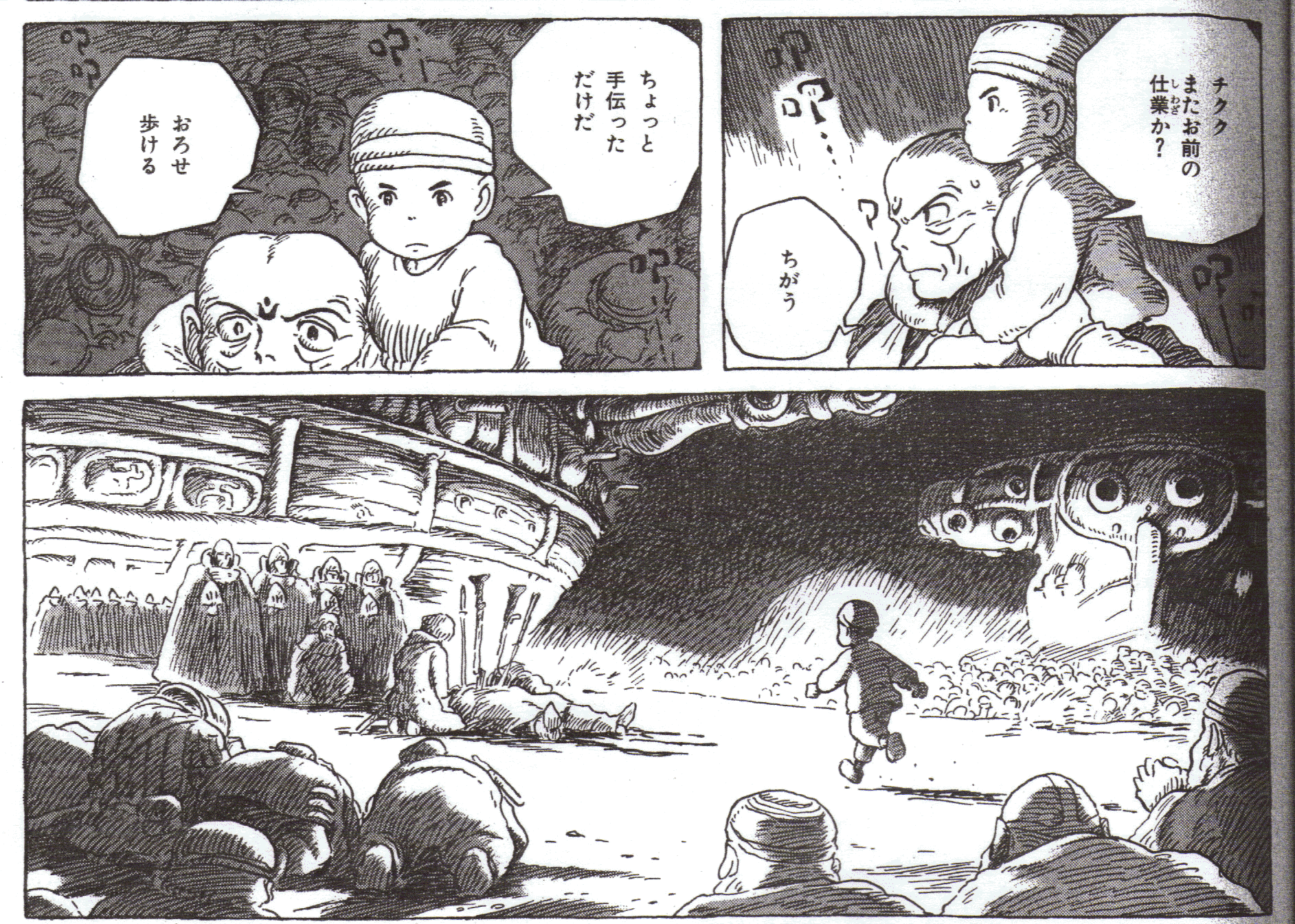
This is the impressive scene where Master Yupa steps in to stop the conflict between the citizens of Dorok and the remnants of the Tolmekian Army at the cost of his own life. Panel 1 and 2 show the boy witnessing the death of Yupa while being carried on monk’s back, while Panel 3 shows him rushing over to Yupa. Here, the cut between Panel 2 and Panel 3 is B’. With a B’ cut however, there should fundamentally be a continuation of the overall action, as is the case with the prior example of Shirley, which is covered by the action where the young maid quickly makes a cup of tea for her master. However, in this example, with panel 2 you have the boy sitting on the man’s shoulders without moving, and then with panel 3 he’s running. Technically, his overall action has been interrupted between these two panels.

However, you can see a line of dialogue in panel 2 where the boy says, “Put me down. I can walk.” Thanks to this line, the overall action is continued. Let’s try covering up the line, if you like (Here, the lecturer puts is hand over the projector to cover the words “Put me down. I can walk.”). Even with this, there’s nothing hindering the transition between Panels 2 and 3, but now don’t you sense something amiss? It’s like a baby stroller being pushed along and then suddenly hitting a bump in the road. But when you add in the line, “Put me down. I can walk,” (moves hand away) now it becomes smooth. The overall action of “rushing over to Yupa” continues in panels 2 and 3. In other words, B’ is established here. I think it subtly proves that Miyazaki cares a lot about having his readers enjoy Nausicaa and has a good sense of what will improve that enjoyment.

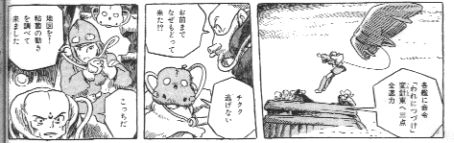
Nausicaa also has a clever use of Pattern B”. Let’s see the beginning of the old edition of New Treasure Island once more. If you compare the two, you will find that the two use the same Pattern B”. Here, Nausicaa and Chikuku are returning to a Dorok airship via air. In New Treasure Island the vehicle runs along hastily, while in this scene from Nausicaa, Nausicaa, Chikuku, and the monk are in a rush. That’s right, they both fall into Pattern B”.

Volume 5 p.62

“You’ve come back, too!?” “Chikuku won’t run away!” “A map! I’ve traced the movement of the mold.” “This way!” [CL1] These three panels look perfectly continuous since their dialogue goes on, in spite of the discontinuity in physical action in these panels. It’s the same technique as the one in the three-legged race I referred to earlier.[1]

Speaking of Pattern B”, I know there is another example in Nausicaa.


Volume 5 p. 87

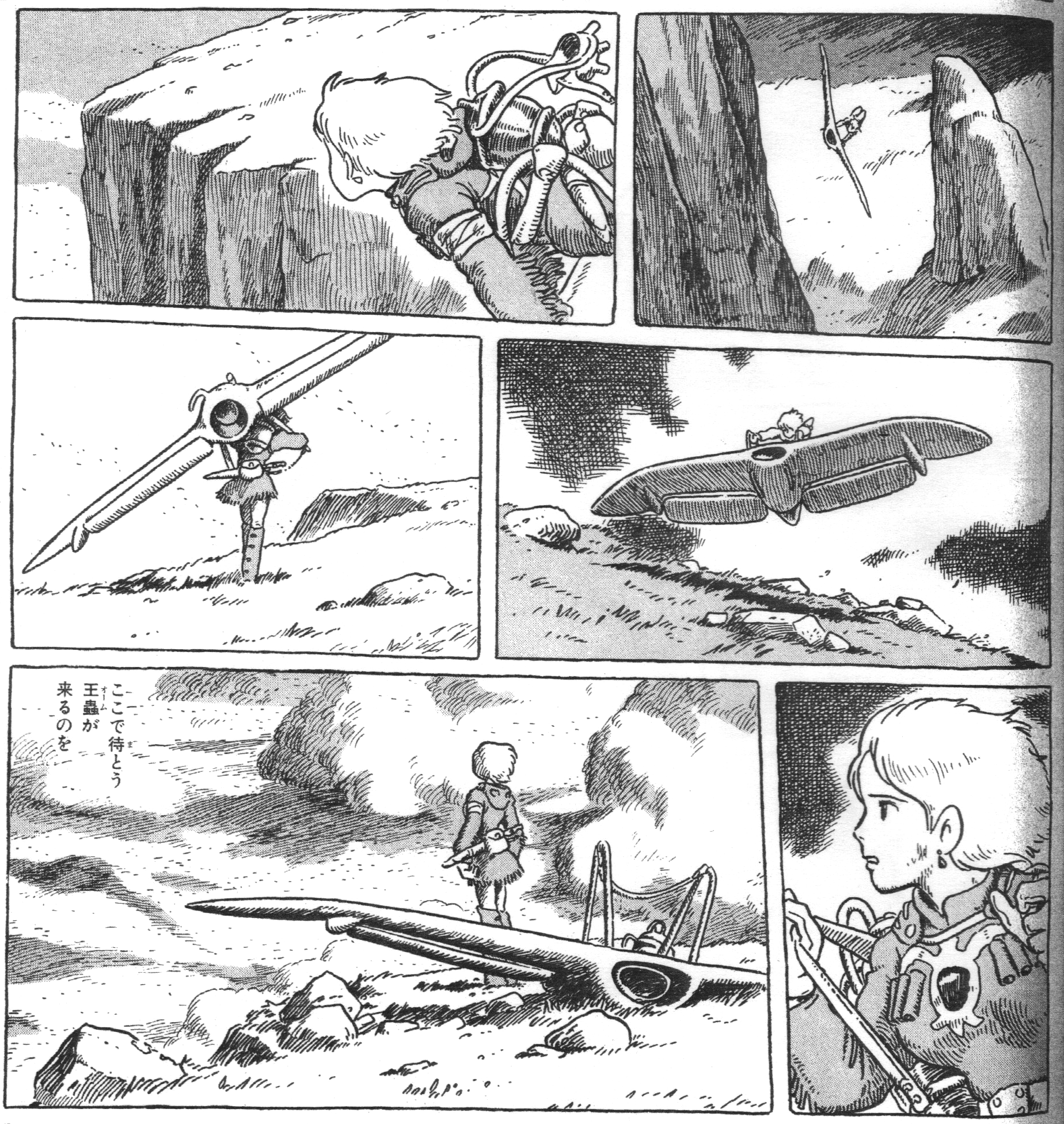
The world of humans is on the verge of destruction, and with Teto in tow Nausicaa goes on a solitary flight. She lands on high ground and decides to wait for the army of Ohmu, who know the key to the situation at hand. The action in these six panels is not continuous, and so one might determine these panels to be an A” sequence[2]. And yet, you can follow these panels smoothly, as if you were watching a movie, in spite of the lack of speech or sound to give you a sense of continuity. Actually, while these panels do not follow Nausicaa’s actions continuously, including how she lands on the ground and how she shoulders her kite, you can still follow those actions smoothly because the overall action of ‘her swooping down from the sky and landing near some high ground and then walking towards it’ remains continuous, or is uninterrupted. And so you sense that they are still continuous. This is Pattern B”.

Let’s look at another example of B”.

Emma Volume 5 (Mori Kaoru/Enterbrain) p.76-77

This is Emma. I’m impressed with this author, who takes a total of four pages just to draw Emma changing into her maid uniform. However, when you look at it, the omissions in the actions that happen from panel to panel are assuredly there. If the sequence were to be drawn in its entirety, a mere four pages would not have sufficed. When you read it, however, it looks perfectly continuous. The overall action of “changing from plain clothes into maid clothes” is done consistently, and the small actions which are not drawn instead take place in your head and complement the action. This is a typical example of Pattern B”[3].

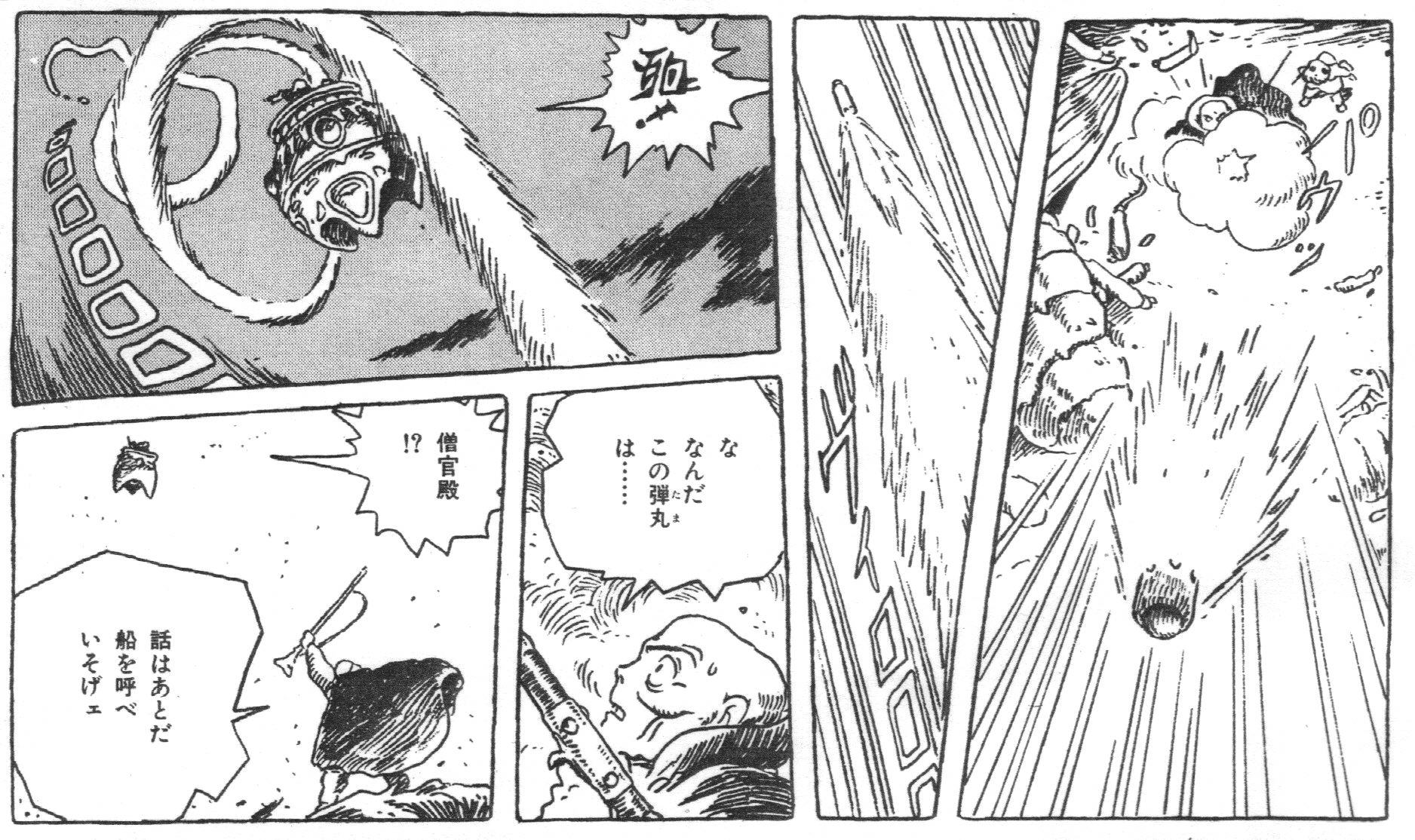
By the way, recall that earlier I explained how the Pattern B you see in movies theoretically cannot be replicated in manga, and that in order to do so you would need some way of falsely approximating the process. Actually, it is not impossible. Here, the monk points his gun at the sky and fires. Then, the subordinates up in the sky make their presence known.
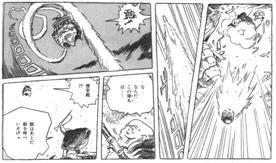
Volume 4 p.124

The sequence from Panel 2 to Panel 3 is key here. If you were to put this into a movie, in panel 2 the bullet would appear to be flying OUT of the screen, and then a cut would happen. Then, in panel 3 you would suddenly see the bullet flying, or, to put it differently, you would see the bullet flying IN when the officers in the sky riding the flying turtle are startled by it. That’s the exemplary editing it would need if it were put into cinema. Simply put, this is a Pattern B sequence. Pattern B may be theoretically not replicable in manga, but take a good look at Panel 3. The trajectory of the bullet is shown by the smoke trail. “Wha… What kind of bullet was that?!” [CL2] exclaims the astonished monk. Indeed, it’s a little more like a rocket. Thanks to this however, you can now tell with just one look that Panel 3 is an IN shot. Wow, this is definitely like a B sequence from a movie!

Incidentally, this kind of smoke is associated with the “action lines” which you might remember from Zipang, where it is used in aerial battles. Contrasting with the physically impossible and fanciful assemblage of lines, the smoke in Nausicaa has a physical existence. It does not feel insubstantial, but rather actually quite real and natural. If we analyze the transitions in those five panels, they are A’ B’ D’ A’; in other words, they are all single-dash (‘) sequences and not double-dash (”) ones.

Miyazaki’s composition of these panels is so awfully sophisticated that I’m terrified, but the examples I’ve drawn upon so far have been from when Miyazaki’s manga had been serialized for a while and he was establishing his own form of manga syntax, and not at the point when he first began serialization, back when his refinement was still lacking. Take a look here at the first page from Volume 1.

Volume 1 p. 9

I touched on it just before, but the second image here is unusual for Nausicaa in that the rectangular panel does not have a border. Actually, when it was published in Animage originally, the title logo for Nausicaa of the Valley of the Wind was inserted here. When it was being collected together for the tankobon, Nausicaa flying with the glider was drawn in, and so the edit from panel 1 to panel 2[4] is not B” so much as it is B”-. It’s the same as the beginning of the revised edition of “New Treasure Island.”

Now what’s a good way to explain the transition from Panel 2 to the giant skull in Panel 3? In a movie it would be a B. You’d think then that it would be a B’ sequence, but when you compare it to the way the bullet was handled in the panel I mentioned earlier, I must say it looks less sophisticated than a typical B’ scene.

And then, doesn’t the edit from Panel 3 to Panel 4 feel abrupt? First, some of her actions seem omitted. 1) The glider lands -> 2) Nausicaa pulls the gun from the glider -> 3) Nausicaa carries it on her shoulder -> 4) Nausicaa faces the Sea of Corruption and walks (Here, the lecturer demonstrates the way in which Nausicaa walks). That is how Nausicaa is supposed to act in this sequence, but three out of four of her actions have been removed. Moreover, while in Panel 3 she was gliding very close to the skull, in Panel 4 the scene is set at ground level, and so they cannot be A, B, or D. So, is it supposed to be C? No, because Pattern C is a scene change, which usually does not have the continuous presence of the same subject.

So then, what exactly is the sequence in these panels? If I had to explain it, I might venture to say that it’s like the old version of “New Treasure Island.” That is to say, it can be categorized as B”. However, there we have the consistent action of a moving vehicle. In this page of Nausicaa, the glider vehicle’s action is interrupted. Perhaps, if Panel 4 illustrated the glider flying towards the Sea of Corruption, it would be a smoother sequence, although Nausicaa would crash right into the tree trunks! (laughter) …even if it would be a smoother sequence.

Here’s the same scene from the movie version. Here, it is incredibly smooth.

1

2, 2’, 2’’

3, 3’

4

5

6

Nausicaa sweeps over the giant skull (1) -> Nausicaa prepares to land very close to the Sea of Corruption (2)~(2)” -> Nausicaa makes a soft landing below onto the sandy surface (3)~(3)’ -> Nausicaa pulls the gun from the glider (4) -> Nausicaa hangs it over her shoulder (5) -> Nausicaa walks towards the Sea of Corruption (6). They are edited in quite a normal fashion. But when you see this and then look at the same scene from the manga, you find that the sequence from the manga has less elegance to it in comparison. It suggests that Miyazaki was unsure of how to transfer and convert movie syntax onto paper when he began drawing the first chapter[6]. Also, the first chapter was 18 pages. With only so many pages, the complicated sequences where Nausicaa appears, wanders through the Sea of Corruption, reunites with Yupa, and then flies to the Valley of the Wind—a sequence which in the movie takes 15 minutes—has to be drawn, then the panel sequences would inevitably feel crammed and rushed.

If you were to again look over this first serialized chapter, you’d wonder why, despite the fact that the drawings are made to be dense, does the comic look so stark-white? Really, why? After thinking about it, I realized the answer: there are no screen tones being used. Do you understand? I brought some with me today. Can those sitting in the back see this? It’s a somewhat thin, net-like sheet. There are dozens of varieties of these, and they’re used by nearly every manga artist, cutting and pasting them onto their manga in order to create effects such as shadows and clothing patterns[7]. But in the first chapter of Nausicaa, all shadows are hand-drawn.

Volume 1, p.19 (with close-up)

With that, it’s pretty white. But actually, in the comic a bit of screen tone does get used.

Volume 1 p.26 (with close-up)

This is a close-up of Yupa’s face. Notice the shaded area. On top of the thin lines drawn here, a layer of screen tone is pasted onto it. This is the last page in the serialized chapter 1.

There are other instances of Miyazaki’s process of trial and error showing up in his drawings.

Volume 1 p.23

Nausicaa here is running with a big smile on her face. This same scene is also in the movie, but in the manga the scene has more of a slow-motion feel to it, and gives the impression of being a slowed-down moment. This is the weakness of B”-. Here, Nausicaa is sticking out of the panel, and is quite possibly Miyazaki’s deliberate attempt to reduce the slow feeling here. This technique, called “off the panel,” is incredibly common in Japanese manga, but this is the only instance[8] of its use in Nausicaa. “How should I draw a manga?” Miyazaki probably asked himself as he was holding a variety of manga magazines in his hand, and tried his hand at making something “off the panel.” Miyazaki had most likely not yet developed his own methodology as of chapter one.

Such is also the case with this panel, where if you look at it after you’ve come to know Nausicaa it seems unpolished.

Volume 1, p.24

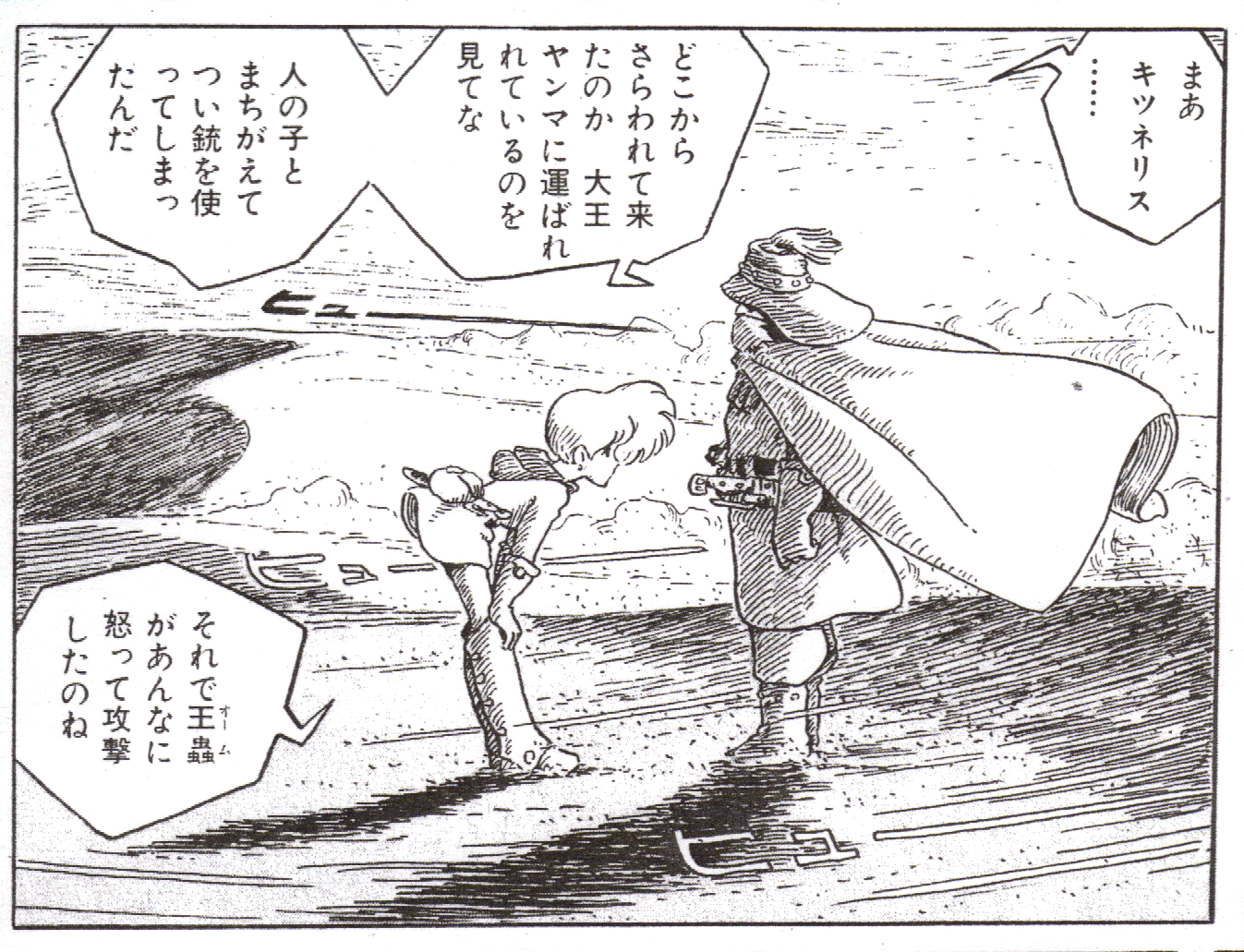
First, the use of the “hyuu” sound effect and the streamline seem rather forced. Second, the scene composition gives the impression of unsophistication. For a genius layout man like Miyazaki, the scene is too loose and incomplete. Why is that the case? Well, it’s because too many words, or should I say “speech balloons,” have been crammed into the scene. Later on, Miyazaki would use a multitude of panels to handle such a scene, but I think here Miyazaki decided to depict their conversation only for one panel because Nausicaa and Yupa are holding still. There are many speech bubbles in the panel, so the scene feels relaxed.

And so on and so forth. In chapter 1, examples of Miyazaki’s trial and error are everywhere. “There’s a lot I want to talk about, a lot I want to convey, but I am not trained enough to put what I really want to tell into manga. This is so frustrating!” thought Miyazaki, I suppose. However, the second chapter is much more stable. And listen, ladies and gentlemen, he finished the second chapter not in pen, but in pencil! When the first manuscript for Nausicaa was handed over, the Sherlock Holmes (aka Sherlock Hound) project was given the go-ahead, and so Miyazaki no longer had any time to draw manga. However, Animage persuaded him to continue the series, with Miyazaki finally agreeing to do so, on the condition that he could draw the Nausicaa manga in pencil because it enabled him to finish it more quickly. Nausicaa, as a result, became the first commercial manga ever drawn in pencil.

Volume 1, p.35 (with close-up)

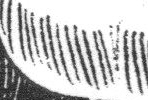
One of the unique characteristics of the manga version of Nausicaa is how the shadows are rendered by drawing a series of thin lines. This is influenced by the French comic artist Moebius[9]. Look at the right image. You can see that these shadow lines are chipped subtly. That’s because it’s drawn in pencil (laughter). For your information, Miyazaki seems to have used a variety of pencil types, including a B and an H.

But then around the second half of the second volume, the comic goes back to being in pen. Now I might have this wrong, but I get the feeling that even after that it occasionally goes back to being in pencil. Here, for example.

Volume 3, p.41 (left) Volume 3, p.42 (right)

For the sake of the Nausicaa movie, the manga’s serialization was put on hiatus. The image on the left is a panel from the final page before Nausicaa was put on hiatus, and the image on the right is from the page right after serialization resumed. In the collected volume (tankobon), they’re printed on the same piece of paper, one on the front and the other on the back, but in reality there was a 13-month gap. Now if we were to magnify the dangling ends of the gas mask…

Do you see? The lines in the image on the right are more chipped. This means it’s a pencil drawing. You might know that in animation key frames are drawn in pencil, and so while making the Nausicaa movie, Miyazaki became more attuned to using pencil. I guess after the manga resumed, he was unable to draw with a pen the way he wanted to, and so after the manga started up again, the first new chapter was done in pencil. But then in the next chapter, the comic goes back to being in pen. Incidentally, when he resumed the Nausicaa manga after having completed the movie Kiki’s Delivery Service, the lines look a little chipped. I think that it was also drawn in pencil. Then, it returned to pen.

Now we’re going back to analyzing what it means to be “cinematic.” Having the background be out of focus is a technique frequently used in live action film, or should I say, photography. Suppose there were many little flowers blossoming and you attempted to use your camera to shoot one of them very closely. However hard you tried, the shot would get crowded by the other flowers. For that reason, you have the camera focus on just the one flower and leave all of the other flowers out of focus (Lecturer projects it on the screen). This is a terrible example though, granted (laughter).

The “out of focus” method is also in Nausicaa.

Volume 2, p.116

This scene is the duel between Yupa and Asbel. It’s an action scene, and yet it’s more akin to stopped motion. In my opinion though, I wouldn’t call it stopped motion so much as the removal of sound.

Look at this scene from the Nausicaa movie (DVD playback). A giant transport vehicle crashes into the Valley of the Wind. By the window is a girl who looks the same age as Nausicaa. The sound disappears in this cut. Movement in this scene hasn’t stopped, and yet doesn’t it seem like time has stopped for an instant? The panel in question, the one with Yupa and Asbel, achieves the same result on paper, although this scene was drawn before Nausicaa was ever turned into a movie. It is said that Takahata, who joined the production of Nausicaa the movie as a studio manager, worked as the sound supervisor as well and removed all the sound in this cut. His sound removal method must have impressed Miyazaki, as Miyazaki applied it to the Nausicaa manga in a more refined way later.
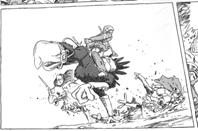
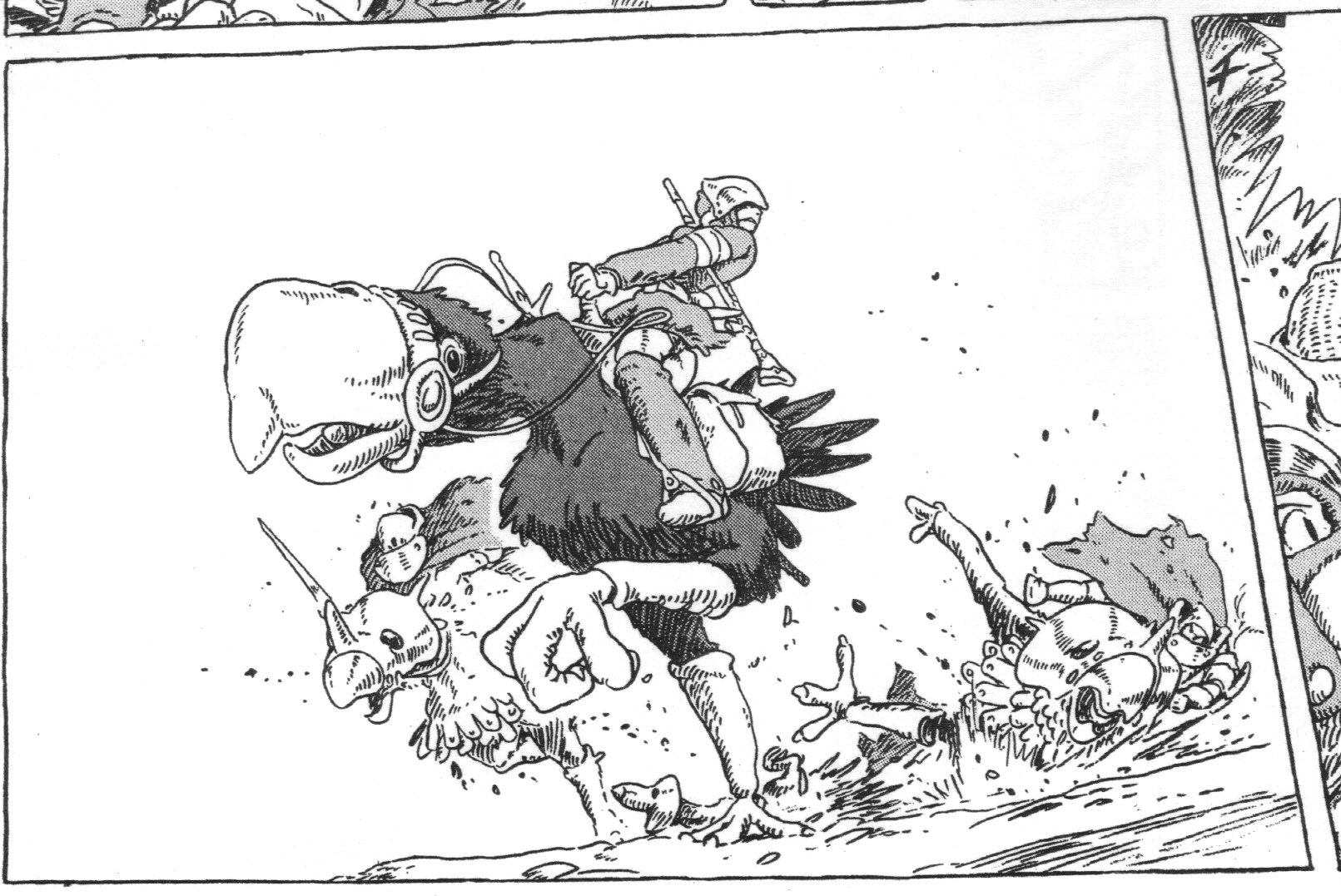
Volume 3, p.139

Here, Nausicaa is fleeing from a Dorok cavalry. Of the guards who are desperately covering Nausicaa with their bodies, one of them gets hit and falls over. It’s quite exciting. At the same time, the lack of a rendered background emphasizes her psychological shock and as a result gives off a sense of stillness, a sense of stopped motion [10].

The overlap technique seen in films is also used. It’s not used that often, but if you take a look here:

Volume 5 p.75

For some reason, the monk has a worried look on his face, and Nausicaa appears behind him flying. Drawing an image like this on paper is a little too bold, but in actuality the image does not feel out of place. In other words, it reminds us just how heavily we have adapted ourselves to the scene dissolves that occur in movies and television.

Speaking of which, this is a manga which faithfully uses rectangular panels. There are, however, exceptions, like here.

Volume 3 p.13

This image brings back some memories from when I was in elementary school, especially the illustrated encyclopedias that would be available in the school library. Boys who are into science or technology like illustrated encyclopedias, and a young Miyazaki would be included among them. (laughter). Now have a look.

Volume 7 p.105

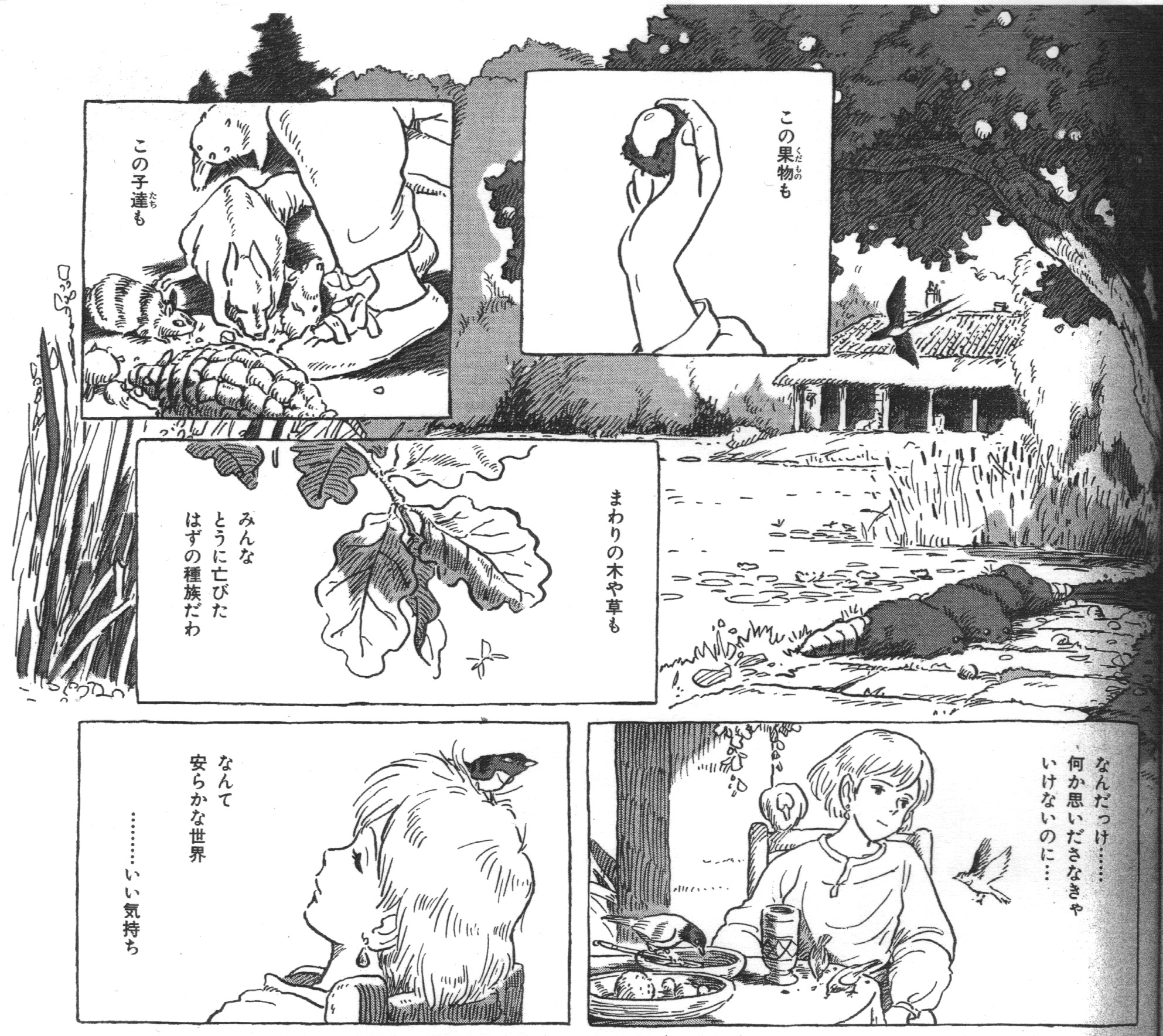
Oh! Here we have Nausicaa relaxing with a silly look on her face (laughter). She’s forgotten her usual self-denial and self-restraint, feeling quite relaxed and refreshed, with the image of the garden bleeding past the edges of the page as if to reflect the calm in her mind[11]. The author wanted Nausicaa to relax for a short while. After this, she would be sacrificed to a journey filled with despair…

…Which is my own humble analysis of Nausicaa. Seeing this manga, I’m impressed that almost all of the panels are rectangular, something quite unusual for modern manga, while each of those panels is packed with the passion and energy of such an extraordinarily talented creator. This gives off the impression that Miyazaki was holding back. As he was most likely extremely conscious of how the movie’s sequences and transitions would be edited, the activity in the actions from panel to panel, in other words A”, are united with the context of words and dialogue. In short, Nausicaa is the manga which blends cinematic methods exquisitely into classical manga syntax.

Miyazaki learned Disney-style full animation at Toei Animation, and then left the studio where he and his comrades ended up falling in labor union activities. He and Takahata joined the TV cartoon industry, trying to achieve maximum “cinematic” efforts using lower budgets and fewer animated drawings. In his autobiography, veteran animator enthusiastically writes about how Miyazaki had been living his vision.

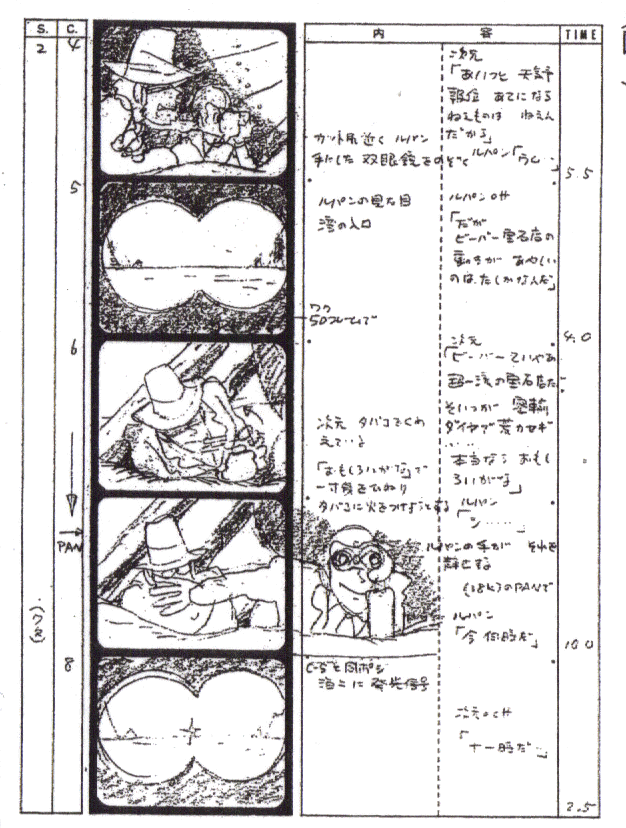
This is Miyazaki’s storyboard from the 1971 Lupin III[12]. Otsuka compares Miyazaki’s storyboard with one done by a different animator. If we look at this other storyboard done by someone we’ll call “Mr. X…”

The Animator Clawing His Way (Sakuga Ase-Mamire),
Revised and Expanded Edition by Yasuo Otsuka,
published by Tokuma Shoten Publishing, p.149

…there’s an A cut. However, with Pattern A, the action must be continuous, which makes drawing the images for it labor-intensive. Miyazaki’s storyboard on the other hand is entirely D edits. If the action isn’t continuous, then the drawings become easier to do, all the while Miyazaki remains perfectly faithful to the principles of film editing.

Looking at the Nausicaa manga more closely, not only can you see that the D’ sequences are well-done, but that there are a lot of A’ sequences (with actual A sequences being impossible). When A sequences appear in TV anime, a character’s actions must be singular, and it must be a simple action—like an arm extending—to shorten the amount of labor put into the drawing. Manga, however, is by nature a series of still images, so with Pattern A’ or even Pattern A”, the readers will conceive the movements in their heads. Showcasing clever uses of this mental mechanism is the air battle scene I showed you earlier. In Panel 8, the gunship is depicted flipping like a springboard diver jumping backwards into water. If you were to actually try to animate it, the process would have been laborious and would have required many frames of animation to be drawn. However, because it is manga, the complementary actions are envisioned mentally by the reader, where less labor is needed than in drawing animation frames, and so it becomes an easier task.

Thus, what you have here are the patient efforts of Japanese animators over dozens of years to make TV cartoon shows as fully cinematic as possible in spite of difficult circumstances in production, as well as the brilliant efforts of Japanese manga artists over dozens of years to achieve cinematic style on-paper in spite of the fact that manga is just composed of still images. One of the most brilliant fruits of their labor is the subtle and bold fusion of the two sides that is Nausicaa of the Valley of the Wind. That is my conclusion. (Applause) What? Why are you all clapping here? (Big laughter, huge applause) I’m grateful! Oh, don’t you think NHK will have to invite me as a guest commentator whenever they have their “Manga Night Talks” show about Tezuka’s New Treasure Island? (laughter).” Not that Tezuka Productions would ever give the OK on it, even though this is the 80th anniversary of Osamu Tezuka’s birth[13] (laughter).

Next week, we’ll continue to discuss Nausicaa. This time we discussed technique in depth, but next time we’ll be analyzing and getting at the core of its story and themes. I hope to see you all in this classroom next week. Class dismissed.

Footnotes:

[1] It goes without saying that the three-legged race I mentioned earlier is A”. However, the two girls’ swing of conversation fills cinematic gaps among the three panels.

[2] Notice how in panels 1~5 there are no speech balloons, sounds, or entire figures. On the other hand, you have Footnote 9, or “Osaka splitting her chopsticks apart,” where sound and figures make it easier to follow the panels smoothly, as if it were cinematic.

[3] In an interview, Mori mentions liking this sort of panel sequence.

[4] For the sake of convenience I called this “panel 2,” despite it having no actual borders.

[5] Actually there’s another solution here. If one were to insert a panel of Nausicaa preparing to land in between panels 3 and 4, it would become B”.

[6] I also referenced Yukihiro Abeno, who said, “Miyazaki is the ultimate and most fortunate amateur manga author.” (Seidosha Publishing, Eureka Special “World of Hayao Miyazaki” Issue)

[7] The first time this was used in a manga was by Miyomaru Nagata. Around 1955 or so.

[8] An omission.

[9] Moebius, born on May 8th, 1938. He is famous for having influenced the styles of Katsuhiro Otomo and Hayao Miyazaki, and apparently Moebius style had an influence on Tezuka’s Hidamari no Ki, the samurai drama featuring Tezuka’s ancestors. As an aside, Moebius named his own daughter “Nausicaa.

[10] In Nausicaa, when an action scene occurs the closing line in the panel becomes diagonal.

[11] I believe this technique of piling fragment-like panels on a larger, non-bordered image was first used in Japan by Shotaro Ishinomori (January 25, 1938 – January 28, 1998).

[12] At first Satoshi Dezaki drew the storyboard for the sequence, but Miyazaki rejected it and drew this afterwards. Though keep in mind that Dezaki was not “Mr. X.” In fact, the second storyboard on this page was drawn by a younger animator whom Otsuka got to draw it years after the production of the first Lupin.

[13] The old New Treasure Island was finally re-released on February, 2009.

MERRY CHRISTMAS! I HAVE A PRESENT FOR YOU!

Genshiken Chapter 56: Spring Has Come Again, Translated

Rapidshare
Sendspace
MediaFire
Torrent

UPDATE: I made a few errors in my translation that I didn’t catch, but the translation is about 98% accurate. A version 2 will be on its way, and this post will be updated in kind.

Celebrating the C-Class of the C-Class: Black Dynamite and Animexploitation

Last night, I had the fortune of seeing the Blaxploitation Homage/Parody Black Dynamite, and it was fantastic. Despite not being familiar with blaxploitation films. The closest I’ve ever gotten to watching anything like that was The Last Dragon, which I’m kind of sure doesn’t even count. Anyway, fun was had by all, and for a good review you should read the one over at Subatomic Brainfreeze. And if you have the opportunity to go see it, go see it. Because you have the opportunity.

When I got home, Sub linked me to an interview with Scott Sanders and Michael Jai White, co-creators of Black Dynamite (with White playing the movie’s titular character), and something there caught my interest. In it, they said that their goal was not to make Black Dynamite representative of the apogee of blaxploitation cinema, but the films that were made when studios realized they had a successful formula on their hands, and sought to milk that cash cow for all it was worth. They wanted to celebrate the films which went through a checklist of items,  from the rich white guy by the pool side, to the hot bitches, to the liberal application of kung fu, all wrapped in a packaging of shoddy cinematography and excessively expository dialogue. They wanted to celebrate the successful, yet mediocre blaxploitation films in all their film school-reject glory.

It’s an unusual idea I think, in any sort of media, to look fondly upon those works which were just kind of okay at best and weren’t terribly deep, but which sold and made names for themselves. Even in anime discussion, we usually celebrate the so-bad-it’s-good works while shunning the mediocre. And with anime the way it is now, people accuse it of running through checklists, utilizing excessively expository dialogue, and exploiting anime fans to make ultra-formulaic shows. Which they might be, but that doesn’t mean we can’t have fun with it.

From the bit of reading on blaxploitation I’ve done since yesterday (which obviously makes me an expert, right?), the genre came about when US movie studios, suffering the lowest revenues in about 20-30 years, realized that the African Americans were spending a large amount of money in the theaters and so decided to specifically target them by making movies for black people about black people. Much like Super Hero Comics fans and figure-buying moe fans, they became the target audience for relevant genres of entertainment media, for better or worse, because they had the money. Creativity aside, companies would like nothing more than for your dollars to go into their pockets so that they can keep making new works and continue to profit.

That’s the way things go, and much like how Black Dynamite really celebrates the genre of film it’s parodying, warts and all, I have to wonder how fans and creators in the future will regard the anime that comes out now. Maybe in ten to twenty years, we’ll be seeing throwbacks to those old shows of 2009. Not remakes, and not references to the ones that made you think, but the ones that told you, John Animefan, that there’s some kung fu and titties and nekomimi nurse maids in this show so why shouldn’t you watch it?
Ninja Warrior’s Subtitles

“Ninja Warrior” and “Women of Ninja Warrior” known in Japan as “Sasuke” and “Kunoichi” respectively, are competition shows taken from Japan where men and women compete to complete increasingly difficult obstacle courses to prove their ninja prowess. And as anyone who’s seen these shows on G4 in America know, most of the program is Japanese language subtitled into English. For anyone who knows a bit of Japanese though, you might have noticed that the subtitles are never 100% accurate or really even 70% accurate, with parts of sentences being dropped and even entire sentences being left out entirely.

Watching subtitled anime all the time, others like me may be wondering why they do their subtitles this way, but when you realize that most viewers of G4 don’t know any Japanese and are probably not used to reading words at the bottom of the screen, their decision to simplify and omit certain parts makes a lot more sense. First, they probably don’t want the subtitles to be too distracting, and second, if you’re unfamiliar with subtitles it can be a hassle to keep up with them, especially because the Ninja Warrior announcer speaks rather quickly and will load his sentences down with humorous descriptions of the contestants. To just be able to get the gist of what’s going on is more important, especially when they want your eyes focused on the guy dressed like Amuro Ray falling into cold and muddy water.

The funny thing is that this is how subtitles used to be. If you go back and watch old movies, they had to simplify a lot so that people could keep up with them while still paying attention to the films themselves. The desire for perfectly accurate subtitles is probably a minority, especially when you realize that not very many people would even be able to notice if the translation was a little off.

Otakon 2009: When Guests Are the Real Deal

Otakon 2009 was punctuated by a number of personal differences and changes in my life, not least of which were a new method of travel, as well as a variety of new travel buddies. It was also my first year at Otakon as a member of the Press (thanks to the existence of this blog), and while I can’t say that it was as rockin’ as last year’s Otakon, I can tell you that it was a fine experience where I never felt like there was too little to do.

My trip began Thursday afternoon, where while on the bus to Baltimore and then on the city bus to Downtown Baltimore we argued about moe in all of its forms, seeking to wrestle the elusive beast to the ground with mixed results. Baltimore that day was a breezy 93 degrees Fahrenheit, the kind of weather perfect for strolling through the city carrying luggage. Dropping off our belongings at the hotel, we went off to dinner at the Cheesecake Factory and met up with esteemed guests such as Patz, Ed Sizemore, and Clarissa from Anime World Order. A variety of fine topics were discussed, such as the joys of showing little kids the Real Power Rangers and the deliciousness of beef (conclusion: it is very delicious).

Upon returning to the convention center to get our badges, we realized that there was a line still snaked around the building that normally would not be based on past experience. I luckily had my badge waiting for me at Press Ops, but many were not so lucky. It was yet another sign that this year’s Otakon was Different. The lines would continue throughout the weekend.


The Pre-Registration Line for Otakon 2009

I also had dinner with people on Friday and to a lesser extent on Saturday, meeting the rest of the AWO crew, Erin from Ninja Consultant and others who I can’t quite remember because the table was quite long. If you’re willing to sit down and relax, the downtown Baltimore area is good for food, and if you’re able to travel further out there are also some excellent restaurants. If you want fast food, that’s also available, and if you want to save money on food I recommend Grape Nuts and Parmalat. Grape Nuts is a dense cereal in a small box and is very filling and nourishing. It has the Ogiue Maniax seal of approval.

Food aside, there were so many events each day that they’ve started to blur in my head, and instead of discussing what happened chronologically I’m going to talk about things more categorically.

Industry and Otakon-related panels I attended were the Funimation panel and the Opening Ceremony panel. Funimation, as you might know already, announced some big-deal shows, namely Casshern Sins (which I reviewed here), Eden of the East (one of the best shows of last season), and the “Dragon Box” master edition remastering of Dragon Ball Z just like the one the Japanese have.

The opening ceremony also marked the second year that Madhouse animated a special opening for Otakon, akin to the Daicon IV opening of legend. This year’s animation incorporated the entire Otakon staff and had numerous references both eastern and western. If you wanted to see the Enterprise duke it out with the Yamato, this was your chance. Unfortunately, we were given the news that the director of the Otakon 2009 Opening Animation, Endou Takuji, had died the week prior, and our condolences go out to a man who reached out to American fandom so readily. Endou was also the director of Record of Lodoss War, a show which many fans in America consider vital to their beginnings as otaku.

As you might guess from the title of this post, guests this year were remarkably good in their decision to not constantly dodge questions and defer to others, though it still happened occasionally when it had to.

Yamamoto Yutaka, aka Yamakan, dropped down answers to questions which clearly showed him putting in some genuine thought and not just defaulting to stock answers. One person asked him how he got to be a director, and his response was that he wanted to be an animator but then couldn’t draw so he had to pick something else that would let him work in anime without drawing talent. To follow up, I asked what he thought of Takahata Isao, director of Grave of the Fireflies, because Takahata is also a director who cannot draw. Yamamoto answered that Takahata is one of the two directors who inspired him to get into anime, and that he considers the Anne of Green Gables anime directed by Takahata to be pretty much THE finest example of an anime TV series and how to tell a story in that format. Sadly, he would not reveal the second despite prompting.

I also asked him about Tonari no 801-chan’s anime debut, and he said that the original author asked him personally to do it, and that he felt destined to do it. Other highlights from Yamakan include his belief that what’s most important in animation is having characters stay “in-character” (and anyone who’s seen Tsugumi in Kannagi can attest to him putting his money where his mouth is), his desire for fellow anime creators to be capable of being creative with each other so that they may grow and improve, and his belief that today’s anime creators lack strong enough personalities akin to Miyazaki, Tomino, and Anno. As you can tell, he was not a “normal” Japanese guest and I am grateful for that.

Oh, and as for his definition of moe: If you like it, it’s moe for you.


Frederik L. Schodt

Frederik L. Schodt (apparently pronounced “Shot”) meanwhile revealed very good knowledge of the scanlation scene and an understanding of its appeal, as well as being good at handling the audience at his Astro Boy panel. At his Q&A panel, I asked him about instances where either American culture values in Japanese comics made them unapproachable by an American audience and vice versa. For the manga example, he pointed out how works are still censored to an extent, and that some companies are forced to claim the girls in their media are 18+ when they clearly are not given the context of the story, and that most of the genres of manga in Japan never come to the US, such as mahjong manga. His answer for American comics that were deemed not appropriate for a Japanese audience was even more interesting.

Schodt had accompanied the great Wil Eisner of all people to Japan, as Eisner was interested in publishing his works there and and there was a Japanese publishing company which published non-Japanese artists. However, when shown the work of Eisner, the company said that he had to rework it to flow more like a Japanese comic and have it read right to left. Eisner, who was over 80 years old at the time, naturally did not want to entirely redo one of his comics which had sold successfully internationally for decades and so the deal was off. He also talked about how much he likes The Four Immigrants Manga by Japanese immigrant Henry Yoshitaka Kiyama, a comic from California in 1927 which is written in a sort of simultaneous Japanese and English (thus requiring knowledge of both to read properly), and is arguably the first existence of a comic book in America, as well as predating Tezuka’s debut by a number of years. After the panel, I got Schodt to autograph my copy of Dreamland Japan.

While I did not manage to score any one-on-one interviews, I did attend some very informative press conferences. There was a sudden press conference with Maruyama Masao (head of Madhouse), Ishiguro Noboru (director of Macross and Legend of the Galactic Heroes), Kikukawa Yukio (producer of Legend of the Galactic Heroes), and Matsubara Hidenori (character designer for the Ah! My Goddess anime), which started off with Ishiguro and Maruyama deciding to just sit in the audience and act like they were members of the press. At this point we had some fun interviewing the translator in the room, asking him throwaway questions such as, “Who are your translating influences?” and “What made you decide to become a translator?” When the press conference actually began, as it were, it turned out to be one of the most informative hours of my life. This press conference will most likely appear online in its entirety at some point so you don’t have to worry on that front, but there are a few highlights I’d like to mention.

From left to right: Kikukawa, Maruyama, translator, Ishiguro, Matsubara
One interesting set of answers was everyone’s response to the anime they would love to make if they could. Matsubara said he would love to adapt the Tezuka manga Dororo into an anime, and even has the support of Maruyama. Maruyama meanwhile said that there were so many he’d like to have made and that’s why he makes them. Ishiguro wants to make a story set in Tokyo in 1948 that he’s been wanting to make for 30 years and even has the entire story plotted in his head. Kikukawa’s dream anime is to adapt the Darkover series of science fiction novels by Marion Zimmer Bradley.

Another interesting answer was one to my own question, where I asked Ishiguro to talk about his experiences with the deceased Nagahama Tadao, creator of Combattler V, Voltes V, and Daimos, as well as one of the directors of Rose of Versailles. Nagahama, as it turns out, was actually in puppet theater of all things before he became an anime director. Also, when working as a director he would act out every part, male and female, in the script to give a better idea to his staff as to how the story should go. Finally, because he had no talent for drawing, whenever he wanted to make corrections to a key animation (and he inspected every single one), he would write a detailed description on the back as to what needed changing. Nagahama is not terribly popular in the US even among old school fans so this was an amazing bit of information to find out. I personally cannot wait to ask Tomino this question at New York Anime Festival.

While the other press conference I attended with MELL was not nearly as informative, what I found was that MELL opened up to us much more than I would expect from a musical guest. We found out that, despite the heavy use of English in her songs she was never good at it in school, she had her first band at around the age of 15 or 16 where she sang for a college band, and that she mistook a guy for a girl due to his elaborate cosplay of a Victorian era character.

MELL was also one of the concerts I attended at Otakon, the other being the Tamura Naomi concert, and both were beyond my expectations. I am no music expert and my music vocabulary is entirely lacking, but I will say that MELL and her band knew very much how to perform and keep the audience in the mood. She sang songs from Black Lagoon and Rideback, and showed off why she’s well regarded among fans.

Sunday’s concert with Tamura Naomi showed how incredibly powerful her voice can be, as she demonstrated that the notes she hits in those opening themes she sings are notes she can hit in a live performance. Highlights of the concert include her own rendition of the Jackson 5’s I’ll Be There, and her Rayearth songs, namely Yuzurenai Negai (1st series opening), with which she ended her concert.

I also held my own concert on Sunday where I sang the theme song to the Golgo 13 NES games. In case you didn’t know, the song actually has lyrics!

My dealer’s room experience was also a most pleasant one as I managed to get everything I was looking for, specifically Ogiue-related…merchandise… as well as the recently released Revoltech Souther from Hokuto no Ken, or, as he’s known on the box, “Thouzer.”

On the fandom side of things, while I did not pay much attention to cosplay I was glad to see a good variety of costumes. While you had your endless Sora from Kingdom Hearts and the general love for Naruto and Bleach you usually expect, I also got some pleasant surprises, such as a cosplay of Kitarou and Nekomusume from Gegege no Kitarou.

Something I did not approve of was the near-total lack of Tainaka Ritsu when it came to K-On! cosplay. I like Mio too and all, but the ratio of Mio to Ritsu was unacceptable. I’m just saying.

The fan panels I attended were all well-run and had people who at least to some extent knew what they were talking about. The Neo-Shounen panel run by Daryl Surat succeeded in its goal of showing how Shounen as a concept changed over the years, mainly in its desire to appeal to both male and female readers, and the Lost in Translation panel was a good beginner’s panel for those interested in seeing some of the difficulties of translating from Japanese to English. The Mecha Appreciation Panel had knowledgeable panelists, but the format was a little haphazard and could have used some focus. If you ran this panel, I was the one who said “King J-Der” for coolest Gaogaigar robot.

I also went to the Anime Recruitment panel by the Reverse Thieves, which provided very good advice for how to get people into anime without scaring them off, offering tips such as, “If your first attempt fails, don’t press the issue. Instead, give them time to cool off, like three weeks or however long it takes.” I’ve spoken before on how difficult I find recommending anime to be, so I will take this advice to heart.

I had a personally vested interest in attending the Otaku TV and Genshiken panels, both run by Viga the Otagal, and was curious as to how these panels would go. Overall, they did a good job of showing the audience what these shows are all about, though I think Viga was a little too spoiler-friendly and it could scare off people who would want to see these series otherwise. Still, I was very glad to see such significant attendance for Genshiken-related panels. After the Genshiken panel, someone in the audience actually greeted me as a reader of Ogiue Maniax and asked to take my picture. Whoever you are, that made my day and I thank you.

Viga said in her Genshiken panel that she believes “The Psychology of Ogiue” would provide enough material for an entire panel, and I am inclined to agree. Keep on the lookout for that.

Overall, I have no serious complaints about Otakon this year, as I feel that the events I would have complained about I simply did not attend, such as the apparently misleading title of the “Sailor Moon’s Influence on Hentai” panel. The fact that Daryl Surat’s Anime’s Craziest Deaths got shut down because no one actually knew what Apocalypse Zero was disappointing, but I’m sure both sides will know how to better handle it next year. As a member of the Otakon press, I also would have felt better if I was told in advance that I would not be getting any interviews, rather than being left dangling. However, because this year’s Otakon was so packed with activities and intriguing and intelligent guests, I can say that this was one of my finest convention experiences, and everyone I traveled to Otakon and back with agreed wholeheartedly.

Bad Writing vs Bad Translation

The Eureka Seven manga was released by Bandai Entertainment alongside their anime release. For those of you who haven’t read the manga but have seen the anime, it’s a different take on things with I think less solid storytelling but still has its good points. However, the dialogue in the English language version was often very awkward-sounding. It didn’t sound like people actually talking. Lines which were supposed to be “cool” or “dramatic” ended up landing with wet thuds. I had read a bit of the manga in Japanese prior, but as I finished it up with the English release, the flow of language in it continued to bother me. I had to wonder then, was it the translation, or was the original writing simply that stilted and it was my lack of complete Japanese fluency that didn’t notice it originally?

Whenever I read a translated manga where the dialogue seems off or unusually poor, I have to wonder where the blame lies, seeing as how there are so many people and factors involved. You have the original writer, writing in their native language, coming from their own culture, and then you have the translator, adapting to their own native language, keeping their own culture and readership in mind for just how much they change or allow to remain “as is.”

Is it that the translation is bad? Or is it that the writing wasn’t so great in the first place? And if the writing is bad, do you massage it until it becomes fine and readable English prose? It sort of goes beyond the literal accuracy vs spiritual accuracy argument when you have to factor in a source which may not be regarded as the pinnacle of literary talent. And it’s something that without proper research can be difficult to detect, aside from a few obvious examples where you can just tell the translator was struggling with a very Japanese-sounding sentence. “The burning passionately me now challenges you to a duel!” That sort of thing.

And then you throw money into the mix.

Let’s say that you’re a translator (and who knows, maybe you are!), and you’re giving the script to some work with achingly bad dialogue, like say, Government Crime Investigation Agent Zaizen Jotaro, and as much as you think there are definitely better works out there, you’ve been handed this and your company’s supposed to make a profit off of it. Do you try your best to salvage the bad writing and make it presentable? Or do you show it for what it is? And if so, are you prepared for idiots like me to accuse you of doing a poor translation?

The Go Go Curry Rant

I found out from kransom recently that 2ch has its own curry board, and by extension its very own threads about Go Go Curry. A 2ch poster decided to do his own spin on the infamous “2ch Yoshinoya Rant,” so I’ve gone and translated this variation, seeing as how it differs here and there, especially towards the end.

I’ve used the original translation that’s been around for a while as the base, to make it more recognizable to those familiar with the original rant.

Anyways, >>1, please listen to me. That it’s really related to this thread.
I went to Go Go Curry today; you know, Go Go Curry?
Well anyways there was an insane number of people there, and I couldn’t get in.
Then, I looked at the banner hanging from the ceiling, and it had “All dishes 500 yen” written on it.
Oh, the stupidity. Those idiots.
You, don’t come to Go Go Curry just because it’s 500 yen, fool.
It’s only 500 yen, 5-0-0 YEN for crying out loud.
There’re even entire families here. Family of 4, all out for some Go Go Curry, huh? How fucking nice.
“Alright, daddy’s gonna order the Business (Double in America) Roast Katsu.” God I can’t bear to watch.
You people, I’ll give you 200 yen if you get out of those seats.
Go Go Curry should be a bloody place.
That tense atmosphere, where two guys on opposite sides of the U-shaped table can start a fight at any time, the stab-or-be-stabbed
mentality, that’s what’s great about this place.
Women and children should screw off and stay home.
Anyways, I was about to start eating, and then the bastard beside me goes, “Extra cabbage.”
Who in the world orders extra cabbage nowadays, you moron?
I want to ask him, “Do you REALLY want to eat it with extra cabbage?”
I want to interrogate him. I want to interrogate him for roughly an hour.
Are you sure you don’t just want to try saying, “Extra cabbage?”
Coming from a Go Go Curry veteran such as myself, the latest trend among us vets is this, nattou double topping.
And then, extra roux. This is the vet’s way of eating.
The nattou has a raw egg in it. With this substitution there are no fried foods. This is the key.
Then you add cheese, a hard-boiled egg, and some pickled shallots. This is unbeatable.
However, if you order this then there is danger that you’ll be marked by the employees from next time on; it’s a double-edged sword.
I can’t recommend it to amateurs.
What this all really means, though, is that you, >>1, should just stick with the Economy Roast Katsu during Go Go Time.

My Response to Tamagomago’s “Otaku Girl Moe”

Yesterday I posted my translation of Japanese blogger Tamagomago‘s post about the moefication of the “Otaku Girl.” This is my own follow-up to it, and how I feel about the various themes and ideas put forth by Tamagomago.

While I think the threat of otaku confusing reality with fantasy is not that likely for the most part, I do see how “Otaku Girl Moe” is different from most other types of moe, with the possible exception of “Imouto Moe, ” though that mistake can be quickly dispeled by interacting with real little sisters. Otaku Girls actually exist in the real world and are in a sense closely related to Otaku Guys, so the line between fantasy and reality can blur quite a bit. It’s sort of like how most people probably wouldn’t realize that a model’s photo was airbrushed, or that the situations that occur in porn have very little chance of actually happening, but because we associate those things with “reality,” e.g. photos are realistic, we as people can be susceptible to their illusion.

Basically, while I don’t think there’s an immediate danger involving confusing the Otaku Girls in Anime with Otaku Girls in real life, there is a sort of precedent.

I of course also agree with the notion that as strong a character and as realistic as Ogiue is, she’s still just a character in a story. Though I can still hope…!

Another interesting point Tamagomago talks about is what I translated as the “exceedingly shaky” foundation upon which otaku build their preferences for women. I mentioned an earlier example of confusing fantasy with reality, but this one is particularly interesting as it’s almost an inverted example from the one above.

What we have is a situation where an otaku will take a realistic goal, i.e. finding a girl that can relate to them, and using their doubts and fears to transform it into an impossible dream. In other words, they’ve taken what is real and confused it for fantasy, something not talked about quite as often in these conversations about moe we have on this internet.

Of course, the part that generated the most conversation was where Tamagomago said that the act of calling someone moe is “violent” because it strips them of their individuality. Perhaps it was my translation not being completely clear, but the point that Tamagomago was trying to get across was that real people are not anime characters. It’s kind of an obvious thing to say, but within the context of moe you’re using a term associated with fiction and fictional characters and attaching it to real human beings with real depth and personalities. Let’s forget the word moe for a second, and instead imagine that I was talking about one of my female friends and I said, “Her character development is excellent!” It’s still a compliment, but it’s kind of bizarre to use that kind of language with an actual girl.

One more note, I don’t really think calling girls fujoshi is that bad, especially as it’s taken on this specific meaning of “yaoi fangirl.” Words in languages are malleable things as much as some would like to disgree, and the word “otaku” is a perfect example of this as its negative properties have fluctuated over the years. It’s like, I know that the word decimate originally meant “reduce by 10%.” Do I care? Not at all.

So in conclusion, I can’t wait for Hirano Kouta to knock down Tamagomago’s door for daring to say that there’s no such thing as Otaku Guy Moe.

It’s Okay to Propagate the Idea that “Otaku Girls” are Moe, But…: The Aggression and Difficulty Inherent in Moe

Translator’s Introduction: This is a translation of a post by Tamagomago aka Makaroni-san for his blog, Tamagomagogohan. It’s a post talking about his feelings in regards to the moe-fication of female otaku by their male counterparts. Because it’s written in a somewhat casual style, I’ve altered the language in small parts to be a little less stiff. The paragraph formatting is different from the original, as I’ve tried to make it more friendly for English readers. Also, Tamagomago has a tendency to put key phrases into quotes, a property I’ve kept, though admittedly something gets lost in the translation.

There’s also the occasional meme or internet humor used by Tamagomago, and whenever that happens I’ve tried to find an English equivalent. Translation notes are at the bottom of this post.

In any case, please enjoy Tamagomago’s essay.

‾‾‾‾‾‾‾‾‾‾‾‾‾‾‾‾‾‾‾‾‾‾‾‾‾‾‾‾‾‾‾‾‾‾‾‾‾‾‾‾‾‾‾‾‾‾‾‾‾‾‾‾‾‾‾‾‾‾‾‾

It’s Okay to Propagate the Idea that “Otaku Girls” are Moe, But…: The Aggression and Difficulty Inherent in Moe

I previously participated in the magazine Gendai Shikaku Bunka Kenkyuu 3 (The Study of Modern Visual Culture Volume 3) with an interesting project titled “This is the Kind of Otaku Girlfriend I Want!”

Let me introduce it briefly.

In short, it’s a feature which in order to promote the concept of “Otaku Girl Moe” says things like, “Girls who are otaku are cute, aren’t they?” For instance, something like this.


“A girlfriend who will make a manga out of my embarrassing fantasies.”

…Does not exist! That’s what I think, but I’ve got to admit that when a situation like that is turned into a drawing, the result is dangerously cute. While there are a variety of complications inherent, there is definitely a strong emotion involved when a guy thinks, “Wow, she’s willing to go this far just for me?!”

But there’s no such thing. At all.


A girlfriend delivering a fervent speech about Sega.

Now this is possible. In fact, I’d like to have conversations this nice.
This is what I would call a good girlfriend. There’s no such thing as a bad person who likes Sega.

These sorts of anything-goes fantasies are the kinds of feelings I’m utilizing when drawing the “Portrait of an Otaku Girlfriend.” It’s not an artistic design, but rather one completely steeped in the kind of subculture that surrounds Gendai Shikaku Bunka Kenkyuu, and I do feel it’s the right decision to make.

I consider it to be the right decision because its topic is difficult to really take “seriously” as it were. It would probably receive snickering comments along the lines of, “Whoa, I get it! It’s definitely a fantasy… but that’s okay, isn’t it?” That sort of thing.

That said, in truth I do like the “Otaku Girl” character.

I’m an otaku myself, and so I have no trouble speaking about this stuff, but that’s not what’s most important here. Instead, having someone who’s capable of completely immersing themselves in something, that is the real appeal of Otaku Girl characters.

Lucky Star‘s Konata, Kagami, and Hiyori. Doroko (Thundering High)’s Rin and Chouko. Rakkyou no Kawa (Shallot’s Skin)‘s Maki, Tsukiko, and Ms. Shiogama. Every character in Comic Party. And others still.

Seeing that Otaku Girl characters do actually exist, it then might be possible to have Otaku Girl characters that are “moe,” and can thus be looked upon with adoration. But with this “Otaku Girl Moe” concept you have a mountain of problems piled high up, acting as an obstacle. The “Otaku Girl Moe” genre is one where you just can’t quite get a proper foothold.

The reason is that there’s actually a kind of violent aspect connected with moe.

Hold on, I’m about to do some serious thinking.

From the Very Beginning, Some Went Down the Wrong Path

How female otaku became a topic of conversation is itself a conversation from long ago with no clear origin. However, one particularly important point at which the discourse changed was with the arrival of Genshiken.

With the introduction of Ohno and Ogiue, the topic of conversation became “Girls Who Like ‘BL.'”


The blunt and honest Ogiue is very cute.

The reason why we have someone like Ogiue, who has such a disagreeable and problematic personality, is of course to create in the story a character with whom the reader can easily relate and empathize. The core of Ogiue is that she’s a girl who with honesty and seriousness approaches life with everything she has.

Then there’s Ohno, who claims, “There’s no such thing as a girl who hates homos!”

Oh, of course it’s useless to actually accept them as real. THAT’S THE JOKE.

In one sense, I feel that the idea that “Female otaku go through life giving all they’ve got despite their suffering” has really picked up, and it’s something that’s being drawn quite often now as a result. Genshiken is a splendid work. But we must never forget that, in the end, we’re talking about “manga” here.

No matter how realistic it gets, it’s still a fantasy.

I don’t really think there’s many people who will tell me, “Hey that goes without saying,” but I want to point out that it does not, in fact. As proof, three years ago there was a misunderstanding by the media, and from then onwards a strange and unusual searchlight was placed on the “fujoshi.”

A character who really likes BL is fine when that character is in a 4-panel gag strip. However, when that becomes a sought-after quality in real life, well there’s a big problem. To start with, when actual girls are called fujoshi, I believe they are being done quite a disservice. When you get down to it, doesn’t it sound like a masochistic joke? Even if there were people who called themselves “disgusting otaku,” to be called a disgusting otaku by people I don’t know would elicit the same negative reaction from me.

Certainly, within the context of a manga, Girl Otaku are lovely. But to have written articles for the purpose of riding this wave, with statements such as “Right now, fujoshi are in!” and “How to get fujoshi to fall for you!” and then to have those statements be given in all seriousness, to actually see these things written for people, why it made me dizzy.

C’mon now, it’s just their hobby, you know? Just treat it as a hobby, and then leave it alone.

And then there’s the problem where female otaku in general are now being bunched in with those whom we would call “fujoshi,” and men’s magazines are marginalizing female otaku as a whole. That’s the worst part of it to me.

Then again, men’s magazines already give tips on how to hit on women. Considering the condescending nature of these magazines towards women, you really can’t expect much else.

For the sake of completely removing themselves from the path of sensibility, some have come to accept a great and terrible and very 2D idea: “Otaku girls sure are cute!” Well that’s obvious. But when it comes to actual girls, those same guys will just be all, “Hey, leave me alone, okay?”

It is never a good idea to confuse the two-dimensional world with reality. Ever.

If this strange fad had never caught on, if these guys and girls could simply realize the charm of being people who live for their hobbies and interests and then use it to attract others, that would have been just fine. However, it seems we’ve gone and removed ourselves from that path.

The Foundation of “Moe” is Violent

To see someone actually say, “This is so moe,” and actually mean it is quite mystifying. That’s because declaring something to be “moe” is an extremely violent act in the first place.

In cases where someone is moe for a two-dimensional tsundere character, it’s really just a matter of holding a commanding view of the character, or, perhaps, it’s a matter of cherry-picking what’s convenient. There are no alternatives. If that girl character suddenly strays from the supposedly correct path and gets closer to another guy, it’s often the case that some people will just abandon her. It’s not impossible at all. Because when it comes to “moe,” all you’re looking at is just one aspect of a girl. It’s not impossible, that is, because it isn’t “love.”

However, when it comes to two-dimensional characters, I think this is fine. Those who are capable of loving a character to the very end are wonderful and all, but there are those characters who can only be loved so much. That too is nature’s providence.

They are containers to hold and store the desires of aggressive humans.

But what happens when you take that idea and apply it to reality?

“This person is different from what I expected!”

“This person’s changed compared to what I thought they were!”

The only outcome then, is denial of the other.

These are individuals we’re dealing with here. You’re free to say, “I fell for you,” or, “I love you,” but don’t ever say to someone, “I’m moe for you.” It’s a violent act in which you try to deny them their individuality.*¹

The reason tsundere and maids have been so successful is that they are two-dimensional characters clearly separate from the real world. And sure, there are actually things like tsundere cafes based on these memes, but no one in reality would actually want or desire a tsundere. Even if you unexpectedly fall in love with someone who gives off a tsundere vibe, given enough time that fictional character-type image you created of her will go away.

But of course “female otaku” are not uncommon. Nevertheless, unlike “Shrine Maiden Moe,” “Nurse Moe,” and other similar types of moe, female otaku are to some degree in possession of a “guilty conscience,” a conscience which causes these girls to exclaim, “Leave us alone!” Particularly, those who like BL live their lives burdened with hardships, as they’re confronted with tons of people saying either, “Moe!” or “Give me a break!” in response to them.

“Female Otaku Moe” is a Fantasy

Based on what I’ve read and considered, the true identities of these two-dimensional “Otaku Girls who get the guys feeling moe,” so to speak, are “girls who act like guys.” Of course, I think the easiest example to understand is Lucky Star’s Konata. While she has some feminine qualities, her nature and her desire to collect are extremely similar to that of male otaku.

She immerses herself in her hobbies, and while she’s a little rough around the edges she gives it her all. Occasionally her eccentricities show. Rather, she doesn’t really bother to try and be more “feminine.”


Even if this girl was a boy, she wouldn’t feel uncomfortable at all.

‘s why she’s cute.

If we were to turn this around, it’s like otaku are saying, “A girl whose tastes are like mine, a girl who I can speak to honestly without pretense, isn’t that just a dream?” and so the manner in which they’ve developed their taste in girls is exceedingly, and I mean EXCEEDINGLY shaky.

If I were to rephrase the above paragraph, I would say that I think of it as a matter of wanting someone who understands you and enjoys being with you.

Whenever someone says, “Girl otaku characters are cute,” I want you to understand that by no means are they saying that they harbor an excessive amount of sexual desire for real actual female otaku, or that they want to sleep with those female otaku.

For the guys, this is considered “fantasy” and is viewed as a line that will not be crossed. Thought of in that manner, girls then are just a source for “memes.”

If that’s the case, this seems like a good time to talk just a little more about the moe that I myself haven’t been able to exclaim, the “Girls who are otaku are cute!” moe.

It would be strange of me to say, “Don’t moe them!” so I think it would be nice if we could find some kind of balance or harmony.

On one final note, people who with all earnestness engage in otaku activities are in a sense guys and girls filled with enthusiasm, which gives them a certain charm, no doubt. …Right?

———————————————————–

Addendum.

There have been a lot of otaku marriages recently. How nice…

But these aren’t people saying, “I married someone because they’re an otaku,” so much as, “I married an otaku I fell in love with,” and nothing beyond that. These are normal marriages, no more and no less.

Hmm. In comparing “Female Otaku Moe” to other types of moe, there’s too great a sense of reality with the former, and because of that it’s also become a rather harsh subject to approach. Nevertheless, if we accept the logic that “a girl who’s engrossed in something is cute,” it’s inevitable then that we would see girls who are “into” the “otaku culture” so close to us as being cute, and that the level of demand stemming from this preference would rise greatly. However, there’s pretty much no such thing as “Otaku Boy Moe.” At all.


Gendai Shikaku Bunka Kenkyuukai 3 (Sansai Mook Vol. 3)
(The Society for the Study of Modern Visual Culture 3)

Sansai Books


Rakkyou no Kawa—Moero! Morinomiya Koukou Manga Kenkyuubu (6) (Gum Comics)

(Shallot’s Skin!—Get Moe! Morinomiya High School Manga Club Volume 6)
By Abekawa Kineko
Wani Books


Kyoumeiseyo! Shiritsu Todoroki Koukou Toshoiinkai 3 (ID Comics and Zero-Sum Comics)
(Resound! The Thundering Private High School’s Book Committee! Volume 3)
By D. Kissan
Ichijinsha


Mousou Shoujo Otakukei (5) (Action Comics)

(Fujoshi Rumi Volume 5)
By Konjou Natsumi
Futabasha

If there’s any title that has a relative balance of the realistic and the cute, it would be Mousou Shoujo Otakukei. It doesn’t bother to hide its sharp edge and instead thrusts at you using bitter words like “disgusting.” It’s not just a series which remains closed to outsiders while shouting, “LONG LIVE OTAKU!” But as we all know, lively girls are adorable.

‾‾‾‾‾‾‾‾‾‾‾‾‾‾‾‾‾‾‾‾‾‾‾‾‾‾‾‾‾‾‾‾‾‾‾‾‾‾‾‾‾‾‾‾‾‾‾‾‾‾‾‾‾‾‾‾‾‾‾‾

*¹ Idols, maid cafe maids, and others involved in constructed roleplays excepted.

‾‾‾‾‾‾‾‾‾‾‾‾‾‾‾‾‾‾‾‾‾‾‾‾‾‾‾‾‾‾‾‾‾‾‾‾‾‾‾‾‾‾‾‾‾‾‾‾‾‾‾‾‾‾‾‾‾‾‾‾

Translator’s Notes:

Moe: This is a very difficult word to translate, not because the word can have multiple meanings but because the meaning can change drastically depending on who you’re talking to. It means something along the lines of “passion” or “infatuation,” particularly for fictional characters, and often for characters who are somehow weak or deeply flawed.

Otaku Girl, Girl Otaku, Female Otaku, etc.: Tamagomago uses a variety of phrases to say the same basic concept of an otaku who is a girl, and so I’ve tried to vary it accordingly, but it’s still not 1:1 because I didn’t want to use crazy phrases like “Otaku Lass.”

BL: Stands for Boys’ Love, refers to the genre of guy-on-guy action targeted primarily at female readers. I know most of you know this, but I’m being safe.

Fujoshi: A slang phrase used to refer to girls who are obsessed with Boys’ Love. A pun on the Japanese word for a lady, the kanji used with this Fujoshi (腐女子) literally means “rotten girl.” A frequent topic on this blog.

Disgusting Otaku: In Japanese, “キモオタ” and pronounced kimo ota, an abbreviation of kimoi otaku.

THAT’S THE JOKE: The actual phrase used here in the Japanese is “ネタをネタだと(略” which is an incomplete way of referring to someone who doesn’t realize a joke is a joke or that a meme is a meme. I used the popular quote from Simpsons character Rainier Wolfcastle’s movie, McBain: Let’s Get Silly.

Genshiken: A manga by Kio Shimoku about the lives of otaku in college. Published by Kodansha in Japan and Del Rey in the US and made into an anime by Palm Studio and Studio ARMS. If you aren’t familiar with Genshiken, I suggest you read it, seeing as this entire blog is devoted to one of its characters.

Gendai Shikaku Bunka Kenkyuu: Despite being similar to what “Genshiken” stands for, this is not the above-mentioned manga but rather an otaku-oriented magazine, or more specifically, a mook.

Mook: Magazine + Book. Used to refer to publications which focus on a single topic, thick but bound together like a magazine. The Gundam series tends to get a lot of mooks.

Lucky Star: A 4-panel manga by Yoshimizu Kagami about an unabashed otaku named Konata and her three friends in high school. Published by Kadokawa Shoten, it was turned into a very popular anime by Kyoto Animation.

Doroko: Short for Kyoumeiseyo! Shiritsu Todoroki Koukou Tosho Iinkai, a 4-koma high school comedy which occasionally switches to a more normal panel format, kind of like Azumanga Daioh.

Rakkyou no Kawa: Short for Rakkyou no Kawa-Moero! Morinomiya Koukou Manga Kenkyuubu. A manga about a “former” otaku in high school.

Comic Party: Originally an erotic game by Leaf/Aqua Plus about doujinshi artists, it has been converted into a variety of media.

Mousou Shoujo Otakukei: Released in America as Fujoshi Rumi. The manga is about a high school girl who loves BL and yaoi. Published by Futabasha in Japan and by Media Blasters in the US.

Oshii Mamoru… and a Play About Tetsujin 28???

Below is an article from the Mainichi Daily News’ website, translated for your convenience.

Actually it’s for my convenience as it lets me practice my Japanese, but we’ll leave that aside.

Tetsujin 28: A 500kg Iron Man Stands Tall! Minami Kaho Claims the Robot “Has a Life of Its Own” at Public Dress Rehearsal.

The robot manga Tetsujin 28 [Originally brought to America as Gigantor] by Yokoyama Mitsuteru (deceased) has been transformed into a play by Oshii Mamoru of Ghost in the Shell 2: Innocence fame. During the public dress rehearsal on the 9th, viewers witnessed the roughly six-meter-tall [approx. 19.7 ft], 500 kg [approx. 1102.3 lbs.] Tetsujin. They also showed the climax where main character Kaneda Shoutarou (played by Minami Kaho) rides in Tetsujin’s hand as the robot itself stands up.

For the theater edition of Tetsujin 28, Oshii Mamoru helped with both the script and production. Originally known as “Prototype 28,” the giant robot emerged towards the end of the Pacific War as a decisive weapon of the Japanese Army and is later revived in 1964 around the time of the Tokyo Olympics. The story tells of boy detective Kaneda Shoutarou, who takes control of the Prototype 28 in order to fight against a terrorist organization. After the dress rehearsal ended, Minami Kaho remarked that to her surprise she was able to sense life in the robot, claiming, “It feels as if it has a life of its own.”

The performance will be open to the public in Tokyo at the Galaxy Theater  from January 10 – 25. In Osaka, the performance will be at Umeda  Arts Theater’s “Drama City” from February 5 – 8. S-rank seats go for ¥11,000 [$121 US] while A-rank seats go for ¥8000 [$88 US].

Writer: Kawamura Naruhiro (I don’t actually know how you’re supposed to pronounce this name. If anyone could help that’d be great)