The Appearing and Disappearing Wave of Generational Change in the Meaning of “Fun” in Genshiken II Volume 1/Genshiken Volume 10

Translator’s Introduction: This is a translation of a post by a well-known Japanese anime and manga blogger known as Tamagomago concerning his feelings towards the recent Genshiken revival. As there are certain terms that are very Japanese, as well as information that might not be that well-known to English speakers, I’ve included translation notes at the bottom of this post.

The images used are necessary for the post, but because the originals were in Japanese, I’ve taken the liberty of replacing them with existing English translations. The images are also larger than the ones used in the original post, as the English text would be impossible to read if the images were the same size as the original’s (not as much of a problem with Japanese and its use of kanji).

This is actually also the second otaku and fujoshi-related post from Tamagomago that I’ve translated. The first can be found here, with my response to it available here.

———————-

Genshiken II [Nidaime] Volume 1, aka Genshiken Volume 10 is out.


How I should I put it…

Genshiken Volume 1 came out in 2002.

Has it really been almost 10 years…?


Back when Genshiken was coming out, it was often compared to Kyuukyoku Choujin R.[1]

As individual works they’re completely different, and there’s no use comparing them directly (for starters, R has the Light-Image [Photography] Club, high schoolers, and no particular otaku interests among its members, while Genshiken has the Society for the Study of Modern Visual Culture, college students, and is based around a group of otaku). But when you look at the  different age groups among the members and how there’s something of a generation gap in terms of how they enjoy their hobbies, the above comparison is easier to understand than one might expect. It’s about seeing how they spend their free time having fun.

This was actually discussed so often that I lost count. It’s a part of the history of the 00s.

However, to the younger otaku readers, the world of R was like a heavy burden on them, and the reason is that the senpai [upperclassmen] have an overwhelming presence.

I love Tosaka-senpai and the rest of them, but if you were to say to me, “They’re bothersome senpai,” I certainly wouldn’t be able to deny it.

Not only that, but by comparison, Genshiken‘s Madarame-senpai casts a light shadow, following a philosophy of living peacefully at any cost. When you look at that, it’s really quite cute, but you can also really feel that the senpai-kouhai [upperclassman-lowerclassman] relationship is rather thin.

That’s the first generation gap.


And now this is the second.

The number of people who have admired Genshiken and turned into otaku because of it has increased.

I bet there are people who just read that sentence and thought, “Wait, what?”

They’d say, “‘Become’ an ‘otaku?’ That’s not something you just decide on and then it happens, wouldn’t you say?”

That’s right, but during the 00s, the meaning of the word “otaku” suddenly became unclear. It no longer meant that you were some kind of “outlaw,” and it no longer had a negative connotation in people’s minds. That said, it obviously also depends on who you’re talking to.

The decisive blow came in the doujinshi that Shinofusa Rokurou drew for the special edition of Genshiken Volume 9 (the final volume).[2]

This is pretty much it. I think there’s a lot of people recently who haven’t read or seen Genshiken (since it’s out of print), but you won’t regret reading it. Same with Mozuya-san Gyakujousuru.[3]

Yasuhiko Yoshikazu[4] once said, “To a guy like me who hates otaku, Genshiken is a manga full of love for otaku that’s designed to exterminate otaku.” Those are some really mixed feelings, wouldn’t you say? But I pretty much understand him.

There are now more and more people who aren’t “beautiful despite being otaku” but instead people who are “beautiful while being otaku.” It has nothing to do with physical appearance, nor is it just the end result of ressentiment; rather, what’s changed is that being otaku now means you’re enjoying a “fun hobby.” Genshiken is a work that’s drawn while relatively consciously of this.

It’s not my intention to formulate a theory about why the generations are different after all of this. No matter what I say, what’s most important is to ask oneself, “What do I personally think?” However, I feel that, at the very least, the number of people who can stand in the light and declare, “I’m an otaku!” have risen.

For someone like me who lived in the era of the closet otaku and thought, “I can’t say that I’m an otaku,” this is quite a strange feeling.

Though I’d say what we have now is the healthier scenario.

This divide can be seen in how Genshiken has been drawn. Madarame’s year consists of otaku who are relatively private and who try to conceal their hobbies, unwilling to come out to others about it.

Ohno meanwhile concealed her hobbies as well, but was the type of person who wanted to be able to share them with like-minded individuals.

Kohsaka and Sue just freely and openly show how much of an otaku they are and how much they enjoy it, while Sasahara is the type of person who saw the truth after entering college.

I used to think that Kohsaka’s existence was something of a fantasy, but I realized that people like him actually exist.


Volume 9 came out in 2006. It’s been almost five years.

Now we have Volume 10.

And in it, the characters feel significantly different from how the characters used to be.

If times have changed, then the characters in Genshiken have changed as well, in terms of where they come from and what their points of view may be.

From here on in, I’m going to write a bit about the respective perspectives of the new character Yajima as well as Madarame.


The Impression of a Gap in the New Generation of Genshiken

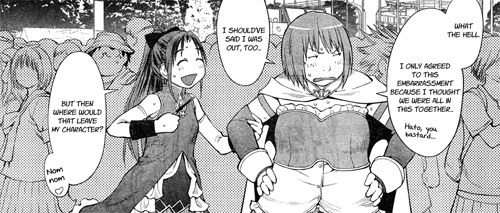
I think this panel in Nidaime probably makes the contrast easiest to understand.

…Whoa… They’re like… so young!

The three new club members are gathered alongside the old members in Ogiue’s room (i.e. the place where Ogiue produces her manga). Madarame and Sasahara are obviously among the “old boys.”

If you look at the ratio of men to women, you’ll notice that the girls outnumber the guys (though there is a certain exception), and that none of them are particularly concerned with avoiding the others. If you didn’t tell me that this is an otaku circle, I never would have guessed.

Obviously you can say that it’s because this is manga, but still, everyone there looks like they’re having fun.

Among them is one character in particular, sitting on the sofa with a sour look on her face: Yajima.

Among the freshmen, there’s a male crossdresser… or should I say, a “boy-girl.”[5]


What Yajima has to say about all of this is unbelievably cute.

“I’m… quite opposed [very resistant] to it.”


Yajima’s feelings on the matter are, in a certain sense, the bridge between the various conceptions of what it means to “enjoy oneself” within Genshiken. She’s caught in the middle, and it depresses her.

If you look at the previous generation, there was the episode where Madarame was opposed to “stylish fashion” and thought it made no sense. Though he ended up having a change of heart, the way Madarame and Yajima distance themselves is similar.

The term “ota” itself is actually rarely used in Genshiken.

In this volume, the only person other than Yajima to use the term is Ogiue, and it’s the negative meaning of “ota.” Yajima’s line in the above image, “Since we’re all otaku, it doesn’t matter,” pretty much says it all.

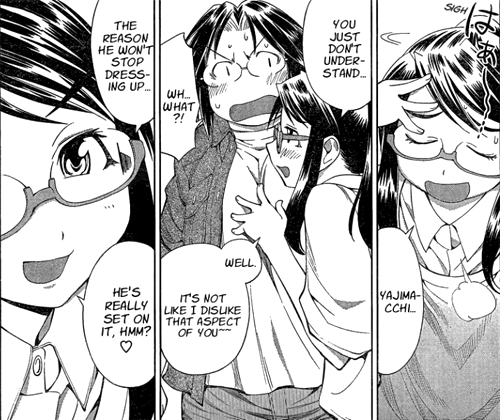
On the other hand, you have another new character, Yoshitake (the bespectacled girl in the middle of the sofa), who in contrast to Yajima exclaims, “Female otaku and fujoshi are different!” while using the term positively.

Yoshitake has determined her own status. She considers herself a “fujoshi” and doesn’t hide it. Although Ohno herself had a first step where she realized that it’s better to come out about it, with Yoshitake there wasn’t even a first step to be taken at all.


So as one might expect, neither Yajima nor Ogiue are particularly concerned with fashion. They’re fine with just wearing jeans. Then again, if I compare Ogiue now to how she was in the beginning when she was wearing hoodies, her fashion sense has become more refined. That necktie looks really cute on her! Those jeans though, I don’t really get them.

The “boy-girl” Hato is incredibly stylish. Yoshitake, who also has a relatively varied wardrobe, comes across as a girl with diverse artistic and literary interests. Even Yabusaki from the Manga Society wears a bit of makeup.

Yajima senses this gap and is extremely bothered by it.


Yajima herself originally joins the club because she thought, “I’d sure like to do something fun,” and went with it. She has an inferiority complex, but that also has to do with her otaku hobbies. She’s never been crushed by a traumatic event, nor does she carry any heavy burden.

Unlike Ogiue and Ohno, she never undergoes an intense initiation process.

Even so, she acts strongly on her feeling that there’s a drastic and irreconcilable conflict between what she feels to be an “otaku” and what she sees.

She wonders about how far one should go for the sake of having “fun,” and her heart is perplexed.

In particular, she wonders about the very existence of Hato as a boy-girl.


The Boy-Girl.

Hato as a boy-girl is quite a unique character… or rather, he would be, but recently there have been a surprising increase in people like him. He’s not a “complete fantasy,” which I find interesting.

That said, he’s certainly still unusual.

There is a definite difference between a “boy-girl” and a “male crossdresser.”

To begin with, “male crossdressers” are those who wear women’s clothing even if it doesn’t fit them, or perhaps people who still retain some of their masculinity when donning women’s clothing. However, “boy-girls” are those who, to the best of their ability, completely transform themselves into “girls,” or something close to it. They’ll shave their body hair, and even take great efforts to adapt their voices to be feminine. Recently, you even have terms like “the dual-voiced”[6] to refer to them.

And, this is the most important thing, they consider themselves to be men inside.

At first they seem like they want to become girls, but it’s not like they have any particular romantic interest in men or anything. Instead, they are passionate in their desire to become beautiful.

Their fashion is the result of serious effort.

This is the first reason that Yajima just can’t accept it. “Why are you like that?” she says.

That line feels like it has a lot behind it.

Hato is a man through and through.

As a man, his desire of “I want to become the absolute cutest” gave birth to the female Hato.

Yajima, who is bothered by the thought of “I’m an ota, so I’m awful,” is contrasted with the “this is our hobby and that’s that” attitude of Hato, a boy-girl, and Yoshitake, a berserker girl, both of whom possess not a single regret or doubt about it.

No wait, Hato had an incident that became the trigger for him. However, it’s quite different from Ogiue and the scars she received upon her awakening to BL. While Ogiue had to struggle with her own traumas, Hato easily sublimated himself into his current state.

I suggest actually reading the chapter with this episode in it, but I also think that there is a large gap between what Yajima and Yoshitake thought about it. Yoshitake really understands why Hato wears women’s clothing, whereas Yajima doesn’t get it at all (she thought it was the result of some trauma).

“If it’s fun, it’s fun; that makes it okay, doesn’t it?” That’s the attitude they take, and it allows them to face front and charge ahead.

This is the new world of the kids of the second Genshiken, and it’s become a world that they don’t hide from.

If I could elaborate, Yoshitake and Hato are about thinking “Does it matter if you’re an otaku or not? Whichever is fine.” I might even go so far as to say that they feel otaku-ness to be “just another personal attribute,” about the same as wearing glasses.

It’s because she’s Yoshitake: stylish, wears glasses, and incredibly cheerful. Geez.

Better yet, Yoshitake is like a bullet shell of positivity, a fine mood maker. She seems like she could even say something like “I oink”[7] without a problem.

…I wrote above that I wouldn’t be making any theories concerning generation, but in spite of that “Nidaime” [Second Generation] is still in the title. This is a work which shows how one pursues or enjoys their “otaku hobbies” has changed on an individual level, and it must be intentional on the part of the author.

At this current point in time, I think that there is a line—Madarame-Ogiue-Yajima-Hato—where each of them produces  a feeling of disparity relative to one another. Both the men and the women have disparate levels of recognition which don’t really link up that well with each other, and this work shows the “interesting” results of when they gather in the same place.


No Escape, Ever

So, let’s talk about Madarame.

This time around, I’d been reading the story completely from Yajima’s point of view, but I must say, the cutest person there was Madarame.

It can’t be helped; Madarame’s “boyish” mannerisms are just so cute. I can’t be the only one who thinks this way!

For some reason I want to hug Madarame, even though he’d hate me for it!

The reason that he’s so dear to me is that deep inside, Madarame overwhelmingly feels that it’s “impossible” to act as a “man.”

Now, the girls’ camp has increased in number such that the club atmosphere feels completely different. By comparison, it’s no longer a world where a girl like Saki acts as a counter to the club itself by virtue of “being a girl.”

That’s where Madarame came from, and where he is now.

What is this? It makes me feel unbearably lonesome.

…For Madarame, this is a place that he loves because he loves being able to spend time with his fellow otaku.

And then, he fell in love with a girl named Kasukabe Saki, but he kept it to himself the whole time.


……

Aw man!

Madarame, you’re way too cute! Seriously, you’re like a little boy!

By comparison, someone else has grown along another direction entirely. Certainly, he treasures the connections that were born from here, and he has always valued them, but that was something else, and now he walks an entirely different path.

Personally, I think that Kugapii is incredibly “real.” Despite being reasonably skilled at drawing, he pursued it halfheartedly at best. He then maintained that halfhearted approach all the way to graduation without producing anything outstanding, and now he has a normal, steady job. This character is also dear to me. He’s a really good guy. He works hard and with earnest. Despite his setbacks, he acts exactly as an adult ought to. He prioritizes his work and doesn’t slack off.

In a way, he’s quite the realist.


Madarame, on the other hand, is really a romantic.

This is the scene where Sasahara’s sister told him about how, even though no one’s ever actually mentioned it out loud, Saki definitely had known that Madarame has feelings for her.

(If you look at Volume 9, there’s a part where Sasahara’s sister, Ohno, and Ogiue are all aware of how obvious this is.)

Whether Saki really knew about all of this was not made clear, but even at the end of Volume 9, her behavior was received as that of “someone who evidently knew what was going on but wouldn’t actually say anything about it.”

This is to a large extent how a boy would “perceive” a woman (“I just don’t understand girls!”), but that’s Madarame through and through.

Madarame is lost in a way that might be referred to as stagnation. He’s also becoming a full-on working adult.

But what Sasahara’s sister says is absolutely correct.

For example:

For argument’s sake, let’s say that Madarame gets a girlfriend. He gives the impression that he still wouldn’t throw away those photos of Saki in his possession. This is just my imagination, but Madarame seems like he’d take those photos to the grave.

He would keep those memories safely tucked away. Actually, he’s already doing that.

Madarame: a man who really seems like he would drag a situation out as much as possible.

Along with everything going on with Yajima, I think that, from here, how Madarame will turn out is to be a point of heavy focus in the comic.

If I dare say, I want to believe in this quote from Ohno.

“Not only that, but there’s still plenty of fun to be had!”


In conclusion:

Madarame is cute.

Was Nidaime made so that we could feel moe over how Madarame behaves like such a little boy…?

Well, he also probably feels a vague twinge of loneliness because of the new blood.

This is unrelated, but I guess Madarame is part of the Azunyan faction (from p.183).

———————-

Translation Notes:

[1] Kyuukyoku Choujin R is a manga by Yuuki Masami, which ran in Shounen Sunday from 1985-1987. Its main character is a teenage robot named R. Tanaka Ichirou.

[2] Like Volume 6, there was a special edition Genshiken Volume 9 which came with a bonus doujinshi, though unlike Volume 6 it was not part of the Del Rey release.

[3] Mozuya-san Gyakujousuru is a manga by Shinofusa Rokurou. Running in Monthly Afternoon (the same magazine as Genshiken) since 2008, it is about a girl afflicted by a bipolar disorder named after its discoverer, Dr. Josef Tsundere.

[4] Character designer for Mobile Suit Gundam and many other anime. Currently draws Gundam: The Origin.

[5] The term that “boy-girl” is a translation of the Japanese term “otoko no ko,” (男の娘) which is a play off of the word for boy, “otoko no ko,” (男の子) but which substitutes the Japanese character for “child” for the one for “girl.” Normally in such an instance I would leave the word untranslated, but ecause the wordplay is in the kanji, it would be impossible to distinguish “otoko no ko” from “otoko no ko.” Another possible translation for it is “trap,” though the inherent implications of “trapping” others is why I avoided using that term.

[6] “The dual-voiced” is a translation of “ryouseirui” (両声類), referring to people who can speak in both a lower, masculine voice and a higher, feminine voice.

[7] “Buhireru” (ブヒれる) literally a verb to describe oinking like a pig, implying that one is a disgusting anime fan7

Marvel vs Capcom 3: English vs Japanese Profiles

The other day I was looking through the Japanese Marvel vs Capcom 3 website when I noticed that a lot of the profiles were actually quite different from the ones on the official English page. I’ve translated them below so that you can compare. Though not an absolute rule, the Japanese profiles tend to talk more about personality and origin, while the English ones focus on powers and abilities.

Do note that the DLC characters do not have any Japanese profiles yet, so I’ve left placeholders for them until they do.

Amaterasu

English: The wolf incarnation of the Sun Goddess. She uses her power to restore peace and beauty to the lands.

Japanese: 100 years ago, she triumphed in the battle against Orochi, but was injured and lost her physical form. Afterwards, using spiritual energy she resurrected herself as a guardian deity, but lost all of her miraculous power. Amaterasu now travels out into the world, slowly regaining her power, in order to restore her life.

Arthur

English: Sir Arthur is a brave and valiant knight who goes into hell to save his love Princess Guinevere.

Japanese: He is the legendary knight who traveled to the demon world alone in order to rescue his princess from the Demon King. He has a courageous personality, pushing forward in spite of fiendish monsters and dangerous traps, but he also has a cute side, as shown by his favoritism towards strawberry-print underwear.

Captain America

English: A scrawny fine arts student who grew up during the Great Depression, Steve Rogers was injected with the Super Solider Serum, giving him superhuman strength and agility.

Japanese: The one and only super soldier born out of the “Super Soldier Project, his strong feelings of patriotism for his country and unmatched sense of justice earn him the highest respect even among other heroes. He works as leader of “The Avengers,” a team formed in order to protect the world.

Chris Redfield

English: Part of the S.T.A.R.S Alpha team, Chris was one of the first to see the horrors of the Umbrella Corporation. He is also one of the founders of the B.S.S.A, designed to deal with Umbrella-like threats.

Japanese: Ever since the incident in Raccoon City and the destruction of Umbrella, he has taken on biological weapons all over the world. However, as he continues to fight, more and more questions come up. He is searching for his former partner, Jill, who disappeared without a trace.

Chun-Li

English: An undercover Interpol detective with lightning fast kicks, Chun-Li seeks to avenge her father’s death.

Japanese: Clad in a China dress, she spends her days searching all over for the criminal organization Shadaloo in order to eliminate it. Though notable for her strong conviction to her professional responsibilities, she also has a contrasting feminine side; in her heart is the wish to “live like a normal girl.”

Dante

English: Dante is a mercenary dedicated to vanquishing demons, which were responsible for killing his mother and corrupting his brother. He is also half demon himself.

Japanese: Born from the union of the demon Sparda, a legendary dark swordsman, and Eva, a human woman, he is half-human and half-demon. As a child, his mother was killed by a demon attack, so in order to search for his enemies he opens up a demon-hunting service. Indicative of his skill as a Devil Hunter, his shop is named “Devil May Cry.”

Deadpool

English: The Merc with a Mouth…while he is incredibly silly, Deadpool is one of the most effective mercenaries out there

Japanese: In order to cure his terminal lung cancer, Wade participated in an experiment to grant him artificial mutant powers. As side effects, his skin gained the appearance of being covered in burns and his mind was warped. Though he enjoys running his mouth, he is absolutely and profoundly mad, making him often difficult to comprehend.

Doctor Doom

English: Victor von Doom is a genius and ruler of Latveria. Often thwarted by the Fantastic Four, he uses his incredible mind and vast resources in repeated attempts at world domination.

Japanese: He is the masked genius scientist plotting world domination. Although his physical abilities are ordinary, he uses his brilliant mind to invent a vast number of super-science weapons. Utilizing them in his elaborate operations, he has tormented many superheroes.

Dormammu

English: Dormammu rules the Dark Dimension, using his mystical powers to try and conquer other dimensions.

Japanese: Originally an energy-based lifeform from another dimension known as the Chaos Dimension, he obtained a physical form made out of metal, aspiring to enter our reality and conquer it. Currently, he is king of a mysterious dimension known as the Dark Dimension.

Felicia

English: A cat woman raised by nuns, Felicia left the convent and is on a quest to become a star.

Japanese: A cat woman found and raised by kindly nuns, she has a cheerful and gentle personality. Relentlessly pursuing her dream, she works splendidly towards granting her own wish of becoming a musical star. In order to take care of children who have experienced the same difficult circumstances as her, she also works as a nun at an orphanage.

Hulk

English: When Bruce Banner was exposed to radiation from a gamma bomb, the power of the Hulk was unlocked. Now, whenever Banner gets angry, he becomes the massively strong and powerful Hulk.

Japanese: Once a brilliant physicist, while testing a bomb he was bombarded by high doses of gamma radiation. Now, when his anger and frustration rise, he transforms into a green-skinned being possessing a power well beyond human. Hulk’s overwhelming power is the point of reference by which all other strength is compared.

Iron Man

English: Billionaire Tony Stark fights the forces of villainy in the high-tech Iron Man armor. He is one of the cornerstones of the Super Hero community and a founding member of the Avengers.

Japanese: He has the brains and the technical ability to be able to develop and modify his very own battle suit. As Iron Man, he is equipped with a variety of weapons and has mastered the ability of flight.

Jill

English: Jill was one of the members of the S.T.A.R.S Alpha team. She was also one of the few people to escape Raccoon City before it was destroyed.

Japanese: N/A

Magneto

English: With almost complete control of magnetism, Magneto is one of the most powerful mutants alive. He uses his massive powers to fight for his own mutant agenda at any cost.

Japanese: A survivor of the Auschwitz Concentration Camp and genocide in the Second World War, he strives for the salvation of mutants while embracing the idea that “mutants, being superior to humans, should lead mankind.” Ruthless, he will go to any length for his agenda.

M.O.D.O.K.

English: M.O.D.O.K., the Mental Organism Designed Only for Killing who leads Advanced Idea Mechanics, is gifted with super intelligence and psionic power, using these powers to vex the world’s Super Heroes.

Japanese: Though once a normal human, his body was experimented on and he became “M.O.D.O.K. (Mental Organism Designed Only for Killing).” Possessing the abilities of superhuman intelligence and psionic power, Modok refers to himself as a “supreme scientist” and has buried all of the researchers involved in his experiment.

Morrigan

English: A fun-loving succubus, Morrigan is very powerful and prefers to neglect her duties and spend time in the human world.

Japanese: Known as a “succubus,” or a demon who seduces men with her charm, her notable characteristics are her outstanding proportions and her bewitching outfit. She is the head of the House of Aensland, one of the three great families in the demon world, but hates the everyday tedium that comes with the position.

Ryu

English: Ryu lives only for the fight and seeks opponents stronger than himself. He fights using the art of Ansatsuken as taught to him by his master, Gouken.

Japanese: Having fought the Emperor of Muay Thai and won, his name became widely known by the warriors of the world. However, fame is of no concern to him; he travels the world, trading fists with others in order to become a “true warrior.”

She-Hulk

English: When Jennifer Walters received a blood transfusion from her cousin Bruce Banner, she gained the power to become She-Hulk.

Japanese: Cousin of Robert Bruce Banner (The Hulk), in the past she suffered a serious injury and received a blood transfusion from Dr. Banner and gained the ability to transform into She-Hulk. The transformation applies not just to her body but to her personality as well; she stops being hesitant and becomes more self-condident.

Shuma-Gorath

English: Shuma-Gorath is an ancient and terrible being who wants to enslave humanity with his supernatural powers and ability to shapeshift.

Japanese: N/A

Spencer

English: Spencer is a bionic operative for a special branch of government. However, the government betrayed him, forcing him to go rogue.

Japanese: Once a great hero from his active service in the war against the Imperial Army, he was charged with treason, imprisoned, and given the death sentence, anticipating the government’s extermination of all Bionic technology. But when the Organization for the Revival of Bionics appears, he is dispatched to resolve the issue, choosing the path of warfare once more.

Spider-Man

English: When a radioactive spider bit Peter Parker, he gained the proportionate strength and agility of the arachnid, which he now uses to fight evil.

Japanese: When a young Peter attended a science exhibition and was bitten by a radioactive spider, he gained super powers and became Spider-Man. After experiencing the murder of his beloved uncle by a burglar who he had once let escape, he took to heart the words, “With great power there must also come great responsibility.”

Super-Skrull

English: The Super-Skrull (also known as Kl’rt) was given all of the powers of the Fantastic Four. He uses these powers as a champion of the Skrull Empire.

Japanese: After the Skrull invasion of the Earth was thwarted by the “Fantastic Four,” he was created as a super warrior, genetically modified to oppose them. His choice of words and his enormous pride indicate a disdain for other lifeforms; however, this stems not from any belief in personal superiority, but a cultural characteristic common to all Skrulls.

Thor

English: The God of Thunder wields the mighty hammer Mjolnir to fight the forces of evil. He is also a founding member of the Avengers.

Japanese: Son of Odin, the king of Asgard (the land of the gods), he is referred to as “Asgard’s Greatest Warrior.” Though once arrogant, he matured greatly after being reincarnated as a human as a form of discipline. Currently, he acts as a member of Earth’s Mightiest Hero Team, “The Avengers.”

Trish

English: A woman created by a demon to seduce and destroy Dante. However, she ends up aiding Dante on his quest to vanquish demons.

Japanese: Though once a demon created to seduce Dante, she was charmed by Dante while with him and betrayed the demons. Currently, she works at Dante’s shop as his partner.

Tron

English: A pirate and mechanical genius, Tron Bonne uses her servbots to do her bidding.

Japanese: The only daughter of the Bonne family of air pirates, she is prideful and absolutely hates to lose. However, she shows adorability in her inability to be honest with those she loves, as well as a gentleness when it comes to her family. Though she goes around the world in the hopes of obtaining wealth in one shot, she always fails and only ends up increasing her debt.

Viewtiful Joe

English: Sucked into Movieland, Viewtiful Joe fights for truth and justice using the time altering powers of his V-watch, which is activated by the magical phrase “Henshin

Japanese: Before transforming into Viewtiful Joe, he’s a 17 year old guy who loves heroes and movies. He has a strong childish side to him, which make his girlfriend Sylvia get mad at him quite often.

Wesker

English: Albert Wesker was part of the S.T.A.R.S. Alpha team. However, he was secretly working for the Umbrella Corporation. He has since betrayed Umbrella and is now working for Tricell.

Japanese: Extraordinarily cool-headed, he is a dangerous human being who will not hesitate to use others if it benefits him or his goals. He plots to complete the Uroboros virus and release it into the world, creating a new world where only he and a chosen similar few exist.

Wolverine

English: This Canadian member of the X-Men is the best there is at what he does, with his healing factor and adamantium claws. But what he does isn’t very nice.

Japanese: Often mistaken for a berserker devoid of civility, he has an extremely chivalrous personality and cares greatly for his friends and loved ones. However, he also has a dry side. He gives no mercy to his enemies and will not hesitate to lift a hand, regardless of time and place.

X-23

English: A female clone of Wolverine, X-23 has all of his powers in female form.

Japanese: She is a clone created from Wolverine’s genes. Having never been named since birth, she possesses a storied past, driven to a life as a highly-trained killer. Spending every day training for battle, she was named “Laura” by the scientist she considered her mother, she is prepared to cut open a path to taking back her life.

Zero

English: Despite being created by the evil Dr. Wily, Zero fights for good and righteous causes throughout his robotic existence.

Japanese: A male reploid discovered within some ruins by Sigma, since then he has worked as an Irregular Hunter. While ordinarily cool, he has an unusually strong hatred of evil; in combat with Irregulars, his fierce and decisive blade can annihilate his opponents in an instant. He is good friends and allies with X in the 17th Elite Unit.

Enter Animefan

A couple of days ago I made a post discussing the way in which the purchase of anime-related goods often transcends the purchase of anime itself. I didn’t concentrate much on the act of buying anime, and was planning a follow-up post, but Omo over at Omonomono beat me to the punch. He brings up some good points that I want to touch upon while also elaborating on this whole idea of what it means to “buy anime.”

First, a story.

I once told someone that I pretty much only buy DVDs of things with which I’m already familiar, to which he simply responded, “Why would you buy something you’ve already seen?”

Whereas I saw my ownership of DVDs as a testament of sorts to the shows I felt were good and enjoyable enough for me to have them in my collection, the other person saw DVDs simply as a way to try new things out. In the end, we agreed to disagree.

While this person was not what you’d call a hardcore fan of any kind of media, I think his philosophy applies to a lot of how anime fandom sees anime: Why spend money to see something that isn’t new to you?

Omo hit upon a simple, yet profound idea: the act of purchasing DVDs is “meta.” Anime fans generally love anime because it presents a world to them with a story and characters to whom they can relate or from which they can derive some kind of enjoyment or escapism. They become fans of the anime, but not necessarily fans of the anime as a creative work. If most anime fans find some way of watching their favorite anime for free, and they subscribe to the idea of not paying for shows already viewed, then it is difficult to see why they would purchase a DVD of it, as that would require them seeing their favorite show not necessarily as a window into another world, but as an endeavor born out of the thoughts and efforts of its creators. In other words, on some level, they would have to appreciate their favorite anime as a work of art, which I have to ask, how often does that happen with entertainment in general, let alone anime?

Are anime fans actually less likely to appreciate their favorite shows as works of art? I believe so, and I use anime conventions as an example. When it comes to anime convention guests, the people who get by far the biggest crowds are the voice actors. On the one hand this tells us that a lot of fans can at least see past the character the actor portrays to the individual performer, but on the other hand the voice of a character is directly a part of the show itself. The influence a producer or a director or even a writer has upon a work is less readily noticeable by someone viewing a show, and as such these guests tend to get fewer sheer numbers. Is this any more or less than the audiences who see actors over directors for live-action movies? I don’t think so, but I wanted to show that as far as anime is concerned, this is the kind of thing that happens.

My words bring up another potential conflict: is there something bad about being one of those fans who sees anime purely as a window into another world? My answer is that I do not find anything necessarily wrong with not engaging one’s favorite shows on that “meta” level. Nor is seeing the strings necessarily a good thing; it’s pretty much all subjective in the end. Actually, if you want to see a good example of a fandom which balances the meta with the immersive, then look no further than professional wrestling.

In pro wrestling, there traditionally have been two terms used to describe people who enjoy it: marks and smarts. Marks are people who believe wrestling is 100% real, that the Hulk Hogan in the ring is actually who he’s supposed to be. They see pro wrestling as a venue for good to defeat evil, or at least for bad-good to defeat namby-pamby-evil. Smarts on the other hand are fans who know that wrestling is all staged. They know that there are writers and scripts and politics behind the facade of Nothern Light Suplexes and Shining Wizards, and having a keen understanding of the backstage actions is where they derive their enjoyment.

But those are the two extremes, and in this age where the cat is completely out of the bag about wrestling being “sports entertainment,” there arises a new category of fan: the “smart mark,” otherwise known as the “smark.” Like smarts, they seek the truth of what goes on with the wrestlers as actors, but are also eager to suspend their disbelief just long enough for them to cheer for the good guys and boo the bad guys.

So who is the “better” fan? Is it the mark for his genuine immersion, or is it the smart who appreciates the performance?  Or is it the smark who tries to combine both worlds, arguably at the expense of either side?

And how do you get all of them to buy your stuff to keep you afloat?

Japanese is My Friend, Even If I Forget About It Sometimes

I’ve been studying Japanese for a number of years now, and often times I worry about my Japanese ability slipping. When it comes to language, it”s true what they say about using it or losing it, and as I do not have many opportunities to regularly converse in Japanese for extended periods, I think about the possibility that my Japanese is getting less potent.

But even as it risks fading into a less than satisfactory state, I am reminded that I have spent a lot of time and effort into learning Japanese. In fact, I have recently been using it to great effect in my jobs, and even if my capacity isn’t perfect, that I’m able to accomplish a task on account of my Japanese fluency is almost a reward in itself.

I also know that my usage of keigo is severely lacking, but I think they forgive me because I’m clearly not a native speaker. That’s one barrier I intend to pass someday.

The Society for the Study of Ogiue Dialogue 2: “Come Here, My Dear”

Though my first experience with Genshiken came as a result of watching the first series fansubbed, my first impression of Ogiue comes from the Japanese version of the manga. And in the original Japanese language version, Ogiue speaks in a way that I can only describe as “polite bluntness.” In a normal situation where she is not flustered to the point of switching back to her native dialect, Ogiue uses a standard polite form of Japanese, but does so in a very terse manner, like she’s telling people to back off, or that she wants to say as little as possible and end the conversation quickly. The content of her words also speaks towards this, as exemplified in her legendary introduction, translated officially as “My name is Ogiue and I hate otaku.”

When you look at the original Japanese however, the structure of the sentence is different. To clarify what I mean, I’m providing not only the original image along with the original Japanese, but also the romanization of the Japanese, as well as a more literal translation.

「オタクが嫌いな荻上です。」

“Otaku ga kirai na Ogiue desu.”

“I am the otaku-hating Ogiue.”

You can sort of see how much is changed here. Now, keep in mind that the official translation, the “My name is Ogiue and I hate otaku,” is very much how I prefer to translate that very line. The overly literal translation doesn’t sound like good English, and the grammatical differences between English and Japanese, let alone the cultural ones, mean that you cannot achieve the same effect through a strict translation. But at the same time, I began to wonder just how much Ogiue’s manner of speaking was able to translate from the original releases in Monthly Afternoon to the Del Rey Manga English versions. I’ve read a good deal of the English version, and often times I felt like the many of the subtleties of the dialogue were being lost in translation. There was a problem, however.  The Del Rey version was not designed for people who knew Japanese, and I was in a sense “tainted” by my exposure to the original Japanese.

This potential problem with dialogue didn’t apply to just Ogiue, and in fact I noticed it possibly moreso with the rest of the cast, but I decided to use Ogiue as a metric. So a week ago, I asked people via this blog, what do you think of Ogiue’s dialogue? I asked it without explaining my experiment, as I was worried that I would influence the people responding with my own doubts, though looking back, I think by asking them specifically about the “English” version, I already planted that seed. In spite of that, however, I managed to get some good responses which had me re-evaluate my own thoughts on the accuracy of the “spirit” of the translation.

Chaostangent felt that Ogiue’s dialogue “never seems too polite or too brash,” which in a way is how Ogiue talks, or is at least a compromise. Paul said that Ogiue “always sounded angry when she talked,” which is also quite accurate. And digital boy even claims that in reading the English version, he could “hear” the Japanese voices in his head. So, at least according to people who weren’t looking at it from the perspective of having read it in its original language, Ogiue’s character comes across in her dialogue. Though it might not be to the extent that it captures 100% of everything there, it still works and works well, enough to turn people into fans of Ogiue.

And I also think I focused too much on the dialogue itself. Ogiue as well as all the other characters don’t show their personality just through their usage of Japanese, but through their facial expressions, their mannerisms, and not just how they speak but when they choose to speak and why.

So, I know I’m going to regret explaining the background on this, but I am once again going to ask people how they feel about not just Ogiue’s, but the dialogue in Genshiken in general. Let’s not even limit it to the manga translation, but the anime as well. For those of you who’ve seen the dub, how does the translation fare? I found it unusually stilted, but again, maybe I’m just biased.

Praying Towards Castle Grayskull

When it comes to the international phenomenon that is Pokemon, producer Ishihara Tsunekazu had the following to say:

石原: 北米ではけっこうクラシカルに伝説系のポケモンの人気があるんですけど、リザードンのような見た目か ら強そうなタイプのポケモンが好まれています。それとミュウツーでしょうか。

Ishihara: In North America, classical-style Legendary Pokemon are popular, but Pokemon who look strong like Charizard are also preferred. Mewtwo as well.


Charizard and Mewtwo

While Ishihara then goes on to say that  universally speaking, Pokemon like Pikachu are popular everywhere, I want to to focus mainly on this unique bit of difference North America has.

While I can’t speak for Canada, Mexico, or Central America, I think it’s very well-known that America likes powerful characters. More broadly, America likes the hero who rises above all, the larger-than-life figure. He may have a humble background, but the end result is still strong. It speaks to our culture of individualism, and it is reflected in the popularity of action movies as well as in the existence of iconic heroic figures in cartoons and comics such as Superman, Captain America, He-Man and Flash Gordon. When the US encounters the creative output of another nation such as Japan, it very profoundly reflects this ideal.

This is also partly why I think many of the anime that have been popular in the US are or were popular. Compared to the less popular One Piece, Naruto and Bleach exude seriousness and power in their aesthetics, doubly so for something like Dragon Ball Z. The hyper violence of MD Geist and its contemporaries in the 80s and 90s felt new and fresh to some extent, but that level of violence is I think something comfortably American, animated cousins of action movies.

I think it’s very easy to take one’s own cultural upbringing for granted, to think that the ideals of your own culture are the ideals of everyone else’s. It’s not small-minded or biggoted so much as it is a fairly natural progression if there is nothing to jar you out of it. In an article from 1987, Frederik Schodt, author of Manga! Manga!, points out that American superhero comics do not do well in Japan. Back then, they were considered too plain and too wordy, and today I can tell you that superheroes are better known through their movies than anything else. When I was studying in Japan, I had a conversation with a Japanese classmate, where I tried to explain the Flash to him. I told him he was “red and very fast,” to which he responded, “Daredevil?”

That said, there are a number of manga artists influenced by Americann superhero comics, such as Nightow Yasuhiro (Trigun) and Takahashi Kazuki (Yu-Gi-Oh!). In anime, it goes at least as far back as Gatchaman. Still, you will find that just as we have taken anime and said, “This is what we like in our anime,” they have said, “This is what we like in superheroes” and transformed it into something more in-line with their culture.

Cultural exchange, as they call it.

One last thing to dwell on is the way Europe has approached anime and manga. Taniguchi Jiro, who is influenced by the French comic artist Moebius, is much more popular in Moebius’s home country than he is in the US. His style is very European, incorporating complex and detailed backgrounds and placing a great visual emphasis on environment (not to be confused with “the environment”). But as I said before, I’m no expert on European comics, so I’ll leave someone else to fill in that blank until I catch up.

The Society for the Study of Ogiue Dialogue

Today, I want to try something out with anyone who reads this post and has read the official English-translated Genshiken manga from Del Rey. It’s a simple question whose answer from a great many I would like to see.

What do you think of the way Ogiue talks in the English version of the manga?

I don’t want to reveal the entirety of my intentions quite yet (though they may be somewhat obvious), but do know that I plan on doing a follow-up post once I have gathered responses.

Maybe Scanlators Just Gotta Scanlate

Lately I’ve been following a most insightful user on Twitter called otaku dog. A Japanese person running an otaku goods import service, otaku_dog has made his presence known on the internet through his desire to engage with the English-speaking anime fandom. While I have not tried out his “Otaku Personal Import Agency,” I have had a chance to have a few discussions with him via Twitter.

It was in one conversation that he talked about how he is not only a fan of anime and manga, but also American comics, particularly Neil Gaiman’s Sandman. He spoke of his desire to read more of it, but that the translation never finished and that in general translation projects of American comics tend to die down and never revive.

“American comics translating projects often do not continues to last….(;- -)”

I do not know if he meant official translations or fan ones. Regardless, it made me think about the scanlation and fansubbing community, and how for all of the negatives in those communities, from the egotism to the translations wrought with errors to the personality clashes and drama and millions of other problems fan translators can have and often do, things still get translated. It might be the most popular series which get the most attention, but we see translation groups occasionally gravitate towards  fairly obscure series, even if the motive is to garner attention and praise. This is a huge contrast to otaku dog’s description of the reverse and in a way it’s quite impressive.

One possible factor for this wide disparity might be the fact that Japanese comics generally have significantly less text than their American counterparts, particularly with someone like Neil Gaiman penning the work. This is related to the differences in storytelling through panels that emerged between the two countries, and even those from the Golden Age that were produced purely for the enjoyment of children and not today’s older audience tended to be densely packed with text, making translating American comics possibly more time-consuming.

The difference in text density between Japanese and American comics also makes me think about that old stereotypical moment from throughout the decades, where a parent takes a child’s comic book away because it isn’t “really reading,” and that pictures in books are a sign that it’s juvenile. If only those parents knew about the brevity of dialogue in manga…

(By the way, I’m well aware that the title of this post can be a bit misleading.)

Manga Criticism Translation: “At First, I Wanted to be a Manga-ka”: Analyzing the Nausicaa Manga by Kumi Kaoru, pt 2

Blogger/Translator’s Note: This is the long-past-due followup to the translation posted by kransom over at his blog, welcome datacomp.

As stated by kransom, the translation is based on a lecture by freelance writer Kaoru Kumi and included in a book he has written about Miyazaki. More information can be found in the introduction of part 1. For the sake of consistency and other things, all names in the essay are first name first, unlike my usual style.

Incidentally, just as we have translated his writings from Japanese into English, Kumi has translated an English book into Japanese, “Astro Boy and Anime Come to the Americas” by Fredd Ladd and Harvey Deneroff. More information about the Japanese translation can be found here, and you can purchase the original version from Amazon.

So without further ado, Part 2.

___________________________________________________________

Actually, the Nausicaa manga also frequently uses these techniques to create a sense of smoothness between panels, the difference with Yotsuba&! being that the sequence from Nausicaa relies on speech, while the one in Yotsuba&! relies on sound in order to keep the flow continuous. In short, this sequence utilizes a spoken word to smooth the sensory incongruity between the two panels.

Volume 7 p.83

This is the impressive scene where Master Yupa steps in to stop the conflict between the citizens of Dorok and the remnants of the Tolmekian Army at the cost of his own life. Panel 1 and 2 show the boy witnessing the death of Yupa while being carried on monk’s back, while Panel 3 shows him rushing over to Yupa. Here, the cut between Panel 2 and Panel 3 is B’. With a B’ cut however, there should fundamentally be a continuation of the overall action, as is the case with the prior example of Shirley, which is covered by the action where the young maid quickly makes a cup of tea for her master. However, in this example, with panel 2 you have the boy sitting on the man’s shoulders without moving, and then with panel 3 he’s running. Technically, his overall action has been interrupted between these two panels.

However, you can see a line of dialogue in panel 2 where the boy says, “Put me down. I can walk.” Thanks to this line, the overall action is continued. Let’s try covering up the line, if you like (Here, the lecturer puts is hand over the projector to cover the words “Put me down. I can walk.”). Even with this, there’s nothing hindering the transition between Panels 2 and 3, but now don’t you sense something amiss? It’s like a baby stroller being pushed along and then suddenly hitting a bump in the road. But when you add in the line, “Put me down. I can walk,” (moves hand away) now it becomes smooth. The overall action of “rushing over to Yupa” continues in panels 2 and 3. In other words, B’ is established here. I think it subtly proves that Miyazaki cares a lot about having his readers enjoy Nausicaa and has a good sense of what will improve that enjoyment.

Nausicaa also has a clever use of Pattern B”. Let’s see the beginning of the old edition of New Treasure Island once more. If you compare the two, you will find that the two use the same Pattern B”. Here, Nausicaa and Chikuku are returning to a Dorok airship via air. In New Treasure Island the vehicle runs along hastily, while in this scene from Nausicaa, Nausicaa, Chikuku, and the monk are in a rush. That’s right, they both fall into Pattern B”.

Volume 5 p.62

“You’ve come back, too!?” “Chikuku won’t run away!” “A map! I’ve traced the movement of the mold.” “This way!” [CL1] These three panels look perfectly continuous since their dialogue goes on, in spite of the discontinuity in physical action in these panels. It’s the same technique as the one in the three-legged race I referred to earlier.[1]

Speaking of Pattern B”, I know there is another example in Nausicaa.


Volume 5 p. 87

The world of humans is on the verge of destruction, and with Teto in tow Nausicaa goes on a solitary flight. She lands on high ground and decides to wait for the army of Ohmu, who know the key to the situation at hand. The action in these six panels is not continuous, and so one might determine these panels to be an A” sequence[2]. And yet, you can follow these panels smoothly, as if you were watching a movie, in spite of the lack of speech or sound to give you a sense of continuity. Actually, while these panels do not follow Nausicaa’s actions continuously, including how she lands on the ground and how she shoulders her kite, you can still follow those actions smoothly because the overall action of ‘her swooping down from the sky and landing near some high ground and then walking towards it’ remains continuous, or is uninterrupted. And so you sense that they are still continuous. This is Pattern B”.

Let’s look at another example of B”.

Emma Volume 5 (Mori Kaoru/Enterbrain) p.76-77

This is Emma. I’m impressed with this author, who takes a total of four pages just to draw Emma changing into her maid uniform. However, when you look at it, the omissions in the actions that happen from panel to panel are assuredly there. If the sequence were to be drawn in its entirety, a mere four pages would not have sufficed. When you read it, however, it looks perfectly continuous. The overall action of “changing from plain clothes into maid clothes” is done consistently, and the small actions which are not drawn instead take place in your head and complement the action. This is a typical example of Pattern B”[3].

By the way, recall that earlier I explained how the Pattern B you see in movies theoretically cannot be replicated in manga, and that in order to do so you would need some way of falsely approximating the process. Actually, it is not impossible. Here, the monk points his gun at the sky and fires. Then, the subordinates up in the sky make their presence known.

Volume 4 p.124

The sequence from Panel 2 to Panel 3 is key here. If you were to put this into a movie, in panel 2 the bullet would appear to be flying OUT of the screen, and then a cut would happen. Then, in panel 3 you would suddenly see the bullet flying, or, to put it differently, you would see the bullet flying IN when the officers in the sky riding the flying turtle are startled by it. That’s the exemplary editing it would need if it were put into cinema. Simply put, this is a Pattern B sequence. Pattern B may be theoretically not replicable in manga, but take a good look at Panel 3. The trajectory of the bullet is shown by the smoke trail. “Wha… What kind of bullet was that?!” [CL2] exclaims the astonished monk. Indeed, it’s a little more like a rocket. Thanks to this however, you can now tell with just one look that Panel 3 is an IN shot. Wow, this is definitely like a B sequence from a movie!

Incidentally, this kind of smoke is associated with the “action lines” which you might remember from Zipang, where it is used in aerial battles. Contrasting with the physically impossible and fanciful assemblage of lines, the smoke in Nausicaa has a physical existence. It does not feel insubstantial, but rather actually quite real and natural. If we analyze the transitions in those five panels, they are A’ B’ D’ A’; in other words, they are all single-dash (‘) sequences and not double-dash (”) ones.

Miyazaki’s composition of these panels is so awfully sophisticated that I’m terrified, but the examples I’ve drawn upon so far have been from when Miyazaki’s manga had been serialized for a while and he was establishing his own form of manga syntax, and not at the point when he first began serialization, back when his refinement was still lacking. Take a look here at the first page from Volume 1.

Volume 1 p. 9

I touched on it just before, but the second image here is unusual for Nausicaa in that the rectangular panel does not have a border. Actually, when it was published in Animage originally, the title logo for Nausicaa of the Valley of the Wind was inserted here. When it was being collected together for the tankobon, Nausicaa flying with the glider was drawn in, and so the edit from panel 1 to panel 2[4] is not B” so much as it is B”-. It’s the same as the beginning of the revised edition of “New Treasure Island.”

Now what’s a good way to explain the transition from Panel 2 to the giant skull in Panel 3? In a movie it would be a B. You’d think then that it would be a B’ sequence, but when you compare it to the way the bullet was handled in the panel I mentioned earlier, I must say it looks less sophisticated than a typical B’ scene.

And then, doesn’t the edit from Panel 3 to Panel 4 feel abrupt? First, some of her actions seem omitted. 1) The glider lands -> 2) Nausicaa pulls the gun from the glider -> 3) Nausicaa carries it on her shoulder -> 4) Nausicaa faces the Sea of Corruption and walks (Here, the lecturer demonstrates the way in which Nausicaa walks). That is how Nausicaa is supposed to act in this sequence, but three out of four of her actions have been removed. Moreover, while in Panel 3 she was gliding very close to the skull, in Panel 4 the scene is set at ground level, and so they cannot be A, B, or D. So, is it supposed to be C? No, because Pattern C is a scene change, which usually does not have the continuous presence of the same subject.

So then, what exactly is the sequence in these panels? If I had to explain it, I might venture to say that it’s like the old version of “New Treasure Island.” That is to say, it can be categorized as B”. However, there we have the consistent action of a moving vehicle. In this page of Nausicaa, the glider vehicle’s action is interrupted. Perhaps, if Panel 4 illustrated the glider flying towards the Sea of Corruption, it would be a smoother sequence, although Nausicaa would crash right into the tree trunks! (laughter) …even if it would be a smoother sequence.

Here’s the same scene from the movie version. Here, it is incredibly smooth.

1

2, 2’, 2’’

3, 3’

4

5

6

Nausicaa sweeps over the giant skull (1) -> Nausicaa prepares to land very close to the Sea of Corruption (2)~(2)” -> Nausicaa makes a soft landing below onto the sandy surface (3)~(3)’ -> Nausicaa pulls the gun from the glider (4) -> Nausicaa hangs it over her shoulder (5) -> Nausicaa walks towards the Sea of Corruption (6). They are edited in quite a normal fashion. But when you see this and then look at the same scene from the manga, you find that the sequence from the manga has less elegance to it in comparison. It suggests that Miyazaki was unsure of how to transfer and convert movie syntax onto paper when he began drawing the first chapter[6]. Also, the first chapter was 18 pages. With only so many pages, the complicated sequences where Nausicaa appears, wanders through the Sea of Corruption, reunites with Yupa, and then flies to the Valley of the Wind—a sequence which in the movie takes 15 minutes—has to be drawn, then the panel sequences would inevitably feel crammed and rushed.

If you were to again look over this first serialized chapter, you’d wonder why, despite the fact that the drawings are made to be dense, does the comic look so stark-white? Really, why? After thinking about it, I realized the answer: there are no screen tones being used. Do you understand? I brought some with me today. Can those sitting in the back see this? It’s a somewhat thin, net-like sheet. There are dozens of varieties of these, and they’re used by nearly every manga artist, cutting and pasting them onto their manga in order to create effects such as shadows and clothing patterns[7]. But in the first chapter of Nausicaa, all shadows are hand-drawn.

Volume 1, p.19 (with close-up)

With that, it’s pretty white. But actually, in the comic a bit of screen tone does get used.

Volume 1 p.26 (with close-up)

This is a close-up of Yupa’s face. Notice the shaded area. On top of the thin lines drawn here, a layer of screen tone is pasted onto it. This is the last page in the serialized chapter 1.

There are other instances of Miyazaki’s process of trial and error showing up in his drawings.

Volume 1 p.23

Nausicaa here is running with a big smile on her face. This same scene is also in the movie, but in the manga the scene has more of a slow-motion feel to it, and gives the impression of being a slowed-down moment. This is the weakness of B”-. Here, Nausicaa is sticking out of the panel, and is quite possibly Miyazaki’s deliberate attempt to reduce the slow feeling here. This technique, called “off the panel,” is incredibly common in Japanese manga, but this is the only instance[8] of its use in Nausicaa. “How should I draw a manga?” Miyazaki probably asked himself as he was holding a variety of manga magazines in his hand, and tried his hand at making something “off the panel.” Miyazaki had most likely not yet developed his own methodology as of chapter one.

Such is also the case with this panel, where if you look at it after you’ve come to know Nausicaa it seems unpolished.

Volume 1, p.24

First, the use of the “hyuu” sound effect and the streamline seem rather forced. Second, the scene composition gives the impression of unsophistication. For a genius layout man like Miyazaki, the scene is too loose and incomplete. Why is that the case? Well, it’s because too many words, or should I say “speech balloons,” have been crammed into the scene. Later on, Miyazaki would use a multitude of panels to handle such a scene, but I think here Miyazaki decided to depict their conversation only for one panel because Nausicaa and Yupa are holding still. There are many speech bubbles in the panel, so the scene feels relaxed.

And so on and so forth. In chapter 1, examples of Miyazaki’s trial and error are everywhere. “There’s a lot I want to talk about, a lot I want to convey, but I am not trained enough to put what I really want to tell into manga. This is so frustrating!” thought Miyazaki, I suppose. However, the second chapter is much more stable. And listen, ladies and gentlemen, he finished the second chapter not in pen, but in pencil! When the first manuscript for Nausicaa was handed over, the Sherlock Holmes (aka Sherlock Hound) project was given the go-ahead, and so Miyazaki no longer had any time to draw manga. However, Animage persuaded him to continue the series, with Miyazaki finally agreeing to do so, on the condition that he could draw the Nausicaa manga in pencil because it enabled him to finish it more quickly. Nausicaa, as a result, became the first commercial manga ever drawn in pencil.

Volume 1, p.35 (with close-up)

One of the unique characteristics of the manga version of Nausicaa is how the shadows are rendered by drawing a series of thin lines. This is influenced by the French comic artist Moebius[9]. Look at the right image. You can see that these shadow lines are chipped subtly. That’s because it’s drawn in pencil (laughter). For your information, Miyazaki seems to have used a variety of pencil types, including a B and an H.

But then around the second half of the second volume, the comic goes back to being in pen. Now I might have this wrong, but I get the feeling that even after that it occasionally goes back to being in pencil. Here, for example.

Volume 3, p.41 (left) Volume 3, p.42 (right)

For the sake of the Nausicaa movie, the manga’s serialization was put on hiatus. The image on the left is a panel from the final page before Nausicaa was put on hiatus, and the image on the right is from the page right after serialization resumed. In the collected volume (tankobon), they’re printed on the same piece of paper, one on the front and the other on the back, but in reality there was a 13-month gap. Now if we were to magnify the dangling ends of the gas mask…

Do you see? The lines in the image on the right are more chipped. This means it’s a pencil drawing. You might know that in animation key frames are drawn in pencil, and so while making the Nausicaa movie, Miyazaki became more attuned to using pencil. I guess after the manga resumed, he was unable to draw with a pen the way he wanted to, and so after the manga started up again, the first new chapter was done in pencil. But then in the next chapter, the comic goes back to being in pen. Incidentally, when he resumed the Nausicaa manga after having completed the movie Kiki’s Delivery Service, the lines look a little chipped. I think that it was also drawn in pencil. Then, it returned to pen.

Now we’re going back to analyzing what it means to be “cinematic.” Having the background be out of focus is a technique frequently used in live action film, or should I say, photography. Suppose there were many little flowers blossoming and you attempted to use your camera to shoot one of them very closely. However hard you tried, the shot would get crowded by the other flowers. For that reason, you have the camera focus on just the one flower and leave all of the other flowers out of focus (Lecturer projects it on the screen). This is a terrible example though, granted (laughter).

The “out of focus” method is also in Nausicaa.

Volume 2, p.116

This scene is the duel between Yupa and Asbel. It’s an action scene, and yet it’s more akin to stopped motion. In my opinion though, I wouldn’t call it stopped motion so much as the removal of sound.

Look at this scene from the Nausicaa movie (DVD playback). A giant transport vehicle crashes into the Valley of the Wind. By the window is a girl who looks the same age as Nausicaa. The sound disappears in this cut. Movement in this scene hasn’t stopped, and yet doesn’t it seem like time has stopped for an instant? The panel in question, the one with Yupa and Asbel, achieves the same result on paper, although this scene was drawn before Nausicaa was ever turned into a movie. It is said that Takahata, who joined the production of Nausicaa the movie as a studio manager, worked as the sound supervisor as well and removed all the sound in this cut. His sound removal method must have impressed Miyazaki, as Miyazaki applied it to the Nausicaa manga in a more refined way later.

Volume 3, p.139

Here, Nausicaa is fleeing from a Dorok cavalry. Of the guards who are desperately covering Nausicaa with their bodies, one of them gets hit and falls over. It’s quite exciting. At the same time, the lack of a rendered background emphasizes her psychological shock and as a result gives off a sense of stillness, a sense of stopped motion [10].

The overlap technique seen in films is also used. It’s not used that often, but if you take a look here:

Volume 5 p.75

For some reason, the monk has a worried look on his face, and Nausicaa appears behind him flying. Drawing an image like this on paper is a little too bold, but in actuality the image does not feel out of place. In other words, it reminds us just how heavily we have adapted ourselves to the scene dissolves that occur in movies and television.

Speaking of which, this is a manga which faithfully uses rectangular panels. There are, however, exceptions, like here.

Volume 3 p.13

This image brings back some memories from when I was in elementary school, especially the illustrated encyclopedias that would be available in the school library. Boys who are into science or technology like illustrated encyclopedias, and a young Miyazaki would be included among them. (laughter). Now have a look.

Volume 7 p.105

Oh! Here we have Nausicaa relaxing with a silly look on her face (laughter). She’s forgotten her usual self-denial and self-restraint, feeling quite relaxed and refreshed, with the image of the garden bleeding past the edges of the page as if to reflect the calm in her mind[11]. The author wanted Nausicaa to relax for a short while. After this, she would be sacrificed to a journey filled with despair…

…Which is my own humble analysis of Nausicaa. Seeing this manga, I’m impressed that almost all of the panels are rectangular, something quite unusual for modern manga, while each of those panels is packed with the passion and energy of such an extraordinarily talented creator. This gives off the impression that Miyazaki was holding back. As he was most likely extremely conscious of how the movie’s sequences and transitions would be edited, the activity in the actions from panel to panel, in other words A”, are united with the context of words and dialogue. In short, Nausicaa is the manga which blends cinematic methods exquisitely into classical manga syntax.

Miyazaki learned Disney-style full animation at Toei Animation, and then left the studio where he and his comrades ended up falling in labor union activities. He and Takahata joined the TV cartoon industry, trying to achieve maximum “cinematic” efforts using lower budgets and fewer animated drawings. In his autobiography, veteran animator enthusiastically writes about how Miyazaki had been living his vision.

This is Miyazaki’s storyboard from the 1971 Lupin III[12]. Otsuka compares Miyazaki’s storyboard with one done by a different animator. If we look at this other storyboard done by someone we’ll call “Mr. X…”

The Animator Clawing His Way (Sakuga Ase-Mamire),
Revised and Expanded Edition by Yasuo Otsuka,
published by Tokuma Shoten Publishing, p.149

…there’s an A cut. However, with Pattern A, the action must be continuous, which makes drawing the images for it labor-intensive. Miyazaki’s storyboard on the other hand is entirely D edits. If the action isn’t continuous, then the drawings become easier to do, all the while Miyazaki remains perfectly faithful to the principles of film editing.

Looking at the Nausicaa manga more closely, not only can you see that the D’ sequences are well-done, but that there are a lot of A’ sequences (with actual A sequences being impossible). When A sequences appear in TV anime, a character’s actions must be singular, and it must be a simple action—like an arm extending—to shorten the amount of labor put into the drawing. Manga, however, is by nature a series of still images, so with Pattern A’ or even Pattern A”, the readers will conceive the movements in their heads. Showcasing clever uses of this mental mechanism is the air battle scene I showed you earlier. In Panel 8, the gunship is depicted flipping like a springboard diver jumping backwards into water. If you were to actually try to animate it, the process would have been laborious and would have required many frames of animation to be drawn. However, because it is manga, the complementary actions are envisioned mentally by the reader, where less labor is needed than in drawing animation frames, and so it becomes an easier task.

Thus, what you have here are the patient efforts of Japanese animators over dozens of years to make TV cartoon shows as fully cinematic as possible in spite of difficult circumstances in production, as well as the brilliant efforts of Japanese manga artists over dozens of years to achieve cinematic style on-paper in spite of the fact that manga is just composed of still images. One of the most brilliant fruits of their labor is the subtle and bold fusion of the two sides that is Nausicaa of the Valley of the Wind. That is my conclusion. (Applause) What? Why are you all clapping here? (Big laughter, huge applause) I’m grateful! Oh, don’t you think NHK will have to invite me as a guest commentator whenever they have their “Manga Night Talks” show about Tezuka’s New Treasure Island? (laughter).” Not that Tezuka Productions would ever give the OK on it, even though this is the 80th anniversary of Osamu Tezuka’s birth[13] (laughter).

Next week, we’ll continue to discuss Nausicaa. This time we discussed technique in depth, but next time we’ll be analyzing and getting at the core of its story and themes. I hope to see you all in this classroom next week. Class dismissed.

Footnotes:

[1] It goes without saying that the three-legged race I mentioned earlier is A”. However, the two girls’ swing of conversation fills cinematic gaps among the three panels.

[2] Notice how in panels 1~5 there are no speech balloons, sounds, or entire figures. On the other hand, you have Footnote 9, or “Osaka splitting her chopsticks apart,” where sound and figures make it easier to follow the panels smoothly, as if it were cinematic.

[3] In an interview, Mori mentions liking this sort of panel sequence.

[4] For the sake of convenience I called this “panel 2,” despite it having no actual borders.

[5] Actually there’s another solution here. If one were to insert a panel of Nausicaa preparing to land in between panels 3 and 4, it would become B”.

[6] I also referenced Yukihiro Abeno, who said, “Miyazaki is the ultimate and most fortunate amateur manga author.” (Seidosha Publishing, Eureka Special “World of Hayao Miyazaki” Issue)

[7] The first time this was used in a manga was by Miyomaru Nagata. Around 1955 or so.

[8] An omission.

[9] Moebius, born on May 8th, 1938. He is famous for having influenced the styles of Katsuhiro Otomo and Hayao Miyazaki, and apparently Moebius style had an influence on Tezuka’s Hidamari no Ki, the samurai drama featuring Tezuka’s ancestors. As an aside, Moebius named his own daughter “Nausicaa.

[10] In Nausicaa, when an action scene occurs the closing line in the panel becomes diagonal.

[11] I believe this technique of piling fragment-like panels on a larger, non-bordered image was first used in Japan by Shotaro Ishinomori (January 25, 1938 – January 28, 1998).

[12] At first Satoshi Dezaki drew the storyboard for the sequence, but Miyazaki rejected it and drew this afterwards. Though keep in mind that Dezaki was not “Mr. X.” In fact, the second storyboard on this page was drawn by a younger animator whom Otsuka got to draw it years after the production of the first Lupin.

[13] The old New Treasure Island was finally re-released on February, 2009.

MERRY CHRISTMAS! I HAVE A PRESENT FOR YOU!

Genshiken Chapter 56: Spring Has Come Again, Translated

Rapidshare
Sendspace
MediaFire
Torrent

UPDATE: I made a few errors in my translation that I didn’t catch, but the translation is about 98% accurate. A version 2 will be on its way, and this post will be updated in kind.