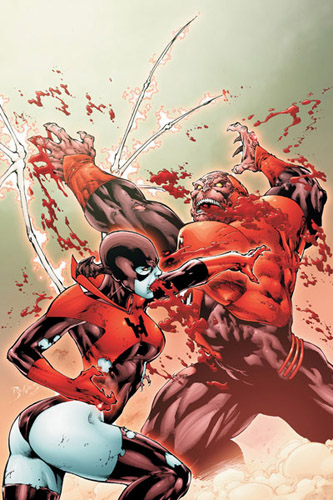
Anime and Idealized Figures

When it comes to figure drawing in the western art tradition, the standard human is marked at about 7-7.5 heads tall. Increasing those proportions will result in a more idealized figure, to the point where if you want to make a figure look heroic you make him 9 heads tall. However, based on information I’ve learned from the manga drawing workshop at Anime Expo 2012 (and backed up by the Wikipedia entry on body proportions), it turns out that manga and anime much prefer a 6.5-head-tall character as its baseline, and in some cases as an ideal.

The Wiki entry gives moe as an example of where those proportions change, but even putting aside moe girls and going straight into masculine tough guy territory, what I find particularly interesting is that even some of the majestic figures in anime and manga are about 6.5 heads tall.

Reinhard von Lohengramm (right) is a genius tactician and a brilliant leader beloved by all who serve under him, someone who’s not just heroic but legendarilygalactic heroic, and yet he himself is only 6.5 heads tall, maybe 7 heads at best.

Kinnikuman is a super powered wrestler with muscles rivaling even the greatest of American comics superheroes, and yet he too ranks in at about 6.5 heads tall. The same even applies to that most recognizable of anime superheroes, Goku.

Obviously not all anime and manga characters are 6.5 heads tall, and there are plenty of tall, svelte characters who go into fashion model territory, but I have to wonder how this might affect people’s perceptions of characters both male and female. For example, are anime characters viewed as more child-like or less powerful when viewed by someone unaccustomed to manga for these reasons?

Stand Aside, Book Smarts: The “Knowledgeable Girl”

While reading the Drops of God recently. I took notice of the supporting character Miyabi, a sommeliere-hopeful who assists the hero Shizuku, bolstering his seemingly supernatural sense of taste (literally tasting things with his mouth) with a larger knowledge of the wine world. In this setting, Shizuku’s genius, though achieved through years of work and forced training, comes across as of a deeper quality than Miyabi’s superior book smarts.

Miyabi falls into a character type I might refer to as the “Knowledgeable Girl,” a trope I see most often in shounen manga. This character is different from someone who’s simply smart or studious or is a bookworm. Instead, it is the character who seems to play two roles: the first is to have a solid foundation of knowledge so as to be useful when exposition is necessary, and the second is to have that knowledge contrasted with the hero’s more impressive abilities, as if to say that, while the hero lacks conventional knowledge, he is such a radical that he can overcome it, or that it’s only a matter of time before he picks up that knowledge as well. In a way, she is meant to be surpassed.

Probably the most prominent example I can think of is Sakura from Naruto, who, like Miyabi, criticizes the male hero for not knowing the basics, and whose book smarts are ultimately shown to be less powerful and important than the unique flavors Naruto himself provides. I bet you can think of many others as well.

I don’t think this is a character type doomed to mediocrity, as the key, I feel, is to actually give a true advantage to book smarts, something that just isn’t waiting to be trivialized. Female coach Riko from Kuroko’s Basketball (AKA THE BASKETBALL WHICH KUROKO PLAYS), for example, while very much in that supporting role, at least shows a strategic knack owing to her intense study lacking in the players. Tokine in Kekkaishi, more knowledgeable than her counterpart Yoshimori, is better at refining her abilities than at simply making things bigger and more powerful.

I wonder if it’s possible to argue that no character type is truly terrible and that it’s all in the execution? I’m sure I’ll be corrected rather immediately.

Operation Bring Devil Curry to the World

So it turns out that one of my favorite places in the world to eat, Go Go Curry, is teaming up with legendary manga creator Nagai Go to create a new super spicy curry. Called “Devil Curry” in honor of the 40th anniversary of Devilman, it is going to be a permanent fixture on the Japanese Go Go Curry menu.

These days, however, Go Go Curry is international, with stores in New York and Singapore. I know I want Devil Curry where I live, and for those of you who feel that Go Go Curry, while good, isn’t quite spicy enough, I’m sure you’d like to try it out too. The only choice then is to campaign for the international release of Devil Curry.

Every time you go to a Go Go Curry, tell them you heard about Devil Curry and want to have it on the menu.

For the times you’re not near a Go Go Curry, they also have twitter accounts: GOGO_CURRY and GOGOCURRYUSA

The only concern I have is that it might end up losing its Devilman connotations upon going abroad. I’m not sure how I feel about that.

Thoughts on Fandom Structure: Facilitating the Moe “Lifestyle”

In a recent conversation, I was presented an interesting question: why is that moe seems to engender the type of fandom which seems on some level staunchly devoted to it and has fans who can take attacks on moe personally? After some consideration, I thought of two reasons.

The first reason is that on some level, whether it be deep or shallow, I think moe fosters a very individual, perhaps even private connection. Regardless of the specifics and any sort of moral/aesthetic tastes, the idea (nebulous as it may be) begins to resonate with concepts such as catharsis, fantasy, sexual desire and identity, self-reflection, stress, and so on.

The second reason, and the one I’m more interested in for this post, has to do with the ease by which one can become a fan of moe. In a recent interview concerning Starcraft 2 fandom, commentator and personality Sean “Day[9]” Plott was asked why so many SC2 fans have a tendency to identify themselves as “Starcraft fans” and to put down other games as inferior products, to which he responded:

There’s a lot of people who are into Starcraft and it’s just become their identity because, honestly, there’s so much Starcraft content that you can watch it all day, every day, just like you can be into football or baseball. And so, rather than just say, “I like this,” they look down on other things.

I think these words can apply to moe as well, in the sense that not only is there so much of it currently available that you can watch and read nothing but moe genre titles and have your entire day filled, but that the system behind it actively promotes and encourages this sort of obsession. On the fiction-production side, you have this tendency towards characters who each possess easily expressed individuality, and so make it easy to define a favorite, and it’s a process that can be renewed with the next show and the show after that. On the merchandise side, you have figures, posters, limited edition DVD boxes, fan clubs, official events, and so on. If you’re into some show, there’s a good chance you can buy something related to it, and though there’s a lot of talk these days about how fandom is moving beyond expressing itself through simple consumption, it can’t be denied that it is still in its own way an expression of one’s self.

Obviously this model doesn’t only apply to moe or even just anime/manga, nor does every single fan of moe do this (and I want to make the point clear that I’m not characterizing an entire fanbase as having a singular mindset). However, when combined with that very personal connection which moe fosters, I think it creates a particular kind of devotion, which, while not entirely unique, more easily manifests itself as something just that personal.

Language, Insults, Slurs

In online communication, whether it’s on a forum or in a video game, it isn’t uncommon to see some strong insults (racist, sexist, etc.) being thrown about, and the ubiquity of such language has created a lot of debate on the subject among fans and others concerned. What I see from those arguing, however, is a tendency to take a rather extreme stance in one direction or the other, which ends up avoiding much of the nuance of such a complicated topic which goes well beyond video games and technology and into the deep recesses of human history. I’m no expert on the matter myself, and I’m bound to have my own oversights, but I wanted to lay out my own thoughts, as well as my own personal philosophy on the matter.

One of the stereotypes of being on the internet is that, in order to successfully participate, one must have or develop a thick skin. Behind the safety of a computer screen and at least a few hundred miles, it’s easy to say what you want, when you want. People will take anything they can to put you down, whether it’s because they want to seem tough, or they want to psych you out, or because they actually feel that way, and race, gender, and sexuality factor into that equation as well. However, while it’s true that listening to what every single random person has to say about you online and taking it to heart is a bad idea and that having an impermeable hide can help deflect the insults away, there’s still the problem of the very fact that words such as “n****r,” “f****t,” and “slut,” are considered viable as insults.

How often do you see someone try to put down another person by calling them white, heterosexual, or masculine? We take these values to be in may ways a societal default on practically a subconscious level. When you call someone a n****r online to try and get under their skin, even if you don’t really mean it seriously, even if they’re not actually black, you’re implying that being black is in itself a terrible thing. It’s one thing to trash talk to get a mental edge, and it’s another to even unknowingly reinforce the idea that some people are perpetually inferior on some inaccessible level simply because of the color of their skin or whom they find attractive.

That said, I am very much against censoring or removing slurs from the English language.

While I do not believe that words are necessarily innocent in and of themselves, as they may have elaborate backgrounds rooted in hatred and intolerance, I am a firm believer in freedom of expression, whether that’s artistic or verbal or any other form, and that includes the nastier side of how we speak. If the writer of a story wants to convey hatred through strong language, then that option should be available to them, just as the option to deride them for doing so is available to everyone who chooses to read (or not read) their work. If people feel the desire to express themselves using that language, then I do not think it’s right to deny them their own feeling. To simply say that we need to erase these words is like layering bricks over a massive sinkhole.

The problem with “f****t” isn’t that it originally meant “twig” or whatever and that we polluted its meaning, but rather that we allowed ourselves to believe that homosexuality is a quality worth insulting in the first place. This is also why I think people using words like n****r and f****t in a positive fashion, or at least trying to do so, is not necessarily reinforcing the negativity associated with these words, but that is a topic I will leave for another time.

One thing I am well aware of is the way such language can be so commonplace that those who are exposed to it frequently while growing up can wind up having it as a part of their subconscious mind and not realize the potential strength of these words. Using them becomes habit, as simple as saying “good morning.” I’ll admit it myself: when I was younger, I would use the word “gay” to mean “awful,” as in “You got a 50 on a test? That’s so gay!” If you had stopped me and asked whether or not I actually thought homosexual were inherently worse as human beings or that I actually hated them, I would’ve said of course not, but still, “gay” was in my vocabulary as an adjective to describe mundane areas of life. Eventually, I stopped using the word in that fashion altogether, but it didn’t come from me declaring that “from this day forward, I will no longer use the word ‘gay’ in a way which implies negativity!” It simply happened gradually and almost unconsciously, and if I had to attribute it to anything, it would be to meeting and becoming friends with people who are gay, the act of which likely educated me into thinking of them not as some distant idea or label, but as fellow human beings. Just as easy as it was to start using the word “gay” in that particular meaning, it became just as easy to stop after the fact.

In contrast, when I was even younger, I made the active decision to stop cursing, and while I’ve gotten somewhat more lax since, I still try to avoid such words as much as possible. I never mind if others use them and use them often, but I have knowingly limited my own regular vocabulary because I think it serves me better, and I will still use them when I’m quoting another person who’s used a word like “fuck,” or if I’m discussing it as a topic and feel that ideas get too obfuscated through the use of euphemisms.

The fact that I’ve consciously removed some insults from my language and unconsciously removed others can seem rather contradictory I realize, because it might seem as if I’m saying that people should consciously remove certain words from their vocabulary while also claiming that it happens naturally and we should just let nature take its course. The difference here, however, is that I am not claiming a solution wherein everyone eliminates offensive language from their vocabulary or society deems it fit to consider the use of those words a crime in and of themselves. Nor am I claiming that people should use only the words that I use. Rather, I think the key to addressing the use of slurs, whether the user did not consider the weight of those words, is simply education, and not on a didactic level.

If we can show people about how words can and do have power, or encourage people to realize that those they see as “others” are not some nebulous concept but as a group of individual human beings, then we can give them the power to shape their own language usage from an informed position, instead of an ignorant one. This way, when someone unconsciously uses a word that encourages intolerance, they can be shown the potential problems of doing so without forcing upon them a false paradigm of “right and wrong,” or trying to instill shame into them. Thus, if they stop using a word, it isn’t because the word never existed or that it has some vaguely defined negativity, but because they felt that, on some level, whether conscious or unconscious, that it isn’t how they would like to express themselves. Vocabulary is avoided but it isn’t removed.

Gratis! Free Comic Book Day, Netherlands Edition

This past weekend was yet another Free Comic Book Day for the United States, but as it turns out, it was also the first ever Free Comic Book Day for Netherlands and its neighboring country of Belgium (don’t know about Luxembourg). FCBD has been a tradition for my friends and I back in the US for many years now, but sadly I was unable to join in on the fun in 2011 on account of living overseas, so I was glad to see the concept reach all the way over here.

Unlike the complicated Manhattan crawl I’m accustomed to where we’d hit every comic store around, the city I’m living in only has two comic shops so it was a far simpler affair. What I found particularly interesting, though, was the selection of free comics. I typically think of the FCBD giveaways as being a mix of superheroes, some humorous Archie-esque comics, a couple of more experimental works, and then a smattering of manga offerings, and this year appeared to be no exception. In contrast, the comparatively small selection of comics for the Dutch/Belgian FCBD primarily involved European comics, with The Walking Dead being the only American comic as far as I can tell. Of particular note is the Dutch Storm, and the variety of lively artwork in Het beste van Oogachtend FCBD (a compilation of various artists’ work) probably makes it my favorite overall.

Sadly I can’t really read Dutch so I can’t actually tell you how these comics are, but they’re quite pleasant as souvenirs regardless. For those of you familiar with Dutch comics, I currently have as my distant, distant goal for Dutch literacy volumes of Agent 327 and Suske & Wiske, as well as a Dutch-translated issue of Yoko Tsuno. Some day…

Gundam AGE as Healthy Failure?

I’ve been enjoying Gundam AGE quite a bit since it began airing, and I think it’s a solid show (thought not without its flaws) which successfully utilizes its main premise of a battle being fought over multiple generations. The second generation hero Asemu is a far cry from his dad Flit when they were similar ages, and through hindsight it ends up highlighting what made Flit unique in the first place. As it turns out, though, Gundam AGE isn’t doing so well in the ratings, and it apparently has failed to reach the kids demographic it was trying for in the first place. At this point, it’s pretty easy to just say that the mistake was marketing to kids, that they shouldn’t have repulsed the older fanbase through the kiddier designs and the like, and that the solution is more UC (or things similar to the Universal Century stories), but I think this would be a huge mistake.

Putting aside the fact that this is not the first time that a good Gundam series has disappointed in the ratings (see Gundam X and even the original Mobile Suit Gundam) and just assuming that nothing the show does now will turn it around, the kind of risk that Sunrise took in gearing Gundam AGE towards a younger demographic is, in my opinion, the healthiest kind of failure there is. Well, if you consider it in terms of profits lost I’m sure there would be some disagreements, but what I mean by healthy failure is that they didn’t have to do this, but saw that there is a potential market from a new generation far removed from the original 1979 anime, and made a concerted effort to appeal to it. It reminds me of Sunrise’s recent hit, Tiger & Bunny, because that show was a surprise hit to even Sunrise themselves, and I have to wonder if it encouraged them to take more risks. Obviously I don’t know if AGE was in planning before or after T&B, but there seems to be this general spirit of experimentation which I’d rather not see stifled because of this setback.

When Sunrise did research into why kids weren’t getting into AGE, they arrived at the conclusion that kids these days don’t understand or know about wars and space colonies. It seems like an odd result, but assuming that this is the problem (or perhaps more accurately that modern kids don’t care about space war by default), the thing I want to point out is that there are ways to work from this information without just abandoning it entirely. If the children of Japan today are ignorant of wars and space colonies, then perhaps one of the goals of a Gundam which targets them should be to introduce those concepts  as if they were entirely new. In other words, if it’s unfamiliar, make it familiar.

Perhaps an easier solution would be to just find out what the kids like and transform the premise to fit the current trends, but I don’t think the solution has to be an all-or-nothing endeavor, even if Gundam AGE may have toed the line too much. Heck, I think looking back at the previous alternate universe of G Gundam could provide some nice possibilities, not so much because of the martial arts aspect, but the premise of having Gundams from various nations each with their own special abilities, which isn’t that far off from the cast of a collectible card game/monster battle show.

Superhero Comics and Being Sexy on an Individual Basis

Introduction

When it comes to the controversial approach to sexuality in superhero comics, probably nothing is more exemplary than the oft-seen exaggerated pose where a female character twists her torso such that both her butt and her breasts are facing at the reader directly. Known as the “brokeback,” the pose is frequently the target of criticism as an example of sexualization gone wrong. Generally, the criticisms concern the fact that, as action-based stories, the pose is a completely impossible and extremely impractical thing to do in fighting. The idea is that, by showing them as such, comics communicate the idea that when it comes to female characters the T&A is more important than their identities as heroes or characters in general.

The point at which I might diverge from other opinions is that I believe strongly in freedom of artistic expression and think that such works have a right to be drawn and a right to be enjoyed by readers on a sexual level. While I think that the disparity in idealization between genders can definitely be too much, something has to be said for the fact that the visual arts in general can make the impossible happen in the first place. If people are literally physically incapable of contorting themselves into the “brokeback” pose, then mediums such as comics are the only places where it is possible at all.

I also think people have the right to admire a character while simultaneously desiring her or the pose that she’s taking. Again, the fact that forms of fiction such as comics make it more than possible for the portrayal of a female character to be an effective fighter while doing the least physically sensible thing possible is not an inherent negative, as long as we’re being honest about the fact that it is indeed done for sex appeal. No matter how much we’re able to point out that those contorted positions would shatter someone’s spine, or that other poses come straight out of pornography, they successfully generate sexual attraction. Individual tastes may vary, but they’re also called “porn poses” because they work, and at the end of the day pornography drawn or otherwise does not automatically turn people into misogynists.

But while the act of making or consuming such products causes no harm in and of itself, when the brokeback pose becomes the default method for portraying sexual attractiveness, it creates two major problems in particular. First, while anyone has the right to enjoy any type and degree of sexualization, if the goal is to try and attract a larger female readership, then no one should be surprised when such portrayals lessen their desire to pick up superhero comics. Second, and what will be the primary concern in this article, is that by having that style of sexualization be so ubiquitous, it creates a singular image of how a female (character) is supposed to look when they’re being “sexy.”

Sex as Character

Over the month of February, comics news and editorial site Comics Alliance published a series of articles on sex in comics. One of the articles discussed Adam Warren’s Empowered, where writer David Brothers argues that, even though Empowered is more sexually explicit and has more overt fanservice than regular superhero comics, it still approaches the topic of sex in a much healthier and more mature fashion.

Although a majority of commenters have voiced their understanding of David’s points and explanations, there are a few dissenting responses which I found interesting for what they imply. The recurring criticism, which not only appears in David’s article on Empowered but also many of the other posts, basically calls out the writers for having a double standard, praising the portrayal of sex in indie comics, while lambasting the presence of sexuality in superhero comics, in something of a high art, ivory tower, porn vs. erotica-type argument. Another criticism leveled at Empowered in particular, is that its crass displays of actual sexual content and juvenile-sounding dialogue make it worse than the other superhero comics to which David compares it.

I think David actually addresses this well in the article itself when he describes the primarily sexual relationship in Empowered, that of the main heroine, Emp, and her ex-henchman boyfriend, Thugboy:

Empowered‘s eponymous heroine is a superhero with issues. Her costume is too skintight and ineffectually fragile, and neither her teammates nor her nemeses respect her. She gets tied up way too often for her liking.

They both get different things out of the relationship, aside from just sex. Thugboy clearly loves Emp, and expresses that in a way that’s both a little paternal and a lot touching. He gets her issues with her body and career, and when she doubts herself, he’s there to point out how wonderful she is. He supports her, and the reverse is true, too.

More important than that, though, is the fact that she’s comfortable expressing her insecurities to him.

The thing to take away from their relationship is that when Emp has sex, it’s not simply a display of sex but rather shows the specific scenario of “sex with Emp.” It takes all of the various bits and pieces of her characterization and doesn’t forget them even during moments of titillation. The trouble with how sexuality is frequently visualized in superhero comics then, assuming the goal is to show female characters in a sexual manner in the first place, is that this level of specificity doesn’t exist in most portrayals. Rather than a female character making a sexy pose, it becomes a female character conforming to a sexy pose template, no matter her personality, history, or quirks. When combined with the way that superhero comics can grow and reinforce bad ideas, we end up in the current situation where this approach to sexuality generates an entrenched position that causes people to staunchly defend it as if it is simply the way that comics communicate “sexy,” as if there is little alternative.

The issue of posing isn’t confined to just “bad” artists, as the above example from Jim Lee demonstrates. Taken from his famed X-Men run in the 90s, the image is well-drawn and the women are idealized without necessarily going off the deep end, but aside from Jubilee (front) all of them are taking the same sexy stance. Psylocke (left), Rogue (center), and Dazzler (right) all have very different backgrounds and personalities, so it seems strange that they would all be in the same pose. This goes double when you compare them with all of the male characters, each of whom showcase their individuality in the way they’re standing or sitting, or Jubilee once more, whose “attitude” comes across in her slouched position.

Again, there’s nothing wrong with showing attractive girls in exaggeratedly attractive poses in and of itself, nor is there any fault in enjoying them, but superhero comics are in the business of creating unique, iconic characters. This is why they have different origin stories, different costumes, and different powers. The goal is to be able to see how a particular character stands out from the rest, and if sexuality is involved, then comics can benefit from making sure that the erotic is also made to fit the characters.

Alternatives from Anime and Manga

I’m going to steer away from superhero comics and take a look at anime and manga, a territory I’m much more familiar with, and one which I find provides some strong examples of works where the sexuality of their characters is both emphasized and individualized. This is not to say that anime and manga are devoid of sexism, or that any of the examples shown below are perfect in their portrayal of women. Instead, I want to show how these works go out of their way to portray their characters’ sexuality in ways which also reflects their unique characteristics, and to point out how the issue with pushing just one type of sexuality can be an issue even when the goal is to portray characters in a sexual fashion.


Senjougahara Hitagi (above) and Kanbaru Suruga (below) from Studio SHAFT’s Bakemonogatari/Nisemonogatari

The first title is Bakemonogatari (and its sequel Nisemonogatari), which features a number of attractive and highly-sexualized female characters. The characters depicted above are both the same age and both attracted to the main character. However, Senjougahara’s seductive body language is fed by her sardonic personality, whereas the athletic Kanbaru, a self-admitted pervert and an exhibitionist, shows a more forward and aggressive approach. What isn’t as clear from these screenshots is that the show banks on their sex appeal being highly individualized down to the very way that conversations happen.

Left to right: Ran, Madoka, and Muginami, from Rinne no Lagrange by Studio XEBEC/Production IG

Next is the recent Rinne no Lagrange. The three main characters depicted above are all clearly meant to be attractive, but in addition to having varying styles of dress which set them apart at the same time that they emphasize their figures, the three girls also literally sit differently. Just having them relaxing on chairs in unique manners suggests the differences (as well as differences in physical appeal) between them, and I might even go so far as to say that a person could get a rough idea of their personalities based on this image alone.

What of the brokeback itself, then? Is the pose forced to contain only one connotation, such that it cannot become a characterization factor? I believe the answer is that any way of posing a character, even the brokeback, does not automatically void its own potential to be a factor in showing a character and their particulars. The easy answer here is that if some seductress character wanted to stand that way to entice men sexually (and I’m assuming heterosexuality here mainly because that is the site of this debate), then it would make sense, but it doesn’t require that the character herself to be hypersexual, provided that it does not take over her overall portrayal or the view of sexuality in the comic itself.

Akashi Kaoru (right), heroine of Zettai Karen Children by Shiina Takashi

In these pages from Zettai Karen Children, we have its main heroine Akashi Kaoru standing in a way that emphasizes both her chest and her rear. It’s in the context of “stretching for a run,” which lends some practicality to it, but as I said in the introduction, I find arguing from a point of realism as if to say that once you undermine the physics of the pose, you break its spell to be a flawed one, somewhat like arguing that Superman shouldn’t fly with one arm out because that would just create unnecessary wind resistance. Instead, the reasons I see Kaoru’s pose as being be different on some level compared to the typical broke back are that first, the twist of the torso isn’t quite as exaggerated, and second, it is shown to be just one pose among many within these two pages, let alone the rest of the book. Her stance is neither the primary display of athleticism nor the primary display of Kaoru herself, and on top of that she contrasts with the other girls shown.

To re-emphasize, my goal with these examples isn’t to assert some kind of general superiority of manga over American comics, but to say that the problem with having the brokeback and what it represents be the default for comics in general is problematic for more reasons than simply “sexism.” Comics and other media don’t necessarily have to go so far as to possess the highest quality of characterization, nor do they have to be the most tasteful or thought-out. Rather, if the goal is to create unique characters, then that uniqueness shouldn’t be subsumed by some generic template, sexual or otherwise.

Conclusion

The topic of poses and how they emphasize female sexuality in certain ways almost inevitably leads from the action of the body to the body itself. That is, the idea of “defaults” and “templates” can also encompass specific body types, and even a cursory glance at superhero comics shows that certain proportions on women are far more prominent than others. To address the issues of “body” and “body image” would make for an entire essay (or several) in and of itself, so I won’t touch on it except to acknowledge it, and to state that, like the brokeback for poses, the “big-breasted porn star” look isn’t inherently valueless, but it can be abused. Instead, the real problem lies not in the porn poses or the porn star bodies in and of themselves, but in their sheer ubiquity, as the singular image of sexuality that they create winds up narrowing the overall perception of beauty and idealization in comics. However, by broadening the approach to sexualization and showing that different forms of “erotic” exist, it is possible for even female characters with extremely similar bodies to show a greater degree of variety as characters, and can help to expand the number of ways a woman’s sexuality can be portrayed.

Dead or Alive 5 and the Portrayal of Women

When Tecmo’s Dead or Alive 5 was first announced, the developers express the desire to portray their female characters better than they had in the past, with Team Ninja’s head developer Hayashi Yosuke even mentioning in an interview that “we’re trying to focus on the real women that surround us; the voice of a female, the mannerisms. We are being realistic about it.”

The DOA franchise has always been known for its sex appeal, from the first game’s available option to set level of breast jiggling to the Xtreme Beach Volleyball series where the girls trade their fighting uniforms for bikinis, so the promise of increased realism and improved depictions of women led to a some questions. Just what did they mean by real women, and could this fall flat on its face? Thus, although the guest appearance of Virtua Fighter protagonist Akira Yuki was the main headline, the new promotional trailer for Dead or Alive 5 is significant in that it gives us our first glimpse at just what the developers were aiming for.

Kasumi, main heroine, in DOA4 (left) and DOA5 (right)

Given the comparison image above and the statements from Hayashi, I think it’s clear that the changes to Kasumi’s look are not caused solely by improvements in graphics technology in the 7-year time span between the games. While Kasumi is still meant to be obviously attractive, there has been a bit of a reduction in her breast size and her face is substantially different, coming across as indeed “more realistic.” In fact, given the track record of the series, where greater realism could have meant shapelier breasts, Team Ninja has done a better job than probably anyone expected.


Ayane, Kasumi’s sister and rival, in DOA4 (left) and DOA5 (right)

Another feature that’s not really obvious without another character for comparison purposes is that DOA5 looks to be making more of an effort to give each character a more distinguishing face. When you look at any of the girls in previous titles, there isn’t much difference in their facial structure, andhen you look at the DOA4 versions of Kasumi and Ayane especially, they’re not that different from one another. With DOA5 however, their faces have substantial differences. They’re still designed to be attractive, and they still have similarly idealized bodies, but there seems to be an effort to vary the characters by more than their costumes and three sizes.

One element of Kasumi and Ayane’s newfound realism is that she seems to come across as “more Asian” than their previous iterations. Even though I haven’t actually seen this point discussed, I feel like this could potentially lead back to an argument concerning the appearance of anime characters where Japanese characters supposedly look “white” or distinctively “non-Japanese,” and that there may be some underlying psychological and historical reasons for making Japanese not look Japanese. The counter-argument to this has been that to assume the wide eyes of anime characters somehow equals “whiteness” is a cultural assumption in and of itself, but in the face of these revised looks, how does this hold up?

When I look at DOA4 Kasumi, even though her face comes across as “less Asian,” I still find that it comes across as more Asian than anything else, especially when compared to the non-Asian characters. And actually, Asianness and Whiteness as a binary is probably the most important mistake to avoid. Instead, the key difference is in another type of realism. In previous versions the characters come across across as more plastic and doll-like, especially in the eyes, with Kasumi’s own doe-like gaze, for example, acting more like an element of innocent seductiveness than anything else. In somewhat of a contrast, Kasumi in DOA5‘s eyes aren’t more realistic just because they’re closer to an Asian’s eyes in the real world, but because there is a sign of personality behind them.

I think the change in not just the way the characters’ eyes are, but the way in which they stare speaks towards what Hayashi meant when he referred to “the real women around us.” To some extent, this is aided by the improvement in technology, but it still requires the desire to move in that direction. Even as Kasumi continues to act as the sexy poster girl for the franchise, and while it can also be argued that her (and everyone else’s) bodies are ridiculous, I think that from what we’ve seen, Team Ninja actually seems quite serious about making the changes to the franchise that they promised.

The “Real Fan”

Though I don’t talk about it often here, I enjoy watching Starcraft, be it Brood War or the current Starcraft 2. Currently, competitive Starcraft 2 is enjoying something of a boom, with tournaments and teams popping up all over the world, from Korea to Ukraine to Las Vegas. This past weekend, one organization tried their hand at a new tournament broadcast format: pay per view.

Typically, Starcraft 2 tournaments are free to view online in some capacity, with additional content available at a cost, such as higher quality video, additional video streams, or recorded match videos you can watch after the live event is over. Major League Gaming, known as having the most exciting Starcraft 2 tournaments in North America, decided that they would have a supplemental event called the “MLG Winter Arena” and that it would require $20 to view live. This barrier to entry in turn caused a large amount of discussion, whether or not $20 was simply too much, business models for eSports organizations, etc. I personally did not pay to watch MLG Winter Arena, especially given that there was a second big tournament going on at the time.

One comment I saw cropping up repeatedly had to do with being a “real fan.” The idea was that if Starcraft 2 tournaments were so important to you, why wouldn’t you prioritize them? For those who can’t afford it at all, there’s no choice, but for those who can, isn’t the product worth its value (tons of big names, very good production values, promises of extremely intense competition). I had the money, but I didn’t use it. For me, as much as I love spectating, Starcraft is not my primary passion or hobby, and if given a choice between spending money on something anime/manga-related and spending money on SC2, I’ll typically lean towards the Japanese comics.

That’s not to say I’m not willing to spend money on Starcraft at all. I felt that the convenience of being able to watch matches any time instead of adhering myself to the Korean time zone was reason enough for me to subscribe to GOMTV’s Global Starcraft 2 League. But I didn’t get the premium package, I got the light one. All of those nice perks offered for the extra money weren’t worth it for me, and I’m glad they gave me the choice. That’s one thing that GOMTV correctly recognized that seemed to get lost in this flurry of discussion: Starcraft fandom (or any fandom in general) does not exist in a binary setting where it’s either one or the other. People can like something, but there may be a limit to how much they like it, especially if money is involved.