Ultimate Character Combo: Idols, Gals, and the Jougasaki Sisters

As character types, the “idol” and the “gal” (or gyaru) have both been around in Japanese media for decades. However, they seem to have hit even greater notoriety in recent times. On the idol side, there’s been heavy hitters like Oshi no Ko and Love Live! Then there are works like Hokkaido Girls are Super Adorable and An Otaku Who’s Kind to Gals, where gals are the main heroines or the central focus.

The idol is an idealized symbol of pure devotion to the fans, for better or worse. Fan support is why she’s able to grow as a performer. The gal is attractive, forward, and runs up against traditional Japanese beauty standards. When portrayed with a heart of gold (or as someone who’s secretly a virgin), she transforms into dork kryptonite. 

What happens when the two are combined? Naturally, it would make for a powerful character.

In thinking about the relative success of both archetypes, I began to wonder if there are any examples of such a convergence. Then I remembered that there are indeed a couple of characters who occupy that intersection: sisters Jougasaki Mika and RIka from The iDOLM@STER.
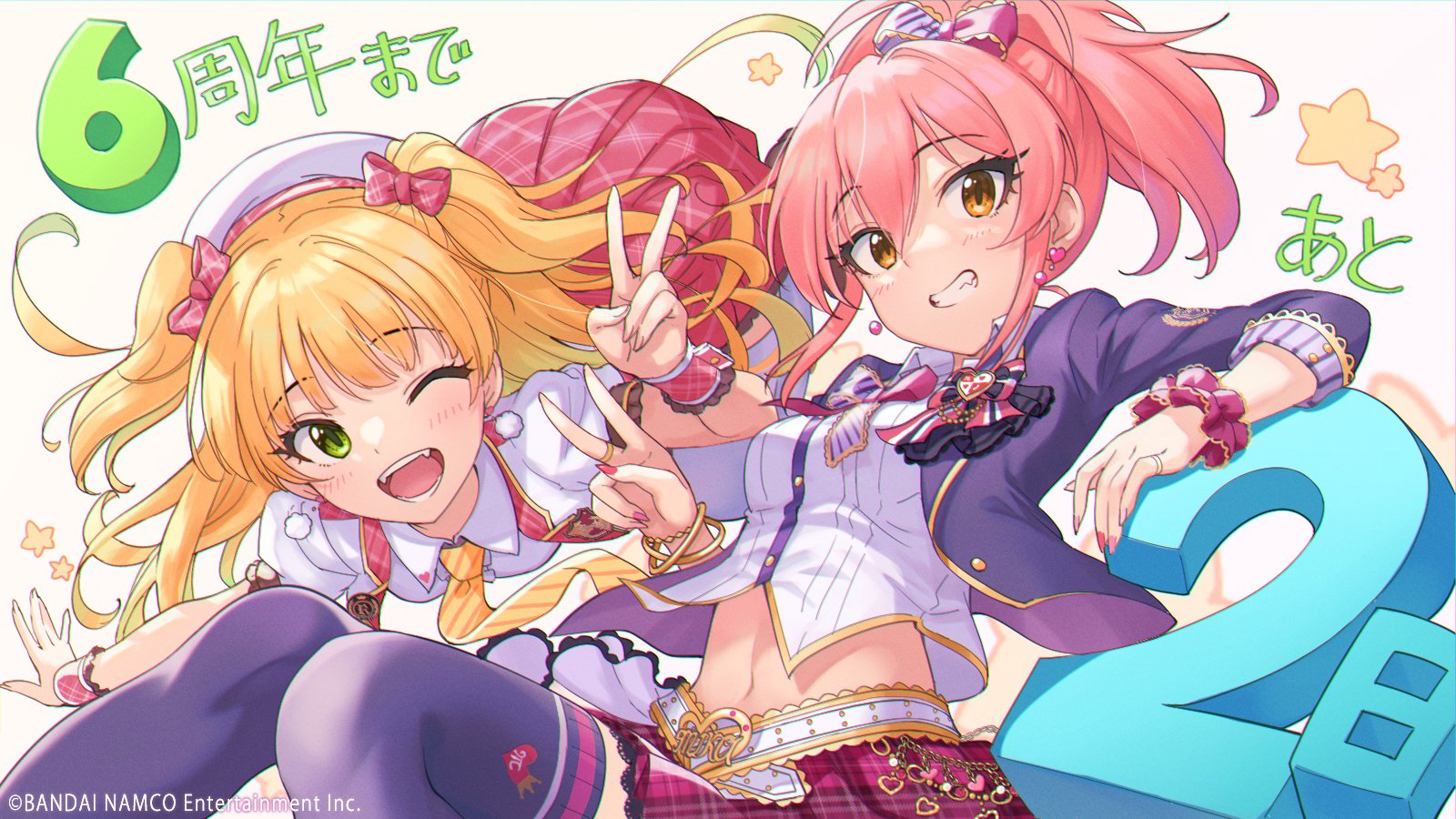
I am by no means an expert or even a dedicated fan of The iDOLM@STER. What I do understand, based on my limited knowledge, is that 1) Mika and Rika were introduced in the Cinderella Girls mobile game in 2011, and 2) I’ve been seeing their fanart for what seems like forever—Mika’s especially. In all instances, they exude “gal” energy. According to the popularity polls, Rika was initially ranked higher, but Mika emerged as more of an enduring mainstay. As if to reflect Mika’s notoriety, the Cinderella Girls anime portrays Mika not as one of the main characters, but an established idol whom others look up to.

One thing I don’t know is whether Mika and Rika have been merely a reflection of the two trends or if they actually contributed to their presence in significant ways. In other words, while I can guess that their popularity has come from being gal idols, how often is it the case that the Jougasakis are the reason people got into one or both sides? Gal subculture has been around for a long time, but I don’t recall them being nearly as prominent as characters in 2011—at least, not in the way they are today, and not in terms of their cultural presence around in the 90s and early 2000s.

While one can hardly attribute the increased visibility of idols to primarily Jougasaki Mika or Rika (they are from games where nearly everyone is an idol, after all), I can’t help but wonder if they’re significantly responsible for shining a greater spotlight on “gal characters” in a way that has persisted over a decade later. If the sisters have played a large role, it would make them influential in a way few other characters can match.

And if there are any other examples of gal idols, I’d like to learn about them.

Alter Egos in VTubing and Pro Wrestling

Sometimes, I think about how so many members of hololive have “other personas,” and I don’t mean past lives as other streamers or entertainers. More than simply being a yandere-esque hidden side, they’re more like split personalities or alter egos. Some come from lore, while others are developed over time. It really reminds me of what we see in pro wrestling.

Haachama, Eater of Worlds

Akai Haato, aka Haachama, is arguably the most famous example of showcasing alternate identities. What began as a conscious decision to move from low-key tsundere schoolgirl to unpredictable eccentric eventually turned into an interactive narrative, and then as two possible ways for Haachama to stream. You never know which one you’re gonna get, and it gives special meaning to her self-proclaimed title of “World’s Strongest Idol.”

While I once compared her to Brian Pillman and Matt Hardy, this versatility also reminds me of the late Bray Wyatt, who drastically evolved his gimmick over time to feature multiple contrasting identities. At one point, he would switch between being a disturbed children’s show host and the otherworldly Fiend. Before that, he was a bayou cult leader. Every time, it felt like a grand opportunity to peer into an unpredictable mind, and this is what Haachama brings as well.

Moona Hoshinova and Gawr Gura, and their Demons

Moona from hololive Indonesia is supposed to be a college girl who also works as an idol and a singer. According to her official bio, she is sometimes taken over by another self called “Hoshinova,” who has a deeper voice and a sadistic streak. The transformation is best showcased when she performs her original song “High Tide,” further emphasized recently by a change in eye color. It’s as if having the two sides allows her to be both silly and serious.

Similarly, Gawr Gura has her “red version.” It wasn’t originally part of her lore, but it became a feature of her character with the release of her original song “Reflect.” This facet is part of the song’s lyrics, and even factors into her animated short Shark’d. Red Gura doesn’t appear often, but when she does, it’s special.

Because their alter egos appear more rarely, they bring to mind wrestlers like Jushin Liger and Finn Balor. Each has had a special transformation where they get more fierce: Kishin Liger and The Demon, respectively. 

Ayunda Risu and Shirakami Fubuki, Masters of Versatility

Moona isn’t the only hololive Indonesia member to have two contrasting sides: her fellow genmate Ayunda Risu also divides herself between being the high-pitched Risu and the silky-smooth Ayunda. Over in Hololive Japan, fox girl Shirakami Fubuki sometimes turns into the darker Kurokami Fubuki. In both cases, the transformations highlight the vocal talents of the performers. Risu is regarded as one of the best singers and possesses impressive range, while Fubuki is famous for her impersonations.

These transformations are similar to the difference between Mutoh Keiji and his other self, the Great Muta. Unlike so many other transformations, Mutoh and Muta actually wrestled different styles—not unlike how Risu and Fubuki can significantly change their voices.

The Many Faces of Amelia Watson

The time-traveling detective has gone a different route by creating an entire story built around a multiverse. According to herself, Amelia is just one of an infinite number of Amelias whose ranks include smol gremlins, bees, muscular hulks, and more. Here, Amelia shifts her personality slightly and treats each model as a different entity, but they’re all fundamentally the same persona.

In this way, Amelia resembles latter-day Mick Foley, who would wrestle as all his various gimmicks: The violent Cactus Jack, the disturbed Mankind, and the groovy Dude Love. And like how Mick once actually appeared as all three in a Royal Rumble match, it was once not unusual for Ame to feature her parallel selves. These days, it happens much less often.

Other Occasional Gimmicks

There are a few who will have creative costumes meant to be alternate selves. Inugami Korone has her fur ball model. Kureiji Ollie has Olivia (see above), a meek human version who never died. Takanashi Kiara sometimes has her stream taken over by Frogiwawa, a gun-toting amphibian version of her.

These I would consider similar to one-off jokes. Elias once became his brother, Ezekiel. Braun Strowman once came out in nerd glasses claiming to be a sibling named Brain Strowman. This approach makes for a bit of enjoyable mirth.

The Power of Possibility

I think the consequence of these alternate selves is that it allows a greater degree of creative freedom and a chance to experiment. Just like in pro wrestling, doing this seems to help prevent a VTuber from getting too boxed into being a specific way no matter what. It can help break up a sense of monotony, and hopefully just make things fun and fresh for the creator and audience alike.

Hololive and the Year of Amazing Dancers

I once described La+ Darknesss as having a level of skill and confidence in dancing nearly unmatched all of Hololive. That was back in March, shortly before 4th fes (the latest of the annual live concert events), and at the time, I left a caveat that there were actually a number of members who had yet to debut in 3D, and things might change.

Well, things have changed.

At this point, every girl in Hololive outside of the most recent debuts have gotten full 3D models, and many have shown themselves to be noticeably amazing physical performers. Among these talents, there are three that stand out to me in particular.

Hakos Baelz of Hololive Promise.

Vestia Zeta of Indonesia Gen 3.

And Vestia’s genmate Kobo Kanaeru. 

I have zero technical or artistic knowledge of dancing (outside of reading Wandance!), so my praise of them is mostly based on vibes. From that limited perspective, I get the sense that they move better than the vast majority of their fellow Holomembers. On top of that, they all seem to approach dance in different ways compared to one another, to the extent that I start to feel like their personalities and quirks come through in their respective performances. 

To me, Bae moves as if her entire body from head to toe is equally super-charged, Zeta from the ground up (with her legs being a big focus), and Kobo like she’s acting just as much as she’s dancing. La+, in comparison, seems to dance from the core and then have her energy radiates outwards into the rest of her body. I don’t know if this is even accurate or makes sense, but I start to wonder if I might be able to recognize each of them through their dancing even if they shared the same 3D model. Either that, or I’m just overestimating myself.

We might be entering a new Renaissance period of VTuber dancing. The recently announced 5th fes, Hololive Island, is likely to feature all of them and be an incredible showcase. On top of that, an upcoming Riot Games event in Japan is going to have a performance by Murasaki Shion and three of the names I’ve mentioned above: La+, Bae, and Kobo. And with ReGLOSS’s Todoroki Hajime making dance a major part of her character, I can see things only getting more exciting in the near future.

The Emergency Heteronormative Character

There is an archetype in anime and manga that I’ve begun calling the “Emergency Heteronormative Character.” 

In the beginning, many manga creators do not know where their comics will end up. Rose of Versailles was supposed to focus a lot more on Marie Antoinette than Oscar. Kinnikuman famously began as a superhero parody before it turned into a full-on wrestling manga—and all because its authors, Yudetamago, really got into the latter. A single storyline in Yu-Gi-Oh! about a trading card game permanently altered its entire trajectory. I think the same thing happens with series where character relationships are important.

Some love triangles know exactly who the end girl will be, whereas others might not arrive at an answer immediately (or ever). But I have also seen series where a particular character, usually a minor one, seems to exist just in case, as if above them is a message that reads “Break Glass if Heternormative Romance is Necessary.” 

I have never read Slam Dunk, but I’ve heard about Akagi Haruko: the female love interest of the protagonist, Sakuragi Hanamichi. She is a fairly important character at the start (being the one to spark Hanamichi’s entry into basketball), and she’s even the focus of the anime’s extremely beloved first ending sequence. But over time, she recedes into the distance because the dynamics between the players themselves are what really draw people in. 

The appeal of shounen sports series for shippers plays right into this pattern. Whether it’s Prince of Tennis or Yowamushi Pedal, there often seems to be a girl character who is like an anchor on the port of heteronormativity, allowing a manga creator to double back if need be. Even Saki has some of this energy in the earliest volumes. The character of Koutarou began as the sole male member of the mahjong club, acting as a potential male audience stand-in to witness the girls in their nonchalantly risque glory.

BL and yuri potential often drive a good deal of the relationship interest in series like the ones mentioned. However, the Emergency Heteronormative Character can even exist in series that are pretty heterosexual too. In Rokudo’s Bad Girls, you have Tsuyukusa Mizue, the only non-delinquent girl in the series. She’s meek and cute, and always worried about how the main character Rokudo seems to be turning to the dark side. And while the anime is on an accelerated timeline, the early part of the manga makes it pretty clear that she could have been Rokudo’s “saving grace” if the series had gone a little differently.

Emergency Heteronormative Characters aren’t automatically bland, and they can be fun and charming in their own right. That said, they often feel like the product of an author hedging their bets, and they typically shine less brightly because they are simply not meant to be in the spotlight as much. I also have to wonder if these characters exist on some level for in case a title needs a quick romantic conclusion should things need to wrap up quickly. However, as we further leave the era where nice and neat heterosexual relationships are seen as necessary, maybe the archetype will have to evolve into something else entirely.

Why It’s So Hard for Shounen Battle Manga to End on a High Note

The author of One Piece, Oda Eiichiro, once stated that he always wanted to make a manga series where the ending is the most exciting part. Right now, it looks like his flagship series could very well be heading in that direction. However, when I thought about whether this is possible, I couldn’t help but think about the fact that the graveyard of shounen manga is strewn with series that failed to hit that goal—if they even had a chance at all.

So many shounen manga, particularly popular battle manga, usually peak well before the end. While taste is subjective, I think it’s a common opinion across various titles. In Kinnikuman, the tournament to determine the king of Planet Kinniku is actually pretty good, but it kind of pales compared to the Akuma Daishogun arc. Fist of the North Star peters out after Kenshiro’s climactic clash with Raoh. Naruto and Bleach have many possibilities as to the best arc, but it’s definitely not their finales. L in Death Note is remembered far more fondly than other rivals. Even with Oda’s beloved Dragon Ball, Majin Buu is not usually the villain people would regard as the best or most memorable.

That’s not to say it’s impossible. Two answers I received when I asked on Twitter were anything by Fujita Kazuhiro (Ushio & Tora, Karakuri Circus) and Yu-Gi-Oh! Funnily enough, these two examples also came up in a private conversation I had on the same subject. Nevertheless, the odds are not in One Piece’s favor.

The reason for this hurdle is pretty simple, I think: Most successful shounen series end up getting somewhat zombified, as they’re expected to keep going for as long as they’re popular in the hopes of bringing in more readers. No matter how creative manga authors might be, or how well they can plan, it just gets increasingly difficult to run on all cylinders. On top of that, even if an author has a brilliant ending in mind, they might still get canceled early, or their attempts to force a finale are ignored. Toriyama, for example, clearly tried to finish Dragon Ball in the Freeza and then the Cell arcs, only for the manga to keep going.

One big X-Factor is that Oda is on another level in terms of long-term planning. His signature series is basically an armory full of Chekhov’s guns situated next to a clothing store dedicated to alternating shoe drops. If anyone can pull it off, it’s surely him, but when your manga has been going on for almost 30 years (!!!), that is a whole lot of anticipation to live up to. Good luck, man.

So…Can you think of any shounen battle manga that was at its best and most exciting by the end?

Social Connection and Nostalgia for Web 1.0

I have a somewhat rose-colored view of an internet from long ago, and based on my observations on social media, I’m not alone. Increasingly, I see among those who surfed the superhighway a desire to return to a still-connected but far less prominently “public” presence. There’s no doubt a heavy element of nostalgia, but I also think there’s another major factor: a longing for a time when you could feel comfortable baring your insides, both the beautiful and ugly parts, without risking attack en masse.

The internet has thrived as a way to help people feel less alone without great risk to themselves. Whether it’s a political belief, favorite book, or even a sexual fetish, thinking you’re the only person in the world who’s into something can be an incredibly isolating experience. Are you “normal?” If not, are there at least others who can relate to you?

Now, especially as an entire generation has grown up being encouraged (or even forced) to make their online presence and extension of their offline identity, it’s not surprising that people would become afraid to share themselves. In a recent interview, game creator Sakurai Masahiro (of Smash Bros. and Kirby fame) said something related to this, which was summarized by a translator as follows:

“Sakurai talks about how he feels like today’s culture is too combative & people are quick to tear down things they don’t like in bad faith, and that the people putting things out into the world are vulnerable whereas the critics aren’t; he has little faith that things will change.”

I think it captures the environment well, along with the fear it creates.

Trying to find out if there were others like you carried a risk in the past too, of course. I’m under no illusions that those days weren’t filled with trolls or mean-spirited assholes eager to tear people down, but compared to today, the potential damage to the self feels less severe. Or at least, it would be localized.

There’s an anime called Jormungand about a mercenary team led by an arms dealer. In the final episode [Spoiler Warning], the main characters essentially cripple the ability to wage war from the other side of the world, though more regional conflicts are still very possible. In other words, while they can never truly stop war, they at least wanted to slow its spread. I think the desire to return to an era of web rings, bulletin boards, and extremely unpolished personal sites comes from a similar sentiment. Call it harm reduction, perhaps.

The Safe Yandere

I’ve been thinking about what I call “safe yandere,” or alternately “yandere aesthetic.”

Yandere character fetish feeds off many things. The notion of a character who’s so in love with another that she turns into a crazed axe murderer (and that this is a good thing!) is at the same time obvious and complex. It’s a realm of fantasy that, in my estimation, works by essentially being so hyper exaggerated as to feel real—like how food for astronauts is made extra spicy because the sense of taste is dulled in space.


Because yandere characters come primarily from media like anime, manga, and visual novels, there are many visual shortcuts to convey that quality. The thousand-yard stare, the creepy smile, the icons of sadism, and so on make portraying a yandere in a single drawing perfectly possible. What this also means is that this aesthetic can be extracted and placed onto characters who aren’t necessarily trying to trap their significant others in cement so that they can be together forever.

The first example that stands out to me is Jabami Yumeko in Kakegurui. She has all the visual hallmarks of a yandere, except she directs that primal energy towards the art of gambling instead of a person. She doesn’t take pleasure in hurting others so much as she does mutually experiencing the torrent of emotions that stir when everything is on the line. 

Another is the teasing girl. They’re not exactly yandere—more like a midway point between that and tsundere—but they can serve a somewhat similar function. Nagatoro might be the most well known at this point, and her sneers evoke a kind of pain/pleasure combo that aligns with the general yandere for vibe. 

The last example actually comes from the world of VTubers. The Hololive zombie girl Kureijii Ollie has a visual presentation that is very reminiscent of yandere, especially in the eyes, but her personality is far from it. I suspect that this contrast is part of her charm, though, and a reason she’s so popular. Incidentally, another Hololive member, Ceres Fauna is sort of the opposite: Her appearance is gentle but her words and demeanor can get yandere, especially in ASMR streams.

I don’t think separating out the visual component of yandere is a bad thing—far from it, in fact. It gives people the opportunity to assess themselves and what they enjoy, allowing for greater personal discovery. It also reminds me a bit of what has happened to the concept of vampires. Some people just want a specific sub-flavor of hotness, and that is okay.

I don’t know if we’ll reach a point where the definition of yandere has fundamentally changed and it goes towards the safe yandere. I doubt it, given the continued popularity of characters like Toga Himiko from My Hero Academia. But like so many things, I’d rather people be able to remember that this transformation has occurred rather than wholly adhere to some specific definition. History is important, even that of the yandere.

(And technically, all fictional yandere are safe precisely because they remain in the realm of fiction. Though that does mean VTubers can blur that line…)

“Son Goku” vs. “Sun Wukong”: The Challenge of Translating Chinese Names in Japanese Media into English

Let’s say you’re watching an episode of Raven of the Inner Palace in Japanese. Or maybe it’s Thunderbolt Fantasy. A new character appears and introduces themselves, but the voice seems to say one thing and the subtitles another. Is the eponymous heroine Raven “Ryuu Jusetsu” or “Liu Shouxue?” Is the hero of Thunderbolt Fantasy “Shang Bu Huan” or “Shou Fu Kan?” 

They look kind of similar but also not. It feels discordant to read and hear two different things that are supposed to be the same, so you might be wondering why such a decision was made. 

What you’re running into is the legacy of how the Chinese language came to influence the Japanese language.

I am no expert when it comes to to Chinese-Japanese linguistic history, but I believe I can sum it up very briefly as follows. The Japanese language originally did not have a writing system, eventually began importing Chinese between the 3rd and 7th centuries AD to deal with that problem despite the fact that the language structures are dramatically different. Japanese began to use Chinese written characters (kanji), in some cases choosing to adopt Chinese pronunciations of words as well. Yet, because the languages are so far apart in fundamental ways, these pronunciations had to be approximated. The word for wood (木) was pronounced as muk in Chinese (specifically what’s called Middle Chinese by linguistic scholars), but due to the lack of ending consonants in Japanese, this became moku. Such onyomi, as the Chinese-approximate pronunciations came to be known, were codified into Japanese and are still used today.

But the Chinese languages continued to transform in China, and many pronunciations changed over the centuries. Various factors, from the rise and fall of dynasties to physical barriers creating pockets and enclaves of peoples meant that not only did the language end up different from its 7th century form, but also resulted in regional variations that can often be mutually unintelligible. While the Cantonese word for “wood” retains the “k” sound at the end (similar to how it was said in Middle Chinese), Mandarin Chinese (what is today the official language of China and the most common throughout the world) pronounces it as mu. This is because most of the ending consonants disappeared from Mandarin.

So when you have a hero or heroine with a Chinese name in an anime, that name can generally be written in Japanese through kanji. But when it comes to pronouncing these kanji, the default in Japanese is to use the old onyomi pronunciations. This is why Sun Wukong becomes Son Goku, and why Kongming (like in Ya Boy, Kongming!) becomes Koumei. But then, if these characters are ethnically Chinese or have origins in Chinese stories, might it be better to write their names out as if they were being pronounced in Chinese? The question is whether an anime based on Chinese culture should go Chinese -> Japanese -> English with names, or make it Chinese -> English. And if it’s a manga or novel, and there is no issue of text and audio disagreeing, is it still an issue?

There are many other factors that can complicate this decision. While many anime and manga are set in China, some series take place in a world that is merely Chinese-folklore-inspired. Twelve Kingdoms, for example, is a fantasy series where all the countries have names that would make sense in China, but would translating the names into Chinese be too far removed from the source material, given that the series is originally Japanese and the world of the Twelve Kingdoms isn’t technically China? And even if a story is set in China, what if it takes place in the 5th Century AD or any other time when even “official” Chinese sounded substantially different from its modern form? Or what if a story takes place in a region of China where Mandarin Chinese isn’t the dominant form? What if there’s a Chinese character living in Japan, and everyone pronounces their name as if it’s Japanese but they refer to themselves internally with their Chinese pronunciation? In English, we’re increasingly at a point where the right thing to do is to respect the person’s own desire for how to pronounce their name, but the context of onyomi in Japanese complicates that decision.

The toughest thing is that there is no right or wrong answer because it’s not even a matter of Japanese vs. English but rather Japanese vs. English and the point at which to insert the inherent Chinese cultural aspect into a translation. Whatever choices are made, it‘s important to understand that “accuracy” and “faithfulness” are not so simple. 

(Happy New Year!)

Inktober 2022 Archive: My First Time!

After years of hemming and hawing, I decided to actually do Inktober this past October. The results were, well, results.

Especially with the state of Twitter being extremely abunai, I decided it’d be good to just have a gallery here.

Right-Wing Scare Tactics, Midterm Elections, and the Attack on Fandom

Election Day in the United States is only days away, and it’s a midterm with major consequences. From my previous writings, I think it’s clear that I have fairly progressive and left-leaning politics, and in this case, I am concerned that Republican wins will harm the US in numerous ways. From the environmental crisis, to the right to abortion, to gun deaths, to bad economic policies, to public safety in the face of an ongoing pandemic, to the undermining of democracy itself through election denial. But another topic has concerned me lately, and while it’s a bit small potatoes compared to the above-mentioned subjects, I think it ties into the generally fascistic threats that are happening: the attack on fandom.

Recently, right-wing media has been spreading a false story about a student supposedly identifying as a cat and receiving a very public litter box at school. It plays on the fear that accommodating trans people will lead to a slippery slope of moral degradation, and this tactic also attacks teachers and public education. It also clearly puts a target on the backs of furries. To see such vitriolic rumor-mongering about that group on primetime cable TV in 2022 (instead of 2002 on Something Awful) is disconcerting because I think it‘s part of a larger effort to remove spaces for inner exploration through fandom.

Even for a cisgender, heterosexual person like myself, being in fandoms has helped me learn about myself and to broaden my perspectives on various topics, including but not limited to gender and sexuality. Using fandom to find out what you like and don’t like, and then deciding whether or not to interact with others through a shared media experience, can be a very rich and rewarding experience that helps one grow emotionally. Over the years, it’s become increasingly obvious that fandom can help people to realize their identities, be it LGBT+ or otherwise. My fear is that right-wing politics seeks to remove all spaces, online and offline, where people who do not conform to their narrow values can be themselves.

I’m well aware that the description of fandom I just gave is a bit rosy, and that there are toxic elements to fandom that don’t originate with right-wing politics. But I think the general threat of disinformation and using false morality as a tool to leverage power is far greater from the right wing.

Scaring parents by showing freaky fandoms goes hand-in-hand with banning gender-affirming care, and it altogether might drive enough ill-informed people to the polls who mistakenly believe they’re saving America. Trans people, furries, and so many other marginalized groups have been used as scapegoats to distract voters from bigger problems. It’s the Satanic Panic. It’s violent video games. It’s every other fear-mongering propaganda about hobbies meant to scare people into voting against their best interests. I hope we don’t let the same mistake happen.