Japan’s famous all-female theatre troupe, the Takarazuka Revue, put up a recording of one of their performances for international streaming. The theme: Castlevania, the classic Konami video game series about fighting vampires, and half the namesake of the “Metroidvania” genre.
In fact, Castlevania: Awakening in the Moonlight is actually a loose adaptation of the franchise’s first Metroidvania, Symphony of the Night. It even starts with Richter Belmont’s refrain (in)famously translated as “Die, monster! You don’t belong in this world!” And after Dracula’s defeat at the hands of Richter, time jumps forward to focus on the main protagonist of this story: Dracula’s half-human son, Alucard.
Despite having traveled to Japan before, this was my first time watching Takarazuka. I had some idea of what to expect based on numerous cultural references in Japanese media, but all my assumptions were waiting to be defied or affirmed.
I believed Takarazuka to be non-stop singing, but that wasn’t the case. While it’s certainly a musical, the numbers are interspersed between spoken scenes. I also wasn’t sure how they would incorporate the action element of Castlevania, which turned out to be more of an interpretive dance-fighting that fits the medium, and largely takes a secondary role to drama, angst, and romance. That said, they do include some elements from the Symphony of the Night I had not expected.
And sometimes, something happened that would reinforce my preconceived image of a Takarazuka Castlevania while also throwing me for a loop. Namely, they somehow manage to incorporate the French Revolution into this thing, and Robespierre is even a prominent character! The Rose of Versailles is one of the Takarazuka Revue’s most iconic adaptations, so it’s not wholly unusual that they would use France as a partial backdrop to Awakening in the Moonlight. Nevertheless, making Castlevania more familiar and accessible to the typical Takarazuka fan in this manner is pretty amazing.
I believe all the music is taken from the games and adapted for the stage with lyrics and all. Given that Castlevania as a whole has a fantastic soundtrack, it’s not a surprise that they would take this approach. That said, it’s certainly different from other times they’ve added words.
I could tell that I was limited in some ways by the home viewing experience. While I definitely appreciate the opportunity to watch it from the comfort of my couch, I’m 100% sure that it pales in comparison to being there in person. There are parts that feel a bit long, but I wonder if the live spectacle would change the experience—I’ve seen enough musicals at this point to know this can happen. Maybe I should make the trip out to Takarazuka next time I have the opportunity.
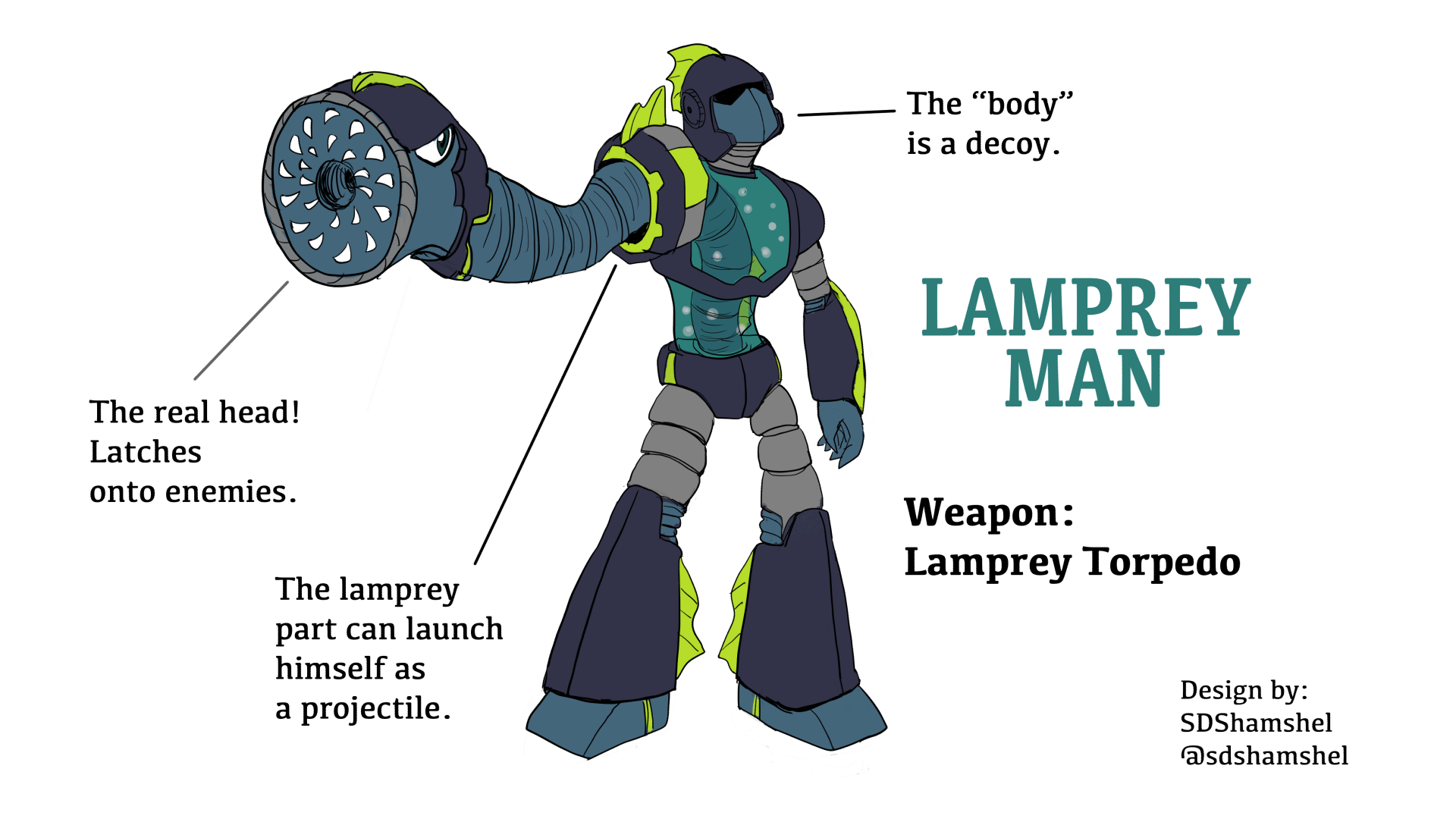
Capcom held a contest for their upcoming game Mega Man: Dual Override, and for the first time in years, they held a Robot Master Design Contest.
As someone who grew up reading Nintendo Power and loving Mega Man, I dreamed of getting my own boss designs into a game someday. Despite barely drawing at all in recent years, I knew I had to at least try.
Unfortunately, I didn’t make it into the Top 20. Fortunately, however, that means I can share my design here: Lamprey Man!
All entries had to follow the basic template of a boss with a hose-like suction arm, and I wanted to stretch the idea to keep it from just being a vacuum robot.
Chrono Gear: Warden of Time combines two of my favorite things: action platformers and hololive. As implied by its title, the game centers around the sardonic and leggy Ouro Kronii from the English 2nd generation, Promise. Her official backstory positions her as an overseer of time itself, and her role in Chrono Gear sees her recovering the stolen pieces of a temporal device of her own making through sword slashes, time manipulation, and other techniques.
While using the popular VTuber company as a basis doesn’t guarantee quality, I found Chrono Gear immensely satisfying to play. The basic controls can be kind of clunky at first, but it doesn’t take long for Kronii to control smoothly and comfortably in multiple scenarios and gameplay modes. And unlike a lot of platformers that basically demand precision from its players, Chrono Gear is fair and lenient even in the hardest difficulty without feeling like handholding. The stages are creative and meant to have multiple paths without being focused on exploration, similar to 2D Sonic the Hedgehog games. And as a fan of good boss fights, I’m happy this one has them in spades. It doesn’t hurt that La+ and the girls of holoX are among them.
I’m never a fan of games that make you use all four shoulder buttons, but I know that’s just common these days.
Much like the bullet heaven game HoloCure, Chrono Gear doesn’t waste its use of popular source material. It’s clearly made by fans who love hololive, and they incorporate its lore and history in creative ways that often add to the gameplay instead of just being there for flavor and fanservice. Other hololive members (notably the rest of the full hololive Promise roster) make appearances—and whether they’re friend or foe, their personalities come through in dialogue, animations, and actions. One of my favorite examples is how the time-traveling Amelia Watson (a mere human among supernatural beings and cosmic deities) has four smaller health bars instead of a single big one. There’s just a great fusion of various elements with a lot of care put into the whole package.
The funniest thing about this game is that it’s basically an extremely intricate and interactive piece of TimeRyS fanfiction, pairing Kronii with her genmate IRyS in not-so-subtle ways. But even if you don’t care about this ship or shipping in general, there’s more than enough to make playing Chrono Gear a worthwhile experience. It doesn’t demand your attention, yet it’s easy to sink in more and more hours—to beat the game, relive your favorite parts, improve your stage times/scores, or even just bask in its beautiful world.
One of the ideas I keep revisiting over the years (and decades!) is a Super Robot Wars game focused away from Japan. It’s a thought exercise that actually predates this blog!
With the release of Super Robot Wars Y, I’ve once again started devoting actual mental and creative energy towards this idea. What titles would appear in, say, an SRW focused around the history of the mecha genre in the US? And how would the different plots and settings be reconciled into a (relatively) cohesive universe?
I asked on Bluesky if people were actually interested in seeing this bit of fan wankery from me, and more than a few people actually said “Yes,” to my surprise. So here we go.
Also, I was inspired by some ideas for others, such as the cool fanart by Chase Burns below:
I drew this a while back, and I will forever regret not adding the Mighty Orbots or Robot God Akamatsu.How many can you recognize? The tags will name three of them, but I'll leave the rest up to you.#superrobotwars #srw #pacificrim #megasxlr #lancer
In terms of criteria for titles, I wanted mainly to have works that either originated outside of Japan and was available in the West…or anime that were significantly altered to be their own thing, and became hugely influential in the process. So while anime is increasingly part of mainstream culture, things that reached North America relatively untouched don’t count for this sort of thing.
Working from this, I think the biggest title to focus the overall setting would have to be Voltron. In combining the two anime Golion and Dairugger XIV into Voltron, World Events Productions created the notion of a Voltron stationed far from Earth and close to Earth respectively, and this creates a good opportunity to divide the titles involved into “Far Universe” and “Near Universe” plotlines to kick things off. The idea would be that you would follow each side separately, and then the two would merge together down the road when the stakes are higher.
A lot of series take place in the future (albeit with different ideas of what the “future” looks like), so it’s not too much of a stretch to set them all in a vaguely advanced era of humanity. However, there are a few series I’d want to include that are specifically tied explicitly to certain periods—namely prehistoric times and the mid-20th century. For that reason, I’d place those works under “Time Displacement.”
And I’m leaving out Robotech because eh.
So here’s how I’d break down the above three categories.
Far Universe
Lion Voltron: The Galaxy Alliance is the main governing body in this SRW. The Lion Voltron is sent to protect from threats on the other side of the galaxy, and focuses on Planet Arus. This Voltron is special because of the fact that the enemy Robeasts are magical, which is actually pretty uncommon in this universe.
Transformers: This has to be G1 Transformers, and the appearance would focus on the series around Unicron and the animated movie and through to the return of Optimus Prime (because you gotta have the Autobot Matrix of Leadership as an ultimate attack, right?) Cybertron is under Decepticon control and so it cannot be part of the Galaxy Alliance, but the Autobots do help the Alliance out. Optimus doesn’t necessarily die, and Megatron doesn’t necessarily turn into Galvatron, depending on how the missions go.
Challenge of the GoBots: Unlike Cybertron, Planet GoBotron is part of the Galaxy Alliance. The Gobots are actually cyborgs—humans who converted their bodies to transforming machines—and they were inspired to take this path by the robots of Cybertron. In this setting, the Transformers have been fighting for a long time, while the GoBots are just now leaving for Earth.
Bionicle: I will admit that I don’t know much about this series, and would need help making sense of it. What I have so far is: Some (but not all) planets in the Sol Magnis System are part of the Galaxy Alliance. However, they tend not to interact very heavily with others. The legend of Mata Nui either directly or indirectly inspired a lot of other worlds to create giant robots.
Super Robot Monkey Team Hyperforce Go!: Planet Shuggazoom is also part of the Galaxy Alliance. However, various factors keep the other mecha from intervening in its battles normally. The monkeys do eventually become very fond of Optimus Primal from Beast Wars, however.
Mighty Orbots: The Galactic Patrol is one of the peacekeeping forces of the Galaxy Alliance, and Mighty Orbots was made to deal with threats that the Voltrons can’t get to. While based on Earth, they’re currently in the Far Universe to mount an offensive against Umbra. Unicron tried to devour Umbra but was actually repelled; the two don’t get along.
Near Universe
Vehicle Voltron: Defends Galaxy Alliance HQ on Earth. “Entrusted with the secret of how to form Voltron.”
The Bots Master: Ziv Zulander is a brilliant robot AI developer, and this attracts nefarious forces, including the Decepticons. Jungle Fiver is made because Blitzy is inspired by Mighty Orbots and Devastator, and Blitzy becomes friends with Daniel from Transformers. Characters from other series are very fascinated by the boost the BOYZZ get from “Laser Time.”
Sym-Bionic Titan: Actually not part of the Galaxy Alliance, and comes from even further away. However, their planet was visited in the past by Mata Nui, and helped inspire the combination of heart, mind, and body to combine as one (the technology is different from what Voltron uses.)
Megas XLR: Coop built Megas XLR in New Jersey, like usual. He is actually friends with Spike Witwicky as some blue-collar dudes. Thinks Ziv is a super genius, but doesn’t know him very well. He’s always getting inspired to put new weapons into Mega thanks to all the robot shenanigans going on, and this only grows when Near and Far universe plotlines merge. Evil Coop has to appear at some point, especially with the time displacement/time travel parts of the story.
Big Guy and Rusty: Big Guy was a hero who helped the fight against aliens and the Decepticons in the past. He fought for the US as part of the Earth Galaxy Alliance HQ. Ziv Zulander is very well informed about Rusty, but doesn’t know the secret of Big Guy. Rob Simmons from Mighty Orbots and Dwayne Hunter strongly suspect each other of being the Orbots Commander and Big Guy respectively, but haven’t explicitly confirmed it.
Pacific Rim: Jaegers were developed purely by humans back when other technology hadn’t been discovered, and they needed two people to pilot. The passing of the secret of how to form Voltron helped alleviate this and lead to other less dangerous possibilities, but Jaegers still remain the best defense against Kaiju in particular.
Gen:Lock: I admittedly don’t know anything about this series, other than that it has a lot of big names for voice actors and that it ended up disappointing pretty much everyone. However, I’d like to see it get the SRW plot fix treatment. While the series takes place on a dystopian Earth, I could see a world where it doesn’t get quite that bad because of all the other things going on. Here, the setting of Gen:Lock would take place on a part of the planet rather than the entire thing.
Time-Displaced
Dino-Riders: Yes, I am counting dinosaurs wearing armor as essentially giant robots. Originally, the Valorians were working together with the Maximals in the far future, but were flung back in time by a joint attack from the Rulons and Predacons. At some point in the story, they manage to fix the Step Crystal, but the interactions with the dormant Transformers in prehistoric times causes them to jump forward. Inadvertently, their effects on the past inspire the creation of the Dinobots.
Beast Wars: Because of their nature as Transformers, they don’t need to commandeer the local dinosaurs and other animals to fight. However, they’re still inspired by those forms. Maximals and Valorians work together on prehistoric Earth, and they form a real bond before they’re all brought forward into the future to meet Gigantor and the Iron Giant.
Gigantor:While Tetsujin 28 explicitly takes place in Post-WWII Japan, Gigantor is originally set in the “future year 2000.” However, for the purpose of this SRW, Gigantor still takes place in the relative past as an early attempt at building giant robots on Earth, and it still retains the plot element of being a weapon meant for destruction that instead becomes a protector of the peace. Big Guy is essentially a government project meant to replicate the success of Gigantor. The time travel vortex drags Jimmy Sparks and Gigantor along.
Frankenstein Jr: Frankenstein Jr. and Gigantor were built around the same time. Professor Conroy was familiar with Jimmy Sparks’s father, and began his work on Frankenstein Jr. to counter Gigantor. Jimmy and Buzz Conroy are glad they’re on the same side. The Impossibles are included, and are part of a specific attack that Frankenstein Jr. can use. They are not swept up by the time displacement, but build a time machine to actively chase after Gigantor, knowing that trouble is afoot.
The Iron Giant: When flying away as Superman, the warping of the space-time continuum causes the Iron Giant to sense a similar mechanical being in Gigantor (a robot made to be a weapon), and another sentient robot in Frankenstein Jr. This causes the Iron Giant to warp forward in time as well.
I’m Open to Other Ideas
Obviously this is all just a bit of fandom thought exercise, and nothing about this really matters. I’m also less familiar with some series, so any sort of feedback is A-OK by me. Heck, anyone who wants to use this as a base for their own ideas—or tear it to shreds and do something they find better—is welcome to take a swing.
Phantasy Star is a series whose name has always floated around in the background of gaming history for me, yet was something I never engaged with directly. I knew it was significant without really knowing why. However, I watched Jeremy Parish’s Segaiden episode where he covers the original Phantasy Star. That’s where I learned that it’s basically the first JRPG to focus completely on defined characters and an established narrative (as opposed to customizable characters and an emphasis on player choice), and that it features the first female protagonist in the genre. Knowing this and seeing the Sega Ages remaster on sale, I decided to give it a try.
Unlike many RPGs of the time, Phantasy Star includes a science fiction aspect alongside the more standard swords and sorcery. The heroine is Alis Landale, a girl who sets out to avenge her dead brother after he’s killed by the oppressive forces of Emperor Lassic. Her adventures take her across planets, where she encounters allies who join Alis on her quest.
The game is gorgeous even today, and while I don’t have a firm tack on the general aesthetics of the Sega Master System, the graphics blow its contemporaries on the NES out of the water. The faux-3D of the dungeons, the excellent music, the look and feel of the environments (especially from planet to planet), and the detailed enemy sprites all contribute to an immersive experience. Little hints or story points that crop up at the beginning don’t pay off until much later, making figuring out various mysteries very rewarding. It’s no wonder that Phantasy Star is generally regarded as one of the best titles of the Master System.
Phantasy Star is very much of its time, and it reminds me of a conversation I saw on social media recently. A younger person was trying out older Pokémon games (pre–Black and White), and they were puzzled by the fact that “important NPCs” weren’t always obvious. They questioned the need to arbitrarily talk to literally everyone in the game, but others pointed out that this is what RPGs used to be like. You were expected to approach the game as an explorer and check out every nook and cranny to find hints on how to move forward. In the context of Phantasy Star, I did feel stymied by this at times despite my familiarity with this type of gameplay, like when I couldn’t remember the names of individual random towns, making backtracking much more tedious.
The Sega Ages version comes with a mode that has a few quality-of-life changes: fewer enemies, faster leveling, more gold earned per battle, faster walk speed, and auto-drawn maps. I felt two ways about this, as I often don’t like having extra hand holding for older games, but what ultimately tilted me in favor of the Sega Ages version were the maps. If I were playing this back in the day, I would have to bust out the graph paper and make them myself, and that is something I don’t enjoy. The faster leveling also helped speed up the game and allowed me to fit it into my schedule, but I definitely think I was overleveled for most of the game in a way that allowed me to accomplish things I wouldn’t have otherwise. As a result, I’m not sure I necessarily got an entirely authentic Phantasy Star experience, even if I enjoyed the game.
From what I understand, the Phantasy Star franchise only got more elaborate and complex over time. This first game acts as an introduction to the ideas and feel that would help define Sega RPGs as a whole, but I do think it’s fun as a standalone title. It also took me back to my younger days, almost like I was experiencing an alternate timeline of how my taste in games could have gone if a few circumstances had changed. Perhaps I would have been the world’s biggest Phantasy Star fan, talking about how I never tried any Final Fantasy games.
Anime Central 2025 featured the Global Anime Challenge, what is described on ACen’s official site as “a three-year program funded by the Japanese government’s Agency for Cultural Affairs. Its goal is to nurture the Japanese anime industry’s next generation of creators. The program participants aim to develop brand new and exciting contents for the ever increasing global anime fans.”
While it’s not entirely clear how the GAC plans to accomplish this, their panel at the convention gave some basic ideas. Essentially, the animators do internships abroad with the eventual goal of making pilots or short films to be presented at Annecy and AX. They’re also involved in participating in and even creating events, such as a lecture by animator Inoue Toshiyuki, who worked on Ghost in the Shell and The Eccentric Family, among numerous other works.
The guests at ACen were Sato Keiichiro (director of Frieren), Nakame Takafumi (producer of Frieren), Tanimoto Kaoru (calligrapher and animator whose brush work was used extensively in Sengoku Youko), and Kudo Mana (animator on the Cardfight!! Vanguard franchise). The panel began with introductions from all the guests, where they showed things they’ve worked on, as well as drawings and other items of note from childhood. It was a nice window into how these creators discovered the joy of creating.
Nakame’s early drawing was of him capturing a stray cat as a pet, and his first manga he ever bought: Vols 3 and 10 of KochiKame. He showed the opening to Witch Watch, a show he helped produce.
Saito showed the dream of his five-year-old self, to become a truck driver selling toys. Another drawing was a perspective shot looking down at the school yard from a window in 4th or 5th grade. (It looked extremely good for elementary school.) His hometown is known for getting a lot of snow, but the only reason the drawing had lots of it is because he didn’t want to color it. His featured video was from Bocchi the Rock!
Kudo Mana’s childhood art was of a stuffed pheasant in her grandmother’s house. She then showed some clips from Cardfight!! Vanguardwill+Dress of a character freaking out and hitting her shin on a bench.
Tanimoto’s first drawing was a very crude one of him with his mom and dad. He also made a picture book with his mom. His showcase was of his calligraphy used in attacks, episode titles, and the end-of-series image for Sengoku Youko. In one case, there were numerous talisman papers, and despite it being the same words written over and over, it was not a copy-and-paste job. Instead, Tanimoto actually wrote separate ones for each piece of paper.
After the introductions to each creator, they had a Q&A mixed with a live drawing. Saito drew Kikuri from Bocchi the Rock! Kudo decided on Yuyu from Cardfight!! Vanguard crossdressing. Tanimoto did two girls from Sengoku Youko, and Nakame didn’t draw.
Tanimoto was asked when he was satisfied with the storyboard, and he said he would try to get it good enough initially and then spruce it up during the QC stage.
Nakame wants to learn what people love overseas through the Global Anime Challenge. He works domestically in Japan, but wants to co-produce with great animators abroad.
Saito’s favorite part of Frieren is the introduction and how it feels like both an epilogue and the beginning of a story.
According to Nakame, the challenge of making the Frieren anime is that both the action sequences and the everyday life parts need a lot of work.
They all collaborated on artwork to be used on various merchandise, such as t-shirts and even alcohol. “Chicago” is written on the shirt and poster using the official kanji to spell it: 市俄古.
I am not a hardcore fan of The iDOLM@STER, but I understood what a big deal it was to have Nakamura Eriko and Imai Asami as guests, aka the respective voices of first-gen “765 Pro” members Amami Haruka and Kisaragi Chihaya. I was able to attend one of the panels for Eriko, but sadly couldn’t make it for any of Imai Asami’s.
Because I’m not an iM@S Producer or anything, there are things I probably got wrong. Nevertheless, I still want to post my notes from this panel. In this day and age, simply having information out there on the internet to find can be difficult. Also, The iDOLM@STER just celebrated its 20th anniversary, so I figured it would be a good time to post this.
Eriko was in Chicago for the first time, and the panel was a Q&A. She turned out to be quite the jokey type, or at least that’s how she presented herself. She mentioned getting lost trying to get to the Opening Ceremony, and that her dream was to be “more biggest,” i.e. taller, so she can see further back.
When asked how she decided to become a voice actor, Eriko said she thought it was the field where she thought she could stand out most as a performer. She described her path there as being haran banjou, a Japanese term that means a life of many ups and downs, but can also mean life is something where surprising things can happen. Someone followed up by asking what it was like to audition for Haruka, to which she first pretended she couldn’t remember, then elaborated that it actually didn’t involve any singing. She received a script and a storyboard, and played Haruka looking out from the train. She said that this was the first and only time she had such a free-feeling audition.
Later, Eriko elaborated on being a part of that first generation. They recorded their parts individually: just her, the script, and the sound engineer. Back when it was just that original game, she had to imagine what it was like for everyone to be together, and the first time she heard it all together, it was like 765 Pro had come to life.
When she got the chance to perform songs from a different branch many years later, and for others to perform songs from hers, she responded that seeing others build on the foundation they laid was a valuable experience.
The audience of fans got her to say the line, “Producer-san, Dome desuyo! Dome!” in reference to Haruka being an idol and the importance of the Tokyo Dome as a major landmark for idol performers. Eriko said the last time she was able to say that was in fact two years ago at the Tokyo Dome.
When asked what advice she would give a voice actor, Eriko revealed that there’s a concert in August, and her answer is in that pamphlet.
As for what has changed, Eriko mentioned that she chats a lot more with people after recordings because she’s been doing it for 20 years with all the staff and everyone else supporting them. Eriko is also always sending messages on LINE, especially stickers, to the point that the others tell her to stop. The members of Million Stars tell her that they need to sleep.
One person asked Eriko what she thinks about when she’s out there as a major representative of The iDOLM@STER. Her response: “I don’t think about that at all. Haruka is just a 15-year-old girl, she can’t have the wait of the franchise on her shoulders.”
Kio was at Gallery Zenon and the Rakuen cafe. He went with manga author Tsuruta Kenji.
Kio founded the Madarame Cream Soda to be really fizzy, capturing the viewpoint of the manga. The gelatinous bits also make it dangerous to talk while drinking it.
Kio lays out his vision of what he wanted to see in Gundam GQuuuuuuX Episode 7 [SPOILERS KIND OF?]:
Machu and Shuji start the Clan Battle as MAVs -> Nyan deals with the money -> Deux goes berserk because of the kira kira -> The Psycho Gundam does severe damage to the colony -> The Military Police gets wiped out -> The Psycho Gundam reaches the building where Kycili and Machu’s mom are -> Machu and Shuji can’t stop it -> Xavier’s Gyan and Shallia’s Kikeroga arrive in style -> The Hambrabi is shot down -> The Psycho Gundam is pushed back, leading Deux to go Newtype berserk even more -> Zeknova -> The Red Gundam vanishes -> Xavier is shot down -> Challia and Machu form an impromptu MAV combo and destroy the Psycho Gundam -> Machu leaves her cockpit to find Shuji -> Machu’s identity is exposed by the broadcast -> She goes with Challia because he knows about Zeknova -> Nyan fails to procure the money and flees -> She runs into Xavier after he crashed -> Nyan goes to Zeon.
I’ve been thinking about Pokémon a whole bunch lately, particularly about the online community and how much time has passed. The competitive players I considered my friends are so far in the past that the next generation after them is considered the “old school.” I met many of them during Generation 1, and one of the most fascinating times was in the transition to Generation 2, particularly with regard to theorycrafting.
The importance and limitations of theorycrafting is something all players have to deal with in any competitive environment, but back when information was scarce and we only had questionably translated materials from the Japanese release, it really felt like something different. As with every generation change, players on sites like Azure Heights tried to figure out what would be strong in Gold and Silver. One answer that came up was Starmie.
On paper, it made sense. Starmie was among the top picks in Red, Blue, and Yellow. It was fast. It hit hard. Its movepool was also among the best. Not only did it learn powerful moves that benefited from its Water/Psychic typing (Psychic, Surf, Hydro Pump), but it could also cover every type combination in the game with Ice Beam and Thunderbolt (or Blizzard, which was ~90% accurate in Gen 1), and it learned amazing defensive/support moves in the paralyzing Thunder Wave and the health-restoring Recover. Being Psychic type was also a huge boon in a generation where they had no actual weaknesses.
Gen 2 introduced egg moves: techniques that Pokémon could only learn via breeding. This could potentially be transformative, and one move stood out in Starmie’s list: Confuse Ray. Being both paralyzed (25% chance to not move at all combined with a 75% speed reduction) and confused (50% chance to hit yourself and not execute a move) was among the most annoying things to deal with in Gen 1. To have parafusion on a single Pokémon seemed like a nightmare scenario, and so Starmie was predicted to be a serious meta threat.
Time proved things out differently, however. While parafusion could still be annoying, the changes made to the battle system went far beyond players’ early theorycrafting. The dividing of the Special stat into two (Special Attack and Special Defense) meant that moves like Amnesia and Psychic were not quite as effective. The introduction of the Dark and Steel type, and to a lesser extent the improvements made to Bug, all took away the Psychic types’ major advantage. Curse turned out to be an incredibly strong move, especially when paired with an incredibly bulky choice like Snorlax—even when stuck in place while paralyzed and confused, they could weather the storm and Rest off the damage. Heal Bell, a move that removed all the status effects inflicted on your own team, trivialized attacks like Thunder Wave. And this is the generation Mean Look and Perish Song was introduced, creating the Perish Trap strategy that could lock opponents in and force them into no-win scenarios.
Back then, the false hype of parafusion Starmie taught me something important: People will theorize based on their previous experiences because that’s what they have to rely on, and that strength is relative. Strategies don’t exist in a vacuum, and things that were considered universally strong sometimes falter in a different environment. (And sometimes, things are actively nerfed.) This is far from the only instance of theory not matching practice in Pokémon or even beyond, but it’s one I remember with a strong tinge of nostalgia.
Kio spent all of April Fool’s driving, so he couldn’t see any of the jokes. Someone suggests he still has time to fly to the US and experience the day there, and Kio responds that he’d only end up seeing American April Fool’s gags as a result. Another person mentions that he heard Genshiken 3 was coming out, to which Kio replies, “Yay!”
Kio drew fanart of Sis-tan (the mascot of the arcade Okayama Fantasista) for her 10th anniversary. SIsta-tan tells Kio that he’s helped make her anniversary more splendid, and asks Kio what games he’s played at arcades.
Kio responds that there were certain games—namely Neo-Geo ones—that he would only ever watch at the arcades because he wasn’t brave enough to play against other people. He did get to play them at a friend’s house, though. When it came to games he actually played, he liked vertical-scrolling shooters like Gunbirdand RayForce.
Sis-tan replies in turn that it was still great that Kio had an environment where he could play Neo-Geo, especially one where no one as skilled as Kohsaka in Genshiken would show up. And while Okayama Fantasista doesn’t have a whole lot of vertical shooters, it would still be great if he came to play the ones that are there.
Kio got help to finish his work schedule for April, but it looks like some of his other work will spill into May. A person replies that Gundam GQuuuuuuX model kits come out in May, but Kio doesn’t think he’ll be able to buy them, so he’s giving up now. He really wants them all, though.
Kio is happy to finally have some time to watch the first episode of Gundam GQuuuuuuX. He’s jealous of those who can watch the first episode without having seen the theatrical release, The Beginning, which he did.
Kio thought nothing would really surprise him in the first episode of GQuuuuuuX just because he saw The Beginning in theaters, but the ending theme made him a lot more emotional than he expected. [The ED is by hololive’s Hoshimachi Suisei!]
He was already seeing fanart of the show’s characters before the first episode even aired, so watching the ending video had him in tears. The personalities contrast between the two main girls is right up his alley, and his imagination is running wild as a result.
Someone responds that he also expects to see old men dancing to the opening. Kio recalls grinning so hard he could die at “Naatu Naatu” from RRR, and wonders if the old men dancing to “Plazma” could beat that.
Despite a busy schedule, Kio went to the Hirano Kouta Super Expo gallery, featuring the work of the Hellsing author. He thought it was fantastic, from the way it showcased the power and insanity of the work, to the choice of manuscript pages to feature, to the way it showed off what makes all the characters great.
He wanted to listen to the audio guide by the Hellsing characters Luke and Jan, but he didn’t realize that he needed to connect to it through his smartphone, so he ran out to get some cheap earbuds.
Kio wears bifocals, but he likes to look at his work with the naked eye. However, when he does, he risks getting headaches and has to take Bufferin (a brand of aspirin).
Kio is happy that after a day of intently painting erotic naked skin in grayscale, he then gets to watch trailers for the new Ghost in the Shell and Steel Ball Run anime.


 OGIUE MANIAX