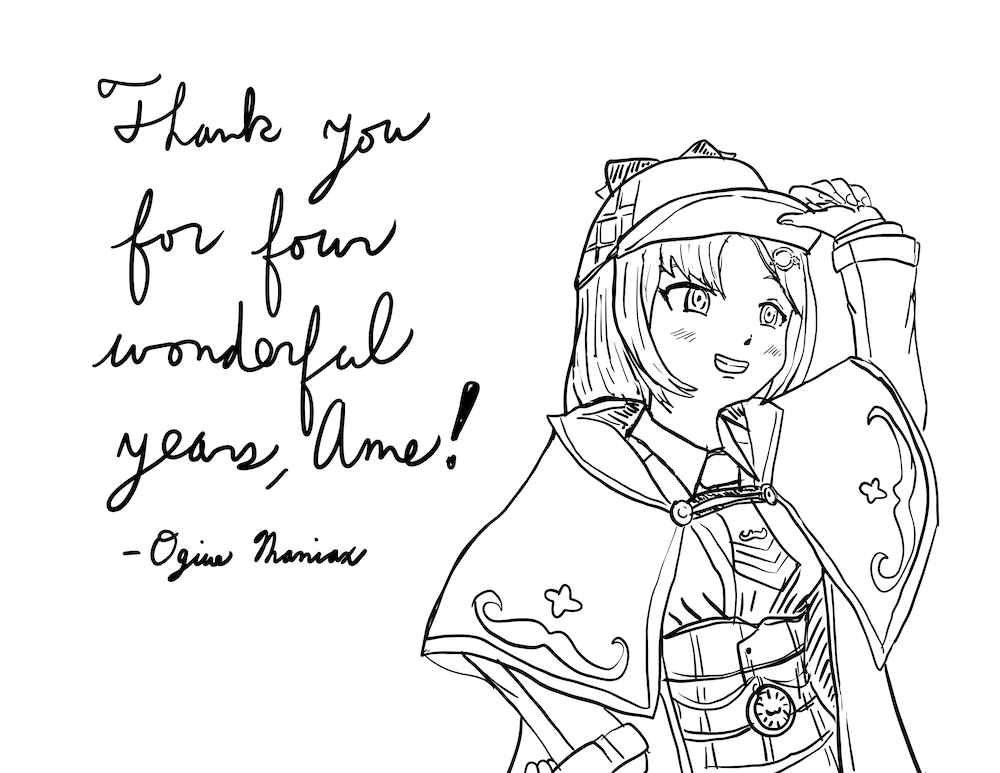
This past month was a real rollercoaster, not least of which was due to hololive talent Amelia Watson announcing that she will be stepping back from actively being a part of the company, and then following that with a marathon of streams. The 4th anniversary of Myth and the 3D debut of ReGLOSS were eventful enough, and now we had this. I even drew on my tablet for the first time in years. If I thought my brain was pretty filled with VTubers last month…
Amid my turbulent emotions, a new anime season is here! The amount of interesting-looking shows is actually overwhelming: Mecha-Ude, Trillion Game, A Terrified Teacher at Ghoul School!, Thunderbolt Fantasy Season 4, Love Live! Superstar!! Season 3, etc. On and on and on. I’m worried I won’t have time for it all.
And I’m still trying to watch through some old anime, like Blue Comet SPT Layzner.
I hope my supporters on Patreon are okay with how I’m doing. Thank you as always.
A few days ago, I felt an urge to write an essay dedicated to Amelia Watson. It’s something I’ve been doing for all my favorite VTubers over the past few years—using my humble platform to celebrate these talented individuals that I’ve grown to adore. However, between Breaking Dimensions, Anime NYC, a whole host of big hololive happenings in September, and me just being busy in general, I had decided to wait.
I mistakenly thought I could take my sweet time penning a post dedicated to an active, ongoing career.
Today, Amelia (Ame to fans) has announced that she will be concluding her streaming, participation in events, and periodic merchandise. While something akin to a graduation (i.e. an idol/VTuber leaving a company on relatively good terms), it is not actually one. In fact, Ame herself has mentioned in a Youtube comment that she might still show up on occasion, though this does not count as a transition to staff.
So here we are.
The Story of Myth
Let’s rewind to September of 2020, at the height of the COVID-19 pandemic and with many people around the world staying at home to prevent the spread of the virus. It was in this environment that the Japanese VTuber agency hololive announced their first English generation: Myth. At a time when so many were cooped up at home and in need of some joy, when the ability to even see other human beings in person came at a real risk to one’s life, Myth breathed life into people. The success they found might very well be forever unmatched.
Four of that first EN generation were shown to carry ancient and supernatural motifs—Calliope Mori the grim reaper, Takanashi Kiara the phoenix, Ninomae Ina’nis the eldritch priestess, and Gawr Gura the Atlantean shark. The fifth was Amelia Watson, a “mere” human detective investigating the others. Not only did she stand out as unusual in terms of her theming, but she was the last to officially debut. And from the very beginning, it was clear that she was bringing something unorthodox. Whether it was starting off with a tongue-in-cheek joke about actually being British but needing to put on a “fake” accent, or her inducing “hallucinations” in the audience through an injection of her “Watson Concoction,” Ame’s wit and imagination were on display.
The AmeWay
Ame didn’t reveal her entire character concept at debut: She’s not just a detective but also a time traveler. In the severe extenuating circumstances of a global pandemic, she began to express this facet by playing around with 3D models, VRChat, and other interesting software and technology. As fan works of Ame poured in, she commissioned artists to make variations of her: a chibi (that went on to become a mascot of hololive called “Smol Ame”), a bee, a mountain of muscles, and even recently a hand puppet.
Ame is often referred to as “creative,” and while that’s certainly true, a more detailed description would be that she pushes the boundaries of what is possible in any space she’s in through a combination of out-of-the-box thinking and sheer stubbornness. Sometimes it’s in her approach to video games. Just yesterday, she started playing on hololive’s Grand Theft Auto Online server, where she successfully got past a fence on her unicycle by riding downhill to build up momentum and crash through. During Part 1 of the hololive Minecraft roleplaying event “Enigmatic Recollection,” she could be seen trying to glitch the block mechanics to create shortcuts for herself, while also being one half of the wild “Jyonathan and Gonathan” romance story with Gigi Murin that captivated fans. Other times, it’s through her exploration of the technical aspects of VTubing. Fans call this the “AmeWay,” and it speaks to the notion that if two paths diverged in the woods, Ame would cut her way through the trees in the middle.
During that dark period when Japan was locked down and travel into the country was impossible, Ame found a way to give her and the other Myth girls their own “3D event” of sorts through VRChat, and by giving everyone a “Smol” model of their own to pilot.
Even later down the line, as the world opened up, Ame continued to push the envelope. For Myth’s 2nd anniversary, Ame set up a special 360 degree view where fans could move their phones around to explore the 3D space with her and the other girls.
One of Ame’s strengths is her interest in technology—even building her own 3D studio at home—and she provided a lot of behind-the-scenes support for her fellow talents, both peers and later generations alike. It wasn’t uncommon to hear other EN members mention her giving them computer tips or advice on what equipment to buy, or to catch a glimpse of her acting as the cameraperson in VRChat streams. Even when she wasn’t on screen, her presence could be felt.
The Road to Idol Ame
If there was one thing I really missed while staying at home during the pandemic, it was the ability to go out for karaoke. So when I started seeing that VTubers do their own karaoke sessions, I would tune in. I don’t know if Ame’s was the first, but it’s one that sticks out in my memory in a big way.
In that first karaoke stream, one thing was apparent: In a VTuber generation filled with musically inclined peers, Ame was by far the weakest singer. Constantly off-key and unable to keep the rhythm, Ame could not carry a tune at all.
It was beautiful.
For those who don’t karaoke, one thing that might be hard to understand is that singing ability doesn’t matter all that much—at least around good people. It’s about finding songs that you enjoy, giving it your best shot even if you sound like ass (speaking from personal experience here), and just having a good time with others. And if someone’s got pipes, that’s cool too—karaoke isn’t about hating. What Ame brought to that singing stream, and all subsequent ones, was that “karaoke with friends” energy. And in 2020, that energy was all the more powerful.
That spirit alone would have been enough to make me a fan, but then she hit me personally deep in my soul by singing Sixpence None the Richer’s “Kiss Me,” a favorite song from my childhood. The fact that it would become one of her go-to songs over the past four years is something I’m grateful for. And if that’s where Ame’s musical performance journey ended, I would have been satisfied. But that’s not the whole story.
Ame kept singing over the months and years, and bit by bit, something happened. She started hitting those notes a little more cleanly. Her voice wouldn’t squeak as much. She was actually improving! And while Ame had set up a bleeding-ear emote as a self-deprecating joke, fans eventually stopped using it entirely.
In the time since that first karaoke session, so much has happened. Ame got to appear on the big stage with her official 3D model at 3rd fes, putting on a memorable cover of the cute and bizarre “Puru Puru Pururin” from Welcome to the NHK! She released her own original song, “Chiku Taku” (accompanied by a video game based on it), and then performed it at two separate live events, including the first EN concert. The latter was even a ska rendition that reflected her own musical tastes, which she accompanied by skanking on stage. She had her official 3D showcase, where she got to show off her detective’s office, do cartwheels, and collaborate in person with Japanese hololive members like Haachama and Yozora Mel. At 5th fes, Ame upped her choreography game too.
Just recently, her “IDOL” duet with Gura was one of the absolute highlights of last month’s Breaking Dimensions concert. And in their recent 4th anniversary online concert, she was able to keep up well with the other strong singers of her generation and help make “The Show Goes On” the best Myth group song ever. Each step of the way was evidence of her improvements as a performer, and while she never embraced the shining lights, that’s also why she embodied the “idol journey” so thoroughly.
The Hiccup
I want to just mention this brief thing that has little to do with achievements and interests, but is inextricable from Ame’s story. There are a lot of unique things about her, but perhaps none are more iconic than her chronic hiccups that can often be heard on her streams. It’s not clear if it’s a hiccup exactly or something else, but whatever it actually is, the result is something that is identifiably Ame. What’s more, unlike a particular way of talking or laughing, it pretty much can’t be replicated. Even in this simple way, there will never be another Amelia Watson.
The Closing of a Chapter
While hololive isn’t a piece of fiction in the traditional sense, Amelia Watson is often positioned in fan works and headcanons as the “protagonist” of Myth and possibly hololive EN as a whole. A lot of it has to do with her motif as a completely human detective (albeit one unbound by time), but I think it’s also because she also comes across as very human in a different sense. She’s not anywhere near the best singer or dancer, she doesn’t have that non-stop gift of gab that others might, and while she’s definitely one of the strongest gamers, it’s not her main focus either. But Ame has ingenuity, and in a way, she’s sort of like the Batman of hololive.
I have a tendency to like creators, VTuber or otherwise, who experiment and expand the range of what is considered “possible.” That’s where Ame has thrived and why I became so fond of her, and countless others feel the same way. It’s hard to overstate just how much of an influence her tinkering and her ideas have had on the VTubing scene, especially in the English sphere. There has been a constant outpouring of love from other VTubers, many of whom are citing her as a real inspiration—especially for those who wanted to do something different than the established norm.
Personally, the timing of Ame’s announcement is kind of funny. Until literally last month, I didn’t own that much of her merch. Now, as she begins her retreat from the spotlight, I find myself coincidentally with more than I ever expected: a desk mat, figures, keychains, and so on. I even just uploaded a video of her to my Youtube—one of only two VTuber clips on my entire channel.
One thing I haven’t done is try to draw her. After all, I had assumed there was plenty of time to get around it. Maybe I need to change that.
In a way, we Teamates and Investigators are very lucky. Not only did we get four years of one of the best to ever do it, but the fact that this isn’t a full-on graduation means there will likely be opportunities to reunite with her in this familiar form. And no matter what, the thing that really matters is that the person behind the virtual avatar can find happiness in whatever form it takes.
(And there’s always the off chance we might see her without her coat in 3D.)
Anime NYC 2024 was a focal point for many areas of Japanese pop culture, but the one that caught my attention the most was the massive presence of hololive, the world’s biggest VTuber agency. Because I wanted to miss out on as little of it as possible, I prioritized it above all else, and this con report reflects that fact.
A New Date
2024 saw the first summer Anime NYC, as it moved from the weekend before Thanksgiving to the tail end of August—a controversial move because it brought potential advantages and disadvantages. Being at the tail end of the summer con season could also carry some of the momentum of other events, and according to the showrunners, LeftField Media, was that they would now be able to utilize more of the Jacob Javits Center. However, this drastic change could disrupt people’s planning for cons. Also, summer in New York City can be very hot and humid—even dangerously so if attendees have to wait outside.
Luckily for Anime NYC, weather was on their side. The weekend was probably the most pleasant the city had been all summer. The good fortune didn’t stop there either: It also narrowly avoided the curse of the missing 7 train.
Averting Train Trouble
For many years preceding Anime NYC, the closest subway to the Javits still necessitated a 15–25 minute walk (depending on how quick you were). The 34th St. Hudson Yards station on the 7 Line was specifically built to get people closer to the Javits area, making it ideal for conventions. However, every Anime NYC up through 2023 occurred on weekends where the 7 was shut down for construction, making the stop pointless. With the move to the summer, it seemed as if Anime NYC was finally going to avoid this fate—only for construction on the 7 to be announced.
Thankfully, the MTA at some point changed it so that the 7 Train would run as a shuttle from Time Square to Hudson Yards (a total of two stops). Thus, while the loss of most of the 7 Line was a real inconvenience for those coming from Queens, there as at least this little bit of good news.
This one small change mattered a lot for VTuber fans: That same weekend, hololive’s second ever English concert, Breaking Dimensions, was taking place in Brooklyn. While not terribly inconvenient due to the presence of public transportation, traveling between boroughs could still be a hassle that required some time management and perhaps sacrificing some events to get there on time. Had that shuttle train not been there, it would have been a real struggle.
Phase Connect + Mint Fantome
Before getting into the hololive content, I want to shine the spotlight on another VTuber agency that had a presence at Anime NYC: Phase Connect.
A couple weeks before the start of Anime NYC, the Canada-based organization announced that they would be holding their own 3D concert on Sunday, and that it would feature talents from their first generation, Phase Origins: Tenma Maemi, Pipkin Pippa, Fujikura Uruka, and Lia. They also revealed as a special guest the indie darling Mint Fantome, adding some significant star power.
Aside from Mint, I was only passingly familiar with a couple of them, but it was overall enough to convince me to plunk down some more cash despite expecting a busy weekend. Tickets came in two price tiers, but they did not affect the quality of the seat. Instead, the slightly pricier option meant an attendee could get a special gift, which turned out to be a random polaroid-style image (of Uruka) and a random keychain (of Maemi).
(I also bought a Dizzy Dokuro keychain on Saturday at the Phase Connect Booth.)
Though not completely sold out, there was still a sizable live audience. All the Phase girls had 3d models that matched their default appearances, while Mint (who I believe doesn’t have an official standard 3D design) went with a chibi look. The acoustics weren’t great (that’s the Javits for you), but between Uruka’s rich singing, Maemi’s versatility, Pippa’s energy, Lia’s confident dancing, and Mint’s idol spirit, all of them brought something memorable. I also got a real sense that Phase Origins set the tone for the rest of Phase Connect’s talents and their generally unhinged presentation.
The event felt less polished than hololive’s concerts, but I knew that would probably be the case going in. The moments that stood out to me the most were Uruka’s darkly comedic Self-Introduction song (about having to go against her family to pursue music), and a huge chunk of the live crowd getting up and forming a circular dance line as Mint sang the Hamtaro opening. Apparently a lot of the crowd was familiar with wotagei culture. (Security was also clearly visibly confused by what was going on.)
There’s one last thing I want to mention about Phase Connect. One unique aspect of the company is that they sell VTuber-themed coffee beans. Though I didn’t plan on getting any, I was curious about it. When I asked, though, it turned out that they had completely sold out by Saturday.
The hololive Meet Booth
The most visible hololive presence of the Exhibit Hall booth. Like last year, it featured exclusive talent streams for con attendees. Participants included members of every branch (including Holostars JP and EN), and ran the gamut of topics. Kureiji Ollie taught the crowd fan chants for popular hololive songs, Haachama and Roboco tried to make edible insect gelatins from insect powder, and various karaoke sessions had the crowd singing along throughout. The least popular times were during showcases of Holoearth—not surprising, given how those were the least interactive, and that the game still has no clear direction.
One very conspicuous thing about the booth was the large crowd that would form in front of it (which sometimes included myself). It was located near the front of the Exhibit Hall, and it would actually sometimes bleed out past the entrance. This could cause traffic flow issues, and while I don’t blame the attendees for wanting to see their favorites in this unorthodox environment, I do have to wonder if there’s a better option.
Other hololive events, like the panels and the in-person concerts, have IRL audiences, but these Meet booth showcases are like an interesting halfway point between those and the standard online streams. The physical presence of the crowd combined with the less structured and more informal setup of the broadcasts themselves made for an entertaining and comfortable interactivity that both the VTuber and the people watching could feed off of.
I find that there are certain talents who thrive in this environment. Ollie’s unmistakable enthusiasm for all things hololive was infectious. Momosuzu Nene had to overcome the language barrier, but she also showed her best side through her karaoke.
As big a fan of Haachama as I am, I ended up leaving hers early in order to catch the train to the Breaking Dimensions concert. Given that the latter started an hour late, I could have made it in hindsight, but I didn’t want to risk the possibility, the NYC subway being infamously inconsistent.
hololive STAGE World Tour ’24 Soar
Photography was not allowed at the concert, so look at these standees instead.
Ever since hololive announced that their 2024 world tour would be kicking off at Anime NYC, I’d been anticipating it. Not only was it a rare opportunity to see something that wouldn’t be streamed, but the lineup was stacked: Baelz Hakos, Moona Hoshinova, Takanashi Kiara, AZKi, Nimomae Ina’nis, Kobo Kanaeru, and Tsunomaki Watame.
Each number got the audience pumped and eager for more, and there were plenty of personal highlights. I was pleased to see Bae bring out an exciting new choreography for her song “RxRxR”; when she debuted the song for her birthday concert earlier this year, Bae simply freestyled it. Getting to hear AZKi’s singing was a real treat—she never sounds anything less than amazing. I cheered when Kobo came out for her original song (and one of my favorites in hololive) “HELP!!” And when Bae, Kiara, Moona, and Kobo performed Kiara’s “DO U” together, it made me wish that everyone else could someday, somehow get the chance to see it and be amazed.
The official call-and-response chant was: “The world is the stage!” “Soar, soar, soar!”
My only complaint about the concert was the space itself: As with the Phase Connect event, the Main Events Hall for Anime NYC is simply not great for seeing music acts. Not only are the acoustics lacking, but the seating isn’t elevated, so if the people in front stand, it forces everyone else to do so as well if they actually want to see what’s going on. Combine that with the harsh concrete floor of the Javits, and your feet may not forgive you. I actually purchased a new pair of sneakers this year to help deal with situations like this (the New Balance Fresh Foam More, if you’re curious), but I still think that’s a lot to ask of people.
holoEN Justice
It’s become tradition for the newest generation of hololive EN to make their US convention debuts at Anime NYC. Elizabeth Rose Bloodflame, Cecilia Immergreen, Gigi Murin, and Raora Panthera—collectively known as Justice—joined the event remotely, talking to the MC and answering trivia questions about New York City. It was in many ways similar to Advent’s panel from last year, except rather than doing audience polling, they would ask a few attendees up. Later, it became questions about themselves that the audience had to answer, where a correct answer would make one of the talents do a random embarrassing voice line, and a wrong one would mean the audience had to do one instead.
A couple moments that really stood out to me both involved Gigi, the self-proclaimed “Fister” of Justice. First, when in the second part with attendees answering, Gigi quickly suggested a rule amendment to avoid cheating. I think it gave an interesting glimpse into her thought process. Second, at one point Gigi had to do a tsundere roleplay, and it turned into an improv skit where she tried to pass off a cake she baked for Ceci as one she picked up off the floor after a rat had already been on it. Ceci then hit a reversal by saying she’d only eat a nibble if Gigi ate the rest of it.
I think it ran a bit more smoothly compared to 2023, and I wonder what might happen if there isn’t a new generation to showcase next year.
Shirakami Fubuki and Ookami Mio
The pair from hololive Gamers also had a Main Events panel, and it followed a similar format to Justice’s, with the added element of an interpreter for these Japanese VTubers. Fubuki and Mio asked members of the audience trivia about hololive Gamers, including the order of all four members’ birthdays. They also invited people for an English language challenge that they themselves had to answer. Every so often, Fubuki would bring out a mask of Yagoo (the hololive CEO) to get a laugh out of the audience.
The two also had a nice treat for the audience at the end, with a mini karaoke session featuring their signature songs. It made the hour feel more special.
Final Thoughts
It’s interesting to see hololive gradually turn into a bigger part of Anime NYC, and to treat it as a major event. To have both a concert at the con and a separate one in the same city on the same weekend made it feel like things are only getting more intense. The downside I see is that I actually did want to check out other aspects of the con (like the appearance of three members of the group Liella! from Love Live! Superstar!! and manga scholar Frederick Schodt), but I had to pick and choose. I don’t regret my decision, but I do wish there was more than one of me sometimes. I’m also kind of giving up on the idea of Anime NYC ever having regular hololive meet ’n’ greets.
One very important takeaway I had from Anime NYC (and Breaking Dimensions) was that it’s beautiful to see people gathered who want to bask in what they enjoy. It might sound a bit generic, but when you look at online spaces and social media, there can sometimes be an atmosphere of negativity surrounding both the VTubers and their fans. But being there live and seeing people just having good times—it feels like that is the actual core of the fandom. That doesn’t mean you’re only a true fan if you attend in person, but that this loving energy and positive enthusiasm should ideally be the driving force of VTubing.
In July of 2023, I went to hololive English’s first full concert, Connect the World. I was grateful for the opportunity to be part of that milestone, and felt that if I never attended another event like this, I would have been content. Who knows if I’d be able to make it again anyway? Then June hit, and Cover corp announced a second concert right in New York City called Breaking Dimensions. It would be the first real-life concert for the third EN generation, Advent, bringing them together with their predecessors Myth and Promise.
Upon hearing the news, I had one thought: Even if I wasn’t able to get a ticket for any of this two-night event, I had to try. Thankfully, with some luck and a good friend on my side, I was able to see both days in person. In the end, I came away with immense satisfaction at what everyone at hololive, as well as the fans, created.
Changes from Connect the World
Breaking Dimensions took place August 24–25 and improved on its predecessor in virtually every way.
While I certainly enjoyed Connect the World and cherish the experience, it wasn’t without issues. For example, the immersion could falter at times due to what seemed like the quality of the video projection. At Breaking Dimensions, the setup was a lot more convincing, and it felt much more like I was really watching VTubers on stage. I even got to see it from very different seats between Day 1 and Day 2, and they maintained the illusion in both cases.
Connect the World was also a bit regimented in terms of its setlist: group songs purely by generation, individual performances also by generations, and a few big numbers. Compared to the major holo fes concerts in Japan (the biggest live events for the company), there were no interesting talent mixes. Breaking Dimensions fixed all that and more, featuring various duos, trios, and even quartets that had me cheering out loud. Whether it was fan-favorite combos or new experiments, the whole thing was full of pleasant surprises.
The only downgrades from the first concert were the lower seating capacity and the one-hour delay that occurred on Day 1 due to long lines (despite the fact that all seats were assigned). The Kings Theatre can hold about 3,000 people, and over 20,000 tried to get in when tickets first went on sale. I suspect this has to do with the fact that New York City is not a good place for mid-sized venues; you either do something like this or you have to go all the way up to Madison Square Garden/Barclays Center, and the latter locations are not cheap. And one upside of the Kings Theatre is that it’s gorgeous. I saw fans considering dressing up to match, but the summer heat put the kibosh on that idea for the majority of concert goers.
And while this isn’t a problem with Breaking Dimensions specifically, I do wish the colors in the penlights were either more saturated or labeled. As someone with a bit of color blindness, I struggled sometimes with switching between colors, especially when it came to purple vs. violet. There were definitely a few great choreography moments I missed or caught only glimpses of as I struggled with the penlights.
The Concert Was Simply Great
The whole show fired on all cylinders from start to finish, and by the time I was done, I had absolutely zero regrets about going (despite what my wallet might say).
I’m serious when I say that it had too many great moments to count, so much so that I decided that the next best thing is to give my thoughts on every talent one by one in the hopes of capturing enough of the finer details. I want to give them the respect they both earned and deserved, as VTubers and as people.
Below are my thoughts on each EN member, in order of their first solo appearances. Following that is a section for the guests from hololive Japan and Indonesia.
I also want to reiterate an important point I’ve made in the past about these large group hololive concerts: While there are certainly individuals involved who are exceptionally skilled at performing on stage, it’s not a prerequisite or even necessarily a desired expectation from their fans. hololive is in many ways similar to an idol or music company, but it is not actually either. Sometimes the reward is just getting to see them stand in front of the bright lights, basking in being these identities they’ve built up for themselves.
hololive EN
IRyS
When IRyS appeared as the first solo act on Day 1, there was little doubt as to what song was coming. She had just released her first original in about a year and a half, and this was the perfect environment for it. “Carbonated Love” is a Eurobeat tune directly inspired by the soundtrack of Initial D, and with IRyS being among hololive’s very best singers, my anticipation was sky high.
Her performance was everything I wanted. IRyS generally sounds even better singing in person than in studio-produced tracks, and her melodic voice pierced through the venue, never wavering in its crystal-clear beauty. The addition of some mildly daring gyrations also sent the crowd into a tizzy. And fortunately for everyone, IRYS is in the free section on YouTuber, so everyone can see her in action.
Later group acts on “High Tide,” “Promise,” and “Blue Clapper” (the last of which was with her fellow CHADCast members + Koseki Bijou) benefited immensely from IRyS’s vocals. No matter what song she was on, she sent shivers up my spine in the best way.
FuwaMoco
As the only twins in hololive, FuwaMoco are generally in a unique situation compared to the rest of the talents, including sharing a Youtube channel. At Breaking Dimensions, neither got a solo performance, but they did have two duets: their original song “Born to Be ‘BAU’DOL” on Day 1 and a cover of “SHINKIRO,” the city pop tribute originally by Houshou Marine and Gawr Gura, on Day 2. The contrast between the peppy cuteness of the former and the wistful melancholy of the latter showed off their versatility, especially because Fuwawa and Mococo sing differently and have to find the right approach together in each case.
This was also Advent’s first IRL concert, and it was great having them in all their glory on the big stage. FuwaMoco’s ability to harmonize with each other is unlike anything else in hololive—the clear product of continuous effort and a life at each other’s sides. Their performance of “Doggy God Street” with Korone and Kobo (humorously called “Wet Dogs,” “Dog Water,” and other similar nicknames) also brought some welcome lightheartedness.
I wonder if we’ll see FuwaMoco split up for some songs in future concerts. Either way, the idol journey of the guard dogs will be something to look forward to.
Shiori Novella
Witnessing Shiori move in three dimensions has been one of the biggest surprises of Advent. One of the fun things about seeing VTubers get their 3D models is learning their body language and movement, but the other Advent girls have acted more or less as expected: FuwaMoco are great at idol dances, Bijou is jumpy and energetic, Nerissa is poised. Shiori, on the other hand, was hard to pin down.
Between her 3D Showcase and her appearance at Breaking Dimensions, what has become very clear is that Shiori possesses remarkable physical charisma. She’s not a great dancer or athletically impressive, but it’s like she makes every move count ten-fold. Similarly, while her singing is inconsistent, she does decently at her lower registers. Shiori’s solo (“world.execute(me)”) and her song with Kronii and Ina (Tokoyami Towa’s “FACT”) show this well. And her number with Fauna and Nerissa (“Lonely in Gorgeous,” the opening to Paradise Kiss) is one of my favorite performances of the entire concert.
Ouro Kronii
Kronii is known more for her speaking voice and acting skills than her singing, but she was able to not get lost in the shuffle. Having listened to her at Breaking Dimensions, one interesting thing about the Warden of Time is that despite having a fairly deep voice, she actually sings better at higher notes. In that sense, she’s sort of the opposite of Shiori (though I assume it’s just coincidence that their MCing was so unhinged).
It’s no secret that Kronii has a very loyal audience who loves to see her move on stage, but I myself found that she brought some nice flair to her dancing and singing, especially in her solo cover of “Bocca della Verità.” The contrast between her cringing at corny things but willing to throw caution to the wind only makes her stage presence stronger. Kronii’s group performances—with Kobo and Korone, and then Ina and Shiori—are notable for how her “cool” persona provided a different kind of balance in each trio.
Takanashi Kiara
As the best dancer in the 1st gen, Myth, and an experienced hand at performing in general, Kiara always seems comfortable when the spotlight’s on her. Her choice of “Pineapple,” a summery pop song from her album Point of View, let Kiara show a different side of herself while still emphasizing her status as the consummate idol of hololive EN—especially coming off of her world tour performances the Friday before.
One of the biggest cheers in the entire event was when Kiara warped in along with Calli, which only grew louder as the audience realized they were going into their group song, “Fire N Ice.” Playing on their respective motifs of blazing hot phoenix and chilling grim reaper, their performance highlighted two major things: 1) their clear improvement in singing and dancing these past four years, and 2) how truly special the TakaMori pair has become. Sure, it was hololive EN’s first major ship and for that reason still has many dedicated fans, but it’s developed into something much more powerful: close friends who respect each other and have each other’s backs through thick and thin.
Ceres Fauna
Fauna recently released a video short talking about how she joined hololive without knowing how to sing, and that she’s made many missteps up till now. Indeed, it’s true that singing still isn’t one of her strong suits. But despite her limitations, she still managed to draw me in.
First was the debut of her new song with Mumei based on their goth and emo outfits, appropriately titled “It’s Not a Phase.” Second was her solo—a cover of city pop classic “Mayonaka no Door/Stay with Me” where her gentle voice gave it a soothing quality. And as for “Lonely in Gorgeous” with Shiori and Nerissa, Fauna contributed a delightfully haunting quality to one of my favorite performances.
Gawr Gura
Gura, one of the icons of VTubing, is known for her love of Hatsune Miku, and her childhood dream of being on stage like her Vocaloid idol someday. Naturally, Gura has tended towards Miku covers for her real-venue performances, but Breaking Dimensions felt like a real “she made it” moment as she sang Miku’s most iconic song, “World Is Mine.”
Gura has two general modes of singing, and she weaponizes them to great effect: smooth+soulful or smug+bratty. She used the former in her “Bibbidiba,” while her cover of “IDOL” from Oshi no Ko with Amelia Watson was the latter. Her rendition of “World Is Mine” leaned towards cute but incorporated both styles, accentuated by the song’s signature high-pitched yells and Gura’s own adorable dancing with lots of tail-wagging antics.
Every appearance she made sent the crowd into a raucous frenzy. Truly, Gura is the queen of hololive EN, whose singing makes you feel like they’re the only person in the room with her, even if you’re in a packed theater.
Baelz Hakos
The chaos rat has become synonymous with top-tier dancing in hololive. I knew that much, coming into Breaking Dimensions. I thought I was prepared, but I wasn’t. She took me for a loop in every performance, especially her solo.
Bae released her first album this year, with each track based on an animal from the Chinese zodiac. Her solo choice, “GEKIRIN,” is written from the perspective of an ancient and prideful dragon. As if to embody that image on stage, Bae coiled and flowed elegantly like a heavenly serpent, occasionally unleashing powerful moves bursting with fire and fury, all while delivering on the singing. The subtleties of her performance could sometimes be hard to see in the crowd, so the online audience had certain advantages.
As for what’s next, I have my predictions. Given that the fourth English generation, Justice, has a lot of appeal towards Europe, I think the next big concert is going to be in either London or Paris. I don’t think I’ll be able to attend that one, but I’ll be happy to cheer from home, and hope that others will get the opportunity to have as good a time as I did at Breaking Dimensions.
In a later stream, Bae mentioned that the choreography for “GEKIRIN” was not of her own making, and that she was even a little daunted by the sheer difficulty. But the choreographer said to her, “I know you can handle it.” I think that sheer dedication and ability to push the envelope of what is possible in VTuber dance is something truly special about Bae.
An aside: On the morning of Day 2 before the concert, I was wondering what song she would pick, and I actually predicted that Bae would perform “GEKIRIN” from ZODIAC. Because I got her song choice correct, I decided that evening to see if fortune was in my favor and went to play the lottery. As for how it went, there’s a line in “GEKIRIN” that goes, “Oh, you humans so naive and desperate/Enough to think that luck and fate have favorites.” It was a lesson I learned the hard way.
Amelia Watson
I cannot emphasize enough how far Ame has come as a singer. From one karaoke stream to the next, and with each concert, you can literally hear her improve—a far cry from the days where she basically got by on vibes.
The idol side isn’t her wheelhouse, but the ways in which Ame was celebrated at Breaking Dimensions really struck a chord with me. She participated in a cover of “Puru Puru Pururin”: a callback to her debut 3D appearance at hololive 3rd fes. This time, she was accompanied by FuwaMoco and Koseki Bijou, and it made me realize that we’ve gone long enough with Myth that these returns to old songs actually feel kind of nostalgic. It didn’t come across as a retread either, specifically because she was joined by two of the biggest champions of mid 2000s online anime fandom, as well as a perpetual meme lord. Ame’s cover of Nekomata Okayu’s “Mogu Mogu Yummy” was also a great way to chill out, and it’s also in the free section on Youtube!
Ame’s reappearance towards the end of Day 2 made for one of the most exciting moments throughout the weekend. Seeing her distinctive yellow star appear, realizing she was about to start singing “IDOL” from Oshi no Ko, and then seeing Gura emerge from behind her led to such a rush of emotions in me. The roar of the crowd (one of the loudest across both days) made it clear that my fellow audience members agreed. I also noticed the fact that our resident detective was able to rap in Japanese—no small feat.
Koseki Bijou
The short-statured gem girl affectionately known as Biboo is more famous for her musical memes than her actual singing, and sure enough, she engaged in her most famous cringe earworm, “Sticking Out Your Gyatt for Nerizzler” in one of the MC sections. But even in the actual song performances, Biboo showed up and put herself out there.
If there’s one thing that Biboo’s performance communicated about her, it’s that she appears very comfortable with the prospect of being in front of thousands of fans. Either she’s a brave soul or she’s very good at pretending to be one, but the result is the same. Her choice of a more serious song in Hatsune Miku’s “Love Is War” showcases her willingness to take risks and to play into the chuuni parts of her personality. And in “Blue Clapper,” she didn’t feel out of place at all with Calli, Bae, and IRyS despite the fact that those three have been an established trio (the CHADCast) for a long while.
Ninomae Ina’nis
Over the past year or so, I’ve felt that Ina is on the cusp of really breaking through as an exceptional singer. That characteristic low-energy voice of hers can give her songs an ethereal quality, and it feels as if she only needs a little more refinement to take it to the next level. Ina performed a cover of “Synchrogazer” (the first Symphogear opening), and she demonstrated that she’s able to carry a song and give it a feel that emphasizes those unique aspects of her.
In the group songs, namely “Beyond the way” and “Bibbidiba,” her quieter approach also helped provide a bit of contrast with the other singers. While the Ina-Kronii-Shiori trio had none of hololive’s heaviest hitters in song or dance, it was still very memorable because they’re somehow aesthetically in the same general direction while each being very unique.
Nanashi Mumei
I still don’t quite grasp how Mumei sings the way she does. The way I often describe her is that she sounds like what other people get if you apply a ton of pitch correction and autotuning to them—except Mumei does it naturally. Or it’s like if you tried to trick Mumei into attempting to imitate an AI singer, only for her to beat it at its own game and then some. Alongside the fact that she can also go deep (as heard previously in “Mind Craft” and in the “Breaking Dimensions” song), you have one versatile songstress.
While many others went with newer works in their catalogs for their solos, Mumei actually sang her very first original, “A New Start.” Because it’s from early on in her hololive career, I think the single itself showed only a fraction of what Mumei is capable of, and the Breaking Dimensions performance highlighted the fact that Mumei has only grown more skillful and expressive. This also came through in “Beyond the way” with fellow birds Kiara and Nerissa.
The stand-out moment for Mumei came in the reveal of her original 2000s-era-inspired goth-emo duet alongside Fauna, “It’s Not a Phase.” She was very good at balancing “Haha silly joke” with “No, I’m as serious as a dark abyss” while making both sound good. As the stronger singer of the two, she helped keep the two sides cohesive.
Nerissa Ravencroft
As the singer of Advent, whose character is premised mainly around the forbidden power of her voice, I think there was a good deal more pressure on Nerissa for her first IRL concert. Even the namesake song, “Breaking Dimensions,” features her in a unique fashion as she harmonizes with the chorus other members sing. But I think she lived up to her reputation and lore here, and even danced remarkably well for someone who literally has a metal rod down her spine due to health issues. Whatever limitations this might impose, Nerissa worked around them very well.
Nerissa’s tune of choice for her solo was “Sweetest Scarlet,” which she also sang for her 3D debut. While it would have been great to hear something different for variety’s sake, I think having it done in front of a live crowd changes a lot. At times, it almost felt like she could pull in the entire audience into her embrace with her sultry notes. And whether she was the power singer in the holotori EN trio’s performance of “Beyond the way” or the central pillar for “Lonely in Gorgeous” with Shiori and Fauna, Nerissa was an important part of making those songs land effectively.
Calliope Mori
Calli has had a hell of a year, even recently landing on the US’s Billboard Top 100. Her commercial success is admirable, but what really jumped out at me during the concert was just how much her singing has leveled up. She’s been transforming from a primarily rap-centric performer to equal parts singer and rapper, and the fruits of her labor are showing in spades.
“Go-Getters” might be my favorite song she’s ever done, and part of it is that her vocals can keep up with the ambitiousness of the song. There were points I felt like she might not have the power to deliver on some sections, but she always pulled through. Similarly, I could hear in “Blue Clapper” the greater consistency she developed. And with “Fire N Ice,” her gruffer voice balanced out Takanashi Kiara’s well and even sounded better than the original recording. It also didn’t hurt that TakaMori’s choreography was spot-on.
Calli’s victories are not just in accolades but also real improvement. You love to see it.
JP AND ID Guests
Hoshimachi Suisei
Suisei showed up on two songs, including her record-smashing hit “Bibbidiba” with Gura, Ina, and ID’s Moona. While it’s hard to pick a single best singer in hololive, Suisei is definitely a contender while also being nearly unmatched in terms of mainstream recognition for her music. What isn’t as clear is that she can keep up dance-wise as well. Her star power was undeniable, as every time she came in with her rich voice on both “Bibbidiba” and “High Tide,” the audience’s cheers would grow ever stronger.
Kobo Kanaeru
I truly feel that Kobo is one of the most well-rounded VTubers, with even greater success only limited by the fact that the Indonesian language is not as ubiquitous as English or as anime fan–oriented as Japanese. A big part of her potential for stardom is her immense singing ability that transcends cultural barriers, along with her peppy dance moves and air of confidence.
For Breaking Dimensions, she sang “HELP!!,” one of her originals and also one of my favorite songs as of late. It was actually the second time she performed it that weekend, thanks to her appearance on the hololive World Tour at Anime NYC. The big difference is that whereas the world tour rendition was a solo, this rendition was as a trio with Kronii and JP’s Inugami Korone. The other two aren’t the singer Kobo is, but it was still an enjoyable experience seeing them all together.
Inugami Korone
Korone brings an energy that few if any can imitate or duplicate. While she didn’t bust out any athletic feats for her original song “Doggy god’s street” or “HELP!!,” her attitude on stage shouted, “I might not be the very best, but I belong here and no one can tell me otherwise.” It was like the world conformed to her existence. While she didn’t perform with Koseki Bijou, I actually think they’re made of similar stuff.
Moona Hoshinova
Moona appeared for both “Bibbidiba” and her own original song “High Tide.” Unlike her past performances of the latter, she was joined this time by IRyS, Bae, and Suisei.
I believe Moona has the best balance between singing and dancing in all of hololive, and exudes more “diva” energy than anyone else. That’s why having two of the strongest vocalists and arguably the top dancer in the company worked so well for “High Tide.” The body rolls, the powerful notes, and the high performance rate from the quartet was one of the brightest spots in a concert event rife with highlights.
Big Group Songs
There were five big group songs over the course of Breaking Dimensions: one for each of the three generations, a big finale both days, and then different encores for each concert.
Myth’s song, “ReUnion” is an okay track that ended up hitting a lot better in front of a live crowd. Promise’s, aptly titled “Our Promise,” has a “grand adventure” motif that sounds lovely but left the crowd a bit confused as to how to chant along because it just isn’t that type of song. “Rebellion,” the debut song for Advent, strikes the best balance, and it was perfect for the stage.
I must admit that I was listening to “Breaking Dimensions almost nonstop in the lead-up to the concert. I love the way that it emphasizes the particular qualities of each generation—Myth’s trailblazing through the unknown, Promise’s unity in the face of tumultuous times, and Advent’s mold-breaking while standing on the shoulders of their predecessors. One big treat with the two concert performances is that you could see them change things up a little compared to the music video. The chorus sections were sung by all 15 girls instead of sets of 5. Bae changed up her moves during the choruses from body rolls to more of a sway with a head bob. Biboo went from staying in position for her rap portion on Day 1 to walking around a bit on Day 2. And Ame, who strikes the final pose a split second later than the others (to cute effect), actually got the timing right for both days. I cheered especially for her tiny victory, and I wondered if others did the same.
For the encores (“Connect the World” on Day 1 and the English version of “Our Bright Parade” on Day 2), it was fun seeing and hearing these symbols of hololive EN’s continued success.
Final Thoughts
I try my best to reflect on what I see with a positive perspective without just spouting unalloyed praise, yet I know much of this review sounds like I’m gushing. I truly do think very highly of what hololive accomplished here, and attending it is one of my favorite experiences in the past few years.
Since Connect the World, my opinion of hololive has only gotten better, and I find myself paying attention to so many more talents. That’s not even simply because they’ve literally debuted multiple generations, but because they manage to thread the needle between feeling both very personal and highly professional. The Breaking Dimensions concert really puts this balancing act on full display. It’s like each member gave the audience a solid peek into their various journeys, ones whose paths diverge and intersect over and over. And the fans reciprocate, helping to make these VTubers feel like the superstars they are.
PS: I spotted my support message on the screen while waiting for the concert to start:
It’s been almost two months since hololive debuted its 4th English generation, Justice. Now that I’ve gotten to watch them for a bit, I wanted to give some general impressions and other thoughts.
Justice consists of the warrior singer Elizabeth Rose Bloodflame, the violin-playing automaton Cecilia Immergreen, the gamer gremlin Gigi Murin, and the artist panther Raora Panthera. Their backstory involves a mission to pursue the fugitives of the 3rd generation (Advent), but all of them are just using that as a pretense to get closer to their “targets” and become actual friends. It’s a fun way to add some flavor that makes it easy to both incorporate and ignore their own lore.
One of the biggest changes with the 4th generation is that most of them are European-coded, and they’re generally present during Europe-friendly hours. Elizabeth comes from Great Exardia and has a very British accent. Cecilia is from Immerheim and is natively fluent in German. Raora hails from the Romance Empire, where the local tongue is Italian. The only exception is Gigi from Freesia (which is so full of Freedom), but she streams at the same general time as the others.
There’s long been a lull in the day because hololive focuses on North American and Asian viewers in terms of timing, with only Takanashi Kiara and Kaela Kovalskia around during prime CET hours. Having new girls help fill that void creates opportunities to gain and keep new fans. Also it lets more people feel both the joys of being near the same time zone as your favorite and the agony of that not being the case.
Something I find notable about Justice is that they’re the first English generation where none of them possess strong Japanese skills. Myth has Kiara and to a lesser extent Calli, Promise has IRyS and Bae (with Kronii putting in work), and Advent has the twins FuwaMoco. This is not a knock on any of the 4th Gen girls or any other hololive member. Rather, I think the fact that Cover Corp didn’t feel the need to include at least one person fluent in Japanese is a sign of how much more global hololive has become. Might we reach a point where we have hololive talent who knows neither English nor Japanese?
Currently, I think I like Raora best. Her food tangents are very enjoyable, her voice is very soothing, and the fact that she so readily draws fanart of herself means that she and her fans can appreciate her design together. The other three have their merits too. Elizabeth has an uncanny talent for voice impersonation that she uses in delightfully devious ways. Cecilia has a dry and absurd sense of humor that sneaks up on you. Gigi’s wit and ability to banter are both top tier, and I learn a lot every time I watch her.
I’m curious to see how they’ll be a year later, or whenever they receive their 3D models.
(Actually, I just want to see Raora’s hand talking in all its glory.)
Truly “instant” curry rice is something I’ve always wanted, but the idea of a truly shelf stable with absolutely minimal prep time seemed a bit farfetched. That’s why I was surprised a few years ago to see Minato Aqua, Oozora Subaru, and Usada Pekora from hololive promoting a new product called Nissin Curry Meshi, i.e. Japanese curry rice in a cup.
When I traveled to Japan last year, I used the opportunity to get some for myself. What I didn’t know is that there were multiple versions at this point: the original; the “perfect meal” version; extra spicy; and hayashi, which is technically not curry but often gets lumped in with it. Yotsuba famously called hayashi “fake curry.”
As stated in the hololive video above, preparing these instant curries involves adding water to the cup, waiting a few minutes, and then stirring continuously to get the roux to melt and mix with the rice. It’s a little more involved than Cup Noodles, but not by much.
Every flavor tastes close enough to what they claim to be. They hit the right notes, and wouldn’t be mistaken for anything else. I do think the perfect meal version kicks the whole product into the realm of the mildly inconvenient with its extra separate curry powder, but it ends up tasting all right overall.
Regular
The rice is decent but does not taste 100% authentic. It’s unlikely anyone would confuse this for fresh (or even day old) rice if it was served in a blind taste test. It sort of reminds me of a rice-based breakfast cereal in that it feels like dehydrated rice that has been reconstituted, but not necessarily like it’s cooked rice that has dried out. It’s like the curry isn’t quite all there, nor is the rice, but together, they make for a decent facsimile.
Some of the containers suggest adding a raw egg after pouring the water, but depending on how comfortable you are with eating very undercooked eggs (or how where you live treats its eggs), it might not be the best idea.
Hayashi (left) and Keema (right)
In recent years, Nissin has been selling its seafood and curry Cup Noodles in the US, and these products are closer to the more high-quality versions found in Japan. I hope that they find a way to bring Curry Meshi here. It’s not the best thing in the world, but I could see it doing well with those who want something quick and easy but are getting tired of instant noodles.
(It does make me wonder if Nissin branches would come up with flavors to cater to local tastes. Maybe instead of Curry Meshi, we’d get instant rice and beans.)
hololive VTuber Takanashi Kiara revealed a new outfit last month: a 1980s aerobics ensemble that ties into one of her songs, the vaporwave retro–themed “Fever Night.” The look has proven to be a very popular design with fans, and I’m no exception. But putting aside personal taste, one thing I find intriguing is that while the costume successfully evokes the 80s, Kiara’s hips and thighs reflect a much more contemporary beauty standard.
For better or worse, the Western standard for how women (especially white women) were “supposed” to look in the 80s was big breasts, tiny waist, narrow hips, thin legs, and small butt. There’s a reason “Baby Got Back” is written as a rebuttal to a dominant cultural sentiment.
This is even more the case when it comes to the iconic aerobics wear of the period. There’s a famous YouTube upload of an aerobics championship, and it’s a never-ending parade of fit and smiling folks in spandex showing off their slim lower bodies.
These days, however, wide hips and big butts are in. People online use words like “thicc” and “gyatt” with positive connotations, Instagram models swing in this direction, and Kiara to some degree aligns with these current values. Her default design has more prominent hips, and she even got the backside of her 3D model changed to be more shapely and closer to her non-virtual self—an upgrade that has received extra attention in her “Chimera” music video.
The Fever Night outfit, as form-fitting as it is, emphasizes this aspect of Kiara even more. And rather than seeing it as unfaithful to the 1980s, artists have embraced it, often exaggerating her proportions further still. In a way, it makes all the current fanart depict a kind of (not unwelcome) anachronism.
The way that fans have shown their love for Fever Night aerobics Kiara just has me thinking about how beauty standards can change—not only over time, but also across cultures. The 80s “ideal figure” might not be fashionable in 2024, but it could be seen in a different hololive campaign earlier this year: the hololive Production x Cheer Up collab in Taiwan. The promotional art was created by local artist Yanni, and it’s very clear that the girls’ proportions are different from their respective official designs.
In a way, the combination 80s aerobics outfit with current beauty standards—manifested in the form of Takanashi Kiara—really hits home the way nostalgia for an older time doesn’t necessarily mean every aspect of that bygone era is revived at equal levels. We’re seeing a snapshot of a time that is itself looking backwards, and if that is most readily depicted in the form of large thighs in hot pink, so be it.
PS: Today is Kiara’s birthday—stream “Fever Night!”
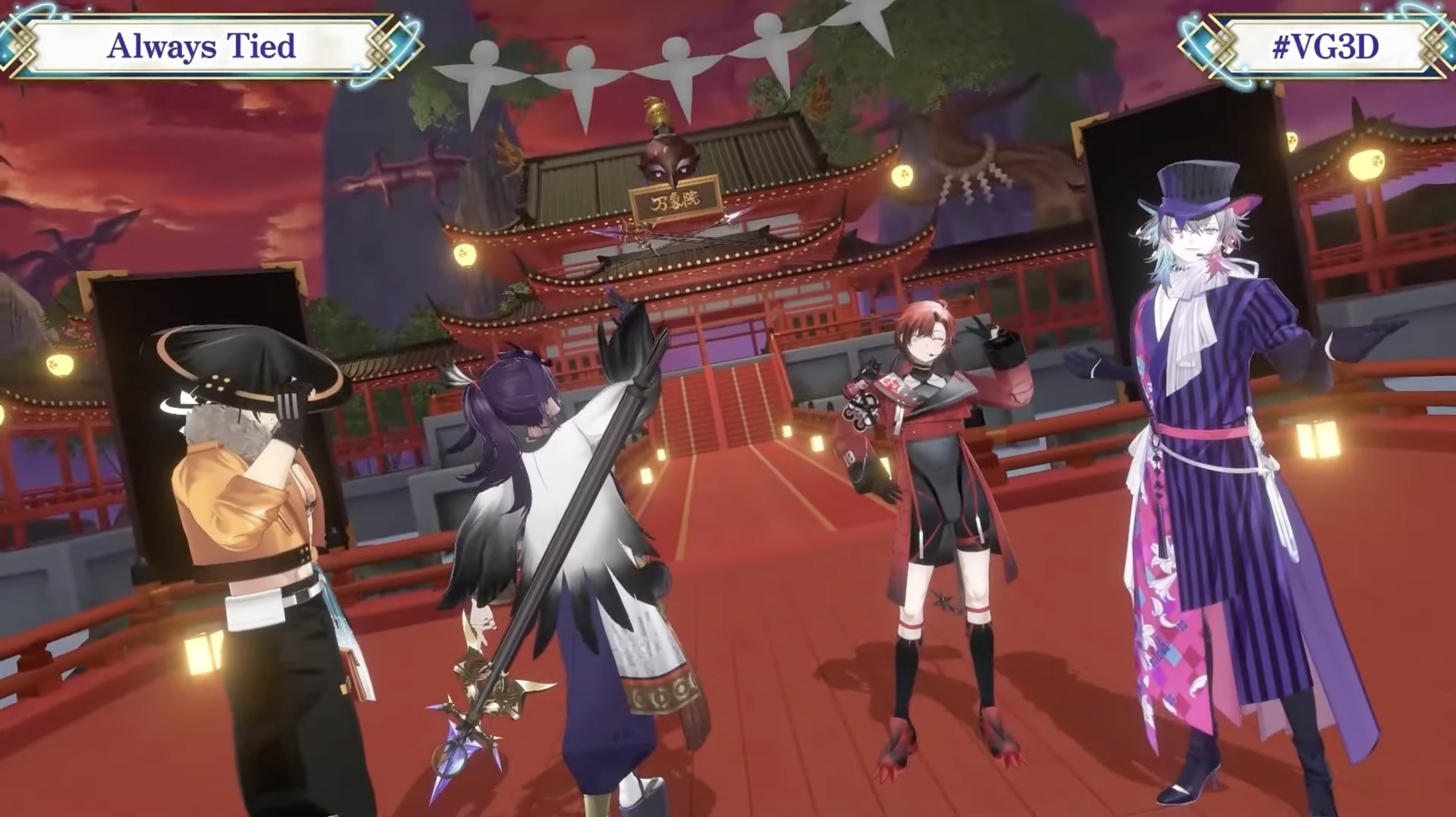
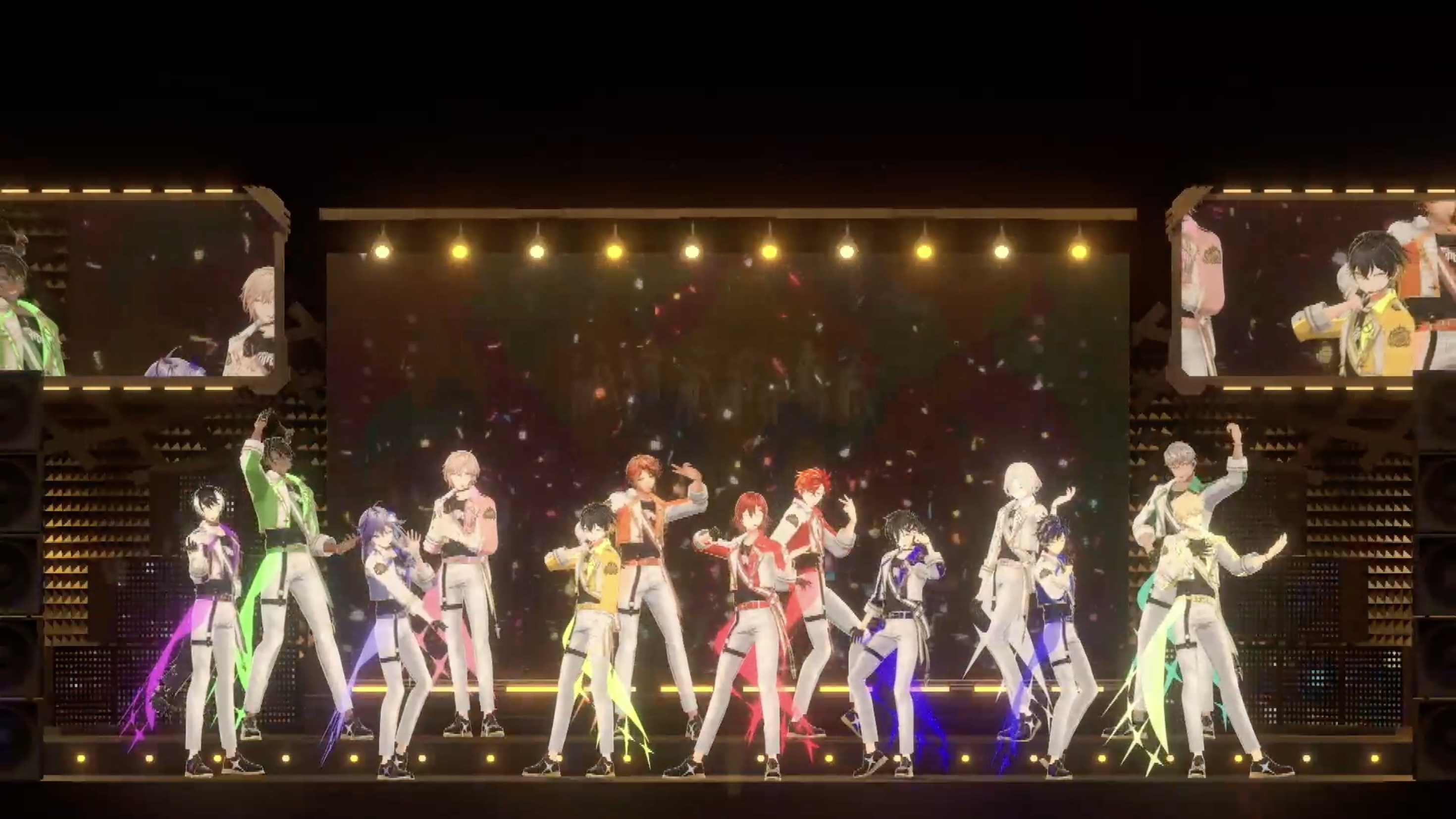
Over the past month, there have been a number of events for Holostars, the men’s side of hololive. While I don’t usually watch them often, I decided to check out both the Tempus Vanguard 3D debuts, as well as the Holostars JP 5th anniversary concert, Movin’ On. While the boys get only a fraction of the attention that the girls do, it’s become clear to me that this discrepancy has little to do with a lack of talent.
Holostars Popularity
I think the massive success of the hololive girls can skew people’s perspectives when it comes to how well the guys are doing. Holostars members have subscriber counts that are sometimes an order of magnitude smaller than their female counterparts, but this is comparing 100 thousand to 1 million—they’re still in the upper echelons of both VTubers and online content creators. I don’t pretend to know what makes anything become enormously popular, but they’ve all garnered sizable fanbases in their own ways. I wonder if the disparity just has to do with how girls are more often willing to watch stuff made for guys, but the reverse doesn’t happen as much.
Tempus Vanguard 3D
3D debuts/showcases are one-time events in the hololive world, and so they naturally attract curious passersby like myself. They also give new insight on figures who were basically only talking heads, with the added benefit that these special streams are built entirely around putting the VTuber’s skills and personality on display. Tempus Vanguard is no exception. Bettel’s buffoonery has extra nuance when you can see him physically clowning around (and getting clowned on). Flayon is surprisingly athletic, which makes him seem even more animated than normal. Hakka’s powerful singing was obvious even in 2D, but getting to see his physical expressions only adds to his performance. Shinri’s willingness to go a bit “out-of-character” for his song selections makes him even more masculine.
Movin’ On
For the Movin’ On concert, I followed Kureiji Ollie’s stream VOD so that she and her watchalong crew could fill in the gaps a little. These events are often culmination points for talents and their fandoms rather than neutral evaluations of their abilities, and I knew that I was lacking the right context in basically all cases. Together with Area 15, Baelz Hakos, and the live audience, I got a somewhat better understanding of the relationship each Holostars member has with their respective followers.
Just like with the hololive girls, though, there are some individuals who can really command the stage. Minase Rio’s singing is beautiful. Roberu carries his jovial charisma from his chatting streams to his performances. Astel Leda has undeniable star power, combining a versatile voice with serious dance skills.
Overall, it’s just good to see everyone in Holostars provide a good time for their fans, be it through thrilling stage performances or as a comforting respite from the world. Maybe someday, we’ll get to see the EN and JP branches together at the annual hololive fes in their own concert (as opposed to a fun karaoke session), or even together with the female talents. Whatever the future holds, I’d like to see them succeed on their own terms.
Movin’ On is still available for a limited time as a VOD costing 6,500 yen.




 OGIUE MANIAX