Canon vs. Fanon vs. Headcanon

“Headcanon” is an interesting term to unpack. It’s essentially an oxymoron that says, “I want to believe in how I interpret a given story over whatever the official narrative says,” making it a contradiction with a strongly postmodern bent. Headcanon, by meaning, lies outside of “canon,” but it’s also a different beast from “fanon,” which often carries a communal element.

As it has gained traction, headcanon increasingly butts heads with the other two. But while the battle of headcanon vs. canon might appear to be the more prominent fight for fans, I think what really defines much of the fandom divisions of the current age is the struggle of headcanon vs. fanon, and how this conflict plays out contributes to the extreme reactions seen in fandom online.

The creation of fanons requires two elements. First, much like headcanon, fans need to prefer some aspect of their own interpretations over something that is unsatisfying in canon by way of quality or omission. If Pokemon fanfic writers prefer a grittier world, it’s because the franchise is geared towards a kinder vision and they want something else. Second, there needs to be some kind of consensus. Not every fan needs to agree about a pairing, but enough fans must exist for a romantic coupling to gain traction, especially if it’s a dominant part of the fan discourse.

Headcanon, however, obviates the need for mutual agreement. The use of the term, though not inherently confrontational, carries with it a notion of the individual over the group. While fans might cross-pollinate ideas, it comes down to each and every fan, instead of what a community thinks.

This potentially leads not just to differing views of a work’s value, but also a disparity between what it means to be a fan and what it means to be in a fandom. Speaking from personal experience, over the years, I’ve gradually moved away from large, online communities to a closer circle of friends. Now, when I encounter “the fandom” of something, it can be like stepping into a foreign country, even down to being exposed to unfamiliar lingo. I wonder how my interpretations, headcanon or not, can differ so much from the dominant ideas in a given fandom collective.

In hindsight, this is rarely surprising. It’s uncommon for a single person to arrive at the same conclusion as a group, and even one group’s ideas will not align with another’s. A person who is truly alone, in the sense of not having others to talk to, would only have themselves to debate with. Moreover, when people form communities around a hobby, they have a high chance of bringing in like-minded peers; all the more so when fandom is a catered experience via Twitter or Tumblr.

Fanon isn’t some monolithic creature. There are multiple fanons, much like how it’s impossible to have every headcanon be exactly the same. One can even argue that a single property can have multiple canons, as long as it never fully defines which version is “official.” But the conflict between fanon and canon is generally old and fairly easy to understand. There’s what the creators say, there’s what the fans say, and even the most tightly controlled work will have moments left to interpretation. Moreover, because the Word of God, so to speak, carries a kind of authority, fanon is positioned as a kind of rebel entity.

But when the fight is headcanon vs. fanon, it’s the fanon that turns into the empire. If a lone fan wants to be accepted, they’ll have to take on enough of the assumed truths of the group, or be willing to encourage debate and disagreement. Because of how fans are so capable of tying their fandom to their personal identity and values, disagreements can hit close to home, or be seen as an affront to one’s beliefs. This is why a focus on social consciousness and progress, even though those concepts aren’t bad ones, can lead to a kind of zealousness that can create a negative image. The way a fandom thinks, even if it’s ultimately in a positive and beneficial direction, can become very hostile to outsiders, i.e. those who have not been baptized in the fires of fanon.

I think one of the major factors contributing to the ways in which headcanon, canon, and fanon clash is, likely to no one’s surprise, social media. It simultaneously allows people to connect while also in a sense isolating them from each other, while the internet itself has long been a space where beliefs, no matter how big or small, are defended seemingly to the death; one set of words vs. another. There’s no sign of it stopping any time soon, but I hope to see a greater awareness of the value of both individual and group mindsets in fandom.

Little Witch Academia Translation Trickery

Little Witch Academia has been out on Netflix since last year, and it’s a wonderful show worth everyone’s time. Having watched it with English subtitles, I’ve noticed a few hiccups here and there when it comes to the translation. These are not deal breakers, but it does speak to how translation is more art than science, and it’s worth looking into the fact that translating for anime and manga comes with its own share of unique pitfalls.

One unusual aspect of the translation that even non-Japanese speakers might notice is a tendency to avoid repetition despite it being present in the original Japanese. For example, a character might say, “Witches.” Then another character would ask “Witches?,” in response. In the subtitles, the first character would still say “Witches,” but the second might respond, “What are you talking about?”

This has partly to do with the fact that using the same word over and over again is not necessarily considered bad writing in Japanese, but in English (which is famous for its sheer amount of synonyms), this can make dialogue sound extremely awkward and unnatural. Changing up the vocabulary for English not in itself a bad idea, but it can run the risk of introducing ideas or words into a character’s speech that might not reflect who they are or what they would say. It creates room for inaccuracy even as it ends up sounding a little more natural, and it’s a tricky balance to maintain.

What’s worse is that sometimes the desire to make the English sound good can backfire. Anime and manga come out on a pretty constant schedule, with little lead time between chapters and episodes. Japanese as a language thrives on context to shape meaning, and terms or phrases are often left intentionally ambiguous, becoming clearer as the series goes on. Sometimes a phrase can be so awkwardly ambiguous when translated directly that a translator might feel compelled to massage it, only for it to bite them in the ass down the line. For example, a character whose gender is unknown can get away with never being referred to by gender in Japanese pretty naturally, but someone who doesn’t know this is an important plot point might assign a gender because gender-neutral pronouns in English are not entrenched into the language.

In Little Witch Academia, to a certain extent, one of the series is a quote from the character Shiny Chariot, which translates literally as “A believing heart is your magic.” It sometimes appears in the show itself, in English, so a simple solution would have been to use that directly, but it does sound a bit clumsy. The translator decided to go with “Believing in yourself is your magic.” Initially, this makes sense, as what exactly the heart believes in is unclear, and the heroine Akko uses it as a refrain to keep soldiering on. However, by the end of the series, this turns out to be somewhat inaccurate; it’s not necessarily that Akko believes in herself, but that she is able to believe in what’s possible.

Given that Little Witch Academia was released all at once on Netflix, there was the potential to go back and fix this, but I don’t blame the translator for not doing so. I don’t know what the schedule or system is like for subtitling on Netflix. It’s just a strong case of why translating is a tricky beast.

Familiar Fantasy: Mary and the Witch’s Flower

Miyazaki Hayao retiring from making films only to pick up his pencil once again is a running joke in animation, but just a couple of years ago the end of Studio Ghibli felt all too real, as a trio of announcements landed one after another. First, Miyazaki declared his retirement following the release of The Wind Rises. Then, Takahata suggested that The Tale of Princess Kaguya could be his last. Finally, Studio Ghibli itself announced that they would end film production. It looked to be not just the end of works by Miyazaki and Takahata, the two titanic figures that defined Japanese animation for filmgoers around the world, but also the end two the far-reaching, culture-crossing mainstream works that characterize Studio Ghibli.

However, while the studio itself had shut down, the people who made up the staff of Ghibli were still around, trained in the Ghibli style. Led by director Yonebayashi Hiromasa, a number of them for founded Studio Ponoc with the clear desire to keep making Ghibli-style films even without the brand name. Their first work is Mary and the Witch’s Flower, a film which is technically and artistically solid but seems to serve more as a message, that the “Ghibli film” can survive even without its most famous leaders.

Mary and the Witch’s Flower ticks all of the basic boxes. Based on a European children’s book? Check. Plucky young female protagonist? Check. Vibrant environments? Fluid animation? Sense of wonder? Check, check, check. Little is technically or narratively wrong with the film, but it seems almost cut from the same cloth as Star Wars: The Force Awakens; both works seem concerned with reassuring audiences that they’re going to get what they expect.

On that level, Mary and the Witch’s Flower delivers. It’s a film I’d easily recommend to those who enjoy Ghibli films, and while I consider the against-formula The Wind Rises to be my favorite Miyazaki work, I understand that the legacy of Kiki, Nausicaa, and Sheeta is important. As much as I value innovation in anime, I don’t think it’s absolutely necessary, especially when no one else had even tried to step up to the Ghibli plate, for better or worse.

One observation I had was that Mary and the Witch’s Flower lacked some of the minute polish of Miyazaki’s films—the man is famous for his obsessive attention to detail, only slowing down once age caught up with him. I don’t think this difference is a deal breaker, and if it spared the animators a little bit in terms of health and wellbeing, that’d be just fine. The film is beautiful regardless, though I think that the setting of The Secret World of Arrietty—Yonebayashi’s previous film—does a better job of showing off the Ghibli/Ponoc staff’s chops.

As proof that Studio Ponoc can deliver what they’re selling, Mary and the Witch’s Flower succeeds. Now, I want to see their The Last Jedi.

Join the Bakery: Kira Kira Precure a la Mode

According to anime, girls and sweets go hand-in-hand. That’s why it’s all the more surprising that the Precure franchise took this long to create a series specifically dedicated to a pastry and confectionery theme. But Kira Kira Precure a la Mode isn’t merely a baking-themed magical girl show—it’s also quite possibly the Precure most dedicated to its central motif.

Kira Kira Precure a la Mode follows Usami Ichika, a middle school girl who enjoys baking. Learning of a nefarious force that creates havoc by stealing the very deliciousness of desserts—their kira kiraru (sparkles)—Ichika’s resistance is rewarded with the ability to become one of the warriors of legend known as Precure. As Cure Whip, she is joined by other friends and Cure allies to save the sweets, and by extension the world.

Aesthetic themes found in Precure are developed to varying degrees from one show to the next. While Go! Princess Precure directly asks what it means to be a princess and makes this a major narrative focus, Yes! Pretty Cure 5 is a bizarrely eclectic mix. There are butterflies? And dreams? And they fight an otherworldly corporation? But Precure a la Mode goes all-in. The heroes are all based on desserts. Their attacks include chocolate swords and whipped cream. The villains are trying to corrupt pastries and snacks. There’s even a recipe of the week most episodes, and the kids at home can learn how to make all of them! By the end, the show posits the notion that the love and kindness that comes with wanting to bake tasty treats for others can act as an antidote for malice and apathy. A generous claim, perhaps, yet the surest sign that this anime is wholly dedicated to its pro-baking message. It can be a bit ridiculous at times, but I prefer this over not developing the theme enough.

The core cast of Cures is pleasantly varied without falling too hard into generic five-man team syndrome, but their differences are not limited to just their standard color-coded contrasts. While all of them are involved in baking, each of them comes to it in unique ways resulting from what drives each of them. Ichika wants to make people happy through baking. Arisugawa Himari (Cure Custard) is a student of the science of baking, and wants others to appreciate the chemical magic that goes into cakes and cookies. Tategami Aoi (Cure Gelato) is more focused on her dream of being a rock star, but sees baking as a similar space for her passion. Kotozume Yukari (Cure Macaron) excels in nearly everything she does, but her inability to make perfect macarons becomes her opportunity to challenge herself. Kenjou Akira (Cure Chocolat) is the handsome and caring type, who bakes as an extension of her personality, as well as a way to treat her sickly little sister to something delicious. Later additions to the cast, especially a darkly snarky villain named Vibry (or Bibury, if you prefer) further add to the cornucopia of characters that highlight the series.

The Cures complement each other well overall, but special attention should be paid to Yukari and Akira. First, their personalities are rather rare in Precure. Yukari’s wry cleverness makes her almost an anti-trope character, frequently figuring out tricks and traps that the typical magical girl heroine would fall for in any other series. Akira is pretty much a Takarazuka Revue star transplanted into the world of Sunday morning children’s cartoons. Second, both are in high school as opposed to middle school, which is the typical age range of Precure girls. Third, though never stated 100% outright, it’s clear that there’s some shared romantic feelings between the two, with episodes dedicated to their trying to understand each other. While Precure is known for its significant yuri fanbase, these two bring it up a notch by combining multiple franchise-defying aspects together.

Overall, Kira Kira Precure a la Mode is a strong and solid entry into the Precure canon. It doesn’t quite hit the extraordinary highs of some of the franchise’s absolute best, but it’s definitely enjoyable from week to week, carries nice messages about how everyone’s unique, and even pushed that yuri envelope judge a smidge further than expected. It’s capable of appealing to the absolute newcomers as well as those with long-time experience, almost like a perfect chocolate chip cookie—simple, yet profoundly effective.

Fan Fan Fine: Ogiue Maniax Status Update for February 2018

It’s February, also known in these parts as “new Precure time!” Satou Junichi (Ojamajo Doremi, Sailor Moon, Princess Tutu) helming the new Hugtto Precure! means I’m eagerly anticipating it, though I’m trying not to get my hopes too high up. As much as I love his shows, he’s not infallible or anything.

Whether you’re celebrating Valentine’s Day, the Lunar New Year, or some other holiday, I’d like to thank the following Patreon sponsors for their support.

General:

Johnny Trovato

Ko Ransom

Alex

Diogo Prado

Viga

Sue Hopkins fans:

Serxeid

Hato Kenjirou fans:

Elizabeth

Yajima Mirei fans:

Machi-Kurada

My favorite posts from January:

Down-Home Food Therapy: Atari no Kitchen!

A food manga I’ve been enjoying for a quite a while, I finally got around to writing about it!

A Strong Foundation: How the Japanese Smash 4 Tournament Format Helps the Community

A detailed look at what I believe are the underlying reasons behind Japan’s noted character diversity at high levels of competitive play.

“We’re Just Like You!”: The Empathy Scam of the Alt-Right

A post on a more serious topic: how the alt-right’s use of internet memes and subculture might act as false masks to lure in frustrated young men.

Return to Genshiken

Part 7 of my Genshiken re-read delves into the depictions of love and lust in my favorite manga.

Patreon-Sponsored

The Past and Future of Anime Blogging

I wax nostalgic about anime blogging but also how it’s positioned versus other mediums.

Closing

I’m high off of watching EVO Japan 2018 and seeing both Asuka and Shinsuke Nakamura win the Royal Rumbles. I’m also hyped for the new Kio Shimoku manga coming out this month.

May your February be as inspired.

Love and Lust. Return to Genshiken: Volume 7

Volume 7 is the point where Genshiken starts focusing much more heavily on Ogiue’s story, for better or worse (guess which side I’m on!). As the only character at this point who has a powerfully emotional backstory (though I wouldn’t have minded learning about the others in their younger days), it makes sense, even if it pulls the manga away from its more laid-back origins.

What is Return to Genshiken?

Genshiken is an influential manga about otaku, as well as my favorite manga ever and the inspiration for this blog, but it’s been many years since I’ve read the series. I intend to re-read Genshiken with the benefit of hindsight and see how much, if at all, my thoughts on the manga have changed.

Note that, unlike my chapter reviews for the second series, Genshiken Nidaime, I’m going to be looking at this volume by volume, using both English and Japanese versions! I’ll also be spoiling the entirety of Genshiken, both the first series and the sequel, so be warned.

Volume 7 Summary

It’s the dawn of a new age for Genshiken, as Ohno now leads the club. However, an awkward scene with Kuchiki drives away all prospective members, aside from Sasahara’s sister Keiko (who doesn’t even attend the school). This means the balance of the club has shifted to actually have more women than men.

Ogiue’s troubles are only beginning, as she finds out she’s been accepted for Comic Festival. Given her outward hatred of fujoshi, the idea that she’ll be putting out a BL doujinshi frightens her. However, thanks to a pep talk by Ohno, she begins to move forward, though Ohno also uses this as an opportunity to get Ogiue into some mildly skimpy cosplay. Sasahara sees this, and later begins to fantasize about Ogiue, and the other girls in the club (including Keiko!) pick up on the small, yet smoldering sparks between the two.

Ohno and Kasukabe begin plotting to get the two closer, which ends up with her bringing her American friends, Angela Burton and Susanna “Sue” Hopkins, to ComiFes as a way to get Sasahara and Ogiue to be at the event together alone. The two actually begin to hit it off (to the point that it overwhelms Ogiue a little), but a chance encounter with two hometown women from Ogiue’s past—people she hesitantly calls “friends”—clearly induce emotional anguish in her. A confusing moment with Sue at first helps Ogiue calm down, only for her to flash the most hardcore page from Ogiue’s own doujinshi in front of Sasahara—the last person she wanted to show it to.

Sasahara, meanwhile, has his own non-romantic troubles, namely being unable to find work. He’s decided to pursue a career in manga editorial, but keeps getting rejected. Finally, he lands at a dedicated freelance editorial company and uses his experience with Kugayama and Ogiue to finally land a job.

The volume ends with Ohno and Kasukabe setting up a club trip to the resort town of Karuizawa, where they intend to finally get Sasahara and Ogiue together.

Is Kuchiki “Okay?”

Kuchiki’s character is being “that guy”: the one whom the other members barely tolerate because they don’t want to drive out because they either 1) don’t want to get too aggressive 2) have empathy for someone so socially awkward. It’s an understandable situation for anyone who’s had experience with a social circle full of dorks.

Given what’s happened with women and the rising tide against sexual harassment, however, Kuchiki’s character becomes increasingly hard to swallow. It’s not just that he’s got lascivious behavior, and it’s not just that he fails to respect personal space, but that he actively tries to creep on the girls, including attempting to peep on them bathing. Even Nidaime, with its female-centric cast, shows the ladies of Genshiken pretty much enduring Kuchiki’s existence and waiting for him to graduate.

I don’t fault Genshiken for this, simply because it does a good job of reflecting the reality of anime clubs in the 2000s and before. Not only is Kuchiki portrayed as being too spineless to actually threaten them, but it’s not like Genshiken rewards or praises the character. And yet, I have to wonder if a socially conscious series made in 2018 would even let him through the front door, so to speak.

Kuchiki’s not all bad, as he does try to defend Ohno’s cosplay from that one thief, but it’s arguably just an example of having a worse villain make a milder one look better. Sasahara sticking up for him and treating him like a human being does help Kuchiki grow a little bit, but is Sasahara’s kindness accidentally a form of complicity? It’s made more complex by the fact that it’s also one of Sasahara’s best qualities, and what helps him get his editor job. A later chapter in Nidaime has an in-love Ogiue praising this very quality of Sasahara, and even here in Volume 7 you can see her being somewhat smitten by that accepting demeanor. It’s perhaps the fate of the moderate force to sometimes not do enough.

Ogiue’s Right to Love

Volume 7 is where the layers of Ogiue begin to peel away, revealing not just a self-hating fujoshi, but one marred by trauma. The first time I read this volume, it wasn’t entirely clear where it would go, but re-reading while fully aware of Ogiue’s past actually makes it kind of heartbreaking. Her anxieties creep to the surface in many of her interactions, and as her feelings for Sasahara get stronger, it’s clear how much her experiences weigh on her mind.

One of the big moments comes when Ogiue is talking to Ohno about having to make a doujinshi for ComiFes. In it, she directly mentions that she’s drawn doujinshi before, and that she hates herself for being a fujoshi. Looking back, the idea that Ogiue has experience drawing more extreme material only makes sense, but I recall it being a bit of a revelation back when I first read it. This conversation is also the first true indication of Ogiue and Ohno having become friends. Before that, there was still a noticeable amount of animosity between them, and I believe here is where it begins to die down a bit.

Ogiue’s blushing profusely as Sasahara smiles at her is incredibly adorable but also complicated. You can feel the inner turmoil raging inside of her as she questions whether she should be happy. Also, I think her switch from a Haregan [i.e., not-Full Metal Alchemist] doujinshi to a Mugio x Chihiro Kujibiki Unbalance one is an early sign of her secret Sasahara x Madarame drawings.

The Society for the Study of Getting Turned On

There’s something very real and refreshing about the way Genshiken portrays sexual desire. The fact that it’s not limited to the male characters also means Genshiken goes a long way in showing women as beings with sexual desire. The approach isn’t like the hyper-eroticism of a fanservice series or a pornographic title and it doesn’t revel in the lasciviousness of its characters carnal wants, but it also doesn’t shy away from showing their libidos at work in public and private contexts.

Nothing shows this better than when Kasukabe drags Kohsaka off so that they can “do it ten times.” Immediately after, Keiko informs her brother that she’s not staying over that night, and Madarame decides it’s his cue to leave too. Keiko and Madarame, having the hots for Kohsaka and Kasukabe respectively, are clearly thinking similarly about how to “remedy” the situation in private. You can practically feel their hormones being barely contained.

Then the manga cuts to Sasahara playing an erogame while thinking about Ogiue in cosplay. It implies that he’s going the same route as his little sister and Madarame, but the fact that he’s thinking about Ogiue (and not Kasukabe) is significant. The Ogiue cosplay moment happens in the previous chapter, which means Sasahara had Ogiue on his mind the entire time. Let’s also not forget that the guys in the club were willing to use the other girls as masturbatory material, so this shows how much Ogiue’s been encroaching on Sasahara’s psyche. This obviously isn’t the first sign that Sasahara’s into Ogiue, but it certainly is one of the most vivid. Later, when they have a ComiFes planning meeting with Ohno, Sasahara’s brief glances at Ogiue show much his mind’s image of Ogiue still persists.

Angela and Sue
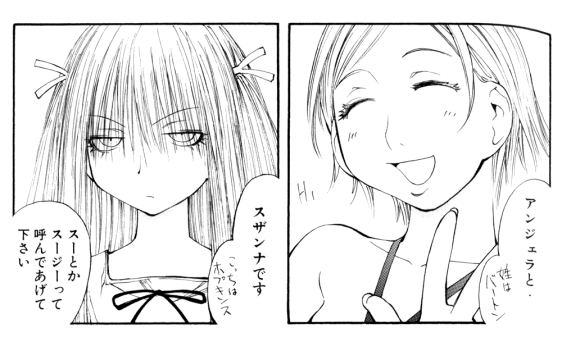
As we know from the end of Nidaime, Madarame eventually ends up with Sue. It’s kind of funny that he’s the first guy she meets in Genshiken, as if it was all a long play into the most classic of romance tropes.

I always found Angela and Sue to be fairly realistic, if exaggerated portrayals of American fangirls, but I think that it’s become even more the case as time has passed. Maybe it’s my greater exposure due to social media like Twitter, but Angela’s willingness to just announce her fetishes without hesitation seems not that unusual. Then again, Yoshitake from Nidaime is built from a similar cloth; the only difference is maybe level of sexual experience (Angela is clearly sexually active, while Yoshitake is very much not).

In Volume 7, Sue has a certain grumpiness about her, even as she becomes attached to Ogiue. However, Ogiue is pretty surly herself. I wonder if the softening up of Ogiue leads to Sue becoming less harsh as well.

It’s also funny to think about the fact that, at the time of Genshiken, Sue’s combination of Asuka reference (“Anta baka?”) and Ruri reference (“Baka bakka”) was like, anime nerd knowledge 101. Now, I think it wouldn’t be unusual for the typical fan, Japanese or otherwise, to not have it click immediately.

Final Random Thoughts

The between-chapter specials this volume include Sasahara and Madarame discussing preliminary Kujibiki Unbalance designs. Those drawings are clearly from a younger Kio Shimoku, as it’s the same style as the first chapter of Genshiken! Kio’s aesthetic changes are amusingly visible as a result.

As Sasahara is thinking dirty things about Ogiue, there’s a Gundam model kit box in the background. I think it’s a Sazabi.

In Sasahara’s job interview, he talks about how Kujibiki Unbalance has changed so much since the original cast graduated, to the point that it doesn’t even feel it’s the same series anymore. At the time, it feels like it might have been referencing the graduation of Madarame, Kugayama, and Tanaka, but now it seems to reflect Genshiken Nidaime even more—almost as if Kio doubled down on this idea for the sequel. We know he’s a guy who likes to get referential with his series, but I wonder if Nidaime is even more meta than any of us realized.

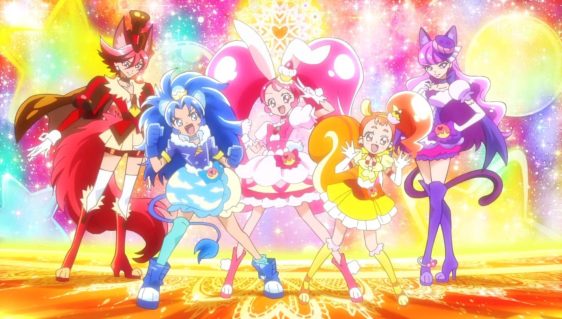
Cardcaptor Sakura and the Alternative Canon: What is the “Clear Card Saga” Anime Following?

When the Cardcaptor Sakura: Clear Card Saga anime announced, one of the questions asked was, would it be following the canon of the manga or the anime? Although the two versions share many similarities, there are also some notable differences between them. Now that the new TV series has been out for little while, it’s evident that they’re acknowledging the old anime…but I have my suspicions that this wasn’t always the case.

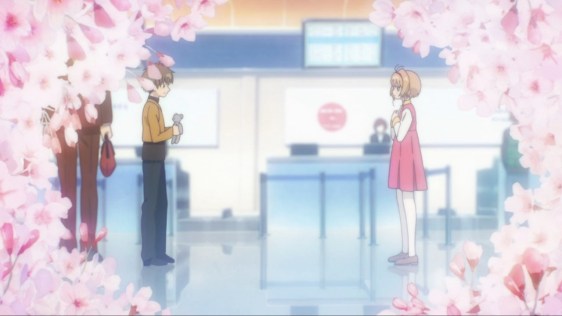
One of the tell-tale differences between the two iterations of the original Cardcaptor Sakura is how they end. While both involve an exchanging of teddy bears as an expression of mutual love and a temporary separation as Syaoran returns to Hong Kong, the anime has this happen at the airport, while the manga’s version takes place as Syaoran is riding the bus to the airport. Also, while the anime has them reunite in the second film, the manga immediately follows this with a timeskip where Syaoran shows up to greet a now-middle school-aged Sakura. This is roughly the point where Clear Card Saga starts.

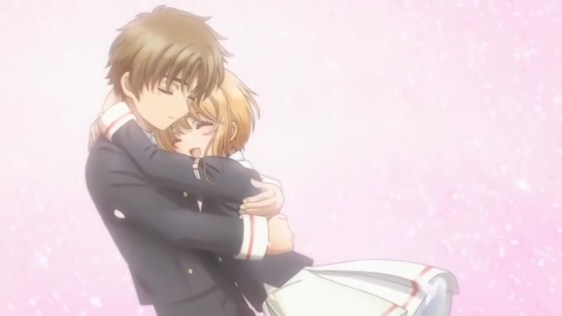
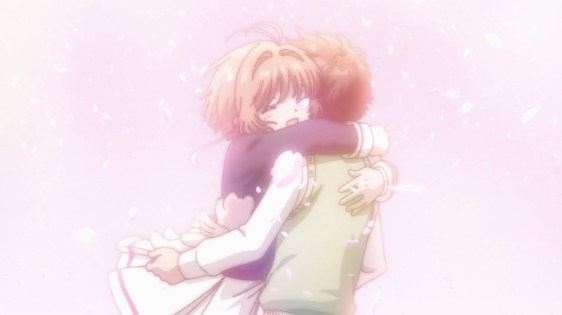
Prior to the premiere of the Clear Card Saga TV series, there was a special OVA released as a way to bridge the old and new anime. As seen above, this OVA takes its cues from the manga by having the bear exchange take place at the bus, and then transitioning to the middle school timeskip. With this, I assumed the matter was settled. The Clear Card Saga anime would definitely be sticking closer to the manga.

Then episode 1 hit, and things didn’t quite line up.

When Syaoran shows up again in the manga and OVA, he’s wearing a Tomoeda Middle School uniform. In the new anime, he’s wearing street clothes. Maybe this is just a timing or aesthetic issue. Perhaps it doesn’t make sense for Syaoran to have a uniform after just moving back. Maybe the fact that they show Sakura at school before meeting Syaoran means he couldn’t be there (because she or one of her friends would’ve inevitably noticed him walking around in uniform). Either way, here is a discrepancy from the manga.

But they also flashback to the teddy bear exchange, and it’s at the airport! That’s a scene that explicitly calls back to the anime and not the manga. Maybe they just did that for the convenience of the people who watched the old anime.

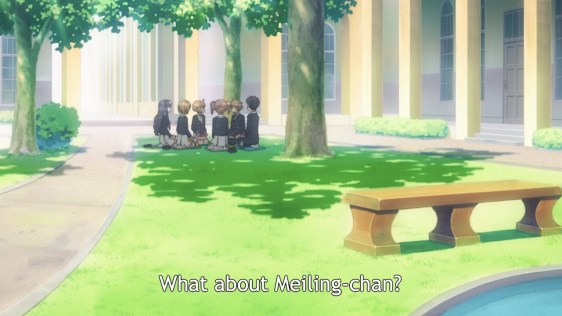
The smoking gun comes in episode 2, when the characters are having lunch together at school. During their conversation, Tomoyo asks Syaoran how Meiling is doing. The reason this is a big deal is that Meiling never shows up in the manga. She’s an anime-original character, and one of the many elements used to turn a 12-volume manga into a 70-episode anime. Whatever the case may be, we have clear unequivocal acknowledgement that the old anime’s events are either partially or wholly canon in the Clear Card Saga anime.

So why make that OVA? I suspect that it served multiple functions. First, it might’ve bridge the gap between series, as mentioned above. After all, it’s been about 15 years. Second, it could’ve been used to get the staff and actors used to working on Cardcaptor Sakura again. Third, I really do think the anime was going to follow the manga more strictly, as a way to keep things simpler, but that they changed their minds at some point. If this were the case, maybe it was because they realized many had only ever seen the anime, and thus would be confused by the differences.

While the old anime appears to be canon for the new show, the question remains as to how much will actually be different from the Clear Card Saga manga. Referencing Meiling is one thing, but what about having her show up? Will the new anime have more clear cards than the manga, just like it’s predecessor? And what of the fact that Sakura’s dad is a partial reincarnation of Clow Reed—a fact revealed in the manga but never in the anime?

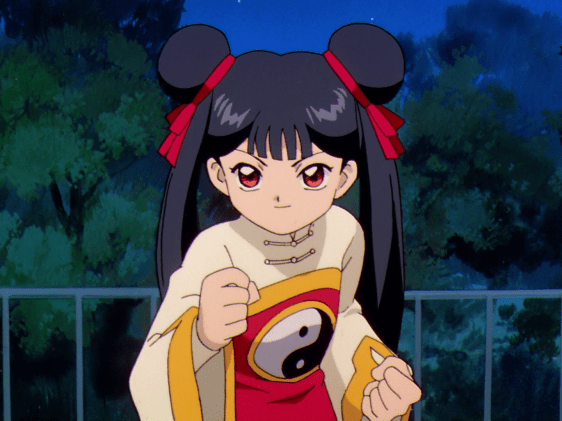
Personally speaking, I wouldn’t mind seeing Yukana reprise her role as Meiling and treating us to some Kung Fu fighting.

A Strong Foundation: How the Japanese Smash 4 Tournament Format Helps the Community

Introduction: Japan, Land of Hidden Bosses

If there’s anything that the Japanese Smash 4 competitive scene is known for, it’s a high average skill level across its player base, as well as a great amount of character diversity. Many of the world’s greatest character specialists come from Japan—Ranai and his Villager, Kameme and his Megaman, Shuton and his Olimar, and a whole slew of powerful Duck Hunts. A lack of monetary prizes is frequently cited in online discussions as a reason why so many Japanese character specialists exist, but I think that’s just a starting point and not a sufficient explanation by itself.

On occasion, fans will point to the extremely volatile rankings at Japanese tournaments as proof of Japan being a haven for character specialists, while others will counter that the average format of Japanese tournaments (Best of 1 round robin pools, followed by Best of 3 double elimination often even into grand finals) is inherently inconsistent. However, while this inconsistency might be a strike against the tournaments themselves providing reliable results, I think the format Japan uses is actually a key factor in helping its player base grow and improve compared to the common formats elsewhere (double elimination throughout, starting Best of 5s much earlier in the bracket), especially when it comes to creating those intimidatingly strong character loyalists.

The Mother of Invention

One of the reasons Japanese tournament matches tend to be so much shorter than their North American and European counterparts is time constraints. Often times, these events last only one day at venues that cannot allow them to stay later. They’re working with what they have. Yet if you look at how they use that limited time, it’s clear that the format is designed to give all players the most amount of playtime possible. Best of 1 round robin means that, even if you don’t make it out of pools, you potentially get to face a far greater number of opponents than the two you would encounter in a double elimination bracket. Everyone, even the worst players, get to gain real experience against more characters and more play styles.

Fostering Young Lions

Top players in Japan seem to prefer the “Western” style more because it favors them—as the best, their skill gets better rewarded the longer the sets are. While not going in that direction works against the best of the best, it’s also clear that the Japanese tournaments are meant to be as hospitable to newbies as possible. In addition to the round robin format initially, there’s also something called the “B-class tournament,” which is a separate bracket for all of the players who didn’t make it out of pools. In other tournament formats, less skilled players are usually given a chance to improve by dedicating a section for non-tournament “friendlies.” The B-class bracket is an opportunity to continue to play in a tournament-style setting.

When Japanese Smash 4 tournaments first began, there was even a question of whether or not to restrict the stage selection to Omega stages—flat levels without any platforms—only because it was the only stage type available on Nintendo’s default online competitive format, For Glory. While the Japanese scene ultimately went away from this idea, it shows a desire to cater to newcomers. Combined with extremely reliable high-speed internet that makes Japanese online play better than other parts of the world, this means Japanese tournaments are a good environment for those who are considering transitioning from online play to offline events.

Best of 1: “Random?”

Another aspect to consider is that the Best of 1 format itself might help advance player improvement. Although Best of 1 matches are not preferred for showing who can win consistently, it does foster certain skills that longer formats do not, as once pointed out by fighting game commentators UltraChen. A player can’t wait until the second set to try and figure out their opponent; they need to do it now. Super Battle Opera, once Japan’s most prestigious fighting game tournament, used a Best of 1 format, and its players adapted to it. While a Best of 5 match shows who can adapt the best over a longer period, Best of 1 forces players to learn how to adapt extremely quickly, which in turn teaches them how to “gamble” better when the chips are down. This might be why Japan is somehow known for both more reserved play and riskier (but not necessarily aggressive) styles as well.

What’s more, the inconsistency of Best of 1 pools might actually help in giving more players experience as well. If the very best players advance every single time, this means that the lesser players do not get to feel what it’s like to move up the bracket and face increasingly tougher opponents. With the “randomness” of Japanese tournaments, many more players get to feel what it’s like to be in a Top 16 or Top 8 against the country’s best.

Conclusion

The Japanese format is geared towards expanding the Smash 4 tournament scene by being an inviting space for players of all stripes. Best of 1 pools and B-class side tournaments not only allow all competitors both strong and weak to experience a variety of players and characters, it allows character loyalists and champions (two groups which do have crossover!) to level up at a higher rate. Shorter matches also foster a certain type of adaptation, and the inherent volatility potentially gives many more players to get accustomed to playing at later stages of a tournament. Whatever the ultimate goal of a given player, the Japanese tournament format provides the foundation for a strong player base.

The Past and Future of Anime Blogging

In many ways, anime blogging is a living relic. Born in the age when “Web 2.0” was a newly coined term and blogging in general was a young and exciting differentiation from the era of fan shrines and webrings, the anime blog was a way for writer-fans to establish an identity outside of enclaves such as forums and livejournal groups. Like the anime websites of old (and even the IRL anime clubs before that time), they filled a desire for information, appreciation, and criticism of anime and manga.

I think there’s a charm to the written word that allows it to endure and keeps it falling out of true relevance, and this applies to anime blogging. Certain ideas are better conveyed through writing (especially extremely complex ones that require a lot of small detail to fully explain), and certain people (myself included) are more comfortable with text than speech or visual performance. Writing will never truly go away because it’s just capable of so much with so little. Nevertheless, it is true that the amount of anime blogs have declined over the years.

I don’t have a falsely inflated idea as to the supposed “importance” of anime blogs in year past—it’s always been a niche. But where once an “Aniblog Tourney” existed not just as a popularity contest but as a sign of a loose “aniblogosphere,” the increasing prominence of social media platforms like Twitter, Tumblr, Facebook, and even something like Anime Amino have moved discussion back into more isolated communities. I think, on some level, “aniblogging” feels less like a distinct position than it used to. Perhaps it’s because so many anime fans these days are omnivorous consumers of pop culture that the “fan” is more important than the “anime,” but I think the rise and dominance of social media networks and alternative formats like YouTube also makes it less enticing for younger, enterprising fans to enter the field. In a “field” with a high turnover rate due to burnout and just the passage of time, not having new warriors to pick up the mantle means a gradual decline.

The anime blogs of today, whether they’re young and fresh or old and crusty, are contending with new ways to get one’s thoughts and opinions out to the world—alternatives that can be more attractive to would-be bloggers. In particular, the minor stardom that can come with YouTube can also mean potential income, perhaps even enough to earn a living. Anime fandom isn’t the only realm affected by this, but because anime is more niche than, say, gaming, it also means a smaller pie to share overall. Only a select few vloggers can get six-digit views, but it’s a lot likelier than accruing those numbers through blogging. For even the best and most charismatic writers, blogs are at best a partial or supplementary income. In other words, it’s never been easy to sustain a living just from anime blogging, for better or worse. At the same time, it’s also never been easier to actually make money from blogging thanks to platforms like Patreon. While I’m not exactly filling my coffers to the brim, my own Patreon has been a great boon.

All it really takes to write an anime blog is a genuine passion for anime and manga, as well as a desire to write one’s thoughts. It’s profoundly simple, which is why, even as anime blogging as a “thing” has waned, I think you still see the occasional challenger take on the endeavor. Writing is timeless. I don’t carry any illusions that it’s the path to fame and fortune, but it’s a space that remains open and welcome. If we want to rebuild the aniblogosphere, however, it’ll take a restored sense of “community,” no matter how nebulous and disparate it might be.

Once upon a time, anime bloggers debated the merits of “episode blogging” vs. “editorial blogging.” In hindsight, it seems so quaint.

This post was sponsored by Johnny Trovato. If you’re interested in submitting topics for the blog, or just like my writing and want to support Ogiue Maniax, check out my Patreon.

Down-Home Food Therapy: Atari no Kitchen

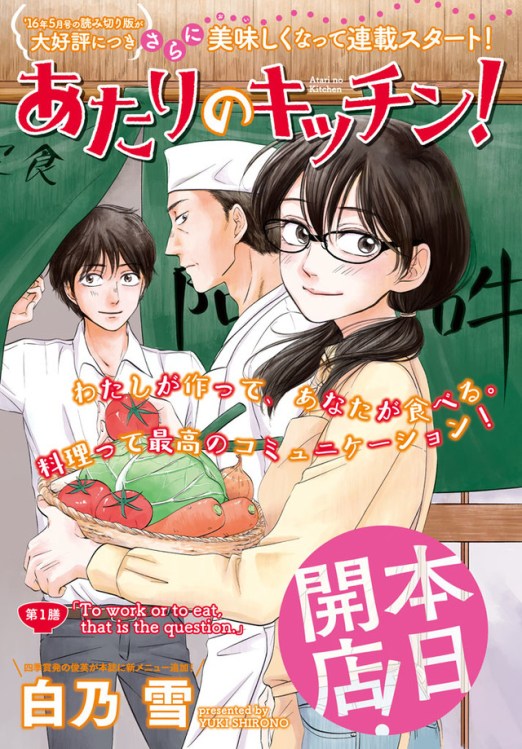
I enjoy food manga in all its forms. I was even quoted on the back of the English release of Sweetness & Lightning Volume 1! But within the Afternoon manga family is another food series I’m enjoying. Called Atari no Kitchen!, it follows a college-aged woman who starts working at a small, family-owned restaurant and helps to inspire dishes that are just right for each customer.

Atari no Kitchen! is very similar to manga such as Bartender and La Sommelière, where the food experts act almost like doctors prescribing particular spirits for each individual’s problems. Where I enjoy Atari no Kitchen! more is in its focus on food instead of alcohol. I have nothing against spirits, but their differences are much more subtle and alien to me, making their assumed effects much less relatable on a personal level. To put it succinctly, I’ve consumed far more food than alcohol in my life, and it makes this series easier to understand.

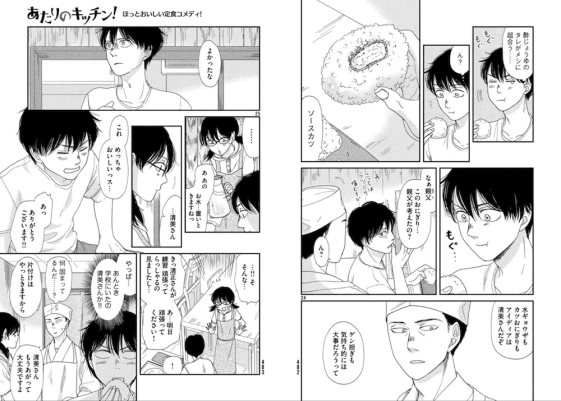
Because the setting for Atari no Kitchen! is a small restaurant (think of where Soma from Food Wars!: Shokugeki no Soma comes from), the dishes are not fancy foie gras or blowfish, but foods meant for working-class families to enjoy. For example, one chapter involves trying to find a better menu for the son of the restaurant owner, who’s set to participate in a sports event. Usually, he eats katsu, as a classic pun on the Japanese word for “win,” katsu (勝つ), but Kiyomi reads that katsu is pretty heavy and oily, and so doesn’t digest as efficiently as one might want for physical activity. So, she sets out to make a more balanced menu that still carries the flavor and spirit of pork cutlets. I think this is easy to understand and envision, even if someone’s never eaten a katsu in their life.

Kiyomi herself is also adorable, and I would be lying if I said she didn’t charm the socks off of me. The son, Kiyomasa, is also clearly smitten with her. It’s not exactly a romance series, but the fact that their names are so similar (they even start with the same kanji!) tells me that their feelings will grow as the series continues.

If you can read Japanese, you can find it on sale wherever Japanese books are sold. If not, it is a Kodansha title, so there’s always a chance it’ll get translated someday. Let’s hope!