Angela Attack: Genshiken II, Chapter 66

I’ve been waiting for a month to use that title.

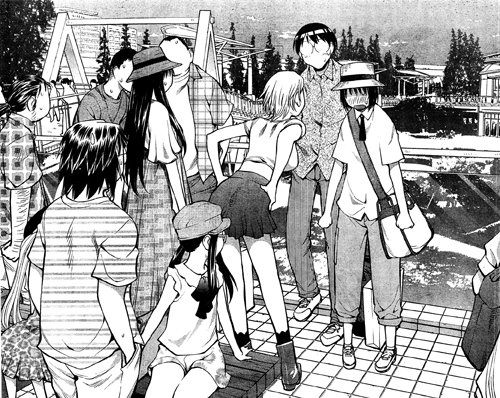
The final day of Comic Festival is nearing its end, and Madarame is in deep trouble, at least from Hato’s perspective. First, Madarame and Hato encounter Kohsaka, whose picture-perfect crossplay (to promote his company’s new 18+ game) blows away both of them. Hato remarking with amazement that Kohsaka, unlike himself, doesn’t even need makeup to complete the gender illusion, wonders why things aren’t more uncomfortable between Madarame, who likes Saki, and Kohsaka, her boyfriend. Hato comes to the conclusion that Madarame’s just isn’t able to compete for Saki’s affections. Madarame and Hato comfort each other over their respective areas of inferiority relative to Kohsaka, though Hato points out that he’s much better at undergoing the cross-gender transformation by using his feminine voice.

Angela strikes, laying on the flirt as thick as humanly possible, with Madarame naturally not being sure what to do. Hato jumps in for the rescue, pointing out that Angela is flying back the next day, so obviously there’s no way anything could happen between them, but Angela doesn’t quite agree.

Knowing that the actual reason Madarame can’t even begin to think of Angela is because Saki is still in his heart but not wanting Madarame to know that he is aware of Madarame’s unrequited love, Hato changes his thought midstream to try and find a safer reason. In doing so, he blurts out that Madarame is such an uke that there’s no way he should be with a girl, though unbeknownst to Hato, Angela is a big fan of Madarame as “sou-uke,” and instantly bonds with him. Wanting to point out however that real life and fiction are different, physically different, Angela tries to give Madarame his Very First Boob Grab, but is deflected by Sue, who then admonishes Angela’s rash action with a roundhouse kick.

At the end of the day, Angela still has her eyes set out on the 72-year-old Pit Viper, Madarame and Hato grow in their friendship, and Madarame comes to the shocking realization that he is in fact perceived as the catcher in yaoi imaginings.

Angela’s forwardness and acknowledgement of previous experience with one night stands sets her far apart from the nerds of Genshiken and at first it might come across as too far out there from how Genshiken has been in the past, but given what has happened in the manga before, it doesn’t seem so inappropriate. If you think about it, the awkward expression of sexuality has been a big part of Genshiken from day 1, whether it’s Saki having to come to terms with Kohsaka’s 2-D complex, the Sasahara x Madarame doujinshi that underscores Sasahara and Ogiue’s relationship, or even the fact that every ComiFest ever has been about buying comics not to “read” but to “use,” and the understanding that everyone else you know is doing the same. In this regard, the most awkward moment of all might just be seeing Angela’s “sex on the first date is okay” viewpoint collide with Madarame’s otaku chivalry, the same noble attitude that at first kept Madarame from taking a seat on the train in place of Saki back in Chapter 32.

That said, it is still a bit of a shock to just see Angela just blast down that implied wall of silence that surrounds the topic of sex, a wall that normally is talked around  or through tiny holes, but is rarely trampled over so easily. It’s a kind of bluntness similar to Sue, and I have to wonder if this is a shared American trait for the purpose of the story. On the other hand, Angela and Sue’s aggressive attitudes aren’t quite the same, and while we see Sue expressing her fondness for yaoi or making references all the time, I can’t really ever see her coming on to a guy as nonchalantly as Angela does. It makes me want to see their friendship in action outside of the context of a visit to Japan.

While that might be considered an inter-otaku cultural gap between Japan and America (and even only somewhat so), the inter-otaku generation gap is also clearly  present in this chapter with Madarame and Hato. At first when Hato sees Madarame talking to Kohsaka. “Why isn’t Madarame seeing him as a rival?” Hato wonders, but just the fact that Hato is asking that question shows a different mindset from the older members of Genshiken. Going after a girl who’s already in a relationship when, on top of that, you’re friends with the both of them? That stuff is for fiction, man. How differently might this manga have turned out had Madarame gone for it from the start, or if Ogiue and Ohno already had boyfriends prior to meeting Sasahara and Tanaka? Would those two have even bothered? But that’s just not how Genshiken is, because that’s not how the characters are. After all, I’m sure that people besides Tanaka entertained the thought of having a relationship with Ohno after she joined, but once it was established that she had a thing with Tanaka, that ship sailed. It’s not a matter of monogamy or anything like that, but simply that someone like Hato (or Yoshitake) carry an extroverted attitude and awareness of interpersonal relationships romantic, sexual, or otherwise, that only the non-otaku Saki and Keiko could see as clearly.

It’s also nice to see the friendship that has formed between Madarame and Hato. Could it be something more? I doubt it, given that both have said outright that they are not into same-sex relationships, at least outside of the world of BL, but I could see the idea continuing to make things a little awkward for them, especially given the number of (too much) high-power fujoshi populating the club.

There was only one small Ogiue cameo this chapter, so let’s close out with it.

Robot Cops Are Cool Dudes: Ogiue Maniax on the J-Decker Episode of Podlabor

I was recently on the Podlabor podcast, where host Patz, fellow guest Narutaki from the Reverse Thieves and the Speakeasy, and I discussed the 90s super robot anime, Brave Police J-Decker. For those unfamiliar with the series, it’s from the same franchise as the more well-known Gaogaigar, and features giant robots who are also detectives. If that didn’t scare you off, have a listen, and if it did, you might be surprised to find out how much heart J-Decker has.

We also discuss a bit about Otakon, which is this weekend.

Podlabor Episode 6: Brave Up J-Decker

The Manga Amber of Otaku Hardcore

Sometimes the really hardcore otaku manga out there are criticized for holding back anime and manga, for catering mainly towards maniacs who want their series to look and feel a certain way, and in doing so restrict the respectability that comes with artistic variety. But as much as topics like fanservice and moe exist prominently in these sorts of criticisms, and as much as there’s the image of the anime fan with seasonal short term memory, I feel that having hardcore devotees of anime and manga allows certain drawing styles to exist in comics even well after their heyday has passed.

70s-style shoujo manga is called such for a reason, and unless you’re Miuchi Suzue drawing Glass Mask and you’re literally a 70s shoujo manga artist still drawing to this day, it’s hard for an artist to draw in that manner and succeed on a mainstream level, especially if they’re a younger artist. Sure, you could put some blame on otaku liking more modern styles, but it stretches well beyond that demographic to the average reader, and the otaku magazines also seem like the only places left where someone can draw 70s shoujo-inspired comics and be appreciated for it.

One example I can think of is the title Christie High Tension, a detective series centering around the niece of Sherlock Holmes. She learned the game from her Uncle Holmes, and now she’s heir to the name Jaaaames B- uh, in any case it has an art style straight out of that Candy Candy/Rose of Versailles vein, and it runs in the same magazine as Dance in the Vampire Bund of all things.

Certainly you couldn’t call it “progress,” as it’s more a kind of preservation of the past, but I know that I always feel a little sadness when I look back to older manga art, and ask where this all went. It’s not really about lamenting the changes that have happened to manga, so much as it is wishing that as trends develop, the old ones still don’t end up being forgotten, that manga continues to increase its variety.

Less-Than-God Voice

The other day I had the opportunity to karaoke again, and I took full advantage of it, singing anime songs from all decades and genres (but mostly giant robots). It had been, what, over a year? since I was last able to belt out some tunes and it felt pretty good.

Ever since the last time, I’d developed another favorite song to karaoke: “Tatakae! Reideen” from the 70s robot show Reideen, if only because there’s a part where you just start shouting aggressive words of encouragement.

IMA DA (NOW)! FIGHTO!

YUKE (GO)! FIGHTO!

TATAKAE (FIGHT)! FIGHTO!

And so on and so forth. Try it some time, it’s good for blood flow and for relieving stress.

Sadly I’m unable to provide a proper link for it at this moment, but at the very least you can see listen to its singer, Shimon Masato, and his most famous song ever, about a piece of Taiyaki which escapes into the ocean.

Would Fans of Superhero Comics Like Tiger & Bunny?

With its German-sounding location (Sternbild City), prominent use of English, and decidedly American superhero motif, Tiger & Bunny resembles something closer to the comics of Marvel and DC than it does Japanese-style costumed heroes, your Kamen Riders and Gatchamans and the like. At the same time, it’s not just a direct imitation of the superhero genre, and puts an interesting twist on the whole thing by making the heroes both celebrities and walking billboards for corporations, like if the fame and fortune-seeking Booster Gold (I know, he’s changed now but bear with me) was doing those old Hostess snack cakes advertisements.

Because of how Western Tiger & Bunny is in concept, though not necessarily execution, I’ve been wondering whether or not the show would be capable of reaching that English-speaking superhero comics fan community in any form, be it through the current Hulu stream  or dubbed and put on cable television. In considering how I would sell the series to superhero enthusiasts, I’ve pictured myself describing it as a somewhat more light-hearted Watchmen because of how it takes a critical, yet relatively optimistic view of heroes, but when I consider how many factors might make that comparison feel off for readers. They might find that the writing isn’t as airtight as Alan Moore’s and that I’m insolent enough to compare the two. They might feel unsure about the title itself (“‘Bunny?’ Do you really expect me to take that seriously?”), or that it’s still too anime for their tastes, or that the popularity of the show among fujoshi sours its reputation. They might not even like Watchmen and the comparison would have them want to check it out even less.

So I’d like to ask both superhero comics fans, anime fans, and fans of both to tell me what you think about selling Tiger & Bunny to the Marvel/DC crowd. From your experience, how do you think it would fare? If you’re a comics fan and you’ve never heard of Tiger & Bunny, what do you think of my basic Watchmen/celebrity comparison? If you have heard of it but chose not to check it out, what about it turned you away?

If Kyoto Animation Made Sacred Seven…

Fans would pay through the nose to own AUTHENTIC REPLICAS OF REAL ROCKS AND PEBBLES that the characters collect.

Don’t you want to feel a little closer to Wakana? I’m sure you do. I’ve got a couple of things in my pocket to help you out.

BUDDHA DISLIKES SUFFERING: The Buddha Film

I had the opportunity to see the Buddha animated movie recently, thanks to the New York Asian Film Festival. Based off of a manga by that one-and-only god of comics, Tezuka Osamu, it is meant to be the first part of a trilogy. I have no prior experience with the Buddha manga, so my reflection on it is not influenced by a comparison to the source material.

Following the life of Prince Siddhartha from birth to adulthood, the Buddha movie tells us about the life of Buddha. And by that, I mean it really tells us. Repeatedly, over the head, with a hammer gripped by two ham fists. Scenes which actually start out with some subtlety soon after get bludgeoned by the desire to make every message as clear as possible, whether it’s through excessive narration (literally telling and not showing), dwelling too long on certain details, or having an extremely overwrought musical accompaniment. I found myself at times getting into the movie, feeling for the characters in their lowest hour, and then in comes the music which really, really wants you to know that this is a sad moment. This turned out to be a recurring theme throughout the viewing.

To Buddha‘s credit, this meant that the film was continuously successful in pulling me in, but to its discredit the film would also drag me right back out almost without fail. In a way, the movie is its own worst enemy, and it is very clear that this film is meant to appeal to a wider, more mainstream audience, a summer popcorn flick that can’t seem to get its act together entirely. Siddhartha himself makes for a somewhat lackluster main character, not necessarily because he’s a religious figure and portrayed in the film almost without flaw, but because his “development” just feels like events plucked out of his life, all of which tell the same story. As a young boy, Siddhartha was naturally predisposed to disliking the death and suffering of others. A traumatic event causes him to dislike them even more. As a teenager, Siddhartha still is against death and suffering. Another traumatic event occurs to reinforce those feelings. As an adult, once again, death and suffering bad, here’s another thing to show that Siddhartha continues to be really against those facets of the human condition. His character never really develops, it just becomes much more of the same. This isn’t entirely bad, as I doubt any film like this would show Siddhartha’s “rebellious middle finger to the MAN stage” (and disliking war and violence and the Hindu caste system is technically sticking it to the man in this instance), but if this is just how it happens, then the film could have just been structured around that better.

There are other characters in the film as well, but their strengths and weaknesses are almost the same as Siddhartha’s, except for perhaps one twist in the character of a young peasant named Chapra, who tries to go against the caste system as well, in his own way.

Overall, I think Buddha was just okay, and that’s only because the good narrowly outweighs the bad, of which there is a lot. Again, the film is successful in becoming engrossing, but it continually undermines itself. What would have been much more powerful or poignant are cut off at the knees for the sake of removing ambiguity. Should the next sequel ever get made, I sincerely hope they realize that they have something, albeit mired in so much mud.

The Fujoshi Files 22: Arisaka Haruka

Name: Arisaka, Haruka (有坂 遥)
Alias:
Harurun (はるるん), Haruharutei (ハルハル亭), Ice Cream (あいすくり~む)
Relationship Status: Single
Origin: Otaku no Musume-san

Information:
Arisaka Haruka is a high school-age manga assistant who lives at Higan-sou, a small apartment filled with otaku and other eccentric individuals. The younger sister of a popular doujin artist, Haruka also attends Comic Market frequently as an artist. Unable to find self-confidence on her own, she began mimicking her sister both in drawing style and personality, and even quit high school as a result.

Though she originally copied her sister, Haruka was able to rediscover her own style and conviction to draw manga thanks to the help of Higan-sou resident and fellow manga assistant Morisaki Kouta, his daughter Yukimura Kanau, and Kanau’s friend, Serio, who was a fan of Haruka before she started copying her sister. Haruka has since begun attending high school again and developed a crush on Kouta. Since returning to school, she has gained a friend and fellow fujoshi in her classmate Rika.

Fujoshi Level:
Haruka’s fujoshi mind has been able to fantasize about Kouta and another resident of Higan-sou in loving embrace using that energy and her own artistic talents to bring those ideas to life. Fueled partially by her crush on Kouta, it is unknown to what extent the fictional BL Kouta’s personality differs from the real thing.

Legitimately Enjoying Things Ironically

At some point after the term “hipster” became a popular put-down among nerds, the phrase “I enjoyed this…ironically” became a running gag designed to emphasize everything that is perceived to be wrong with hipsters, highlighting that, at least for the stereotypical image of the hipster, that the enjoyment of kitsch is all an act. Because of this, I now sometimes see nerds who are afraid to enjoy things ironically for fear of being associated with that crowd.

To you, I want to say, it is okay to enjoy things “ironically.” The idea that something is “so bad it’s good” is a valid one, and being entertained on that level does not necessarily have anything to do with being “hipster.” There is a caveat though.

The key to enjoying something in an ironic fashion and not having it make you seem like less pleasant of an individual is that enjoyment of the product at hand, t-shirts, beer, anime, should be top priority or close to it. If the “ironic” products are consumed in service of enhancing or giving flourish to your image in the eyes of others, that’s when it starts to cross over into “hipster” territory. It is pretty unappealing when someone looks like they’re doing something just to make themselves seem better than others.

Certainly, some things will inevitably be part of personal presentation, such as clothes. Wearing clothes that make you look good is not a “hipster” thing. If you’re not sure about the distinction, here’s a simple test: If no one was around to see you, would you still be enjoying things ironically?

Mario Shoryukens Luigi: Ura Tougeki, Tournament of Under-Kings

It is well known by mankind that for every action, there is an equal and opposite reaction. The fighting game community is no exception, and if there exists an ultimate fighting game tournament in Japan, there must exist a mirrored counterpart. While Tougeki, the Super Battle Opera, exists on one end of the spectrum, on the other is Ura Tougeki, the Reverse Tower Opera.

If you’re wondering, there’s a kanji pun there between Tou (闘 Battle) and Tou (塔 Tower).

So if Tougeki features either the latest and/or greatest games, your Super Street Fighter IV: AE‘s and King of Fighters XIII‘s, Ura Tougeki picks the most obscure and broken fighting games it can, games that aren’t fighting games but get manipulated to act like them anyway, and a few literal button mashers.

Each iteration of Ura Tougeki begins with an Outfoxies tournament and ends with Street Fighter II: Rainbow Edition. The Outfoxies is a weird Smash Bros.-esque game that actually predates Smash Bros, and which I discussed previously as an example of an unorthodox fighting game, while SFII Rainbow is Street Fighter II on crack where Blanka’s rolling attacks can go so high as to loop back to the bottom of the screen and what-not.

Those are far and away the highlights of Ura Tougeki, but aside from those I have some particular favorites as well.

The first is Mario Bros., as in the old multi-player arcade game. Whereas the goal in a typical game of Mario Bros. is to defeat all the opponents, the objective of competitive Mario Bros. is to force your opponent to die 3 times and get a game over after 3 rounds, or at least have a higher score. Few things are more exciting than watching Mario punch the platform underneath Luigi and bump him into a fireball while the announcer shouts, “WHAT A SHORYUKEN!”

The second is Hyper Olympics, the first game in a series better known as Track & Field outside of Japan. There’s a certain sense of schadenfreude watching people fail at the ridiculously difficult Hammer Throw section, and overall the tournament is surprisingly exciting. That said, only one Ura Tougeki so far has featured it.

The third is Ice Climber, because the game is absolutely merciless to those who have just lost a life because of how the screen-scrolling works. This game is indeed multi-player.

The Bishi Bashi Champ series is essentially Wario Ware in gameplay.

I’ve included the playlists of all four existing official Ura Tougeki. If you don’t have a Nico Nico Douga account, you can use Nicofire to watch them without one.

So what are you waiting for? Let’s watch some Tower Opera!!

Ura Tougeki 1: The Outfoxies, Samurai Spirits Zero (aka Samurai Sho-Down V) Special, Super Bishi Bashi Champ, Street Fighter II: Rainbow Edition

Ura Tougeki 2: The Outfoxies, Hyper Olympics (aka Track & Field), Hyper Bishi Bashi Champ, Soul Calibur III AE, Ashura Blade, Samurai Spirits Zero Special, Mario Bros., Street Fighter II: Rainbow Edition

Ura Tougeki 3: The Outfoxies, Hyper Bishi Bashi Champ, Mario Bros., Soul Calibur III AE, Astro Superstars, Ice Climber, Shooting Technical Skills Test, Street Fighter II: Rainbow Edition

Ura Tougeki 4: The Outfoxies, Azumanga Daioh Puzzle Bobble, Soul Calibur III AE, Samurai Spirits Zero Special, Hyper Bishi Bashi Champ, Ice Climber, Cyberbots, Mario Bros., Street Fighter II: Rainbow Edition