Ichika’s Rosy Life: An Infinite Stratos Fanfiction

It was noon at the Infinite Stratos Academy in Japan. There in the cafeteria sat Orimura Ichika, your typical guy who also pilots an advanced robot suit. In fact, it wasn’t the suit that made him special, it was that he was the only man in school, a special and rare case of a possessor of the Y-chromosome being able to pilot an IS. At least, he was, before his new roommate Charles Dunoa arrived from France.

So as Ichika sat there eating his sandwich, a bunch of girls came up to him. They were curious about Charles, particularly because he was quite handsome, and they used this opportunity to not only try to get more information on the Frenchman but also as an excuse to get closer to Ichika.

One of them sat right next to Ichika and said, “I’d like to visit the two of you in your room.”

“I guess that’s all right,” replied Ichika.

“Can I…invite my friends?”

“Sure! We’ll go wild.”

The girls’ faces all turned red and they shouted various exclamations and variants of “Kyaaaaa!” But just as it began to escalate, in  came four of the most talented girls in the school, Houki, Cecilia, Lingyin, and Sarah. Houki brandished her Japanese sword at the blushing girl. Cecilia reprimanded them. Lingyin began to activate her IS. Sarah pushed her short pink hair aside and told the girls that she prefers older men.

Ichika tried to calm the girls down. He figured the best thing to do would be to get up and leave the cafeteria, but while standing up his hand slipped and he fell face first into all of the girls’ chests.

I will leave the grim and violent details to your imagination.

Ichika eventually managed to escape, and saw a mysterious figure with sharp eyes and turquoise hair. Another guy, it seemed. He beckoned Ichika to come over and handed him a note.

Ichika whispered to himself. “This changes everything.”

My Pain

Cross Fight, Cross Fight: Genshiken II, Chapter 62

What was once fated to shine brightly for a few moments in the grand scheme of the universe now has been given new life, as Genshiken II has shed its limited-time status and has revived itself as a fully serialized title. That’s right, Genshiken is back in full force and I can only be pleased by the news. Almost as if to symbolize this new beginning for Genshiken, Chapter 62 feels almost like another introduction to the series and the madness contained therein. Let’s take a look.

As Angela returns for her third trip to Japan and Yabusaki puts the finishing touches on her Fullmetal Alchemist doujinshi, Ogiue is working frantically to complete the second half of her debut as a legit manga artist. Luckily she has the help of the current Genshiken freshman as well as Sue, but the whole situation begins to derail when Hato becomes self-conscious of the fact that his facial hair is growing in. Yajima suggests that Hato wouldn’t have this problem if he dressed like a guy, given that guys aren’t embarrassed by facial hair, but Hato has no men’s clothing with him. Fortunately(?), Ohno left everyone some cosplay outfits, but things get quickly out of hand and everyone ends up working on Ogiue’s manga while cosplaying.  Even Ogiue decides to join the “party” in an effort to take responsibility. The chapter ends with Yabusaki coming in to help Ogiue, only to lecture them for goofing off. Naturally, Ohno deeply regrets not being around for this rare occasion of cosplay goodwill.

So, this heavy chapter obviously has a ton of references, and it’s not exactly big on character development, so I think it’s a good idea to find out just who they all are. Some of them I got, some of them I needed to do some internet detective work. Here’s a list of the costumes worn by each Genshiken member.

Yajima: Yagyuu Juubee Mitsuyoshi, the rather large and voluptuous heroine of Sekiganjuu Mitsuyoshi.

Hato: Ashikaga Yuuki, the cross-dressing main character of the School Days sequel, Cross Days.

Yoshitake: Kurashita Tsukimi, the Jellyfish-obsessed protagonist of Kuragehime.

Sue: The titular character of Comic Master J, a super manga assistant.

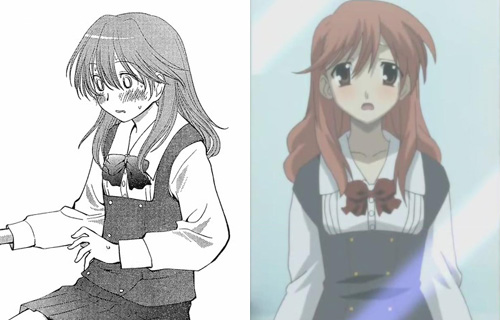
Ogiue: Nakano Azusa, underclassman guitarist from K-ON!

The entirety of Ohno’s selection for Hato consists of crossdressing characters. Though I can’t recognize all of them, at least one of them is Maria from Mariaholic. Yajima’s outfit is arguably the most embarrassing, coming from a manga series by the character designer of badonkadonk resource Real Drive, but given Yajima’s personality that must have been the most conservative outfit of the bunch. It’s interesting that Ohno would see “overweight girl” and interpret that as “cosplay as thick ladies,” though it makes sense in retrospect. Yajima’s outfit this chapter shows that she’s actually quite busty, and much like when Ogiue first cosplayed way back when though, it kind of makes you aware of the fact that Yajima’s baggy clothes are partially the result of shame. How appropriate it is then that Yoshitake is dressed as a character with a similar dilemma.

Ogiue as Azusa of course makes it own kind of sense, especially when you factor in the fact that the girls of the light music club pushed Azusa towards the Azunyan cat motif somewhat resembles Ohno’s own constant persuasion of Ogiue into cosplay. In fact, Ohno can draw a number of parallels to K-ON!‘s Yamanaka Sawako.

Interestingly, everyone except Ogiue is dressed as a main character, despite the fact that Ogiue was pretty much the central focus of the second half of the original Genshiken. If I were to be somewhat liberal with my interpretation, I’d say that this is symbolic of the direction of Genshiken II, where the new girls are starting to establish themselves as the main stars of the new series. As I’ve said before though, I’m quite okay with this, despite my fondness for Ogiue, as it feeds into one of the themes of Genshiken, that of the continuous renewal of the club.

Looking forward, with Angela around, the chances of a Sue-centric chapter rise greatly. And in the spirit of Sue, we’ll end with a fourth-wall-breaking image.

Distance to Travel: The Borrower Arrietty

Thanks to a twitter tip by the fine folks at Tsunacon, I found out that there was a showing last week of the latest Ghibli movie, The Borrower Arrietty, at the Melkweg theater in Amsterdam. Luck would also have it that I’d come down with a cold during the same period, but I managed to power through and experience my first theatrical anime in the Netherlands, and second time in a Dutch theater overall.

The first time, I had gone to see Harry Potter and the Deathly Hallows, Part 1, and it carried the unique challenge of having the audio in a language I understand (English) with subtitles in a language I don’t know but is fairly close (Dutch). Perhaps due to my experience as an anime fan, I found my eyes gravitating towards the Dutch subtitles, and because written Dutch is so closely related to English it would occasionally interfere with my ability to understand what characters were saying, almost as if the subtitles were in English but accidentally taken from the script of Harry Potter and the Half-Blood Prince. For The Borrower Arrietty, the movie was presented with Japanese audio and Dutch subtitles, and I found it a lot easier this time to ignore the Dutch. I think it had to do with both the fact that Japanese and Dutch are quite far apart as languages, and that I had gained the experience of Deathly Hallows. Which is to say, I was able to avoid one potential distraction, and even my cold seemed to play nice. Either that, or the movie drew me in enough that I could comfortably ignore it.

The Borrower Arrietty follows a small family of Borrowers, a race of small people no taller than a ballpoint pen. Living underneath a house inhabited by normal humans, they “borrow” the tiniest amount of materials from the human world in order to fulfill their own needs. The humans meanwhile are oblivious to their existence, and the Borrowers in turn avoid all contact with humans. Arrietty is the family’s only child, a 14-year-old girl who is set to go on her very first “borrowing” with her father, but who is already quite adventurous and often wanders outside to explore. Living above them is a new resident named Sho, a young boy with a heart condition.

The world of the Borrowers is a patch-work world of human products appropriated for use by tiny people, and it is in the portrayal of this world that the movie really shines. Whereas a lesser film would constantly make obvious references to scale, Arrietty does this through a mixture of subtle visual effects and through the characters’ natural interaction with their environment, and it is the first thing that really pulled me into the movie. A hand cloth becomes a blanket, a clothespin becomes a hair clip, staples become the rungs of a ladder. When the family of Borrowers is gathering at the dinner table, they have tea which they pour out of a tiny teapot, but while the teapot is scaled down for their usage, the tea comes out not as a steady flow but as droplets which swell at the tip of the spout due to the small opening and the natural cohesiveness of water. Backpacks are held together by velcro; when viewed from the perspective of a Borrower, the fastening and unfastening feels quite alien. The world is a whimsical and dangerous frontier.

Without giving away too much, The Borrower Arrietty is about physical, social, and conceptual divides. There is the sheer size difference between human and Borrower, the purposeful separation of the two species, and even the way a length of distance for a person can seem mercilessly long to a creature 1/20 our size, or for that matter, for a boy with a weak heart. The film is also about working to bridge those divides, and the degree to which it succeeds actually depends on your own outlook on life. Arietty is as optimistic as you make it out to be.

The Borrower Arrietty is not directed by Takahata or Miyazaki or even Miyazaki’s son Goro, but by Yonebayashi Hiromasa, who has worked on Ghibli films before but is in the director’s chair for the first time. When the movie began, I wondered as to what extent Miyazaki would influence future Ghibli films of which he is no longer apart. Granted, Miyazaki still has a big hand in Arrietty, being responsible for planning and screenplay, but I still had to ask myself how much “Miyazaki-style” and “Ghibli-style” would go hand in hand as time passes. Fortunately (or not), The Borrower Arrietty made me quickly forget my own inquiry with its engrossing visuals and storytelling, and by the time it was finished I felt myself not worrying about it so much.

Vistas: Final Fantasy Advent Children & Character Camera

I’ve written a post concerning Final Fantasy: Advent Children as part of our “multi-vistas” category at the Vistas blog, where everyone on the blog takes a look at the same work and writes a response. Mine is about the character-centric visuals of Advent Children as well as some personal elements, while my colleagues have written about Advent Children as Fantasy vs. Science Fiction and the lack of discrete visibility in its action scenes and its possibilities.

Japan: Opportunities to Give and Consider

A number of sites have cropped up in the wake of the 8.9~9.0 magnitude earthquake that hit Japan last Friday and the ensuing tsunami and nuclear scare with the purpose of uniting anime fans to donate to Japan. Certainly a noble cause, but one that I have honestly not felt entirely comfortable with, just because I don’t want it to be “about” being an anime fan.

I have benefited greatly from anime and manga. It has been a great source of entertainment, comfort, self-realization, and even one of the reasons I currently have an unbelievably wonderful job. I studied in Japan because of a love of animation, and I continue to make friends in Japan because of that passion. But before I could donate as an anime fan or an anime blogger, I had to do so as a human being.

However, I realized that it’s not my place to tell people “why” they should donate, or even if they should be donating at all. I have my reasons for acting as I have, and I know that the folks running these donation drives have the best intentions at heart. The more opportunities the better, and I can at least provide people with links to donate, whether you want to do it as an anime fan, an anime blogger, or just a person who wants to help.

Anime Fans Give Back to Japan: They’re doing a 24-hour podcast tomorrow, March 19th, starting at 6pm EST. They have a number of fans, podcasters, and even industry professionals lined up to show their support.

Crunchyroll Japan Earthquake Donation Fund: The biggest streaming site for anime promises to match donations.

Anime and Manga Bloggers for Japan: They’ve got two donations going, one for Shelter Box, and one for Doctors Without Borders, a self-explanatory group that I first came to know due to their distribution of Plumpy Nut to combat malnutrition in Africa. That’s not exactly the problem here, but I think it says a lot about their mission.

Japan Society: 100% of donations go straight to helping Japan.

Red Cross

UNICEF

Lastly, a lot of artists have been creating work in response to the earthquake, and as much as I have neglected that side of myself, I felt my hand moving on its own when put in front of a piece of lined paper and given a writing tool to work with. It’s not exactly a clear-cut “Pray for Japan” image, but it definitely comes from the heart.

And Then Takuto Will Catch a Bullet with His Teeth

A Star Driver-themed video uploaded to Tumblr, I expect it to get glowing reviews.

Spoilers for those who haven’t seen Star Driver.

Inspired by this tweet.

Hope They’re Okay

I do not have any relatives in Japan, and I’m grateful for that. No need to worry in that regard.

But I do have friends living in Japan, people I’ve met both in real life and online. I’m not sure if this qualifies as irony, but whereas the folks I know primarily through the internet I can more easily find through those channels (or at least try to), the people I met in real life first are the people I have less chance of contacting. Whether it’s through changing e-mail addresses or just lack of contact over time, I have people whom I would call friends who are probably in Japan right now and I have no idea if they’re okay or not, and I have no way of ever finding out. Part of me regrets my own lack of initiative to try and keep up with them in the first place.

It reminds me of the first time I ever ate udon and onigiri, at a small Japanese restaurant in the World Trade Center, back in about 1999 or so. The udon was amazing as far as I could tell with my limited experience, and the onigiri were $2 per ball and absolutely gigantic. I never really got to know the owners or anything, so when 9/11 hit I found myself wondering whether or not the people working there made it out okay. Of course, I have no way of ever knowing.

I do not have any amazingly close ties to Japan. I’m not going to lose much sleep over it. But I do hope my friends are okay.

Creamy Mami, All Alone

I’m a little less than halfway through 80s magical girl anime Mahou no Tenshi Creamy Mami, and though it’s fairly entertaining I haven’t really been feeling it. I’ll watch a couple episodes and then have no motivation to keep watching, unlike when I watch, say, Ojamajo Doremi where I almost have to stop myself from watching more. It’s not particularly boring or offensive or anything like that, so for a while I just wasn’t sure why Creamy Mami wasn’t quite gelling for me, but I’ve finally figured it out.

Morisawa Yuu, the girl who transforms into Creamy Mami, has no female friends around her own age.

Instead, you mostly see her interact with adults (some of whom she primarily talks to as Creamy Mami), a couple of male friends, and only rarely do you get a one-off female character the same age as Yuu. This isn’t a problem in and of itself, especially given that it is very possible for a girl to be friends with guys her own age, but in the show Yuu likes one of them, the other one likes her, and that one is the comic-relief fat kid. We never get to see Yuu interact with someone who can truly be considered her peer and equal, and I think it can be a problem, even if the show was intentionally designed that way. (Cardcaptor) Sakura has Tomoyo, Nagisa (Cure Black) has Honoka (Cure White) and her lacrosse team, and even Mitsuki (Full Moon o Sagashite), who also transforms into an older girl, can be seen interacting with her female classmates. All of them are better characters for it.

Without a female friend of the same age, Yuu kind of feels that she’s only there to transform into Creamy Mami, which she very well might be, but I think that she would have been fleshed out much better in a way that doesn’t run contrary to the overall feel of the anime if she had such a friend. I could possibly say that the show works as a somewhat minimalist anime, where only the bare essentials are needed to drive it forward, but even that could have benefited from a female friend for Yuu.

Quality of the Moe

Moe discussion in anime fandom seems to ebb and flow, and whenever it turns into an argument, both sides tend to overreact greatly. Bikasuishin over at tsurupeta.info recently pointed out a trend among moe detractors who try to argue from a position of intellectual superiority, where they attempt to give a sense of scale, history, and purpose to their examination of moe but get a little too ambitious and fail in the process, an overreaction in the sense that they are overeager to show how moe hurts anime. I want to address what is in a sense the other side of this, the tendency for moe supporters to be overly defensive in protecting their cherished genre. I will not be using as amusingly sarcastic a tone as Bikasuishin, but will instead be offering what I think is a better solution for people who tend to take the defensive position, one of understanding and civility, rather than exacerbating an “Us” vs. “Them” mentality.

Before I get into the meat of things, I want to just clear the ground for the kind of “moe” I’m talking about. Now, I am of the strong belief that feelings of moe are a very personal thing and that you can get them in works that are not specifically designed to be moe. For the sake of simplicity and convenience though, I’m mainly going to focus on titles that are usually considered “moe” either by the desires of creators, marketers, and what have you, or by the fans themselves. In other words, “moe anime” as opposed to “anime that can be moe.”

Imagine a somewhat extreme and simplified argument against moe, such as “moe anime are terrible and devoid of any real value and is a sign of stunted emotional growth.” In such a situation, I often times see a defensive, albeit well-meaning response from moe fans, something along the lines of, “Leave us moe fans alone! We’re just enjoying ourselves.” That’s fair enough, but the problem here lies in the way the accusation was brought up. Nested inside that negative statement on moe is the following statement: “Prove me wrong.” There’s a discrepancy between the attack and the response, as if the two are on completely different wavelengths.

But even though defense is not the best defense, offense is an even worse option. If the counterargument essentially boils down to “No, you’re the man-children and your anime sucks compared to glorious moe,” that accomplishes nothing. This is because hidden inside the nested statement of “Prove me wrong” is another idea: “Moe fans have no standards.” So whether the moe fan has gone completely defensive and tries to trivialize the concept of “quality” or has instead decided to counterattack by showing how moe is “just as good as” or “even better than” other anime out there, to the detractor it seems as if the moe fan could not handle the implicit debate set forth.

Rather than turtling up or fighting fire with fire, my advice is to show that you do have standards… about moe. Show that you can point to one of two moe shows and say, “I think this is a better moe anime,” and be able to state your reasons why. They don’t have to be reasons based purely on logic and rationality and a devotion to a well-crafted story, nor do they have to be overly exacting standards where only .1% of moe is really okay. You can even include your feelings towards the titles in question in your explanation. In fact, I encourage it. The key here is to be able to say, “I find this moe anime personally valuable and here’s why,” perhaps even, “This what I feel moe positively brings to anime.” By doing so, you can show that you are discerning towards the very genre of which you’re a fan, and that the moe genre itself is not simply what happens when you take anime and make it inherently worse, as some might see it.

The goal is not to convert people to moe. Some people simply cannot be convinced, and even if you show your own value system towards the anime you like (or don’t), not all reasons are going to work for everybody. If you tell me you like Show A over Show B because Show A has ten girls and Show B only has nine, while you’re free to say that, I’m just as free to find that to be a terrible reason. But by showing that you have personal standards when it comes to moe, and can perhaps even point out a moe anime that a person who is not a fan of moe can enjoy, you can make your opinion known in a respectful manner, and if they decide they can’t agree, then there’s nothing more to do. You made your case, after all. The key to this “defense” is to not defend at all, but to let people know that moe is a genre that can be utilized effectively, one that can succeed or fail on its own terms, however you want to define the terms of success.

It’s pretty much impossible to defend every single title that falls under the banner of “moe anime,” just as it’s impossible to defend every single giant robot anime or every romantic comedy film, because not only is it highly unlikely that every single one will succeed in what they’ve set out to do, but it’s even more unlikely that a single person will enjoy every approach taken no matter what. However, defending all of moe is not the same as defending moe as a genre. One is defense in absence of personal discernment and the other is defense of the potential of a genre, with hopefully some real examples to support.

If you want to see a more concrete sample of what I’m talking about, take a look at my review of Toradora! It’s not the best thing I’ve ever written, and looking back I think I’m a little too hard on the Kugimiya Rie-voiced tsundere character type, but I think it does a pretty good job of showing why I find Toradora! to be a remarkable moe show, and I don’t expect impeccable writing from every single person writing about what they like about moe. You can also see me defending the show after someone left a negative comment. I have to admit that I got a little too spirited in defending Toradora!, but that’s exactly the kind of experience which has me writing this very post.