Can She Manage? Listen, Bud

The Time of Retribution, Battle 2: Genshiken II, Chapter 63

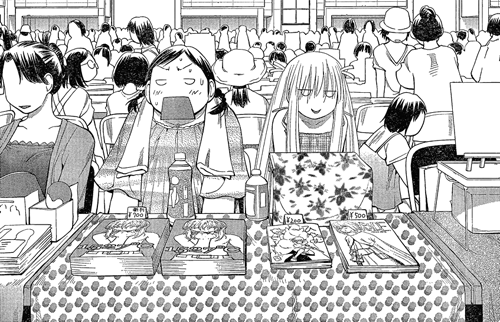
Chapter 63 of Genshiken II is day 1 of Comic Festival, and some of the very best Genshiken chapters have been in that venue. This time around is no exception, and in fact it’s one of the most densely packed chapters ever in the manga. There’s a lot to go through, so let’s do a quick run-down first.

After finishing the second half of her debut professional work, Ogiue pulls an all-nighter to crank out an additional cheaper-quality doujinshi to complement her collaborative effort with Yabusaki. Unable to make it to Comic Festival before the afternoon, she sends Sue in her place, who naturally torments Yabusaki and gets along well with Asada the cat-faced girl, whose first name we discover is “Naoko” (We also get verification on pronunciation of at least the first half of Ogiue’s pen name: Ogino). As Comic Festival begins, a line begins to form at their table due to the popularity of Ogiue’s published manga, which leaves Yabusaki flustered.

I’m not sure if this is Yabusaki’s ComiFest debut or not, but it is Hato’s first time attending. This being Day 1 (the girl-oriented day), he crossplays as Yamada from Kujibiki Unbalance in order to make it less awkward for him to purchase his desired yaoi doujinshi, and in doing so continues the club tradition of Kujian cosplay. Managing to fool men and women alike, Hato ends up facing a dilemma when he’s confronted with having to hold up a large sign for the men’s bathroom, a situation he tries to avoid but is naturally inevitable. While Sue attacks from a fortified position through her signature obscure references (Kyuukyoku Choujin R), Angela brings the gaijin assault head on; when she’s not teaming up for a startlingly apt Panty & Stocking cosplay with Ohno, she’s grabbing Hato’s chest to verify his gender.

Ogiue meanwhile finally leaves her apartment, but at the same time over at Tokyo Big Sight, Nakajima, Ogiue’s old “friend” from her traumatic junior high days, visits Yabusaki’s table expecting Ogiue to be there, wherein the chapter ends on this cliffhanger.

Phew! And again, there’s still two more days of ComiFest left.

The last time Nakajima visited, it conjured up bad memories for Ogiue, who was already dealing with the inner turmoil of shame over her attraction to Sasahara and her fear of hurting him as she did her old boyfriend Makita back in junior high. Since then, Ogiue has learned to accept herself, start dating again, and has even turned her passion for drawing into a career, but when you think about it, she has still never directly confronted Nakajima. Prior to Genshiken II, we could only speculate as to whether or not this would ever happen. Now, short of meeting Makita again, this might very well be the true bookend to Ogiue’s growth over the course of the series, a way to decide her destiny, if you will. All of this has me giddy with anticipation, because while Genshiken II has been delivering so far, all of the fun and games make it easy to forget that this series also handles the dramatic incredibly well.

That’s not to say that the comedy of Genshiken needs to take a hike, as the chapter was hilarious and informative all-around. Hato’s plight is not one I can say I’ve experienced, but I can really feel for the poor guy. It’s interesting to remember that Hato drew a distinction in his mind between cosplay and crossdressing, and also to kind of compare it with Ohno’s own views on cosplaying, particularly that it’s wholly different from dressing sexily. There’s quite a bit of commonality between the two in this respect. And speaking of cosplay, I can’t help but to compare Ohno’s taste in older men to Stocking’s overall poor taste in men, as some would argue that the former is a case of the latter. I’ve also always seen Angela as being more sexually active than the other characters in Genshiken, though obviously not to the extent that Panty does. And if that weren’t enough, Ohno once remarked that her chest is bigger than Angela’s, a situation mirrored somewhat with the Anarchy sisters they’re cosplaying.

The chapter also reveals quite a bit about Sue’s development, specifically in regards to her growing language skills. When Sue first appears, she speaks purely in anime and manga quotes. When she makes her second visit to Japan, she shows that her listening comprehension has grown dramatically. By the time she began studying abroad at Shiiou University, her vocabulary had expanded to the point that she could communicate without the use of otaku references. Now, Sue takes the next step.

It’s not evident in English versions of the Genshiken manga (or at all in any of the anime), but one of the features of Sue’s Japanese is that it’s written primarily in katakana to represent her foreign accent. In this chapter though, some of that katakana has begun turning into hiragana, the script used primarily for non-loan words, indicating that her Japanese is reaching an even greater point of fluency. Personally speaking, I made my greatest strides in my Japanese language skills while studying in Japan, and to see the same happening with Sue brings a smile to my face.

And you wouldn’t believe how glad I am that Kio’s finally told us how to pronounce at least some of Ogiue’s pen name. I’ve even made the appropriate correction to her Fujoshi File.

In any case, I’m probably more stoked for the next chapter of Genshiken II than I’ve ever been. Comic Festival, it always delivers.

The Fujoshi Files 20: 801-chan

Name: 801-chan (801ちゃん)
Alias: Kitaooji Nasubi (北大路茄子)
Relationship Status: Married
Origin: Tonari no 801-chan

Information:
801-chan (pronounced “Yaoi-chan”) is a company employee in her 20s and an otaku with two great joys in life. The first is her boyfriend-turned-husband, Tibet, a fellow otaku she affectionately calls “Chibe-kun,” whom she first met online. The second would be viewing her hobby through the lens of moe and BL, though she has her own complex internal logic about it. She has many favorites, including Dearka from Gundam SEED, but is notably fond of the Prince of Tennis musical, which she has gone to see on more than one occasion. She also draws.

When 801-chan is particularly roused by yaoi, a green furry creature emerges out of her back, representing her passion for it. Fortunately for her, she has many friends who share her fondness for the subject (and also have hidden yaoi forms), notably her good friend BL-chan and an older co-worker named Kifujin-senpai. This also includes her younger sister, Hina-chan, though 801-chan sometimes finds her exasperating.

Fujoshi Level:
That 801-chan possesses an alternate form dedicated to yaoi already shows that she is quite a strong fujoshi, but compounding this is the fact that her appearances as the green monster might just outnumber her appearances as a regular woman. She is also capable of applying BL to unexpected things, such as the all-girl j-pop band, AKB48. Moreover, not only is she one of the representative fujoshi characters in anime and manga, but 801-chan is actually originally based on the author’s significant other. Her twitter can be found here.

Takekuma x Akamatsu, A Must-Read Discussion of the Future of Manga

Kransom over at 2chan.us (formerly known as Welcome Datacomp) has posted a translation of a fantastic discussion between Akamatsu Ken, author of Love Hina and Negima!, and Takekuma Kentarou, co-author of Even a Monkey Can Draw Manga, manga editor, and professor at Kyoto Seika University. The two of them talk about their mutual forecasts of a collapsing manga publishing industry, as well as their widely varying opinions on what they think should be done to correct that. I highly recommend reading all five parts.

They touch on a great number of topics, including the origin of Akamatsu’s J-Comi site and Takekuma’s research into how Shounen Jump became king as an indirect result of the 1973 Oil Crisis, but one of the particularly interesting topics they discuss how the roles of artists and editors may change in an age where big manga publishers such as Shueisha and Kodansha might not even exist. Akamatsu, rather than being the stereotypical artist who cares little for profit, is incredibly practical and sales-oriented, whereas Takekuma concerns himself more with thinking about what the artists want to do.

The danger of self-publishing, be it in a printed book format or as something viewed online or on an e-book reader is that there is a lack of quality control. While the environment that Takekuma and Akamatsu are thinking about is not quite at that point, the common idea here is that a lack of editorial feedback is something which can limit the success of both a weaker manga industry as well as a self-published title. Both Takekuma and Akamatsu agree to the importance of editors, and believe that the key will be an increase in freelance editors who, rather than being able to rely on a salaried position at a publishing company, will have to make a living by showing their skills at fostering talent. They’ll also have to act somewhat as agents for their independent artists, or if not, the artists themselves have to be their own agents. Those who can only draw will not survive, not only because they won’t know how to market themselves, but because they won’t be compatible with this new breed of editor.

I can’t help but think about the power structure that would exist should such a system come into existence. Ideally, the artists, editors (freelance or otherwise), and publishers will all regard each other as equally important in the whole process, but I get the feeling that it wouldn’t quite turn out that way. Granted, the role of editor and artist even now is not consistent across each publishing company, so it’s not like the manga industry would be changing from one universal form to another, but the fact that the manga industry would, in Takekuma’s view, become even more free-market, especially for editors, makes me picture some kind of wild west frontier for manga. Again, this has its benefits, but as Akamatsu points out, one of the benefits of manga is that compared to making a television series or even an anime, making a manga is much less expensive, and so a greater variety of ideas can be explored with less risk to those involved.

If the manga industry does get to a level where those involved with manga have to put more on the line to get published, there is a chance that it might stifle one of the great strengths of manga, and I doubt the artists who tend to be so overworked will have any less of a burden on them. In the face of this, Takekuma’s point that we may see many more manga artists with modest salaries instead of wealthier artists (Akamatsu, for example) may simply be the result of a changing perception of what it means to be “successful” manga.

Madoka Magica and…Sacrifice?

Puella Magi Madoka Magica has come and gone, and it’s going to be a subject of much discussion. Part of it may simply be that the delay caused by the earthquake in tsunami Japan magnified the anticipation for the finale even more than the already huge expectations for the show, but I think this anime is going to stick in people’s minds for at least the near future. Though the show has its flaws, overly expository dialogue and some contrived twists to name a couple, I found it to be an overall strong show and indeed an interesting twist on the magical girl genre that understands what magical girls are about.

I’m going to be discussing the show and its ending in depth, so take this as the Spoiler Warning.

Continue reading

A Tale of Two Harems: Kore Wa Zombie Desuka? vs. Infinite Stratos

WARNING: Spoilers.

When the Winter 2011 season of anime began I saw two harem anime on the schedule. One was Kore wa Zombie Desuka?, which apparently being zombie-themed I wrote off as something to skip. The other was Infinite Stratos, which, while likely not to set my world on fire, had mecha and SF elements that I wanted to check out.  But thanks to a tip from Sub, I decided to check out Zombie after all, and now that I’ve finished these dual harem series, I find that my relative opinion has flipped. Kore wa Zombie Desuka? is a pleasant surprise, while Infinite Stratos‘s faults far outweigh its strengths.

First, let’s actually list the highlights of Infinite Stratos.

  • Good character designs, better than Zombie
  • Charlotte Dunois
  • The fact that it did not turn into a tournament fighting series

In contrast, I feel that the strengths of Kore wa Zombie Desuka? are substantial enough that they shouldn’t be listed in bullet form, but to sum them up, Zombie does a good job of playing with the conventions of the harem genre and bolstering many of the areas where harem shows tend to be weak. The main character in a harem series tends to take a lot of physical damage, so the series incorporates that into the basics of the setup. The hero Aikawa Ayumu is made undead, so that he can take abuse far beyond what is normal and regenerate. Whereas most harem protagonists tend to waffle and lack motivation, we see that from the very start of the series he has an initial goal to spur him on: to find the person who killed him. He’s still your Average Japanese Guy with Extraordinary Circumstances, but just by having drive and personality, you can see why more than one girl might take an interest in him.

Harem anime are really all about the girls. It is something I gladly accept when watching harem shows, but I prefer to see that the girls have fallen in love with the main character for something resembling a good reason. It helps that Ayumu has something called a personality, as well as traits that are actually admirable instead of vague “nice guy” characteristics, but Kore wa Zombie Desuka? also shows the girls actually developing feelings for him. Seeing the female necromancer Eucliwood’s first meeting with Ayumu, we can see how he charms her with a goofy and well-meaning attitude. Haruna, a chainsaw-wielding magical girl, is witness to Ayumu’s continuous noble actions and sense of self-worth. We can even see where feelings don’t develop with Mael Strom, who does not have feelings for Ayumu but actually works to go from indifference to affection-after-the-fact in some kind of twisted parody of an arranged marriage.

The girls of Zombie are not particularly well-developed in terms of personality, but they have a manic edge to them where their simple traits are pushed to the extreme without having them become tiresomely one-dimensional. This is probably most evident with Seraphim, a deadly vampire ninja not unlike a couple of Axe Cop characters, whose hobby, talent, and favorite word are all the same thing: Tsubamegaeshi, a sword technique, and whose catch phrase, calling Ayumu a “piece of shit,” feels delivered with sincere malice instead of being there to compensate for any sort of weak, fragile interior.

Infinite Stratos fails to convince me that most of the girls have legitimate reasons to be interested in the main character, Orimura Ichika. Looking at four out of the five girls in IS, two of them are childhood friends and two of them fall in love with him after a single fight. With neither situation are these explanations given time to develop. They just are, as if their purpose is to get Ichika in the harem situation as quickly and efficiently as possible. Instead of further flattening the characters as Zombie did, IS sees fit to give them contrived flashbacks where a girl will literally narrate to the viewer as to why her life is tragic. Ichika does this as well, and it doesn’t happen until half-way through, so when we first see him, he’s just a bland fellow who draws all the ladies for Some Reason.

This is actually why I emphasized Charlotte Dunois as one of the highlights of Infinite Stratos, because she is the only girl among the five whose eventual attraction towards Ichika was given room to develop. Charlotte Dunois starts off disguised as a boy, and as the only other guy in the school, Ichika finds a comrade in “Charles.” Their friendship grows through this “male” bonding, and with Ichika talking to her closely and comfortably, it makes sense that she would develop intimate feelings. If more of the girls in Infinite Stratos had this sort of portrayal, instead of having their affections develop out of un-reasons, then my opinion might have very well been more even between the two shows.

The essential strength and flaw respectively of each show is that Kore wa Zombie Desuka? creatively manipulates the harem genre conventions while Infinite Stratos feels beholden to them. This is evident even in each show’s approach to the dramatic. While neither series excels in this regard, in Kore wa Zombie Desuka? the dramatic elements are continuously built upon and reach a fairly satisfying conclusion, while with Infinite Stratos, much like the flimsy bases for affection, the drama just seems to appear instantly and recede just as quickly.

Overall, while I would say that the girls in Infinite Stratos are more attractive, it does not feel as complete a product as Kore wa Zombie Desuka?, which is able to show that a lot can be done with the harem genre without completely subverting it School Days-style. In doing so, Zombie winds up being the better anime.

In Celebration of a Life, Short-lived: Sym-Bionic Titan

This past weekend was the final episode of Sym-Bionic Titan. I wish I didn’t have to say that.

When I first started watching anime, one of the most enticing aspects of it over many of the American cartoons I watched at the time was that, not only did they have on-going stories, but that those stories actually finished. They had conclusions. They weren’t always good conclusions (or good shows), and many times they were so open-ended you weren’t sure what exactly had happened, but you knew that if you started something, chances are you’d get something final out of it by the end.

American cartoons had managed to get some decisive finishes through, such as in Gargoyles or Conan the Adventurer, and I’ll even count the end of the Saturday morning version of Sonic the Hedgehog as a decisive finish despite it setting the stage for another season that never came to be. But for every one of those, you got a Pirates of Darkwater, where the show was set up from the start to reach a certain conclusion, but the show just stops in the middle and all you’re left with is your own imaginative speculation and/or fanfiction. I thought we were past this era, but I was wrong.

Sym-Bionic Titan was the brainchild of Genndy Tartakovsky, the man behind Dexter’s Laboratory and Samurai Jack, and it was his most ambitious and best-looking work to date. Following a trio of aliens (Lance the soldier, Ilana the Princess, Octus the robot) who escaped to Earth as the last hope to save their world of Galaluna from a traitorous general, the show took cues from Japanese super robot cartoons, American action cartoons, teen films, and various other areas and channeled them through some of the most deft usage of flash animation I’d ever seen. Much like Panty & Stocking with Garterbelt (and I have drawn comparisons between them before), it poked fun at genre conventions from multiple genres, and did so with style and grace-disguised-as-clumsiness.  It was a sign that Genndy had learned a lot since working on Samurai Jack, where the animation was often nice but felt very flat, and he married it with excellent characters and an intriguing plot. There were many mysteries in the show. What was Modula’s true motive? What really happened to Lance’s dad? Who was the mysterious person behind the Galactic Guardian Group? While the show could have easily gone on forever, it was not in its best interest to do so, as there was a real sense of urgency throughout the show, especially when you learned more and more about the characters and where they came from and why, on a personal level, they fight.

But Sym-Bionic Titan ran its initial 20 episodes, and was not renewed for more. Genndy Tartakovsky has moved on from Cartoon Network, possibly frustrated that they never let him finish his works. Samurai Jack never fought his decisive battle with Aku, and it’s unlikely that Lance, Ilana, and Octus will ever be able to return to Galaluna for a showdown with Modula. Was the show not doing well? Was it just not getting the money behind it to continue on?

It turns out that the reason given is that the show was actually doing quite well, but it did not have enough toys connected to it. I can see this being a problem, but I have to point out the fact that the show is ABOUT PEOPLE WHO TRANSFORM INTO ROBOT SUITS WHO COMBINE INTO A GIANT ROBOT THAT FIGHTS GIANT MONSTERS. That they couldn’t figure out how to convert this concept into toys is nothing short of ridiculous, and so the reasoning behind the show’s cancellation feels flimsy at best, an act of malice at worst.

Now there’s a possibility that Genndy pulled a Bill Watterson and specifically forbade merchandise from being made, but I highly doubt that. For one thing, he had hoped for a continuation of the series. This much is obvious based merely on the way the show is set up and how its final episode leaves room for so much more, let alone him actually saying as such. For another, the show’s explicit homage to Japanese giant robot cartoons makes it very likely that Genndy was not ignorant of the genre’s toy-centric origins or the fact that giant robot anime practically grew that merchandise industry in Japan to enormous proportions.

So even with the lack of an ending, is Sym-Bionic Titan worth watching? Yes, very much so. Do it.

Tsumo Times and a Ron Wait

I was back in New York recently for a short while, a period that just so happened to coincide with the latest instance of my favorite mahjong gathering, the USPML‘s monthly open play events. Bringing with me exotic cuisine from beyond the oceans, I played my first offline mahjong game in many months.

It was good to see many familiar faces and even some new ones, as well as to learn that the USPML has only gained in popularity since I last saw them. Where once we barely were able to get sixteen players to fill four tables, we now had somewhere like 6-8 tables. I even saw an enterprising older woman there, learning the game amongst us young Turks. I wondered if she had experience playing an American form of mahjong and decided to expand her horizons. If that’s the case, she is a better person than me, who has no experience with mahjong outside of Japanese-style and one bad game of Taiwanese mahjong on X-Box Live.

I can’t say whether or not I’ve made significant improvements in my mahjong, but I did end up winning both games I played that day. The first was a rough-and-tumble game where I managed to win here and there and gain a small lead going into the final round. The difference was about 4000 points, so a mangan tsumo or a direct hit with about a 3 yaku hand could’ve knocked me off my perch, but I went for a quick, cheap, and most importantly closed hand. I purposely decided not to call reach as it would have made everyone overly defensive. In the end, I won with a simple pinfu.

The second game, I won a haneman and a mangan early on and held my lead by winning a large amount of cheap hands, many times with no yaku to speak of other than when I decided to reach. In a way it’s a dirty, yet effective way of playing. However, my victory is not the biggest story to come out of Game 2. That honor instead goes to my mahjong comrade, Dave aka Sub.

In an early round (it may have been the first), one of the players had called a closed kan. This was already dangerous, as it was a kan of the dora, but when this new dora indicator flipped over to reveal that it was a twin of a previous dora indicator, things got to a Washizu-level of bad. There, staring us all in the face was an 8-dora hand, an automatic Baiman, and who knew what else lurked within the the unrevealed tiles? Later on, we found out that this was a hand of much destructive power in more ways than one, as it not only turned out to be an 11-dora hand thanks to another kan that had been called, but that it was in position for a possible Yakuman, the Suu An Kou. But whether he got that standard Yakuman or not, the hand would’ve easily surpassed 13 dora, which would have given it equivalent power to a Yakuman. In other words, no matter how he would have won, he would have gained 32,000 points and potentially ended the game right there.

But Dave was a hero. Abandoning any notions of grandeur, he quickly called for some tiles. A few turns later, he won, and off the player with that amazing hand no less. Crisis averted. It was only after Dave’s smooth counter-offense that we realized how much danger we were really in. I may have won the game overall, but did I really?

See you guys around again. Playing has made me want to scope out the Dutch mahjong associations that I know exist.

Preventing Anime Burn-Out

Every so often I’ve been asked how not to burn out on anime, but I haven’t been able to formulate a proper response. Sure, I’ve talked about how to not burn out on anime blogging, but nothing tackling the beast itself. With the new season starting up though, I figured now was as good a time as any to address that malady which afflicts so many otaku and their disposition towards anime. It won’t be a sure-fire guide to preventing burn-out, but I think it’ll at least help get you somewhere in the realm of a right mind.

I’ve never really burned out on anime, so in the sense that I have never hit the bottom and risen back up to fight another day, I may not be entirely qualified to talk about avoiding burn-out. However, I do have times when the act of watching anime can seem overwhelming, as well as times when I just don’t feel like watching anything or feel myself not enjoying what I’m watching as much. One such moment occurred a couple of months ago, as I found my attention was drifting away while watching Creamy Mami. I had some other shows I was watching at the time, but I was feeling a stronger desire to check out competitive Starcraft II matches. I had to ask myself, was it really happening? Was I really getting tired of anime?

Then I remembered that just the day before I was being riveted by Legend of the Galactic Heroes. I had an untouched full series of Ojamajo Doremi Sharp that I know I would enjoy but hadn’t gotten around to yet. The fantastic Heartcatch Precure had just finished or was about to finish, and I’d just been enjoying Star Driver since the fall season. I also knew that some of the shows I was ignoring in favor of watching Nada siege tank someone to death were not shows I was chomping at the bit to follow…at that moment. Things could change given a couple of days. Rather than finding myself in the beginning stages of anime burn-out, I realized that I was simply being incredibly short-sighted.

It’s easy to trick yourself into dwelling on the negative experiences. Remembering the bad more than the good, it then can cause you to create unfair demands for anime because they’re based on a desperation to be knocked out of your funk, and when the next batch of shows don’t rescue you from yourself, the burn-out becomes that much worse.

So then, how do you stop that from happening?

If you’re worrying about the shows in the here and now, I think it’s a good idea to just take a mental step back and look at the shows you’d been watching previously. I know that on the internet and among anime fandom there’s a tendency to quickly forget anime after it has finished airing, but don’t be like me and get caught up in your own myopia. One year ago isn’t that long a period of time, let alone three to six months ago.

Don’t be afraid to stop watching those specific anime that seem to be dragging for you and to replace them with something you think you’d enjoy more. If you’re not sure whether you actually dislike a show or if you’re just not feeling it, put it on the back burner for a while. If it’s a current show that you’ve been keeping up with week after week, don’t get so attached to the rat race that watching it becomes more of a chore than anything else. See if you can come back to it a few weeks or even a few months later, when you’re feeling sharper. If you must keep up with it as it airs, and I have to again recommend you not fall into this trap, let it run as you’re doing other things. A lot of television in general is made with the assumption that its audience will not always be paying full attention.

Anime burn-out is largely psychological. How you define it is ultimately up to you. If you find the amount of shows you’re interested in dwindling, it doesn’t necessarily mean you’re not enjoying anime anymore, it can just mean you’re watching fewer shows. If you’re not feeling any of the shows currently running, don’t be afraid to look backwards, to older anime. If you’re really finding nothing to watch, perhaps think about what it is exactly you’re looking for. Whether you’re following ten shows or just one or are even deciding not to watch any anime for a little while, the quantity of anime doesn’t have to define your interest in anime or your identity as an anime fan.

Who is the Daytona USA announcer’s favorite philosopher?

Roland Barthes