I’m a Dreamer, Moeru Power: Genshiken II, Chapter 61

The newest chapter of Genshiken II hints at the most glorious team-up in otaku manga history. However, the antics of Battlehopkins and Double Asada are only for a few panels, and the real focus is split this time around between Ogiue’s precarious deadline juggling and Hato engaging in a Hato x Mada-themed thought exercise. This month’s theme is friendship!

Before we jump into the chapter though, I want to point out the next-chapter anime references that are at the end of each chapter. We’ve seen Occult Academy, K-ON!, and Heartcatch Precure, among others. This time it’s Jewelpet Tinkle. I didn’t even know that series had an otaku following.

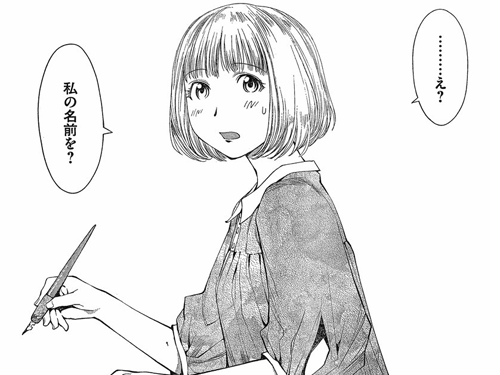
Ogiue discusses her professional debut with Yabusaki, who is equal parts jealous and proud of her former enemy and current doujinshi collaborator. Ogiue’s challenge, as established a few chapters back, is to finish both the manuscript for her first published manga and the doujinshi she’s planning for Comic Festival (which we now know is Fullmetal Alchemist-themed), and though she has an insanely prolific work-rate (see her previous 80-page draft which she drew in about one night), it can be a double-edged sword; as we can see at the very end of the chapter, Ogiue can get so engrossed in her imagination that it can be difficult to put her professional responsibilities above her passions. I get the feeling Sasahara knows this better than anyone, which is why their unofficial editor-artist relationship can be so volatile.

During their discussion, Ogiue and Yabusaki speak in their respective Tohoku and Kansai dialects, which is nothing short of amazing. While Yabusaki does this all of the time, it is an incredibly rare case that we get to see Ogiue use Tohoku-ben out loud instead of just thinking in it, and I believe that this is the very first instance of Ogiue speaking in her native dialect for an extended conversation outside of flashbacks. I think this is a very important indication of not only how much more comfortable Ogiue has become with herself, but the extent to which Ogiue and Yabusaki get along now, even if their faces don’t show it. Ogiue doesn’t even use her Tohoku dialect in private with Sasahara! Her Tohoku talk, combined with her newer hairstyle, in a way reminds me of Heartcatch Precure, where we get to see girls change while discovering their true selves.

At the same time as Ogiue, Sue, Yabusaki, and Asada are talking art, Hato is taking respite from the heat in Madarame’s empty and air-conditioned apartment. Here, we get to see Hato’s gender-divided fantasy in action, as Hato the guy’s thoughts run practically parallel with Hato’s thoughts as a “fujoshi,” represented by an imaginary(?), naked, and decidedly feminine Hato floating nearby. Alternately called a Stand and an 801-chan among other things, Hato’s mind inhabits this unusual territory where he scrutinizes his own natural actions and provides a field day for psychologists of fictional characters. Hato turns out to be so tired that he ends up dozing off, and by the time he wakes up Madarame is already home. A potentially awkward situation to say the least, especially given Hato’s out-of-body musings.

Just as we were able to see a current Ogiue talking in her own dialect for an extended period for the first time in Genshiken, this is also the first time that Madarame gets to see Hato sans drag, but rather than making things more uncomfortable, Madarame just treats him as one of the guys. While sharing dinner, Hato brings up the fact that he does not consider himself to be homosexual, even though he likes BL as much as he does. Anticipating Madarame to react somehow, Madarame still doesn’t seem particularly fazed by this “revelation.”

Speculating as to why Madarame is able to take such a declaration in stride, I can only think that it’s because Madarame, as an otaku, knows the significant disparity that can exist between 2-D and 3-D. Ogiue is into yaoi, but she doesn’t expect Sasahara to be into other guys even when she uses him as “inspiration” for her own doujinshi. An even better example might be Madarame himself, whose taste in the erotic can skew a little young, and yet he finds himself in love with the very mature Kasukabe Saki. For that matter, Sasahara and Ogiue sometimes skew young in their preferences as well (young Ritsuko Kubel Kettengrad and Edward Elric, respectively), so I think the whole of Genshiken understands the divide well. Still, gender and sexuality is not the easiest of topics to talk about, and you might be surprised at how the complex lines of tolerance and understanding can fall within people’s own values.

Seeing how relaxed Madarame is being around Hato despite the possibility that an outsider observer (i.e. “herself”) could interpret all of this as fertile soil for romance, Hato can’t help but see Madarame as a weak bottom because of how open he leaves himself to “attack.” For some reason though, I feel like Hato’s logic behind the “hetare uke” Madarame “character” is different from Ogiue’s. I think Ogiue’s variant has more to do with how passive he is despite his passionate otaku outbursts and the like.

Speaking of Saki, Hato accidentally becomes aware of Madarame’s unrequited love, though Madarame himself is unaware that Hato knows. Maybe Hellsing creator Hirano Kouta is right after all and Madarame really is the most moe character in the series.

It’s Only Greater

Recently I was thinking about how great it is that I have friends and people with whom I can share my love of anime and manga, with whom I can discuss my feelings on specific works, trends among fans, and much more. Nowadays I think that it’s really, really wonderful to be an otaku.

It makes me consider the concept of anime fan gatherings that aren’t conventions or anything tied to specific activities or venues, but just something where everyone can sit back and enjoy themselves, like a relaxed discussion on the internet but in real life, so not everything has to be in words. Preferably this is all done over a big pot of chili (with vegetarian/vegan alternatives for whoever needs them), or I guess donburi if we want to stick to the whole Japan thing.

Surely there are disagreements among otaku all the time, and heated arguments about minutiae that seem many times larger, but just the fact that we can be so engrossed in something is itself a glorious thing.

If you want to know what makes the “geek” special, it’s not brains or looks (or lack thereof) or anything like that, it’s simply passion. I have a lot of it, and as it continues to grow I know I have you to thank.

The Ogiue Maniax Tumblr

For those who missed it, last week I started my very own Tumblr. Its purpose is for housing things that cannot go anywhere else, and this blog is home to a huge variety of posts, so its existence is a matter of necessity. As of now, there’s only one post on it, but I think it’ll make you feel like you can live forever.

THAT Anime Blog, Home of Utopian Philosophy

This past Valentine’s Day, ExecutiveOtaku over at THAT Anime Blog offered a service for all of the single ladies and gentlemen who found themselves alone on February 14th, a “Harem Finder” that would allow you to enter into a Love Hina-esque setting, custom-tailored to your specific wants and passions. Though obviously a joke, the Harem Finder is not without historical precedent, at least in literary terms. In particular, the concept resembles the writings of utopian philosopher Charles Fourier.

Fourier (1772-1837) believed that the denial of passion was the most major problem with the world, and in his utopian writings he proposed a society where everybody would be able to indulge in their passions in a way that would benefit their society. For instance, a man predisposed to death and slaughter would find a job as a butcher. Fourier (somehow) calculated that there are 810 character and personality types to be satisfied. This of course includes sexual passions, so a sadist would be able to meet a masochist, same-sex relationships would be condoned, and so forth.

Priests and priestesses would gather everyone together and initiate extensive tests involving multiple meetings between potential partners, keeping in mind that “love at first sight” does not always happen. And for those dorks who worry about their physical attractiveness, Fourier has them covered too.

In Harmony sheer physical attractiveness will not have the colossal influence that it has in civilization where everyone is transfixed by the sight of a beautiful woman. Of course the Harmonians will not fail to appreciate physical beauty; in fact their judgment will be considerably more discerning than ours. But when it comes to the selection of sympathetic patners their choices will not be determined by physical charm. For their desire for sensual gratification will be satisfied in several different ways.

In a way, the concept of the “harem” in anime and manga is a form of utopia, acting as a very localized, almost self-functioning society where happiness is being surrounded by women (or men) and everything that happens in the world comes from that harem setting. The same idea could be extended to the most slicey slice-of-life shows, especially when you factor in their utility as a form of cathartic escape. These are, after all, “better worlds.”

In a different era, I think Charles Fourier could have very well been an otaku. He would spend every day after work focused on writing about his utopia, and his devotion to passion is well-represented in anime and manga. He also had a thing for lesbians, making it very possible that he’d be a big yuri advocate, and his obsession with precise calculations seemingly pulled out of nowhere (he determined that there are 26,400 men in the world who also enjoy lesbians) would not be that far off with numbers-obsessed mecha or idol fans.

He was also a life-long virgin, but I’ll leave those jokes to you.

We Still Fight

Mazinkaiser SKL and Madoka Magica embody the spirit of 1990s anime and anime fandom.

That I included Mazinkaiser SKL in that statement is not much of a surprise, I imagine. It’s the robot whose name stands for “Skull” because it’s covered in skulls, and its plot, characters, and levels of ultra-violence are taken straight of the worst best OVAs of the era. Mazinkaiser SKL has what thrilled anime fans of the 90s, and it would not have looked out of place next to the likes of MD Geist and Bubblegum Crisis.

My choice of Madoka Magica might be more puzzling, but I insist that in some ways it houses the 90s anime (and anime fan) spirit even more than Mazinkaiser SKL. When you look at how the series has been captivating fans, you see recurring comments in regards to how dark it is, or how it subverts the genre. Even if people don’t necessarily have a good understanding of the original genre being addressed, when it comes down to it Madoka Magica is attracting fans because it feels “different” and worth discussing and thinking about at length. The way people talk about it reminds more of the way people discuss Akira, Ghost in the Shell, or Evangelion than the way conversations about Suzumiya Haruhi or Code Geass go. Madoka Magica has that certain something that thrills people into dividing anime into Madoka Magica and everything else. While the difference is that Akira drew in non-fans and Madoka Magica isn’t really going beyond the existing fandom, it seems to be hitting fans with the same shock that Goku’s death gave to me as I realized cartoon character’s could die after all.

So while Mazinkaiser SKL is aesthetically an anime ripped straight out of the 90s, a time traveler from a different era whose ways may seem at odds with the current day, Madoka Magica takes the effect anime had on anime fans in the 90s and translates that emotional impact across time onto the current fandom. Whether or not these shows will be remembered in another ten years is unknown, but at the very least in the here and now they connect the decades together.

Vistas: Streaming for Profit – Crunchyroll vs. GOMtv.net

I’ve got a new post over at the Vistas blog, this time about the differences in paid services provided by two different streaming sites with two different ideas of what its users should pay for, Crunchyroll and GOMtv.net. Feel free to comment either there or right here on Ogiue Maniax.

Gotta Defeat M. Bison By Christmas

Ever since the Clannad side stories, there has been a small trend in dating sim and visual novel anime where, rather than trying to incorporate all of the vital elements from all of the characters into a single on-going story, adaptations would instead create smaller, alternate-path arcs. In this new model, as shown by last season’s Amagami SS and Yosuga no Sora, every few episodes would be devoted to one girl, and once her story was over, the next episode would act as if that story never existed, instead focusing on the idea of “what if the hero ended up with this girl instead?”

I’m not entirely supportive of this style of storytelling and I worry about its misuse to some extent and the way it can potentially trivialize not just the girls but the male protagonist himself, but the format has merit. In fact, I think it could be of great benefit to a genre of anime that had its heyday in the 90s but is almost non-existent today. I speak of the fighting game adaptation.

Now if you haven’t much experience with fighting game anime, it’s safe to summarize the genre by saying that most of it is very bad, to be somewhat kind. As to why the general quality of fighting game anime is so poor, the reasons are many, including budget, but much of it stems from the sheer numbers of characters that populated the source video games even as far back as Street Fighter II and its 12 warriors. Consider that fighting games have a large number of selectable characters, and that the player picks one and plays through the entire game with them. In time, every character gets their own fanbase. So if you’re making a fighting game anime you most likely want to appeal to the fans, and thus your adaptation has to include all of the characters. 12 is a lot, let alone the 16 when the actual Street Fighter II animated movie came out or the 30+ of the newest games, and inevitably what happens is that the characters don’t all get the same amount of love. Zangief fights Blanka in a ring just because. Lawrence Blood is made into a servant of Wolfgang Krauser just to fit him in.

Generally speaking, that’s fine. Characters should have different levels of focus in a story, that’s the difference between a main character and a side character after all. But while fighting games have official protagonists, your Ryus and Akira Yukis and Terry Bogards, in the context of being a video game the “main character” is whoever the player chose. So with fighting game anime having trouble with allotting enough time and attention to all of the characters, characters who are each important to someone out there, it begins to resemble the dilemma that dating sims, which are themselves video games where a variety of characters are “absolutely important” in their own paths.

That brings me to the big question. What if fighting games took a note from Amagami? What if, instead of trying to cram every character into one story, each episode or OVA was just, “what if this character won the tournament?” Each individual fighter can get their moment in the spotlight that they so rightfully deserve? Most likely this wouldn’t solve the budget issue, but it would showcase the characters in their proper glory.

Once an anime is made this way, call me. I have some very good ideas for the English voice cast.

The Mystery of Ivrogne

Of all the characters in Star Driver, Nichi Keito, alias Ivrogne, has intrigued me the most. With the revelations about her in episodes 17 and 18, I feel like my attention towards her is pretty justified. Before the next episode hits and we learn even more, I want to look at some of the elements to her that made her stand out as a character worth attention, even before the most recent episodes. Before I begin though, I want to state that I am not going to be scrutinizing every little detail about her character by combing through prior episodes. Nor I am trying to shed light on any obscure hints. This is more my observations from watching the show every week, and noticing her behavior somewhat in passing and how it piqued my interest. Naturally, there are spoilers in this post. Continue reading

Wig Party: Genshiken II, Chapter 60

In my last chapter review, I predicted an Ogiue-centric chapter while also pointing out how Hato hasn’t gotten a chapter focused on himself yet but rather seemed to get a bit of focus and characterization every chapter.  Contrary to my expectations however, this latest chapter, despite taking place mainly in Ogiue’s apartment, is actually centered around Hato. Specifically, it reveals the truth as to why he cross-dresses, peeling away some of the enigma that is Hato Kenjirou.

Ogiue has a professional manga debut coming up and in order to meet her deadline she’s recruited Yajima, Yoshitake, and Hato. Yajima, who we know likes to draw, finds herself paling in comparison to Hato not just in looks but also in artistic talent. It also turns out that Hato has been gaining a reputation outside of the club as a mysterious brown-haired knockout who only seems to show up in the afternoon, and given the potential trouble that would-be suitors of Hato could bring, Yajima has to ask Hato once more: why the dresses?

Hato explains that he had kept his fondness for yaoi a secret all through high school, because if and when he revealed his status as a fudanshi, the “rotten boy” opposite the “fujoshi,” he surely would’ve been was persecuted by his peers. So upon entering college, he began cross-dressing mainly so that he could enter a club much like Genshiken and finally be able to talk with people who share his interests.

“Persecution.” The word lingers in Yajima’s head, and it makes her feel absolutely terrible for confronting Hato. While she can’t relate to Hato in terms of choice of attire, as an otaku it’s very likely that she knows the pain of being ridiculed or tormented by one’s peers all too well. Yajima decides to not press the issue at first, but then realizes that Hato’s response was only half an answer. Everyone there now knows why Hato started to cross-dress, but given that everyone in Genshiken knows his secret and his okay with the fact that he’s a fudanshi, it’s no longer necessary. So why does Hato continue to cross-dress?

He enjoys it.

He knows he looks good in it, and it helps to fuel his own fantasies, not necessarily in the sense that the cross-dressing itself is the kink, but that donning women’s clothing can give him the right frame of mind. Through it, Hato can see the possibilities, including pairing himself with Madarame, which also puts the last scene of the previous chapter in a whole new light: were Hato’s signals real or imagined by Madarame?

One significant reveal for me in this chapter is the fact that Hato self-identifies as a man. In planning future entries for the Fujoshi Files, Hato presented a bit of a problem, namely, how much of gender is biological and how much of it is social? Gender studies is not my specialty, and even among the Genshiken characters, you could see that different characters take different approaches: Yajima talks of Hato as if he were a man, while Ohno mainly refers to Hato in the feminine. As you can see as well, I’ve mainly gone with male pronouns when referring to Hato, but I ultimately decided that it would be based on his own personal preference.

So Hato’s crossdressing isn’t entirely the product of a tormented gender identity conflict, but it’s important to avoid thinking that Hato’s crossdressing is somehow less legitimate or even wrong just because it’s a little self-indulgent. Hato has a perfectly good reason to crossdress, and the way in which Genshiken presents his situation, with both serious and more lighthearted aspects, does not and should not lessen either side. Nor should Hato and Genshiken in turn make gender portrayals that are focused more in one direction (such as Wandering Son) necessarily less poignant or entertaining.

We also learn a little bit more about another character whose life rarely gets explored, as we discover that Kuchiki is that guy in more ways than one. He’s not only the guy so lacking in social skills that they became actively antagonistic, but that he’s also able to coast by in life because of nepotism. I wonder what his parents think of him?

I think that Genshiken II has been getting better and better at establishing the New Class as characters in their own right, and I don’t really mind seeing the club veterans step aside so that they can take center stage. It takes a theme already present in the original manga, that of people entering the club and leaving when they graduate to make room for new blood, and realizes it in a much bigger way. It makes me wonder how they would fare if this was the first Genshiken series ever, and we only knew the previous characters somewhat in passing.

Next chapter looks to be again about Hato, but I’ve been deceived in the past, so I’ll hold off making any big predictions until then. Sue didn’t talk too much in this chapter, so I wonder if Kio’s saving her up for something big. The last thing I want to talk about though is Ogiue (of course), and the way that Kio Shimoku has been inserting some some nostalgic references to Ogiue past. Ogiue’s inner thoughts entertain the proposal of Hato x Mada in Ogiue’s native Tohoku dialect, and when Ohno tries to start a cosplay party at Ogiue’s place we’re greeted with a familiar sight. Perhaps we could call this “Ogiue Abridged?”

Trekked to Sliedrecht, Did the Anime Thing: Tsunacon 2011

It’s been quite a few years since I was able to attend any sort of anime-related event outside of the United States, so when I found out that right here in the Netherlands are not one, not two, but three anime cons, why I had to check at least some of them out. This report is about the first of them, Tsunacon, located in the town of Sliedrecht. I’m not sure why it’s called Tsunacon, though I suspect it’s a play off of “Tsunami.”

Held in De Lockhorst, a complex devoted to athletic activities and just having spaces and rooms available for just this very kind of thing, Tsunacon is a one-day event. I’ve attended one-day events before, namely the PAS Spring Fest in New York City and Tekkoshocon‘s Tekko 1/2 held at the Carnegie Library, and if I had to compare Tsunacon to those two mini-cons, I’d say that Tsunacon feels the most like an actual anime convention. This might have to do with the fact that Tsunacon is not a free event (although the ticket price is more than fair) whereas the other two are, but it’s more the atmosphere of it.

Before I go into the con itself though, I have to point out the train to Sliedrecht. Moving between the cities of Dordrecht (not to be confused with Dordray) and Geldermalsen and about 4 cars long, I think it’s kind of adorable and also anime-related if you stretch your logic a bit. You can do it, Spurt-tan!

De Lockhorst is only a short walk from the Sliedrecht train station. On my way there, I saw two couples holding hands and possibly cosplaying as well. Ah, nerd love.

When you get inside the first thing you’ll notice is the concession area. While the collection of Japanese snacks (Yan Yan, Ramune) are likely a familiar sight to the American con attendee, there are a number of uniquely Dutch snacks, such as poffertjes, tiny pancakes in powdered sugar, and frikandel, a kind of minced meat sausage. They also had a cotton candy machine, which I’ve never seen at any US anime con.

The big culinary hit here was Cup Noodles, at €3 a cup. Now you might be asking, “3 Euros?! Isn’t that a bit overpriced?” It most certainly is, but the attendees could not get enough off Momofuku Ando’s glorious creation. I couldn’t tell you why it was so popular, but I wonder if the more traditionally Dutch foods don’t carry the same novelty. Maybe it’s just the sheer joy of eating noodles from a cup alongside your friends.

When I think about it though, the Broodje Kroket (croquet breads) ares kind of like the Croquet Pan you’d find in Japanese bakeries. Even when you’re eating “normal foods,” you’re not too far off, Dutch anime fans!

The real kicker though would probably be that they sell beer alongside everything else. And not just any beer…

That’s right, Japanese beer for the Japanese anime fans.

Given that the average age at Tsunacon was decidedly “teenager,” this might set off some alarms, but I must point out that the drinking age here is actually 16, excluding hard liquors. In fact, despite the relatively low median age of the attendees here, everyone seemed quite well-behaved. Even the “hug me” signs seemed more subdued compared to their US peers.

Tsunacon obviously isn’t devoted solely to food though, and close by were the manga library, a game room, a workshop room, and the dealer’s room.

The Manga Library had a fairly sizable collection of titles in both English and Dutch, as well as a few in Japanese. It grew more and more popular throughout the day, and as if to anticipate the creative spark that reading manga would inspire, they left pencil and paper around so that people could draw. I myself decided to revisit an old friend and read the Sai vs Touya Meijin chapters of Hikaru no Go.

The Game Room, which meant specifically video games (sorry card and board game fans, though I did see a number of Yu-Gi-Oh! players dueling it out), had systems ranging from the classic NES to the X-Box 360 and Wii, as well as popular convention games like Dance Dance Revolution. I have no idea what version it might have been.

One thing that stood out to me was the European SNES, pictured above, which resembles the Japanese Super Famicom a lot more than it does its American counterpart. If you’re wondering what game that is, it’s Battletoads vs. Double Dragon. It is a terrible game, but the thought is appreciated. And yes, 4chan memes are popular here too.

I originally planned on participating in a Super Smash Bros. Brawl tournament, but the slots filled up extremely quickly, and by the time I got there it was too late. However, it turned out that the Super Street Fighter IV tournament was short on competitors, so I decided to throw my hat into the ring. I picked Sagat, my favorite character from the Street Fighter series, and defeated my first opponent only to lose to the very next one 1:2. You might not think that to be terribly impressive, but I was quite proud of myself given that-

  1. I’ve never played Super Street Fighter IV
  2. I’ve only played vanilla Street Fighter IV once

But Sagat is Sagat, and I just threw fireballs and delivered uppercuts on my way to victory, at least for a short while.

The workshop room had workshops on cosplay and drawing manga, all in Dutch so even if I felt particularly motivated to start cosplaying I wouldn’t be able to reap its benefits.

The Dealer’s Room also doubled as the bag check room, and was mandatory if you were planning on doing any shopping, or even playing  in the game room. The main activities of the Dealer’s Room, aside from shopping of course, were the “Manga School” workshop and the goldfish-catching game straight out of your favorite festival episode. The winner who caught the most “goldfish” (they had to use rubber balls here) would win some Haruhi pins and a poster of a J-Pop singer whose name I’ve unfortunately forgotten. My goldfish endeavors came out to a big fat zero, but that’s okay.

Another interesting element of the Dealer’s Room at Tsunacon was that, perhaps due to space limitations, the Dealer’s Room also doubled somewhat as an Artist’s Alley. But while American cons’ Artist Alleys seem primarily focused with individual images, Tsunacon’s anime fan artists were big on self-publishing, often times with their very own original characters, though publications based on existing series were also present. In this regard, one table in particular caught my eye.

A Genshiken-themed doujinshi of all things! Of course I had to get it. It’s not 18+, in case you were wondering.

You know what I like? Ogiue. And you know what else I like? Pokemon. This book manages to combine both, and that is quite all right with me. I was also flattered to find out that they actually knew about Ogiue Maniax, and I was proud to have them do the doujin event thing and get some sketches. Thanks a lot to all of you! I wish you had a website URL in the book so I could direct people.

A short walk from the entrance where the concessions and around the corner landed me in the anime karaoke lounge. Now I’ve done karaoke at dedicated locations, and I’ve done convention karaoke, but what was nice about this place was that it was more or less a small bar/restaurant. In addition to the snacks you could get from before, helpful staffers worked as waiters, taking orders for food and drink while everyone sat around enjoying the fan-powered renditions of God Knows, Hatsune Miku, various Final Fantasy themes, the Chobits opening, and more. They actually had it set up so that the lyrics would pop up in romaji which the singer could follow, much like a real karaoke place. This is quite different from Otakon where they hand you the lyrics on a sheet and you have to do your best given the circumstances. Not knocking Otakon or anything, but this system was way more useful for people who felt like they kind of knew their songs but still needed some help.

I partook of a macaroon from a helpful staffer/waiter before exercising my own lungs. My song of choice: the Mazinger Z opening, which I performed a little better than I thought I would. (Fortunately) I do not have any record of the event, as while I love to karaoke, I am not what you might be calling “talented.” It might be better to say that I can display a degree of courage when it comes to on-stage performances. Despite the relative youthfulness of the crowd, they actually got quite into my performance, and by the time I was done I received a full applause from the room. Thank you all.

If you weren’t paying attention to the singing though, you might have noticed the interesting decorative choice in the form of various Disney statues placed throughout the bar/lounge.


The two “main events” of Tsunacon would have to be the competitions, both AMV and cosplay. Unfortunately, despite knowing this beforehand it somehow slipped my mind while there, and I didn’t go to either. My apologies! While I’m normally not much of an AMV or cosplay sort of person, I still wish that I’d managed to check them out. According to the schedule, the same room also housed video showings and some quiz-based panels, so it was ostensibly the video and competition/events room. Next year!

While I did not attend any actual cosplay events, I did see quite a few excellent cosplayers, which you can see below. There was a really good Crocodile from One Piece cosplayer, but I wasn’t able to catch him.

Overall, Tsunacon was a fun little one-day excursion where there the focus was primarily on letting the attendees do their thing. Rather than going from event to event or even spending the entire day in one location, the con seemed more conducive to just hanging out with your otaku comrades. In that regard, I do wish I had brought others with me, because as cool as it was a one-man trip to a con can only get you so much. It’d also be cool if they had more informational panels in addition to their workshops and games, not for me as my Dutch is abysmal, but to foster learning that doesn’t necessarily have direct utility. The space was also a tad crowded, but nowhere near as insane as some of the bigger cons I’ve attended, and if anything this is a good sign that Tsunacon is getting increasingly popular.

I’ll leave off with these collaborative drawing boards. I drew a couple of things myself. See if you can spot them!