Welcome to the OGI!

Ogiue Maniax is up today in the “Aniblog Tourney,” a competition which asks readers of anime-themed blogs to vote for their favorites while also encouraging everyone to check out anime blogs they haven’t seen before.

For those of you who are already familiar with Ogiue Maniax, I recommend that you check out the other blogs for the day before you decide your votes.

hountou ni

chaostangent

Caraniel’s Ramblings

Who knows, you might find a new favorite.

Now, for those of you who are new to Ogiue Maniax, an introduction is in order.

As the name implies, I am a dedicated fan of the character Ogiue Chika from the manga and anime series Genshiken, who I honestly believe to be one of the greatest characters ever, if not the greatest. However, the content of Ogiue Maniax goes well beyond my interest in this blog’s namesake. As it says on my About page, I strive for a holistic view of anime and its fandom, approaching and analyzing a great number of anime and manga-related topics from multiple perspectives.

As you read my blog, I’d like you to keep in mind my three basic goals in writing Ogiue Maniax:

First, I want to share and express my own passion for anime and manga.

Second, I want to increase my own understanding of these subjects to which I have devoted so much time and energy.

Third, I want to encourage my readers and fellow fans to look more closely at the fandom in which they exist, to think and rethink and to challenge themselves.

It doesn’t matter who you are or how much you know, there’s always something worth learning, even if it’s about yourself.

Since I began Ogiue Maniax back in November of 2007, I have posted at least once every day. As the content of my posts are subject to my everyday whims, the content of Ogiue Maniax is extremely varied. Combined with the large archive, it can be somewhat daunting, especially if you’re new, so to ease you along, I have provided a small sampling of some of my favorite posts. I think they give a good idea of what this blog is like as a whole. Take a look-see and tell me what you think.

Ogiue/Genshiken

Analysis

Fujoshi-related

Translation

Review

Bad Humor

Artwork

On the Usage of Profanities

It’s about my persona ain’t nothing like a man
that can do wha he wanna
Ain’t nothing like man on that you knew on the cornna
See ’em come up and fuck up the owna
See ’em throw up Westside California

-Ice Cube

Personally speaking, I do not prefer to curse. Even on this blog I usually try to find other avenues. But years ago I asked a relative with a similar stance towards profanity a simple question: If you’re quoting someone who cursed, do you quote them exactly or do you still put in your personal filter? His response was a hard-line  “absolutely not.” It was at that point that I began to think about the nature of profanity as a part of the English language.

We can substitute for cursing all we want (and I do), but that doesn’t take away from the fact that curse words carry a lot of meaning with them that is specific to the fact that they are considered profane. There is a certain and special kind of impact that comes from their context in society, and so when you decide to curse, you transmit a message well beyond the surface meaning or even the fact that it’s a profanity. It hints at emotion and personality and any number of things.

You might think that my description is vague, and that it applies to all words, but that’s exactly my point. They can be treated as a part of your vocabulary, like a tool from your toolbox to use when the time is right and when you want to or even need to convey a specific meaning. They can be misused and overused (as was the case with the act of “fifteening,” the addition of excessive profanities in old anime dubs in order to bump up their ratings), but that doesn’t take away from the fact that they say something.

At this point, my non-usage of curses is simply a personal and stylistic choice.

I occasionally find myself in an odd position where I am defending rap and hip hop from criticism. Now while I like rap well enough, I am not a particularly big fan of it, and so I feel kind of out-of-place doing so. However, I think that a lot of people misunderstand rap and hip hop specifically because of that liberal use of profanity on top of the general image of violence portrayed in a great portion of it.

So for me, my non-usage is merely a stylistic choice.

These days, I refer detractors to Ice Cube’s “Gangsta Rap Made Me Do It,” as an example of how words and phrases that can be considered offensive can be used to conjure up certain meanings and images in order to send a specific socially relevant message. If you’re unsure yourself, go ahead and have a listen.

Obviously, there’s explicit content.

I think this sort of thing is relevant to anyone who writes, and that includes anime bloggers.

May’s Live Mahjong Event: Where a Boy Becomes a Mangan

The United States Professional Mahjong League is holding another free play event this Sunday, May 16. If you’ve only played mahjong online and live in the New York City area, this is your chance to play against live opponents in Japanese-style mahjong aka “riichi” mahjong. Saki was right when the show said that playing on the internet and playing live are subtly different due to the external factors, and it’s an experience I recommend anyone try out. And it’s free!

Sadly I can’t make it this time around either, but don’t let that stop you from enjoying yourself.

Now if you’re really not sure whether you should be hanging with the “big boys,” no one is particularly amazing at mahjong to the extent that you’ll feel helpless. This is indeed one of the strengths of mahjong. You might see me talking about the game pretty often now, but realize that I’m not good at the game. It would be a stretch to call me “intermediate.” But I still win some sweet hands and have lots of fun. If you have experience playing at all, even if it’s just a little, you’ll likely do fine, and no one will admonish you for forgetting some rules.

But if you’re really worried about not knowing enough to play, or you know so little that you’d prefer to read “Baby’s First Riichi Mahjong,” then take heart in the fact that they’re also holding a tutorial event for absolute beginners on Sunday, May 23. The rules can seem quite overwhelming, but actually mahjong is a game you can ease yourself into with just a bit of patience.

The location for both events is:

Simple Studios
134 W. 29th Street (b/t 6th and 7th)
2nd Floor
New York, NY 10001

Don’t forget to RSVP on the forums, particularly with the tutorial session, as space is limited.

Wait, Where Am I?

The other day a startling realization hit me.

While I’m still watching anime as I always do, my intake of older and classic anime has been on the wane as of late. When I look at the shows I’m currently watching, Heartcatch Precure, Durarara!, Giant Killing, among others, they’re largely new-fangled series. This solution is as simple as watching older series, but my concern lies more in the possibility that I was getting caught in the seasonal trap without realizing it, that I was starting to get new-series tunnel vision. While I think it’s important to watch what’s new, I don’t want my perspective too shaped by simply what is there “now.”

I also realized easy it is for anyone to get caught in the seasonal trap if you’re an internet-based anime fan. Its ease of access is like a warm embrace and it’s all too simple to just let it happen.

Though actually, I have been getting my “classic content” through manga. I’m on an early shoujo kick, picking up volumes of Attack No.1, reading Swan, getting all of Rose of Versailles, but seemingly at the expense of reading newer titles. It’s like with anime I’ve planted myself with the present, and with manga I’m entrenched in the past. It’s not quite what I’d call a “routine,” but before I knew it these had become my fandom habits.

I’m perfectly aware that there’s nothing really “wrong” with the way I’m doing things, but it’s still something I’d like to change before I get too comfortable with it. After all,  “Running water never grows stale.”

I’d Kill Kill Kill Kill Kill For That Ability

Heiwajima Shizuo of Durarara! is a man of many traits. He’s a berserker. He’s a man who wants to be a pacifist but can’t seem to get it down. There’s one quality in particular that I want to focus on however, and that is how unusually perceptive Shizuo can be.

All of us to some extent set up walls and barriers in our lives. Sometimes they’re to keep people out, other times we reinforce them and build upon them and even decorate them to the extent that we expect others to see us as these walls. But Shizuo’s personality is such that he sees the “truth” more readily, as if his senses are more animal than human. Wall-building is not a trait he’s familiar with, so he ignores it entirely. He’s naturally attuned to human nature, even if he isn’t aware of it.

Shizuo’s perceptiveness reminded me of  another show I’d been watching alongside DRRR! last season, Kimi ni Todoke. In it are two characters who could best be described as “simple-minded,” but it’s that simple-mindedness that allows them to sense deception or the absence of true honesty, much like Shizuo.

The first is Chizuru, the tomboyish friend of the main character Sawako.

The second is Pin, the loud-mouthed, belligerent teacher.

In both cases, you can see how much finely-tuned their instincts are to seeing past the elaborately constructed walls of human life when they interact with the character Kurumi. Kurumi is seen as beautiful and sweet, but her looks hide a manipulative personality. When Kurumi tries to turn on the charm with both Chizu and Pin, they can’t help but feel that something is amiss, even if they can’t pinpoint it. They can see the walls for what they are.

Personally speaking, I really wish I had a trait like this. Or maybe I do, and I don’t realize it. Or maybe I don’t, and I’m just kidding myself.

Well They Do Say That Presentation Matters

A recent episode of Iron Chef America had veteran Masaharu Morimoto taking on Chopped judge Geoffrey Zakarian in Battle Sardine. Morimoto, whose specialty is not only Japanese food but fish in particular provided a formidable challenge for Zakarian. During the tasting portion of the competition, Morimoto served “sardine tacos,” held together with what appeared to be colorful paper. Upon closer inspection however, the paper started to look a lot more familiar.


Milky Rose?!

Ladies and gentlemen, the US TV debut of Yes! Pretty Cure 5 Go Go!

Now as to why in the world Iron Chef Japanese would be incorporating a popular mahou shoujo series into his plating, I don’t have an actual idea, but I do have a few theories, some more outlandish than others.

Perhaps he has a daughter who’s a big fan of Precure, and this is his clever nod to her. Or perhaps Iron Chef Morimoto is himself a fan of the series. It could also possibly be that he chose it because the girls of Precure have colors which match well with the sardine tacos.

Or maybe he just grabbed whatever he could and this was the result.

Still, I think a lot more food could stand to be served on top of anime.

I Have the Answer. What’s the Solution?

Do we really know why anything is popular?

Whenever an anime or manga is super popular, be it with “casual” fans or super hardcore 4channers or die-hard bloggers or anywhere in between, someone eventually decides to ask, “Why is this popular?” The question can be interpreted positively, encouraging people to express why they like that work so much. It can also be interpreted negatively, giving way to sweeping generalizations that categorize a work’s fans in a particularly unattractive light.

As a quick demonstration: Why is Baka to Test to Shoukanjuu so popular?

We can posit why Gundam isn’t popular “here,” or why Captain Tsubasa is popular “there,” but after a while I just have to wonder how often we’re putting the cart before the horse, completely blinded by hindsight and trying to draw conclusions from something most people might have trouble expressing in the first place, even if you asked every Naruto fan why they like Naruto so much. And in a way, when we accumulate more knowledge and experience in anime, we paradoxically move both closer and further away from the truth.

Not saying I don’t enjoy the speculation, nor am I telling people to stop, but popularity (or lack thereof) can be such a difficult entity to grasp and manipulate that I’m sure we’re all wrong more often than not.

Also, I know this doesn’t just apply to anime or manga or even fiction. Asking why stuff is successfully popular is applicable to just about any topic where  group enjoys or uses something.

No, really, why is  Baka Test so popular? I liked it well enough because of the way it embraced the otaku/moe/anime humor and really ran it to some logical extremes, but why is it considered the #1 light novel series of 2009?

(Ooohhhohohohoho…)

In a dream I found myself watching an episode of a Slayers anime. It wasn’t an OVA or a movie as it featured the TV series cast, though it did make a reference to the OVAs. In the one scene I “watched,” an unidentified character who knew Lina Inverse’s history notices a sleeping Lina and decides to mess with her. She gets close to Lina and then whispers a Naga-style laugh into her ear. No effect the first time, so she tries it a little louder, which startles Lina out of her slumber and puts her on edge.

When I woke up, I thought about my own history as a Slayers fan and recalled that, despite my anticipation I had never finished Slayers Revolution or even watched its sequel, Slayers Evolution-R. I laid there thinking that, for someone who once prided himself on having watched as much Slayers as he possibly could, this was quite a disappointment that needed immediate rectifying.

Then I checked Hulu and saw that both series are on there, and I thought, “This is a pretty good time to be an anime fan.”

So Then Maybe Sesshoumaru is Darkseid?

Warning: Inuyasha Spoilers

Despite the fact that Inuyasha: The Final Chapter ended recently, I have not seen very many people talking about it. I know that can’t possibly be the trend across anime fandom as a whole, though. It’s Inuyasha after all, the show so popular it all but defined Adult Swim anime alongside Cowboy Bebop.

I already know about the ending from having read the manga, but remembering just how long and encompassing Inuyasha is, and how much detail that is ideal for a fan-made Wikipedia about the subject exists, I took a look over at the Inuyasha Wiki, reading up on what swords Sesshoumaru uses, what the heck people’s attacks are, as well as the character who deservedly has one of the longest and most complicated entries on the Wiki, Naraku.

As I read Naraku’s entry, his description started to remind me of another famous villain. He’s powered by negativity. His power is seemingly infinite. He increases his power and transforms thoughout the series. He has a vast army of demons under his control which he can absorb in order to regenerate and heal (which the heroes manage to turn against him). At the very end, in a desperate situation, he switches to a strategy of pure revenge and destruction, abandoning his tendency towards elaborate scheming.

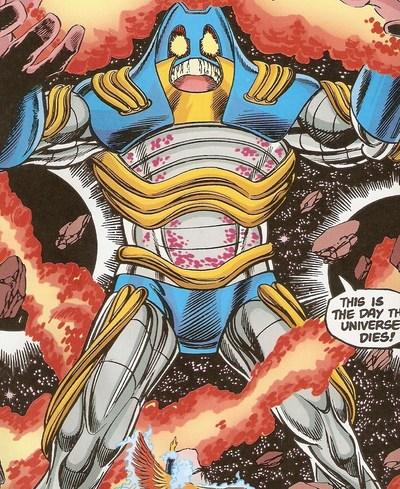
Naraku is like the manga equivalent of DC Comics’ Anti-Monitor.

Go Go Curry: Going Strong, Carrying On

Today, May 5th, is the anniversary of Japanese curry restaurant Go Go Curry, and to celebrate this auspicious occasion in Manhattan they’re making it so that ALL medium-sized curry dishes are $5. I think by now my feelings on Go Go Curry have been well-established, but just in case, if you’re in the area and have never tried it, I highly recommend you do so. It’s on 38th St between 7th and 8th Ave in Manhattan.

They’re also giving away FIVE free topping coupons on top of that. And I know that unless you really like the Go Go, five coupons is a bit much to use up in a month, but they’re great to hand off to your friends, especially those who have never tried it before (just keep in mind you can’t use them in the same day you order).

As for me, it doesn’t really matter what special they have for their anniversary, I’ll be there simply to celebrate its existence and to dine on the best Japanese curry around.