Moe Anime Girl Gets Pregnant, Has Baby – Jigopuri Volume 1

Kio Shimoku is a manga author who is best known for his work on the 9-volume Genshiken series, about the members of a college anime/manga club. It’s personally my favorite manga series ever. It may come as a surprise then to know that Kio’s latest manga, Jigopuri: The Princess of the Hell, concerns itself with a topic normally far-removed from that of watching anime: Teen Pregnancy.

Well, not teen pregnancy per se, but it does center around a widowed 18 year old mother and her newborn child. The mother is Okiura Ayumi, her daughter is Okiura Yumeko, and living with them is Ayumi’s twin sister Hino Kaname. The raising and nurturing of young Yumeko, who is less than one week old when we first see her, is the central focus of Jigopuri, and the manga’s approach to a topic which is incredibly common in the real world but incredibly rare in comics is rather unique.

Despite its realistic tone and content, the art style of Jigopuri is closer to that of Kujibiki Unbalance than it is Genshiken, and it might be difficult to reconcile the fact that doe-eyed moe anime girls are discussing topics such as diaper-changing and the unbearable stress that comes part and parcel with raising a newborn. What can be even more jarring is the fact that Yumeko is drawn in a rather realistic style, more closely resembling a photograph than a kawaii anime infant.

No, Yumeko is not an ideal entertainment baby who is ten parts adorable and one part cuddles. She is a wrinkly, crying, pooping baby who needs attendance at all times because she’s a baby. Everything revolves around this fact, from the deliberately slow pacing of story (chapters generally span only a single day) to the way it handles all of its seemingly incongruous artistic elements, and understanding why Yumeko is portrayed in this manner is the key to understanding Jigopuri.

From the start, Jigopuri puts a young, inexperienced mother with no time or desire for romance in the spotlight, and in doing so makes Ayumi, and by extension the whole of Jigopuri, into something partially meant to stand against the tide of common trends seen in moe anime and manga. Although Ayumi at times feels helpless, it is never because she can’t do anything, but rather because she does so much. That doesn’t mean Jigopuri condemns moe, but it does remove much of the glamor and fetishism that accompanies many tropes of modern anime and manga. Nowhere is this more evident than in the comic’s portrayal of breasts.

As one might expect out of Jigopuri, breastfeeding occurs frequently, but the sight of an attractive woman exposing her large, shapely breasts (with nipples shown) begins to lose its erotic appeal once you are made aware of how inevitably their appearance is attached to the shrill cry of Yumeko as she wakes a sleep-deprived Ayumi up in the middle of the night. After a while, you begin to really feel for Ayumi, as you think to yourself, “She has to take out her breasts again?” And further cementing this un-fetishizing is the fact that Ayumi’s breasts are visibly veiny, an effect achieved through smart use of screen tones, and an indicator that these are not the idealized breasts you’d see in other works willing to show them with the same frequency as Jigopuri.

That’s Jigopuri as of Volume 1, and I really do recommend it, though I understand it’s not for everyone. Its cutesy art style combined with its realistic content can throw people off quite a bit, but if you can read Japanese or if it comes out in English, I think you should give it a chance.
A common sight in Jigopuri is a tired and weary Ayumi with deep bags underneath her eyes, a sign that each day wears on her even if she truly loves her daughter.

The Fujoshi Files 10: Asai Rumi

Name: Asai, Rumi (浅井留美)
Alias:
Asa Matsu (アサマツ)
Relationship Status: Complicated
Origin: Mousou Shoujo Otakukei

Information:
The students of North Haneda High are baffled by how the unassuming Asai Rumi can attract some of the most interesting friends, not least of which are the hottest girl in school, a ladykiller heart-throb and his best friend, as well as the hulking captain of the Judo club. However, what few know is that Asai has made her friends through the power of being a fujoshi. While not quick to admit to the fact, Asai does not deny herself as a fujoshi, and that honesty attracts friends and breaks down the mental barriers, including those of her tormentor-turned-best-friend and fellow fujoshi, Matsui Youko.

Bedridden as a child, Asai Rumi discovered manga thanks to a kind neighbor, a discovery which eventually led to her world being impacted by an un-shrink-wrapped BL title in a bookstore. Since then, she’s worked hard as a fujoshi, attending the major event known as Comic Banquet and even co-creating doujinshi of her favorite series, Fullmetal Prince, with the help of Matsui. Her favorite character is the titular Prince, but only when he is the “uke” in the pairing.

Fujoshi Level:
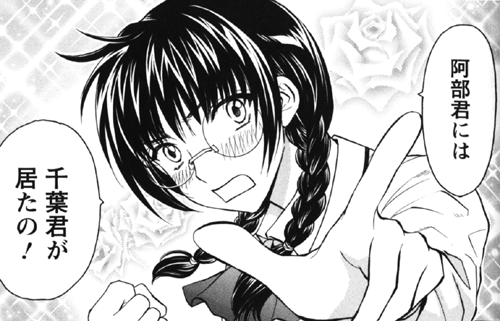
Asai Rumi’s presence as a fujoshi is so strong that she is able to make fujoshi who are in denial confront their own feelings about the stories they love. However, this comes at somewhat of a price, as Asai is so steeped in the world of BL and yaoi that she has trouble understanding normal romantic relationships. It is to the point that while she finds herself mutually attracted to her good friend Abe Takahiro, she manifests her interest by pretending to be an aggressive guy putting the moves on her yaoi lover.

That One Show that Will Never Get into Super Robot Wars

When it comes to the Super Robot Wars series, there tends to be an unspoken rule. For the big-budget main games in the series, such as the Alpha series, the cast lists are for the most part breadwinners and series that people have been anticipating to be in SRW, while for the games on other platforms they don’t expect to do really well with, they let the cast lists run wild and free, as is the case in the recent Super Robot Wars Neo, as well as Compact 3.

So I was thinking, “What series has practically NO chance of getting into SRW?” It’s getting kind of difficult to determine, with more and more shows managing to find their way in. Then I remembered one.

Getter Robo Go, Anime Version

The Getter Robo Go anime, adapted loosely from the manga of the same name, came out in the early 1990s and centered around a team of new Getter pilots in a new Getter Robo which didn’t use Getter Energy as its power source. The concept alone isn’t the problem, however, so much as the show is really, really lame.

Some will complain that the original Getter Robo anime was de-fanged compared to the manga, where Ryouma and friends are all literally violently insane people, but even with a nicer cast they were still pretty extreme, and they don’t compare to the character neutering that happens in Getter Robo Go. You don’t even have to read the manga to know that something is amiss here. It looks and feels like a failed attempt to bring Getter Robo into the 90s.

That opening I posted up there can be misleading, because with the vocals of Aniki the show seems awesome. Let me show you the FIRST opening (which people mistakenly label the second opening).

It’s no wonder they changed the opening!

So, the reasons Getter Robo Go has no chance in SRW (at least in its anime incarnation) are thus: Practically every SRW has Getter Robo in it, and with so many Getter anime available, why would producers pick the lamest one? On top of that, if you want that same robot design but awesome, you can just go with Shin Getter Robo vs Neo Getter Robo, which is a sort of retelling of the Getter Robo Go plot but with characters more in-tune with the original Ishikawa manga vision of them.

Of course, in the end, I would be glad to see Banpresto prove me wrong. C’mon guys.

Let Me Tell You About Comic Market 76 Which I’m Not Attending

…But maybe someday!

It’s Friday evening in Japan right now, and that means the first day of Comic Market 76 has ended. Not living in Japan and not being able to fly over means I can’t join the hustle and bustle of sweaty nerds inching their way to tables full of fan-made comics, but for those of you who are and have been, I wish you the best of luck.

What’s most important though is the fact that people are still making Ogiue doujinshi. They’re not great in number, and apparently according to the catalogue they’re all located at the same table, but to you fine artists who are keeping the dream alive, I salute you wholeheartedly. I may or may not have friends who are willing to exchange my money for your goods, acting as a  proxy for those of us with a passion for Ogiue and a love of supporting those who also understand Ogiue’s position of superiority in the world of anime and manga.

Even More Podcast Hijinks: Ogiue Maniax on Anime3000

Two in a row! Who would have thought?

In case you didn’t tire of my voice yesterday, here I am again.

On this Anime3000 podcast, Hisui from Reverse Thieves, Moritheil, and I discuss the Summer and Fall seasons of anime, mainly what shows we’ve watched and what shows we’re looking forward to. More info at the Anime3000 site.

Ogiue Maniax and the Reverse Thieves Talk Otakon on Ani-Gamers

A while back I was on the Ani-Gamers podcast along with the Reverse Thieves where we talked about our experiences at Otakon 2009 this past July in Baltimore. There’s some overlap with my written review of the invent, but I invite you to listen anyway and hear us crack wise in Real Time.

This episode of Ani-Gamers can be found here.

Studying This Here Kanji Again

No, I haven’t decided to take the JLPT1 at this point, but I have been hitting the kanji again, many months after my successful clearing of the JLPT2.

In reviewing my flashcards, I’m actually sort of amazed I was able to retain so much. While a lot of times the knowledge will be incomplete (I’ll remember an On reading but not a Kun reading or vice versa), it’s still there in parts. The human mind is an amazing thing, and in a way it’s given me further motivation to keep up my independent Japanese studies, as I know that further progress is still very much possible.

One area I feel I lack in which concerns me is a proper understanding of Japanese culture, and how to read certain situations and then speak the language accordingly. Put me into a raw Japanese business setting, and even with my Business-Level Japanese, I’ll flounder because I’ve never studied about Japanese corporate settings.

Ogiue Maniax Posts a Mahjong Screenshot, But This Time Actually Explains It

If you’ve been watching Saki like me, you may have been impressed with the sheer improbability of many of the characters’ playing styles. If you’ve been playing mahjong along the way too, you may have lamented that you’ll probably never get any of the mega hands that seem to flow like water for Saki characters.

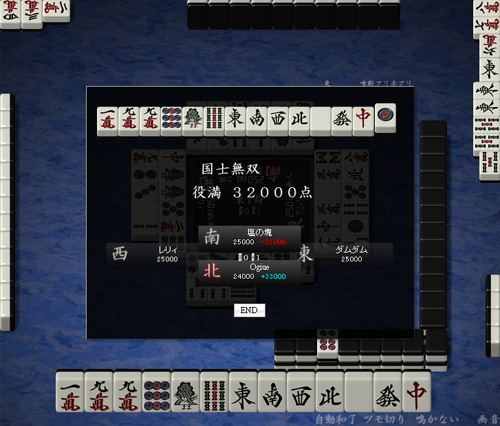
I was like that too, until yesterday when I scored one of the rarest and most difficult-to-achieve hands in the game: Kokushi Musou, also known as 13 Orphans. The hand was so powerful it knocked out one of my opponents in the first round and ended the game instantly. At this point, I almost feel as if I should just stop playing and leave on that very, very high note.

For those of you who know mahjong and are probably much better players than I am, you already know the score. For those who don’t, to properly understand the sheer improbability (there’s that word again!) of a Kokushi Musou hand, I’m going to try to explain it in a way that doesn’t require you to know the rules of mahjong.

Normally in mahjong, you win by having straights and/or three-of-a-kinds as well as a single pair. Most of the hands in mahjong are like this. Kokushi Musou however, cannot be anything but a Kokushi Musou, as the hand actually consists of one pair and then 12 other completely incongruous tiles.

First, what this means is that it is impossible to call on discarded tiles. You may have seen it in Saki or Akagi, where when one player discards a tile another shouts, “Pon!” or “Chi!” or “Kan!” and takes the tile. They are making something, either a three-of-a-kind or a straight or a four-of-a-kind, out of what the opponent had. However, because Kokushi Musou cannot have any straights or three-of-a-kinds, let alone four-of-a-kinds, you cannot call on any tiles without abandoning the attempt to achieve Kokushi Musou. This also means that in order to win, you must draw every necessary tile on your own until your hand is ready to win.

Second, is that while there are other hands which pay just as much as a Kokushi Musou, they usually have a way out, where if the plan to score big fails they can try and fall back on a lower-scoring hand. Kokushi Musou however has no built-in escape routes. If it turns out the tiles you need for Kokushi Musou are 100% unobtainable, then you’re pretty much hosed for the round and you can mount a desperate attack or retreat at best, or you have all the tiles people need to win at worst, which is likely.

Kokushi Musou is called a “Yakuman” hand, essentially an ultimate high-scoring hand. There are also “Counted Yakuman,” where a hand, while not considered one of the Royal Flushes of mahjong, consists of enough high-scoring hands and bonus points to essentially become a Yakuman, not unlike five vehicles combining into a single mighty robot. This Kokushi Musou is my first and only Yakuman ever.

Style Born out of Necessity

In Fred Schodt’s book The Astro Boy Essays, Fred points out that many of the qualities and traits of Japanese “limited” animation (as opposed to Disney-esque “full animation”) could trace their origins back to Tezuka Osamu’s original Tetsuwan Atom anime TV series, a series which was impeded by a staggeringly low budget that all but required these sorts of animaton “shortcuts.” Critics in Japan at that time would remark that the qualities of anime described above, qualities that were born out of necessity, gave anime much of its distinctive Japanese style and that it was in certain ways better than Disney-style full animation.

Of course, not everyone agreed, and others saw the fact that the limited animation style was because of a lack of money, and could not see it as a “style.” Evidently, Tezuka himself had mixed feelings about it: he was happy that these cost-cutting measures allowed him to animate Atom in the first place, but as a loyal fan of Walt Disney it hurt him to be unable to use the full animation he loved so much to bring Atom to life.

There is a sort of latent fear that goes hand in hand with the use of limited animation, and it is the fear of limited animation gone awry: Still frames, camera pans on single images, talking heads, if a show consists of nothing but blatant animation shortcuts, how can it be called animation? From that perspective, the concept of full animation seems safer, but it too carries its own pitfalls, namely “over-animation.” This is where an animation wants to show off its use of full animation so much that everything is animated and nothing ever stays still, to the point that it is difficult to concentrate on what’s actually happening in a cartoon. That’s not to say that it is impossible to do either extreme well, but that ultimately the answer lies somewhere in the middle given the limitations.

A similar problem occurs in 3D animation. Sometimes an animator will work very hard on a scene and it will look visibly impressive and absolutely gorgeous. However, because of the ease of replication in 3D animation, where with a simple switch of the camera angle you can use the same animation or effect and make it seem like it’s entirely new, many animators become tempted. They are so proud of their work that they want to use it again, and again, and again, until it loses all meaning and impact, much like the animators who wanted everything in a frame to move in order to prove just how amazing their animation could be. At this point, the animators must choose to limit themselves, to realize that their tools while seemingly infinite will not produce an infinitely enjoyable experience.

People are boxed in by their limitations, but within those limitations they find ways to improve and to get the most out of what they have. Then, should those limitations no longer be necessary, the people who worked in that style might continue to do so, having honed their technique all those years, and from there it no longer becomes a necessary step but a stylistic choice. Among those stylistic choices are stylistic limitations, to keep a work from being overwhelmed by seemingly endless potential.

What’s amazing about this concept, style born out of necessity, is how often it occurs in art: Tezuka and Tetsuwan Atom leading to the prevalent style of the anime Industry is one example, but you also have video game music of the 80s and 90s giving birth to the “chiptunes” (electronic music made through sound chips, generally the kind found in video games and computers) scene, and even oils becoming one of the de facto forms of paint, among many others. What’s even more amazing is that when you move well beyond the era in which the artistic style was born, well beyond the memories of anyone who was alive to experience that era, you get fresh minds and fresh faces who can approach material with few preconceived notions.

A while back I attended a outdoors chiptunes concert with some friends. While I was enjoying the music myself, I also noticed that a small boy, no more than four years old, enjoying the hell out of the chiptunes. At first I thought it was cute, but then something occurred to me: this kid had been born well after the heyday of the NES and SNES, and so he wasn’t enjoying chiptunes out of some sense of nostalgia, but rather out of the aesthetics he had acquired in the little time he had been alive. It gave me hope that we would be rid of the idea that just because a style was born out of necessity that it would not be considered inherently inferior.

“3D” Super Robot Wars Neo is Very 3D

The first trailer for the Wii-based Super Robot Wars NEO is out, and as you can see from above, the game has gone to great lengths to be a rather odd egg in the SRW franchise. Not only are all the robots being modeled in 3D, something usually shunned by SRW fans as a whole, but the cast list was a surprise to absolutely everyone, and the gameplay itself has seen some drastic modifications which stem primarily from the move to 3D.

The game is no longer boxed in by a grid, and characters have relatively free range of motion across the battlefield. As you can see from the video, each unit has a circle around them, making the game reminiscent of Phantom Brave, while the previous SRW games were closer to Disgaea. There are also many more types of attacks now, rather than just MAP attacks and basic ones which hit one or more units clumped together, as you now also have attacks which have arcs and angles that can go over certain terrain as well as attacks that push enemy units back and so on. And even more intriguing is that the units’ sizes are displayed on the map and even affect battle more readily than their attempt in SRWGC and XO where size difference could make one robot unable to attack another in a critical spot. Size affects many things in NEO apparently, such as attack range and evasion rates, and it’s another example of how much they’re willing to go through with this 3D SRW thing. Oh, and battles can now take place right on the map, a la Battle Chess. That’s pretty cool, I think.

While there are people who say that 3d SRW games are automatically worse, with how ambitious NEO is I want to give it the benefit of the doubt. Besides, it’s only in these non-breadwinning off-shoot SRWs that we get to see the truly crazy casts, and this one is the craziest of all.