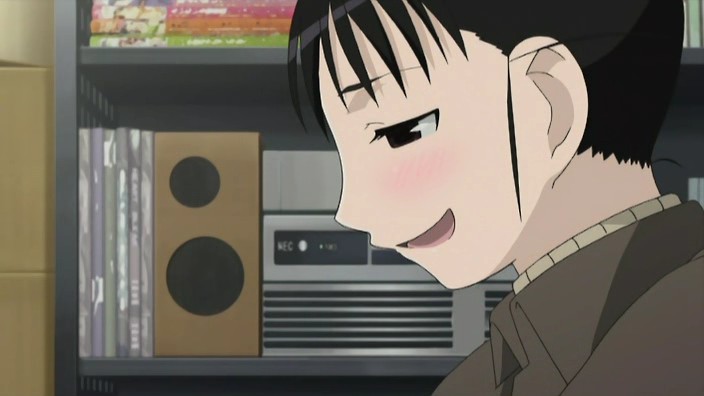
Genshiken, Season 3?

UPDATE 1/23/2013: ANNOUNCEMENT OF A NEW GENSHIKEN ANIME

No, this is not an announcement or rumor for a 3rd season, so please don’t misinterpret the title of this post. Instead, this post is about the possibility of a 3rd television series vs another OVA series.

As we sit here, one episode away from the end of Genshiken 2, those of us who have read the manga know that there is so much more to go through, including what is the most important plot development in Genshiken. It’s already been set in motion throughout season 2 (and even emphasized more heavily when compared to the manga). Of course, I’m talking about Sasa x Ogi.

I really think there is still enough content for another television series. We still have two entire volumes that have been untouched, we have a few stories that were skipped in Genshiken 2 (namely Keiko taking the Shiiou University exam), and we also know that Studio ARMS is not above creating new content or extending existing scenes and doing a good job of it.

If we do get an OVA though, obviously the most important thing it needs to cover is the Sasa x Ogi climax, and that alone provides enough content for two half-hour episodes, if not three.

On Relationships in Genshiken

Genshiken walks a dangerous line by having almost all of its members end up in romantic relationships throughout the course of its run. I have seen the occasional criticism from both English-reading and Japanese-reading people that perhaps the tale of Ogiue is too idealistic, and that at that point Genshiken moved from being a realistic portrayal of otaku to being a sort of wish fulfillment for otaku. While I think that there is a good deal of optimism within Genshiken, I don’t think it’s unrealistic for these incredibly hardcore otaku who comprise Genshiken to have boyfriends and girlfriends, for one important reason: All of them put effort either before or during their relationships.

Saki and Kohsaka are the most normal couple by far, but Saki’s acceptance of otaku has largely to do with her interaction with Kohsaka. They got together fairly simply, and largely due to physical attraction, but the fact that they stayed together through 4 years and their interactions when on-panel show that a lot of progress is made that we are not immediately aware of as readers.

Tanaka and Ohno, even disregarding the anime’s interpretation of how they got together, have a relationship that was fostered through continuous friendship and time spent together. Tanaka not only has good qualities about him, but he has shown these good qualities to Ohno.

And finally Sasahara and Ogiue. While I understand very well the difficulty of a relationship with someone who is into primarily boys’ love, I also understand that Sasahara and Ogiue make a concerted effort to understand and support each other. The entire build up to Sasahara alone with Ogiue in her room was made up of sweat and tears and painful amounts of soul-bearing. And even after that, they know that a relationship isn’t that easy, but to them it’s well worth it.

Otaku being in relationships with attractive individuals isn’t unrealistic, but being in relationships without putting forth any effort IS unrealistic. I’m not saying that romantic relationships are a must for otaku, but then again I am. Otaku are people too, after all.

Why I Like Ogiue, Part 1

I think perhaps it is time I talk more specifically about Ogiue. I mean, I’ve talked about Ogiue in the past before (in case you haven’t noticed), but now is the time to begin discussing the topic of WHY I like Ogiue. I’m referring to this as Part 1 because it’s inevitable that I’ll have more posts on this topic. For Part 1, I am going to focus on my emotional response to Ogiue’s character.

I have always described Ogiue to people as possessing True Moe. Now, I know moe is hard to define, as is truth, but Ogiue is a character I care for deeply because I feel a connection to her plight, her interests, and her progress from self-hating fujoshi to fujoshi girlfriend. She speaks to anyone who has ever been concerned that their otaku nature excludes them from any sort of conceivable romantic relationship, and that includes me. We all have doubts as human beings, but Ogiue’s doubts are very similar to my doubts and to see her overcome them eventually, it’s inspiring, it’s life-affirming, and really, if it were possible, I would give her a hug whenever she needed one. She is someone to whom I can relate, but she is someone else entirely. She’s also a fictional character, but even though she’s not real, her concerns are realistic, and they affect me in such a way that she’s always somewhere either in the front or the back of my mind.

Ogiue is in my opinion the most beautiful and attractive character ever, and the reason why her presence hits me so hard with respect to sex appeal is that, while a lot of her physical and personality traits are things I’ve always liked, such as tomboyishness and having the hottest eyes ever, Ogiue also possesses many traits which I never realized I liked until I read Genshiken. Her harshness, her softness, the way she wraps her doubt in a facade of hate, her problems taking criticism, her tendency to let her imagination run away with her her spurts of creative energy, and yes, even her body type all make her incredibly attractive, but it’s not because of those traits that Ogiue is beautiful.

No, those traits are beautiful because Ogiue possesses them.

One chooses not to acknowledge the mistakes of one’s adulthood

Argh

So I decided to buy the Region 2 DVD 1, with box, poster, and drama CD.

That’s $53 for 2 episodes, and over $300 for the entire series.

And a season 3 is inevitable.

This might be what you call a bad idea.

You Too Can Be Straight for Oscar

I’d like to design an eroge based on 70s-era shoujo manga and anime, the kind with impossibly sparkly eyes and whispy bodies and extreme melodrama.  The sad(?) fact is, that computers simply were not advanced enough in the 70s to pull this off, so we must make up for lost time

The plot would be of that time period, and rather than the stereotypes we get today with the loli, the tsundere, the loli tsundere, and all that, it would incorporate common character types of 70s shoujo as well.

And the sex would involve rose petals flying everywhere and symbolic lightning.

Ogiue, Complex Emotions, Sexiness, such is Genshiken 2 Episode 11

Episode 11 of our illustrious second season of Genshiken covers one of the best Ogiue-themed chapters of the manga, Ogiue selling her doujinshi at Comifes. Watching her relationship with Sasahara further develop is such a joy, even though I’ve seen it all before.

With the introduction of Ogiue’s junior high “friends” though, they’ve set the stage for a Genshiken 3 or at least a handful of OVAs. They absolutely cannot let this plot thread dangle.

Ogiue’s “friends'” names, by the way, are Nakajima and Shigeta. Nakajima is voiced by Endo Aya and Shigeta is voiced by Iguchi Yuuka. Also, with how close those two are, I wonder if Nakajima and Shigeta are, shall we say, pitching for the other team.

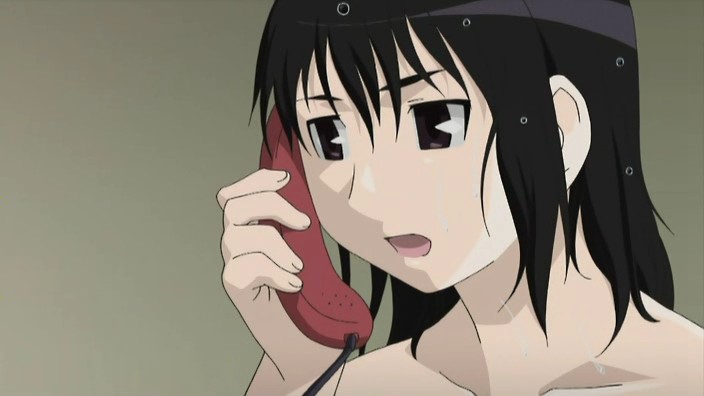
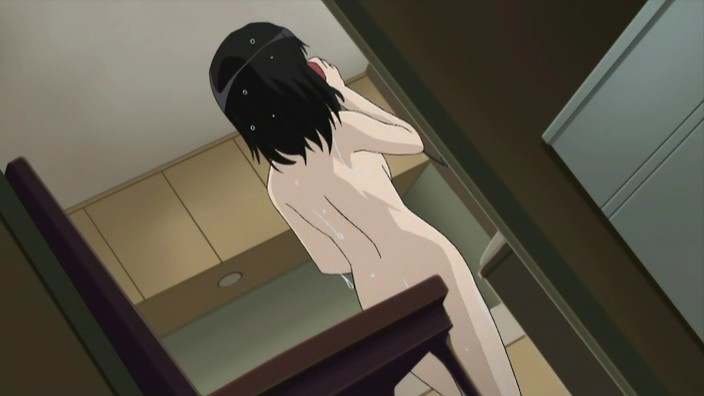
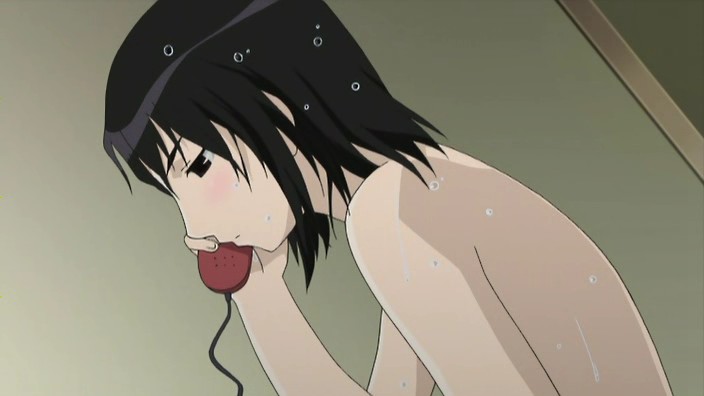
Also, Shiro recently made a post about the joy that is a certain tomboyish Gundam SEED character with wet hair (who is also one of my favorite characters), and also the excellence of anime girls with wet hair in general. Good timing, for Genshiken 2 11 also brings this.

Yeah.

I’m done.

A quick summary of my favorite characters

Figures on Desk

“Slice of Life” they say

This post is inspired by my recently having watched more of Kino’s Journey after a long delay of not-watching Kino’s Journey. Warning: Rambling ahead

I’ve realized how unusual it is that when I think of the term “Slice of Life,” my mind goes immediately to anime. It’s a genre I enjoy immensely, from Azuma Kiyohiko’s works to Haibane Renmei and beyond. You could even consider Genshiken to be “slice of life,” and much of Ogiue’s appeal comes from the small moments in her life. But then, why is it that “slice of life” is so associated with anime, instead of, for example, shows with live actors?

I’ve spoken to friends before about what it is that makes an anime feel like an anime, what differentiates it from other mediums, what makes us come back for more. I think in certain cases, it has to do with this sort of slice of life pacing that’s just not seen as often elsewhere. Of course, I’m not saying that all anime is slice of life, or that there are no slice of life shows outside of anime, but merely that there is a recurring trend that a good amount of people who like anime like it because of shows such as Haibane Renmei. Even if this genre of anime and manga doesn’t occur as often as I think it does, I don’t think anyone would fault me when I say that when it occurs, it leaves a big impression on its fans, perhaps more than even the most soulful of epic tales.

Slice of Life, what does it mean? It means, basically, a story where “normal” life occurs, with less focus on dramatic events and more on the day to day occurrences to which we can relate. I’ve spoken a bit about moe before, and I don’t want to turn this into a moe essay, but I can’t help but feel that there is a corollation between the two. When watching a slice of life show, one desires to live the life of the characters, what tends to be a slow-paced life where the characters involve simply enjoy each passing day. In moe, the appeal is in the “weakness” of characters, the raw, emotional side which is different from stopping and smelling the roses, but also invokes a feeling of realism. If slice of life is “I want to live how they live,” then I think moe is “I feel how she feels.” And of course, the two can co-exist and are often together.

I wonder, then, if animation, as shown through the aesthetics we associate with anime, lends itself to the slice of life genre, much like how moe is associated with anime and manga. Characters tend to be pure and beautiful (though not necessarily attractive). They exist as (seemingly) simple characters leading (relatively) simple lives, no matter what the circumstances. They generally consist of flat colors with minimal shading and black outlines. Due to budget constraints, animation tends to not be very fluid, so still images and animation shortcuts are used, which may lead to slower-paced shows (though that is sometimes called “filler”).  All this may lead to why “Slice of Life” as a genre has attracted so many people to anime.

Or maybe I should just talk to Scrubs fans more often.

Ogiue in the heat of passion

Surely she reverts back to Tohoku-ben.

Mousou Shoujo Getting Too Expensive Kei

First off, importing manga in Japanese is really starting to lose its price advantage over buying translated manga. At this point, I’d really only be doing it to keep my Japanese up.

Mousou Shoujo Otaku Kei. Volume 1. It’s basically one of many in a sea of otaku-themed narratives following the success of Densha Otoko, so let’s see how it stacks up.

It’s the tale of a fujoshi, the boy who likes her, and the guy she wants to pair said boy with. The story focuses mainly on the aforementiond fujoshi, Asai Rumi, and it’s basically a harmless high school romance comedy with a few racy scenes because it’s running in an otaku-oriented magazine.

Asai is no Ogiue, but then really, who is? It’d basically be unfair of me to compare the sheer depth of Ogiue through 6 volumes of manga versus just this one for Asai, so I’ll just say that Asai is a delightful fujoshi character and that it has its funny moments, though perhaps her fujocity is overblown.

Yes, I am coining the term “fujocity.”

Also the term “Asai Fujosault.”