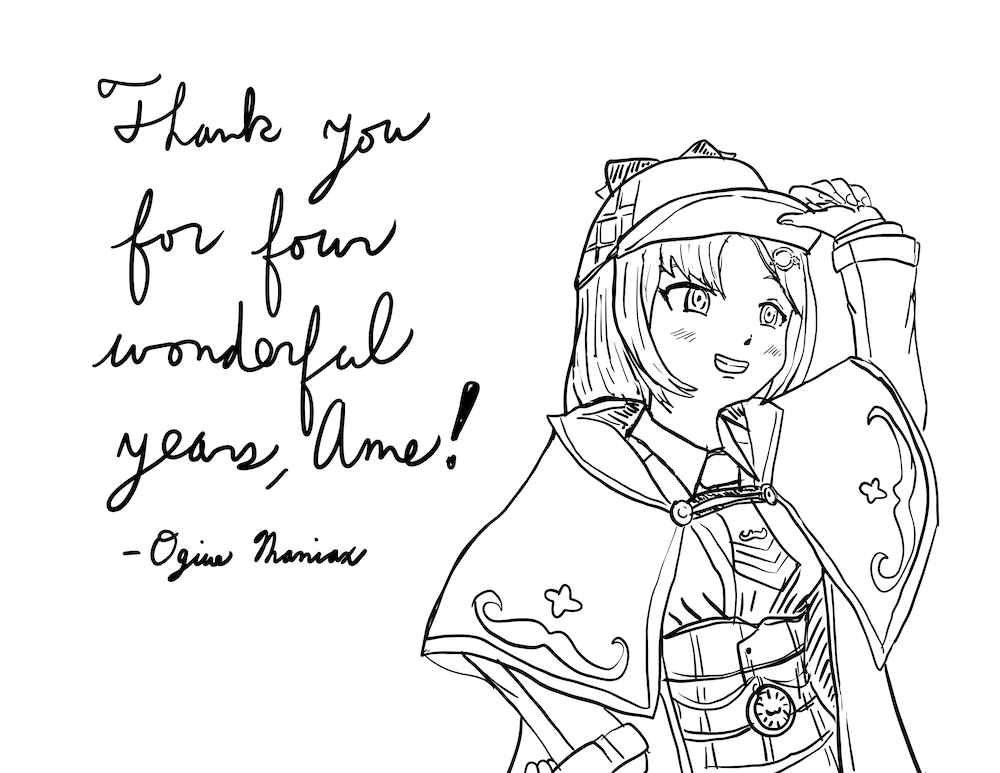
This past month was a real rollercoaster, not least of which was due to hololive talent Amelia Watson announcing that she will be stepping back from actively being a part of the company, and then following that with a marathon of streams. The 4th anniversary of Myth and the 3D debut of ReGLOSS were eventful enough, and now we had this. I even drew on my tablet for the first time in years. If I thought my brain was pretty filled with VTubers last month…
Amid my turbulent emotions, a new anime season is here! The amount of interesting-looking shows is actually overwhelming: Mecha-Ude, Trillion Game, A Terrified Teacher at Ghoul School!, Thunderbolt Fantasy Season 4, Love Live! Superstar!! Season 3, etc. On and on and on. I’m worried I won’t have time for it all.
And I’m still trying to watch through some old anime, like Blue Comet SPT Layzner.
I hope my supporters on Patreon are okay with how I’m doing. Thank you as always.
A few days ago, I felt an urge to write an essay dedicated to Amelia Watson. It’s something I’ve been doing for all my favorite VTubers over the past few years—using my humble platform to celebrate these talented individuals that I’ve grown to adore. However, between Breaking Dimensions, Anime NYC, a whole host of big hololive happenings in September, and me just being busy in general, I had decided to wait.
I mistakenly thought I could take my sweet time penning a post dedicated to an active, ongoing career.
Today, Amelia (Ame to fans) has announced that she will be concluding her streaming, participation in events, and periodic merchandise. While something akin to a graduation (i.e. an idol/VTuber leaving a company on relatively good terms), it is not actually one. In fact, Ame herself has mentioned in a Youtube comment that she might still show up on occasion, though this does not count as a transition to staff.
So here we are.
The Story of Myth
Let’s rewind to September of 2020, at the height of the COVID-19 pandemic and with many people around the world staying at home to prevent the spread of the virus. It was in this environment that the Japanese VTuber agency hololive announced their first English generation: Myth. At a time when so many were cooped up at home and in need of some joy, when the ability to even see other human beings in person came at a real risk to one’s life, Myth breathed life into people. The success they found might very well be forever unmatched.
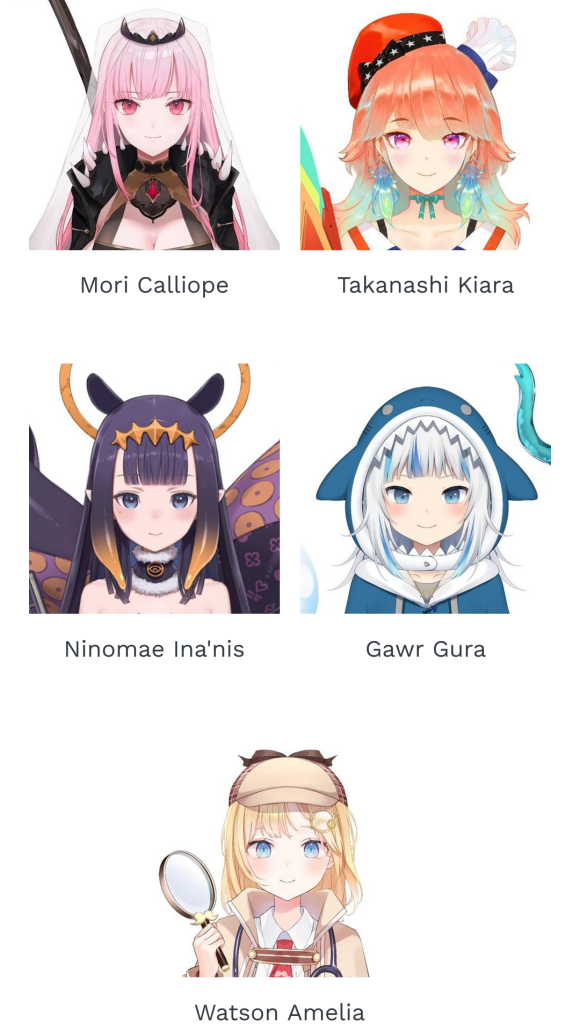
Four of that first EN generation were shown to carry ancient and supernatural motifs—Calliope Mori the grim reaper, Takanashi Kiara the phoenix, Ninomae Ina’nis the eldritch priestess, and Gawr Gura the Atlantean shark. The fifth was Amelia Watson, a “mere” human detective investigating the others. Not only did she stand out as unusual in terms of her theming, but she was the last to officially debut. And from the very beginning, it was clear that she was bringing something unorthodox. Whether it was starting off with a tongue-in-cheek joke about actually being British but needing to put on a “fake” accent, or her inducing “hallucinations” in the audience through an injection of her “Watson Concoction,” Ame’s wit and imagination were on display.
The AmeWay
Ame didn’t reveal her entire character concept at debut: She’s not just a detective but also a time traveler. In the severe extenuating circumstances of a global pandemic, she began to express this facet by playing around with 3D models, VRChat, and other interesting software and technology. As fan works of Ame poured in, she commissioned artists to make variations of her: a chibi (that went on to become a mascot of hololive called “Smol Ame”), a bee, a mountain of muscles, and even recently a hand puppet.
Ame is often referred to as “creative,” and while that’s certainly true, a more detailed description would be that she pushes the boundaries of what is possible in any space she’s in through a combination of out-of-the-box thinking and sheer stubbornness. Sometimes it’s in her approach to video games. Just yesterday, she started playing on hololive’s Grand Theft Auto Online server, where she successfully got past a fence on her unicycle by riding downhill to build up momentum and crash through. During Part 1 of the hololive Minecraft roleplaying event “Enigmatic Recollection,” she could be seen trying to glitch the block mechanics to create shortcuts for herself, while also being one half of the wild “Jyonathan and Gonathan” romance story with Gigi Murin that captivated fans. Other times, it’s through her exploration of the technical aspects of VTubing. Fans call this the “AmeWay,” and it speaks to the notion that if two paths diverged in the woods, Ame would cut her way through the trees in the middle.
During that dark period when Japan was locked down and travel into the country was impossible, Ame found a way to give her and the other Myth girls their own “3D event” of sorts through VRChat, and by giving everyone a “Smol” model of their own to pilot.
Even later down the line, as the world opened up, Ame continued to push the envelope. For Myth’s 2nd anniversary, Ame set up a special 360 degree view where fans could move their phones around to explore the 3D space with her and the other girls.
One of Ame’s strengths is her interest in technology—even building her own 3D studio at home—and she provided a lot of behind-the-scenes support for her fellow talents, both peers and later generations alike. It wasn’t uncommon to hear other EN members mention her giving them computer tips or advice on what equipment to buy, or to catch a glimpse of her acting as the cameraperson in VRChat streams. Even when she wasn’t on screen, her presence could be felt.
The Road to Idol Ame
If there was one thing I really missed while staying at home during the pandemic, it was the ability to go out for karaoke. So when I started seeing that VTubers do their own karaoke sessions, I would tune in. I don’t know if Ame’s was the first, but it’s one that sticks out in my memory in a big way.
In that first karaoke stream, one thing was apparent: In a VTuber generation filled with musically inclined peers, Ame was by far the weakest singer. Constantly off-key and unable to keep the rhythm, Ame could not carry a tune at all.
It was beautiful.
For those who don’t karaoke, one thing that might be hard to understand is that singing ability doesn’t matter all that much—at least around good people. It’s about finding songs that you enjoy, giving it your best shot even if you sound like ass (speaking from personal experience here), and just having a good time with others. And if someone’s got pipes, that’s cool too—karaoke isn’t about hating. What Ame brought to that singing stream, and all subsequent ones, was that “karaoke with friends” energy. And in 2020, that energy was all the more powerful.
That spirit alone would have been enough to make me a fan, but then she hit me personally deep in my soul by singing Sixpence None the Richer’s “Kiss Me,” a favorite song from my childhood. The fact that it would become one of her go-to songs over the past four years is something I’m grateful for. And if that’s where Ame’s musical performance journey ended, I would have been satisfied. But that’s not the whole story.
Ame kept singing over the months and years, and bit by bit, something happened. She started hitting those notes a little more cleanly. Her voice wouldn’t squeak as much. She was actually improving! And while Ame had set up a bleeding-ear emote as a self-deprecating joke, fans eventually stopped using it entirely.
In the time since that first karaoke session, so much has happened. Ame got to appear on the big stage with her official 3D model at 3rd fes, putting on a memorable cover of the cute and bizarre “Puru Puru Pururin” from Welcome to the NHK! She released her own original song, “Chiku Taku” (accompanied by a video game based on it), and then performed it at two separate live events, including the first EN concert. The latter was even a ska rendition that reflected her own musical tastes, which she accompanied by skanking on stage. She had her official 3D showcase, where she got to show off her detective’s office, do cartwheels, and collaborate in person with Japanese hololive members like Haachama and Yozora Mel. At 5th fes, Ame upped her choreography game too.
Just recently, her “IDOL” duet with Gura was one of the absolute highlights of last month’s Breaking Dimensions concert. And in their recent 4th anniversary online concert, she was able to keep up well with the other strong singers of her generation and help make “The Show Goes On” the best Myth group song ever. Each step of the way was evidence of her improvements as a performer, and while she never embraced the shining lights, that’s also why she embodied the “idol journey” so thoroughly.
The Hiccup
I want to just mention this brief thing that has little to do with achievements and interests, but is inextricable from Ame’s story. There are a lot of unique things about her, but perhaps none are more iconic than her chronic hiccups that can often be heard on her streams. It’s not clear if it’s a hiccup exactly or something else, but whatever it actually is, the result is something that is identifiably Ame. What’s more, unlike a particular way of talking or laughing, it pretty much can’t be replicated. Even in this simple way, there will never be another Amelia Watson.
The Closing of a Chapter
While hololive isn’t a piece of fiction in the traditional sense, Amelia Watson is often positioned in fan works and headcanons as the “protagonist” of Myth and possibly hololive EN as a whole. A lot of it has to do with her motif as a completely human detective (albeit one unbound by time), but I think it’s also because she also comes across as very human in a different sense. She’s not anywhere near the best singer or dancer, she doesn’t have that non-stop gift of gab that others might, and while she’s definitely one of the strongest gamers, it’s not her main focus either. But Ame has ingenuity, and in a way, she’s sort of like the Batman of hololive.
I have a tendency to like creators, VTuber or otherwise, who experiment and expand the range of what is considered “possible.” That’s where Ame has thrived and why I became so fond of her, and countless others feel the same way. It’s hard to overstate just how much of an influence her tinkering and her ideas have had on the VTubing scene, especially in the English sphere. There has been a constant outpouring of love from other VTubers, many of whom are citing her as a real inspiration—especially for those who wanted to do something different than the established norm.
Personally, the timing of Ame’s announcement is kind of funny. Until literally last month, I didn’t own that much of her merch. Now, as she begins her retreat from the spotlight, I find myself coincidentally with more than I ever expected: a desk mat, figures, keychains, and so on. I even just uploaded a video of her to my Youtube—one of only two VTuber clips on my entire channel.
One thing I haven’t done is try to draw her. After all, I had assumed there was plenty of time to get around it. Maybe I need to change that.
In a way, we Teamates and Investigators are very lucky. Not only did we get four years of one of the best to ever do it, but the fact that this isn’t a full-on graduation means there will likely be opportunities to reunite with her in this familiar form. And no matter what, the thing that really matters is that the person behind the virtual avatar can find happiness in whatever form it takes.
(And there’s always the off chance we might see her without her coat in 3D.)
I’ve watched the recent anniversary streams of holoX, and in light of the announcement of the Hololive 4th Fes, I’ve been thinking about how holding 3D concerts can carry different types of significance depending on the individual member and what their fans are looking for. Hololive seems to celebrate their stars in a manner inclusive to every Hololive member’s diverse fanbase, and I’m all for it.
It’s no secret that Hololive members can vary tremendously in terms of where their talents lie. Some clearly establish themselves as great performers as soon as they have the chance, like Hoshimachi Suisei. Others don’t necessarily have the background but have worked hard and come into their own, such as Oozora Subaru. And then there are those who don’t reach the level of their fellow VTubers in terms of singing and dancing, but they might have engaging personalities that just make for a special experience.
However, when there are 3D concerts or other major events that bring Hololive members together, they potentially become places where all respective fans can come together and appreciate their favorites for their own particular reasons. Take the Hololive 3rd Fes concert, which was the 3D debut of Hololive English’s first generation. Gawr Gura showcased the singing talent that brought so many fans to her, along with a cute dance. Takanashi Kiara brought a more polished idol flair. Ina came with a soothing voice in a subdued performance. Amelia Watson is definitely not a strong singer, but her choice of music (a weird fictitious anime opening from the show Welcome to the NHK!) put her personality on full display. And Calliope Mori put her well-established rap skills (that have since led to a contract with Universal Music Group) to good use. Hololive Indonesia’s first generation also made their 3D concert appearances, with Moona’s diva-like poise, Iofi’s adorableness, and Risu’s ridiculous vocal range all on full display.
With holoX, there is a similar range of strengths and quirks on display in their anniversary concerts. La+ Darknesss (see above) is a ridiculous total package whose impressive vocals and unmatched dance skills both support and defy her “bratty alien demon lord” concept. Takane Lui doesn’t fit the typical image of an idol, but she’s very good at singing while also staying “in-character,” and her choice of songs conveys a sense of maturity. Hakui Koyori is a jack of all trades who also leans into her character the most by adding in puzzles and brain teasers to her concert. Sakamata Chloe is arguably the best singer in the group, with a voice that can seem unreal; she was also the only one to do exclusively solo performances, as if to prove a point. Kazama Iroha’s cuteness shines through in her energetic performances, and it’s clear that she put in a lot of effort to improve her dancing.
It all reminds me of an essay I once read about the differences in presentation between Japanese idols and Korean pop stars: part of the appeal of J-idols is seeing them grow into the role, whereas K-pop stars appear before fans already fully formed. In the context of Hololive, it’s like there’s a purposeful and perhaps even inevitable contrast. While you might have your “J-idol fan” types who want to see their favorites grow and your “K-pop fan” types who love to see perfection in action, a single banner like Hololive allows these groups (and many more) to all thrive in the same general space.
The power that comes from the variety Hololive has to offer is the way it encourages respect for diversity of talent. People can be fans of different members for different reasons. There are certainly talents whose appeal lies in their sheer skill, and the fans want to see their favorites put their abilities and/or progress on full display. However, there are also Hololive members who aren’t necessarily the greatest performers in one way or another, but their presence on stage makes for a kind of “we made it” moment for their fans. No matter the reason, it emphasizes the idea that there’s no one “right” way for a performance to be, and it encourages the different fanbases to coexist.
As the days go by, I increasingly find myself looking into the world of Virtual Youtubers. I watch the clips and highlights that go around, and I sometimes tune into the live streams of my favorites. I wouldn’t consider myself a devotee of the whole concept, but I’m entertained. I know I’m not alone, as the increasing success of VTubers is a sight to behold—Gawr Gura, one of the first members of the Hololive agency’s push into English-language streaming, hit one million subscribers in just a little over a month and has since surpassed two million.
The more I think about it, however, the more I realize that the success of Virtual Youtubers shouldn’t come as a surprise. They’re in many ways a perfect storm of things that appeal to people on the internet, bringing together different groups who tend towards obsession and converging them onto this amalgam of elements.
The first group is weebs. I generally avoid the term, preferring things like “anime and manga fans,” but I feel that its usage is accurate here—it’s not just about being into the media but being into that strain of Japanese pop culture. With few exceptions, Virtual Youtubers go for that anime aesthetic, recruiting famous artists and character designers to create these avatars. In a sense, they’re anime characters come to life, and that gives them a certain charm and universality that comes with being less realistic in terms of appearance. And while VTubers now exist across the world, they’re firmly rooted in that anime/manga/light novel realm, and expectations derive from the tropes found there.
The second group is gamers. While streaming has had some presence on the internet for decades now, gaming has become one of its absolute pillars. Between the transformation of Justin.tv into Twitch, the prevalence of esports, the enduring popularity of Youtube channels like Game Grumps, and the rise of speedrunning as a spectator activity, there’s no denying the draw. Live streaming your play session is just an easy and reliable way to connect with potential fans, and while streamers usually need some kind of physical or personal charisma to get things going, the sleek designs of VTubers help bridge that gap.
The third group is idol fans. While it’s like every one of them eventually gets their own original songs, what attracts people to idols is that they feel somehow distant yet accessible, and Virtual Youtubers greatly exaggerate both sides of the fantasy by their very nature. The use of character avatars means there’s no mistaking their visual appearances for being the “real” individuals, but that also means being able to project onto them an idealized version. At the same time, unlike Hatsune Miku, they’re real people interacting from behind the curtain. Depending on what level of performativity vs. seeming authenticity a viewer wants, or popularity vs. obscurity (what’s more exciting than seeing your favorite personality grow from small-time to wild success?) there’s probably a VTuber for them. What’s more, the concept of superchats on YouTube allows fans to get instant gratification by giving money to have their messages read and acknowledged.
The fourth group, and there’s plenty of overlap with the other three, is those who are into celebrities. This is a more vague and generalized group, but it’s the same energy that fuels people to follow the goings-on of their favorite movie stars and singers.
A weeb might love all things anime-adjacent but dismiss Western-style game aesthetics. A fan of first-person shooters might love watching anything and everything related to their favorite games but think anime stuff looks weird as hell. But then a Virtual Youtuber who looks like an anime character come-to-life might play Apex Legends, and so now the weebs get their real-life anime girl and the Western-focused gamers get to connect to her through their favorite game. At the same time, even if she isn’t particularly good at what she’s playing, that gives her a kind of element of relatability that an idol fan might be drawn to. And even if someone isn’t an idol fan, seeing someone suffer through a game has an established history of bringing in eyeballs. The crossover appeal is hard to deny.
Thus, when the VTubers branch into areas other than gaming, they can bring all those different groups together. It’s why they can karaoke Japanese, English, and even German songs, all to praise and fanfare. When they do something completely out of the realm of entertainment, like cook, it doesn’t seem out of the ordinary even if the results can range from bizarre to horrifying. The fact that their fans don’t just come from one place also gives the VTubers the flexibility to try new things and see what sticks. Non-virtual streamers who get popular because of one game can sometimes have a hard time playing others because they might not get the viewer counts they normally would, but what makes people want to see Virtual Youtubers goes beyond specific games or titles.
I think the concept of the VTuber allows it a certain degree of freedom that flesh-and-blood streamers do not. By virtue of their virtual natures (pun intended), they invite viewers into a kind of alternate reality. From there, the ability to take that anime character identity and apply it to various domains or interests means that even activities that normally might not appeal to a person can suddenly seem interesting. It’s a lot like how manga can make certain topics more appealing to those who are unfamiliar, but with Virtual Youtubers you get both the slice-of-life hobbyism and the gutsy competition at the same time. And unlike in manga, the wins and losses are real—even if everything is ultimately made up and the points don’t matter.
Virtual Youtubers continue to be a tour de force, reaching beyond Japan to worldwide recognition. Given this success, as well as the crossover appeal of certain English-fluent VTubers (such as Fujima Sakura, Pikamee, and Kiryu Coco), it was only a matter of time before one of the big VTubers agencies would try to make an active effort to court an English-speaking audience. Thus is born Hololive EN, and with it five new streamers.
The tricky thing with something like Hololive English is striking the right balance in terms of audience desire and accessibility. Speaking in the target demographic’s native tongue does wonders for directly engaging with viewers, and offers an experience closer to what the Japanese viewers typically enjoy. Rather than Inugami Korone’s amusing struggles with English, little gets lost in translation. However, it’s also possible that part of the appeal is the existence of a culture gap—that there’s an element of exoticism found in both the language barrier and the moe idol aesthetic. Veering too far in one direction might alienate certain fans.
The route that Hololive English appears to have taken is to feature VTubers with decent degrees of spoken Japanese fluency—enough to interact with the Japanese fans as well. Their true identities remain unknown (as is standard), so it’s unclear if they’re natively multilingual or if they achieved it through study, but the result either way is that there isn’t a complete disconnect with the Japanese origins of Hololive. The style of English seems to differ from one to the next, whether it’s the cutesy affectations of Gawr Gura or the more natural-sounding speech of Mori Calliope. I think this probably a good way to hedge their bets in terms of figuring out what will garner the most fans, though I don’t know how intentional that is.
While all of them are able to speak Japanese fairly well, written fluency varies significantly between the Hololive English members (unless it’s somehow all an act). Case in point, Takanashi Kiara’s language skills are very strong to the extent that she self-translates, Ninomae Ina’nis appears to have a solid handle, and Amelia Watson can struggle with the basics. Kiara’s advantage is obvious, but I think the ones who are less fluent actually have a certain appeal themselves. Not only do they resonate with those of us who grew up speaking our parents’ languages but never became properly literate, but they’re also relatable to those currently learning Japanese or who want to learn Japanese—no doubt a common occurrence among Virtual Youtuber fans.
For now, I don’t really have a favorite, but I wish all of them the best of luck. If they find success, I wonder if other Vtuber groups will push harder to have an active international presence.
This post is sponsored by Ogiue Maniax patron Johnny Trovato. You can request topics through the Patreon or by tipping $30 via ko-fi.



 OGIUE MANIAX