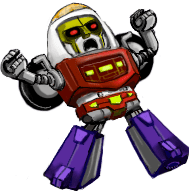
In Celebration of a Life, Short-lived: Sym-Bionic Titan

This past weekend was the final episode of Sym-Bionic Titan. I wish I didn’t have to say that.

When I first started watching anime, one of the most enticing aspects of it over many of the American cartoons I watched at the time was that, not only did they have on-going stories, but that those stories actually finished. They had conclusions. They weren’t always good conclusions (or good shows), and many times they were so open-ended you weren’t sure what exactly had happened, but you knew that if you started something, chances are you’d get something final out of it by the end.

American cartoons had managed to get some decisive finishes through, such as in Gargoyles or Conan the Adventurer, and I’ll even count the end of the Saturday morning version of Sonic the Hedgehog as a decisive finish despite it setting the stage for another season that never came to be. But for every one of those, you got a Pirates of Darkwater, where the show was set up from the start to reach a certain conclusion, but the show just stops in the middle and all you’re left with is your own imaginative speculation and/or fanfiction. I thought we were past this era, but I was wrong.

Sym-Bionic Titan was the brainchild of Genndy Tartakovsky, the man behind Dexter’s Laboratory and Samurai Jack, and it was his most ambitious and best-looking work to date. Following a trio of aliens (Lance the soldier, Ilana the Princess, Octus the robot) who escaped to Earth as the last hope to save their world of Galaluna from a traitorous general, the show took cues from Japanese super robot cartoons, American action cartoons, teen films, and various other areas and channeled them through some of the most deft usage of flash animation I’d ever seen. Much like Panty & Stocking with Garterbelt (and I have drawn comparisons between them before), it poked fun at genre conventions from multiple genres, and did so with style and grace-disguised-as-clumsiness.  It was a sign that Genndy had learned a lot since working on Samurai Jack, where the animation was often nice but felt very flat, and he married it with excellent characters and an intriguing plot. There were many mysteries in the show. What was Modula’s true motive? What really happened to Lance’s dad? Who was the mysterious person behind the Galactic Guardian Group? While the show could have easily gone on forever, it was not in its best interest to do so, as there was a real sense of urgency throughout the show, especially when you learned more and more about the characters and where they came from and why, on a personal level, they fight.

But Sym-Bionic Titan ran its initial 20 episodes, and was not renewed for more. Genndy Tartakovsky has moved on from Cartoon Network, possibly frustrated that they never let him finish his works. Samurai Jack never fought his decisive battle with Aku, and it’s unlikely that Lance, Ilana, and Octus will ever be able to return to Galaluna for a showdown with Modula. Was the show not doing well? Was it just not getting the money behind it to continue on?

It turns out that the reason given is that the show was actually doing quite well, but it did not have enough toys connected to it. I can see this being a problem, but I have to point out the fact that the show is ABOUT PEOPLE WHO TRANSFORM INTO ROBOT SUITS WHO COMBINE INTO A GIANT ROBOT THAT FIGHTS GIANT MONSTERS. That they couldn’t figure out how to convert this concept into toys is nothing short of ridiculous, and so the reasoning behind the show’s cancellation feels flimsy at best, an act of malice at worst.

Now there’s a possibility that Genndy pulled a Bill Watterson and specifically forbade merchandise from being made, but I highly doubt that. For one thing, he had hoped for a continuation of the series. This much is obvious based merely on the way the show is set up and how its final episode leaves room for so much more, let alone him actually saying as such. For another, the show’s explicit homage to Japanese giant robot cartoons makes it very likely that Genndy was not ignorant of the genre’s toy-centric origins or the fact that giant robot anime practically grew that merchandise industry in Japan to enormous proportions.

So even with the lack of an ending, is Sym-Bionic Titan worth watching? Yes, very much so. Do it.

ANIME OPENINGS ARE SO MUCH BETTER

Once again in lieu of actually learning how to make AMVs, I have been abusing Tubedubber to do my bidding.

Here’s a few you might enjoy. I recommend reloading twice to (hopefully) sync the video and the audio up properly.

Play the Game

Love Triangle

Big Ponies

Heroes Everywhere

Dragon Soul

Heroman? What About Villainman?

Question: What’s the difference between Anpanman and Heroman?

The answer is, Anpanman has an arch-enemy.

I recently finished Heroman, the BONES collaboration with American comics legend Stan Lee, and while the show had some positive qualities to it, it fell flat overall, due in no small part to a long run of episodes in the middle which pretty much just meandered about. But in the list of things the show could have done better, what really stood out to me was how Heroman and Joey Jones never got a proper supervillain to call their own. Sure, Heroman and Joey have adversaries and rivals, namely the insectoid Skrugg and their leader Gogorr, as well as Dr. Minami and “Anime Flash Thompson,” but none of them felt quite right, even if two out of the three turned out interesting in the end.

Gogorr had the most potential to be an arch-enemy.  As a galactic conqueror that can augment and evolve his body for combat, he bears a great resemblance to Vilgax, the primary villain in the American cartoon Ben 10, but the main difference here is that, unlike Gogorr, I would most definitely consider Vilgax to be Ben Tennyson’s arch-enemy. With Ben and Vilgax, not only could you sense a greater degree of personal animosity between the two, but Vilgax’s actions directly cause Ben to get his powers in the first place. In contrast, Gogorr feels a little too distant from Joey both emotionally and thematically to be a proper nemesis. Another factor is that the way Gogorr is presented makes him feel a little too powerful to be an arch-enemy, too much of a Goliath to Heroman’s David, and too much of an Archmage to Heroman’s Goliath.

Left: Vilgax, Right: Gogorr

A lack of arch-enemies might seem like an odd thing to single out, and to be sure the inclusion of one wouldn’t have solved all of Heroman‘s problems, but the reason I’m focusing on the concept is that the arch-enemy is a near-integral part of what makes superhero stories feel like superhero stories, and as a show at least partially based on the American superhero concept, Heroman could have benefitted from such a character. On a more intellectual level, they provide a nice foil for the hero, holding up a mirror to the hero’s own abilities either through being the opposite or being the same (or sometimes both), but on a simpler level supervillains expand the world of the superhero by having a great evil that can be vanquished by a great good, highlighting both protagonist and antagonist. I wouldn’t go as far as saying that Heroman needed a relationship with a villain on par with Superman/Lex Luthor or the Fantastic Four/Doctor Doom, but just having someone to stand in contrast to Heroman and Joey would go a long way in highlighting the “What does it mean to be a hero?” theme that persists throughout Heroman.

The Cross-Cultural Exchange of a Couple of G’s

In 1996, Russian-American animator Genndy Tartakovsky premiered Dexter’s Laboratory and pioneered the thick-lined,”flatter” animation style. This style can also be seen in Samurai Jack and Star Wars: Clone Wars, as well as in Powerpuff Girls, where Genndy was director.

Flash back a few month to 1995 and we get one of most the influential anime ever, Studio Gainax’s Neon Genesis Evangelion. Gainax, known for a variety of works from various genres, are especially fondly remembered for their giant robot fare, most notably Evangelion but also Aim for the Top! and Tengen Toppa Gurren-Lagann.

Now, in late 2010: Gainax’s latest anime is a tongue-in-cheek cartoon about a pair of misfits and heavily utilizes thick outlines and very flat character designs, while Genndy Tartakovsky’s newest show is an honest, non-parody attempt at a super robot-themed series. Both series’ debuts occurred less than three weeks apart from each other.

While the relationship between Japan and America’s cartoons and comics have been put in the spotlight recently with collaborations such as the joint Iron Man and Wolverine projects involving Marvel and Studio Madhouse, the fact that Genndy Tartakovsky’s Sym-Bionic Titan and Gainax’s Panty & Stocking with Garterbelt have come into existence so close to one another puts an even greater focus on the two nations’ cartoons. Here in one cross-section of time, we can see the active/passive exchange of ideas as these cultures’ animation styles appear to intertwine so tightly that they sling each other across the Pacific Ocean.

Neither show is so like the animated series of the others’ country that they come off as weak imitations. Sym-Bionic Titan takes fusing robots, a fight against a powerful invading force, and various other giant robot tropes, mixes them in with Genndy’s own character aesthetics, and places the story firmly within America and its own cultural norms. Meanwhile, Panty & Stocking utilizes the visual elements and humor of early “Cartoon Cartoons” (as Cartoon Network referred to them) while also injecting very anime-esque expressions and reactions from its characters, most notably in their faces, and also ramping up the humor to more “adult” levels. The two series and their hybrid styles reinforce both the idea that creativity is not limited by national borders and that individual cultures can still maintain some of their distinctiveness when it comes to artistic output.

This is not a bad thing.

As a final aside, the personal robot used by the character Lance in Sym-Bionic Titan reminds me of the titular robot from Galaxy Gale Baxinger.

I can’t be the only one, right?

True Honorable Spirit in 30 Minutes or Less

Over the years, I’ve probably gotten too much exposure to kids’ entertainment from both Japan and America. Because of that, as well as an idle comment made by someone I was talking, to I was recently thinking about portrayals of Japanese/American relations in each respective country’s cartoons and comics, and how interestingly they mirror each other.

In anime and manga, when an American character meets the primarily Japanese main characters, what almost inevitably ends up happening, especially if the American ends up being a friend or ally, is that he is able to understand the “true Japanese spirit” after his fateful encounter. Usually it’ll have to do with the determination and willpower of the Japanese, as well as just how much they can overcome in the face of superior forces.

But in American cartoons and comics, when a Japanese character appears, he almost always emphasizes honor. Honor is the most important quality in a Japanese character in an American cartoon, and there is always a point in the show, typically towards the end, where one or more American characters prove that they are truly honorable in the eyes of the Japanese character.

To some extent I think the American cartoon’s portrayal has to do with the mystifying image of the orient that has been a part of western fiction for centuries, while the Japanese cartoon’s portrayal supports the reassuring idea that, although Japanese people might not be the biggest or strongest, they can make up for that with intangible qualities. In either case however, this idea of winning over the foreigner and showing that, when you get down to it, respectable qualities remain very similar around the world, even if it’s portrayed through the lens of stereotypes and simple stories.

What do you think of this? Am I on the mark? Do you think things have changed significantly over the years so that this is no longer the case?

Through the Looking Glass (Translator’s Note: Looking Glass Means Mirror)

Here in the English-speaking anime and gaming internet communities, analyses of translations are never uncommon. Whether it’s to praise a localization or to condemn for whatever reasons such as inaccuracies or censorship, it’s something that comes packaged with media coming from other countries.

One thing we do not see as often though is how Japan reacts to localizations of our cartoons and video games. As such, I’ve compiled a list of some interesting posts, blogs, etc. which look at the world of Japanese-English adaptations from various angles.

Adventures in Localization, MW2 Edition

The most recent thing to come up, apparently the Japanese release of Call of Duty: Modern Warfare 2 is marred by poor translations overall, which are leading some Japanese games swearing that they will buy the Asian English-language version of the game before this. Sound familiar?

Sakae Moon Street

See this Japanese fan discuss those wild and crazy cartoons from America such as Ben 10, Avatar: The Last Airbender, and Code Lyoko! He mostly posts plot summaries and information on voice actors and such, but also posts fanart sometimes, and has a gallery full of his older works. He also speaks some English and has even translated a few posts, such as in his review of the Avatar episode, “The Blind Bandit.”

I think that “Colosseum”, “Macho” and “Sumo wrestler” are loved particularly in the American cartoon. The picture of this film is wonderful. And there are a lot of highlights as for the action scene. I think this action scene is rivaled to “Matrix” or “Ghost in the shell”.

Toph’s character is like a princess more than I had thought. She is keeping the weakness secret on the other side of strength of vender power. I like it. However, of course, she is tough too. And I am surprised because Katara grew up tougher. The director of Avatar wants to show that Katara looks senior compared with Toph, isn’t it?

Dekadenbiyori

In the blogger’s own words, “I don’t know why, but translated Japanese things attract me.” Dekadenbiyori is quite unusual though in that it reviews the English translations of Japanese works FOR Japanese readers, something which I imagine doesn’t have the largest audience but is still a fascinating subject. See here as he tears apart the poor localization of the Shakugan no Shana light novel and its inability to not make the main character sound “special.” You don’t need to know Japanese in order to understand his disdain for this translation.

Burning Becky Review

Japanese Super Blogger and Mitsudomoe fan Tamagomago writes a review of a most unusual manga called Burning Becky. The comic’s style is heavily based on American super hero comics, right down to the cover with a logo in the upper left corner as well as English sound effects and the very fact that it’s a manga about a super hero. Tamagomago himself wrote the post as if he were an American speaking Japanese. This one isn’t so easy to read so I’ll provide a little sample. I had planned on translating the entire article here for English-speaking readers to enjoy, but that hasn’t happened. At least not yet.

アメコミのいいところの一つは、ダイナミックで豪快な、まるでイラストレーションのような描写力があるかな?少ないページ数にたくさんのキャラクターが出てくるために洗練された方法かもしれないね。もちろん、それは作家さん次第なので、全部ではないよ。

One of the good points about American Comics is that they’re so dynamic and exciting, one might say that they’re practically illustrations in their descriptive power. This is likely the result of  refining techniques for the sake of including so many characters on so few pages. Of course that’s dependent on the individual artist and so it’s not universal.

Momoiro Kakarichou and the Anime-niacs

I recently have had the fortune of watching Animaniacs dubbed into Japanese. It was a fun experience to say the least, seeing Yakko, Wakko, Dot go about their antics in another language entirely, but one part of Animaniacs stood out to me in Japanese: Pinky and the Brain.

Upon initially watching Pinky and the Brain in Japanese, nothing seems amiss. That is, until you notice an odd aspect of Pinky’s speech: his tendency to put the non-word “Naafu” into his sentences. In English, this is obviously Pinky’s famous catch phrase “Narf,” but in Japanese it ends up being more akin to Ayu’s “Uguu” or Stealth Momo’s “~ssu.”

Then you start to think. Pinky’s primary traits are being dumb, naive, and prone to clumsiness, but his secondary traits are being honest, kind, and strangely wise in a roundabout sort of way. You see Pinky, for all of his goodness and his desire to support the Brain in world-conquering endeavors, essentially to stick together forever, and you realize: in a different setting, with his distinctive catchphrases and wide-eyed innocence, that Pinky could have been a moe character.

I’ll let it sink in for a moment, and also remind you that Laura Winslow is a tsundere.

By Crom! Endings!

In a previous post I made here on Ogiue Maniax, I talked about how as a child I was amazed when cartoons I watched had actual endings or resolutions or at least something resembling a good stopping point, and I specified Conan the Adventurer as one such show. Then, I found out that another show I loved as a kid, Dino-Riders, also had an “ending” of sorts, and then I found out both of these final episodes are on Youtube!

Conan the Adventurer: A Serpent Coils the Earth

Dino-Riders: One to Lead Us

Now I know for many anime watchers, having an ending is not that special. Most anime and manga end at some point, and even the ones that run forever try to come up with some kind of conclusion. Take a look at To Love-Ru, which just ended rather abruptly recently. Even it had a chance to squeeze out a final chapter to give the story a tiny bit of closure. But with cartoons like the ones above, most would just stop running and that was it.

I’m not going to say those cartoons were perfect in any way, but I appreciate that they got the opportunity to do something at the end, to go out with a bang.

High Hopes to Halt a Hiatus (of a personal project)

A few months back I showed a preview of a set of images I was working on. It was great fun working on it, but at some point I stopped. This post is mostly for me, as I want it to mark the point that I decide to finish it, or at least take it significantly further.

Below are some of the bits I finished prior to stopping.

Avatar Finale, or Shut Up About Dangling Plot Threads

They don’t matter. I don’t care how much you want to see them explored, it does not detract from the ending.

Good to see it all over.

…Unless they make a season 4.