Kio Shimoku Twitter Highlights April 2025

April was a relatively light month of tweets for the Genshiken artist.

Kio spent all of April Fool’s driving, so he couldn’t see any of the jokes. Someone suggests he still has time to fly to the US and experience the day there, and Kio responds that he’d only end up seeing American April Fool’s gags as a result. Another person mentions that he heard Genshiken 3 was coming out, to which Kio replies, “Yay!”

Kio drew fanart of Sis-tan (the mascot of the arcade Okayama Fantasista) for her 10th anniversary. SIsta-tan tells Kio that he’s helped make her anniversary more splendid, and asks Kio what games he’s played at arcades. 

Kio responds that there were certain games—namely Neo-Geo ones—that he would only ever watch at the arcades because he wasn’t brave enough to play against other people. He did get to play them at a friend’s house, though. When it came to games he actually played, he liked vertical-scrolling shooters like Gunbird and RayForce.

Sis-tan replies in turn that it was still great that Kio had an environment where he could play Neo-Geo, especially one where no one as skilled as Kohsaka in Genshiken would show up. And while Okayama Fantasista doesn’t have a whole lot of vertical shooters, it would still be great if he came to play the ones that are there.

Kio got help to finish his work schedule for April, but it looks like some of his other work will spill into May. A person replies that Gundam GQuuuuuuX model kits come out in May, but Kio doesn’t think he’ll be able to buy them, so he’s giving up now. He really wants them all, though.

On May 10, Kio will be at the Rakuen: Le Paradis gallery in Tokyo giving a talk with Tsuruta Kenji. It’s a part of an entire month of talk shows.

Kio is happy to finally have some time to watch the first episode of Gundam GQuuuuuuX. He’s jealous of those who can watch the first episode without having seen the theatrical release, The Beginning, which he did.

Kio thought nothing would really surprise him in the first episode of GQuuuuuuX just because he saw The Beginning in theaters, but the ending theme made him a lot more emotional than he expected. [The ED is by hololive’s Hoshimachi Suisei!]

He was already seeing fanart of the show’s characters before the first episode even aired, so watching the ending video had him in tears. The personalities contrast between the two main girls is right up his alley, and his imagination is running wild as a result.

Someone responds that he also expects to see old men dancing to the opening. Kio recalls grinning so hard he could die at “Naatu Naatu” from RRR, and wonders if the old men dancing to “Plazma” could beat that. 

Despite a busy schedule, Kio went to the Hirano Kouta Super Expo gallery, featuring the work of the Hellsing author. He thought it was fantastic, from the way it showcased the power and insanity of the work, to the choice of manuscript pages to feature, to the way it showed off what makes all the characters great.

He wanted to listen to the audio guide by the Hellsing characters Luke and Jan, but he didn’t realize that he needed to connect to it through his smartphone, so he ran out to get some cheap earbuds.

Kio wears bifocals, but he likes to look at his work with the naked eye. However, when he does, he risks getting headaches and has to take Bufferin (a brand of aspirin).

Kio is happy that after a day of intently painting erotic naked skin in grayscale, he then gets to watch trailers for the new Ghost in the Shell and Steel Ball Run anime.

Kio checked out a special for How Do You Like Wednesday?, The Conquest of 21 European Countries in Our 21st Year.
Kio Shimoku Twitter Highlights March 2025

A preview image of Spotted Flower Chapter 48, with Not-Kuchiki in a full dash (presumably to the girls’ bath).

Azumanga Daioh is getting a Kindle edition in Japan. Kio hopes more people get to experience the joy of reading it for the first time. In response to this, manga author Nakamura Hirofumi expresses his love of Sue in Genshiken referencing Azumanga Daioh. Kio responds with the line from when Sue punches Sasahara in the solar plexus: “Here?”

Kio recalls feeling truly moe over Sasaki-san from Azumanga. A fan mentions being a fan of Osaka, and both talk about how great it is being an Osaka fan right now, given recent Yotsuba&! News.

Former editor-in-chief of Gamest magazine created a history of Japanese arcades during the golden age from 1986 to 1999. Kio thanks Gamest for helping him all those years.

Kio especially likes how the book mentions all the help that was needed to make it, and that there are actually still plenty of photos that didn’t make it in.

Kio watched KonoSuba! 3: Bonus Stage, an OVA that got a theatrical release.

Kio bought the book Gundam GQuuuuuuX Anno Scenario & Design Works 2.

He also bought the Tower of Druaga 40th Anniversary Complete Set.

Kio saw the second Mononoke theatrical film.

Having read the manga version of the award-winning Kuni o Ketta Otoko (The Men Who Kicked the Country), and really enjoyed the artist Ikuhana Niiro’s interpretation of the Warring States era.

According to his schedule, Kio swore he was on track to finishing Part 2 of the sequel to his 18+ doujinshi, but he was off by quite a few pages: 30 vs 54.

Spotted Flower Chapter 48 is out digitally in Japan.

The Transformation of Time from Manga to Anime

jotarovssheerheartattack

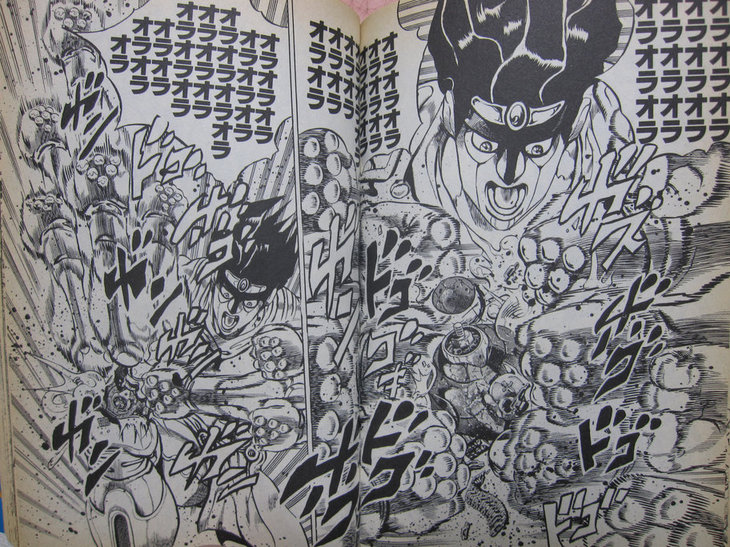
How much does time pass when the mighty Star Platinum punches an enemy Stand in JoJo’s Bizarre Adventure? There are many factors to consider, such as how much time has passed in the show itself, as well as how time is being manipulated within the series’ universe itself. Another important element is the fact that the anime is an adaptation of a manga, where the flow of time is abstracted by manga’s existence as a 2-D paper medium.

As far back as Tetsuwan Atom, adaptations of manga have been a common mode of anime production. Manga act as a spring of new stories to present, and the jump from the comic book format to animation opens up many opportunities. An anime can try to forget its own path through interpretation or divergence from the manga (such as both the Ghost in the Shell films and Stand Alone Complex), or they can faithfully attempt to recreate what exists in the original. However, while the latter cases might often appear to be “direct transplants” of the manga to the screen, the act of having to take a physical and spatial image such as a panel and assign to it a finite amount of time can greatly change the impact of a given scene in spite of the desire for faithfulness to the source material.

In a general sense, having to time dramatic beats for an anime often requires playing around with the contents of the manga. For example, in an episode of Dragon Ball Z, filler sequences (such as the infamous minutes-long powering up spots) not only save budget, but can also be a way to make sure the episode ends on a cliffhanger. On a broader multi-episode scale, Initial D: Fourth Stage does something similar by reversing the order of the final two opponents. Originally, the manga has protagonist Takumi race against a man known as “God Hand,” while his teammate Keisuke races against “God Foot” afterward. In order to make sure the series ends with a climactic battle for its hero, the show has God Foot go first instead.

One consequence of this is that there can be moments when a series feels as if it’s dragging. Sometimes it’s successfully padded out or rearranged so that nothing feels particularly off, but in other instances it is possible to sense an uneven rhythm or pacing.

This notion also extends to the transform of panels into time. Consider that there is generally no specific amount of time that is said to pass in a given panel in manga, or indeed comics in general. What makes a panel feel “fast” or “slow” is partially about how long one’s eyes linger on a panel, and it’s dependent on the amount of content there and the flow of the page. But because time exists differently in manga, things that seemingly pass quickly on the page take much longer on the screen.

shoujofight-hit-small

A common example of this would be the frantic explanations of special moves in an action or sports series. Because we tend to read more quickly than we speak, it is possible to believe that an elaborate speech or thought is being made within the span of a ball being passed from one player to the next. However, commit that to concrete time in an anime, and suddenly you begin to wonder why no one is doing anything as they talk for 30 seconds. To appreciate those moments, it requires a viewer to understand that time portrayed is not literal. This is the case even with series not adapted from anime. It does not “really” take Voltes V two or three minutes to combine together, or for Erika to become Cure Marine.

So when what is a single, snappy panel in manga gets stretched out into an extended scene in an anime, it can dramatically effect how a person can feel about a particular title. I find this to especially be the case with comedy series. Take Azumanga Daioh, a four-panel series. In the manga, there will be a comedic moment that lasts for only one or two panels, such as Sakaki rolling on the floor while holding a wild Iriomote cat. In the anime, this becomes a full-on extended display of non-stop rolling with musical accompaniment. A small moment becomes a big one thanks to time. A more recent title would be Nichijou, where the staccato presentation of the manga’s gags are the equivalent of sharp, quick jabs. In anime form, however, the characters’ movements are exquisitely animated and exaggerated, and the result is a series that is in a way much more physical and almost “luscious” in a sense. While the Nichijou anime pretty much takes things directly from the manga, the two turn out to be pretty different experiences.

My belief is that the unusual handling of the (broadly speaking) space-to-time transition of manga to anime is a likely culprit of why someone might love a manga but hate its anime (or vice versa!) even if the adaptation process is largely faithful. It’s kind of like when an actor is cast in a movie based on a book; what was once a nebulous image reliant upon visual/mental interpretation becomes a little more solid and finite.

Save

Save

Save

Save

If You Combined Azumanga Daioh with Initial D…

…Yukari would be the death of street racing. (Also the death of people.)

…Everybody’s favorite toy would be the rollacorolla.

…Osaka would try to block her opponent on corners by sticking her arms out.

Okay, I know there’s definitely better/worse ones out there. So now it’s your turn.

The Precarious Position of “Seinen Cute”

I am a man who likes cute things. This is sometimes a problem.

As a general rule in societies around the world, cute often falls into the realm of the feminine and the girly, especially when the ones being cute are girls. This is something I experienced when I was really getting into anime in high school, and people who knew about my interest in anime would sometimes say, “Cardcaptor Sakura? Really?

During that period, the shock that fanfiction of Gundam Wing existed that paired men with other men was still fresh, so the idea that Cardcaptor Sakura was capable of appealing to a lolicon crowd didn’t even factor into the equation. It was more a matter of me, a guy (almost an adult at that point!), enjoying something that was made for little girls. It’s a battle I had to fight, and it’s a battle I’m sure many of you out there are familiar with and may even continue to go through. How do you break through societal standards of what is considered “umanly?” It’s a little easier when we’re all nerds and we suck at throwing objects, but even in the realm of geekdom you will find that masculinity plays some sort of role.

So when I see people bothered by how often seinen manga have this girlish, cute, sometimes moe aesthetic, I think back to whenever I’ve run into the problem of being told that I’m not supposed to be enjoying cute things made for girls.

Consider the fact that guys are guys, and while some of us like cute things we all have a tendency to like sexy things, though personal preference affects what “sexy” is. There is cute, there is sexy, and there is cute and sexy. And sometimes they all exist in the same comic, sometimes in the same character, and it can be off-putting for a lot of people while being just as enticing for others. Ask yourself, is it all right that a comic can have both sexualized characters and non-sexualized characters interacting with each other on an equal level? Does having sexualized elements in a character sexualize the entirety of their character?

If I had to take a stab at how Azumanga Daioh creator Azuma Kiyohiko felt about these questions, I think his response would be found in the character of Kimura.

Kimura appears to be a pretty creepy guy. He’s a high school teacher with a thing for high school girls to the point that, for him, age is irrelevant because “high school is high school.” But then you see how the guys in his classes react to him. They consider him a “role model” of sorts because he’s honest with his feelings. Further exploration of Kimura’s character shows that he is both a loving husband and a good father, and that he strongly believes in charity, donating a significant part of his paycheck on a regular basis. At the end of the day, taking all that into account, is he still creepy? Probably, but that doesn’t mean he isn’t a lot of other things too.

Those of you who are creeped out by the state of seinen manga’s more questionable practices have every right to be creeped out, and those of you who enjoy it have every right to enjoy it, and everyone has the right to disagree with each other. To me however, no matter how much questionable material is released and sold, the very fact that cute comics aimed towards adult men are published and manage to be successful is a great triumph that can never be taken away.