FInal Fantasy: Genshiken II, Chapter 120

This month’s chapter of Genshiken Nidaime is about anal sex. No, I’m not kidding. Yes, my title for this post is awful.

Last chapter, after an emotional discussion between Hato and Madarame, Hato runs away. At the advice of Ogiue (who knows a thing or two about a situation like this), Madarame goes after him. As the two talk once more, Madarame explains that he does feel something for Hato (especially after that incident at the hotel), but as he goes into detail about the idea of being with a fudanshi, Hato brings up an important question. Is Madarame truly ready for what “Hato x Mada” really means? After discovering that the rest of the club was eavesdropping (a Genshiken tradition!), Madarame decides that he’ll have to “think about it,” and their date continues.

You can see my immediate reaction to this chapter in the tweet above. While Genshiken has gone many places, I never quite expected it to arrive at this point. Suffice it to say, I’m both surprised and impressed in a multitude of ways. I have to compliment Kio for being willing to take the story this far, and to do so in a way that makes sense for the characters of Genshiken. What also stands out to me about Chapter 120 is the way in which clarifies the conversation between Madarame and Hato in Chapter 119, whereby Madarame finally and much more clearly understands Hato’s concerns. In Hato’s own words, being with Hato consists of having to encounter a series of “landmines.”

Last chapter, Hato expressed the idea that Madarame doesn’t seem to understand what it means to be in a homosexual relationship. This chapter, Hato lays it out. First, Madarame mentions how he’d have to get used to the idea of being seen as a “sou-uke,” a total bottom, as is the trend among Genshiken’s BL fans. Second, Hato reminds Madarame that Hato is not like Ogiue: he’s not a fujoshi but a fudanshi, a guy. Third, he brings up the idea of Mada x Hato, and how he’s prepared for the possibility, which fazes Madarame a bit. Then, finally, he brings up “Hato x Mada.” As realization slowly dawns upon Madarame, the impact of that epiphany on Madarame is, in my opinion, a prime example of what I love about Kio’s storytelling through manga.

Madarame confesses that he hadn’t even thought about “Hato x Mada.” Right there, it becomes clear that Madarame hasn’t actually contemplated the prospect of being with Hato all the way through. Not only that, but it makes perfect sense given just how Madarame has approached the idea. In Chapter 72, Madarame mentions having played games with “girl-boy” characters, and that, because of the censorship and the effeminate appearances of the characters in those games, it’s not that different from heterosexual fare. In other words, Madarame has always seen himself in the “man’s role” so to speak, and the sticky, naked realities of having a mutually satisfying relationship with Hato was just completely outside his realm of imagination until now.

I don’t read very much BL or gay manga, but I get the feeling that these sorts of nitty-gritty details aren’t so common in stories unless they’re particularly explicit or raunchy. Not only that, but given the purpose of those stories, I believe the end result is usually what is expected. In contrast, it’s not clear where Madarame will end up. Of course, correct me if I’m wrong.

The fact that Madarame doesn’t just completely shut down and break away from Hato might say just as much in favor of Hato’s chances, as does Madarame asking the question of whether Hato x Mada would involve Hato in women’s clothes. However, I suspect that the story might actually be heading in a direction where, although the two have a kind of emotional or spiritual connection, Madarame might ultimately not want a physical one. Keiko even brings this up at the end, saying that the body itself will ultimately be the deciding factor (which she believes is in her favor, even with Angela around). In a way, this might be even more ideal for the fujoshi of Genshiken, just because it could be interpreted as a love beyond the trappings of flesh.

I have two more things to say about this chapter. First, we finally learned just what happened when Hato’s other selves, the BL fangirl floating in the sky as well as the Kaminaga version, “merged” with Hato. Obviously he didn’t really have magic ghosts with him. Rather, it was symbolic of him accepting all of his passions, that he can be into both “Mada x Hato” and “Hato x Mada.”

Second, at the beginning of the chapter when Ogiue is talking to Madarame, she mentions how Sasahara accepted everything about her. Just that one gag panel where she ends her sentence in a heart as she blushes profusely is actually one of Ogiue’s most adorable moments ever. As an Ogiue fan, it is quite satisfying.

If you liked this post, consider becoming a sponsor of Ogiue Maniax through Patreon. You can get rewards for higher pledges, including a chance to request topics for the blog.

Future Boy: Genshiken II, Chapter 119

At long last, it’s the final date! Hato gets his turn with Madarame, but while their time together starts off with some comedy, it quickly turns into a very serious conversation that brings Genshiken back to a core theme: 2D characters vs. 3D relationships.

Actually, to be more accurate, the clash between “fantasy” and “reality” emerges from the very beginning. Just calling it a “date event” betrays the entire club’s otaku orientation; among regular people it would just be a “date.” From there, Hato starts to clearly delineate the differences between a biological woman and he himself who only dresses as a woman, namely that a crossdresser tends not to want people to get too close, otherwise they might recognize the truth. Though it ends with a funny moment where Madarame and Hato try out holding hands (did you know that Madarame has cold hands?), only to pull them apart after being spotted by the rest of the group, the tension is already set.

Though the dirty looks from Sue and Keiko (and Kuchiki) are magnificent.

Throughout the chapter you see Madarame use certain words that associate Hato with the the characters in the boy-girl (otoko no ko) games Madarame plays. He uses terms like “spice,” or “forbidden,” which eventually causes Hato to directly confront Madarame about what it would take to be in a homosexual relationship. Hato outright says to Madarame, “I’m a guy!” (pairing an effeminate “watashi” with a masculine “otoko”) and essentially asks if Madarame has really thought about what that means. If he actually starts something with Hato, then in the long term it won’t be a crazy alternative, or a thrilling experiment. Dating a man, even one that dresses convincingly like a woman, won’t be like seeing it in an anime or a visual novel, where no real consequences can occur. If he chooses Angela, Sue, or Keiko, then he won’t have to deal with these hardships.

I don’t know if I’m reading too much into this, but I think that implicit in Hato’s words is the awareness that gays are stereotyped and discriminated against in Japanese society. Picking Hato comes with it a future of tribulations, and the question is if Madarame is really prepared to take this seriously, or if it’s just a fetish at the end of the day that can’t move beyond fantasy.

Madarame’s response in turn, “Sorry,” then signals two things. Hato’s devastated reaction indicates that he’s not so much taken aback by Madarame’s apology, but the very nature of it. That’s because the “sorry” comes across as noncommittal, another case of Madarame vacillating because he still desires for the pieces to fall into place without him having to make any hard choices. Madarame has the potential to start a real relationship with Hato or any of the others, but he’s still afraid to make a decision. It calls back to the Madarame who originally decided to let his crush on Kasukabe slide by unrequited, and was willing to let it eat away at him for the rest of his life.

What I also find fascinating about this entire situation is that it not only subverts that harem aspect of the series, but that it’s a strong reminder that the qualities that have made Madarame somehow charming to these prospective partners are also the very things that can aggravate them. He’s both his own best friend and his own worst enemy, and I believe it keeps the series from truly entering actual “harem” territory.

The question of how Madarame will engage with the reality of having a flesh and blood partner is what I think makes Ogiue’s appearance at the end so interesting. As stated in the chapter itself by Ogiue, Hato’s running away from Madarame mirrors Ogiue trying to reject Sasahara out of fear of both hurting others and being hurt. However, I also feel it’s not really the same situation.

Sasahara hesitated because he was a naive dork who couldn’t read between the lines. Even though he recognized his own feelings for her at that point, when Ogiue told him that she couldn’t date guys, Sasahara took it at face value and almost gave up as a result. Madarame, on the other hand, has to decide whether his feelings are for Hato the person or Hato the image, and whether he’s willing to take a much more difficult road in the process when he clearly has three less troubling options moving forward that he also seems to have feelings for.

Writing all of this out, it makes me realize that Madarame’s hesitation can also be interpreted as wanting to make certain that he makes the right decision. He’s been raised to believe that romance is a special thing, a world of childhood friends and deep bonds that are anything but frivolous (though at the same time sex is raunchy and powerful). It might be another angle worth exploring.

Angela believes that Madarame clearly has eyes for Hato. We’ll see if she’s right.

If you liked this post, consider becoming a sponsor of Ogiue Maniax through Patreon. You can get rewards for higher pledges, including a chance to request topics for the blog.

Kiss Kiss Fall in Love: Genshiken II, Chapter 118

It’s finally time to see Sue and Madarame’s date, which apparently involves ring tosses and ultra obscure references. After Hato comes by and advises Sue to express her feelings not in anime quotes but in her own words, Sue finds an opportunity to say what she really thinks of Madarame.

This chapter is all Sue x Mada all the way, and makes a rather strong argument for why they seem to fit together. Madarame is the only one high-level enough to not only immediately get Sue’s anime and Japanese pop culture callbacks, but also to build on them. What really stands out about their time together, however, is that we finally get to learn the truth behind Sue’s peck on the cheek during the school festival.

You might recall that it was a move to get Madarame to jump out of hiding so that Hato would notice that Madarame’s looking out for him after all, and that Saki saw the whole thing. When next we saw Sue, she would blush profusely whenever looking at Madarame, while denying any feelings towards him. The reason, as Sue explains, is that she herself thought she was just teasing Madarame, but having someone like Saki witness it made her self-conscious of the fact that the only reason she can mess with Madarame is because Sue views him differently. To Sue, Madarame is special. That’s why she can call him Nekoyasha and then ride on his shoulders. That’s why she can be so comfortable around him.  That’s why she can finally confess to him, and be the first of the potential four love interests to do so.

I think it makes sense. Genshiken is full of otaples at this point, and a Sue and Madarame relationship would be at the top of the food chain. Not only that, while “I’m comfortable around you” can seem like the most generic of non-reasons to fall for someone, we see how their interactions play out. To some extent, Sue’s able to behave similarly with Ogiue, and even make jokes about Ogiue being her “wife,” but there’s a certain understanding that it’s all a friendly joke. That’s how Sue was with Madarame, but now Madarame’s open-ness and existence as absolute embodiment of nerdery have transformed into a strange attractiveness. Moments when characters realize their feelings are always highlights of Genshiken, whether that’s Madarame and the Saki nose hair incident or Ogiue seeing Sasahara smile, and this one seems to shout, “kindred spirits.”

Visually, Chapter 118 is unsurprisingly the Sue Show. As a character that doesn’t talk much, her facial expressions carry a great deal of weight. Combined with her sharp yet wistful eyes and exaggerated further by her pale features, light-colored coat, and knee-length blonde hair, it’s like her nervousness and emotional tension either take over the entire page, at least whenever Sue herself isn’t being put side by side with Madarame and his darker features (mainly his hair). Nowhere is this more apparent than at the moment when Sue says, “Madarame, I like/love you.”

I almost didn’t want to include this image, just so it could be a surprise to even those who read this review before the chapter itself. However, I think it makes too striking a statement to leave out, especially when considering the fact that Sue purposely prevents Madarame from responding, as Hato hasn’t had his chance yet.  Also, there is arguably an even better moment at the end of 118, and I think I’ll leave that for you, the reader, to discover.

In the end, what I find interesting about all of the members of Madarame’s “harem” is that they connect to him in different ways. Angela’s attraction is physical, and while that might seem shallow she’s the one who brings to the forefront the idea of Madarame as a sexual being. Keiko is somewhere between physical and psychological, and her strategies reflect this. Hato has the closeness of being a guy, the intrinsic understanding of how Madarame might be thinking of a situation. Sue is as awkward as Madarame in many ways, one of their many similarities.

Next up is Hato, and this, perhaps, is where the show really begins.


If you liked this post, consider becoming a sponsor of Ogiue Maniax through Patreon. You can get rewards for higher pledges, including a chance to request topics for the blog.

Hey Dandy: Genshiken II, Chapter 117

As Hato becomes aware of Yajima’s feelings for him, a heartfelt discussion between the two ensues, where they share their doubts and beliefs about what it means to live with oneself. Though ostensibly a prelude to the last “date” of their trip to Nikkou, the moment between Hato and Yajima might well end up being one of the highlights of Genshiken Nidaime.

Over and over, I think one of the questions asked of Nidaime has been, why a harem arc? Why go for the most stereotypical anime trope that potentially damages Genshiken as this realistic depiction of otaku and fujoshi? Given how Genshiken has turned out in its exploration of Madarame’s awkward love life, one answer has been that it’s commenting on the disconnect between the fantasy of the anime harem and the reality of interpersonal relationships. This has been supported by the characters themselves sometimes even saying as such. However, there’s a second possible answer that’s arguably much simpler, and perhaps even extends out from the original series, which is a desire to portray greater diversity in the otaku population, and that includes a greater number of girls and women.

While I cannot attribute any proof of intent to creator Kio Shimoku’s goals with the second Genshiken manga, there are a few factors that have me considering this. First, there’s the higher female to male ratio. Second, there’s Hato himself, who is, suffice it to say, rather complex when it comes to ideas of gender, sex, and sexuality. Third, there is the greater emphasis on the idea of body image in Nidaime. I think this is perhaps where the “harem,” one of the most upfront formulas for having a heavy amount of female characters in a series, becomes integrated into this idea of diverse representation.

In this chapter, the discussion between Hato and Yajima essentially falls on what it means to “look” or “behave” like a woman. Yajima tells Hato that his crossdressing affects her deeply because it reminds her that she is not beautiful, that she’s overweight and lacking in anything that would attract men. Hato responds that he’s jealous of Yajima because he has to constantly put on this ideal act of being a woman in order to keep from getting found out, whereas Yajima naturally exudes femininity even when she does not fit societal standards.

Moreover, Hato remarks that he totally believes a relationship between him and Yajima would be possible, and fondly imagines the idea of being able to share a love of BL with a fujoshi girlfriend, while also specifically mentioning that not just any fujoshi would do (Yoshitake’s personality he considers possibly incompatible). The very things that make Yajima hate the way she looks, the tension of being a woman but not “acting the part,” are what Hato finds appealing about Yajima. And yet, Hato resists starting a relationship because he came to Genshiken to make friends, fujoshi friends, and doesn’t want to taint that desire and pervert it into a pursuit of a relationship.

There’s a lot to unpack there! We have a clear indication that Hato is bisexual, or somewhere deep in that middle area of the Kinsey scale. We have Yajima, who’s not even part of the Madarame harem, sharing these everyday questions that can haunt the mind and subtly cripple one’s self esteem. Basically, there are these two embodiments of so much inner and outer pressure, and they are opening up to each other in a way that, while it technically fails the Bechdel Test in multiple ways (one of them is sexually a man after all, let alone Madarame being a major topic of conversation), it speaks to something deeper about how people view themselves relative to societal standards. For example, why is there sometimes the assumption that an attractive woman can fall in love with an unattractive man for his inner qualities, but that an unattractive woman has no chance with a beautiful man?

On top of all of this, Yajima shows something that I think is truly impressive: she isn’t fully comfortable with homosexuality still, despite being a fujoshi. At one point, Yajima thinks to herself that she should tell Hato, who has said that a relationship with Yajima isn’t out of the question, that he should make the “right” choice and go with a girl. In her mind, she sees that as the proper way things should go. However, and this is key, she holds back because she realizes how much Hato has gone through when it comes to his relationship with Madarame and the soul searching that he’s had to do. Here is a character who is in her own way affected by the standards society puts on women, yet is vulnerable to assumptions of what is normal and what is not as seen in how she opposes Hato’s crossdressing for so long, and over time is learning and changing her mind at a pace that is her own. In the end, Yajima encourages Hato to try his best in his pursuit of Madarame, and it means so much given what Yajima is thinking and what kind of person she is. It’s a real struggle that is rarely talked about.

Diversity and representation are two of the biggest topics when it comes to current American comics and cartoons. Japan’s history in this regard is different, with things such as shoujo, BL, yuri interacting with a traditional and contemporary sexist society. In Genshiken Nidaime there’s something powerful, almost as if there isn’t an overtly political motivation to improve representation of other sexes, genders, and sexualities, but a simpler desire to show more of the world in all of its complexities using the tools of manga. I’ve had a feeling along these lines the entire time I’ve been reading Nidaime, but this is perhaps the chapter where it stands out more than any other up to this point.

(Obligatory Ogiue sighting)

If you liked this post, consider becoming a sponsor of Ogiue Maniax through Patreon. You can get rewards for higher pledges, including a chance to request topics for the blog.

Do Not Pursue Sue Bu: Genshiken II, Chapter 116

The truth comes out in more ways than one in this chapter of Genshiken. Not only does it turn out that this entire trip was an elaborate way to help Madarame towards finally making a decision about his love life (much to Kuchiki’s chagrin; it was supposed to be his graduation trip after all), but now Yajima knows that Hato is aware of her feelings for him. Within all of this is… the potential for yuri?!

I should be clear about that last point. Thus far in Genshiken outside of Hato and Madarame and the magical fictional world of BL, same sex relationships haven’t really been a factor. The closest thing we’ve seen is Sue being very attached to Ogiue in a way that makes it unclear whether she’s using otaku and manga references to assert her friendship with Ogiue in an odd way (Ogiue wa ME no yome!) or if there’s something more. Sure, there are yuri fans who ship certain pairings (Ogiue and her old middle school classmate/friend/bully Nakajima for example) but here even I who normally forego donning a pair of yuri goggles saw a few things that caught my attention. One was of course intentional by Kio, when Ohno comes onto Ogiue to make Kuchiki jealous (it’s complicated), but then you have a moment like this:

Actually, it almost feels like a “yaoi” moment using female characters. Has anyone done a study of how interactions are portrayed in yaoi vs. yuri? There’s also significantly more Ogiue in this chapter compared to the previous ones, but more on that later.

What I find especially fascinating about this whole Nikkou trip as a way to move Madarame forward is just the idea that he (and perhaps anyone) should not be able to let his relationships stagnate. As Evangelion has taught us, staying in the same place unable to move forward can be a crippling experience that appears comforting when it is seen as avoiding pain. While it could be seen as them pushing Madarame unnecessarily, his passive personality likely means that nothing would ever happen, and it would hurt everyone on all sides if it persists. Of course, there’s still a chance that Madarame will probably still come out of it indecisive because that’s just how he is, but the very fact that Genshiken is having its characters try to constantly prevent the “series of misunderstandings” that can occur when too many secrets are kept gives me the sense that everyone wants the best for each other.

Probably the biggest surprise of this chapter is everyone’s accepting attitudes towards Sue potentially ending up with Madarame, including the other girls interested in him. I mentioned in the previous chapter review that Yoshitake’s comments about Nikkou being a fake-out meant to draw attention away from Tokugawa’s real grave might be meta-commentary on the statuses of the others gunning for Madarame, and it looks like it’s panned out. Hato and Keiko have gotten so much attention, and Keiko even commented on how Sue is unlikely because of her personality, but here Keiko is in Chapter 116 saying that she won’t interfere with Sue like she does the others because that’s the one other person she’s okay with.

Given the cunning with which Keiko has competed, does this mean that she sees something special between Sue and Madarame that doesn’t exist with the other potential partners, including herself? Perhaps the fact that no one wants to interfere with Sue x Mada is because they understand both of their personalities, and that Sue in particular has her own battle to fight regarding her own feelings. Maybe it’s the fact that everyone other than Sue appears to be using wits and charm to pull Madarame towards them (or at least Keiko believes Hato to be doing this), and that if Sue turns out to be the one, that she’s “won” in more than one sense of the word. Again, suddenly Sue looks increasingly likely when she had previously been dismissed, turning everything upside down.

Kuchiki, in his jealousy, argues a version of a  point that I’ve mentioned before, that Madarame has shown how his 2D and 3D tastes don’t necessarily line up. While he has mentioned that Sue is exactly the kind of person that matches his favorite anime archetype, there’s also no denying his lost love for Kasukabe. At the same time, Genshiken Nidaime plays significantly with the blurring of real and fictional interests, or rather the reveal that the difference between them is possibly fairly porous even if the two aren’t the same. However, there’s another possibility, which is that Madarame and Sue’s connection goes well beyond looks, and that, other than possibly Hato, Sue is the only one who match him blow for blow when it comes to otaku power levels, creating a truly ultimate “otaple.”

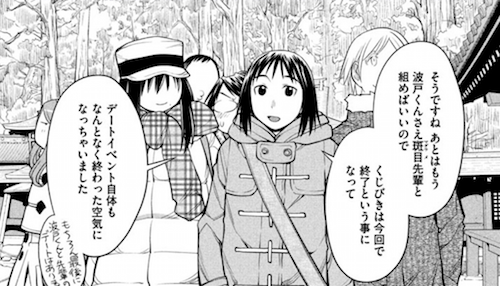
As I mentioned above, Ogiue has gotten more attention in this chapter than every other one in this “Nikkou Arc,” though not enough to make her a particularly important character for this story. However, it does give us many glorious Ogiue faces.

A lot could be said about Hato and Yajima, but it seems like they’re saving the big guns for next chapter, alongside Sue & Madarame’s Excellent Adventures. Until then…!

If you liked this post, consider becoming a sponsor of Ogiue Maniax through Patreon. You can get rewards for higher pledges, including a chance to request topics for the blog.

Turnabout: Genshiken II, Chapter 115

It’s Keiko’s turn for with Madarame, and she uses the opportunity as only Keiko can. At the same time, she shows both some chinks in her armor and her resilience in spite of that. The chapter also ends with a reference to Overman King Gainer, which is never a bad thing.

One thing I’ve neglected when it comes to these recent Nikkou chapters of Genshiken is the potential meaning behind Yoshitake’s historical expositions. One purpose is to show that Yoshitake is indeed a history otaku, and visiting such a culturally significant place as Tokugawa Ieyasu’s tomb would set her off, yet I can’t help but feel that there’s a sense of metacommentary behind it. According to Yoshitake, Ieyasu purposely lied about the true location of his grave in order to mislead his enemies, and similarly it’s possible that Kio Shimoku has been placing one Madarame love interest in front of the others as a kind of red herring. The question is, then, which of the four is actually in the “lead?”

The answer is probably Keiko or Hato at this point, and you could make cases for either. In Chapter 115, Keiko outright states her case. Keiko: The Realistic Choice. It’s not the most inspiring campaign slogan, so to speak, but as I’ve mentioned in the past that is part of the Keiko x Mada pairing’s charm, that they already seem like a married couple, that opposites attract, etc. In certain ways, like a tangent graph, the more Keiko x Mada is a thing, the more it approaches (but never quite reaches) Spotted Flower. It’s realistic in a very specific sense of the word, where it reflects a popular image of how monogamous love and relationships are “behind the scenes.”

As for Hato, Yoshitake makes a comment that Hato has gotten closer to Madarame as a guy than he ever has in his female guise. Whether Yoshitake realizes it or not, she’s directly addressing one of Keiko’s criticisms of Hato, that he’s putting on an act, a performance, to get attention. Is this gender performativity, and is Keiko any less guilty of it?

If Hato is the front-runner, however, then this chapter is possibly the undermining of that, and again it has to do with Keiko. At the end of the chapter, Speaking of that, Keiko defies the standard manga progression, where secrets are unspoken and affect the dynamics of the love polygon, by just telling Hato about Yajima’s feelings for him. Cutting to the chase in that way is very characteristic of Keiko. You’d think it’d perhaps also be Saki-esque, but I feel like while Saki was devious, it’s a different kind of planning and awareness when Keiko is involved. Keiko is “realistic,” and part of her “reality” is that she both shatters illusions while creating others, and is very aware of everything that goes into presenting herself to Madarame. The main thing that throws her off is that Madarame is indecisive beyond her imagination, to the point that she at first interprets his waffling as rejection. There is a great deal of miscommunication because Keiko just perceives the world differently compared to the primarily otaku cast.

Keiko’s reaction to her “rejection” is fascinating in its own way. You can tell just from how shocked she is that Madarame might not be interested in her just how much confidence she had about winning. It actually didn’t occur to her that she wouldn’t be able to do just the right things to get Madarame to fall into her arms. It’s indicative of how she thinks that she feels that Angela is the biggest threat to her but is thankfully stymied by a long distance, and sees Sue as being too reticent for anything to happen, not realizing that this might be part of her appeal. Keiko aims for physical desire, and aims her personality in that direction.

So what does it mean that Hato is aware of Yajima now? It could go in a lot of different directions, but I could see it going for a while where Yajima doesn’t know that Hato knows about her crush. Yajima is fairly observant, but nowhere near on the level of Keiko or Saki, and Keiko is likely going to try and push them together. In other manga, Keiko might be viewed as the scheming villain, but I wonder if Hato and Yajima would be so bad after all. For one thing, characters like Yajima, especially in terms of physical appearance, are kind of a rarity in manga and anime, and to have them together might make for an interesting statement.

As for the red herrings, perhaps neither Keiko nor Hato are as likely choices as they seem.

If you liked this post, consider becoming a sponsor of Ogiue Maniax through Patreon. You can get rewards for higher pledges, including a chance to request topics for the blog.

I’m Bad, I’m Cool, You Know It’s True: Genshiken II, Chapter 113

The previous chapter of Genshiken ended with most of the characters pairing off in unexpected ways (none of them romantic), setting up the anticipation that there would be some intriguing interactions that go outside of the normal range that Genshiken has been using as of late. In this regard, Chapter 113 is far from being a disappointment.

After Yoshitake finally reins in her history otaku nature and ceases to be a tour guide through the shrines of Nikkou, all of the groups do their own special thing. For this reason, for this month’s review I think it’s worth talking about each notable pair on their own.

Madarame and Yoshitake

In a lot of harem manga, the characters that act as if they’re stringing the main character along through feigned expressions of affection often fall into the category of the harem as well. Because they show the possibility, they’re part of the fantasy too, even if they’re supposed to be tongue in cheek. Not so with Yoshitake. She drags Madarame away not only to spark the fire among the characters who actually are interested in Madarame, but also slyly manipulates Madarame as well by making it seem as if she’s also into him. Perhaps I’m reading too much into it, but the reaction on Madarame’s face seems less like surprise and more like, “Oh no, not again,” which when you think about it is a far cry from where he was originally in Genshiken.

Yajima and Kuchiki

Kuchiki wants what Madarame has but he’ll never get it because it’s hard to imagine too many girls who would like Kuchiki’s personality (then again he did have a girlfriend once upon a time). At the same time, their mildly venomous conversation has a lot of grains of truth being sifted. Kuchiki mentions the appeal of the girl-boy, which is that you have the physical attraction of a female without the seeming mystery of trying to figure out how they think and feel. This actually isn’t far off from what I’ve read about the appeal of certain, shall we say, “alternative” forms of adult entertainment in anime and manga, and it even reflects something I’ve seen before in an old Ann Landers/Dear Abby, which had to do with a wife questioning if her husband was gay. Long story short, that aspect of being able to directly understand the feelings of another, whether that’s more spiritual or more physical, is something that’s understandable when you think about it. As for Kuchiki almost figuring out Yajima’s feelings for Hato, that probably has less to do with Kuchiki being perceptive and more that Yajima is often an open book (see her first meeting with Yoshitake’s “brother”).

Hato and Keiko

It’s been established that the two don’t really get along, and this chapter I think really shows the foundation of why that’s the case. Essentially, both Hato and Keiko believe that the other is somehow manipulating Madarame. Hato believes Keiko is just stringing him along, while Keiko sees Hato’s personality as an ideal construct, pleasing but artificial. Together, they both open up to each other in an antagonistic manner, giving details as to what transpired in each of their respective close encounters with Madarame. Now they both know the approximate truth, and while it can’t be said that Madarame is a two-timer, I do think Hato and Keiko have bonded in a rather bizarre yet understandable manner. That said, I think their lowered opinion of him comes from somewhat different places; with Hato it’s because of how easily Madarame was enticed, and Keiko because it connects to the whole thing about Madarame being happy about Hato’s chocolates.

And then…

I think there’s something to be said about the way that the characters of Genshiken try to exert their wills in this chapter. Yoshitake temporarily dons the role of a fawning admirer to mess with Madarame, Keiko intentionally withholds the fact that Kugayama was at her club too to make Hato think that Madarame came of his own accord, and Hato throws the events of the previous night in Keiko’s face. Nowhere is this clearer than with the fact that Angela’s time has arrived, and she’s come prepared for bear, so to speak. As soon as she finds out she’s pairing with Madarame, out come her noble familiars, barely constrained and ready to serve their master.

I’m not sure if it’s clear from my previous posts, but I love the idea of Madarame and Angela, if only because to me it’s the most hilarious. This chapter begins to prove why that’s the case, even if she probably has the slimmest chance out of the four. Will next month be the most fanservicey chapter of Genshiken ever?

Speaking of Angela and Madarame, or rather the renewed kujibiki drawingI do find it interesting that Yoshitake’s plan to see the temple Youmeimon, the culmination of her trip to Nikkou, is derailed by construction much in the same way that her original plan to mix the group up into new and exciting pairings also backfired in terms of its original intent. It makes me wonder if this second lottery is going to also be reflected in Yoshitake somehow encountering an even more amazing sight.

Last thing of note: as seen in the first image in this post, this chapter clearly used photo references for its color pages that lend a greater amount of realism to the backgrounds, to the extent that it feels like the chapter is actually promoting tourism for Nikkou. I don’t think that’s actually the case, but Genshiken rarely goes for that look.

Sakuraaaaaai: Genshiken II, Chapter 112

After the bomb drop that was last month’s Genshiken, Chapter 112 winds things down a bit, only to then create anticipation for next month. In a way, it’s a much needed break, but the fact that it ends by mixing up the formula a bit basically makes me want to read the next chapter already.

As Yoshitake nerds out about the history of Nikkou and its connections to Japan’s past (something I don’t specialize in but would totally make an interesting post by someone other than me), they remember Hato’s return the previous night. While a lot of the girls are suspicious about what happened, especially Keiko, Hato quietly resigns for the evening, and Yoshitake turns out to be the kind of snorer you can’t ignore. Yoshitake then proposes an idea: draw straws (“kujibiki” in this case), and randomly pair off. While the hope to further some romances looms about, the gods of probability crush almost all hope of that happening.

I’ve never been a part of Hetalia fandom, but I’m aware that it’s encouraged a lot of girls (and even a few guys) to study history more extensively. In that respect, I wonder if Hetalia fans feel a significant connection to Yoshitake, even if Hato is the one who’s explicitly stated that he’s into that series. Speaking of Yoshitake, I’m always impressed by the translators who bother to work through all of her text. The way it’s hand-written, and appears as if it’s trying to economize every last bit of word balloon space, and the fact that this chapter even features a map in the middle of one onslaught of verbage makes it seem like you’re not really meant to read what she has to say.

As is often the case with Genshiken, this chapter is primarily about setup, a brief pause after the weightiness of Hato’s heart to heart talk with Madarame. While of course the decision to break these characters off into specific pairs was probably not random (unless Kio actively chose to replicate what Yoshitake does in the manga itself), I think it’s both telling of Yoshitake’s desire to be the grease that moves the wheels forward, and that both the author and the characters haven’t forgotten about good ol’ Kujibiki Unbalance.

While it’s doubtful that anyone who’s still reading Nidaime doesn’t know what that is, it’s kind of fascinating that the series which so dominated the conversations of the old generation have all but vanished with these youngins. I wonder if Kio misses that a bit. Not only is the chapter title, “Kujibiki Unbalance 1” a reference to it, but at one point Yoshitake says, “Kami-sama no iu toori,” or “Do as God says,” which is a line from the Kujibiki Unbalance anime opening.

When Yoshitake revealed the kujibiki, I was hoping for the wildest and nonsensical pairings to happen, and in the end my wishes were fulfilled where it counts. While it wasn’t 100% off-the-wall (Ogiue + Sue and Angela + Ohno are obvious ones), seeing things like Hato + Keiko and Madarame + Yoshitake has a certain odd thrill, either because there’s so much tension or because there’s none at all. It’s almost like when characters have to change seats after a semester, and it becomes an opportunity to really see sides of them that we the manga readers haven’t before, or when you’re watching a fighting game tournament and two characters who rarely fight each other are in the grand finals. You’re not sure if you like it more, but the novelty alone keeps you glued.

If we’re allowed to speculate (and seeing as this is my blog I’m going to say it’s okay), I think that the main focus of the next chapter will probably be Hato and Keiko, which will involve Hato trying to pussyfoot around the subject of Madarame and Keiko going straight for the proverbial jugular. Keiko, while not the sharpest tool in the shed in certain respects, is still very perceptive, and even if that’s not enough she’s the type to really egg someone on and force them to admit something. From there, I predict Keiko will really try to force Hato to confront why exactly he crossdresses, and might even explain directly what she finds to be so disingenuous about Hato’s personality and behavior.

Also, on the topic of Keiko, is she purposely wearing a coat that’s similar to Madarame’s? It’s not the kind of clothing I typically associate with her, and as stated previously, she’s intentionally toned down her makeup to appeal more to Madarame’s sensibilities.

And if I were more into yuri, I’d probably make a bigger deal out of both Ogiue and Sue pairing off for the trip, and the fact that they slept in the same sheets at Yajima’s home. I’ll leave that to the other intrepid fans.

If you liked this post, consider becoming a sponsor of Ogiue Maniax through Patreon. You can get rewards for higher pledges, including a chance to request topics for the blog.


orz: Genshiken II, Chapter 111

Chapter 111 of Genshiken II more or less features Madarame on top of Hato for the entire duration. Is it a sign of Madarame’s feelings gradually changing, an extended comedy scene, a heart to heart pep talk, nerds nerding it up, or something more?

I find it very appropriate how the conversation between Madarame and Hato goes, with respect to the mix of anime/manga analysis, sexual confusion, genuine desire to help, and how all of this connects to the basic premise of Genshiken as the story of a club of awkward otaku. Almost as soon as Madarame accidentally falls onto him (see last chapter), Hato starts to talk about Madarame as a “lucky pervert” (lucky sukebe), the trope often found in anime and manga (especially harem series) where guys and girls will accidentally fall on each other in compromising positions. Like gusts of winds blowing skirts up, it’s generally regarded as something that only conveniently happens in fiction. By mentioning it, Hato attempts to deflate situation and, as we can later see, to avoid having his imagination go wild. “It finally happens, but it’s when I’m a guy. How unfortunate for you.” While “This isn’t manga!” has itself become a trope of Japanese comics, here I think it’s used to different effect as a way to highlight Hato and Madarame’s characters.

I believe the fact that Hato is a guy during this situation is an important factor, and not simply for the possibility that Madarame might be feeling something for Hato even without his female guise. Rather, it’s because Hato is a guy that Madarame can speak comfortably to him in this situation and even encourage Hato to not be so down on himself. Madarame basically says to Hato to stop mentioning “reality” as if it’s the final destination, the end of hope, the cruel master that rules over him, and uses his own feelings about Hato giving him chocolates as the example of how Hato’s actions have meaning, pperhaps playing into the idea that reality is a social construct and that people can attempt to change reality through the same channels. At the same time, he engages in a dialogue with Hato that follows a similar flow to the typical Madarame/Genshiken discussion over anime, manga, moe, and other otaku topics. In a way, because Madarame has a tendency to freeze up when confronted with the opposite sex, even though it’s clear that he is attracted to them, all of this could only have happened when Hato was a guy.

As mentioned above, Hato tries to use otaku talk to deflect, but Madarame actively engages with it to bring the situation back to “reality.” I think it’s because, while Madarame certainly doesn’t confuse fantasy for reality, he long ago embraced his 2-D complex and his love of anime for all of its worth, seemingly at the expense of his connection to the real world. Of course, the current arc with its emphasis on potential romance for Madarame is partly about how much this has changed, and the more I think about it, the more I find it interesting just how these two characters, as well as every other character in Genshiken, approaches that anime/fantasy vs. reality question in different and fascinating ways. It’s actually one of the topics that’s been with Genshiken throughout, and perhaps it should be the subject of a future post. It’s been a long time since I wrote about Genshiken outside of these chapter reviews, after all.

I think at this point it’d more than make sense for Madarame x Hato to happen, but at the same time I find that the other girls have their own interesting interactions with Madarame as well, so it’s not like this one outshines the others. In that sense, perhaps Genshiken provides more of a “harem” feel than most actual harem series, because often times those will have one girl clearly stand out among the rest as the “main heroine.” For Genshiken, all of the possible Madarame romances have potential, and all operate under different dynamics. Connected to this somewhat, when Madarame brings up the topic of BL, which Hato tries to mentally resist, he says that this situation isn’t right for Madarame, who’s supposed to be an “uke.” While admitting that he doesn’t really know anything about BL in the first place, Madarame replies that Hato is the only person out of the “harem” where Madarame would probably be the aggressive one, even if alcohol were to be involved.

Upon reflecting on Madarame’s words, I find that he’s actually right. Only Hato would end up in this situation because Angela, Keiko, and Sue are very strong-willed. With any of the three girls, with the possible exception of Sue, it’s hard to imagine them even in that position, and if Angela and Keiko were it’d probably be of their own devices, an intentional seemingly passive action to appeal to Madarame’s otaku senses/fear of women.

In any case, I feel like this is a point of no return for Madarame and Hato, not least because they were “interrupted” by Kuchiki, rather than breaking apart of their own volition. Whether or not it ends in love, pain, or just mutual yet awkward friendship, they’ve arrived somewhere new.

If you liked this post, consider becoming a sponsor of Ogiue Maniax through Patreon. You can get rewards for higher pledges, including a chance to request topics for the blog.

Hey I’m Grump: Genshiken II, Chapter 109

The vacation has turned into a house party. As Keiko and Angela try to butter up Madarame with alcohol and sex appeal, Yoshitake and Ohno give Kuchiki somewhat similar “VIP” treatment. Kuchiki asks Ohno if he can touch her breasts, who unsurprisingly refuses, especially when Kuchiki references Ohno’s tendency to avoid getting a job. Hato gets tired of Angela and Keiko and tries to make Madarame jealous by appealing to Kuchiki, but accidentally makes him pass out from too much alcohol. After some arguing where Keiko and Angela try to use this as an opportunity to be alone with Madarame, Hato and Madarame are tasked with bringing Kuchiki back to the hotel.

This chapter has made me realize that breast-touching, or the prospect of it, has been a recurring theme of sorts in Genshiken Nidaime. I know that might sound kind of absurd, but hear me out.

Between Kuchiki futilely requesting Ohno, Madarame’s risque evening with Keiko, and even the fact that Kuchiki has already indeed crossed this threshold (albeit unconsciously), the “value of boobs” has been present for many chapters. At first glance, this might very well appear to be the descent of Genshiken into something cliche and unrecognizable, but I think that there’s a certain critical or observant eye towards the division between guys and girls that still exists to a certain degree in Genshiken, otaku culture, and perhaps even culture at large.

The reason I believe this to be the case, though for the most part it’s probably just an opportunity for jokes, is that one of the notable differences about the second series compared to the first is the mostly female main cast. It’s a point I and others have brought up again and again, to the extent that it’s arguably not even necessary to repeat, but Genshiken currently consists of this very candid, almost unglamorous look into the lives of these female otaku. Even in this very chapter, you have Kuchiki talking about how every guy in Genshiken secretly wanted to feel up Ohno juxtaposed with three girls in the bath, casually nude, talking casually, while none of them are the “targets” of this desire. On the one hand, breasts are almost a holy grail of manhood, a reflection of the mentality of the Genshiken old guard. On the other hand, girls are letting it all hang out and breasts aren’t a big deal, an indicator of how things are now.

All of this is further contrasted by Angela and Keiko. There’s a certain chasteness among the other characters and even the idea that the boob grab is this life-changing event, and then there are these two characters who are so far beyond the borders of whether or not a guy has touched a breast before, so distant from even the question of virginity, that I can imagine the other people on this vacation seem almost quaint to them. In fact, they’re utilizing their breasts for the exact reason of appealing to Madarame’s innocent awkward otaku mindset, and even the Madarame Harem itself consists of two characters who are highly experienced when it comes to sex and relationships, and two who are absolute beginners. In a way, it reminds me of the image and existence of otaku culture itself, which is in a way childish (this is not a bad thing) but also filled with adult concerns (also not a bad thing), and I don’t even mean that in an “otaku suffer from arrested development” sort of way.

What I think this all leads to is an emphasis that there are many different perspectives at work, to the extent that the idea of the otaku is not as simple and monolithic as it once was. This is perhaps what Tamagomago was trying to get at when he said that the concept of “otaku” as we knew it no longer exists.

While I don’t want to put too much into author intent, it’s a fact that Kio Shimoku is married and has a kid now. He knows and has had the experience of touching a breast. In fact, I bet a lot of manga creators have had this experience, even the ones who draw the most fanservicey, harem-y series around. I have to wonder how much Kio has maintained this theme for the purpose of remembering that being an awkward, unsocial guy who can’t even talk to girls can make it seem as if breasts are attainable only in fantasy, only he’s tempered it by taking into account the point of view of girls as well, not as objects of desire, but as people. In the case of Angela and Keiko, and perhaps even Hato, they’re people actively working to present themselves as objects of desire. Hato himself might be the center of this storm, a male otaku who is also a fudanshi, who has to come to realize his own sexual orientation, and who actively works with symbols of the feminine both inside and outside of notions of romance. Even this chapter features male Hato in makeup for the first time, as if to say that the borders within himself are becoming nebulous. That’s not to say that guys can’t wear makeup, but for Hato makeup has a very specific function.

This chapter review has turned more into a small essay, it seems. I think I’ll cut it short here so I can mention a few other things. Yajima’s mom continues to show that she’s more Yoshitake than Yajima. Mimasaka continues to confirm that her attachment to Yajima is probably something bigger. In the extras of Genshiken Volume 17, Angela tried to send Madarame some dirty footage of herself for Valentine’s Day(whether it’s photos or video they never show or say) , but they got intercepted and destroyed by Ohno before reaching their destination. I have to wonder if Angela is operating under the assumption that he was able to see it.

As always, I prefer to end each review talking about or showing something Ogiue-related, and sadly I could not fit “on the title page Ogiue is wearing that boob window sweater that’s become a popular meme in Japan” into what I was talking about above. It’s the obvious joke, that Ogiue doesn’t have the size to properly fill out that sweater, an idea that fan artists have already leaped on with other similarly-proportioned characters. While I know that Genshiken is full of references to popular culture (Sue makes references to both Dragon Quest and Sakigake!! Otokojuku this month), it’s much rarer for a meme of this kind to reach the pages of Genshiken. At the same time, no one really draws Genshiken fanart, so I guess it’s up to the creator himself to undergo the task.

What’s funny is that, if not for the boob window, this is very much the kind of outfit that Ogiue would wear.

If you liked this post, consider becoming a sponsor of Ogiue Maniax through Patreon. You can get rewards for higher pledges, including a chance to request topics for the blog.