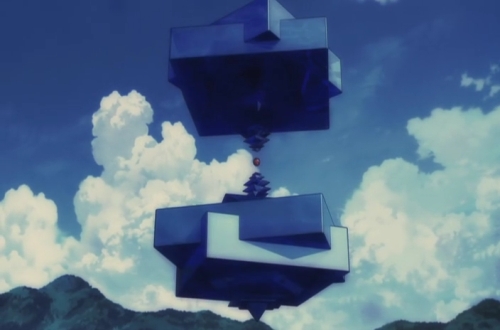
What if Bokurano were in SRW?

Bokurano is a manga by Kitoh Mohiro, creator of Shadow Star: Narutaru. The centerpiece of Bokurano is a large robot called Zearth, and so one technically is able to call it a giant robot manga, though as you might expect from the man who created Narutaru there are some serious twists. When it was adapted into an anime by GONZO these twists were less severe, but still most of them were present.

As with any giant robot series though, there’s always the potential to have it included in the Super Robot Wars series of crossover video games. Only thing is that Bokurano’s plot makes it an EXTREMELY difficult series to fit into the general framework of SRW games, particularly because SRW games tend to have an overall uplifting message, which Bokurano only arguably does half the time.

But that’s where the following challenge lies: How do you fit Bokurano into SRW without detracting too much from either?

I think it should be obvious, but I’m going to warn you here and now that everything below this line is going to be MAJOR spoilers for MULTIPLE series. You have been warned. Check the tags to see if there’s a show you don’t want ruined for you.

There are two main issues to deal with in regards to Bokurano. First, is that the idea of one pilot dying per battle until all of them are gone. Second, is the fact that when the Zearth wins, another Earth in another dimension gets destroyed. I think you might already be able to see how this clashes with some of the themes common to SRW.

Let’s address the one-pilot-per-battle thing first. One possibility is that the Zearth will not be deployable against anything but Bokurano enemies, and that every time you use it the pilot changes (and the spell list and stats of the pilot accordingly) until you reach the last pilot. Another possibility is to have the Zearth ALWAYS deployable except whenever you reach a stage that’s Bokurano plot-based you lose the current pilot.

Of course, you don’t want to just lose all the pilots and then have the Zearth unusable, so there has to be a way to revive the pilots and in a way where they never die again and then you can use all of them. A few possibilities spring to mind.

There’s Steel Jeeg, which stars the IMMORTAL Cyborg, Shiba Hiroshi. Somehow getting the Bokurano kids to make their bodies not entirely natural may be a way of circumventing it.

Another possibility is having Shinji from Evangelion somehow find the lost souls of the Bokurano pilots and return them to their bodies and then maybe do some magic with AT Fields.

There’s also Murasame Kenji from the Giant Robo OVA who is revived whenever he dies. Granted Giant Robo is off-limits due to the death of Yokoyama and the subsequent licensing cost hike, but let’s ignore that.

The ending of Ideon meanwhile involves civilizations dying and the humans and Buff clan members having their souls “reborn.” If this could be localized into the Zearth then that’s also a potential revival method. Also keep in mind the parallels between Ideon and Zearth, in that both are extremely powerful robots that have destroyed entire planets,  are absolutely frightening monsters when you realize their true identities, and wipe out all life if either of them lose.

Now what about the whole killing billions of innocent lives per battle? How can this cycle end once and for all? In this regard, we need to deal with series that address the concept of alternate and parallel universes.

The main one I can think of is Change! Shin Getter Robo: Armageddon. In a scene from this OVA, Shin Getter Robo and Shin Dragon perform a Shine Spark, during which they discover that there are alternate Getter Robos in alternate dimensions all fighting the good fight. Well what if all of the Getters work together to simultaneously stop the horrible contest of Bokurano?

Those are more or less the more well-thought-out possibilities I’ve considered. Of course, there’s lots of potential for other crossover plot points. Here’s a couple.

Gaogaigar
The act of destroying the cockpit of an enemy robot in Bokurano bears some resemblance to when Gaogaigar was about to crush the Zonder core until Mamoru stops it and shows that it’s actually a transformed human being. Perhaps the healing power of Mamoru could do something about the other cockpits.

God Mars
In God Mars, the main character Takeru’s robot Gaia has a bomb inside of it where if the main character dies the bomb is detonated and the Earth is destroyed. So with this, even though you don’t have a sure solution on how to keep the Earth from disappearing in the even that Zearth loses, it will at least allow the Bokurano kids to have someone older to relate to. Also, a robot named GAIA and a robot named ZEARTH? Eh? Eh?

So what can you think of? Let me know!

Living Light 2.0: The Angels of Rebuild of Evangelion

I have always considered the Angels of Evangelion to be at the pinnacle of monster design in anime and the giant robot genre. More than the Mecha Beasts of Dr. Hell, the Mechasauruses of Emperor Gore, the Dolems of Mu and so many others, the Angels inspire fear and discontent with their unorthodox, downright eerie designs that make you question the facts of their existence. With the Rebuild of Evangelion, it turns out that the Intelligent Designer decided to get another PhD, as we are now treated to highly improved revisions of the Angels we know and love.

Whereas the Angel’s core in the TV Series was akin to a glimmering gem, this vital organ has been re-imagined as a fleshy, amorphous, organic substance that has been tempered and forged into an object that resembles solidified blood. The bodies of the Angels themselves have been given similar treatment. When alive, they resemble sculptures molded by a divine hand, but upon death their natures as living beings are revealed as they collapse into a pile of undefinable viscera.

The relatively static Shamshel, the second Angel that Shinji must face and the namesake of my online alias, is given new life. Shamshel’s relative immobility is contrasted by the undulation of its many ribs, evidence of a Perfect Design where the living and un-living blend together. Its partially translucent torso also reveals an unknown liquid bubbling inside, giving further evidence of it being alive.

The most drastic change comes from Ramiel. I was a fan of the simple diamond design of its TV incarnation, but Ramiel has been re-imagined into a being who also toes the line between the organic and the artificial but in an entirely different way. Ramiel is not limited by how we perceive space, and as it transforms into various geometric structures it does so with a surprising amount of life and personality.

One unusual thing about the Angels in Rebuild of Evangelion is that their numbering system has been bumped up by one. Whereas Sachiel was once the 3rd Angel, it is now the 4th and so on. The movie also hints at the fact that there will be fewer Angels than in the TV series, so we’ll be seeing a few of the lesser ones getting the cut.

Zeruel and Bardiel are shoe-ins, but sorry Matarael, no one likes you.

You’ve won this round, Kanokon

It’s the kind of show which won’t last long in the memories of anime viewers, the kind of show that will have come and gone. Certainly not the kind of show that would result in a long post from me explaining how it relates to other anime.

And yet, Nozomu’s little stunt, where she consciously tries to achieve the “toast-in-mouth-late-for-school” look is endearing. The last time I saw such conscious pandering with this very specific method was episode 26 of a certain show.

I don’t think it’s at all a mistake that this girl with the seemingly emotionless voice would be trying to imitate the most famous emotionless girl of all.

Nanoha Cannot Be the Best Magical Girl Anime

I take issue with people who declare Mahou Shoujo Lyrical Nanoha (or one of its sequels) to be the best Magical Girl series ever. The magical girl genre is understandably focused primarily on relationships, the pursuit of love, and other similar themes. Nanoha, meanwhile, is noted for its magical girls engaging in earth-shattering battles with devastating laser barrages and bone-shattering impacts. The general impression I get from people who make the claim is that Nanoha is great because it’s a magical girl show without all the fluff and romance.

In other words, it’s the best magical girl show for being nothing like a magical girl show.

I don’t think this is a case of breaking genre conventions, though the thought occurred to me. It’s different from a show like Evangelion which turned the mecha genre on its ear because Evangelion did not go against what defines the mecha genre in the first place. The characters may have been emotional wrecks, but the common theme of humanity and its relationship with war and suffering is a long-running concept since even before First Gundam, and it’s present in Evangelion with a twist. Princess Tutu, as an example closer to the topic of Nanoha at hand, approaches the issue of meta-stories and the very nature of “story” itself, but it maintains itself as a magical girl series with, again, its emphasis on relationships.

I like the Nanoha series, but the appeal of it is more like a Sunrise mecha show than it is a magical girl series, and I think to judge it from that perspective is a little unusual. It would be like saying that a plate of spaghetti you just ate is the best yakisoba ever, despite tasting nothing like how a yakisoba should. The key word in mahou shoujo is shoujo, and personally I think the fact that Nanoha is basically only a magical girl show on the surface automatically disqualifies it.

PS: If you’re wondering what I consider to be the best magical girl series, Cardcaptor Sakura, of course.

Why hasn’t there been another Evangelion?

Evangelion is an anime which resonated with the Japanese population because it accurately captured what they were feeling at the time of its broadcast. Probably for similar reasons, this is also why it resonated with fans around the world. It materialized feelings.

Now, I think the reasons why there has not been another Evangelion, in the sense of a title which transcends the normal/otaku divide and causes a lasting emotional influence on the public at large are many. I feel that the otaku community may have gotten more insular. I feel that the animators respond to this by trying to cash in easily on things like moe. When the shows DO try to resonate with their audience, there is resistance and backlash. Perhaps a show has the power to reach fans far and wide and affirm their feelings has been shown, but it was put in a bad time slot. I do not fault anyone for doing any of these things, and it may be a sign that there is simply too big a diversity of opinion among people now for a show to hit on the level Evangelion did. Blame everyone and blame no one.

So what’s the answer to my question? Perhaps that for an anime to affect people on such a large scale again, there has to be large scale events affecting Japan in the real world that the normal person and the reclusive otaku can feel in their daily lives.