

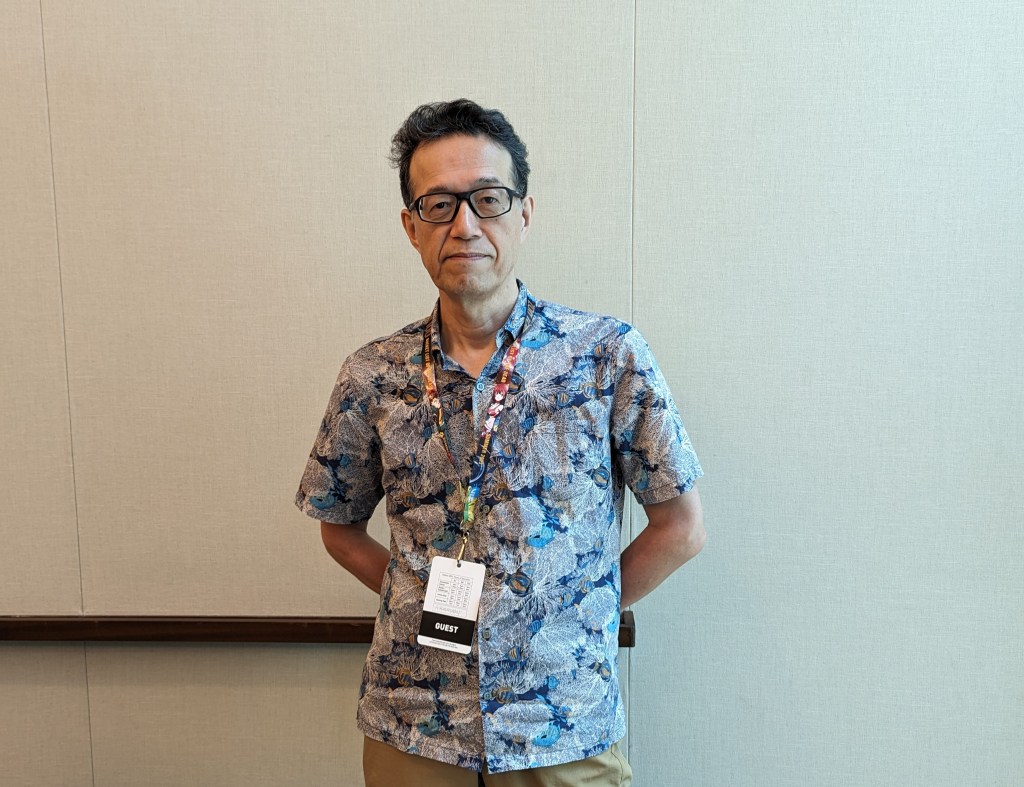
Terada Takanobu is a veteran game producer, and has been involved with the Super Robot Wars franchise since the 1990s. This interview as conducted at Otakon 2023 in Washington, DC.
Hello, it’s great to meet you. I’ve been a long-time fan of the Super Robot Wars series, and I’m very glad that is finally easy for people to play around the world.
My first question: You recently announced that you were becoming a freelancer. How has that change been for you? Have there been any particular advantages or challenges that come with it?
There were lots of interests I wanted to pursue, so I decided to step down from the producer role to become a supervisor, and use that time to do the things I’d like to do.
I want to make toys and plastic models, and original robot animations—ones that are not Super Robot Wars OG.
Do you have any all-time favorite anime or even tokusatsu works?
My favorite super robot is Mazinger Z. As for tokusatsu, Ultraman and also Masked Rider. And more and more.
Original Kamen Rider, or…?
It would have to be the first Masked Rider, fundamentally.
One signature element of SRW is the continued use of very creative 2D attack animations. What are the reasons you have stuck with this style even though so much has changed about video games over time?
In Super Robot Wars DD, we’re doing 2D animations and something between 2D and 3D too, so we’re diversifying.
In SRW DD, the idea behind going for 3D animation is to better capture the original. But more than when I was a producer, I can now better create the content I make compared to before
What has it been like developing mobile games, as well as having multiple games out there? Is it part of a broader strategy?
With regard to the overall strategy of creating mobile games, that lies with the publisher, Bandai Namco, so I can’t really speak to it. However, as for challenges in mobile games specifically, I’d say one that having a deadline every month is a bit challenging. For example, before, if it was for a console, you had three years to get the battle animations and the scenarios and put everything into one package. But now, with the mobile games, you have everything packaged every month.
You started at Banpresto in the 90s. Are there any staff from that era still at [its successor] BBSoft?
There are some.
Do you have any specific series or character units that you thought turned out especially well in terms of their presence in SRW? Or do you think there were any storylines that were executed very well?
It’s a bit difficult, because all of them are a lot of work, and I’m mainly putting effort into making what’s there. It’s a cyclic process of making and releasing and making. More than myself, it’s ultimately the users who decide what’s good.
Are there any titles you are especially proud of being able to obtain for SRW or thought you’d never get for the series?
Space Battle Yamato, aka Star Blazers. As for recently, too many. Hmm…recently, Gridman, Mobile Suit Victory Gundam, and Gun x Sword. In SRW DD, Devilman and Koutetsu Jeeg. What’s it called in English?
Translator: [Steel] Jeeg.
Oh, just that directly.
Ogiue Maniax: There isn’t much of a Jeeg presence in America.
Ah, I see. Oh, and there are two Jeegs now: [Steel] Jeeg and [Steel God] Jeeg.
The impression I have about SRW is that there are the “main” games—Alpha, F, F Final, V, X, T, 30, etc.—and then there are smaller ones that tend to be a little more daring with game mechanics and what series they include. One title I think of is SRW Neo, with Jushin Liger. Is there any truth to the idea that you see the smaller games as more experimental?
Before, yes, there was a difference with the more experimental ones. But now, SRW DD is the only one out, and in there, we try all sorts of things like Jushin Liger and Granzort. SRW DD does embrace the style of SRW, such as the game stages and the scenarios and everything.
I know that you cannot reveal any unannounced information, but has there ever been any consideration to include giant robots from non-Japanese media?
I’m not allowed to say what it was, but there were past attempts. There’s lots I would like to license, but it didn’t work out.
Do you receive feedback from the directors and other staff involved with the titles included in SRW? For example, have you ever had to interact with directors Tomino or Anno?
Yes, there has been some feedback—and actually, there have been some ideas that came from Tomino-san and Anno-san. And actually, I came across some suggestions that Kawamori-san of Macross had earlier. But I had to tell him that’s not something I have control over.
One last question: Over the years, you’ve worked with many voice actors, and unfortunately, some have passed away. Sometimes, they are replaced by new actors, and other times, you re-use existing voice clips. Do you have any say in who gets recast in SRW, or is it outside your control?
If it’s stated by the original source material, I will do as the source material requests. Otherwise, I have the freedom to choose.
Thank you very much!
 OGIUE MANIAX