A Mission for Myself: New York Comic Con

General Thoughts

As New York Comic Con has come to rival San Diego Comic Con and become its east coast counterpart, the scope and demand of NYCC are constant points of consideration for any potential attendee. While the convention pretty much improves every year and little can be faulted for how it’s run, the guests they bring, and just the amount of stuff there is to do (aside from perhaps the inevitable over-emphasis on professional and industry panels), I find that there’s a certain evaluative process I notice my friends and me going through every year, which all boils down to the simple question: should I attend next year?

First and foremost, as an anime and manga fan I have to say that NYCC delivered, and in ways I hadn’t expected to affect me so deeply. This year, they most notably brought Naruto creator Kishimoto Masashi and Uzumaki Naruto voice actress Takeuchi Junko and premiered Boruto: Naruto the Movie for the first time outside of Japan (see my review here). Aside from some hiccups in terms of the Hammerstein Ballroom venue—the overly strict no food policy went so far as to ban bottled water, and the concert-oriented seating obscured the screen for significant portions of the viewers—it was the most memorable part of the convention for me, and it brought me back to 13 years ago when I was at the height of my own Naruto fandom.

On top of that, the announcement of a Tiger & Bunny film helmed by Ron Howard was the biggest surprise by far of NYCC, and the opportunity to get a personal drawing from Attack on Titan animator Asano Kyouji was a rare treat. While I was unable to get Asano to draw Holon from Real Drive like I hoped (to be fair that show is 10 years old), this image of Sasha from Attack on Titan is the coolest thing I brought home from New York Comic Con:

However, my experience with NYCC made me realize just how disconnected I am from a lot of current fandoms. This isn’t to say that I disliked New York Comic Con, or what it does. I’ve always enjoyed the mix that New York Comic Con brought, between the opportunity to meet professional artists, the focus on entertainment media that has extended out from the superhero movie boom, and just the general celebration of nerd culture. However, partly because I was out of the country for four years, and partly because of my own general taste for things, I haven’t been as deep into certain popular works in recent years as I might have been in the past.

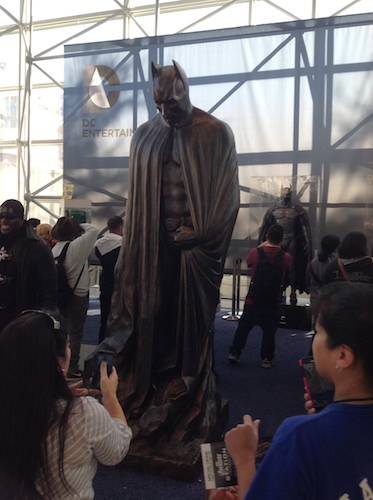
What really brought this point home to me was how much I enjoyed the Justice League Reunion panel. Seeing Carl Lumbly talk about bringing his cultural heritage to the role of the Martian Manhunter as an immigrant with a traumatic past, finding out that Justice League Unlimited was a clever and creative compromise with a soulless marketing engine that wished to use the cartoon purely as an action figure commercial, and hearing Kevin Conroy sing “Am I Blue?” flooded me with so many fond memories of what made that series great. It made me recall the character of A.M.A.Z.O. and how incredibly deep and interesting his story was, and the “Ask the Justice League” portion was downright hilarious, especially Martian Manhunter’s greatest enemy being “a villain made of flaming Oreos.” It made me want to find this feeling again within more non-Japanese works.

This is certainly not a criticism of the current state of animation; many fantastic works have been and are still being created. Rather, it has made me aware of just how much a connection to the “nerd mainstream,” as it were, fuels New York Comic Con. NYCC is a for-profit convention backed by the entertainment industry, and it will aim for the works that hit the widest audience, or at least the widest audience within a niche. This is what fuels the decision for a Firefly panel, or indeed inviting a manga megastar like Kishimoto. Rather it fuels my desire to expand my interests further than where they are currently, to get a better sense of the zeitgeist of current American (and non-American!) fandoms.

Exhibitor Hall, Artist Alley, and Panels

Again, when it comes to the actual con, there was much to enjoy. In the Exhibitor Hall, I got the chance
to try Street Fighter V, say, “Domo” to Ninja Slayer, and get that cool Sasha drawing from Asano.

The Artist Alley, as always, was a great place to meet artists, find out about new works, and see the trends that fuel the creators. Superheroes are a no-brainer, anime is less prominent but if it is it’ll be something that captured the imaginations of American fans, such as Dragon Ball Z or Sailor Moon. Stylistically, I made just one purchase at Artist Alley this year, issue 1 of a comic called Henchgirl by Kristen Gudsnuk, the premise of which is exactly what it sounds like. The Artist Alley filled with everything from amateurs to industry veterans, with talent abound. However, I tasked myself with a challenge, which was to find something that spoke to me, that didn’t rely on name recognition, and that wasn’t too tempered by my own preferences for specific types of characters or heroes. Gudsnuk’s drawings resonated with me the most because of the humor and soft, cartoony style. If you’re curious, you can read the comic online for free.

The other highlight of the Artist Alley might have been seeing a small kid, probably no older than 6 or 7, hand a copy of Days of Future Past to Chris Claremont.

As for panels, it’s no secret that a for-profit con like NYCC will have a different flavor from a fan-oriented endeavor such as Otakon. I generally enjoy the latter kind more when it comes to programming, but NYCC has a pretty consistent track record of quality, possibly because it’s such a big deal now and encourages industry hosts to bring their A-Game, as seen with the Justice League Reunion.

The Kishimoto panel was a rare opportunity to get into the mind of one of manga’s most successful creators. While the questions were curated, the host did a great job of opening up Kishimoto, and I’m sure that him no longer having to keep deadlines or worry about how his answers might influence sales of Naruto allowed him to give responses that were a bit more candid than what is usually seen from Japanese guests. Probably the best thing I found out from the panel was the friendly rivalry shared by him and One Piece‘s Oda as Shounen Jump‘s two frontrunners, as well as the titles that influenced him most. That said, I hope the audience that was mostly silent after hearing Kishimoto mention Tezuka Osamu’s Phoenix get the chance to find out more.

“Push Boundaries Forward: Gender, Diversity and Representation in Comic Books,” featuring Marjorie Liu, Darryl Ayo, David Brothers, Amber Garza, Jeremy Whitley, Joey Stern, and Shannon Waters was one of many panels over the weekend that focused on addressing the changing dynamics of comics creators and readers. Both the audience questions and panelist answers showed a strong desire to move forward, to learn, and to understand that greater diversity in comics is a multifaceted challenge that never ends, and is ultimately beneficial to comics as a whole.

The Felicia Day panel was pure Q&A, and that’s exactly what the audience wanted out of it. Incredibly charismatic in that awkward way that appeals to geeks most, Felicia Day genuinely engaged her audience with an attitude that was both deeply caring and kind of flippant, bringing a realness to her answers. The best moment was when she complained that you couldn’t have sex with her character in Dragon Age 2, which her manager had ordered the studio against.

The Sunrise panel showed once again that they’re one of the direct-from-Japan studios to really get what it means to throw a panel. In addition to the surprising news about Tiger & Bunny, their announcements were varied and spoke to different portions of their audience. By the way, if you heard a couple of loud guys cheering for Giant Gorg, that was me and Patz from the Space Opera Satellite Podcast. We were serious, too. Giant Gorg is a rare series directed by the character designer of the original Gundam, and had been in licensing hell for years.

GORG!!!

Yo-kai Watch is also a thing.

Finally, I decided to attend a screening of a Love Live! concert, partly to satisfy my curiosity about this particular aspect of Love Live!‘s media mix, and to see the fan reaction. What I got out of it is exactly something I mentioned in my review of The School Idol Movie: the series is extremely malleable by fans, going from a warm, inspiring story full of interesting characters to a mountain of instant memes at the drop of a hat. As people shouted at the character Ayase Eli, “DON’T LET YOUR DREAMS BE DREAMS,” I wondered if that could somehow be parlayed into the slogan of Love Live!: “Make our dreams alive!”

Cosplay

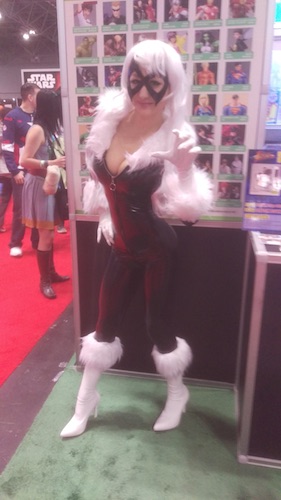
As with most con reports at Ogiue Maniax, I’d like to leave off with some cosplay. Truth be told, I wasn’t digging a lot what I saw, but Sunday really turned it around.

Rediscovering the Ninja Spirit – Boruto: Naruto the Movie

This review is part of Ogiue Maniax’s New York Comic Con 2015 coverage. Major spoilers for the Naruto anime/manga and minor spoilers for Boruto: Naruto the Movie are included.

Once upon a time, I was a huge fan of Naruto. Having both read the manga and seen the anime from the very beginning, I can still remember what got me hooked onto the series in the first place. The rich world of competing ninja villages provided the space for elaborate and creative battles. The fact that every character, hero or villain or somewhere in between, had their own stories and their own pasts that shaped who they are made it so that Naruto could be so many things to so many people. I wanted explore their society, to imagine what powers and characters would appear next. I have many fond memories of Naruto that can be best summed up by the fact that, even if he was never among my favorite characters, Uzumaki Naruto himself embodied not only a sense of tragedy but also the drive and empathy to move forward and help those who are similarly lost.

At some point, however, I fell off the Naruto fan wagon. Sure, I still enjoyed it to an extent, and I more or less kept track of what was going on, but I found that the continuously escalating power creep of shounen manga and the ever-growing and unwieldy cast just made Naruto feel as if it had lost focus. I don’t mean that it didn’t know where it was going, but rather that when the series became chapter after chapter of gigantic, virtually city-sized attacks, those humble beginnings of Naruto and his companions trying to navigate their world got lost in the shuffle.

This is why I actually enjoyed Boruto: Naruto the Movie so much. It felt like a return to the foundations of what made Naruto great, yet also does not deny all of the artistic and narrative development that happened since then, power levels and all. It encapsulates Naruto and eternal friend/enemy/rival Uchiha Sasuke’s growth by showing how they pass their experience on to the next generation.

At the start of the Boruto, it’s been many years since Naruto saved the world. Naruto’s son is Boruto, whose mother is Hyuuga Hinata (who is my favorite Naruto character). Unlike Naruto, who was an orphan and shunned by his community due to housing the fox spirit, Boruto must deal with the fact that his father is the world’s greatest celebrity. Naruto, who has since fulfilled his dream of being Hokage, is so busy that this leaves little time for Naruto to be a father, and Boruto lashes out against that. Understanding between father and son, as well as the value of hard work, are ultimately the main themes of the film.

When I say that Boruto feels like a return to the Naruto of old without shunning what it became, what I mean is that it really captures a sense of the inner struggles of its characters within their elaborate world of ninja fantasy, while also communicating the passage of time perhaps better than the manga itself ever did. For the younger generation, it gives a strong sense of what motivates each and every character, while remaining sharp and complete as a story. For the older generation, one can feel the developments, through their interactions and especially through the fighting, that brought these familiar faces to where they are now. Rather than being in the haze of hundreds of chapters or episodes, the movie conveys just how much these characters have grown over the years, both within their universe and as characters in a work of fiction. When Naruto harnesses his ultimate powers, what jumps out is the sense of hard work, pain, and joy that led him to this point.

While Naruto has always been a story of generations, particularly the young both surpassing and learning from the old, a story dedicated to exploring the relationship between father and son is something new to the series. Sure, there was the arc where Naruto finally meets his father, among other examples, but for the most part Naruto is generally a manga and anime where parents’ legacies are more important than the parents themselves, who are either dead or in the background. Naruto was an orphan, Sasuke’s parents were murdered by his own brother, Sakura’s folks were still alive but hardly relevant. Now, not only is it Naruto and Hinata with children of their own, but most of the rest of the characters as well, and it’s a joy to see the direct connection between generations play out in greater detail.

I watched Boruto as part of the 2015 New York Comic Con, which, much to the delight of Naruto fans, invited Naruto creator Kishimoto Masashi and Naruto voice actress Takeuchi Junko as guests. During his first interview of two, Kishimoto mentioned that he had remained true to his vision for the ending (which he came up with back in 2009), one where Naruto ultimately saves Sasuke from himself. Looking back, it made me realize just what Kishimoto had been going for at a point when Naruto as a story seemed to be getting crushed by the perils of long serialization (Naruto ran for 18 years). There was a point in the manga when it seemed to transform into the Sasuke Show, that it was it turn doomed to a fate of meandering and directional changes. Now, I realize that it was meant to show Sasuke’s descent into darkness so that Naruto could be the light that guides him out of it, but again, within that long weekly shounen struggle it’s all too easy to lose sight of the overall context.

In contrast, Boruto suffers no such issues, and that helps it stand out in a significant way. The movie keeps at a fine pace in spite of the gigantic cast of characters. It would be all too easy to falter by showing too many characters doing too many things, but this is really Boruto’s story in the end, and it’s a satisfying and heartfelt one.

The last thing I want to say is that, at certain points in the movie, I was on the verge of tears. Thinking back, I recall the same thing happening upon seeing the tragic story of Zabuza and Haku, Naruto’s first real antagonists, play out beautifully. It was at that point all those years ago when I realized that Naruto was something special, and Boruto feels very similar. A part of me, the part that remembers what it was like to first discover Naruto and to be fascinated by its world, would like the story of Uzumaki Boruto to go on, but overall I would be fine if this ends up being Naruto‘s swan song.

If you liked this post, consider becoming a sponsor of Ogiue Maniax through Patreon. You can get rewards for higher pledges, including a chance to request topics for the blog.

And Then Came Comic Con: Ogiue Maniax Status Update for October 2015

September I feel was kind of an exciting month, and I think I’ve put out some of my best articles in a while. Chief among them are my review of Love Live! The School Idol Movie and a monthly sponsored Patreon post, “The Rise and Fall of Saimoe.” In fact, even though it’s against the rules of my Patreon, I want to extend my gratitutde to Johnny Trovato, who while no longer a patron was the first to take me up on my offer to write posts based on topics chosen by my patrons. Thanks, Johnny.

Over the past month I’ve introduced a new type of pledge, where you can pledge a certain amount based on your favorite Genshiken character. In all honesty it’s just an excuse for me to make bad puns, so that’s why the amounts are all over the place. Of course, this also means that there are now different categories for sponsor shout-outs.

This month’s special Patreon sponsors are:

General:

Ko Ransom

Alex

otarsus

Anonymous

Yoshitake Rika fans:

Elliot Page

Kyubey Bryant

Hato Kenjirou fans:

Elizabeth

I haven’t gotten to all of the Genshiken characters yet, but if there’s one that you really want to see (Kaminaga? The younger Yoshitake? Ohno?), then speak up! It’ll be interesting to see which characters are still the fan favorites after all this time.

As for what’s on the horizon, New York Comic Con is this week, and I’ll be attending all 4 days! Of course I’ll have a con report for everyone to read, and you’ll be able to (most likely) catch me at a number of panels. Of course, given the hectic nature of NYCC, there’s no telling for sure!

Thu. Oct. 8
5:30 – 6:30 pm
VIZ Media Presents: An Evening with Masashi Kishimoto, Creator of Naruto
Location: Main Stage 1-D Presented by AT&T
Panels & Screenings
Fri. Oct. 9
8:00 – 9:30 pm
Love Live! School Idol Project
Location: Room 1A05
Panels & Screenings
Sat. Oct. 10
11:15 am – 12:15 pm
CBLDF Presents: Comics Censorship in 2015
Location: Room 1A05
Panels & Screenings

My Return: New York Comic Con 2014

New York Comic Con 2014 was my first in five years. I wasn’t around for the dissolution and complete integration of New York Anime Festival. I did not see the claustrophobia-inducing crowds created by people sneaking in that nearly drove some of my friends to never, ever go back. I was not around as the aging Jacob Javits Center itself expanded as best as it could to account for not only this convention but others as well. My experience with NYCC 2014 is almost that of a time traveler, as what I have to mainly compare it to is an old existence, before this convention was being labeled as the San Diego Comic-Con of the east coast.

As much as a convention should be about being a magical and informative experience where fans connect to the media they love as well as to their peers, the first thing worth mentioning about NYCC 2014 is its use of RFID badges. I was informed of their inaugural usage last year, but seeing them in action made me fully aware of the boon they provide to both the convention goers themselves and the staff running the entire thing. Essentially, attendees must use a card to check in and check out of the convention area, which not only cuts down on the number of people who shouldn’t be there but means that there are plenty of opportunities to actually relax and take in the con experience. Just having a space that is outside the convention building itself but still part of NYCC was so beneficial, as it allowed attendees to catch some fresh air if they needed it. Though I didn’t know anyone personally who had difficulty handling large crowds (and the NYCC attendance population is around a staggering 100,000), I suspect having not only the front entrance but other outside spots may have been a life saver for some.

Of course, all of this is not to say that New York Comic Con 2014 was neither magical nor informative, as I found it struck a fine balance as a convention of industries, artists, and fans in terms of activities and opportunities. New York Comic Con is a for-profit venture, designed to make money and to benefit all of those who take part in it on the industry. For one thing this means greater industry presence in both the panels and the showroom floor, and fewer fan panels where enthusiasts can analyze and discuss particular interesting angles of the things they love. However, as much as I’m used to industry panels being fairly by the numbers affairs about shilling products (not that there’s anything wrong with it), at NYCC these panels, although different from fan-run events, still carried with them a lot more meta-discussion of the industry and what it means to be “in” comics. You have to expect the sales pitch to some degree, but it was rarely much of an issue.

For example, I attended a couple of panels about women in comics (be they characters or creators or fans or anything else), and it involved industry professionals of all sorts who didn’t necessarily all agree with each other discussing an important topic in a way that encouraged further conversation instead of necessarily having as their primary agenda the sales of their own products. In the “Women of Color in Comics” panel, for instance, you had both industry veterans and independent creators. One veteran emphasized the idea that if you want to change how the big companies see women, you have to know how to communicate in their language, bring portfolios that old white men would understand, while some of the freelance artists stressed the importance of being able to work for yourself to create the characters you want.

The women in comics panels were illuminating and informative overall, though I do have one criticism for a prevailing sentiment I saw: when asked about how to deal with men who aren’t even aware that there is sexism and discrimination in the industry and its fandom, the answer I saw most often was “who needs those guys, forget them.” I understand that dealing with ignorance getting asked “what sexism?” for the 1000th time is a trying, perhaps soul-draining experience, but I do think that it’s still a group of people who need to be addressed and who might honestly just not know.

It’s actually quite impressive how supportive of female fans and creators New York Comic Con was. In addition to the panels, there were large “Cosplay is Not Consent” signs that were noticeable but not terribly intrusive which aimed to prevent sexual harassment of cosplayers by appealing to the human brain’s ability to think ahead. I hear it was largely effective, though without context I do wonder if some people thought that the signs were saying that cosplaying was not okay.

Maybe this has to do with the number of artists, writers, and creators as guests instead of marketing folks, but in a lot of the panels I attended I felt that the audience was let in on their creative processes at least to some extent. Obviously they’re not taking advice from attendees, but it seemed like the answers reflected the personalities and styles of those who gave them. Notably, when manga artist Obata Takeshi (Death NoteHikaru no Go) spoke, it was clear that he was not a people person, and was unaccustomed to the spotlight. When he explained how he worked, his answers were muddled like so many other artists I’ve met. In contrast, at one of the Image panels, Matt Fraction could talk up a storm and really present the job of comics writer as something not so much glamorous but intense and personal. While obviously I can’t agree with their sentiments, seeing the panelists at the European Comics Artists panel thinly veil their displeasure towards manga was also similarly revealing.

Before going to the con, I received some useful advice for attending panels: always line up an hour beforehand. It doesn’t matter how small a crowd you think a panel is going to get, because more likely than not you’ll be on the wrong end if you don’t play it safe. Bizarrely, the lines felt rather relaxing. They were times to rest one’s feet, to chit-chat with friends and sometimes strangers, and in my case to play against other people in Super Smash Bros. for Nintendo 3DS. I matched my Mega Man against others and had an exciting time. More importantly, though, the fact that the lines were able to remain these fairly civil affairs (aside from The Walking Dead panel according to what I heard at con feedback) indicates how effective this year’s organization was. At Otakon one year, I had a friend from England who found it mind-boggling that a place could be so bad at queueing. While I don’t know if NYCC could hold up to his superior English line standards either, I think it would have at least gotten a higher grade.

Overall, what might be the strangest thing about my NYCC 2014 experience is that I expected a rushed, frantic time where I would feel overwhelmed to the point of some bizarre euphoria. At times, coming down the escalator and seeing the absolute mob of people in the main lobby made it seem as if I were about to descend into a pit of madness. However, what I actually got was a relaxed, comfortable experience learning about the things I love and trying my best not to spend all of my money. Now if only I didn’t have to buy four 1-day tickets because all of the 3-day tickets sold out in like two minutes, then it would’ve been a lot better.

To conclude, here are some of my convention highlights.

  • Attending my first Avatar (Legend of Korra) panel only to realize that it might be the last Avatar panel ever.
  • Getting Obata Takeshi’s autograph on Volume 1 of Hikaru no Go.
  • Obata would have liked to draw Otter no.11 as an actual manga.
  • Meeting at last my long-time internet friend David Brothers.
  • Asking Juanjo Guarnido (author of Blacksad) about whether the extremely popular comics that the Franco dictatorship in Spain used as propaganda still had any influence today (his answer was no).
  • Being like, maybe one of two people to cheer for Tribe Cool Crew at the Sunrise Panel. I yelled so loudly one of the panelists immediately looked at me. Also, watch Tribe Cool Crew. My review of it is pending.
  • TURN A GUNDAM LICENSED (also First Gundam). I was actually repeating Turn A Gundam like it was a mantra, as if I were trying to cast a magic spell. I guess it worked?
  • Seeing all of the animators’ demo reels at the Kakehashi Project (The Bridge for Tomorrow) panel. A lot of the work reminded me of the more visceral art that often appeals to me yet is rarely found in anime. I especially liked the work of Shiroki Saori.
  • Watching the US premiere of the Kill la Kill Episode 25 OVA. It was a great revisit of the series, and in one brief moment during one of Mako’s speeches I swear she transforms into Baron Ashura from Mazinger Z.
  • Playing all that Super Smash Bros. for Nintendo 3DS with people.

Return to New York Comic Con

Tomorrow is the start of New York Comic Con 2014, and I for one am pretty excited. Though I’ve attended NYCC in the past, it’s actually been five years since I was last able to attend, and I’ve heard from people that it’s changed a lot. Heck, people over the past couple of years have been talking about how it rivals San Diego Comic Con now, and that is certainly not the convention I left back in 2009.

I know that at a con this big I won’t be able to do everything I want, but here’s some stuff I’m considering.

Thursday

Walt Disney Studios Tomorrowland and Walt Disney Animation Studios Big Hero 6. 1-2:30pm, Main Stage 1-D

Comics – What We’ve Lost, What’s Ahead. 2:15-3pm, 1A01

Nickelodeon’s Legend of Korra: Book 4. 5:15-6:15pm, Empire Stage 1-E


Friday

“Marry, Do or Kill?” What Will it Take to Shatter Female Stereotypes in Comics? 11:15am-12pm, 1A05

Voltron: A 30th Anniversary Celebration Presented by Perfect Square. 2-2:45pm, 1A21

Weekly Shonen Jump Presents: Takeshi Obata. 5-5:45pm, 1A10

CBLDF: The Battle of New York – Creativity, Censorship & the Comics Code. 6-6:45pm, 1A18


Saturday

Sunrise Official Panel. 1-1:45pm, 1A21

The Mary Sue Presents – Strong Female Characters: The Women Shining in Geek Media. 1:15-2pm, 1A01 (Conflicts with above)

Vertical Manga 2014. 5:15pm-6pm, 1A14

Kill la Kill Episode 25. 8:15-10pm, 1A06


Sunday

Image Comics: I is for Inventive. 12-12:45pm, 1A10

Kakehashi Project – New Japanese Animation Talent. 1-1:45pm, 1A21

Kodansha Comics. 2-2:45pm, 1A18

The Mary Sue Presents – All on the Table. 3-3:45pm, 1A21

Seeing Manga for What It is

New York Anime Festival, much like the teenagers who attend it, is a fairly young convention especially when compared to other cons. This year saw it merged with its sister convention, the New York Comic Con, and while I did not attend, a number of reports have stated how the Comic Con side so dominated the Jacob Javits convention center that the Anime Festival became relegated to what has now been commonly referred to as the “anime ghetto.” There is no word as to why the ghetto formed, or whether the sharp delineation between comics (and everything else) and anime was a sign of disrespect towards anime fans, but regardless of intent, it is quite clear that things were Different. Dave over at Colony Drop writes:

Far from the exhibition floor, there was an invisible line in the Javits Center that weekend: one that denoted where the comic con ended and where the anime con began. I marked this line down in my mind late in the first day, when I stopped to make a phone call and saw my first pack of running, screaming Hetalia cosplayers. This display was immediately followed by a creepy girl who was going around the hallway alone and serially glomping any character she recognized. It had taken me all day to get there— NYCC offered me more as a gamer than NYAF offered me as an anime fan— but there was no mistaking that I was now in Anime Country.

That invisible line that Dave mentions is largely social; all the con did was greatly exaggerate it through the structure of the convention center itself. Anime fans want to be seen as anime fans. They want to be different and special. Others are glad to oblige, doing so by expressing their disdain for “those damn anime kids.” In either case, a division is formed, between “anime and manga” and “not-anime-and-manga.” Meanwhile, others are quick to step in and give the message that “it’s all just cartoons and comics anyway.”

The trouble with both the acknowledgment and disapproval of such categorizations is that each side has its own fair share of pitfalls. By regarding manga as special (and from here on out I’ll be sticking to manga for the sake of convenience), supporters can end up tying it down, obscuring (or even willfully ignoring) the fact that one of manga’s real strengths is its sheer diversity in style, content, and tone. Instances of this can be seen in the way that early iterations of the Morning International Comics Competition (back when it was called the Morning International Manga Competition) were less aesthetically diverse than the more recent ones. This is further compounded when its detractors regard manga as being narrowly defined by negative traits. And yet, while it is in no way disrespectful to refer to manga as “comics,” doing so becomes problematic when the traits that have developed as the result of a unique comics history are intentionally brushed aside for the sake of generalizations. A person who regards manga as being no different from other comics inadvertently disregards the histories of comics cultures the world over.

One mistake people commonly make when they talk about what separates one form of comics from another is that they start at the visuals first. Some never get beyond the surface, and they define a form of comics entirely by the look of characters and details. Others can look beyond the first layer and delve deeper, finding meaning behind those images. Now taking the top-down approach is actually perfectly valid, but it only provides half of the total picture. By also taking a bottom-up approach, you can begin to see how the various non-visual contents of stories in comics manifest themselves on the pictorial level. It is good to not only see how the river-like flow of panels in manga affects storytelling for instance, but also how the storytelling can influence the panel structure in manga. From there, you can really begin to see what makes manga special, and at the same time discover its connections with the greater category of “comics.”

It can seem like a complete contradiction to say that manga should be seen as both unique and like all other comics, but that’s only the case if you define it in black and white terms. Look carefully, and you’ll see that the actual lines which separate manga from other forms of comics are actually quite nebulous. Rather than having manga’s identity be frozen in time, forever unwavering and unchanging, it is important to see manga as the result of decisions made over the years, trends that ebb and flow, and the combined efforts of people who dared to pick up a pencil and merge words with images in sequential format. Even as comics creators increasingly take notes from their peers two continents away and the divisions begin to crumble, they do not automatically wipe out what has come before. Just the same however, manga is not beholden to its past, and can grow in unpredicted ways. The past provides a foundation for the unseen future.

DO YOU WANT TO EAT DURING NEW YORK ANIME FESTIVAL/COMIC CON?!

The Brotherly Combination of New York Comic Con and New York Anime Festival is this weekend (Oct 8-10), and while I cannot go this year due to that pesky thing called the Atlantic Ocean, I still want to help out any way I know how. As of late, I’ve noticed that people planning on attending the con, especially those from outside of NYC, are concerned about where to go eat, and it just so happens that I love eating and eating in New York.

First thing first however, there are some “harsh” truths I have to get out of the way. Namely, the Jacob Javits Center, located between 34th St and 39th St on 11th Ave by the Hudson River, is quite a ways away from everything else. Even 10th Ave can feel distant, and the closest trains, the A, C, and E (aka the “blue” trains), are as far as 8th Ave. So unless you want to pay those ridiculous convention center food prices, you’re going to have to walk, and you’ll need at the very least 10 minutes to even get to the closest place, a McDonald’s on 34th St and 10th Ave which undoubtedly be packed. Another thing to keep in mind is that, generally speaking, “avenues” are much longer than “streets” in New York. Remember that as you plan out where to go with the time you have.

Oh, and seeing as I’m not in NYC, I cannot verify everything will be as I say it is for the weekend. Food places open up and close all the time in New York, after all. My apologies!

The simplest method to obtaining food is to go along 34th and you’ll hit a number of other fast food places. There’s a Burger King, two Subways, a Wendy’s, and even a Chipotle’s by the time you reach 8th Ave. Of course if you take the food to go, you’ll save even more time.

But I hear you asking, what if we want to sit down and eat, maybe take our time? Well first, I would have to ask if you planned on going back to the con center, and second, I would have to once again point out the New York City subways. They may not be the most reliable, but they’re plentiful and they go to almost every nook and cranny in Manhattan, let alone the other New York City boroughs. At that point, I would say just find whatever, but I know that a lot of people are distinctly looking for places to eat near the Javits.

Once you understand that “near” is a relative term, you have quite a few options. There are multiple diners along 34th, such as the Tick Tock Diner and the Skylight Diner. All of them are decent enough, and good for holding a large crowd if you get there at the right time.

Also keep in mind that you’re in Hell’s Kitchen, and going north along 9th Ave (and to a lesser extent 10th Ave) is going to reward you with any number of restaurants of varying costs. As a general rule, the further up you go, the pricier the food will be, but you can still find places, like Burgers & Cupcakes on 9th Ave between 35th and 36th. According to a friend, there’s a couple of excellent bars as well, Pony Bar and Rudy’s. Don’t be scared by the appearance of smaller locations either, as they may very well serve good food. One such place is Tehuitzingo Deli Grocery on 47th St and 10th Ave, which serves the best tacos I’ve ever eaten. Try the cow tongue!

If you’re really unsure of how you want your dining experience to be, then my location of choice is 38th St between 7th and 8th Aves. Not only is this the street where you can get my beloved Go Go Curry, but if you’re looking for places that can hold more people, there’s Lazarra’s Pizza, a sit-down Balkan restaurant called Djerdan (if you’re a real anime fan you’ll get the Musaka and shout, “MASAKA?!”), Korean Fried Chicken at Bon Chon, and even a Chinese restaurant called simply 38th Street Restaurant and Bakery which serves food closer to the kind you’d find in Chinatown than your typical General Tso’s fare. Also along 8th Ave between 38th and 37th is 2 Bros Pizza, which has convenient $1 slices. There’s also a 42nd Times Square Yoshinoya, in case you want to quickly feed your desire for Japanese food and Go Go Curry is too full.

If you have a bit more time than that and a bit of cash to lay down, then I must recommend Tony’s Dinapoli, a family-style Italian restaurant located on 43rd St between 6th and 7th Aves. The place is popular so you’ll need a reservation, but the portions are big and the food is hearty, and they’re used to housing large crowds.

And if you’re vegetarian, you may want to check out some of the nearby Indian restaurants. While I haven’t been to it myself, the closest one appears to be Tawa Tandoor, on 34th St by 9th Ave.

So those are some basics to eating during your New York Anime Festival/Comic Con weekend. Happy dining! And if you want to find something specific to eat in NYC, even outside of the Javits range, don’t be afraid to ask me on Formspring or Twitter or even in the comments below.

King Kirby Over: New York Comic Con 2009

New York Comic Con 2009 came and went, and all I have to show for it is some good memories, some good friends, and an autographed copy of Crisis On Infinite Earths. Good times.

I got to the Jacob Javits Center Friday afternoon, and with the benefit of a professional pass was able to enter the con without too much waiting. It was in this early period that I managed to get an autograph from Marv Wolfman, one half of the creative duo for the first Crisis series. I also got a chance to meet Peter Laird, co-creator of Teenage Mutant Ninja Turtles. I then looked for the panel rooms, but could not find them in time and missed one of the panels I wanted to see. Instead, I got to sit in on a panel devoted to building manga collections for libraries. Apparently the answer is “Kazuo Koike.” Sage advice that I will not argue against. I also got an autographed sketch from Mike Krahulik (Gabe) of Penny Arcade. He drew a Witchalok.

At some point I met up with Sub and other friends, and Sub and I tried to get tickets for the Friday showing of the new Yatterman live-action movie, but a deadly wall of raving fangirls prevented us from getting tickets. Apparently the lead actor playing Yatter-1 was one Sho Sakurai, a super popular j-pop boy band singer, and the fangirls were willing to do anything to get close to him. The Yatterman booth attendants had planned on bringing Sho Sakurai down, but when they saw the fangirl mob they told them that Sho Sakurai cannot come down in that current situation, and if they all left the area he would arrive. Naturally, this caused them draw in closer to the booth, and ultimately led to Sho Sakurai canceling his appearance.

Sigh, fangirls.  And I bet they didn’t even appreciate the Yatterman movie they diligently lined up for, and then squealed whenever Sho Sakurai was on-screen. Please do not tell me if what I said was actually true, because I’m really afraid.

We then saw the new Futurama movie (funny, not really good as a movie), and then ate at a nearby diner and talked about a variety of topics, as we all ranged from super American Comics fans to Anime fans and Sci-fi and everything in between despite being a relatively small group. Good fun for all.

Saturday’s crowd was, as expected, much larger than the Friday one. The first Saturday highlight for me was the Penny Arcade panel, as I have never been to PAX and thus had never seen them in person prior to getting that sketch on Friday. It was really a hilarious panel, and I recommend that anyone who gets the opportunity to go see them, even if you’re not much of a fan of Penny Arcade, as they know how to make a panel enjoyable.

The real high-point of NYCC Saturday though was a blogger dinner with many fine individuals, though the way we ended up sitting at the Tick Tock Diner, I spent most of my time with Sub, Evan of Ani-Gamers and the Reverse Thieves, Narutaki and Hisui and also Kohaku. Missing the Rodeo Burger of Burger King, I decided to construct my own. Also, the fact that you can order just plain cereal at a diner never ceases to amaze me. The topics of conversation ranged from Godfrey Ho Ninja Movies, Segata Sanshiro, Gold Lightan, and uh…teachers from our youth who turned out to be pedophiles…

Anyway, it was really great.

After dinner, some of us joined another group consisting of the Ninja Consultants, Dave (minus Joel), the paranormal Ed Chavez, among others, and we sang most excellent karaoke. Sub joined with me on a number of anime songs that began with Yuushaoh Tanjou! and included Ai o Torimodose! and Chala Head-Chala, finally concluding with KING GAINER OVER. We’ve done it before, but I think every time we try (key word being try) to sing King Gainer Over, it leaves us with a newfound appreciation for the song.

Sunday was relatively uneventful con-wise, though I attended the Penny Arcade How to Make Comics panel which was intended for elementary school students and ended up being populated by mostly adults. Funny how that works. The best part was that the PA guys did not change their lesson in any way.

Jerry: How long have you been drawing?”

Mike: (speaking to audience) Why, I’ve been drawing since I was YOUR age!”

Sunday’s con ended pretty much with me getting the last autograph given out by George Pérez, the other half of the creative duo responsible for Crisis On Infinite Earths, making my copy now Perfect. I actually had been looking for him all weekend, but some misinformation on the part of the con made it so that I had to rely on a friend to tell me exactly where he was located.

This is probably a good time to talk about some of the issues I had with the con, some legitimate, some simply personal preference. First was that there was NO schedule chart for the con on the website or with the con guide, and it made scheduling for anything impossible. At some point I just decided to abandon the notion of having a well-constructed plan for the day and just did whatever, as you may have noticed. Also the con guide itself was horribly out of date, which just compounded the problems.

New York Comic Con is a professionally-run for-profit convention, and it shows in many ways, not least of which is the fact that the Dealer’s Room is the centerpiece of the whole thing. Being located in NYC, home of Marvel and DC Comics, it allows them to get a lot of professionals and to really play that part of it up. This is good in that it gives you access to a lot of pros you wouldn’t meet otherwise, but the overall result is that a lot of the panels have a pure PR-type of feel to it, and only guys such as the Penny Arcade dudes can bridge this gap. Compare this with the also-professionally-run New York Anime Fest, which had its share of problems too but also had a greater fan aspect to it, with panels run by non-professionals.

NYCC is also, at least for me, a commuter con, and commuter cons feel very different from cons for which you stay at a very nearby hotel. I prefer the latter. I also have this strange feeling that the con floor is not good for walking as my soles were aching all day.

But I criticize because I love. Or something.

The con was over, but the day was still young, so a group of us consisting of some common friends, the Reverse Thieves, and Sub traveled to Kinokuniya and Book-Off, where we claimed many wonderful prizes. The highlight for me was another volume of La Sommelière and a copy of the Matsumoto Leiji manga Big Metal III. Sub purchased many excellent things, and I’m expecting him to review them all. YOU’D BETTER, MAN.

Riding the train home, saying my farewells (until next time), it was overall an enjoyable con, though murder on my feet.

I leave you then with this realistic rendition of Sho Sakurai fangirls at NYCC.

Less than 1 Week Until New York Comic Con

Let’s see what fun surprises are in store for us.

Not really much in the way of anime-relevant guests but for comics in general the guest list is astounding. You have Geoff Johns, Grant Morrison, Brian Michael Bendis, ART SPIEGELMAN, Gabe and Tycho, and Marv Wolfman and George Perez, among many others. And I hear the Ravedactyl artist’s alley table is gonna be back this year. Let’s hope the man himself also makes an appearance!

Panels and screenings are a bit more anime/manga-relevant but still kind of hilarious. “Turning A Bestselling Series into Manga: A Dark-Hunter Journey.” Well, I’ll give it the benefit of the doubt for now.

There’s the Live Action Yatterman movie which I feel needs some watching.

Why I Like Ogiue, Part 4, or Being a Man who is a Fan of Ogiue

As I stated in my previous post, I spoke to the Ninja Consultants at New York Comic Con, and among the topics we discussed were of course Genshiken and Ogiue. Erin pointed out to me that, as far as she knows, the majority of Ogiue fans in the US (or at least in the New York area) are female, and being a male Ogiue fan is kind of an exception.

Ogiue being more popular among girls than guys makes perfect sense, actually. Female anime fans would of course relate to the fujoshi that is Ogiue. It’s all obvious, with hindsight.

And yet, this fact didn’t really hit me just how rare a breed I am until Erin mentioned it. And I know that there are other guys out there who like Ogiue, just not as much as me, which I’m sure is a huge shock. The real point though is that it seems like not many of them are big, big fans of Ogiue, at least not compared to the number of girls who are.

What makes Ogiue stand out to me so far above other characters is the fact that I’ve been very fond of her every step of the way. From her brash, one-armed introduction to the club, to the revelation of her psuedo-real-life fantasies and denial of such, to her gradual softening and then hardening, to her acceptance of herself and her relationship with Sasahara, I was pretty much a fan from day one as anyone who’s read this blog will know.

And all along, I’ve been evaluating Ogiue from the perspective of a male otaku, not that I can evaluate from any other. And of course, I’ve also been doing this with every character I see. I don’t plan on talking extensively on gender roles in anime any time soon, but it just leaves me thinking about my position among anime fans at large, half of whom are female.