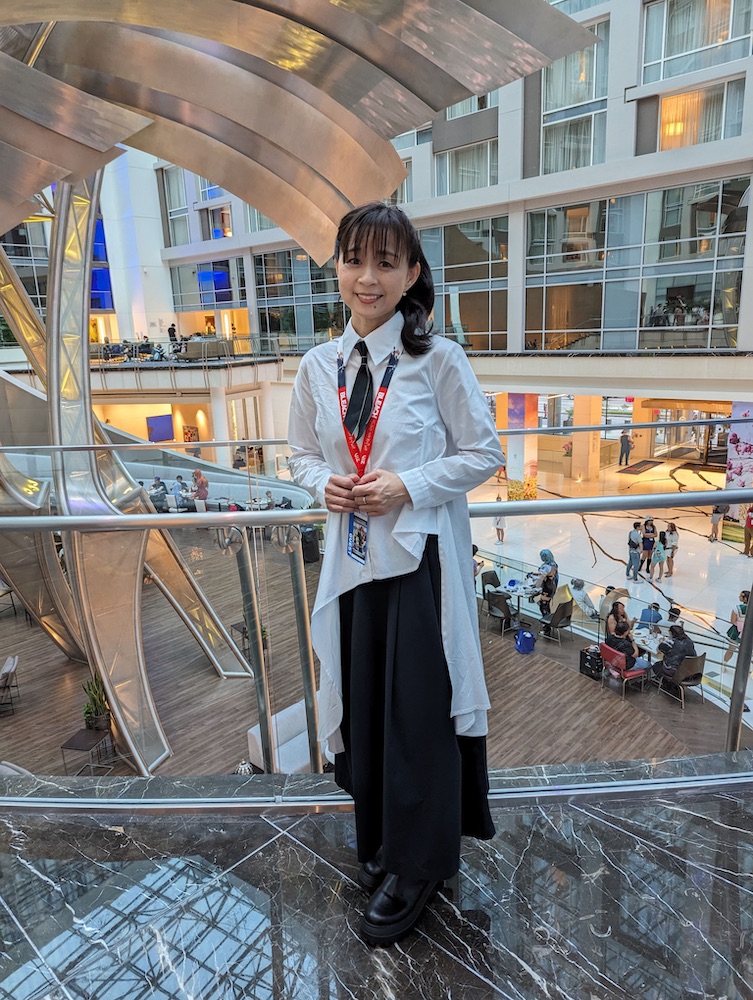
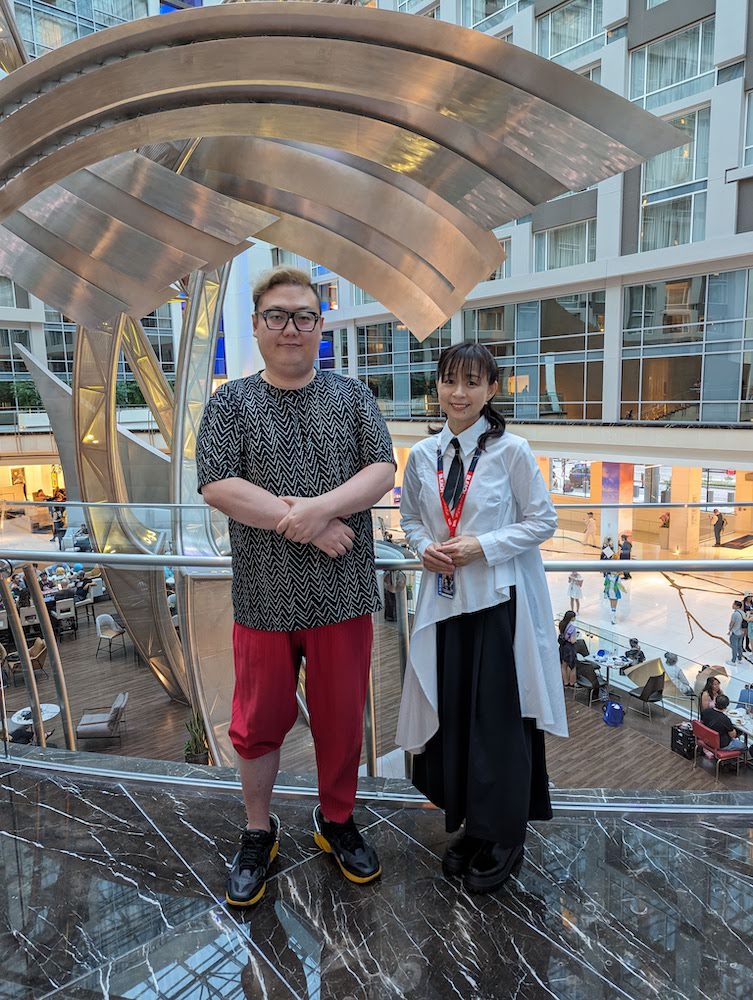
Interview: Super Robot Wars’ Terada Takanobu (Otakon 2023)

Terada Takanobu is a veteran game producer, and has been involved with the Super Robot Wars franchise since the 1990s. This interview as conducted at Otakon 2023 in Washington, DC.

Hello, it’s great to meet you. I’ve been a long-time fan of the Super Robot Wars series, and I’m very glad that is finally easy for people to play around the world.

My first question: You recently announced that you were becoming a freelancer. How has that change been for you? Have there been any particular advantages or challenges that come with it?

There were lots of interests I wanted to pursue, so I decided to step down from the producer role to become a supervisor, and use that time to do the things I’d like to do.

I want to make toys and plastic models, and original robot animations—ones that are not Super Robot Wars OG.

Do you have any all-time favorite anime or even tokusatsu works?

My favorite super robot is Mazinger Z. As for tokusatsu, Ultraman and also Masked Rider. And more and more. 

Original Kamen Rider, or…?

It would have to be the first Masked Rider, fundamentally.

One signature element of SRW is the continued use of very creative 2D attack animations. What are the reasons you have stuck with this style even though so much has changed about video games over time?

In Super Robot Wars DD, we’re doing 2D animations and something between 2D and 3D too, so we’re diversifying. 

In SRW DD, the idea behind going for 3D animation is to better capture the original. But more than when I was a producer, I can now better create the content I make compared to before 

What has it been like developing mobile games, as well as having multiple games out there? Is it part of a broader strategy?

With regard to the overall strategy of creating mobile games, that lies with the publisher, Bandai Namco, so I can’t really speak to it. However, as for challenges in mobile games specifically, I’d say one that having a deadline every month is a bit challenging. For example, before, if it was for a console, you had three years to get the battle animations and the scenarios and put everything into one package. But now, with the mobile games, you have everything packaged every month.

You started at Banpresto in the 90s. Are there any staff from that era still at [its successor] BBSoft?

There are some.

Do you have any specific series or character units that you thought turned out especially well in terms of their presence in SRW? Or do you think there were any storylines that were executed very well?

It’s a bit difficult, because all of them are a lot of work, and I’m mainly putting effort into making what’s there. It’s a cyclic process of making and releasing and making. More than myself, it’s ultimately the users who decide what’s good.

Are there any titles you are especially proud of being able to obtain for SRW or thought you’d never get for the series?

Space Battle Yamato, aka Star Blazers. As for recently, too many. Hmm…recently, Gridman, Mobile Suit Victory Gundam, and Gun x Sword. In SRW DD, Devilman and Koutetsu Jeeg. What’s it called in English?

Translator: [Steel] Jeeg. 

Oh, just that directly.

Ogiue Maniax: There isn’t much of a Jeeg presence in America.

Ah, I see. Oh, and there are two Jeegs now: [Steel] Jeeg and [Steel God] Jeeg

The impression I have about SRW is that there are the “main” games—Alpha, F, F Final, V, X, T, 30, etc.—and then there are smaller ones that tend to be a little more daring with game mechanics and what series they include. One title I think of is SRW Neo, with Jushin Liger. Is there any truth to the idea that you see the smaller games as more experimental?

Before, yes, there was a difference with the more experimental ones. But now, SRW DD is the only one out, and in there, we try all sorts of things like Jushin Liger and Granzort. SRW DD does embrace the style of SRW, such as the game stages and the scenarios and everything.

I know that you cannot reveal any unannounced information, but has there ever been any consideration to include giant robots from non-Japanese media?

I’m not allowed to say what it was, but there were past attempts. There’s lots I would like to license, but it didn’t work out.

Do you receive feedback from the directors and other staff involved with the titles included in SRW? For example, have you ever had to interact with directors Tomino or Anno?

Yes, there has been some feedback—and actually, there have been some ideas that came from Tomino-san and Anno-san. And actually, I came across some suggestions that Kawamori-san of Macross had earlier. But I had to tell him that’s not something I have control over.

One last question: Over the years, you’ve worked with many voice actors, and unfortunately, some have passed away. Sometimes, they are replaced by new actors, and other times, you re-use existing voice clips. Do you have any say in who gets recast in SRW, or is it outside your control?

If it’s stated by the original source material, I will do as the source material requests. Otherwise, I have the freedom to choose.

Thank you very much!
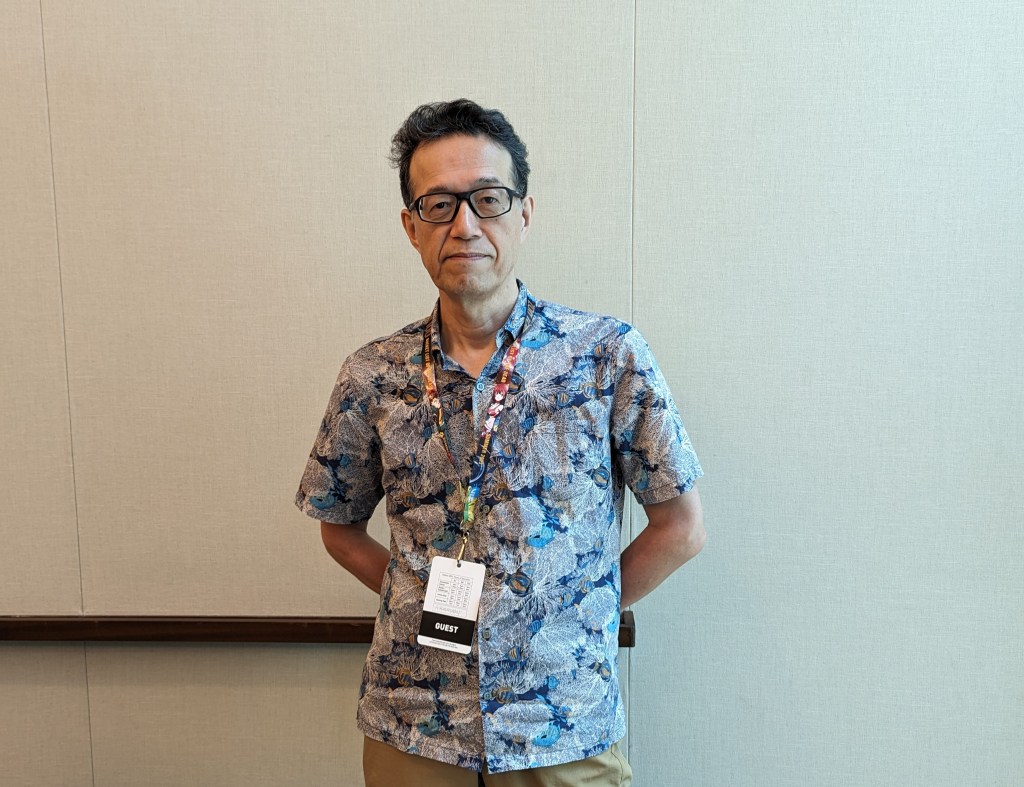
Interview: Aramaki Shinji (Otakon 2023)

Aramaki Shinji is a creator known for his mecha design work on Bubblegum Crisis, Genesis Climber Mospeada, Megazone 23, and more. He also designed many of the toys that became Transformers, including Soundwave. Aramaki is also an anime director who has focused on pushing 3DCG animation since the early 2000s.

You have a lot of experience as a mechanical designer, and I understand that different mechanical designers have different processes for designing. For example, Kawamori Shoji has talked about how he uses Legos. What are the key aspects of your approach?

Well, it depends a lot because I get different requests for each project I work on. For example, you mentioned that Kawamori Shoji-san uses Legos, but I think that’s mainly for designing transforming mecha. Should I answer just based on transforming ones? It’ll make it easier if we narrow it down to a certain genre.

Sure, let’s go with transforming.

So we initially choose two or three shapes/forms, and we ask, what are we going to transform and how. But we start out with the two coolest forms.

Would you say you sort of work backwards from the final designs/silhouettes perhaps?

Initially, we don’t really get into the details. We just think, oh this is what a cool bike looks like, and this is what a cool robot looks like. So we just start off with what looks cool and don’t get into the particulars of how it transforms yet.

It gets difficult from there. In the past, I used to study how things might transform using papercraft. Nowadays, though, we can use 3D programs. We start off with simple blocks, but using them, we can join them and see how these volumes move around.

If we use 3DCG, we can study how these forms look from varying perspectives, so it makes the process much easier.

The next work is one that you might not be as known for. I looked up your credits, and it said that you’re responsible for conceptual design on the anime Star Driver. The style of the mecha there are quite different from what I typically think of when it comes to your work. How far removed are the final designs compared to your originals?

Actually, for Star Driver, I didn’t do much mechanical design, and I didn’t really touch any robots. But I actually designed the landscapes and backgrounds—the stage design—for Star Driver. The series is set on an island, and I designed what the island is like, and what the school is like. I did it based on discussions I had with the director, Igarashi, to set the mood for the anime.

You directed works such as Appleseed, which was, at this point, decades ago. I remember seeing them first start to show up, and that was a time when directing in full 3DCG wasn’t nearly as convenient as it is today. What are some of the challenges you faced in the early 2000s?

Back then, we actually had a lot of problems. There was no standardized software for design, so the character design software was different from the landscape design software. That made it really difficult to organize everything and keep it together as one team. 

For one scene, when we decided on the camera angle and looked at the scene, the table and the character were sort of shifted because they were designed using different softwares.

These seem to be simple problems, but back then, Japan wasn’t as advanced in the field of CG. So we faced challenges every single day.

My final question: I actually have fond memories of the cartoon M.A.S.K. and its toys, and I was excited to learn that you worked on it. What designs were you responsible for, and what did it feel like to work on a foreign production?

This series involved a lot of transforming vehicles such as trucks and boats, but the original designs came from the toy company, Kenner. Back then, I was working in LA, but I went to Chicago where their company was based, and took a lot of pictures of the prototypes. We did drawings to help with animations.

Most of the mechas were designs provided from the toys, but some were not from the toys, so I got to design them.

I don’t remember all that well where they appeared in the show, but they let me design two transforming vehicles back then, where I got to pick the car types and how they transform. They were called the Manta and the Shark.

Thank you for this interview. It was great to have you at Otakon!

Thank you.

Otakon 2023: The Iwao Junko Panel

At Otakon 2023, Iwao Junko (Tomoyo in Cardcaptor Sakura) had a panel focused exclusively on her history and career. This is a summary of the panel, as well as notes from the Q&A that occurred. To read the interview I conducted with her and collaborator Kawamura Ryu, go here.

The Beginning

Iwao started off the panel by talking about her childhood, and how she loved listening to records found in storybooks, watching anime, listening to music. At that time, voice acting wasn’t seen as it is today, so when she asked others about a career in that realm, they told her she would have to be an actor or a singer/musician. Even so, she thought about getting into voice acting since she was 6 or 7 years old.

Around 13, she secretly auditioned to become an idol, and while she was ready to get rejected 100 or 200 times, she ended up getting accepted after just on try. Her parents (especially her dad) were very against it, but she promised them that she would quit in ten years if she didn’t make it.

So she went to Tokyo and did lessons, and she eventually debuted as an idol in a four-person group at the age of 16. She was actually replacing another idol in the group who had “graduated” (i.e. quit and moved on), but the group was already planning to split up after one year. Once that was done, she had to do part-time jobs and attend night school.

Iwao’s First Anime Role

From then on, until the age of 23, Iwao just worked and auditioned, ending up with various jobs. She was in musicals, and also played an assistant in a science show for kids. She even worked at a train station. One day, one of the members of the science show saw Iwao and asked if she had given up on show business. At that time, the ten-year deadline she had promised her parents was almost up. This person mentioned that a certain show was looking for someone who could act and sing, and so Iwao went for it because it could be her last chance. After auditioning, she was nervous waiting for results every day. 

It was her first anime role, and it was Melissa Thorn, one of the main characters in an Japanese-French co-produced anime called Montana Jones, about explorers on a voyage. Got the part of one of the main characters of Montana Jones. When she told her parents about it, worried that time was technically already up, her parents instead congratulated her, and said they want Iwao to keep trying for another 10 or even 20 years.

From there, Iwao joined a voice acting school and practiced for her debut in Montana Jones. One thing that surprised her about working on the show was that there was no rehearsal time in anime. The first day of recording is when you meet the rest of the cast.

Another surprise was that they recorded based on roughly drawn non-color animatics. She expected to be acting in reference to finished animation, and while there was sometimes color, that was often not the case. Sometimes, ttwo characters would even be represented by just a red line and a blue line.

The other main characters were played by Otsuka Akio (Solid Snake, Black Jack) and Nakao Ryusei (Freeza). Their performances were so good that she worried there were actually prior practice sessions that she didn’t know about and missed. Iwao couldn’t keep up with them at all. 

The way the recording studio was set up, 10-plus people had to work with four microphones. And in fact, one of those mics was the “main character mic,” exclusively used by Ohtsuka as Montana Jones. The result: you ad to quietly get up to the mics each time and constantly choosing which of the three you’d use every time. Not only that, but recording was analog back then, and the tape didn’t stop for you. Every take was 15-minute long (about half an episode), and whenever there was a mistake, everyone had to start all over again. Iwao remembers the other voice actors getting frustrated with her and asking, “What is this amateur doing here?” It was Otsuka and Nakao who helped her through the process, until they eventually finished the first episode. 

After the debut episode, haired, the show actually got complaints from viewers who wanted her to be replaced with someone more experienced, and she even received a stack of physical hate mail complaining about her. The other actors supported her and let her know that everyone has to deal with this. Gradually, the staff also supported her, and she gained fans little by little. She still got negative feedback, but would also receive letters from fans. Because of that, she wanted to become someone who could someday help a newbie overcome these same troubles. Something curious she noticed was that once she started having a more positive outlook, she started landing a lot more roles.

Going Full-Time

At first, she didn’t have enough voice acting gigs to quit her day job, but eventually had enough roles that she could go full-time. Her first time as protagonist was in Key the Metal Idol, and from there, it was Cardcaptor Sakura and Evangelion and so on. She remembers her manager saying, “You’re gonna get it,” in regards to Eva. It was with Eva that she could make voice acting her sole career. One thing she learned, though, was that despite the job being “voice acting,” a  lot of her work seemed to be event-related. Couldn’t get much sleep, which was rough.

Iwao recalled that the Eva audition was 15 minutes long for everyone. There was a long bench where everyone sat as they waited to try out, and she could see so many voice actors there who were interested. Iwao actually auditioned for two roles, and hinted that the second role has become known recently, but did not specify which one.

Q&A

  • At the 20th anniversary CCS exhibition, she got to go to dinner with all the other actors outside of work. 
  • Shows she wishes people would know more: Harimogu Harley, Betterman, Key the Metal Idol.
  • Perfect Blue was a case where she actually received a real script and storyboards prior to recording. Iwao’s time as an idol only lasted one year, but she knew from others while working at that time that some of the things Mima goes through in the film actually dho happen. What she didn’t find out until later that director Kon Satoshi didn’t know anything about her idol history or age, and decided it based on one line that everyone was supposed to recite for their audition: “Who…are you?” Kon had decided on voice alone, so when he looked at her résumé, he reacted to Iwao’s extremely strong-sounding family name, which translates roughly to “Boulder Man.” Kon was excited to see what kind of Rock-like Man would show up, and was surprised Iwao was rather small. Because of this, he was watching her with a stern and scary face, but she didn’t know this was the reason, and Iwao was so scared that she couldn’t greet him. When playing Mima and the “other” Mima, she had to have separate recording days for the different personalities, and thought Matsumoto Rica (who played Rumi) gave a powerful performance.
  • When asked if she ever had the chance to be the mentor she wanted to become during Montana Jones, she mentioned that she thought upon entering her 50s that this would be her mentorship phase (Iwao is 53 this year). The series where she was able to to do this was an anime called Shining Post, where she thought, “Now is my time to shine.” Iwao ended up telling the new voice actors about what she herself had experienced.
  • I got to ask a question as well, one that I couldn’t fit into the interview! “Are there any roles you played later in your career that would have been difficult for you  earlier in your career?” Iwao replied that it would have to be Hisae in Onihei, as it was a role where she felt she could bring the experience she had built up over time. When playing her, Iwao thought, “Finally, I can play adult roles.”
  • Everyone who worked on the Madoka Magica found out about the twists and turns week by week, so it was a surprised to everyone.
  • Iwao is from Kyushu, and a major Tomoyo/Iwao fan asked the final question, which was regarding recommendations for anyone traveling to her home prefecture. Iwao’s Her recommendations are Beppu in Oita Prefecture, which is famous for hot springs. She also suggested checking out Nagasaki.

Interview: Iwao Junko and Kawamura Ryu (Otakon 2023)

Iwao Junko is a singer and voice actor most famously known for playing Daidouji Tomoyo in the anime Cardcaptor Sakura. Kawamura Ryu is a musician and composer who has frequently collaborated with Iwao on musical projects. This interview was conducted at Otakon 2023 in Washington, DC.

My first question is for Iwao-san: I first came to know you through your role as Tomoyo in Cardcaptor Sakura, and you helped make her one of my favorite characters ever. I’ve noticed that in the first series, our approach to Tomoyo was a little different from how it turned out later on. Was there any catalyst for this change?

Iwao: Daidouji Tomoyo in the Clow Card series is an elementary school girl, and she’s grown up a bit in Clear Card. So as some years have passed, I played her a little more mature.

Iwao-san, your singing as Tomoyo is beautiful but also notably different from how you approach your personal music. How do you manage to stay in character so well while singing as Tomoyo?

Iwao: When I sing as Tomoyo, I sing as an elementary school girl. But when I sing as myself, I use my natural voice. 

Is it a challenge to play Tomoyo while singing?

Iwao: It’s not all that difficult, actually.

My next question is for Kawamura-san: What made you decide on the bass as your instrument of choice? 

Kawamura: I’d have fewer rivals.

And how did you go from playing music yourself to also arranging for others?

Kawamura: It’s actually something I learned from Tanaka Kohei-san. What he mentioned was that, as a musician/player, you don’t get the same royalty payments as you would if you’re a composer. So what I learned is that you should be well-rounded, and have both “composer” and “player” under your belt.

Are there any other lessons you’ve learned from working with Tanaka-san that have stuck with you?

Kawamura: His policy was “make something other people won’t make.” He’s ingrained that in me.

Speaking of Tanaka Kohei, I also know Iwao-san from a series called Betterman, and your performance really stands out to me when you play Sakura—it’s very haunting. What was it like working on Betterman?

Tomoyo: So on Betterman, which Tanaka Kohei-san did the music for, I auditioned and landed that role. I wanted to play the character of Sakura as a girl who is cute, yet enigmatic and even a little frightening. Expressing that scariness was not so much about changing my tone, but rather taking care to change the tempo within the lines.

Kohei-san was the one who basically welcomed me into the world of anime, so I’m very grateful to him. I had done various jobs as a singer and such, but I always longed to be involved in the world of anime—to be a voice actor. I was missing that step towards that industry, though, and It was Kohei-san who allowed me to get into singing covers of other songs, providing me opportunities for people to see and hear me. So he is a very important figure to me. 

Another series Iwao-san worked on that is very influential is Evangelion. Do you have any memories of working on Eva that stand out strongly in your mind?

Iwao: I got the role of class rep Horaki Hikari from auditioning. When playing her, Director Anno-san asked me to express her energeticness and her “class-rep feel” through my voice. However, in Shin Evangelion, Hikari is a mother, and as a mother, she would have a different voice tone as well as a different emotion to her compared to the television version where she was a school girl and a class rep.

On that note, over the past decade or so, you returned to many roles—in Evangelion, in Cardcaptor Sakura: Clear Card, and you even reprised the role of Sakura in Super Robot Wars 30. What is it like to revisit these older characters of yours?

Iwao: Going back to previous roles is very interesting because what I thought I remembered I may not actually remember, and some things might have changed—like the tone of my voice. I would want to focus on meeting the expectations of my fans. For example, for Super Robot Wars 30, the Betterman director, Yonetani-san, was actually there to see over my breaths and my tones so that I was better able to reproduce what I sounded like and what the fans expected me.

Thank you very much!