OGIUE MANIAX

Anime & Manga Blog | 50% Anime Analysis, 50% Ogi

Precure is Not a Lesser Sailor Moon

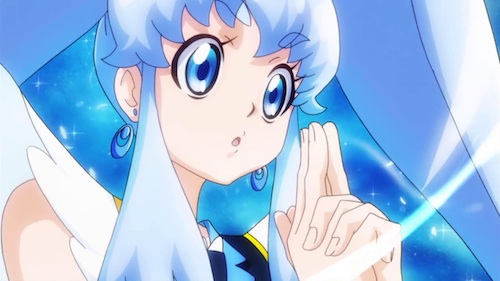
curemoonlight

A few months ago at Otakon, I was talking with Alain from the Reverse Thieves, who had attended a panel about magical girls and feminism. He had described how the presenter went through the various series she’d be discussing, but made specific mention that she’d be omitting Precure from the discussion, citing the fact that she wasn’t particularly impressed. Although I did not attend the panel myself, I found that to be unfortunate, not because of the dismissal of Precure by the presenter in isolation, but because this stance on the long-running magical girl franchise is not that uncommon. Among many fans, presenters, and even scholars, Precure is assumed to be bland and generic and not worth discussion.

In my opinion, that kind of thinking is a mistake. Precure is not only the biggest and most popular magical girl property of the past ten years, eclipsing even Sailor Moon in certain ways (sales, longevity on TV, etc.) and therefore worth observing for its cultural footprint, but it is also a fount of positive imagery for girls. While there are certain elements that can remain issues, such as the increasing ubiquity of pink as the only possible color for the main heroine and the fact that a lot of the magical girl outfits have high heels, Precure utilizes strong female characters by default, rather than making a big deal out of their existence. What’s more, because the series refreshes itself every year or two, its variety results in different approaches to characterization of female characters and themes pertaining to feminism. You have weak girls who become strong over time (as well as a nuanced exploration of what it means to grow), heroines who are more ideals of human potential, and even characters who try to reclaim the term “princess” to mean something more than “demure.” Even the very first series is significant due to its portrayal of girls having aggressive, hand to hand fights (in a show for young girls, no less), and the fact that its two main characters are more about their life goals than pining at the boys around them.

I have my suspicions as to why Precure has ended up with this reputation, and a lot of it has to do with Sailor Moon. It was the first of its kind, the sentai-inspired battling magical girl genre of which Precure is a part. In terms of cultural influence around the world, Sailor Moon has crossed the barrier from niche interest for anime fans only to seminal work, and is frequently cited as a pivotal show in the development of many young artists. Just the fact that it portrays these mature-looking girls who fight and win is on a basic level empowering and inspiring, and so any similar series gets compared not only to Sailor Moon but also its presence as a kind of nostalgic defining moment where any weaknesses it possesses as a series are forgiven. It’s also very important to point out that, especially in the US, Precure is just plain hard to come by. As a result, for English speakers it has much less potential of becoming part of the fabric of one’s upbringing, with the possible exception of Smile Precure!, which has been loosely adapted to become Glitter Force on Netflix.

I get the feeling that, when the Sailor Moon generation typically sees Precure, a common process occurs. First, they see that Precure is similar, and that its story (depending on which version they watch) is often more lighthearted initially. Second, they see that the character designs are younger-looking, and so it seems less mature as well. Third, they might do a bit of research and become aware that the franchise is also popular with adult men, lending a sort of “creepy pervert” vibe to their impressions. Finally, they fill in the blanks, and without watching much more, jump to the conclusion that the franchise can’t possibly do things so differently from Sailor Moon that it’d be worth looking into more, or that it’s only for sad otaku (unaware that Sailor Moon was the show for doujinshi in its heyday). Moreover, because Precure doesn’t have the more immediately apparent dark appeal of a Revolutionary Girl Utena or a Madoka Magica, it’s further assumed to be generic kiddie fare. That’s not to say that the series isn’t for children, but that the type of maturity it carries is more in how it approaches the task of trying to show strong images for a female audience. As discussed above, I believe Precure does this to great success, and to see it brushed aside saddens and angers me.

I like Sailor Moon, and I don’t mean to paint fans of that series with the same brush. However, because it is a defining magical girl show for a lot of people, it gets written about as if it is the be-all, end-all of its particular brand of mahou shoujo. The reputation of Sailor Moon surpasses what is actually in the series in a certain way, and it casts an unfair shadow on Precure when Precure does many things that I would argue are improvements or directions that Sailor Moon never goes. This is especially the case with its feminist qualities. My hope is that, when people think about progressive portrayals in anime and the magical girl genre, they not only remember that Precure exists, but are aware of all that it offers.


If you liked this post, consider becoming a sponsor of Ogiue Maniax through Patreon. You can get rewards for higher pledges, including a chance to request topics for the blog.

Save

Go! Princess Precure and the Flames of Atonement

WARNING: This post contains Go! Princess Precure spoilers

There’s a recurring problem in the Precure franchise, which is basically a post-resolution amnesia to any significant narrative climax. This is especially evident when a new Cure is introduced or an evil character turns to the side of good, complete with a new human guise free of all of the old visual cues that marked her as being on the side of “evil.” In the process, these girls usually not only take the spotlight because they’re so new and exciting, but their newer forms are so fully integrated into their now-human lives that it’s like the show wants you to forget their past.

As a result, while the prospect of a turncoat who sees the light is generally thrilling, the addition of this new Cure to the main team often comes with a small helping of fear and dread. When Go! Princess Precure first introduces its evil rival character, Princess Twilight, the possibility that she would become the fourth Precure in this new series was already there, but the following questions would come up while watching. First, will this new character overshadow the old girls. Second, will the series act as if she’d always been everyone’s best friend?

22 episodes later, we have our answers. Twilight is really Towa, a princess who was kidnapped and brainwashed when she was a little girl, and Cure Flora, Cure Mermaid, and Cure Twinkle are able to rescue her and restore her memories. Thus begins the potential process for Twilight to essentially be “Cure-washed,” but Go! Princess Precure rather impressively makes the misdeeds of Towa’s past a part of her story and her struggle. Even after being rescued and having her original appearance restored (Twilight had long white hair while Towa’s hair is red and done in elaborate curls), Towa is shown to still be in Twilight’s original dress, and the switch away from this outfit is actually a plot point in Episode 23. Even more indicative of the show’s desire to not forget about “Princess Twilight,” however, is Towa’s transformation into Cure Scarlet.

When Towa transforms into a Precure, there are a number of interesting visual cues that she seeks not to totally divorce herself from her problematic past. First, the villains of the series have pointed elf ears, and when Towa becomes Cure Scarlet she also retains this feature. Not only that, but the transformation sequence actively emphasizes the shape of her ears.

Second, her her hair goes from being a bright red to a pale pink, closer to the white of her Twilight form.

Finally, the ever-present fire in her transformation sequence, though a different color from the flames used when she was evil, are so powerful and overwhelming that they appear sinister and frightening. While past fire-themed Precures also had blazing infernos bursting forth from their bodies, in the case of Cure Scarlet it’s almost as if they’re hinting that she’s liable to commit arson. Of course, that’s not the actual point of the transformation, but it again points to a character who might be “good” but hasn’t necessarily forgotten or ignored her wrongdoings, even if they were arguably beyond her control.

The overall result is a character that I’m looking forward to seeing develop. While there’s no guarantee that she won’t end up overshadowing the rest of the characters, I have greater faith in Go! Princess Precure because of how consistently impressive and high-quality the series has been up to this point.

If you liked this post, consider becoming a sponsor of Ogiue Maniax through Patreon. You can get rewards for higher pledges, including a chance to request topics for the blog.

Ogiue Maniax Reviewing HappinessCharge Precure! on a Reverse Thieves Case Closed Podcast

cureprincess-gunblow

Once again, I’ve sat down with Alain from the Reverse Thieves to talk anime. This time, we discussed the end of HappinessCharge Precure! You can also hear our thoughts on the overall quality of the series, as well as how it stacks up to previous anime in the Precure franchise.

Check it out here.


Making Lemons Out of Lemonade: Empty God Core at the B²OA Gallery

02_diablos

As an anime and manga blog largely focused largely on commercial output, it is rare that I will report on and review an Art Show in all of its capitalized glory. However, I feel it important to discuss the “Empty God Core” show at the B²OA Gallery, featuring the works of Japanese artist Umezawa Kazuki.

I am well aware of the fact that anime and manga have been subjects of exploration, self-discovery, and exploitation since at least Murakami Takashi and his “superflat” movement. Often times challenging and presenting the exoticism of Japan’s visual culture, artists like Murakami tend to feel as if they come not from the otaku subculture itself, but are reacting to it as it has grown over times. While I would not go so far as to say that this is some unforgivable flaw in his work, that he may not be a “true” otaku, it does make me notice when a piece of art conveys the perspective of someone who has embraced the lights and sounds of anime and manga as almost existential hazes.

That is the impression I received from Umezawa’s work, though even before I saw the actual show itself I had an opportunity to meet him for the first time thanks to our mutual friend, Ko Ransom. If there is anything that stood out to me most about him at first glance, it would have been his A Certain Scientific Railgun pins adorning his clothing. The one most prominent could be seen on his chest, a chibi version of Nunotaba Shinobu, my favorite character in the Index universe. A teenage scientist with a propensity for interlacing her speech with English, Nunotaba comes nowhere near the default choices for popular characters in her series, so I knew that Umezawa was serious business.

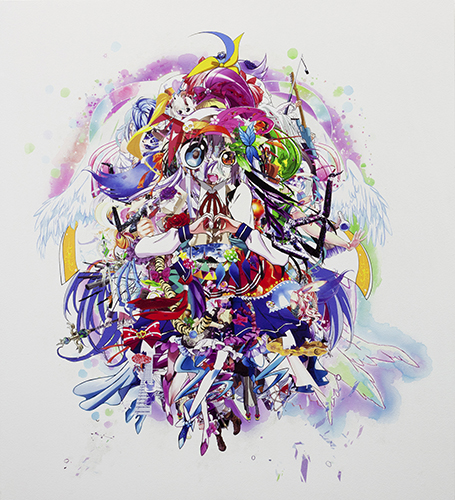
That being said, while I was aware that Umezawa was an otaku before I saw “Empty God Core,” I would have jumped to that conclusion almost immediately if I had come in without knowing a thing. Umezawa’s works consist largely of collages of anime characters, scrambled to the point of almost losing all recognizable qualities, and then rearranged to create futuristic, apocalyptic landscapes and large, god-like figures. I say “almost,” because the first thing I spotted in one of his digital paintings was the characteristic blonde poof of Cure Peace from Smile Precure! Soon after, I spotted bits of other characters as well, but it made me realize how distinct Precure hair is designed to be, so that, even divorced from the very bodies on which they sit, one can see that, yes that over there is a piece of Cure Blossom, and down by the side is Cure Beauty. The iconic nature of anime and manga characters jumps to the forefront, and their fragments are used to construct worlds.

There is a general idea when it comes to anime fandom that a lot of its qualities arose from the perception of 1980s Japan as a kind science fictional space. Like Blade Runner, which envisioned a future city amalgamated from Tokyo and various Chinatowns, the common discourse positions otaku as products of their time, and their subculture a result of changes to the world, the economy, and the degree to which societal values crumble or ossify in response. In this environment, otaku have historically been viewed in a negative light, people who cannot confront reality, loners who can only consume their media in ways which reinforce their divorce from society, while anime and manga become increasingly shallow and lacking in any real substance. What Umezawa’s work does is flip that script on its head, and show how this otaku subculture and its inhabitants can utilize the “vapid” qualities of anime and manga and its devotion to signs and icons of cuteness, beauty, and sexuality as building blocks, as atoms to form universes. Rather than a dystopian cityscape creating the otaku, the otaku creates the dystopian cityscape. He turns lemonade into lemons.

This post is regrettably a little late, but if you’re in or around New York City, the show is running until November 15th. The B²OA Gallery is at 515 west 26th street in Manhattan, and is open Tuesday through Saturday from 10am-6pm.

Powerful Otaku, Terrible Scholar

In Episode 23 of HappinessCharge Precure!, the character Cure Fortune reveals a new attack: Precure Oriental Dream. Cure Fortune appears in a Middle Eastern-influenced outfit and performs a dance that causes the enemy minions to fall over. Upon seeing this, I made the following tweet.

I was making a reference to a seminal book in post-colonial studies, Edward Said’s Orientalism from 1977. In it, he famously argues that the “Orient” is not a neutral description of an area of the world, but a conglomeration of various cultural, philosophical, academic, and imperialist modes of thought and action that position the “East” in such a way so as to define the “West” as superior.

That said, this is not me trying to demonstrate my knowledge. Instead, what I would like to point out is the fact that, as important as I’ve known this book is, I’d still never read it, and it was only after making the joking tweet that I decided to actually seriously sit down and look at Orientalism. Seriously, it wasn’t the fact that I should be aware of how my growing up in the United States while being Asian might have influenced my perception of Asia, nor was it being in the company of intelligent people who have used this book as the background for their own investigations into cultural perceptions that prompted me to open it up. It was a dumb joke I made on Twitter while watching a magical girl anime.

I’m not sure if I’m an awesome or a horrible human being.

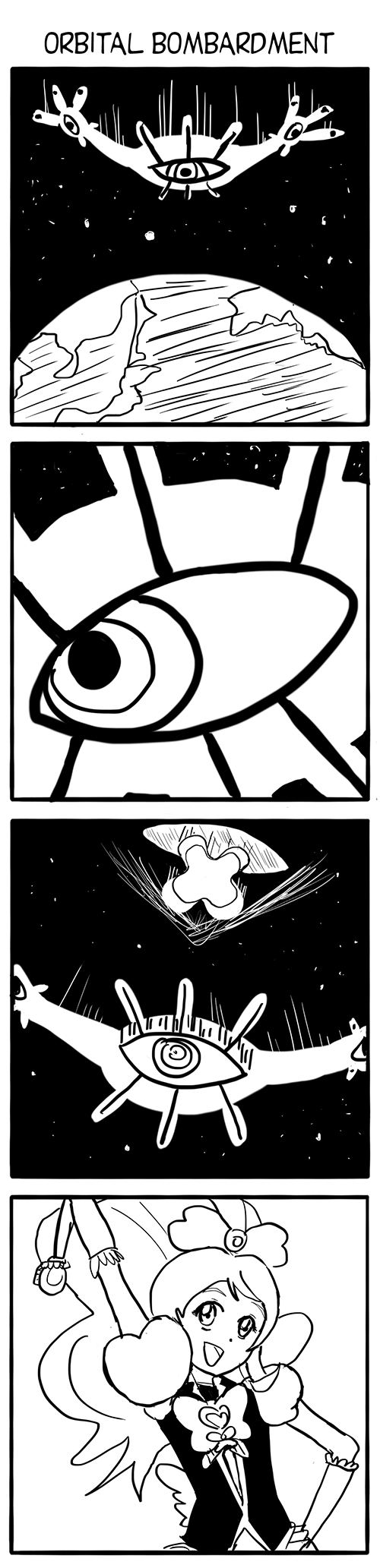
I’ve Been Wanting to Draw this Comic for a While

orbitalbombardment-small

They’re Better Than You: Dokidoki! Precure

If there’s one thing about Dokidoki! Precure that really stands out, it’s the characters.

You might be thinking, “But isn’t that true for just about every other Precure you’ve reviewed?” It’s certainly true that the characters tend to be a substantial part of Precure, and with its “enemy transforms people’s selfish desires into monsters whom the heroines must fight with the power of magic sparkles and martial arts action” premise Dokidoki! Precure is pretty typical for the franchise. However, with respect to its heroines, Dokidoki! Precure differentiates itself from its predecessors in that it really pushes the concept of its main cast as role models and targets of wish fulfillment. The girls of Dokidoki! Precure are larger than life even before they transform into magical girls.

Take Hishikawa Rikka, Cure Diamond. She’s a level-headed student council vice president, the best friend of main character Aida Mana, and the top student at their school. Her dream is to become a doctor, and the fact that she’s already studying medicine in middle school is pretty amazing. In terms of ambition and power, she’s already at a level higher than most previous Precure characters, who are usually just the ace of their athletic teams or club heads or whatever. She’s also in a way the least impressive of the Dokidoki girls.

Left to right: Kenzaki Makoto, Yotsuba Alice, Aida Mana, Hishikawa Rikka

Mana, Cure Heart, is student council president. She also gets high grades (though not as high as Rikka), and is sought after by all of the sports clubs because of her all-around amazing athletic skills. On top of that, Mana is relentlessly energetic yet cool under pressure, able to handle the work of ten people without breaking a sweat. Mana is perhaps the most effective leader in Precure history, and yet even she’s no match for Yotsuba Alice (aka Cure Rosetta), who is the kind-hearted heiress of a powerful business conglomerate, well-versed in a variety of martial arts, and is basically what you’d get if Daidouji Tomoyo mega-evolved into Batman (complete with badass butler). And even that arguably pales in comparison to Cure Sword, the last surviving warrior of a kingdom destroyed by evil and greed, who has escaped to the human world in the guise of Kenzaki Makoto, pop idol sensation, while bearing the burden of having to restore her fallen homeland.

All of the central characters in Dokidoki! Precure are outstanding beings, and the degree to which the anime is able to live up to that standard is essentially what dictates the strengths and weaknesses of the series. Dokidoki! Precure follows a pretty typical children’s anime pacing, where there’s a lot of episodic content and then a swell of story during the end of each approximately 13-episode chunk, and although there are plenty of episodes which explore the characters’ impressive qualities, there’s a sense that they could have done more. Alice is  the biggest example of this, as every episode about her ends up being amazing but are also few and far between. Similarly, I thought Makoto’s reverse-identity (her real name is Cure Sword) wasn’t portrayed with as much consistency as the concept could have handled.

Also I really wished they kept using the awesome bows from the middle of the series, perhaps the most impressive Precure toys ever in terms of giving young viewers the chance to wield things that look like actual weapons. …Maybe that’s why they went away.

I’ve seen some people be critical of Mana, saying that she overshadows the other characters, but I never found this to be the case. The issue isn’t that Dokidoki! Precure devotes too much to Mana, or that Mana is somehow too perfect to be a protagonist, but that many episodes are designed to be formulaic and self-contained to a fault. If you look at the episodes which are devoted to the greater narrative, they do an excellent job of pushing things forward, and by the end the story wraps up nicely with a conclusion unprecedented in Precure.

While I enjoyed watching every week, Dokidoki! Precure ends up being one of those shows which benefits from having a list of “important episodes,” especially because the show concludes very well in spite of some large plodding spaces in the middle of its run. At the same time, if you’re comfortable with kids’ show pacing, it’s not much of an issue. Dokidoki! Precure is reliable as an introduction to the franchise as a whole, while its different take on characterization can be refreshing for those already familiar with Precure.

PS: The first ending of Dokidoki! Precure is actually now my favorite Precure ED ever. Maybe it’ll be yours too.

Future News: Cure Heart Restores Pulse of Japanese Economy


precuredreams

A trailer for the new Precure crossover is out, and it reveals that they visit the Dream World where you get to live out your dreams. The above screenshot shows a bunch of the main heroines and their aspirations, and they’re mostly in line with what we know about them already.

  • Saki wants to be a baker, like her parents.
  • Nozomi wants to be a teacher, just like mascot sidekick/love interest Coco.
  • Love wants to be a dancer, which we see her work on throughout her series.
  • Tsubomi, who loves flowers, wants to be a florist.
  • Hibiki wants to be a concert pianist, which is part of her general character arc in her series.
  • Miyuki wants to create picture books, which is one of her defining features.
  • And last but not least, Mana wants to be PRIME MINISTER OF JAPAN.

I know everyone else’s dream jobs are cool and all, and full of effort and wonder and something we assume they’d be amazing at given their never-give-up attitudes, but I feel like Mana’s is on another scale. Of course, just like the others it’s an extension of her identity in her own series (Mana is class president in Dokidoki! Precure), but even so that is some serious ambition for a girl in middle school, or a boy for that matter. She’s even able to imagine being selected by the National Diet.

precuredreams-mana-small

The more I watch Dokidoki! Precure, the more I think Mana is probably the best true “leader” character out of all the protagonists in Precure. She’s not my favorite in her series or in Precure as a whole, but just from this trailer she impresses me even more. On some level, I wouldn’t be surprised if they actually end her series 30 years in the future and she actually is Prime Minister.

Strength in Precure

With its combination of cute characters, kid appeal, and detailed fighting scenes, the Precure metaseries is presently the most popular and prominent magical girl anime. Though each series has its own share of unique features, one constant that always impresses me is the approach Precure takes to showing strength in its heroines.

When it comes to depicting strong female characters, there is a lot of media out there which relies on some sort of conflict revolving around a character’s gender. Confronted with a sexist/condescending/ignorant adversary, the idea is that the girl then shows what she’s made of and proves her equality/superiority. This is not inherently a problem, and there are many examples out there which make such scenes empowering, but there are also many cases where this becomes lazy or uncreative shorthand for conveying “girl power” as a way of achieving the bare minimum of inspiration.

Precure completely circumvents this issue by depicting its heroines as capable in a way where gender doesn’t really matter. Villains will mock them for inexperience, or talk about how hopeless they are for struggling, but the fact that they are girls and not boys is never really considered. When confronted with the question of whether or not girls can be strong, Precure simply says, “Of course they’re strong, why is that even a question?”

The gradual building of inner strength and emotional resolve in Heartcatch Precure! is the obvious example, but let’s instead take a rather stereotypically feminine-looking character such as Kise Yayoi (aka Cure Peace) from Smile Precure! Yayoi can be described as a crybaby who’s full of enthusiasm but lacking in confidence, a point which the villains will constantly bring up to taunt her. In regards to strength, Smile Precure! does two things. First, it provides four other girls to show how crying is not just something girls “do,” but something specific to Yayoi as an individual person. Second, it has Yayoi prove that being a crybaby doesn’t mean you’re incapable, it just means you can be capable while also crying a lot. Even with a character such as this, where it wouldn’t be surprising to see a show  convey her as “strong, for a girl,” Yayoi’s gender is never the issue.

This is not to say that Precure is devoid of traditional notions of femininity, as other signature features are brightly colored frilly outfits and cosmetics/accessories-based merchandise, not to mention the rare romance. With respect to the potential and capability of of girls, just as there’s no need to spend time in a film or cartoon to show that the sky is blue or that fire is hot, this approach treats the existence of strong female characters as such an obvious non-question that it becomes capable of normalizing the very notion that girls are strong. Without the need to “prove” anything, it can tell stories without being bogged by the classic obstacle that is the gender-centered confrontation.

No-Smile Precure: The Transformation of Kenzaki Makoto

Recently,  Dokidoki! Precure revealed all of its main cast and their transformations. In seeing comments about them, I’ve noticed that the transformation for Cure Sword (pictured above), has received somewhat less fanfare compared to the others because it’s not nearly as fanciful as the others. When you look at the Makoto/Cure Sword sequence, it really does lack many of the flourishes of the other Cures, but rather than this being simply a less impressive transformation I do think that the simplicity both in the “camera work” as well as the small amount of details is intentional, as it gives a better sense of Cure Sword’s character.

curerosetta-outfit curesword-armsraised
(All gifs taken from http://lemedy.tumblr.com)

Cure Sword is different from the other Cures in Dokidoki! in that she is a seasoned warrior familiar with being a Precure. Just the fact that she stretches her arms above her head and lets the costume simply form over her is reminiscent of someone just putting on a standard and familiar uniform. When you compare that with Cure Rosetta’s playfulness and spring in her step as she transforms, it becomes especially obvious.

Makoto’s change into Cure Sword is thus rather straightforward. While other girls’ hairstyles bob and flow tremendously, Makoto’s barely does so. And where the other girls move as if they’re dancing while announcing their names, further giving that feeling of excited performance, Cure Sword slashes at the air, giving the impression of a serious fighter.

curediamond-posecuresword-slash

The thing that really differentiates the Cure Sword transformation from the rest of the Dokidoki! team is simply the fact that, unlike the rest of them, she has a glower on her face pretty much the entire time, only changing her expression into a smile during the final team pose. When put side by side with the other Cures, it really makes her stand out, and along with the lack of movement in her tranformation it becomes indicative of her more serious personality.

Makoto is not the first character in Precure to have a stern look on her face as she transforms, as Cure Moonlight’s features a similar expression, and much like Cure Sword, Moonlight’s transformation appears more efficient than the others’ in Heartcatch Precure! There is still a difference, however, and I think the key factor to consider is Makoto’s origin. When you look at the transformations of other characters in Precure, including Dokidoki!, it’s as if they’re undergoing a metamorphosis. Even when you look at the characters who are from other worlds like her, such as Milky Rose, Cure Passion, Cure Beat, and Cure Muse, they take on a new identity by transforming. Makoto, however, is simply returning to her true self. Rather than being a normal girl who becomes a warrior, she is a warrior who disguises herself as a normal girl.