Smash Bros. vs Traditional Fighters and What Lies at the Core of Fighting Games

Fighting games at this point are decades-old. While it’s debatable what can be considered the very first fighting game, what is indisputable is which game is responsible for popularizing the genre: Street Fighter II. That game, as well as all of its upgrades, are the standard by which all other fighters are judged, and it’s had a profound effect on how people discuss fighting games in terms of gameplay and strategy. However, if Street Fighter II is the archetype, there are a number of deviations from it, and one that’s become increasingly popular in recent years has been the Super Smash Bros. series.

Whereas in the past these two communities, traditional fighters and Smash, remained fairly separate (and one even unfairly mocked the other for not being a “real” fighting game), over the past year with the release of the latest Smash Bros. games, this has begun to change. One curious outcome of this has been that, when it comes to Super Smash Bros. for Wii U, a number of notable traditional fighting game community (FGC) members have taken to it, such as EVO Champion Infiltration and commentators Ultra David and James Chen, but it has also received negative attention from many players of Super Smash Bros. Melee, what is widely considered the most technical and mechanically difficult game in the franchise. The reason I believe this disparity exists is not only because of a difference in terms of the games themselves, but also a difference in how these respective communities have argued for what makes their games great.

The arguments made by many Melee supporters as to why it’s the superior game tend to revolve around the slew of difficult techniques that expand the range of possible moves available, as well as a heavier emphasis on free-form combos. The idea is that, while Melee is simple on the surface, being a game that was intentionally designed to be more accessible than the traditional fighting game, it in fact hides layers and layers of complexity. What might appear to be a game that is competitively limited due to its simplicity is in fact only the first step into a demanding realm of technical depth and discovery. Super Smash Bros. for Wii U lacks many “advanced techniques” and is slower-paced, and is therefore seen as an inferior game.

Perhaps this reasoning is a product of the way in which the FGC would dismiss Smash Bros. as a whole as “kiddie games,” but, whatever the case, this is the rhetoric that has been built up from Melee, that simplicity makes way for complexity, and that complexity equals depth. In the documentary The Smash BrothersMelee commentator Prog likens the difficulty of Melee to Starcraft, a game that is also known for its mechanical difficulty that leads to a wider range of options for a player, with the idea that this leads to a kind of expressive freedom (though it should also be noted that the documentary’s director, Samox, chose to include that in the first place).

EG|PPMD—recent champion of Apex 2015, the largest Melee tournament ever—shares this sentiment:

EG|PPMD: Melee allows me to express myself on a very profound level. I am not just playing the character, I am my character. I am not just playing against my opponent, I am communicating with that person deeply and getting to know them on a very personal level and conversing on that level with the game as a medium.

Said differently, the depth and speed of the game allow me to really bring myself out. Competition is also incredibly fun! I would be really surprised if another game gave me this feeling, but that would be awesome if it did happen.

In contrast, the most prominent arguments as to why traditional fighting games are great take the opposite angle. Traditional fighting games are known for being difficult to learn on the surface, due to specialized inputs (quarter-circle forward + punch makes Ryu throw a hadouken, while just hitting the “special move” button for Mario makes him throw a fireball) and complex combos, but the prevailing philosophies are of the mind that the ideal core of fighting games, what makes them really worthwhile and competitive, is a foundation of simplicity and elegance, and that this is what leads to depth.

While the above video is super corny, it reflects the lessons taught by great players such as Tomo Ohira, who is featured in that video and is often argued to be the first king of Street Fighter II in its earliest days. For another example, take the fighting game player turned game designer David Sirlin, who argues that what makes fighting games games truly interesting is the level of mental interactions that come from “yomi,” or reading the mind of the opponent. Others such as Ultra David have argued that yomi isn’t as important as developing and executing a strategy, but the emphasis is still on the idea that technical complexity should ideally make way for something more basic and fundamental. This is what drives Divekick, a stripped-down fighting game that attempts to get to the core of fighters by limiting players to two buttons and emphasizing spacing and reads.

Although what I’ve shown above are not universally held beliefs by either community, I wanted more to show that they exist and are prominent parts of each community’s identity when it comes to their games. I also don’t want to give the impression that the communities believe that complexity vs. simplicity and their relationship with depth is black and white in either direction, nor that the games necessarily reflect the philosophies described above 100%. Rather, it’s more about how people visualize depth, and why the idea of depth becomes so subjective.

As for why all of this matters, there are two points to consider as to why traditional FGC members might praise Super Smash Bros. for Wii U whereas Melee enthusiasts might look down upon it. First, much like Divekick, the Super Smash Bros. games with their simplified commands have already removed a surface layer of complexity, and to many experienced fighting game players this is seen as a positive. Complexity hides an elegance of simplicity and what makes fighting games truly beautiful. These players want to introduce this beauty to as many people as possible, and Smash Bros. allows this.

Second, while previous games in the Super Smash Bros. franchise were developed by its director Sakurai Masahiro with a team that was more experienced in other genres, Super Smash Bros. for Wii U was developed with the help of Namco, which is known for fighting games such as Tekken and Soul Calibur. Although there haven’t been any specific statements made on this matter, I believe that the development team, rather than viewing Melee as their template, looked more to conventional fighting games for ways to add competitive depth to Super Smash Bros. and that the mechanics of the new game reflect this. In discussions with Dave Cabrera, a friend and someone much more knowledgeable about fighting games than I am, he had a similar impression. Ultra David and James Chen also state how they find Melee to be a more momentum-based game similar to the also-unconventional Marvel vs. Capcom series while Smash Wii U is more positional, similar to Street Fighter games.

The result is a clash of perspectives. On the one hand, the Melee community, which has developed its conception for what makes a good competitive game based on Melee and the idea of hidden complexity, sees Super Smash Bros. for Wii U as lacking many of the elements that made Melee great, and that it is therefore a lesser experience. On the other hand, the fighting game community, which bases its standards for fighting games on Street Fighter II and the idea of hidden simplicity, has in this new Super Smash Bros. something that exemplifies that concept while also catering more to their tastes. Whatever the reasoning, it’s clear that there are two different philosophies at work driving discussion.

If you liked this post, consider becoming a sponsor of Ogiue Maniax through Patreon. You can get rewards for higher pledges, including a chance to request topics for the blog.

10 Tips for Using Mega Man in Smash Bros.

megaman-greenwhite

I’m not a super high level player, but I’ve dedicated a good amount of time to learning the intricacies of Mega Man as a character in Super Smash Bros. for Nintendo 3DS & Wii U. For those of you curious about Mega Man, or looking to use him as your primary character, here are ten tips you might find useful.

1) Mega Man is more durable than he looks

Mega Man may be small, but you might be surprised how much he can survive. He’s actually among the fastest-falling characters in the game, and above-average in terms of weight. This means he’s slightly harder to kill off the top of the screen than Ganondorf, and harder to kill off the sides of the screen than Mario. Combined with his tiny frame, it means that Mega Man can live for a pretty long while, and in this game the higher damage you’re at, the more knock-back your attacks have (this is often referred to as “rage”).

2) Mega Man is extremely maneuverable in the air

Mega Man moves very similarly to how he would in his source games, and it means that Mega Man is very “wiggly.” If you’re just using Mega Man exclusively you might not notice it, but pick a character like Marth or (especially) Little Mac and try to move back and forth in the air. It can feel like molasses compared to Mega Man. Because he also has a crisp second jump, the ability to act out of his Up Special, and high fall speed, it means Mega Man can quickly weave in and out while in the air. When combined with his heavy array of ranged weaponry, it can be a strong way to keep the opponent guessing.

3) Mega Man is a mid-range fighter, not a long-range one

The first thing you probably notice when using Mega Man is how many projectile-based moves he has. They occupy approximately 50% of his moveset, while other melee attacks such as the down tilt (Slide) and dash attack (Top Spin) are also designed to hit from afar by moving Mega Man forward. However, if you think you can stand on the other side of the screen and throw stuff at the opponent all day long, you’re in for a rude awakening. Not only do some characters out-range Mega Man (Link and Toon Link, for example), but his projectiles do relatively little damage. Instead, they’re best used as a means of getting close to the opponent, getting the opponent off of you, or covering your retreat, depending on what’s needed at any given moment.

4) Mega Man is about patience and slow, gradual damage

Related to the previous point, Mega Man is not a combo-oriented character, nor is he generally a heavy hitter. If you get too eager or brash with your movements, you will suffer because Mega Man doesn’t have as many tools for fighting at close range compared to other characters. Wear the opponent down with projectiles, grab and throw them as they’re trying to shield to get them in the air, and then, rather than expecting Mega Man to be able to immediately follow up with some ridiculously strong attack or long combo, use this time to improve your physical position relative to the opponent’s, or to gain a small lead. For example, slide into them as they try to land.

5) Pellets are your friend

Mega Man’s jab, forward tilt, and neutral air attack all mimic his basic attack from the Mega Man games, and while they do not pack much power they are extremely versatile. Pellets are very quick to come out, can neutralize most projectiles (including those reflected back at you), and can halt head-on approaches. It can also cover up some of his other weaknesses. When Mega Man uses his Up Special (Rush), for instance, he usually suffers some kind of cool-down upon landing that renders him vulnerable. One way to cover for this is to land while shooting, which offers you some projection. When fighting a character like Peach who possesses a strong ability in her signature float, you can shoot at her to keep her at bay, to damage her as she tries to retreat. Just keep in mind, again, that the range on the pellets is relatively short compared to your other projectiles.

6) Mega Man has only a few KO moves

Unlike a lot of characters, relatively few of Mega Man’s attacks are meant for outright finishing the opponent off. However, the few he does have can be extremely potent as long as you understand their strengths and weaknesses. Up Tilt (Mega Upper) is basically a shoryuken from Street Fighter: it’s quick to come out and can KO very early, but leaves Mega Man wide open to an attack if he misses. Back air (Slash Claw) is quick and reliable, but really only works as a final blow if the opponent is near or off the ledge. Down Smash (Flame Burst) is very strong but has a very small window of opportunity combined with long start-up and cool-down, which means it’s best used for punishing the opponent’s attempt to roll behind you. Up smash (Spark Shock) is quick, but lacks range and for a KO move is pretty weak. As for the last notable attack…

7) When it comes to Mega Man’s forward smash (Charge Shot), quality is better than quantity

I know that it’s tempting to use Mega Man’s charged forward smash to try and hit the opponent from a distance, but it’s actually not good for this purpose. The opponent can generally see it coming from a mile away, especially because it travels further the more it’s charged, and if you miss you’re very much a sitting duck. Instead Mega Man’s Charge Shot is best used intelligently. For example, use Charge Shot to catch an opponent rolling back, if they’re trying to recover after being knocked off the stage, or if they’re trying to land. This last one is especially important, because in this game if the opponent tries to air dodge too close to the ground they become vulnerable for a brief moment, perfect for a giant energy blast to connect with their face.

8) Mega Man is good at keeping his KO moves at full power

Smash Bros. has a system called “stale moves” where the more you use an attack the weaker it becomes, and the way to restore the power of your attacks is to use different moves. This is another area where Mega Man’s pellets shine. All of his basic Arm Cannon attacks all do low damage already so they are less affected by this system, and all it takes is a few rounds of fire to bring your other attacks back to their maximum potential.

9) Mega Man’s air attacks are great for air to air combat, but terrible for air to ground combat

Mega Man’s air attacks are all very potent against airborne opponents. Forward air (Flame Sword) and back air (Slash Claw) are both quick to come out, do not count as part of Mega Man’s body, and Slash Claw can even KO at decent percents. Up air (Air Shooter) and down air (Hard Knuckle) both count as projectiles and can finish the opponent off early in certain situations. However, with the notable exception of his neutral air mentioned above, all of Mega Man’s air options have long landing lag, which means that if he lands while performing an attack, it will leave him vulnerable. If you try to hit the opponent with a Flame Sword and they shield, for example, they can generally retaliate without you being able to do anything about it. This doesn’t mean you should never use them against a grounded opponent, but it should be as a punishment after they’ve whiffed an attack, or if you’ve tricked them into not shielding.

10) Metal Blade has  a ton of uses

This point could probably be expanded into ten different sub-points, but it’s important to understand just how versatile Mega Man’s Neutral Special (Metal Blade) can be. It counts as an item, which makes it unaffected by Stale Moves. It has different properties when fired as a projectile and when thrown, including damage (higher if thrown) and range (can travel eight directions if fired but only four if thrown). It can be used while Mega Man is running away. If you’re coming in from off-stage, you can fire Metal Blade to keep your opponent from coming after you. If held as an item, Metal Blade can be dropped instead of thrown; try using this against an opponent recovering onto the stage from below. Perhaps best of all, while the opponent can steal it from you, it means that as long as they’re holding the Metal Blade they don’t have access to their regular attacks, thus limiting their options.

I hope that this helps out you aspiring Mega Man players, either to look more closely at the character either or to start you off on your quest to defeating all of the proverbial Robot Masters around you. Keep in mind that these tips provide a fairly general overview of Mega Man, and that each point can be elaborated upon in much greater detail. I didn’t even really talk about the other special moves! Most importantly, don’t forget to have fun playing.

Smash Bros. and Games as Physical vs. Mental Competitions

Note: As is evidenced by some of my recent posts, I’ve been quite into the new Super Smash Bros. as of late, and have been participating in online discussions more because of it. Rather than keeping those posts in forums or on other sites, however, I’ve decided to also include them here as “supplemental” blog posts.

Taken from Smashboards:

I’m not competitive on the level of anyone in this discussion thread, but I wanted to post in here just because the direction of this conversation is one that I’ve seen fought a million times over in multiple competitive gaming communities. I’m not a game designer so I can’t say firsthand what works and what doesn’t, but what I mainly want to say is that it’s very easy to take a firm position on how competitive games “should be” but it risks inadvertently accusing others of making or even playing games “incorrectly.”

Sirlin usually comes up in these arguments because of his emphasis on yomi and how polarizing it can be. To simplify Sirlin for a bit, he believes that execution barriers are the devil and if we could all play with purely our thoughts and intentions games would be much better. Essentially, Sirlin wants games to answer the question, who is the superior thinker? It makes sense, but mainly if you see games as “brains over brawn.”A number of years back Sirlin took a class on Starcraft Brood War that was being given at a university, and from his perspective one of the issues with Brood War is how tedious the game is in terms of things you have to click to even play the game at a remotely decent level. I can’t remember the exact words, but he basically suggested something like a maximum cap to APM so that who presses buttons faster wouldn’t be a measure of skill. Instead, it would be about using your actions wisely instead of simply some people getting more opportunities than others. Naturally, the Brood War community disagreed. It loved the idea of APM as an execution barrier, or more specifically the combination of speed and precision needed to use it effectively. It separated chumps from champs, and when a great player is able to build his army so perfectly because he never misses a beat in his production cycles, it’s viewed as a thing of beauty.

We’ve heard it over and over again that fun is subjective. It’s the rebuttal that competitive Smash players use against the argument that they’re playing the game wrong because they don’t embrace the free for all chaos that Smash advertises itself as. It applies here too: different people get satisfaction out of games differently, and this includes competitive gaming as well. In other words, while Sirlin views games as a domain of the mind, some people like the idea of being able to defeat brains with brawn even in games. They like the idea that they can train up their “muscles”, and that, by being bigger, faster, and stronger too, even the most brilliant tactical mind in the world wouldn’t be able to keep up.

For some, mastering a frame-perfect 50-hit combo in an anime fighter sounds like the most tedious thing ever. You sit around, committing things to muscle memory, hardly a showing of your mental skill. However, for others, improving your ability to read the player and to think more critically in a match is too abstract a reward. Others still might believe that the true test of skill comes from managing luck and taking advantage of uncertainty, as in games like mahjong or Texas Hold ’em. Depending on where you fall between those two extremes, different games appeal to different people because of what they believe “competition” means. Bobby Fischer famously promoted a version of chess where starting positions were randomized because he believed that chess was becoming too reliant on memorizing openings, but it didn’t stick because, most likely, people on some level liked being able to improve by having superior memorization compared to their opponents (inertia from years and years of tradition was probably a factor as well).

I think the implicit disagreement as to how games should be competitive is what creates such tension within Smash Bros. itself. You have this massive clash of philosophies within a single franchise, and even within a single game. Putting aside the fact that Melee is more mechanically difficult than Smash 4 (as far as we know), and that this has created some dissatisfaction for players who believe the Melee way is the best, even Smash 4 itself has different philosophies behind its characters which can cater to different people’s idea of “competitive fun.” We’ve seen the argument that Sonic’s gameplay is degenerative because it forces the opponent to have to guess where he’s going to be and throw out moves in the hopes of catching Sonic, but there are people who love the idea of games as gambles, of having to shoot into the darkness because there’s a thrill in being able to more effectively navigate uncertainty. This isn’t to deny the frustration fighting Sonic can create, nor is it an argument that Sonic or any other character is balanced or imbalanced. Rather, it’s about the fact that different characters in Smash end up embodying different concepts of competitive play, and when they clash there’s always the chance that arguments of a character being bad for gameplay for being too simple or complex or whatever. It’s important to think beyond our own conception of competitive fun and to be able to see from the perspective of others.

Smash Bros. and the Desire to Learn Bad Characters

I’ve been playing quite a bit of the new Super Smash Bros., first for Nintendo 3DS and soon for Wii U. In both cases I waited in line along with millions of other folks with the intention of playing the game until the cows come home. In celebration of the true beginning of the 4th generation of Smash Bros., I’d like to talk about the idea of using “inferior” characters.

Whenever I see a comment that X or Y character is garbage, something compels me to try that character out. I don’t consider myself an exceptionally talented player, nor am I going to win any tournaments any time soon. Even if i were, I also definitely don’t think I will be responsible for revolutionizing any character’s style or for defying tier lists in a major way, like Taj did for Mewtwo or aMSa has done for Yoshi in Melee. Instead, I think what prompts me to start delving into seemingly weaker characters is that when I see others so strongly deny a character’s ability to compete, it makes me genuinely curious.

Is this character really as bad as they say? Is there perhaps some aspect to the character that may have been overlooked? While in the end they might very well be right and a certain character could end up being the bottom of the barrel, often times I feel as if there is some incompatibility between a player’s preferred style and a character’s attributes that could lead to a bit of wasted potential (even if that potential might not be particularly high). For example, I often see “this character has no combos!” on a character not built for combos, or using a very aggressively oriented character defensively or vice versa.

It’s like there’s something peculiar at work in the minds of players, at times unspoken philosophies which dictate how an individual approaches their game. Case in point, when players/commentators Scar and Toph discuss why Melee player Hax is not a Captain Falcon at heart due to his preference for perfect, impenetrable technical skill over relying on reading the opponent. I want to try and adapt myself to different frames of mind for different characters.

My current project is Meta Knight. He’s had something of a fall from grace since Brawl where he was the undisputed best character, but there are all these little aspects of the character that make me feel as if those who regard Meta Knight as terrible are perhaps missing something vital to the character. Of course, now there’s a patch and Meta Knight has gained some extra tools, but even before that I felt that while I wasn’t going to wow the world with my Meta Knight, as I practiced and saw more of his ins and outs, I honestly felt that it was possible to put all the pieces together and create a formidable opponent, or at least one who would put up a decent fight against all opponents. Now that he’s been augmented in certain areas (notably killing power), things will probably be easier.

This is less a point of pride for me and more a learning process. If you read this blog and are familiar with my anime and manga content, I think you might see this approach applied there as well. Of course, unlike anime and manga in Smash Bros. there’s really only one criteria for how strong something is (how often it wins), but I think that difference is sort of inevitable.

I’ll see you online!

Iconic Sounds in Super Smash Bros.

Super Smash Bros. for Wii U is coming out this week. While a lot of the fun of the franchise is its sharp gameplay and visual nsotalgia, one thing I find fascinating about Smash Bros. as a celebratory game is the fact that many of the sound effects are taken from the original games. When Mega Man shoots his Arm Cannon, it makes that characteristic pew pew noise. When Mario does his Super Jump Punch, he has that classic “boing” effect. If you know the sounds, they’re pretty nostalgic, and if you don’t, they probably seem as if they come from a bygone era.

Smash Bros. is certainly not the only game to do this. In fact it might very well be the Dragon Quest series which does this the most, as the same sounds for spells since the original game are still being used in every sequel. However, what’s interesting is more than just the use of those classic sounds, as there are also clearly decisions to not use those sounds as well.

For example, when Charizard uses its Flamethrower, it’s just the sound of fire spewing forth, and not the original Game Boy games’ crackling noise. Its nostalgia, arguably, is not located in that aspect. In contrast, Duck Hunt’s special moves are loaded with audible NES references, whether it’s the sound of a falling duck or a wild gunman shouting, “FIRE!” while garbled by primitive voice digitization. Here, it’s as if Duck Hunt is there to represent the NES Zapper line as a whole, and because the existence of the Zapper is tied to a specific era in video games, most of its sounds have not been updated, unlike Charizard’s. It’s also notable that the Pokemon have their voices from the anime, as it implies that their cartoon is the primary way by which Pokemon characters are associated aurally.

Of course it doesn’t mean much for gameplay whether the sound effects are modern or retro, but they do give a lot of flavor to the characters and the game as a whole. It’s easy to get the sense that, ah yes, this is the character I remember from my childhood.

Mewtwo is Back, Baby! Thoughts from a Mewtwo Fan

mewtwo-super-smash-bros-4

Back in 2008 when Super Smash Bros. Brawl was released, it was a bittersweet victory. While the new game was huge, and it had a ton of amazing new characters (King Dedede! Captain Olimar!), it came at the expense of one of my favorite Pokemon of all time and my favorite character to play in the previous game Super Smash Bros. Melee, Mewtwo. How cool was it that Mewtwo didn’t hold items with his hands but with his mind? How great was it that Mewtwo was voiced by Ichimura Masachika, his actor from the original movie and also the original Japanese Phantom of the Opera? I wasn’t depressed about his exclusion or anything, but I’d hoped he would be back next time.

Fast forward a few years to the impending release of a new Smash Bros. Not only did they announce another long time wishlist character of mine in Mega Man, but 2013 was a different time for Mewtwo. While it hadn’t really gotten anything new back when its position was essentially supplanted by Lucario, Mewtwo had developed further within its own games. It received the devastating Psystrike as its signature technique. It was upgraded to have two Mega Evolutions. It even appeared in a new Pokemon movie (albeit that Mewtwo was different from the first one). Surely Mewtwo had a chance now, right?

After another year, after closely following all Smash Bros. updates looking for any hints and being taken for a ride (the Greninja trailer not only makes it look like Mewtwo at first, but also conspicuously does not feature Mewtwo as part of the background Pokemon), the 3DS game was released and the final roster revealed. The bad news: no Mewtwo. I said to myself, “It’s not so bad, I at least got Mega Man, which in a way I’d hoped for even more.” And I’ve been having a ton of fun using Mega Man, getting used to all of his odd quirks. I also began using Palutena, who is sort of like Mewtwo. I was content.

Then came Thursday and the 50-Fact Extravaganza (not really 50). Mewtwo as DLC.

I freaked. Inside, that is. I’m not the type who loses all control of himself even in emotionally exciting times. The dream is real, Mewtwo strikes back, and he has a fancy new 3D model to boot. I have my most desired dual mains. The only thing left for me to do is buy a Wii U.

Now, given Mewtwo’s inclusion in Super Smash Bros. for Nintendo 3DS & Wii U, one question still remains in my mind: how will the game implement Psystrike? Will it be a Final Smash, or will that be reserved for one (or both?) of its Mega Evolutions? If it’s a special move, how would they translate the particular properties of Psystrike, if at all?

Here’s my idea. In the Pokemon games, there are different forms of offense, Physical Attacks, which are resisted by Physical Defense, and Special Attacks, which are resisted by Special Defense. Mewtwo in those games has long been famous for having an absurdly high Special Attack stat, and so the best way to combat it would be to use Pokemon with high Special Defense. However, Psystrike flips that relationship on its head. Instead, if calculates Special Attack against the opponent’s Physical Defense, allowing Mewtwo to more effectively attack opponents that it might have trouble with otherwise. While Super Smash Bros. doesn’t have Physical and Special stats, what it does have is horizontal survivability and vertical survivability. Mewtwo’s Smash rendition of Psystrike could play off of this distinction by having it be a vertical KO move but calculate its launching power based on the opponent’s horizontal survivability (or vice versa).

The easiest way to understand horizontal vs. vertical survivability is to look at some examples. Take Bowser vs. Dedede, for instance, where Bowser is generally the heaviest character in the Smash series without modifications and is thus the most difficult to KO off the left and right sides of the screen. Dedede, while also very heavy, isn’t quite as robust in this regard. However, try to take them out by launching them off the top of the screen, and Dedede lives longer. There are even more extreme casse: Samus is very difficult to KO horizontally but quite easy to dispatch vertically, while Fox and Falco are the opposite. Thus, assuming that Psystrike KOs vertically based on the opponent’s horizontal survivability, it would mean that the move is relatively ineffective against Samus but great for taking out team Star Fox.

I also decided to try and express these thoughts in audio, just as a fun test. Tell me what you think!

So in short, Mewtwo hype all around. See you on the Battlefield.

Smash Hype

I’m attending a midnight launch for the new Super Smash Bros. for Nintendo 3DS and of course I’m super excited. In the coming days, if you see a Mega Man on wi-fi called Nobie, that’s me. Let’s fight like gentlemen.

Speaking of Mega Man, I’ve already played the hell out of the demo. While this only gives me limited exposure to the cast and how they can fight against Mega Man, one thing I do want to say about the character is to not give up on him. He may seem awkward and clumsy at first, but it’s because he’s actually really counter-intuitive to how you’d typically play a character in Smash Bros. All of you aspiring Blue Bomber players, keep that in mind!

Approaching Smash Bros. Games on Their Own Terms

Over on the Smash Bros. subreddit a poster by the name of Revven made a post advising people not to go into the upcoming Smash Bros. games hoping to find the key aspect that makes it more like Melee (the competitive gold standard of the franchise) but to approach it on its own terms.

In order to help people understanding this point, I wrote up an analogy that’s turned out to be pretty effective, so I’m posting it here for posterity.

Imagine that Melee is pizza. People love it, it’s got all of this flavor and depth.

Then Brawl comes out and it’s chicken soup.

Obviously, a lot of people would prefer pizza over chicken soup, but then you hear some of the complaints: “What the hell is this? This tastes all wrong!” people declare. “I’m trying to pick up a slice but my hands just get all wet, and I try to eat it with a fork but I barely get anything!”

But there are people who are eager to “prove” that chicken soup is fine, and all it takes is finding and adding the right key ingredients. “Hey, it might be chicken soup now, but if we add some mozzarella and some tomato sauce, you’ll see that it’s great!” No matter what they do, though, it just doesn’t taste like pizza, it doesn’t feel like pizza, and people are disappointed in it even more.

In the end, it’s not wrong to like pizza more than chicken soup, and it might even be possible argue that pizza is a superior food in general. Hell, maybe Brawl wasn’t even a particularly good chicken soup and was just soup in a can. However, because people were unable to see or accept the fact that chicken soup isn’t pizza, they also failed to approach it on its own terms. Instead of trying to add the right seasoning that would match the flavor profile of chicken soup or using a spoon, all they had were hands dripping with broth, and a look of dissatisfaction.


Geno in Super Smash Bros.

smashbros-genomoves-small

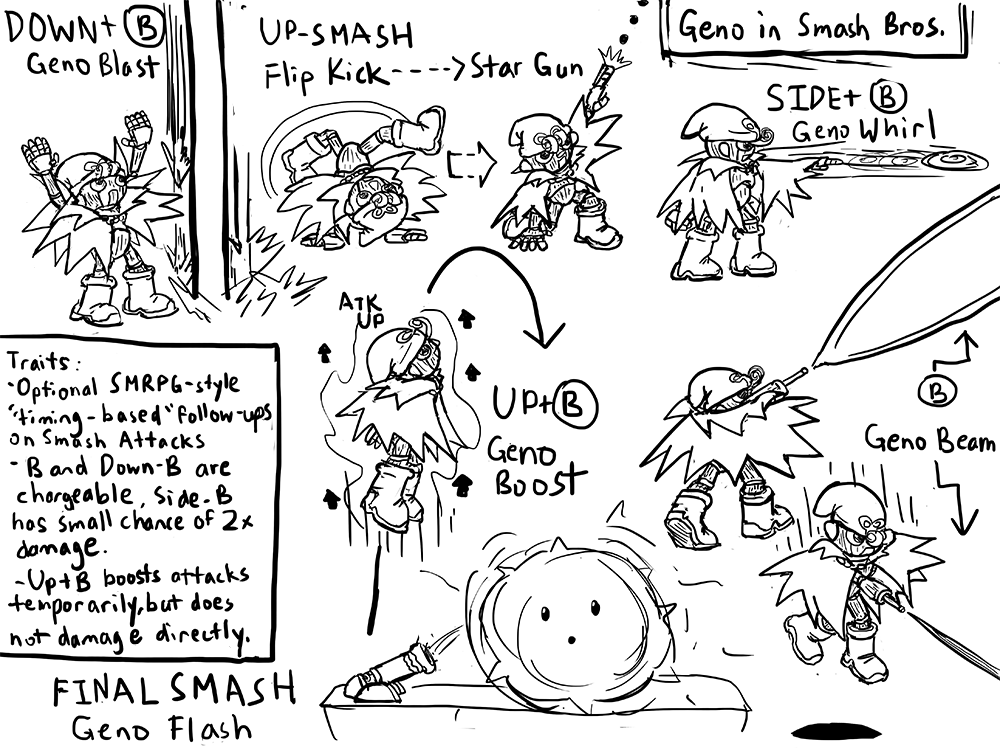
Geno is quite a popular choice when it comes to character requests for the Super Smash Bros. series, and so there is plenty of fanart out there in support of his inclusion. While this makes my drawing a bit redundant (and the special moves are all pretty much what everyone else has for Geno’s attacks), I felt that the concept of Geno as a playable character could be taken an extra step beyond simply having his moves map 1:1 with his Super Mario RPG techniques.

In particular, I had this idea that Geno could utilize the “timing” system from Super Mario RPG where pressing or releasing a button at the right time makes the characters’ attacks stronger in some way. This is demonstrated not only in the depiction of Geno Beam and Geno Blast, but also in Geno’s smash attacks. As shown with Geno’s up-smash, the idea is that Geno’s smash attacks have an additional secondary component that Geno can chain into, similar to Kyo Kusanagi in the King of Fighters series or Fei Long in the Street Fighter series. Because it wouldn’t be terribly strategic to have the follow-up be automatically better every single time, the secondary part of every Smash Attack would have its own strengths and weaknesses (like leaving Geno vulnerable if the first part doesn’t connect properly, or not hitting at the desired angle at high percentages), so it would be an active choice at all times whether or not to use the timed attack system.

Other than that, Geno would have two other main features. The first would be his space control due to the fact that many of his attacks are ranged and come in at odd angles instead of straight-on (Geno Beam shoots diagonally upwards on the ground but diagonally downwards in the air, for example). The second would be that Geno’s normal moves emphasize the fact that his body is that of a doll, so it is extremely flexible, as demonstrated in that up-smash. This would give Geno a lot of unusual hitboxes on his attacks or allow him to slip past attacks by suddenly collapsing low to the ground, for example.

Great Puma (NES Pro Wrestling) for Super Smash Bros.

smashbros-greatpumamoves-small

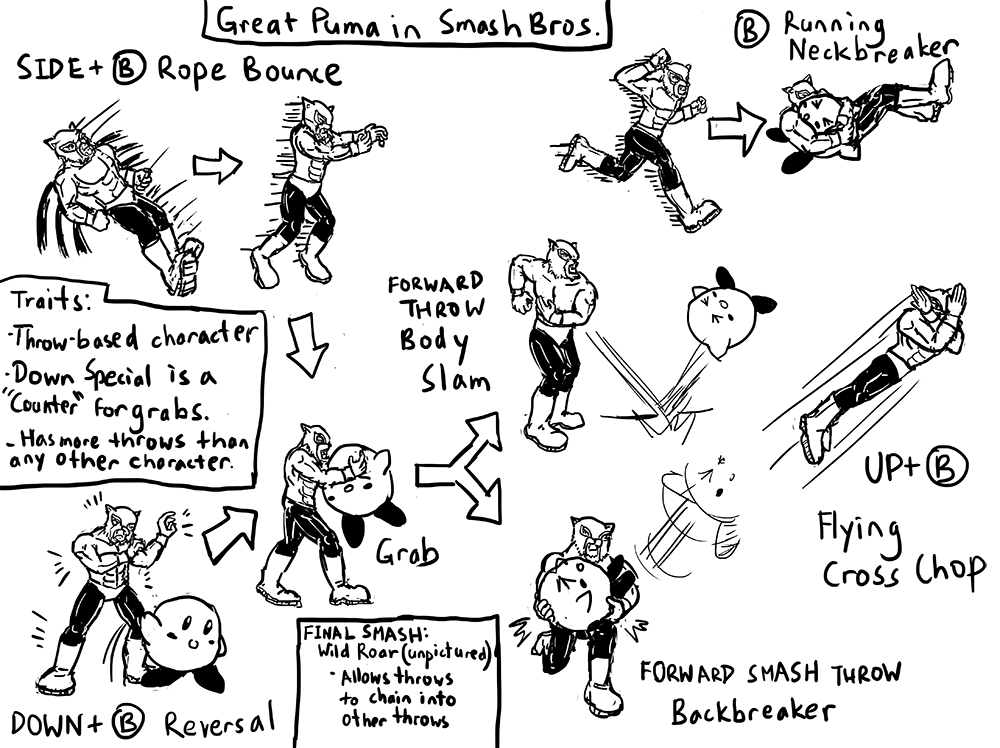
Unlike the previous characters I drew movesets for (King K. Rool, Princess Daisy), Great Puma is much more obscure. He’s the final boss from Pro Wrestling for the NES, and notoriously difficult, if only because all the button mashing you had to do to defeat him would hurt your thumbs (unless you used a turbo controller).

The reason I decided to draw Great Puma over the other wrestlers is because he 1) is a villain/antagonist 2) represents a popular retro series 3) has that final boss characteristic of knowing all of other wrestlers’ moves, which allows him to represent the full repertoire of Pro Wrestling. Kirby is depicted as the victim because I wanted to get across how the moves would look on someone distinctly non-humanoid.

As a Smash character, Great Puma specializes in holds and throws. He not only has more throws than any other character in the game, but he has two special moves that also facilitate grabbing the opponent. His Rope Bounce is sort of like a pseudo-wavedash in that it allows him to quickly retreat and then spring forward into a grab animation. His Reversal works like Marth’s Counter but it activates only when the opponent tries to grab him, which causes Great Puma to grab the opponent instead. Even his Running Neckbreaker is considered a throw, which overall makes him a difficult opponent to shield against. His Flying Cross Chop is surprisingly powerful but is only mediocre in terms of stage recovery.

His Final Smash, Wild Roar, allows Great Puma to link up to three throws together. This isn’t quite the same thing as a chain grab, as that involves grabbing the opponent immediately after a throw and then repeating. Rather, this allows him to do things like Grab -> Pummel -> Backbreaker -> Piranha Bite -> Piledriver before the opponent goes flying. Also not pictured are most of his moves, such as his back-air being Fighter Hayabusa’s Back Brain Kick (Enzui Giri) and his forward smash being Giant Panther’s Iron Claw.

I changed his tights because I think they just look better this way.