
Introduction: “Gattai Girls” is a series of posts dedicated to looking at giant robot anime featuring prominent female characters due to their relative rarity within that genre.
Here, “prominent” is primarily defined by two traits. First, the female character has to be either a main character (as opposed to a sidekick or support character), or she has to be in a role which distinguishes her. Second, the female character has to actually pilot a giant robot, preferrably the main giant robot of the series she’s in.
For example, Aim for the Top! would qualify because of Noriko (main character, pilots the most important mecha of her show), while Vision of Escaflowne would not, because Hitomi does not engage in any combat despite being a main character, nor would Full Metal Panic! because the most prominent robot pilot, Melissa Mao, is not prominent enough.
—
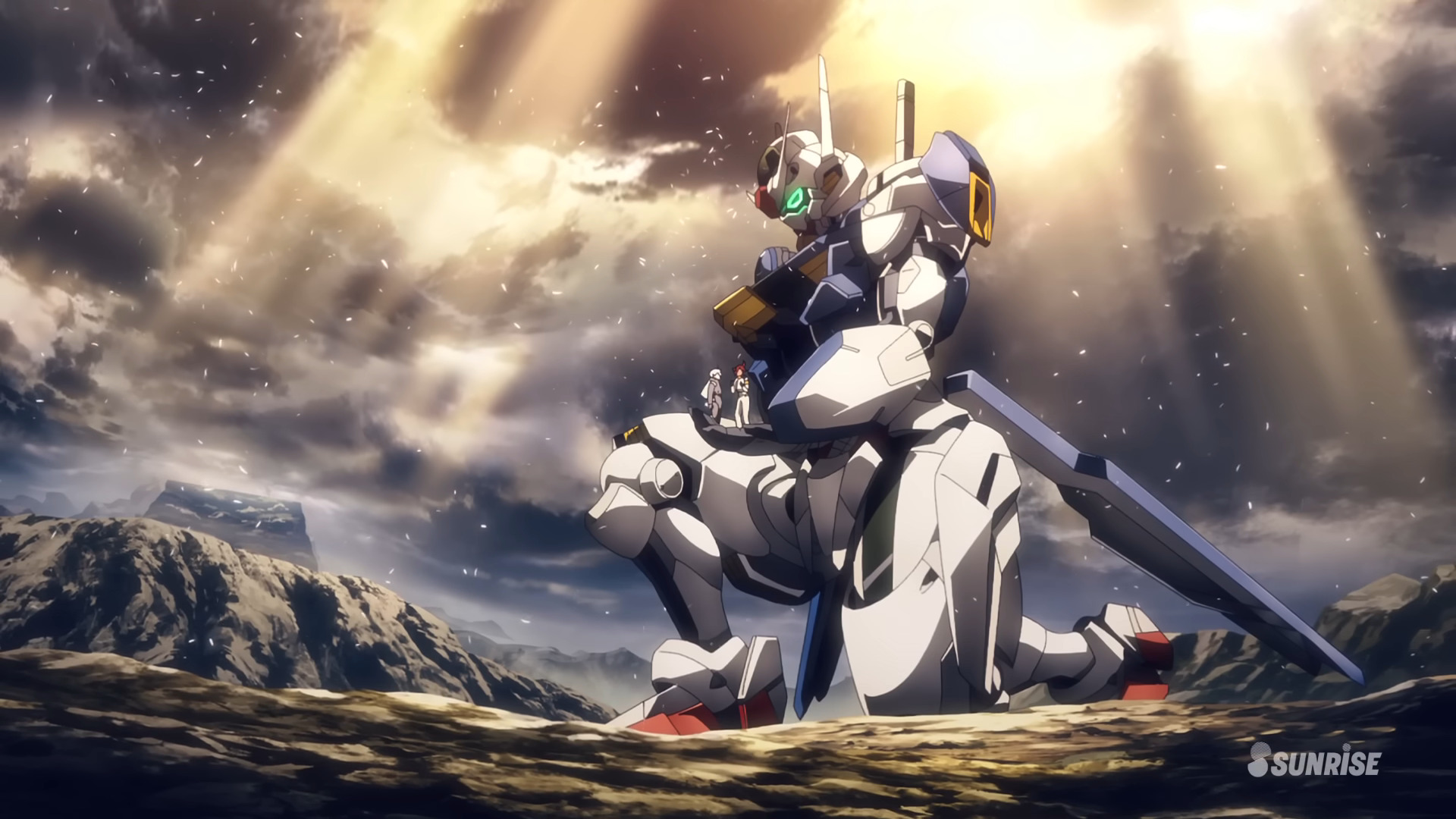
I truly believe that Mobile Suit Gundam: The Witch from Mercury will go down as a pivotal work in anime history. There are the surface reasons, of course: It has the honor of being the first mainline Gundam anime to feature a female protagonist with a same-sex primary romantic interest. It’s also the first main Gundam to be only 24 episodes when even the next shortest series still got 39. But the core of why I think Witch from Mercury is a game changer is that it ncludes many elements unfamiliar or in defiance of Gundam that manage to tell a compelling and thought-provoking story that carries both idealism and realism in its narrative.
Witch from Mercury takes place in a world where Gundams are forbidden, even though they were originally based on research to help people with disabilities. Years after the banning of Gundams and the seeming purge of all involved, a shy and awkward girl named Suletta Mercury arrives at Asticassia Academy, a mobile suit school for the elite where student matters are officially resolved through giant-robot duels. Suletta wins a match in her Definitely-Not-a-Gundam, Aerial, ends up engaged to the daughter of the school’s owner, Miorine Rembran, and in doing so inadvertently steps into the complex corporate, social, and political forces at play.
The anime starts off reminiscent of both Revolutionary Girl Utena and G Gundam, but ends its first half throwing the relatively isolated nature of Asticassia into stark relief with the world at large, whether it’s the crushing disparity between Earthians and Spacians, the specter of war and how the parents of all the kids have a hand in perpetuating military conflict, or the realization that Suletta’s naivete isn’t merely an innocent quirk but points to an unusual and possibly even disturbing past.

The second half seems to calm down, only to ramp up even harder and throw the established order into further disarray. Things that other series might have left linger for 10 episodes are brought to bear in a fraction of the time. The anime can actually feel pretty rushed as a result, but in certain ways, I think this actually works out in its favor. Gundam series often meander and plod as they get into the latter 25-ish episodes as they try to incorporate extraneous characters and merch-friendly elements, whereas this one cuts out a lot of the fat, albeit with some of the flesh as well. The outcome of all this is a Gundam where I would get genuinely surprised and shocked, especially in terms of character deaths)—feelings that were often missing from my viewings of Gundam anime that have come out in the past 15 years.
The characters, especially the women, are memorable and one the best parts of Witch from Mercury. Suletta is a unique protagonist, both in comparison to her Gundam predecessors and in general due to the way she has to grapple with her own upbringing and the way she ends up establishing her own identity. She takes the viewers on a rollercoaster of a personal journey that makes her position as first heroine much more than a cynical decision for the sake of diversity. Similarly, Miorine’s aggressiveness makes for a great companion and foil, and the way she navigates her privilege and her desire to do more for humanity is wonderful. And Suletta’s mom Prospera is not only the best Char Aznable in ages, but shows the quiet fury of a woman who will do anything for her child.
As for minor characters, there are plenty of examples regardless of genders. Chuatury “Chuchu” Panlunch is refreshingly no-nonsense in a way rarely seen in anime. Guel Jeturk, a rival/potential love interest of Suletta, goes from annoying dude to endearing guy—something that actually happens more often than not with the cast. A number of characters are on the larger side but are not treated as jokes. And while Secelia Dote only has seven minutes of screen time across the entire series, her snarkiness manages to steal the show every time. I could keep going.
One of the more amazing things about Witch from Mercury is how well it strikes a balance between having ubiquitous mobile suits and incorporating them into the story and setting. They’re also very aesthetically pleasing, particularly the Aerial. It’s identifiably a Gundam, but its proportions and flourishes give a slight feminine feel without going straight into Nobel Gundam territory. I also enjoy the way it contrasts with other mecha, as it makes the Aerial come across more something that will disrupt the status quo. Moreover, Aerial is also a rare instance of a mobile suit basically being a character unto itself—something that has serious consequences as the series progresses.

A common criticism of Gundam as a whole is that while it generally contains anti-war messaging, the cool factor of the mobile suits can end up drowning it out. Although the designs in this particular series are indeed among the best ever, Witch from Mercury is also the first to establish that the technology did not begin as a military endeavor, and this helps throw the use of mobile suits as weapons into stark relief. It’s also part of a greater look at the inequalities and inequities suffered by those who lack the financial and familial might to make the world care—a world where even the children of those in power feel the burden of having to deal with their parents’ bullshit.
On that note, corporations play a major role in the series, and I’ve seen people get extremely confused with all the different alliances and factions. While I won’t say it’s simple to keep track of everything, one way to navigate that web is to understand that many adult decisions are the result of corporate greed, and trying to find positions to have the best profits with the least accountability. This is what makes Miorine’s ultimate decision all the more satisfying, as she throws that structure off kilter using the means available to her. Gundam series often feature politics because of how they take place on grander scales.
These two elements together help Witch from Mercury’s politics feel very contemporary and relevant to our times, instead of coming across as dated or tepid.
Witch from Mercury brings a new sense of what Gundam can be. It possesses many of the franchise’s well-worn tropes without being beholden to them. It breaks boundaries of all kinds, whether through its unique cast of characters, its central same-sex romance, or its perspectives on conflict and humanity. I truly feel that what we have is a turning point in Gundam and anime as a whole, and I’m hopeful it’ll be for the better. Suletta is the first main Gundam heroine, but she won’t be the last.











 OGIUE MANIAX