
Tamon’s B-Side is a shoujo manga that first got on my radar because it received praise from hololive VTuber La+ Darknesss. She’s an extremely prolific reader of manga, and even if our tastes don’t necessarily align, I know I’m in for an experience, and I decided that the anime adaptation would be a reasonable way to see what the series is all about.
What I did not expect is for the premise of the series to make me think about a fairly involved philosophical question: What should you consider “the real you”?
The story follows Kinoshita Utage, a high school girl who’s a big fan of the male idol group F/ACE (pronounced “face”), especially its center, the impossibly handsome and suave Fukuhara Tamon. To her surprise, she’s assigned one day for her part-time work to housekeep for the real Tamon himself, only to discover that the confident ladykiller he appears to be in public is nothing more than a facade, and that he’s actually a nervous wreck prone to self-derision when not in “performance” mode. Utage is such an ultra-fan, however, that she refuses to let anyone badmouth Tamon—even himself. Over time, she gets to know the other members of F/ACE as well, which includes their own “inner selves.”
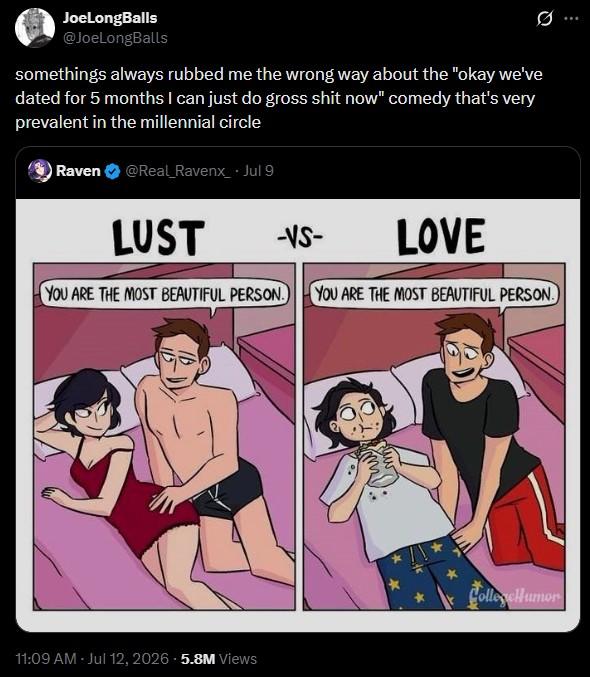
Not long after I started watching the anime, I saw a person on social media reacting to a piece of a comic called “Love vs. Lust.” Apparently, the comic and the above reaction drew so much attention that they’re both featured on Know Your Meme.
While the comment is an attempt to dunk on millennials, I think the poster’s implied values make for an interesting discussion, and also map onto Tamon’s dilemma very well. In front of outsiders, he’s an incredible talent brimming with confidence, but behind doors, he sees himself as the very opposite. And yet, all that talent and ability he displays in public are undeniably products of his own talent and effort. It’s also not uncommon for flamboyant performers on stage to be much more quiet in private, e.g. Freddy Mercury.
We live in a world where even regular people try to create a “brand” for themselves and curate their own image. This can easily make one’s outward image an endless cascade of smoke and mirrors, and for the unadorned self to be rejected in a sad and unfortunate way. But what if someone lives in a situation where their core being is denied by those closest to them, and it isn’t a place where they feel “at home”? What if their main way of finding their true selves comes from a social media account, or even going into chatrooms in the year 2000 and talking with people sharing the same hobby? How does this interact with a topic like sexuality or gender or gender dysphoria?
Tamon, with his two sides, is like a “safer” version of these topics. And the fact that Tamon goes back and forth means it’s more like asking what if there were two Ships of Theseus where both were 50% old and 50% new parts.

