Cross Counter: Genshiken II, Chapter 68

Last month, we were promised a chapter with Yoshitake in the spotlight and Chapter 68 delivers in spades. We learn a lot about Yoshitake’s personality, her family, and even her deepest, darkest secret!!! Suffice it to say, a lot happens, so there’s more to talk about than usual, so you’ll have to forgive me if the following synopsis is wordier than usual.

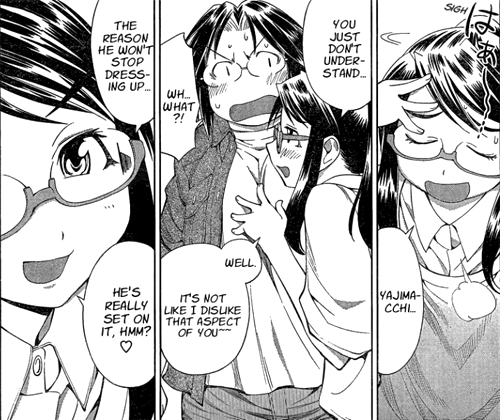
When a couple of guys enter the Genshiken club room in an effort to hit on Hato, and the only senior member available is a spineless coward (Kuchiki), all seems lost until a tall and striking figure appears and shoos them away. The man turns out to be Yoshitake (Rika)’s brother, Rihito, and we learn the following about him: he is one year older than Yoshitake, attends a different university, and is an otaku (also apparently a shotacon). Yajima is completely smitten by this knight in shining armor, which Yoshitake picks up on immediately and uses to tease poor Yajima in subtle ways.

It turns out though that the guy who’d been hitting on Hato (and who had been asking about “the girl with the long brown hair” back in Chapter 60) is a member of the student government named Harima. Harima’s boss, a serious-looking man in glasses named Mikami, is concerned with the fact that this brown-haired girl no one knows has been seen around Genshiken since the start of the semester. There are strict rules against non-students attending, and Hato, though he is of course a student at Shiiou University, is fearful of having his secret revealed. Harima interjects and convinces Mikami to let him handle it.

Harima tries to clear up the misunderstanding about himself with Hato, except that it wasn’t really a misunderstanding and he actually was trying to hit on Hato after all. The awkward situation is only exacerbated when Kuchiki runs in for the “rescue” and is immediately choked out (again) by Hato. Harima is scared off, and Kuchiki falls unconscious with a smile on his face, though in the process inadvertently places his hand on Rihito’s chest. This in turn generates a decidedly feminine response in Rihito, who reflexively recoils away with a yelp, revealing an elaborate charade.

Yoshitake Rihito turns out to be Yoshitake Risa, Yoshitake’s younger sister who attends an all-girls’ high school and is a member of the school’s basketball club (but still actually a shotacon). Risa is a senior and was checking out Shiiou University as a prospective college, when Yoshitake decided to use the fact that Risa is often mistaken for a boy anyway to pull a prank on the others in Genshiken. However, Risa inadvertently reveals that her older sister is older than she seems. Yoshitake, though a freshman in college, is in reality 20 years old due to a combination of having failed the entrance exams the first time around and having an April birthday (the Japanese school year starts in April), and is the reason she was able to buy all of that alcohol back in Chapter 58 without any hiccups (20 is the legal drinking age in Japan). The chapter ends with the first years + Risa drinking over a discussion of the pairing between Mikami and Harima.

With all of the new character introductions and particular displays of characterization contained within Chapter 68, there is a lot to think about, more than even I’m going to talk about, but let’s begin anyway.

As has been pointed out by Japanese blogger Tamagomago, Yoshitake is very socially savvy, and nowhere has it been more obvious than in this chapter. Probably the best example of this is the fact that she is able to immediately pick up on Yajima’s attraction towards “Rihito” because of how Yajima keeps looking away from the older younger Yoshitake sibling. One might say that it’s as classically obvious a signal as possible, but stuff like this can be surprisingly difficult for nerds to pick up on. While Yoshitake isn’t quite on the level of Kasukabe or possibly even Keiko in terms of perceptiveness, she is still far greater than the average otaku. Sasahara may be considered the “normal” otaku to an extent, but I can’t help wondering if Yoshitake deserves that title more, though its meaning changes when applied to her. On the topic of siblings, this is the first familial relationship we’ve seen since Sasahara and Keiko, and in looking at the interaction between Yoshitake and Risa with a bit of hindsight, Yoshitake really does act like the older sister. This is shown in the way she hits Risa, and how Risa appears to be completely used to it.

When I first saw “Rihito” I thought to myself, “So this must be where Yoshitake gets it from.” It seemed that Yoshitake simply had a good role model who made it look perfectly all right to be an otaku and that it didn’t have to affect your attitude or wardrobe. However, the truth turns out to be far more interesting, as the more likely scenario, given what we know now, would have Rika being the model responsible for Risa’s success in balancing a life of exciting high school basketball competition with one of rampant otakudom. Yoshitake makes being otaku look cool and normal, and it has an admirable effect on her younger sister and her generation of fandom.

Speaking of basketball, Risa makes me think of that fateful scene from Volume 5 where Ogiue tries to explain away her attendance at a Scram Dunk BL event by claiming that she has a younger brother who’s into basketball. I wonder how Ogiue would react to seeing “Rihito?” How quickly would her mind race in order to conjure up dangerous situations for Risa? Actually, Ogiue doesn’t even make an appearance this chapter, so I have to wonder if Yoshitake is going to try to pull a fast one on her (and the other absent members) in the near future.

Risa’s character design is quite interesting in that generally when you have a crossdressing female character in anime and manga, they tend to still look very feminine regardless of the clothing (Mayo Chiki), and even someone like Fujioka Haruhi from Ouran High School Host Club, who can pass for a guy fairly well, is still smaller than the men around her. Risa, on the other hand, even when her secret is revealed and she stops acting “manly” (an act which I think was clearly modeled on bishounen characters in the manga she reads) doesn’t just suddenly look like a girl. Her mannerisms do change to an extent (her body language differs and she begins to use her older sister’s signature -ssu in her speech), but she’s still quite different from what you’d typically expect out of a crossdressing female character. Her height helps with this of course, being one of the tallest characters in Genshiken and dwarfing her older sister. The fact that she’s so tall also puts a bit of a spin on the fact that she’s a shotacon, though I’m not exactly sure how.

I’d also like to point out how Risa and Harima in this chapter mirror each other somewhat. Both are assumed to be one way at first (Rihito is a cool dude, Harima is a sleazebag). Then the truth comes out (Rihito is Risa, Harima is a member of the student government), but it turns out that there was a grain of truth in the lie (Risa is into shota after all, Harima was actually trying to get with Hato). One of the trademarks of Kio Shimoku is having his chapter titles (“Your Name is?” being 68’s) mean more than one thing, and this parallel showcases that aspect of his work.

As for Yoshitake’s dark secret (being 20 years old), I think many of her fans are probably breathing a sigh of relief that it didn’t turn out to be anything more serious. As it stands, Yoshitake is not cheerful to compensate for something else, she just is that way. That she was embarrassed of the fact that her behavior isn’t stereotypically befitting of a 20 year old shows that she indeed aware of how things are “supposed to be” but willfully flouts them anyway, and at the same time also shows that she’s not invincible in the way perhaps Kohsaka is. She’s concerned with what others might think about her, but not too much. It adds a nice dimension to her character that we knew was probably there, but weren’t quite sure what form it would take.

The last thing I want to talk about in the chapter is Yajima’s reaction towards “Rihito” because I think it perfectly captures the feeling of the nerd crush, complete with the fact that Yajima clearly felt that he was out of her league. In that respect, it feels different from the other attractions we’ve seen in the manga in that Ogiue’s, Sasahara’s, and Madarame’s had the awkwardness that comes with familiarity, and Kasukabe thought herself on the same level as Kohsaka. Yajima also has to contend with her own personality in that instance, so the embarrassing nature of that moment for her comes not just from body image problems but also that she has set herself up to be kind of a “cool” character. It reminds me of Yajima’s introduction to Genshiken where she tried to pass off her interest in the club as something kind of casual, and the emotional confusion this whole situation has caused for Yajima is surely going to be a fun thing to explore.

So there we have it for Yoshitake’s first-ever chapter with internal monologue. Next chapter continues the drinking party, and I hope we get to learn more about everyone, as much as we’ve learned already. The next chapter quote is taken from Mawaru Penguindrum, which is to say, watch Penguindrum for more sibling hijinks (also penguins).

The End of Kaiji 2 and…Akagi???

Kaiji 2 has ended, and while I won’t spoil any of the things that happen in the show, I want to point your attention to a particular moment in the final episode.

Here you have what looks to be a bunch of messages from artists/staff members/etc. with stuff related to Kaiji. But take a closer look up above.

Two Akagi images! And not just that, but the drawing on the left has some writing.

アカギ再び!!

or

Akagi Once Again!!

Is that a message of desire, or is it a hint of something to come?

I don’t want to get my hopes too up, but the possibility is there…

I was also amused by this:

The Dynamo of Nidaime, Yoshitake is Really a Charming Girl

Translator’s Introduction: This is another post by Japanese blogger Tamagomago about the new Genshiken series that is currently running in Japan. This time, the focus is on the new character Yoshitake Rika.

The original post was actually written back in June, which means that the contents of the post do not take into account any events that have occurred past Chapter 65. Just the same however, the most recent chapter, 68, focuses heavily on Yoshitake, so before you read the latest chapter I hope you take the time to read Tamagomago’s article first.

Like the last translation, I have used translated images in place of the originals because the text contained in them is mostly relevant to the points being made, and the images are larger because of the difficulty in reading shrunken-down English text.

———

The Dynamo of Nidaime, Yoshitake is Really a Charming Girl

My article “The Appearing and Disappearing Wave of Generational Change in the Meaning of ‘Fun’ in Genshiken II Volume 1/Genshiken Volume 10” has been translated into English.

Thank you! I am very fortunate to have this.

Now then, my initial feelings while reading Genshiken Volume 10 (Genshiken Nidaime Volume 1) were about the sense of distance Madarame and Yajimacchi have towards “how otaku have fun,” as can be seen in the article above.

Is it all right for me to like this stuff? How much is it okay for me to open up? As I get older, will the nature of my passion change? And so on. If the first part of Genshiken starts with “coming into contact with otaku culture,” then the current Genshiken is about the extremely wide age gap between the employed otaku, like Madarame, and the freshmen, Yajima, Yoshitake, and Hato.

Don’t make light of that, five years makes for quite a difference these days.

With that said, this time I’m interested in Yoshitake.

This is from Volume 10.

The three newcomers are characters who are extraordinarily bold and rich, but Yoshitake is something else. By the time she’s reached Genshiken, she openly refers to herself as fujoshi, will say “oink”[1] without batting an eye, and wholeheartedly pursues the things she enjoys. She’s a hyper, out-of-control, super express girl.

As you can see, her way of not hiding anything and showing her true otaku disposition to others is really a lot of fun to watch.

So, I talked to a friend of mine who really loves Yoshitake and we had a discussion regarding the topic of, “Just what kind of role is she going to play?” Then I jotted down the resulting notes.

The Glue that Holds Everyone Together, Yoshitake

Last month’s cover is magnificent.

Look at this!

This image makes it clear that the one who connects the individualistic wills of Hato and Yajima is actually Yoshitake. This confirms it.

No matter how you look at it, with the all-too-conspicuous foreigner otaku Sue and the girl-boy Hato, Genshiken right now has an unusually thick, bold flavor. Yoshitake is also worthy of being considered a bold character, but is something like the average between the others.

While Yajima is more plain, her complexes and irritations are expressed to such a painstaking degree that she instead stands out as a character with whom it’s easy to empathize. That she doesn’t put any effort into fashion also makes her stand out.

Yoshitake is fashionable.

You can’t really say she’s “extremely fashionable,” but I think you can at least say she’s “fairly fashionable.” Even dressing casually, she wears clothing that matches her own figure and style to a certain extent, and she has a new outfit on every time she appears.

Red and bottom-rimmed, even her glasses are fashionable. There’s a big difference between hers and Yajima/Madarame’s; the two of them would just say “All that matters is that they work.”

But while she is fashionable, she isn’t really on what you’d call the cutting edge of fashion, and her attire reflects this quite splendidly. Her subtle, child-like clothing choices are also rather charming. You could say that she’s like a Mori Girl[2], but that doesn’t quite feel right. How can I put it? It’s like she’s still comes off as otaku… but she’s also fashionable… Argh! Whatever, I’ll leave this to someone who actually knows about fashion.

(PS: After consulting a friend, we determined that her style is probably Daily Casual. You can see it at Konshuu no Osusume|tiptop blog.)

Most of all, while I don’t know how to distinguish her style of dress (let’s name it “Yoshitake-style!”), she seems to recognize herself as a so-called “loli-faced character.”

When it comes to the extreme difference between those in Genshiken who care a lot about their attire (e.g. Ohno and Hato, people for whom their clothing is a part of their personalities) and those who couldn’t care less (like Ogiue, who doesn’t care about a lot of things), the middle point between them holds some value.

So then, is Yoshitake’s personality also average among Japanese people? Actually, it’s more like she stands out, but only just a bit.

First of all, her seeming inability to “read the mood” is beyond top class.

But then, I suppose she’s a character who actually just fakes her inability to read the mood, and that she’s instead using her top-notch social sense to liven things up.

It’s complicated, isn’t it? She’s especially similar to characters like Mugi-chan from K-On! and Erika from Heartcatch Precure.

Using all of her power to maintain “fun” and to connect everyone together, I think that’s what Yoshitake is all about.

Yoshitake’s Recent Appearances Have Been All Fun and Games

This month’s cover image connects with last month’s cover. It’s quite nice, wouldn’t you say?

This month’s Afternoon features a Doujinshi Event, and the comic drawn is essentially “All of the Genshiken members cosplaying.”

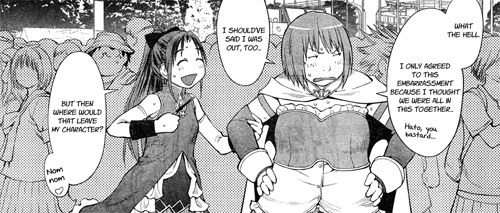
Homu Homu Ohno, Mami-san Angela (not-Genshiken), Sayaka Yajimacchi, and then Kyouko Yoshitake and Kyubey Sue.

Hato was probably supposed to be Madoka. Ogiue got sick last month and had to bow out. Kucchii is a salesboy.

For everyone in the club to cosplay together like this is in itself rare, but if Ohno doesn’t exercise her influence at an event, then it can’t possibly happen in the first place.

So then, what I want you to see is this.

From beginning to end, Yoshitake makes only a brief appearance (because the main focus is on Ohno and Angela), but you can see that she’s smiling the entire time that she’s cosplaying.

The sweat is probably because it’s hot.

Indeed, this girl really enjoys herself.

Yajima has a body image complex and so must have not wanted to cosplay.

And yet, there she is. It’s a bit surprising.

I mean, if she really were against it she would have rejected it, right?  But then she says, “I only agreed to this embarrassment because I thought we were all in this together.” Actually, this “Madoka Cosplay” became a topic of conversation on the internet. Not only that, Yajima winds up cosplaying the most scantily-clad character, Sayaka.

…This is one of the things that makes Yajima cute.

Let’s put that aside.

The reason Ogiue and Saki-chan have already cosplayed is that Ohno pushed and pushed and got turned down, and finally got them to dress up, but with Yajima, she does so surprisingly without making any fuss.

Huh?

The first thing I felt was that perhaps the bar is lower for this generation when it comes to “cosplay.”

It’s not anything special, but by comparison is instead recognized as just one way among many to play around.

But even so, Yajima should dislike cosplaying.

That’s where Yoshitake comes in.

“But then where would that leave my character? Nom Nom.”

Yoshitake is always, always with Yajima. Here, her good qualities come to the surface.

It’s likely that not just Ohno but Yoshitake also encouraged Yajima to cosplay.

I don’t have a particular reason for using thinking in the following way, but if you can say that the two of them are good friends, and that they’re always together, then it’s quite simple.

Moreover, they must be aware of the pairing of Kyou-Saya.

Let’s take another look.

Hato, worrying (?) about Madarame, splits off this time to be a salesboy. Yajima of course feels something along the lines of, “Why that jerk, running away from this,” which brings about her complex, but Yoshitake pacifies Yajima when she’s in that state.

First, she says that as a pairing cosplay, she would be in trouble without Sayaka.

Next, she suggests that Yajima should find this good for Hato-chan, when one considers how Hato is acting.

That’s right. Let’s look things over.

  • Yoshitake, from the bottom of her heart, has fun cosplaying with everyone else. That she also prepared Pocky for it is really nice. Could it be that the title image for Chapter 59 was foreshadowing?!
  • Yoshitake understands Yajima’s objections, and knowing them is thus able to follow and respond. She doesn’t just ignore it.
  • Yoshitake really understands Hato’s complicated feelings, and cheers him on. She of course does the same for Madarame.

Yoshitake is amazing.

That girl, she’s capable of going along with everyone, and she has a lot of fun while doing so.

Whereas the others up until now have dressed poorly, possessed complexes, experienced trauma, and tried to escape from the world, she’s a little different.

I can feel strongly her desire to have as much fun as she can while considering everyone’s feelings.

At this point, the notions I want to entertain in regards to Yoshitake are, “Just what are her shortcomings,” and “Does she have any problems at all?”

However, to think that her cheerful behavior comes from some kind of inner suffering is perhaps an outdated way of thinking about it? At least, that’s how I’m feeling.

When I asked a friend who likes Yoshitake, “What do you like about her?” he said, “I like Yoshitake because she enjoys the things she likes.”

Ah, I get it. I really do. It has almost nothing to do with her “being an otaku.”

If Yoshitake’s hobby was film, then she’d be a film maniac. If she liked soccer, then she’d be playing soccer.

It just so happens that she likes anime, manga, and BL. That’s why she has fun as an otaku.

Whichever she chooses, she’ll definitely be showing a smile on her face.

She’s not just having fun without any care in the world.

…No wait, that might be an incorrect way to phrase it. She’s definitely carefree, but it’s not like she doesn’t think about anything while she’s having fun.

After thinking about how she should have fun, whether it’s all right to be enjoying herself, and whether she’s being a bother to other people, she consciously tries to have the most fun that she possibly can.

This is the scene in Volume 10 where she enters the club. Right from the beginning, she accurately confirms whether or not liking BL is OK there.

It’s very interesting that she states so plainly, “If it’s NG [no good] then I’ll stop [coming].” In other words, in confirming whether or not the things she likes are okay in there, it shows that she came there looking for a place where she could pursue enjoyment.

She wasn’t relying on escaping or anything, she was being active.

Another friend was saying to me that what she really meant was “If it’s NG then I’ll stop [talking about BL].” If that’s the case, then that’s also amazing.[3]

I might even say that if “BL being NG” means that she would find another way, then that would be the ultimate form of being able to pursue fun.

Therefore.

She’s able to make close friends, and my friend thinks that she has like the greatest smile. That’s why he loves her.

“Yoshitake, has fun doing the things she likes.” Indeed, that’s also why I like her so much.

To have fun doing the things she likes with such firmness, and to even be able to say that she likes it, is truly what makes her so charming.

Yoshitake and Yajima

In the work itself, things are often drawn from Yajima’s point of view, while Yoshitake’s feelings aren’t drawn all that much.

That’s why Yajima can be seen as incredibly cute, but still I’d like to see Yoshitake a bit more.

Yajima’s spirit is filled to the brim with mud.

However, it’s completely different from what’s inside Madarame, Kugapii, Ohno-san, and especially Ogiue, who is an extreme case. She doesn’t have an inferiority complex over being an otaku. She professes her interest in BL, too.

She’s unable to outright talk about her figure. It’s an incredibly vague complex to have, as a human, as a woman, and perhaps more.

That said, it’s clear that it hasn’t turned into hatred.

Currently, she’s enjoying Genshiken. No, it’s more like, she’s able to enjoy herself there.

Here is where I think Yoshitake has an enormous presence.

It’s possible that even if Yoshitake weren’t around, Yajima would have still gone into Genshiken. She possibly would have helped out with Ogiue’s manga as well. She would have probably had fun doing so.

However, that Yajima is able to be in the prime of her youth (it IS the prime of her youth, right?!) is partially because she’s being guided by the raging engine of Yoshitake.

Well, Yoshitake is more like a runaway train going off the tracks, but they’re still really good friends.

They come together through their hobbies, and it really seems like they have fun doing so.

Looking at this makes me happy.

With that in mind, there’s another scene of them with a hint of sorts. This panel is where I picked up on the closeness of their friendship.

Yoshitake is a girl who engages in physical intimacy in the truest sense of the term. She doesn’t go quite as far as Sue, but she clings to Yajima especially.

Yoshitake really cares for Yajima as a friend. This is another instance of “the fun of Yoshitake.”

Yajima also likes Yoshitake. She pretty much reflects on the idea that “Oh well, it seems like I made some fujoshi friends.” Here, “friend” undoubtedly means Yoshitake. It also includes Hato to some extent, but in the end she’s still consciously aware of his status as a “boy.”

“Fun” with respect to Yoshitake appears under a large variety of conditions, but in this case I think one big point is that it’s obtained through being with Yajima.

Hato-kun is of course a friend, but it’s Yajima who receives Yoshitake’s physical intimacy the most. The upperclassmen are another group entirely.

I think the balance she achieves between her “ability to read the mood” and her “desire to pursue fun” shows how wonderful she is.

She never feels like she’s thinking, “I have to look out for Yajima’s sake!” Rather, she truly thinks Yajima is fun.

She also doesn’t act conceitedly, as if to say “I make this place better.” However, if she thinks “this place makes me happier because I have more fun here,” then she will indeed make that place better.

Ahh.

Once again, I’m fully aware of how amazing it is that Yoshitake “has fun doing the things she likes.”

She’s never gloomy. Though, there’s a chance she will be at some point, but currently it has never happened.

A friend of mine said, “Isn’t she a symbolic example of a ‘positive otaku?'” To that I said, “Ah, you’re right.”

It’s not that “something happened so I became an otaku” or that “something happened so I became her friend.”

It’s that “being an otaku is fun so I have fun being an otaku” and “I just like my friends, simple as that.”

So, it’s really fun seeing Yoshitake be that way.

In my eyes, Yoshitake’s excitement is also one of her good points. Isn’t it super cute?

But I think what it might really be is that I’d like to become Yoshitake.

If I were as positive, as capable of finding fun in the things I enjoy, and as able to express my fondness for the things I like, how happy would I be?

Presently, Yoshitake is in a total supporting role. She hasn’t had a chapter featuring her, and her inner thoughts haven’t been revealed.

I think that could be because she says everything she thinks anyway.

I think she’s probably a girl who’s pure in the best sense of the word.

The only problem is probably “What’s to come.”

Yoshitake, perfectly fine with drinking alcohol despite being underage.

I won’t deny the possibility that something problematic could occur given her too-pure immaturity.

I won’t deny it, but… currently no one’s been hurt, and on the contrary Yoshitake’s the catalyst for cheering others up.

I think it could be nice to have her remain in a supporting role, to have her be something like the one who raises the spirits of the other club members.

At any rate, this month Madarame is in the heroine position. That’s dangerous.

Just how cute can he possibly be…!

Madarame-tan, you’re not a loser underdog, you’re a winner overdog![4]

———

Translator’s Notes:

[1] Like the last article, “oink” refers to “buhireru” (ブヒれる), an onomatopoeic verb to describe oinking like a pig, implying that one is a disgusting anime fan

[2] A Mori Girl, or “Forest Girl” is a style of Japanese fashion where the goal is to look like a girl who lives in the forest, generally tending towards light, natural colors and simple-looking clothing. More information can be found here.

[3] The confusion over the whether Yoshitake meant that she’d stop coming to Genshiken (i.e. quit) or stop talking about BL (i.e. stop) comes from the fact that the words for “quit” and “stop” in Japanese are the same, yameru (やめる). Normally the easiest way to differentiate them is through their kanji (辞める=quit; 止める=stop), but the original Japanese text leaves it ambiguous. As it is my translation of that image that you see above, I interpreted it as the latter.

[4] The phrase here is “make inu” (負け犬), a phrase which literally means “loser dog” but is generally translated as just “loser.” Tamagomago contrasts it with “kachi inu” (勝ち犬), or “winner dog,” which is to say that he’s not a loser, but he’s not just a winner either. As translating kachi inu to just “winner” would have removed this subtlety, I went with the interpretation of “winner overdog” if only because overdog vs. underdog is about as ridiculous as kachi inu vs. make inu.

The Fujoshi Files 26: Momose Tsugumi

Name: Momose, Tsugumi (百瀬つぐみ)
Alias: Momotsun (モモツン)
Relationship Status: Dating
Origin: Mousou Shoujo Otakukei

Information:
Momose Tsugumi is a student at North Haneda High often seen hanging around with other similarly fashionable students. Having a crush on fellow swim team member Abe Takehiro back in Junior High, she was shocked to find him getting increasingly close to his classmate Asai Rumi, and has taken great efforts to make her feelings known, including coming onto him strong.

Believing the term to carry particularly negative connotations, Momose refuses to call herself a fujoshi, citing her large amounts of “normal” friends, her manner of dress, as well as her ability to not come across as an otaku in public. However, she is often exasperated by how boring her non-otaku friends are, and will occasionally engage in some otaku-related activity, albeit at a subdued level. Like many, she is a fan of Fullmetal Prince.

Fujoshi Level:
Despite her denial, Momose exhibits all the signs of being a fujoshi, including a fondness for popular titles among BL enthusiasts and a familiarity with popular doujin artists.

Explaining Decompression in Comics

“Decompression” has been a hot topic in the American comics community for a number of years now. Characterized by a high panel count with each individual panel being relatively “light” on information, it is noted as being the primary mode of panel progression in manga as well as an increasing presence in American comics. Among superhero fans however, it seems to garner a particularly adamant resistance, one that goes as far as to champion “compressed” storytelling in contrast to it.

A cursory investigation on the topic of decompression on comics sites and blogs results in far greater instances of harsh criticism aimed at decompression than ones defending it, with the criticisms usually pointing out a lack of paneling efficiency or an unsatisfactory amount of story development within a given chapter. Because of the thin, monthly format release traditional to superhero comics, decompression is thus characterized as being a waste of not only time and (page) space, but also money. “Why show in five panels what you could easily show in one or two?” is the question lobbed at manga and decompressed comics in general.

Panel efficiency, and for that matter storytelling efficiency in general, is important. A story which gives the impression that it is wasting a reader’s time is a story that will probably never finish for the reader, but what is most fascinating about the criticisms directed towards decompressed storytelling is how it reveals the priorities and values of the American comics community. Consider the following comment from 2004:

Amazingly, at a time when new comic titles are lucky to survive beyond 12 issues, we are seeing comics where an entire month is devoted to the protagonist talking to his girlfriend. Most of us have had relationships that didn’t last that long. It is only a matter of time before we will see a superhero title get cancelled before the hero even makes his first appearance in costume. Imagine “Superman” getting the axe just before the rocket lands in Smallville.

No wonder it now takes five issues for Spider-Man to beat the Green Goblin nowadays.

As well as this one from 2007:

It’s a city in the future (a bagel breakfast cost 9 dollars, some futuristic cars and ad scrolls, the parking meters, the coffee cup disintegrates before it hits the ground).
The main character is black and looks like Avery Brooks, as someone pointed out to me when issue #6 came out. (Sorry, I can’t remember who it was.)

Umm … yeah, that’s it. Four panels for that???? If you found this comic page floating along our hypothetical street after someone in a fit of pique after spending 3 bucks on this ripped it out and hurled it to its fate, you would know absolutely nothing about this comic book except that it’s set in the future. That’s it. Would that make you want to buy the book?

They make a fair point. You don’t want a story with so little content that it becomes completely forgettable. However, from the above statements, you can begin to see how the concept of “content” is defined by the American superhero comics community. Content is a superhero getting their first costume. Content is Kal-El’s ship crashing in Smallville, Kansas. Content is Spider-Man foiling the Green Goblin. In other words, “content” consists of crystallized plot points within a story, things you can point to in a summary however large or small to say, “these are the moments of importance.” What content is not, apparently, is the silent expression of a moment in time or an entire month devoted to a main character and his relationship with his girlfriend. That those elements are considered to be superfluous to what “really matters” is, I think, the root of major misconceptions when it comes to understanding decompression or manga-style paneling.

If you were to go up to a manga author and say to them, “Your manga wastes the vast majority of its space,” they would probably look at you incredulously, because efficiency in page layout is actually very important for manga creators. If you then pointed to a Silver Age superhero comic as an example of brilliant economization of panels, they would probably react with still more disbelief, amazed at how much the page seems to be weighed down by its own contents. This is because the concept of “panel efficiency” is defined differently between the American superhero comics tradition and Japanese comics tradition. The difference can be summarized to some extent as the contrast between efficiency defined as the greatest amount of “stuff” packed into the smallest amount of space possible and efficiency defined as a slick, streamlined experience, but that doesn’t quite tell the whole story.

Above is a scene from Genshiken, a comic about a group of nerds who hang out together. It’s one of my favorite moments from my favorite manga about my favorite character, to the extent that I use it for the Ogiue Maniax banner. In it, Ogiue, the girl with the “paintbrush” hair and this blog’s namesake, has just witnessed a frivolous argument between two guys in her club, and is using that as fuel for an elaborate fantasy involving the two guys as romantic partners. Partway through, she tries to curb her imagination, but it’s so futile that she seamlessly transitions back into the fantasy.

Looking at those two pages, this moment is expressed in 11 panels. While you could make this scene more “efficient” in the American comics sense and just drop it down to maybe three or so panels—one for her beginning to fantasize, one for her trying to stop, and one for her continuing—it would change the very nature of this scene. It wouldn’t necessarily be a “worse” depiction, but the emphasis would be different. In panel 2, you see a closeup of Ogiue’s face with no text. From it, you can sense that the gears in her head are beginning to turn. Then, in the subsequent panels, the thought comes to life, growing slowly as if it has a pulse and rhythm all its own. The panels show Ogiue from different angles with varying expressions on her face, punctuated every so often by a brief pause, allowing the reader to see into her mind, not just in terms of what she’s thinking, but the process by which her thoughts unfold. So while the broad arc is “fantasize, pause, fantasize,” it is the “decompression” of that moment which gives it strength as a moment of characterization.

You may be thinking that the reason I like these pages are because of the fact that Ogiue is in them, but it’s actually quite the opposite. Moments like these are why I grew to like Ogiue in the first place.

Decompression in comics is not the same as having “natural-sounding dialogue” or having a moment feel more “realistic.” While those end up having a presence in many decompressed comics, especially in many of the American comics which have been in that vein, they’re not the reason decompression happens. Instead, decompression is about giving moments in a comic room to breathe, to show that those spaces in between the “major points” are important in their own way, or perhaps just as, if not more important. The result is that it affects everything else in the comic, from characterization to page design.

A “decompressed” comic packed into the same space as a “compressed” comic can have just as much content depending on how you define “content.”

That is not to say that decompression can be used as a default excuse to defend the pacing of a comic. A comic which meanders, whether it’s manga or a superhero comic, can be enormously frustrating, but there is a big difference between “being slow” and “being directionless,” and the idea that “nothing is happening” may actually just be based on a pre-existing valuation of certain traditional elements within American comics that was less emphasized in Japanese comics. It is also important that decompression not be considered automatically a better form of comics expression, because the artistic tradition that has grown out of superhero comics is just as valid as any other. The rich “information density” of a “compressed” comic is its own sort of adventure, and you can even find some manga that utilize it to a certain degree, such as the work of Shirow Masamune (Ghost in the Shell, Appleseed). On that note, it would also be a mistake to say that a comic of purely decompressed panels is better than one consisting of entirely compressed panels. This is because not only is it impossible to truly achieve both (even the most “decompressed” panels involve some compression and vice versa), but also because individual execution and personal preference play enormous roles at that point. Perhaps some of the trouble brought on by the presence of decompression has less to do with the properties of the concept and more to do with the growing pains that have come from transitioning and adapting it into the American superhero comics culture.

Sometimes I think “decompression” is both the right and wrong word to describe this style of storytelling in comics. On the one hand, it does a good job of bringing to mind the “room to breathe” concept, emphasizing the lingering, undefinable inner emotions of a character or growing tension or the blow-by-blow impact of a fight scene. On the other hand, it also implies that the “significant” portions of the story are being pushed further apart from each other, when what is really happening is that the “small” moments are being regarded as anything but.

The Interaction of Mecha Fandom and Code Geass as Mecha/Not-Mecha

I was listening to the most recent episode of the Veef Show, where the argument that Code Geass is not a “robot” show came up by way of another podcaster, Anime World Order‘s Daryl Surat. It’s an argument that I’ve heard before from Daryl, whether it was through AWO itself or just talking with him online, and it all hinges on a simple statement: A show which does not focus primarily on robots cannot be called a “robot anime.” The direction the fanbase of Code Geass takes, one that emphasizes the characters in a variety of ways such that arguments about attractiveness and character motivations occur side by side, is used as supporting evidence. Seeing that I just appeared on the Speakeasy Podcast and endorsed Code Geass as a solid mecha show for people who feel a little put off by mecha though, I figured that it would be a good idea for me to say something. Also because I enjoy both the Veef Show and AWO and they’re cool dudes.

While I’m on the side that says Code Geass is a mecha show, I’m not writing this to argue in its favor.  Where one person draws the line between genres (or whether they choose to draw them at all) is predicated to a certain extent on their own preferences (the reason I put the qualifier of “a certain extent” is that obviously a show with zero robots and zero mentions or implications of robots would have a hard time justifying itself as one), and that argument can just go back and forth with no signs of budging. It happens to all sorts of genres, particularly science fiction, which may be appropriate given the subject at hand, but I’ll leave that alone for now. What I really want to do is look at some of the deeper layers of meaning behind the above argument about why Code Geass isn’t a mecha show, as I think it says some things about the anxiety that exists in a fanbase for a genre which perhaps fears irrelevancy. I do not think Daryl necessarily feels this way, but underlying questions still exist within.

The notion that Code Geass does not fall into the genre of “giant robots” is based on the level of presence that mecha possesses within that series. While they appear in virtually every episode in some way or another, they are not integrated into the main thrust of the story, thus the show does not attract fans through its robots, at least not in comparatively great numbers. Given this view, the first underlying element of this argument is a question, “Why isn’t Code Geass emphasizing the mecha?”

The answer can be presented with varying degrees of cynicism, and I will show two here on somewhat opposing ends. The first version is that their goal is to pander to a larger anime fanbase by placing importance on those character traits previously mentioned. Mecha are thrown in for flavor but not much else. The second version is that giant robots for the sake of giant robots do not capture the attention of a wide enough audience. Whether you’re more inclined to express this same idea as the former or as the latter, the commonality between them is the fact that giant robots as a genre, be they super or real or some kind of hybrid, just aren’t that popular anymore. So then the next question that comes up is, “Why aren’t robots popular?”

I don’t have the answer to that. All I can say is, for fans who got into anime because of giant robots, or those who lived in a period where mecha shows made up such a huge part of industry output that it became one of the genres inextricably linked to anime, the idea that robots do not capture the general viewing population’s imagination can be a bitter pill to swallow. The properties of anime that are bringing in fans now may not be what brought people to the table in previous eras. As soon as what you thought was popular no longer is, and you can’t quite figure out why things have changed, it can be baffling. How you reason through this change can depend on how you feel towards what has supplanted your old favorites, and it can be conveyed with different degrees of discontent.

At this point, it’s important to remember that giant robot shows that place enormous amounts of emphasis on the robots themselves and their influence on the story as a whole still do exist and are still being made. The problem with them, however, is that they are few in number, and that as a niche genre it appeals to a dwindling hardcore fanbase. I know that Daryl is also aware of this issue, as must be a great number of mecha fans whether they consciously realize it or not, and embodied in that feeling is the uncomfortableness of having gone from riches to rags, from being one of the premiere fanbases to a minority. I find that in actuality, the negative reaction towards categorizing Code Geass as a “robot anime” comes not from simply definition semantics and pedantry, but from what I think is perhaps the most central question underlying everything: “Why aren’t Code Geass and other shows doing more to convince people to like giant robots?” With that, giant robot shows must thus not only appeal to fans who already like the genre but also act as ambassadors to people who are less receptive.

For that, I point once again to that Speakeasy episode, because the whole purpose of that podcast was to talk about mecha shows that are capable of appealing not to simply those who are unfamiliar with the genre and just need to be exposed to it, but to people who have been burned by giant robots in the past. With some shows, the mere presence of robots can be enough for people to say “no thanks,” but if Code Geass attracts this large fanbase that is willing to stay even with robots continuously present within the show, then it must be doing something to not have them outright rejected. Perhaps all that is happening is that the robots are being conveniently ignored, but before people can even carry the potential to love giant robots, they should be able to tolerate them first.

Have you seen the “V8 VFusion?” It’s a drink whose purpose is to mask its vegetable content with fruity flavor. It’s even advertised by showing people who don’t like veggies drinking and enjoying it. You can make an argument that it’s not really a vegetable juice and you could even probably make a convincing case of it, but then I have to wonder about how much that distinction really matters.

A Response to Geordie Tait, from an Otaku

In a recent article on Star City Games, Tait wrote an article to his future daughter explaining to her the prevalence of misogyny in the gamer community. He cites the recent buzz over Gizmodo intern Alyssa Bereznak and her own article detailing a failed date with Magic: The Gathering world champion Jon Finkel. In contrast to the cries of “shallow” and “whore,” Tait steps back to examine not just the disturbing ubiquity of such comments, but the combinations of elements that would result in such an environment, and points out that Bereznak’s main problem was that she should have known her tone in her article would have set off the primarily male geek community of Gizmodo.

Tait continues his article, talking about the self-delusion that is the “Nice Guy,” and even his own past where he himself was once one of the pack, decrying women for not looking past the gruff, hairy, overweight exterior of Magic players. There is a good deal of nuance in the article and I think it’s worth your time to read. That said, I have a minor problem with something Tait says.

Oh, Japan. Nearly every female character we encountered was designed by men, for men. Ridiculously proportioned, child-like in voice and temperament, they were calculated to attract the subway-groping attentions of the otaku.

My problem with the above statement has nothing to do with his accusation that female JRPG characters are infantile and designed for men. Despite my closesness to anime, manga, and Japanese video games, I simply haven’t played enough Japanese RPGs over the years to give a fair assessment of the overall picture. The source of my disagreement instead comes from his use of the phrase “subway-groping attentions of the otaku.”

At first when I read it, it seemed like Tait was trying to say that all otaku are the perverts on the train who victimize women by touching them on the train. “But,” you might say, “He doesn’t mean that all otaku are molesters, he’s just referring to the ones who are.”  That is still problematic however, as that qualifier treats “groper” as a subsection of “otaku,” when in reality the “otaku groper” is more the cross-section of a venn diagram. To imply that the primary reason that such things happen on Japanese mass transit is because they’re really into anime, manga, and video games with excessively cute girls is an unfair judgment.

Yes, there are plenty of examples of female characters who are explicitly sexualized in Japanese entertainment idea. Yes, there are characters who are designed to pander to an otaku market. Yes, you can go on the internet and find a whole world of fanart expressing the desire to see these characters as fetishized sex objects. And yes, this can be off-putting for women who see only examples of the “male gaze” where they would prefer personal identification, but all of the above elements do not say that otaku are going out there and waiting to violate women. It’s not a matter of whether or not such otaku are a minority. It’s not even about pointing out the number of female otaku or the amount of works in the “otaku mediums” like anime and manga that have managed to reach and strengthen women over the decades. After all, if a problem exists, it still exists, even in small numbers. But while Tait’s unkind descriptions of nerds are not limited to the otaku, they do not carry anywhere near the same (perhaps unintended) vitriol.

“Caucasian malcontent.”

“Warm, hairy male privilege.”

“Nice Guy™ Gamer.”

Only for the otaku does he define that category of nerd as not just sexually deviant, which is still fairly harmless if insulting, or simply as passive-aggressive misogynists, which is the Nice Guy in spades, but as purveyors of sexual violence. To have that stigma propagated by someone who should very well know better because he just spent an entire article reflecting intelligently on some of the problems among nerds and gamers is really a shame.

An important thing to note: While this is a flaw in Tait’s article, it does not invalidate the rest of the letter. I certainly did not just kick the corner of a house of cards, as his overall points and even many of his examples are still valid, including the realization that there was a good deal of discomfort showing those Japanese games to his girlfriend/now-wife. I think it just goes to show that developing understanding is a continuous path, and this is another area where Tait can continue to grow, just as we all should.

Your First Ogiue Maniax Contest Winner

About a month ago, I opened up a contest here at Ogiue Maniax to give away my favorite anime ever, Galaxy Express 999 (and also to give away Adieu Galaxy Express 999). In order to enter, you simply had to leave a comment talking about your favorite example of an anime or manga character growing up. I received many good entries, and it was actually difficult deciding who would ultimately win, but in the end I managed to narrow it down to one.

Congratulations, arianime.

I’ll let the winner speak for herself.

From a recent anime I watched, I’d have to say that Jomy from “Terra E…” is a perfect candidate for this question. When we first meet him in the series, he is, like many sci-fi protagonists, a sheltered child in a dystopian world (only he doesn’t know it). Over the course of a 26 episode story (and an amazingly short 3 volume manga!), he develops from this child to a leader responsible for the fate of an entire race of people. Most intriguingly, this growth comes with all the troubling moral ambiguity of adulthood.

As an adolescent, Jomy struggles with his unasked-for-power and its implied responsibilities to lead a lost tribe, whether he–or they–likes it or not. After all, Uncle Ben says it best: “With great power comes great responsibility.” Typical (but wonderful) sci-fi/hero movie fodder.

Once he overcomes his frustration at his apparent loss of freedom and decides to accept his duty to lead, Jomy has to learn how to actually do so. Along the way, he finds that his decisions–or rather, indecisions–have life-and-death consequences that he cannot foresee. While he naturally places great weight on emotion and sentiment, he soon realizes that sometimes, these life-affirming things also have immense costs.

His growth as a skillful leader, however, is not without repercussions. In fact, it takes him to deeply questionable places. At one point, he makes the grim decision to kill an entire squadron of surrendered POWs. Although it is clearly a difficult decision for him to make, we never see him waver from this decision or express regret. He internalizes the responsibility for this decision and forges on forward. To him, his charge to take his people to a promised land–a charge that has, in essence, been made for him by the sacrifice of others–has grown to something heftier than his own moral salvation.

The story presents this aspect of his development without necessarily validating it. If anything, it raises the question of whether he has gone too far–whether the responsibility he feels towards those who have gone before him has taken him to a place from whence he cannot return. Without spoiling too much, at one point the audience is made to ask, “were all these struggles and decisions made on a false premise and for an false promise?” The terrifying retort, of course, is “What if they are? Can you still justify them?”

Isn’t that a question that every adult needs to answer for his or her most difficult decisions?

 This response had a lot to it, but I was mainly struck by the description of Jomy as a figure who had to make sacrifices in the name of his own people, but that he never regrets his decisions or actions, because he cannot afford to do so. That said, I don’t think this is the only way for a child to “grow up,” but in this instance I thought it rung well.

arianime, I’ll be e-mailing you soon with the specifics of delivery and such. I hope you find the Galaxy Express 999 to be a journey, a never-ending journey.

A journey to the stars!

What a cocky saucy monkey this one is. All the gods were-

Scratch that last part.

Testing Out Comipo!

Get the trial version here.

No No Scrubs Scrubs

I have a new Tumblr video for all you 90s music fans out there. I hope you are not a scrub and thereby will watch it.

Also, everyone should note that the winner of the Ogiue Maniax Galaxy Express 999 Contest will be announced this Friday! I hope everyone is excited.