The Fujoshi Files 101: Narumi Nakuru

Name: Narumi, Nakuru (鳴海ナクル)
Alias:
Narunaru
Relationship Status:
Single
Origin:
Mayo Chiki

Information:
The cat-eared high school student at Roran Academy with an extreme fondness for glasses, Narumi will go as far as to dive out windows to save a pair. She, like many of the girl at her school, is a big fan of fellow student and butler Konoe Subaru, and is even the president of the “Subaru-sama Warm Watch Group,” one of two major Subaru fan factions in her school. The Warm Watch Group is constantly at odds with their rival group, S4 (Shooting Star Subaru Sama), though neither is aware that Subaru is actually a girl.

Narumi and the rest of the Warm Watch Group are mostly fujoshi, and thus support the friendship between Subaru and “his” male friend, Sakamachi Kinjirou. Narumi herself goes as far as to write BL novels starring thinly-veiled analogues of the two which are so lengthy that they require someone with superhuman strength to staple the pages together, and then acts out the scripts. Owing to the popularity of her doujinshi, she has a loyal fan club of her own.

Fujoshi Level:
Narumi once turned down a boy who had confessed to her, for the reason that she has dedicated her entire high school life to creating BL.

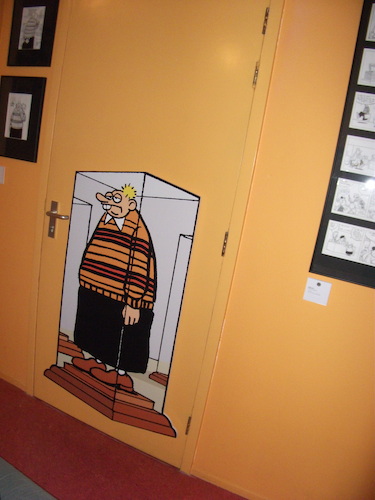
“Low” Art: The Netherlands Stripmuseum in Groningen

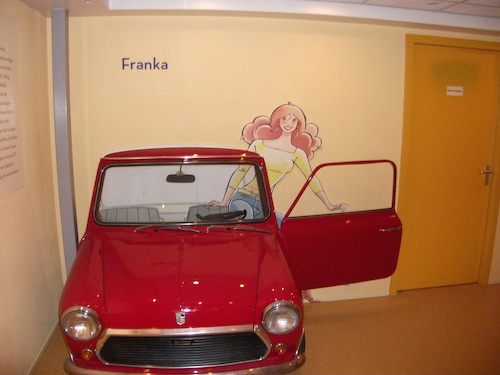
stripmuseum-franka

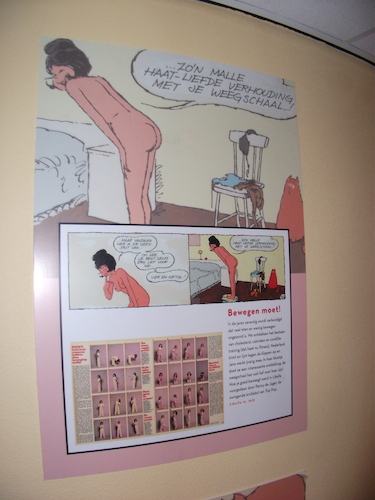
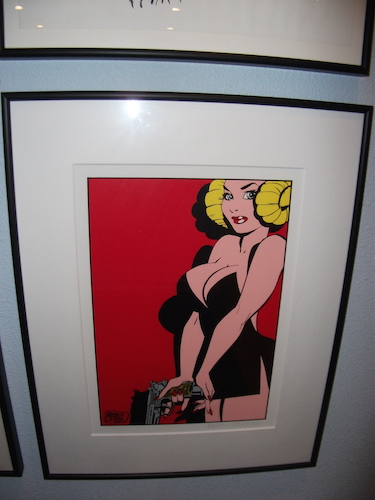
After years of wanting to go but never finding the opportunity to do so, I decided to finally visit the Stripmuseum in Groningen. “Stripmuseum” means “Comics Museum, so don’t get any funny ideas. Then again, I feel like there’s a greater acknowledgement of nudity in Dutch comics compared to especially American comics, and so maybe the joke isn’t too out of place.

stripmuseum-mother

stripmuseum-donlawrence

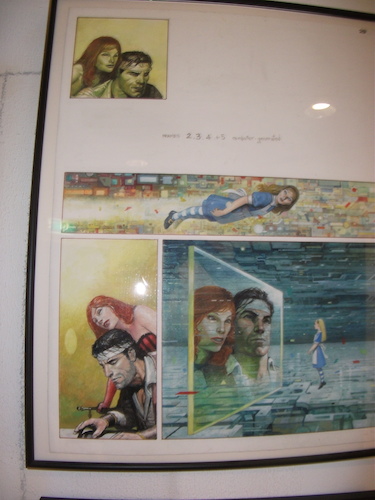
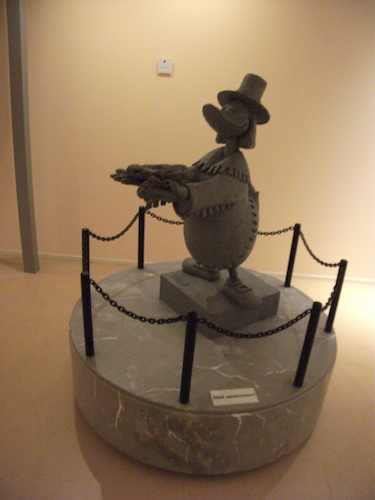
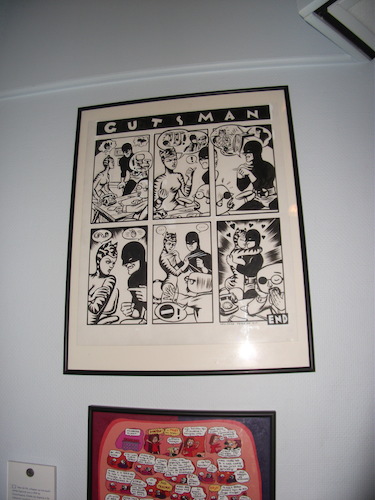
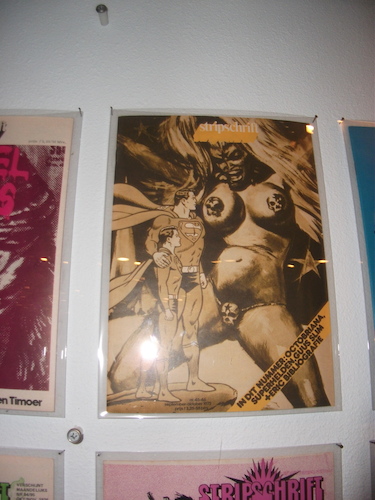
The museum is fairly small but it’s easy to spend a few hours there. The first exhibit that greets visitors is the work of Don Lawrence, a British artist who drew the fantasy comic Storm before passing away. Apparently it has always targeted a primarily Dutch audience, to the extent that the later artists who continued the work have all been Dutch. Another early introduction is artist Don Kriek, creator of Gutsman, not to be confused with a certain Robot Master.

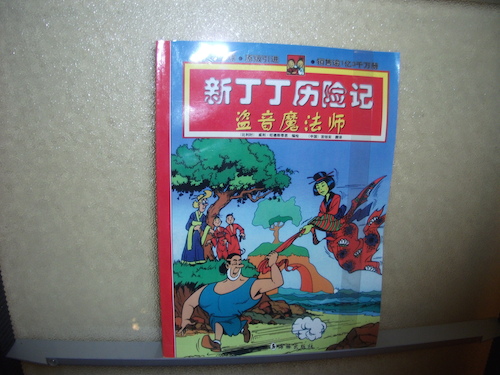
stripmuseum-suskeenwiske-chinese

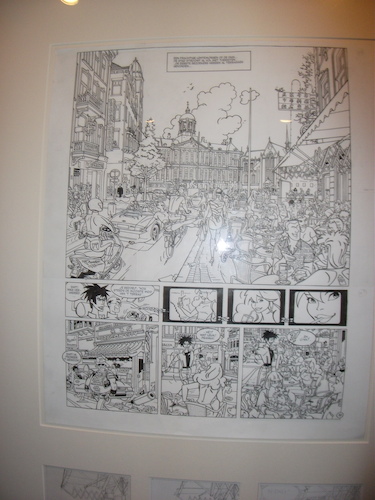
There are a lot of comics samples to look at, going from the earlier days of Dutch comics, such as Tom Poes to ones that have been around for ages such as Suske en Wiske, Agent 327, and Franka, as well as more recent works like Dirkjan and Sigmund. It also touched on properties that may not be “Dutch” or even “Dutch-language” necessarily but have left a mark such as Tintin and Donald Duck. As I can’t really read Dutch, I’m sure that my experience was somewhat limited (though remedied to an extent by an English-language pamphlet), and I can only imagine that people who are literate in the language could spend an even longer time there.

stripmuseum-corneliscoot

stripmuseum-manga2

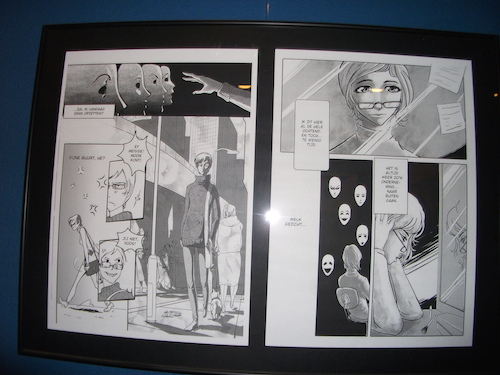
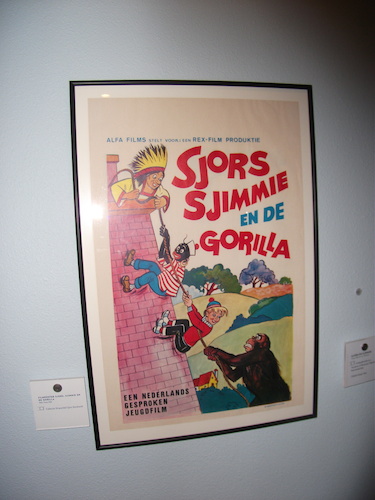
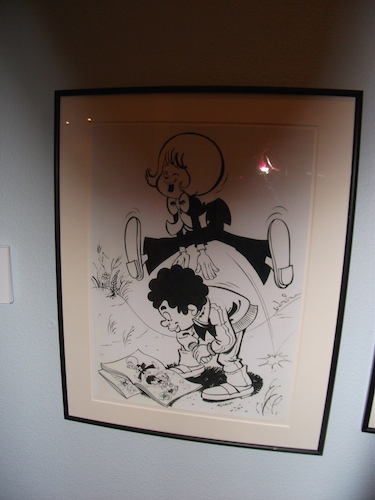
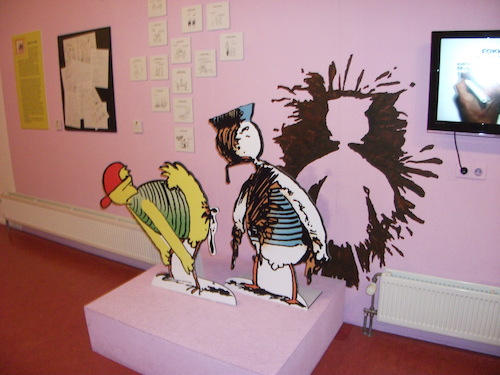
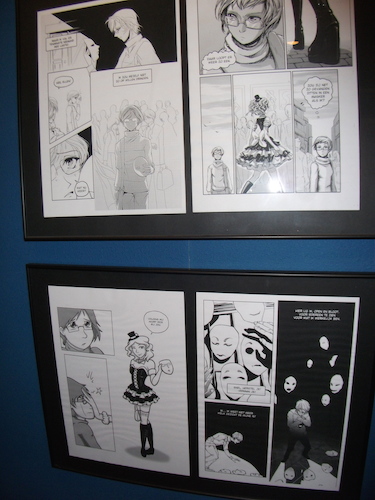
One thing I found interesting was that there was a small section dedicated to “Dutch manga.” Given some of the arguments and disagreements that people get into in terms of what “is” or “isn’t” manga, it’s kind of fascinating to see the Stripmuseum just outright state that, yes, there can be such a thing as Dutch manga, and that it operates under a somewhat different visual grammar. Though my experience with Dutch comics history is pretty shallow at this point (most of the museum information was new to me), I wonder if this ability to accept native-produced material as “manga” is but the newest step in a long line of appropriation, and I mean that in the best way possible. Not only is there the example of Donald Duck (where the magazine named after him is the longest-running Dutch comics magazine ever), but Dutch artists even took the American comics character Perry Winkle, renamed him “Sjors,” and paired him with a kid from Africa, essentially turning it into an entirely different work.

stripmuseum-sjorsensjimmie-early

stripmuseum-sjorsensjimmie-later

I also thought it was notable that Sjors & Sjimmie has been drawn by a number of artists over the years, especially because Sjimmie’s design started off as quite racist but was changed significantly over time. Another interesting fact I learned is that Mark Retera, the artist of Dirkjan, was inspired by Gary Larson of The Far Side. Seeing as The Far Side is one of my favorite comics ever, I feel like I should give Dirkjan a shot.

stripmuseum-dirkjan

If you’re ever in the Netherlands, give it a shot, though I must warn that the train ride can be pretty long if you’re traveling from one end of the country to the other. It was also my first time in Groningen and that city is beautiful. Maybe I should stop by there again just to take a look. It reminds me a bit of Los Angeles mixed with Amsterdam.

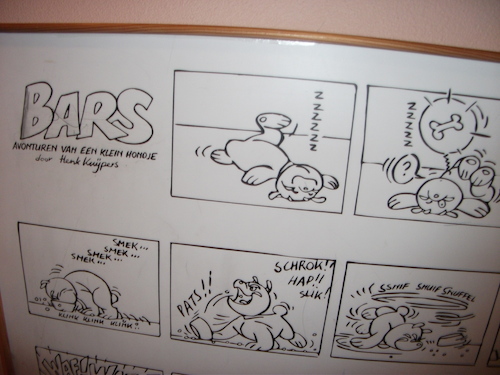
stripmuseum-bars

stripmuseum-fokkeensokke


stripmuseum-frankabw

stripmuseum-gutsman

stripmuseum-manga

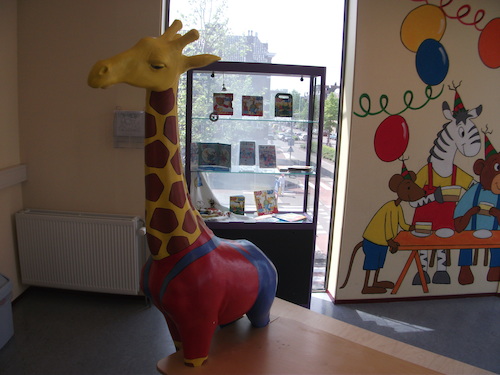
stripmuseum-giraffe

stripmuseum-olga

stripmuseum-superman

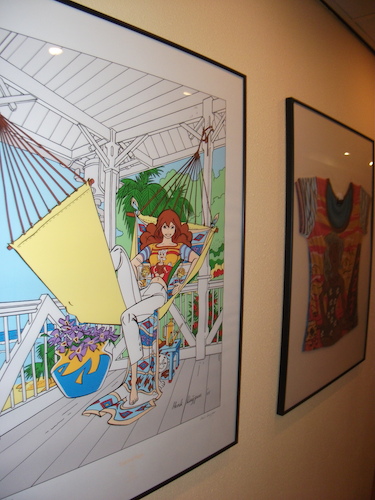
stripmuseum-frankahammock

Of All Things, an Introspective Card Game Anime – Battle Spirits: Shounen Toppa Bashin

A few years ago, I went to an event at the Japan Society in NYC, where Satou Dai of Cowboy Bebop and Eureka Seven fame was a guest. In the lobby, they had design materials from shows he’s written for, and among the works on display was something unfamiliar which caught my eye. This anime was Battle Spirits: Shounen Toppa Bashin, a show whose character designs by Shimogasa Miho (probably best known for Demashitaa! Powerpuff Girls Z) stayed with me for years. Having finally decided to take a look, it turns out that Shounen Toppa Bashin is surprisingly strong in the categories you wouldn’t expect a trading card game-themed anime to even take into consideration, such as personal psychology and portrayals of parent-child bonds. It’s one thing to be an anime like Selector Infected Wixoss, which tries to mess with the conventions of this genre, but this very first Battle Spirits doesn’t subvert so much as challenge and uplift.

The basic premise of Battle Spirits: Shounen Toppa Bashin is about as standard as it gets: kids (and adults) love a trading card game, and they somehow are able to access another dimension and battle with 3DCG monsters. They challenge each other, enter tournaments, form friendships. It basically sounds like a Yu-Gi-Oh! clone. What is notable, however, is that the character relationships in Shounen Toppa Bashin really stand out in a way that I would expect more from a Satou Jun’ichi magical girl show (Ojamajo Doremi, Fushigiboshi no Futagohime) than a TCG merchandising engine. I guess I shouldn’t be that surprised that the man responsible for the series composition of Eureka Seven would also give an impressive showing here.

For example, when you see the extremely straightforward, shounen fighting spirit main character Bashin Toppa talk to his mom Hayami (both pictured above), you get a real sense that his energy and attitude come directly from how she’s raised him. Rather than ignore or deny that familial connection as is often the case with anime, the show uses it to give a real sense of personality to Toppa, to show that his simple-mindedness is also surprisingly deep. After all, what does it really mean to always look ahead, to always want to “Break through the front,” as Toppa often says? It sort of reminds me of Sei and his mother in Gundam Build Fighters, though it also doesn’t hurt that Hayami is not only a classy lady just like Rinko but a taxi driver famous for her Initial D-level driving.

There are a lot of other examples too, but I’ll only mention one more. Another source of delightful interaction comes from the fact that the devious ace player Suiren is actually the popular idol My Sunshine, and Toppa’s inability to see through her disguise in spite of how much time they spend together is pretty hilarious. At the same time, however, it’s also the impetus for Suiren to open up to others and to form friendships with the rest of the main cast. The character designs by Shimogasa really shine here, which reminds me somewhat of Chousoku Henkei Gyrozetter and its own strong character designs and personalities. Speaking of character designs, they’re probably at their best when looking at the show’s ending videos.

Seeing all of these characters with really simple yet vibrant personalities interact with each other in clever and entertaining ways while sporting those strong character designs just makes the show a joy to watch to the extent that it pretty much overshadows the card battling aspect of the series, which almost feels intentional given how much the show rushes through the matches. Usually, when it comes to TCG anime like Yu-Gi-Oh!, the drama is mostly focused on the card game, seeing step by step how the hero overcomes his opponents, but Shounen Toppa Bashin is different. In fact, in most episodes it generally skips a lot of turns to get straight to the climax of a match. The result is that, like Yes! Precure 5, the “fights” seem supplemental to the characters. Maybe not the best for selling the “Battle Spirits” card game, but purely as an anime I would rate it higher than most other shows in its genre.

There is one TCG-relevant aspect, however, that I do find unique to Shounen Toppa Bashin, which is that the anime makes an effort to show how the characters gradually gain experience with the card game they’re playing in a way that is easy to follow. Toppa is head-strong and prefers a straightforward approach of busting through his opponent, for example, but then loses a match early on because he doesn’t take into account strategies that more directly counter his deck type. By the next battle, you see this weakness made up for to an extent, and then strengthened further in a following match. It’s a nice touch to show that the characters are learning, instead of just seeing them bust out a new deck with “all-new secret strategies!!!” (though that happens sometimes too). What also helps is that a lot that both male and female characters are considered strong players, and everyone will take games off of each other fairly regularly so there are no real “weak links” in the core group, and even those who start off that way improve over time.

I’ve only watched 26 episodes so far, but I definitely look forward to seeing how the show continues to unfold. It’s the kind of show I wish more morning boys’ anime would be.

I Didn’t Go to AnimeNEXT 2014 But I Have Some Thoughts on the Studio Trigger Panels

I was unable to go to AnimeNEXT this year, but thanks to the Reverse Thieves and their con report, I’ve learned that the Studio Trigger panels were fantastic and I’m totally jealous of them for being there. Obviously I can’t write about the experience, but there are two points in their post on Trigger that I find interesting to look further into.

The first aspect I want to talk about is in regards to them having an initial version of Kill la Kill with five episodes already planned out in full, but decided to scrap it and start over again with something they felt was stronger. Back when I wrote my review of Kill la Kill I got some comments from a particular poster that criticized Kill la Kill‘s writer for making numerous revisions to the script, as if it had hacked together haphazardly, but with this clarification it’s now obvious that the drastic changes came from the planning stage and were less about cobbling together a frankenstory and more about trying to find the right direction no matter what.

The second little factoid that caught my attention is the fact that the staff at Studio Trigger is really into American superhero comics, which is sort of obvious if you’ve watched all of Inferno Cop. What I find funny about this is the fact that for American comics, superheroes are increasingly seen as this bland, boring, mainstream yet niche thing that we need to move past, while Studio Trigger has this reputation for being a new and cutting-edge anime studio, and they take inspiration from superhero comics.

Love Live! is Like a Golden Age Sitcom

It’s kind of a curious experience watching Love Live! School Idol Project because the more I see, the less the “idol” aspect matters to me. Sure, the songs are catchy and the dance sequences can be quite fun, but I find that it’s actually the show’s sense of humor that really stands out for me.

There are many different ways in which anime does comedy. There’s the slice-of-lifey approach of K-On! or Hidamari Sketch, where the idle moments provide grounds for chuckles. There’s the wild and wacky form of something like gdgd Fairies or Sakigake!! Cromartie High School, featuring one absurdity after the other. In many cases, the characters themselves are not only important to the jokes, but the jokes are subordinate to showing off the characters and how crazy/cute/sexy/rad they are. Love Live!, especially its second season, often feels closer to a classic sitcom than a typical gag anime.

Episode 7 of Season 2 is probably the best example of this so far. When Hanayo is happily chowing down on her over-sized onigiri as Honoka complains about her diet, there’s both the humor of Hanayo inadvertently rubbing it in and the humor of Hanayo’s increasing hubris leading to her inevitable downfall (carbs, man). Later in the episode (10 minutes, 30 seconds), Honoka and Hanayo are jogging when they come across a restaurant. The sight gags and the way they communicate with only excited grunts reminds me of an I Love Lucy skit like the chocolate factory, or maybe something from The Honeymooners. There’s even sort of a similarity between Yazawa Nico and Ralph Cramden.

That’s not to say that the characters are not a focus of the anime, as it is in the end a show about idols designed to have you become a fan and buy all of their merchandise. Despite their looks, however, I often find that the humor isn’t simply about “moe” even when it comes to highlighting their personalities, or if starts out that way then it becomes something else over time. Hanayo, who I describe as “a G Gundam character with the volume turned down to 10%,” essentially has a soft scream that sets up or supports a lot of the jokes in the show. Perhaps the most prominent example of the show doing more with its characters is Sonoda Umi, who in Season 1 is sort of an Akiyama Mio from K-On! type—a cool-looking and responsible girl who is easily embarrassed and writes cute lyrics. However, while she retains those elements to a degree in Season 2, she also begins to show a kind of hilarious intensity that is best summed up by the gif below.

umi-angryface

Another aspect that works in the show’s favor is that it will sometimes take episodes to set up a joke and reward those who’ve been paying attention. In Season 1, it’s when they get a club room (or something, my memory’s still a little shaky), and you can see Hanayo just casually using a rice cooker in there. It’s not the focus of the scene, and no one really makes mention of it, but then when they have their training camp, you see the fact that Hanayo has this gigantic bowl of rice piled so high that it looks like a snowy mountain. When someone finally asks about it, Hanayo’s rsponse (“Don’t let it bother you”) comes and goes so quickly in part due to her soft, high-pitched voice that somehow it just gets funnier.

In Season 2, episode 1 shows Honoka yelling at the sky to stop raining. When rays of sunshine start peaking through the clouds, we’re supposed to think of it as Honoka showing that people can do anything if they set their hearts on it, an inspirational moment for the characters. However, a few episodes later Honoka, Umi, and Kotori get trapped in Okinawa because of a typhoon, and as the weather gets increasingly bleak, we can see Honoka trying to stop the weather again, only this time to no avail. I actually think that little moment in the first episode was partly done to pave the way for this punchline a little down the road.

I find that humorous anime tend to attract a particular audience because it isn’t quite the same as what you’d find on television, and the fact that Love Live! often veers towards the latter may either be a welcome aspect or the very thing that they ran away from when they discovered anime in the first place. The “idol” aspect may also be a turn-off for some, as the concept implies a certain desired level of maniacal devotion, even more than other anime that rely on the charm of its female cast. With Love Live!, however, there’s some real meat to the comedy, utilizing the characters’ personalities but not being solely in service to them.

By the way, my Love Live! top 3 are Hanayo > Nico > Nozomi. 4th is actually A-Rise lead Kira Tsubasa.

The Fujoshi Files 100: Tanaka Mitsuki

Name: Tanaka, Mitsuki (田中美月)
Alias: Hokuto (北斗)
Relationship Status: Dating
Origin: Cyber Yaoi Girl

Information:
Tanaka Mitsuki is a college student who discovered yaoi in her final year of high school. Especially fond of the series Ai no Doronuma, Mitsuki discovers along with her internet connection a thriving Aidoro community. Mitsuki thus spends most of her time chatting with her fellow fans online, and eventually even meeting them offline as friends.

Mitsuki is in a relationship with a fellow student named Koshimura, though she is afraid to tell him about being a fujoshi, and he assumes her desire of privacy is out of shyness, rather than out of wanting to hide her BL collection. While Koshimura does not know the truth, however, his friend Tamagaki does, which makes interaction between Mitsuki and Tamagaki both comfortable and awkward. Mitsuki typically tries to deny that she’s an otaku, going out of her way to exclaim, “My, I’m such a normal girl!” whenever she does anything contrary to fujoshi stereotypes.

Fujoshi Level:
Generally a strong fujoshi, Mitsuki blows most of her budget on yaoi books and internet through which to keep up with her fellow fujoshi.

Eat to Live, Live to Eat: Mogusa-san

When it comes to characters in fiction, it’s fairly common for me to find characters that resonate with me. Much rarer, however, is to find a character that is more of a kindred spirit, someone who fundamentally connects with who I am. This is the experience I have when reading the manga Mogusa-san, the romantic story of a girl who loves to eat all the time.

One of my passions in life is food. When I travel, I mainly think in terms of things I can possibly eat. That is not to say that I am a “foodie,” as the term usually implies someone who is in constant pursuit of the next superbly executed dish. Rather, whereas a typical foodie would not touch Chef Boyardee after having freshly made authentic Italian pasta, I can eat both. I can switch freely between Époisses and Kraft American Singles and not feel that my culinary experience has been ruined. Nor do I consider myself someone with no sense of taste whatsoever, or someone who can’t appreciate finer qualities in food. Trying new dishes, revisiting old ones, complex flavors, simple tastes, approaching different cultures through their cuisine, I simply love the experiences that come with eating. So, when the titular heroine of Mogusa-san (whose name is based on mogumogu, the onomatopoeia for munching) shows a similar fondness for eating, I feel this sense of deep understanding with the character. Heck, I even made her my Twitter banner.

Food manga is a fairly ubiquitous genre, and is usually based around the intense experience of eating something so delicious that it can only be described in metaphor. Yakitate!! Japan, The Drops of God, Oishinbou, Gokudou Meshi, all of these series are about the pleasures of specific dishes and how they were made with love and care. Mogusa-san is a different experience, as it’s more about the feelings derived from the act of eating itself. It’s not just that Mogusa is always hungry or has a large appetite (common features in manga characters) which makes this manga a joy to read, but that the sheer bliss on her face—the wide-eyed sense of wonder, the small but genuine smile, the soft blush that fills the panels—is delightfully overpowering. It more or less describing how I feel whenever I eat, and on a certain level, I find this to be something missing from most food manga.

Mogusa-san feels no need for hyperbole, at least when it comes to describing taste. Instead, its sense of exaggeration lies is in how Mogusa manages to accomplish the task of eating nearly 24/7. While Mogusa is embarrassed about her love of food (because every girl around her is more about dieting), it certainly doesn’t stop her because Mogusa has mastered the art of stealth eating. She keeps packages of eel jerky in her wallet. She disguises an extra helping of rice as a French dictionary. In the image below, Mogusa is supposedly eating only one “Takenoko” chocolate snack, but is actually eating multiple ones, switching between them constantly with the skill of a wild west gunslinger to create the illusion that she’s only been eating one the whole time. In this way, the techniques used by other food manga to describe the taste of dishes transfers over to Mogusa’s consumption tactics.

I’ve been told that I make food look delicious when I eat, and this is also what I get from looking at Mogusa. As much as I love to eat, I also am fond of watching other people enjoy food as well and i n this respect, I also end up connecting to the boy who befriends Mogusa, Koguchi Torao. It’s rather satisfying to me to see someone’s face light up when they eat something that truly blows their mind. In fact, part of the experience of traveling for me is seeing others’ faces light up as they taste something new and exciting, or something familiar and comforting. The art does a good job of showing not only Mogusa’s sense of happiness while eating, but also the fact that Koguchi appears to fall in love with her every time she decides to chow down on something, which, again, is all the time.

Mogusa-san began on the web-only Shueisha platform Tonari no Young Jump, but has since begun serialization in the real Weekly Young Jump magazine due to its popularity. While the first volume has already been published, you can still read a few chapters online in Japanese, and while the language barrier is an issue I think this manga is one where that matters a little less. It’s a manga that I feel profoundly drawn to, and if you love eating the same way I do (or maybe just really like Sasha from Attack on Titan), there’s a good chance you’ll feel the same way.


A Couple of Cool Things About Mega Man’s Final Smash

Yesterday was the Super Smash Bros. for Wii U Invitational Tournament, and during it we got to see Mega Man’s Final Smash in full. Previously, it had already been revealed that it was a combined blast from five different iterations of the Blue Bomber, but what we didn’t see is that the set up for the attack is actually the Black Hole Bomb from Mega Man 9.

I love this, because while Mega Man’s moveset in the new Smash Bros. is basically an elaborate homage to all of the games of the classic series, it was conspicuously missing attacks from the most recent retro-style games. With the Black Hole Bomb, this has been remedied. Mega Man 10 is still missing, but at least we got one step closer.

It also makes a kind of weird science fiction-esque sense that Mega Men from multiple universes and timelines would converge inside of a black hole.

As a side note, seeing Hungrybox get a kill with Kirby’s up-throw in yesterday’s final brought joy to my heart, as it means that throws have killing power at relatively decent percentages again without having to factor in elaborate follow-ups, something that’s been missing since the original Super Smash Bros. unless you count some of Mewtwo’s and Ness’s throws in Melee.

P.S. Where is Mewtwo. WHERE IS MEWTWO.


Achieving 4-Dan and Stepping Away to Improve at Mahjong

mahjong-4dan

In December of 2010 I wrote a post about how I had finally achieved 3-Dan on the mahjong website Tenhou. Finally, after three and a half years, I have hit the next level and rose into 4-dan. The fact that it’s taken me this amount of time to get to 4-dan is either great or embarrassing depending on your own mahjong skills, but I realized that part of the reason I was finally able to break that barrier was that I had stepped away from the game for a while (unless you count posts about Saki or Akagi, I haven’t really posted much about mahjong lately), and that this has in some ways contributed to me being able to play better.

A few months ago someone asked me, “How do you not get angry when playing on Tenhou?” My answer was simple: I do get angry, all the time. Mahjong is a game that takes a lot of mental energy and so long sessions end up being quite taxing on the brain. Since about September of last year I’ve had to really focus on my work, so that risk that mental and emotional exhaustion that comes from playing mahjong wasn’t really worth it to me. During this time, I made occasional trips back to the table (virtual or otherwise) that reminded me of how rusty I become from playing less often, but also actually helped me to distance myself from mahjong and to improve my mental game immensely.

As with many things, one of the dangerous things about going on tilt in mahjong is that your “vision” in terms of what is possible or what is supposed to happen starts to narrow. When you’re not winning hands despite being in great positions, or when you feel like it’s totally “unfair” that you got screwed over in some way, it can cloud your judgment and cause you to make mistakes you may not have made otherwise. One sign I’ve learned to watch out for is when I get too desperate for pinfu. It may be the simplest hand in the game to achieve, but when I’m so obsessed with trying to win “anything at all” I realize I’m not actually playing mahjong. Stepping away from the game has helped me to realize this.

Another thing stepping away allows for, at least far as my relatively low level is concerned, is that it has helped me develop more versatility. Tenhou breeds a certain kind of mahjong player: someone who’s conservative in play, calculates risk extensively, and has a decent head for numbers. It’s the “proper” way to play mahjong, and so when on the Tenhou ladder you tend to learn to play against people like that. However, if thrown in a situation where others are playing “improperly,” doing the things that are suboptimal yet somehow winning anyway, I’ve noticed that a lot of better players have trouble dealing with this, including myself. What I realized eventually was that it was just as much my problem for not having the adaptability to deal with different types of players regardless of whether they pay no attention to theory and probability. It’s kind of like complaining about button mashers in fighting games or not being prepared for a Shedinja in Pokemon. “Nobody does that! You’ll lose more than you’ll win with that!” And yet, at the end of the day, you’re the one who couldn’t deal with it.

Speaking of fighting games, I recommend this video from fighting game community veteran James Chen on “reading your opponent.” I’ve skipped to the part where he talks about why “advanced” players tend to be kind of double-edged swords because they play too close to the theoretical optimal.

Perhaps the most significant if seemingly contradictory thing is that because I’ve distanced myself from mahjong, I’ve actually developed a better sense of my own style, how I want to play. Thus, when I managed to finally find not just some free time, but a week or two to where I could redirect my mental energy to other tasks again, I decided to get back on Tenhou and finally aim for 4-dan. There were of course many highs and lows, but I think that, as I explained to an extent above, trying to “make up for what you’ve lost” from one game to the next is the wrong way to look at it. The more you think, “I got 4th this one game, so I need to get 1st in the next two games!” the more likely you’re going to fall further down the hole. It happened to me quite a bit, as I hadn’t merely stayed in 3-dan the whole time, but actually moved between 1-dan and 3-dan as my own frustration got the better of me. Of course luck is a factor in this game, but not letting it get the better of you emotionally is also important.

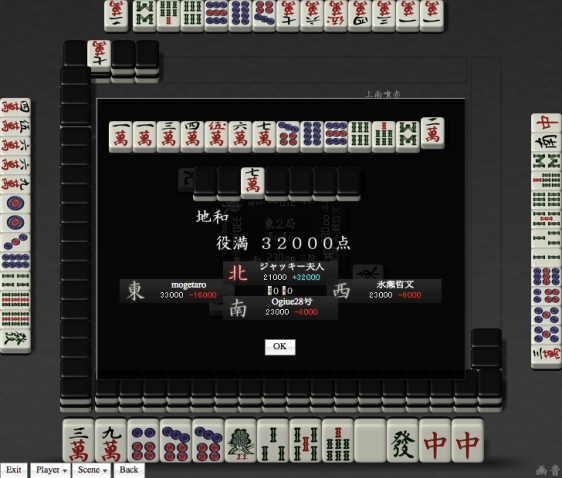
mahjong-chihou

In the end, if I can get hit by a chihou of all things (SERIOUSLY A CHIHOU) and still rebound, then I feel pretty good about my future prospects. That said, I still haven’t fully memorized the score chart. Oops.

Like the Transformers Movies but Less Stupid: Godzilla 2014

The 2014 Godzilla film is a strange amalgam of sorts. The most famous of Japanese giant monsters is many things to many people, its movies spanning generations, the narratives of which vary between Godzilla as the power of nature made reality, a representation of the hubris of humankind, and kick-ass monster eager for a rumble against its fellow kaijuu. Rather than going for the heavy reintepretation as with the old 1998 film, Godzilla 2014 tries to embrace all facets of the lizard with some mixed results.

I have somewhat of an “improper” understanding of Godzilla. Certainly I grew up on some of the movies, having watched my Godzilla vs. Megalon and Godzilla vs. Mechagodzilla VHS tapes religiously as a kid, for example. However, I’ve still never seen the original (not even the English adaptation with Raymond Burr inserted in), nor am I so hardcore into Godzilla that I can tell you all of its production history. I’ve realized that deep down I think of Godzilla first and foremost as teaming up with Mothra or Jet Jaguar and giving monster smackdowns, so when I originally came to the movie expecting something more along the lines of a disaster flick, I could feel the kid inside of me smile as the film revealed that it was definitely leading to a massive battle.

At the same time, Godzilla 2014 definitely does not have the same feel as those Showa-era movies I’d grown up on, the heavy emphasis on military presence makes it feel somewhat closer to the Michael Bay Transformers films. Fortunately, Godzilla maintains the image of futility as the US Navy’s weaponry proves overall ineffectual, a classic trope of the franchise, and so it avoids the more jingoistic feel of Transformers when it comes to representations of the military. Even though the main protagonist is a soldier, and he accomplishes quite a bit as a human being, his significance pales in comparison to Godzilla, and the film does a good job of conveying the smallness of humanity.

In this respect, the movie tries to have its cake and eat it too, being on some level the disaster movie I expected going in, but also the monster mash that Godzilla is famous for, but also the contemporary US blockbuster with that strangely stylish militaristic vibe that has increasingly become a part of the movie experience. I find that it balances these incongruities surprisingly well, which is actually pretty impressive, but I also can’t help but shake the feeling that the “something for everyone” approach allowed it to only go so far. I won’t say that it was like three films in one, as I do think there is a good sense of continuity and cohesion overall. Instead, it’s more that Godzilla 2014 embodies the idea of an “American-made Godzilla” to a tee, for better or worse.