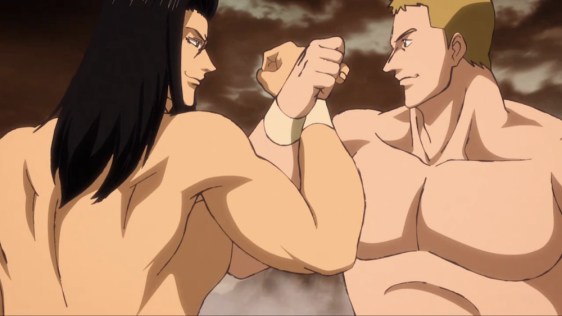
Whether in anime or pro wrestling, when you look like Generic Background Figure #45, there usually isn’t much hope for someone to make an impression. Kevin Anderson (pictured right) defies the odds, even despite the most incredibly generic name. A member of the dastardly Global Wrestling Monopoly, he’s a frequent teammate of the mysterious and nasty Tiger the Dark. But while Kevin is indeed party to some of the nastier elements of GWM, he’s also a loyal friend in an environment where backstabs and grabs for power are par for the course. When Tiger the Dark is at his lowest point, Kevin stands by him. Even when Tiger the Dark abandons GWM, Kevin takes it more as a betrayal of their friendship and fights to bring him back over. Poor Kevin.
BEST FEMALE CHARACTER
Mauve (ACCA 13-Territory Inspection Dept.)
ACCA is the kind of series where you can never tell who’s on what side—sometimes not even the protagonist himself. In a cast full of intriguing characters, Mauve stands out for her striking presence. The director-general of ACCA, an independent watchdog group for the Dowa Kingdom’s government, she holds a lot of power and has to match wits with figures even more influential than her. Mauve embodies brains, beauty, and the idea that brains are beauty, and it’s telling that even our stoic hero, Jean Otus, finds himself a bit flustered around her.
Final Thoughts
I think the qualities that have stood out to me most about the anime characters of 2017 are exceed their trappings and their archetypes, and just a greater sense of cleverness overall. Sucy from Little Witch Academia seems nasty, but she cherishes friendship in her own bizarre way. Both Sakurai and Morioka from Recovery of an MMO Junkie recast the image of the MMO player without delving into wish fulfillment fantasy or rejecting previous characters outright. Cure Macaron from Kira Kira Precure a la Mode is a highly perceptive and aloof teenage heroine—an uncommon combination in that franchise. Kevin is a nobody jobber, but his sincerity is real. Mauve casts a huge shadow on the rest of the story, but it’s more in the sense of Legend of the Galactic Heroes-esque political maneuvering over “innocent honesty.” As more and more characters challenge expectations, I look forward to what 2018 has to offer.
I was asked to talk about the Aikatsu Stars! 2017 Christmas episode, so here I am!
Christmas isn’t the utter juggernaut of a holiday in Japan as it is in the United States, but it’s still celebrated in its own way: as a time for romance and appreciation. It’s not uncommon to see anime and manga feature Christmas stories, notably the many shoujo series where dates happen on and around December 25th. In some cases, series can be long enough Christmas episodes themselves become annual traditions, and this is the case with Aikatsu! Apparently, they even sing “We Wish You a Merry Christmas” every year:
As a Christmas-focused story, episode 87 of Aikatsu Stars! stands out to me for a few reasons. Generally, with these seasons-long children’s anime, the Christmas episodes are pretty self-contained. Maybe it’ll be about meeting Santa, or just having fun with friends. With Aikatsu Stars!, there’s a surprising amount of overall narrative progression. It’s not like they’re throwing revelations left and right, but the fact that M4 (the series’ premier male idol group) is branching off into their own solo careers is kind of a big deal. That there was some romantic development between perennial cat(-like) girl Saotome Ako and M4 member Kiri Kanata is also notable.
I only watch Aikatsu Stars! on and off, so I didn’t realize that Kizaki Rei is from New York City. As someone who just stopped by Rockefeller Center to see the giant tree right before Christmas, and as someone who kind of takes its presence for granted, I found the show’s presentation of it as this stand-out example of “Christmas around the world!” charming. If there’s one thing AIkatsu! has done right that many other series haven’t, it’s having more non-Japanese characters.
Aikatsu Stars! (and Aikatsu! in general) is that it really is in its own world when it comes to idol anime, or magical girl(ish) anime. Other series will be fun and wacky, or they might be a bit serious, but there’s rarely the almost Saved by the Bell-esque feel you find in Aikatsu! Even when the anime are literally about idols using their singing to defeat galactic empires, it lacks that particular brand of mild absurdity that permeates AIkatsu!. This is why Aikatsu Stars! is the sort of anime that could either go episodic forever or rapidly develop into an elaborate story at any moment, and both are equally welcome. Perhaps the Christmas episodes are indicative of that balance of story advancement and self-contained amusement.
—
This post was sponsored by Johnny Trovato. If you’re interested in submitting topics for the blog, or just like my writing and want to support Ogiue Maniax, check out my Patreon.
Recovery of an MMO Junkie is a charming anime about a romance that develops between two MMORPG players, only without the need to trap them in the game. It’s a refreshing series in many ways, with one notable reason being its portrayal of its NEET main heroine.
NEET (“Not in Education, Employment, or Training”) is originally an English term that migrated over to Japan and is one of the many terms used to describe Japanese youths as a way to admonish their lack of drive. In response to this negative image, many anime, manga, and light novels have NEET protagonists rise to the occasion, get the girl, and save the day. However, even when they’re portrayed as lovable losers who become winners in a new world, they still have that aura of initial failure about them.
However, Recovery of an MMO Junkie‘s main character, Morioka Moriko, is not portrayed as being a sad sack who never went anywhere. Prior to her becoming a NEET, she actually had a lucrative office career. While they never explicitly say why she quit, it’s implied that something about the job wore her down over time, and that she left it for her own sanity. Where other series’ NEETS are often presented as people who never even try to enter adult society, Moriko is someone who could have walked down that path but didn’t.
The reason Moriko being a former working adult is important is that NEETs, hikikomori, freeters, etc., are viewed as irresponsible and lazy, as if their lack of employment and romantic success falls squarely on their shoulders. MMO Junkie suggests that maybe there’s something wrong with the corporate and societal culture that grinds people down. It’s similar to the arguments we see about millennials, except it’s been going on in Japan for even longer.
The English title, Recovery of an MMO Junkie, can sound misleading. It’s not about an MMO player getting over her online addiction, it’s about an MMO player using an MMO for self-therapy to help her recover her life. When she worked, it was her nightly reprieve. When the job became too much for her, she needed more extensive healing. Even adults need time to recuperate mentally and emotionally.
Introduction: The above title might seem like a confusing mess. The reason is that this post originally began as my annual review for the Reverse Thieves’ Anime Secret Santa, only for me to realize it also qualified for my ongoing Gattai Girls review series—posts dedicated to looking at giant robot anime featuring prominent female characters due to their relative rarity within that genre. So it’s a double special!
Here, “prominent” is primarily defined by two traits. First, the female character has to be either a main character (as opposed to a sidekick or support character), or she has to be in a role which distinguishes her. Second, the female character has to actually pilot a giant robot, preferably the main giant robot of the series she’s in.
—
Overview
In the year 2070, middle school student and small-town resident Murata Hajime witnesses an extraterrestrial attack. To his surprise, Hajime’s neighbors in his town of Tenmo barely flinch, not even when a mysterious floating titan appears to stop the invader. It’s the beginning of a new life for Hajime, especially when he gets to know two of his classmates tied closely to the secrets of Tenmo: new transfer student Subaru Muryou and student vice-president Moriyama Nayuta.
2001’s Shingu: Secret of the Stellar Wars is an eclectic series. Also known as Gakuen Senki Muryou (“Record of School Wars Muryou”), Shingu combines science fiction mystery, small-town suspense, and everyday school life in a way that makes its continued enigmas consistently satisfying, even when it withholds answers. While the teasing of revelations and the subsequent disappointment of their reveals can often tank even the mightiest of works, Shingu always says just enough and encourages the use of imagination to fill in the blanks without feeling like a cop-out.
The deftness by which Shingu lays out it mysteries can be seen in one of the first scenes, when Muryou shows up for his first day of class in a school uniform. While this seems perfectly normal, it turns out that school uniforms haven’t been a thing for decades. Immediately, Muryou is shown to be unusual by placing him in an environment where what we perceive to be typical, i.e. school uniforms, simply isn’t. It’s an effect also used in the manga Coppelion to convey the uncanny quality of its main characters. The only explanation given is that Muryou got the uniform from his grandfather as a way to blend in, which puts Muryou potentially out of time, or at least sheltered from the world.
Moriyama Nayuta
It’s actually difficult to pin down a true “main character” for the series. Based on the English title, it sounds like Nayuta is the central protagonist, due to the fact that she can transform into the titular Shingu. However, the Japanese title centers on Muryou, who is a major catalyst in the narrative. And while Hajime can come across as a generic audience stand-in, his seeming blandness actually plays an important role in the series, as his ability to go with the flow and keep and open mind are key to humanity’s development. Because this is a Gattai Girls entry, I’m going to focus more on Nayuta and how her role as the Shingu works in the anime.
Nayuta feels cut from the same tsundere cloth as Evangelion‘s Asuka, especially when contrasting her with another female character, the taciturn Mineo. Nayuta has a not-so-secret crush on Hajime and sports the signature hairstyle of the tsundere, the twintails, but she’s not solely defined by those traits. Bullheaded, hardworking, and always eager to do the right thing, Nayuta’s closer in kindred spirit to Sonoda Umi from Love Live!, at least if Umi had the ability to transform into an alien behemoth.
Incidentally, Nayuta is not voiced by the tsundere master, Kugimiya Rie. Instead, Kugimiya plays a different character, Hajime’s adorable little sister Futaba, with Nayuta being played by Park Romi. Shingu is one of many series where Park and Kugimiya work together, perhaps most famously Full Metal Alchemist.
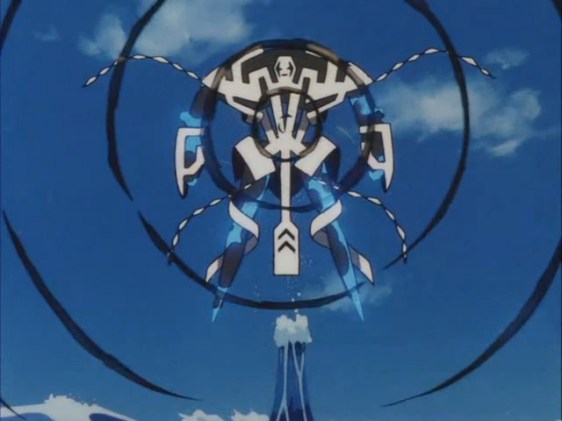
The fact that each of the trio fulfills a very different role, with Hajime and Muryou generally providing support for Nayuta, also means that she is rarely ever overshadowed in battle. As for the Shingu itself, it’s is an unusual design—a hollow vessel resembling paper that is then “filled out” by taking control of a nearby energy source or element such as water. It feels more reminiscent of the monsters found in series like Evangelion and RahXephon, with a dash of Ultraman thrown in. Aesthetically, the Shingu comes across as a combination of the alien other and beings from Japanese folklore, like a science fictional shikigami or tsukumogami.
Overall
Director Satou Tatsuo is more well-known for the series Martian Successor Nadesico, and much of the humor and interaction there can be found in Shingu. However, its mix of SF and the everyday also results in something that feels like the anti-Evangelion. Both Shingu and Eva focus on a trio of middle school students who have varying access to special abilities and must fend off unknown alien-like attackers. Both can arguably fall into the sekai-kei genre—stories where the personal struggles of the individual manifest into global consequences and where often the fate of the world is tied to the relationship between a boy and a girl. But Shingu is also more than just “boys and girls”; it’s about community and history, and the ability for humanity to learn and grow. Shingu: Secret of the Stellar Wars nonchalantly moves from one unexpected place to another, varying in scale from local to cosmic, and believing in people along the way.
Information: Along with her younger identical twin sister Manabi, Hinata is a member of the dance group “Team Sakura.” Together the two specialize in using their close bond as twins to perform dances with superior synchronization, which leads them to be invited to participate in a secret underground competition called “Dance Road.” The more reserved and feminine of the two, Hinata often refers to her mood and situations in general using the English words “happy” and “unhappy.” It is at “unhappy” points that Hinata becomes scarier than her Manabi.
Hinata comes from an extremely wealthy family. In addition to having a loyal butler, she and Manabi frequently travel around the world both to explore and to meet their favorite dancers in person. In spite of all of the amazing performers they have seen, Otosaki Kanon from team Tribe Cool Crew in particular quickly catches their eyes.
Fujoshi Level:
Hinata herself does not seem to realize her unusual fondness for “friendship among boys” until very late into Dance Road. Manabi comments that her older sister’s character “suddenly changed.”
December 15, 2017 will be marked in history as the day AOL Instant Messenger finally died, and with it, a chapter of my online fandom lays to rest.
Long before AIM came on the scene, I was a kid in elementary school who got to try America Online thanks to my family. While the signature “You’ve got mail” chime and the constant refrain of “A/S/L?” weren’t major parts of my childhood, they eventually paved the way for the chat program that would be my go-to form of internet communication for close to two decades.
What began as a way to simply talk to fellow fans in various circles, be it NiGHTS into dreams fanfiction, Pokemon multiplayer strategy, anime, or more. Like so many awkward nerds out there, I had a hard time making friends online, but somehow was able to pour my heart out to those on the other side of my keyboard. I was young, dumb, and full of overwrought emotion, but so were the people on the other side. I remember those early days of my internet life fondly, and lament that the internet as a full-on escape all but died with Web 2.0, let alone the social media landscape we have now.
Out of all my memories using AIM, what probably stands out to me most are the genuinely heartfelt conversations I had with people I truly considered to be my friends, whether we eventually met IRL or not. It felt good to listen to others, and it felt good to have others listen to me, as we shared the things that we found difficult to express to others in person. This might apply more generally to the internet, but at times I felt AIM saved me.
Truth be told, I had still been using it pretty regularly up until the announcement that it was finally going away for good. I know we live in a newfangled world where supercharged messaging programs are a dime-a-dozen, but AOL Instant Messenger will always be my #1.
To Khara, Sonuis, Fish151PKMN, OGT, and all the others out there: thanks for the memories.
The manga Spotted Flower is more than just a story about a male otaku and his non-otaku wife. To fans of the author, Kio Shimoku, the series is also a thinly veiled alternate universe version of his most famous work, Genshiken. With nearly all of the characters in Spotted Flower having direct analogues in Genshiken, the manga is constantly nudging and winking at the audience. Recently, one of those nudges turned into more of an elbow to the solar plexus, and many assumptions about the series have gone out the window. A story seemingly about marital bliss (despite some ups and downs) has become a tale of adultery, and Genshiken fans are left reeling.
The buildup to the big moment occurs shortly after the birth of the husband and wife’s first child, who is named, appropriately, “Saki.” Visited by her ex-boyfriend, the ease with which she and her former lover banter back and forth drives the meek husband to wallow in quiet envy. In a moment of weakness, he ends up sleeping with an old mutual friend—one who’s female up top, male down below, and who still identifies as male—and cheats on his wife. Only, instead of doing the deed, he winds up on the receiving end.
Jealousy and Betrayal
It’s clear which Spotted Flower characters map to which Genshiken identities. The husband is uber nerd Madarame Harunobu, while his wife is the no-nonsense Kasukabe Saki. The ex-boyfriend is Kohsaka Makoto (who is Kasukabe’s actual boyfriend). The one night stand (?) is with Hato Kenjirou, the male BL fan who ends up falling in love with Madarame. Seeing all of these characters act so terribly to each other can feel like a betrayal, especially to fans of the popular Madarame-Kasukabe pairing. But the situation begs the question: where do the Genshiken versions end and the Spotted Flower ones begin?
Spotted Flower resembles fanfiction in the sense that, while it’s possible to enjoy it standalone, the work encourages and even to some extent assumes a certain degree of familiarity with the source material. What use is a story about Mikasa from Attack on Titan turning into a robot, if the reader doesn’t know how Mikasa is supposed to act normally? To that extent, I suspect that the controversial decision to make the husband an adulterer is part of stressing SpottedFlower as the space where all the things not possible in Genshiken become real. The very premise of the series is built on that idea—Kasukabe ultimately rejects Madarame because she loves Kohsaka.
If the husband does all the things Madarame didn’t or couldn’t do, then his poor decisions make sense. At one point in the second manga series, GenshikenNidaime, Madarame comes close to sleeping with his friend’s little sister, Sasahara Keiko. As it turns out, Keiko is actually trying to cheat on her current boyfriend with Madarame, and her casual admission to this fact sends Madarame running for the hills. Madarame is unwilling to be an accomplice in another’s unfaithfulness, but the husband in SpottedFlower is not. Later in Nidaime, Madarame ends up alone with Hato in an awkward spot. Hearts racing, the two come close to having something happen, only for happenstance to deflate the tension. Madarame ends up rejecting Hato later, out of concern that Hato should be with someone better. The evening that goes nowhere in Genshiken certainly ends up somewhere in SpottedFlower.
What’s more, where Genshiken deals in relatively tame kinks and features mostly faithfully monogamous relationships where available (Keiko notwithstanding), Spotted Flower thrives on the unconventional. The not-Hato (hereafter referred to by his artist pen name Asaka Midori) is already in a physical relationship with his manager who’s the Spotted Flower version of Genshiken character Yajima. But rather than being upset or surprised, the manager was already well aware of Asaka’s desire for the husband. She even goes as far as to ask how it was giving anal sex to him. At another point, it’s implied that another character (a manga editor who maps to original Genshiken protagonist Sasahara) could maybe potentially be having threesomes with his girlfriend and her very touchy-feely American girl friend, but doesn’t. “Open relationships” seems to be the name of the game, which further emphasizes the Bizarro Universe-esque aspects of sexual relations in Spotted Flower relative to Genshiken.
Does this mean that Spotted Flower is reliant on Genshiken, or that the sense of betrayal on the part of readers would only come from Genshiken fans? Perhaps not, but the feelings are likely most intense from that established fanbase. However, I find it fascinating that, unlike fanfiction, which typically exists on a very clear line of what is “canon” and not, the fact that Spotted Flower is this very obvious Genshiken what-if with only the barest degree of plausible deniability makes that canon/non-canon distinction much blurrier. At the same time, it is fact that the Spotted Flower characters are definitely not the Genshiken ones, and not just the same characters in an alternate universe or timeline. They simply have too many different physical features that can’t be explained by the passage of time on account of the Spotted Flower characters being older. “Ogino-sensei” (Ogiue in Genshiken) has a different face structure. The blond American otaku behaves like the petite Sue but has a body like the tall, buxom Angela. In some cases, it’s not even clear who’s supposed to be who based on character design alone. Spotted Flower might be a “possible future” as both it and Genshiken like to put it, but it’s practically CLAMP’s manga, Wish—a series based on a JoJo’s Bizarre Adventure doujinshi of theirs with the names and designs altered into “original” characters. Only, for Kio, he’s his own source of inspiration.
Ogiue’s Counterpart: Ogino-sensei
The question as to how much Spotted Flower should speak for Genshiken is a tricky one. The characters of the former mirror the latter. Are they the true desire of the author, or simply a chance to tell different stories? Is it precisely because the characters are alternate versions that this can happen, or does that thread of possibility mean the two are tied together? I don’t believe there to be a true answer to these questions, simply because it really depends on individual readers’ relationships with both series. But it’s also curious that some of the characters and relationships are not as different as others. Ogino-sensei is still seeing her manga editor boyfriend, and their bond seems to have remained strong. The wife’s ex-boyfriend (not-Kohsaka) looks almost the same, except his hair is black instead of blond, and his bright-eyed gaze has been replaced with some kind of seeming cynicism or darkness. Maybe there are characters who can find the same happiness on the alternative route, and those who cannot.
A new character: Endou
How much Spotted Flower will continue to be self-parody remains to be seen. Volume 3 introduces wholly original characters in Asaka Midori’s editor, Endou, as well as her publisher. I wonder if this is the signal that the manga is on the verge of becoming its own entity.
This month’s Patreon sponsor update is, funny enough, going to be about Patreon.
Before I go into detail, I’d like to give thanks to my Patreon sponsors.
General:
Johnny Trovato
Ko Ransom
Alex
Diogo Prado
Viga
Sue Hopkins fans:
Serxeid
Yoshitake Rika fans:
Elliot Page
Hato Kenjirou fans:
Elizabeth
Yajima Mirei fans:
Machi-Kurada
Recently, Patreon has changed the way it handles patron subscriptions and creator payouts. There’s some controversy over the exact intent behind this change too–Patreon claims it’s to increase consistency of payments, critics argue it’s a greedy move to extract more money. Either way, what it means is that many users might end up paying more. Where a $1 pledge once meant you pay $1, it now means $1.36 per creator you support.
If you want to keep supporting Ogiue Maniax at your current pledge level, feel free to do so. But if the extra financial burden from this Patreon change is too much, feel free to lower your pledge amounts as much as necessary–even to $0.
One thing I’m considering is lowering my rewards to compensate for this change, so patrons can get the same perks for the same amount. Tell me in the comments or on Patreon.
Yu-Gi-Oh! is one of those prolific anime that needs little introduction to the world at large. Its cultural penetration is tremendous, and its characters and monsters are iconic. The Yu-Gi-Oh! anime is also a series from a bygone era of heavy localization for Japanese cartoons, and one consequence is that, in many ways, the show America received and then exported to the world is significantly different from the original. It’s a song and dance as old as anime in America, but the result is that audiences potentially come to enjoy each version for differing reasons as well.
The Japanese and English versions of Yu-Gi-Oh! (Yu-Gi-Oh! Duel Monsters in Japanese, to distinguish it from a previous anime by Toei) are not wholly dissimilar. They both feature over-the-top personalities fighting for their lives and dreams through a trading card game. But when looking at the presentation of characters, music, and duels, the two diverge significantly—perhaps to the extent that they could be regarded as two different shows—even when factoring out what would be called censorship, e.g. removing references to death or religion.
Characters
Characters between versions of Yu-Gi-Oh! are generally the same archetypes, but there are instances where they vary greatly. Anzu Mazaki is nowhere near as friendship-obsessed as Tea Gardner. Katsuya Jounouchi doesn’t have the Brooklyn accent, but he’s still kind of a delinquent with a heart of gold. The biggest example of character disparity is undoubtedly Seto Kaiba.
Viewers familiar with Kaiba’s English incarnation know him as an extremely arrogant bully who almost can’t help but simultaneously self-aggrandize and belittle others every time he opens his mouth. He also has an extreme skepticism towards the occult to the extent that even when transported to an ancient, illusory world, he maintains that it’s all holograms.
Japanese Seto Kaiba, while still arrogant, is nowhere near as condescending. Instead, he’s more curt in his speech, and comes across as a no-nonsense individual who has little time or concern for goals outside his own. He’s also extremely intense about the things he cares about, puts himself into every duel, and is more willing to believe in the unknown than his English counterpart. What’s more, while both have fierce rivalries against Yugi, the Japanese version is more willing to give respect where it’s due, even if grudgingly.
Neither is necessarily a better character, but the way they approach scenes with their different personalities shapes and transforms the overall feel of the anime. Scenes of Kaiba in Japanese that are about emphasizing his passion become scenery-chewing exercises in English. Characters in the English Yu-Gi-Oh! can come across as practically parodies of their Japanese versions (which, as an aside, makes Yu-Gi-Oh! Abridged all the more interesting).
Music
To a generation of Yu-Gi-Oh! fans, “It’s time to d-d-d-d-d-d-d-d-d-duel!” is a downright iconic refrain. The music in the English version is made to sound tough and cool, like whoever or whatever it accompanies is a ridiculous badass. Though the Japanese music can also be described with similar adjectives, it comes with another dimension—a sense of personal emotional weight.
Take for example the second opening, “Shuffle,” by Okui Masami (Revolutionary Girl Utena, Scrapped Princess). There’s energy and excitement, but also dread tinged with sorrow. When the chorus hits, there’s a swath of emotions telling the audience that the stakes are high. Those feelings come across, likely even if the listener doesn’t understand Japanese.
English Yu-Gi-Oh! has one opening theme, whereas Japanese Yu-Gi-Oh! has five distinct opening themes, so it’s possibly unfair to compare them when the latter has so many opportunities to change. But one element common to all the Japanese themes is a sense of melancholy mixed with power. While that is arguably just a product of the tendency for anime songs to add some sadness, it still means the Japanese series front loads the expectation that the story is an emotional trial.
Duels
Because of the character and music differences, the duels themselves take on distinct feels, despite the fact that they play out largely the same way in both languages. In English, the duels act as wild displays of the characters’ ridiculous personalities. When Kaiba or Yugi pull off some combo and win the game, it’s like the cherry on top of a cake of absurdity. When a character then explains the logic behind their actions (keep in mind that they pretty much make things up as they go along), the response I have is, “Sure. Whatever you say.”
In Japanese, however, because all of the characters carry a greater sense of personal conviction, and the music is filled with greater variations in emotion, the duels reflect those self-serious attitudes. Even though the actual moves and explanations are more or less similar to the English version, the Japanese characters deliver every word like it’s the most important thing in the world. When hearing them explain their actions, it’s easy to feel as if everything they say makes complete sense, even when it doesn’t.
Both versions create tension and end up in the same positions in terms of story, but what draws viewers in to keep watching the duels feels like the difference between an action game and an adventure game—similar in many ways, but different upon closer inspection.
SoWhat?
Nostalgia plays a tremendous role in how Yu-Gi-Oh! is remembered. Those who grew up with one version or another might very well be as attached to them on a deep and personal level. The desire for the “original” can also fuel disagreement over which version is better. The fact that the Japanese version came first arguably positions it as the “true” story, even though it is adapted from a manga and has its fair share of filler arcs. But even when factoring out nostalgia and reverence for the original and/or “Japanese-ness,” the two versions are different enough that, if you were to re-dub the entire series with the same English voice actors but with a script and music closer to the Japanese version, the experience would be quite different. The English Yu-Gi-Oh! makes the series feel more like an exercise in excess and bombast. The Japanese Yu-Gi-Oh! leans more towards melodrama and intensity.
At a far enough distance, the distinctions made above between English and Japanese Yu-Gi-Oh! can seem trivial. Being built from the same core, they capture a lot of the same important points in terms of story and character. But it’s because the disparities appear mainly when taking a closer look that feelings about which iteration is better can be so strong. Viewers were treated to different sets of emotions and different images of the characters. One version does not wholly deliver the desired effect of the other, leaving those unfamiliar with the “other” either unsatisfied or intrigued.
Information: Chiwa is a 28-year old producer who works at an office with her friends Nana and Kai. She is an “undercover fujoshi,” who resents work getting in the way of attending events. Chiwa often fantasizes about male-male pairings between her co-workers, and even sometimes their visiting relatives, such as her boss’s nephews.
Fujoshi Level: Chiwa has gone as far as to pair a cup of hot water with a cup of cold water.



 Overview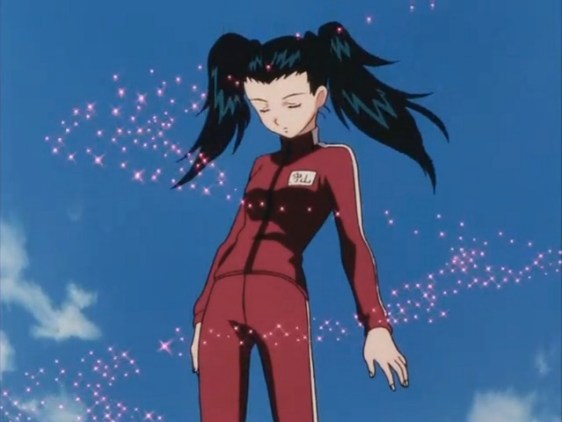

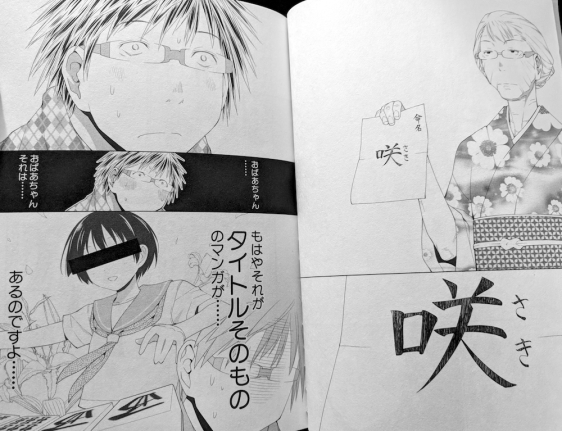 The manga Spotted Flower is more than just a story about a male otaku and his non-otaku wife. To fans of the author, Kio Shimoku, the series is also a thinly veiled alternate universe version of his most famous work, Genshiken. With nearly all of the characters in Spotted Flower having direct analogues in Genshiken, the manga is constantly nudging and winking at the audience. Recently, one of those nudges turned into more of an elbow to the solar plexus, and many assumptions about the series have gone out the window. A story seemingly about marital bliss (despite some ups and downs) has become a tale of adultery, and Genshiken fans are left reeling.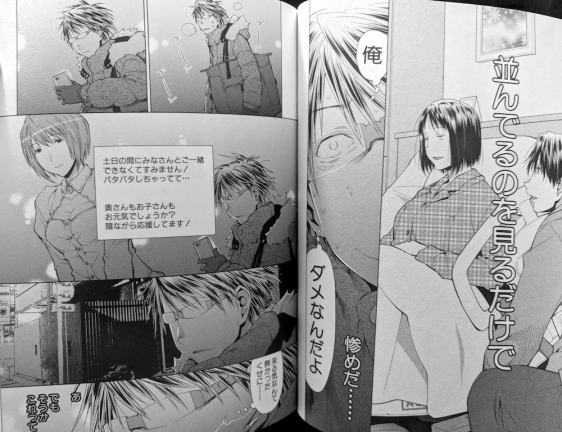


 OGIUE MANIAX