Kio Shimoku Twitter Highlights February 2024

​​Spotted Flower voice comic! Genshiken LINE stickers released! And more from February!

https://twitter.com/kioshimoku1/status/1752718198527681003

Spotted Flower has a voiced manga version now! …Unfortunately, I can’t seem to register for the site no matter how many times I try. If anyone has better luck, let me know!

The cast:

Husband: Hama Kento

Wife: Suegara Rie

Wife’s Friend: Takatsu Haruna

His eromanga is at a stage where the sexy scenes are more of a proper manuscript, while the rest of the book is still in roughs.

Kio submitted the Genshiken LINE stickers for approval.

This isn’t really a Kio post, but Kio retweeted Aoki Ume talking about her illustration for hololive EN member Mococo Abyssgard’s birthday merch.

He had trouble getting approval from the rights holder for his LINE stickers, but he IS the rights holder…


Kio decided to try drawing with a physical pencil again, but it’s a lot more difficult than he remembers. He feels like he’s gotten too used to drawing digitally.

Kio went to the Winter 2024 Wonder Festival!

Last month, Kio drew art for the belly band of the manga Oshibana! Now that title’s author, Shima Tokio, drew art of Not-Kohsaka from Spotted Flower.

The Genshiken LINE stickers are officially out! And it’s even available outside Japan!

Kio hasn’t beaten Elden Ring yet, but he still wants to play the new paid DLC.

That DLC was announced while Kio was just wandering through Crumbling Farum Azura.

Some of the LINE stickers show facial expressions that weren’t visible in the actual manga.

Kio defeated Maliketh in Elden Ring and is about 83% through the story.

He went to a Nagano Mamoru exhibition and enjoyed it. In the end, though, his favorite design is the L-Gaim Mk-II.

Kio left a comment on the A-Koe page for the Spotted Flower voice comic, talking about how shocked he was to hear the spicy lines he wrote being brought to life. He wonders how powerful it’d be if it were ever animated.

He clarifies that the Spotted Flower voice comic has a cinematic element to it using the original art.

BaeDay 2024: The Unceasing Force of Hakos Baelz

February 29 is the birthday of Hakos Baelz, the red-headed rat Virtual Youtuber. Because it falls on a leap year, 2024 is technically her first “official” birthday, and so Bae has turned this past month into an all-out celebration dubbed “Febaerary.” In the spirit of the occasion, I’ve decided to wax poetic about why she’s one of my favorite VTubers and just great in general.

Who is Hakos Baelz?

Hakos Baelz is an English VTuber who debuted in 2021 with the largest VTuber agency, hololive. According to her official backstory, she is the literal embodiment of primordial chaos in the form of a rat girl. On stream, among the things she’s known for are her Australian accent, her outstanding dancing ability, and her strong foreign language skills. Currently, she is a member of the English generation “hololive Promise,” along with four other VTubers.

The Talent of Hard Work

I think the best way to start talking about what makes Bae special is to describe a recent event in her life: She is the first member of hololive English to move to Japan after joining the company. While there are other members who live or have lived in Japan, they were there prior to starting in hololive. But Bae actually made the decision to move away from her caring family and venture out on her own after establishing herself. It’s a hell of a thing for anyone to do, and one that speaks to how serious she is about her VTuber career.

Bae has a ridiculously strong work ethic (to a somewhat concerning degree), and the sheer number of things she can do well often leaves me in awe. She’s an amazing dancer, easily top 3 or higher in all of hololive, with a level of dynamic, yet subtle body control that is literally the best in the company. When I watch her perform, it’s like she moves muscles most others don’t even know exist. 

In response to the prospect of Bae joining Hoshimatic Project—a hololive feature that follows a number of talents as they train for some big group routines—its founder (Hoshimachi Suisei) teased that Bae is “too good” and might be overqualified. Given that a few of the members who participated in Hoshimatic Project are generally considered some of hololive’s strongest dancers, this is high praise.

Bae’s singing, while not the very best in hololive, is still magnetic, and one of her original songs, “Psycho” is among my favorites. And when she brings song and dance together on stage, Bae is just captivating. Her 3D debut onstage at hololive 4th fes was a turning point for her popularity and visibility, as everyone (myself included) got to see her conquer the stage, and things have only increasingly looked up since. Between Bae’s 3D Showcase and numerous other virtual performances, she’s always one of the top highlights of hololive’s concerts.

Bae is also multilingual, being remarkably fluent in Japanese (she’s JLPT N1 and able to converse and banter with Japanese talents), good at Korean through study, and conversational in Cantonese thanks to her family’s background. If that’s not enough, she can even play guitar—and all this at a relatively young age! Multi-talented doesn’t adequately describe Hakos Baelz, and that’s partly because many of those “talents” are clearly born from hard work. 

While Bae doesn’t know any martial arts, I can’t help but think about the actual original meaning of kung fu, which is basically “continuous and sustained effort.” It fits her well.

Developing Her Approach

When it comes to finding the right on-screen persona, it can often take time for a VTuber to figure out what works best for them. In the case of Bae, she started off trying to lean into her lore as the embodiment of chaos by acting as frenetic as possible, but eventually mellowed out into a different and more sustainable approach. The early “character” has receded, and the result is a kind of subdued chaos with peaks and valleys. You never know when her relaxed Aussie accent will transition into a tense ramble or a thrilled squeal, and it makes those moments of excitement that much more special. She also used to hide her Cantonese background, but has more recently been more open about it, and that’s something I appreciate.

Bae is at her most dazzling performing in concerts, but she shines almost as brightly when collaborating with others. This is especially the case when it comes to her fellow Promise members, and doubly so with IRyS, with whom she jokingly goes through a constant cycle of marriage and divorce—a symbol of their close friendship and competitive rivalry. I once described their interactions as combining coffee and soda together, not only because those are Bae and IRyS’s favorite beverages respectively, but because watching and listening to them is akin to just piling on caffeine highs and crashes. 

This is why adding Calliope Mori to the mix to tone them down works so well for their three-person streams, the CHaDcast. Beyond those two, Bae’s banter with Kureiji Ollie (her “mom” due to their similar appearances), Yukoku Roberu (of holostars), and Miori Celesta (her non-hololive VTuber friend) are also memorable and hilarious.

For all her efforts to increase the spotlight on herself, she’ll put in just as much effort to draw attention to her fellow hololive members. After winning 1 million yen through a special hololive raffle, she put all that money towards commissioning the very first all–hololive EN cover song; that includes not only the music itself but also the accompanying artwork. 

Being a Fan

When I watch Bae, I feel a funny combination of admiration, envy, and desire to support. Her accomplishments and her goals make me want to better myself and also see what heights she will reach next. Bae makes her supporters feel like we’re all on a major voyage with her, and as she plants her roots in Japan, I hope we can see her grow and find happiness in her journey. 

Happy “thirteenth” birthday. Looking forward to your 3D Live.

Shinkalion and Japan’s Railway Museum

On my winter 2023 trip to Japan, I happened to do a good deal involving trains and train accessories. This is Part 1 of my experience, focused on the Railway Museum in Omiya, Saitama.

The Railway Museum

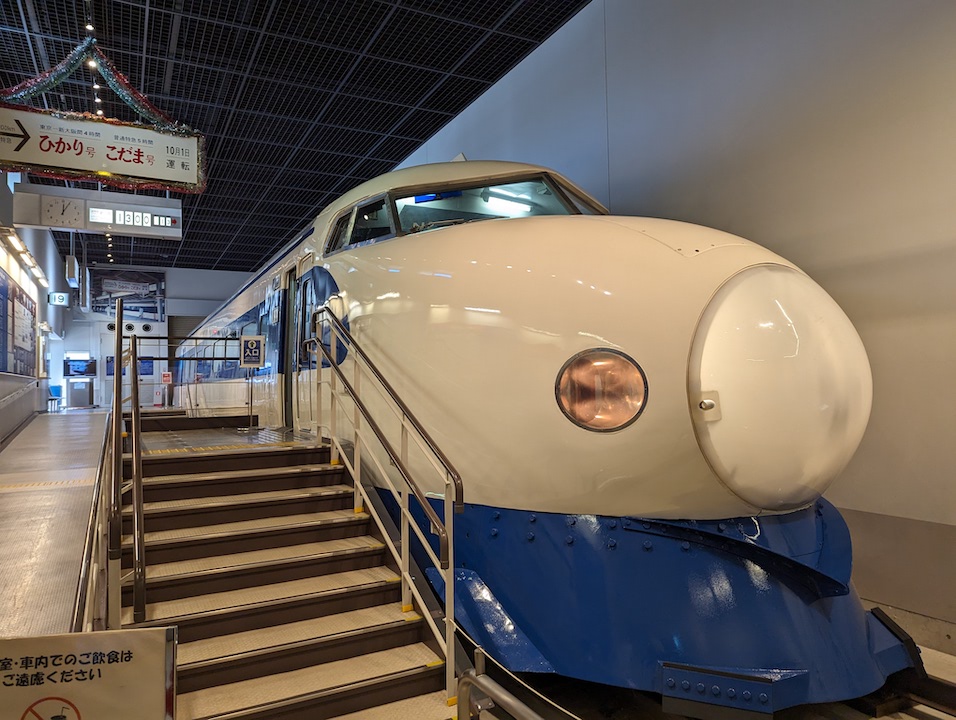
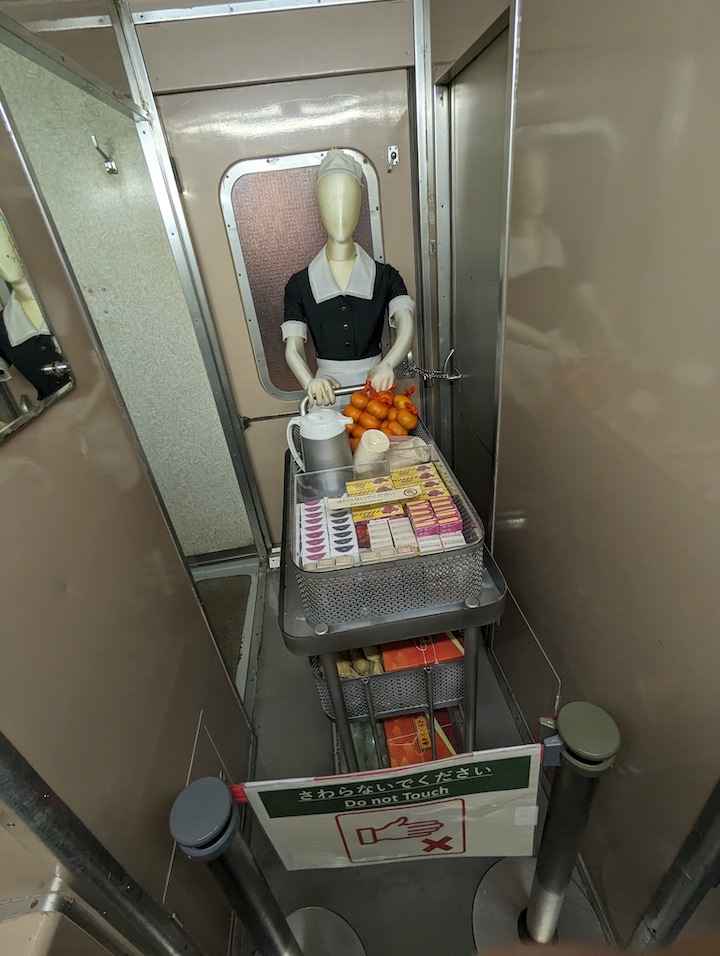
Owned and operated by Japan Railway, the museum features exhibits about the country’s trains, as well as actual decommissioned train cars. Getting to see and even sometimes walk through trains from throughout the history of Japanese rail is a blast that scratches two itches: a fondness for exploring cultural development and a love for large machines. Whether it was going inside the very first bullet train, seeing a train meant exclusively for the emperor, or learning about manually powered carts that utilized laid tracks, I got a lot out of simply being there. 

There was also a restaurant that served authentic train cafeteria foods from the olden days, but unfortunately, I already had lunch plans that prevented me from eating there. I did snag some microwaveable train curry to try at a later date, though (more on that in the future).

One highlight was seeing the kids who loved being there. Whereas some museums typically have adults dragging bored children there, this was not the case at all. These young train fans were captivated by everything they saw, and some even dressed up as conductors. It made me realize that the train otaku of Japan start young—a recurring theme that I saw throughout my trip.

Shinkalion Shorts

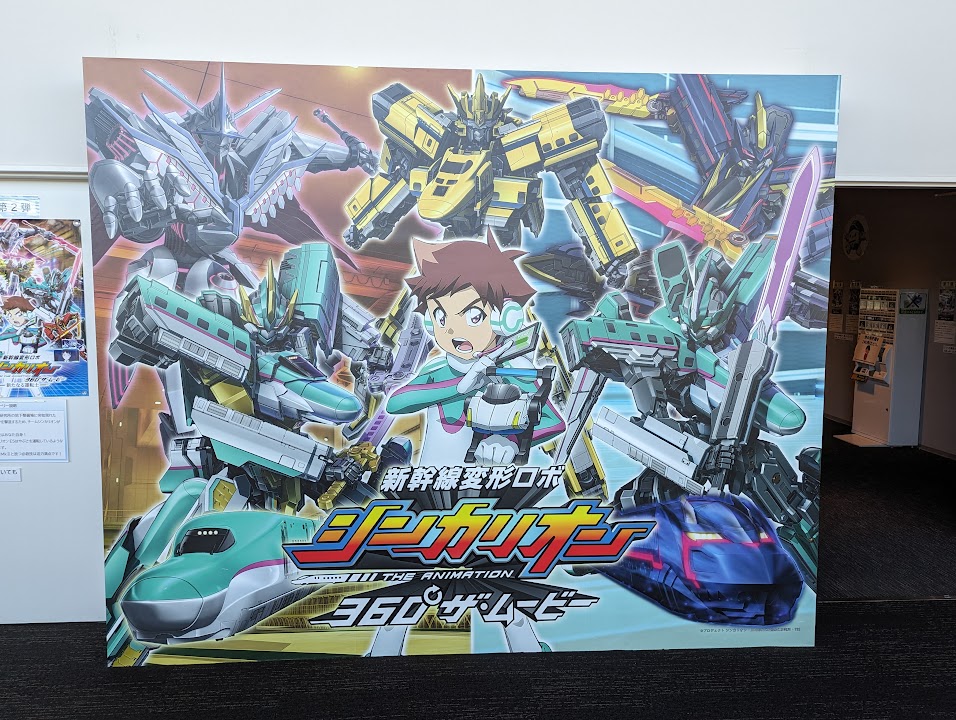
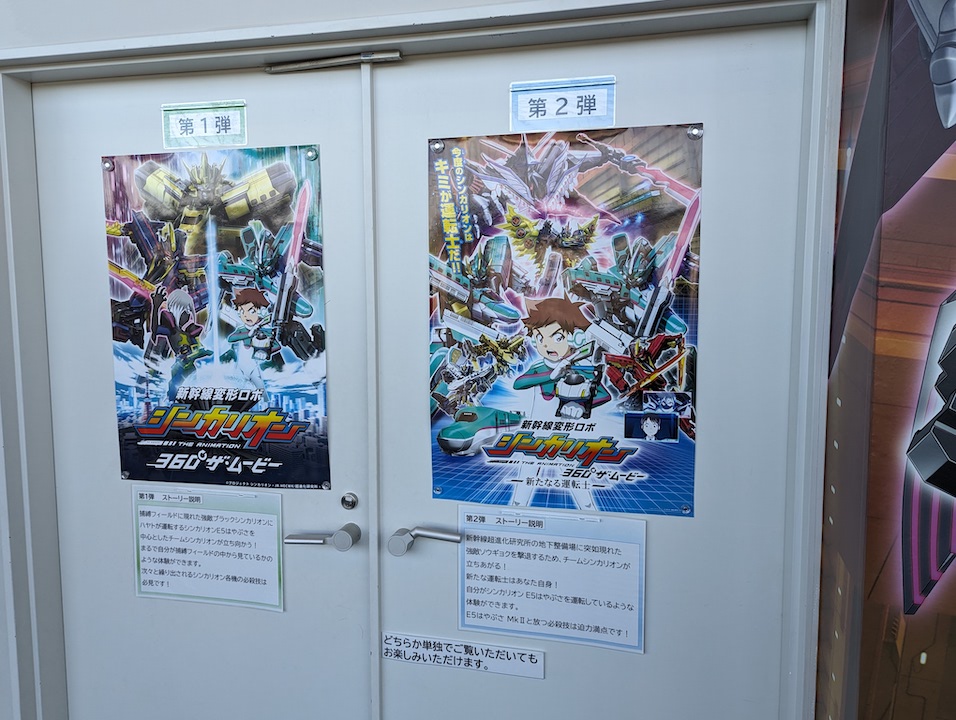
Speaking of kids stuff, I was delighted to find out that the Railway Museum has showings of two shorts from Shinkansen Henkei Robo Shinkalion: The Animation, the mecha anime about transforming bullet trains. Specifically, they’re Shinkalion: The Animation—360° The Movie and Shinkalion: The Animation—360° The Movie: The New Driver. Both cost a little extra—around 700 yen each—with each around five to eight minutes. The seating capacity was quite small (around 20 seats), but I did see some kids and parents watching as well. They also had showings throughout the day, so anyone curious could dip in at their own convenience.

Both shorts take place in the world of the anime, with the second taking place later in the story than the other and including the audience as the titular “new driver.” The main gimmick for these shorts is they’re shot in 3D and (as implied) in 360 degrees. When laser beams go flying, you can look over your shoulders to see it disappear in the distance. They’re fun little things that I’m glad to have experienced.

Coincidentally, the makers of the series actually announced a new anime on Christmas called Shinkalion: Change the World. The characters look a bit more mature than in previous series, and I wonder if they’re aiming for a slightly older audience.

That’s all for now. Look forward to Part 2!

Ganbalance de Desk Job: “Power of Hope: Precure Full Bloom”

With only a few exceptions, Precure has always been resistant to portraying its heroines when they’re older. If they’re middle schoolers, that’s all you’ll ever see them as; if they’re high schoolers, same deal. That’s why one of the 20th anniversary projects, which portrays some of them as adults, came as such a surprise. 

Power of Hope: Precure Full Bloom is a series that brings back the cast of 2007’s Yes! Pretty Cure 5 and 2006’s Futari wa Pretty Cure Splash Star in their 20s, clearly aimed at the original audience of young girls who have themselves grown up. Known as Kibou no Chikara: Adult Precure ’23 in Japan, the story centers on the eight former Precures as working adults. When mysterious shadow monsters start appearing all across town, they discover that they can age backwards to their old middle school selves and transform once again into combat-ready magical girls.

Thematically, one of the biggest things about Power of Hope is the way it portrays a messier and more complicated world than the actual main series of the franchise. In contrast to the generally rose-colored optimism of their youth, the girls are all running into challenges that can’t be solved by sunny dispositions alone. Even those who have basically achieved their childhood dreams see that joy crashing into reality. What’s worse, they are well aware of how little other adults care about their fellow human beings. Rather than concerning itself with girls who are trying to find themselves and what they want to do in life, the anime is more about confronting the cynicism of the “real world,” both locally in Japanese society and on a global scale. Among the topics brought up are overly conservative and sexist workplace bosses, climate change, fear that you peaked too early and that your life is all downhill now, unethical mining in Africa, rampant capitalism, and so on. 

It’s funny to me that this series would come out in the same season as Bullbuster, an anime also about working adults connected to a domain usually seen as kiddy (magical girls, mecha). Like Bullbuster, Power of Hope refuses to say that things will work out in the end—it just hopes we can reach that better outcome. 

The creators of the show clearly put a lot of thought and effort into aging up the girls. Where many series might just make them taller, change their hair a bit, and call it a day, Power of Hope really gives each of them a mature quality that is uniquely their own. In fact, I consider these adult designs to be some of the best I’ve ever seen. The only shame is that they decided not to give them grown-up versions of their magical girl forms. I suspect it was as much a time saver as anything else—it allows the anime to reuse stock footage from the original series they came from. Splash Star kind of gets shafted here just because it’s a digital-paint anime from before the transition to HD broadcasts in Japan, so it really shows its age. 

A number of characters make cameo appearances, and fans of those earliest Precure series are likely to get a kick out of their presence. Of particular interest are the hosts of the online video channel “Dark Night Light,” in which two familiar voices make for surprisingly hilarious comedians. My only real gripe about the guest characters is the fact that Masuko Mika—the old intrepid school journalist—is nowhere to be found.

While the mainline Precure titles touch on some serious topics, they also are not in the business of crushing children’s aspirations. The presence of adversity usually carries a message to not give up because things will look brighter on the other side. But now that those same kids are older, it wants to speak to them as adults. In Power of Hope, it’s more like “some people just suck, but you still gotta work for a better future for yourself and the world.”

Black Jack in the 22nd Century: Gene of AI

My initial impression of the anime Gene of AI was that it reminded me of Urasawa Naoki, manga author of Pluto, 20th Century Boys, and more. Urasawa has a distinct way of drawing characters, and Gene of AI author Yamada Kyuri seems to follow many of his stylistic quirks. But it’s not just the aesthetics that are reminiscent— the robust examinations of humanity and culture are also of a similar vein.

All this might sound like I’m accusing Yamada of being a pale imitation, but I’m not. Gene of AI stands on its own two legs as an interesting piece of science fiction that speculates about a world where artificially intelligent beings called humanoids live alongside humans. Humanoids have their own unique medical challenges, as well as moral and ethical quandaries. In the thick of it all is the main character, a fully human doctor of humanoids named Sudo Hikaru who also secretly performs extralegal treatments for those who can’t go through normal channels.

More than merely asking what it means to be human, Gene of AI examines the complexities that come from a world where equal human rights for sentient AI has long been the norm. The series presents a variety of intriguing problems, like how the artificial limits of humanoid capability and the unknown/volatile nature of human capability can create mutual envy, of how the distinction between humanoid and robot is blurry and imposed from the top down. In this way, Gene of AI bears some resemblance to Urasawa’s Pluto. However, while Pluto is a reimagining of a Tetsuwan Atom story by Tezuka Osamu, Yamada’s series is more like a futuristic Black Jack, all while maintaining its identity as a work of speculative fiction.

There’s more manga than what the anime covers, so I’m hoping we get the next part of the Gene of AI series. In an industry where science fiction is often just window dressing, this is one that challenges viewers to consider more about their world and the future that lies ahead.

Spectacle and Success: Spy x Family Code: White

My winter trip to Japan last year gave me the opportunity to see Spy x Family Code: White, the very first Spy x Family movie. As a fan who has kept up with both the manga and the anime, I was curious to see how they would approach a theatrical release. I sat down with my buttered-potato-topped hot dog and my sour-cream-and-onion popcorn, ready to find out.

Spy x Family is the story of Twilight, an unrivaled master of espionage whose latest mission is to create a false family so that he can get close to a former prime minister, all with the goal of preventing another war from breaking out. To this end, he marries an office worker named Yor and adopts a girl named Anya. Unbeknownst to him, Yor is really one of the deadliest assassins alive. And while neither husband nor wife know the truth about the other, Anya certainly does because she’s actually a psychic. Despite all the secrets, though, the three manage to form a family that on the surface is the envy of all, yet also increasingly seems to be motivated by genuine love and affection.

The recent trend with some Jump series (such as Demon Slayer and Jujutsu Kaisen) has been to adapt an arc or major plot point into a feature-length work, and I wondered if Spy x Family would do the same. However, it turns out that the makers went with a different tack. Rather than going for something canonical, they created an original story. It’s the common choice for mega franchises, e.g. One Piece, Precure, Doraemon, Detective Conan.

In fact, Code: White is pretty much a Detective Conan movie with way less mystery solving and way more action. The story is all right, but spectacle is the name of the game: gorgeously animated chase scenes and fights, a story that takes the trio to ridiculous(ly cool) places, wild stunts, and plenty of explosions. The actual plot developments stretch the limits of what would plausibly keep Twilight and Yor from suspecting each other and wouldn’t be feasible if the movie wasn’t standalone. But given what it is, the makers are allowed to go ham, and they have enough for ten Christmas dinners. It’s a short but sweet popcorn flick.

I think the fact that Spy x Family Code: White is a non-canon entry says a lot about how the franchise is regarded in Japan. Basically, it’s a pop culture hit, almost on par with the heavy hitters. That much was clear even when discounting all the merch available in chains and other big stores to promote the movie. At one point, I stopped in a stationery store that barely sold five manga, and one of those titles just happened to be Spy x Family

It doesn’t look like the hype will be dying down anytime soon.

Kio Shimoku Twitter Highlights January 2024

Tweets for a new year, including the announcement of a planned set of Genshiken LINE stickers!

An Ohno from Genshiken drawing for 2024, the Year of the Dragon.

A Genshiken drawing used for the cover of a 2014 issue of Monthly Afternoon.

Kio considers making Genshiken LINE stickers, and then decides to do some investigating.

Kio discovers late that there was a Sayonara Zetsubou Sensei talk event and exhibition featuring the anime’s voice actors as well as the author Kumeta Kouji. Tsuchiyan, a person involved with Sayonara Zetsubou Sensei’s manuscripts replies to Kio and thanks him. Apparently they’ve met before, back when stuff was original airing.

Kio started wearing a haramaki, a stomach band for keeping warm. People in the replies love Sue.

Kio enjoys a Sayonara Zetsubou Sensei afternoon movie, and plans to watch the evening one as well. (I think this has to do with the SZS exhibit mentioned above?)

A person who is staff for anime radio shows realizes Kio follows her, and gets excited. They’re a big fan of Genshiken. Kio replies that he followed her on Twitter to make sure he doesn’t miss another event like the SZS stuff. 

Kio’s ideas for most of the Genshiken LINE stickers, with him asking for suggestions. I asked him if he was planning on having them available internationally, but he said he didn’t even know that was possible.

The final line-up for the LINE stickers. Many famous Genshiken quotes are in there.

Kio drew the belly band art for Volume 2 of the manga Oshibana. He’s a fan and retweets the author Shima Tokio’s work quite often. Shima thanks Kio, and Kio mentions really liking the main heroine and wanting to draw her.

Kio was smiling all the way while looking at Daydream Hour, the Delicious in Dungeon artbook.

A short comic about building the model kit for Our Treasure’s Magna Palace from The Five Star Stories. Kio also has the comic up on Pixiv.

Wishing Shima Tokio a happy birthday.

Kio saw the live-action Golden Kamuy movie. The bear was properly scary.

Kio read the final chapter of Kuma Miko, and feels a sense of release.

LINE sticker roughs. Kio never thought he’d be drawing Haraguchi in the Reiwa era.

Someone pleads with Kio to get all of Genshiken animated, but Kio mentions that as much as he’d like that, it’s not up to him but anime producers.

Kio got the new Panpanya manga collection, titled Yuriika. He wasn’t able to read the comics in it when they were first being published, but he still take his time and get through them now.

Patlabor, Dai-Guard, and Now Bullbuster

I love me some mecha, and that’s why I want to give my thoughts on the recent giant robot anime that’s been the talk of the internet. I’m referring, of course, to Bullbuster

Was there something else?

Joking aside (Go watch Bang Brave Bang Bravern!), I think 2023’s Bullbuster unfortunately went under the radar in a season and year full of great anime. It’s a mature show, but not in the mocking or edgy sense. Rather, it’s more akin to a salaryman anime with mecha included that, along the way, makes an argument for ethical companies in contrast to greedy corporations and their craven, plundering capitalism.

The plot: Okino Tetsurou is a mecha designer who is assigned to work with a small company called Namidome Industries. He’s a big fan of giant robot anime, and his latest work, the Bullbuster, was created to embody that aesthetic while also being useful for pest control. However, he soon finds out that “pest control” is a euphemism for large monsters roaming, and he learns that Namidome Industries was actually set up to eliminate these creatures so that the displaced residents can return home. However, there are many more hurdles than simply blasting the monsters away—like actually keeping a business running.

Bullbuster is cut from a cloth similar to that of Patlabor and Dai-Guard. While it doesn’t get into the heady philosophy of the Patlabor movies, Bullbuster has that environment of regular people working regular jobs that just happen to involve giant robots. In fact, the mecha are less glamorous than either of those aforementioned series, and they typically come across as more vehicles with robot aesthetics grafted on. That has a charm of its own.

There’s actually an even older work also springs to mind: The Unchallengeable Trider G7, a series about a boy who owns his own company and his own super robot. In its opening, the singer (Taira Isao) asks: “Do we fight to protect our company funds?” He then immediately answers his own question: “NO! We fight to protect the Earth!” Bullbuster is presented with a similar situation, only the heroes are not an ultra-rich kid with nigh-unlimited money like in Trider G7, but rather adults who have to deal with issues like budgets, gaining local support, and other unsexy things. In the process, it becomes a David vs. Goliath story that pits Namidome Industries against the major corporation, whose threat comes not merely from their size but also their prioritization of profit at the expense of all else. One thing I find notable is that while there are moments where the big corporation comes across as possibly just suffering from a few bad apples, it becomes increasingly clear that the rot is actually deep in the roots. 

The main fault of Bullbuster is that it doesn’t look particularly good. Nothing about the visuals whether in stills or in motion is anything to write home about, and the CG used for the monsters looks outdated by a decade or more. Even for someone like me who doesn’t put too much stock into “animation quality,” I think it holds the show back.

Ultimately, what tells me that Bullbuster has an adult perspective is not just the business setting or the lack of teen tropes. Rather, it’s because whatever hopeful message the anime conveys is inevitably tinged with a bit of cynicism that can only come from being worn down by entering “the real world.” Even when problems are solved and people are held accountable, often the ones truly responsible for the harm caused remain protected by power and privilege. Nevertheless, I respect Bullbuster for telling us to not give up.

PS: The singer of the opening is NORISTRY, and he’s actually an utaite, or amateur/semi-pro online singer. If you like the song, he streams and releases covers pretty regularly.

Doraemon the Antifascist – Doraemon: Nobita’s Little Star Wars 2021

On my recent trip to Japan, I watched an anime movie as in-flight entertainment: Doraemon: Nobita’s Little Star Wars 2021. This film is actually a remake of 1985’s Doraemon: Nobita’s Little Star Wars. While I have not seen the original, I have heard that it’s a beloved work in Japan.

Doraemon is one of those Japanese mega franchises that was never part of my childhood, so I hold no particular nostalgia for it. Even so, I do know that the annual movies for enduring mega franchises are big deals (see: One Piece, Detective Conan), both in terms of box office sales and getting major industry names to work on them. For example, in this case, the screenplay is actually by one of my favorite creators, Sato Dai (Eureka Seven, Battle Spirits: Shounen Toppa Bashin).

The basic premise of Doraemon is that a hapless boy named Nobita meets a robot cat from the future named Doraemon, whose main feature is the ability to pull out all sorts of fantastical gadgets: a door that can lead to anywhere, a block of gelatinous konjac that when consumed works as a universal translator, and so on. Nobita, Doraemon, and friends thus get into all sorts of hijinks in general, but in this instance, the adventure comes to them. A diminutive alien named Papi has escaped to Earth because of a coup that threatens his world’s democratic government, and the gang ends up helping out when the coup’s militaristic leader, Gilmore, comes to pursue them. 

I definitely did not expect Doraemon to turn into Voltes V, but the flavor is similar in that both stories turn into the struggle between an oppressor and people who seek to be represented by their government rather than ruled by it. I don’t know if this pro-democracy message is the reason the old film got remade, but given the current state of the world and the rise of authoritarianism, I have to wonder. 

Another thing I noticed is just how much love and care was put into animating Nobita’s friend and crush, Shizuka. I’ve read many times over the years that she is a common first love among kids in Japan, and it feels like the movie really leans into this. 

I came in with few expectations, and got out of it a kid’s movie with a surprisingly important message relevant to this time and all times. Hope it’ll work!

In Search of Hanayo: My “Love Live!” GiGo Collabo Cafe Experience

On my recent trip to Japan, I did the expected thing and went to Akihabara. While there, I spotted a Love Live! collaboration cafe at the arcade GiGO Akihabara Building 3, and decided that I had to go. Not only was it Love Live!-related, but it was actually focused on the OG μ’s girls!

I followed the signs, which led me all the way to the top floor. Curiously, the setup is such that you can’t take escalators all the way. 

Upon entering, I found myself in a small room covered in Love Live! paraphernalia, including posters, gashapon machines, and display cases. As a video played with scenes from the anime, Love Live! Songs could also be heard at the same time, dividing my attention a bit. The actual cafe was hidden behind a door, making it impossible to actually see what it’s like without registering with the cashier there.

In addition to registering a time slot for the cafe, the cashier has another role: accepting payments for even more merch. The goods weren’t limited to the original girls but included all generations, though the only things that weren’t blindbox items were the acrylic stands featuring μ’s in pink outfits. I decided to play the odds a little bit, but as someone who much prefers a guaranteed thing, I also bought the acrylic stand for my all-time fave, Hanayo. Because I bought a couple things, I hit a threshold to also receive a free plastic mini poster with the other eight girls included.

There just so happened to be a time slot available shortly after I arrived, so I decided to put my name down. 

The actual cafe was brightly lit and covered in μ’s art on the walls and the tables. A couple of the voices, Uchida Aya (Minami) and Iida Riho (Rin), had autographed some of the displays. 

The only other collabo cafe/restaurant I’d attended had been for Legend of the Galactic Heroes, which is aesthetically and thematically quite far-removed from Love Live! However, one thing it had in common with the Love Live! cafe is that you could also get merch by ordering food and drinks. In this case, the items consisted of coasters selected at random (of course), with drinks and desserts netting patrons one coaster and main courses two. 

I already had meal plans for later, so I decided to go with just a single Hanayo-themed beverage, which was a soft drink consisting of apple juice and muscat grape jelly (Side note: I learned through this trip that muscat grape is ridiculously delicious). I did not win a Hanayo coaster, but rather one for “START:DASH!!,” which in the anime is the first song performed by Honoka, Umi, and Minami. 

In contrast to my conservative order, other patrons went quite hard. I saw one person end up with around five drinks, two main courses, and I recall at least one dessert (though my memory might be off). Other individuals were similar. However, as someone who never, ever whaled in gacha in mobile form, I was hesitant to do the IRL version any more than I already had. I understand the desire, though.

You can see everything I ended up with (plus a canvas badge of Yugiri Tsuzuri from Hasunora I purchased elsewhere). While nothing there is really mind blowing, I’m glad I got to have this experience, and I’m happy I got to share it today, on Hanayo’s birthday.