Even More Podcast Hijinks: Ogiue Maniax on Anime3000

Two in a row! Who would have thought?

In case you didn’t tire of my voice yesterday, here I am again.

On this Anime3000 podcast, Hisui from Reverse Thieves, Moritheil, and I discuss the Summer and Fall seasons of anime, mainly what shows we’ve watched and what shows we’re looking forward to. More info at the Anime3000 site.

Ogiue Maniax and the Reverse Thieves Talk Otakon on Ani-Gamers

A while back I was on the Ani-Gamers podcast along with the Reverse Thieves where we talked about our experiences at Otakon 2009 this past July in Baltimore. There’s some overlap with my written review of the invent, but I invite you to listen anyway and hear us crack wise in Real Time.

This episode of Ani-Gamers can be found here.

Ogiue Maniax Posts a Mahjong Screenshot, But This Time Actually Explains It

If you’ve been watching Saki like me, you may have been impressed with the sheer improbability of many of the characters’ playing styles. If you’ve been playing mahjong along the way too, you may have lamented that you’ll probably never get any of the mega hands that seem to flow like water for Saki characters.

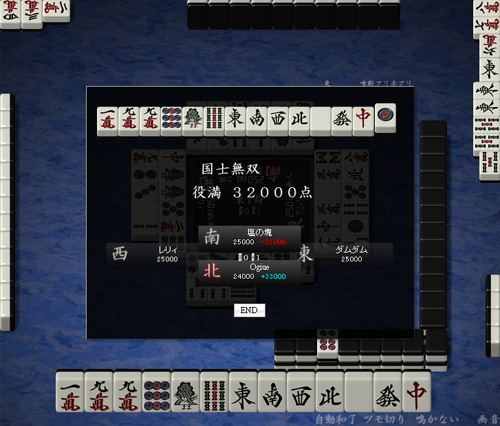
I was like that too, until yesterday when I scored one of the rarest and most difficult-to-achieve hands in the game: Kokushi Musou, also known as 13 Orphans. The hand was so powerful it knocked out one of my opponents in the first round and ended the game instantly. At this point, I almost feel as if I should just stop playing and leave on that very, very high note.

For those of you who know mahjong and are probably much better players than I am, you already know the score. For those who don’t, to properly understand the sheer improbability (there’s that word again!) of a Kokushi Musou hand, I’m going to try to explain it in a way that doesn’t require you to know the rules of mahjong.

Normally in mahjong, you win by having straights and/or three-of-a-kinds as well as a single pair. Most of the hands in mahjong are like this. Kokushi Musou however, cannot be anything but a Kokushi Musou, as the hand actually consists of one pair and then 12 other completely incongruous tiles.

First, what this means is that it is impossible to call on discarded tiles. You may have seen it in Saki or Akagi, where when one player discards a tile another shouts, “Pon!” or “Chi!” or “Kan!” and takes the tile. They are making something, either a three-of-a-kind or a straight or a four-of-a-kind, out of what the opponent had. However, because Kokushi Musou cannot have any straights or three-of-a-kinds, let alone four-of-a-kinds, you cannot call on any tiles without abandoning the attempt to achieve Kokushi Musou. This also means that in order to win, you must draw every necessary tile on your own until your hand is ready to win.

Second, is that while there are other hands which pay just as much as a Kokushi Musou, they usually have a way out, where if the plan to score big fails they can try and fall back on a lower-scoring hand. Kokushi Musou however has no built-in escape routes. If it turns out the tiles you need for Kokushi Musou are 100% unobtainable, then you’re pretty much hosed for the round and you can mount a desperate attack or retreat at best, or you have all the tiles people need to win at worst, which is likely.

Kokushi Musou is called a “Yakuman” hand, essentially an ultimate high-scoring hand. There are also “Counted Yakuman,” where a hand, while not considered one of the Royal Flushes of mahjong, consists of enough high-scoring hands and bonus points to essentially become a Yakuman, not unlike five vehicles combining into a single mighty robot. This Kokushi Musou is my first and only Yakuman ever.

Style Born out of Necessity

In Fred Schodt’s book The Astro Boy Essays, Fred points out that many of the qualities and traits of Japanese “limited” animation (as opposed to Disney-esque “full animation”) could trace their origins back to Tezuka Osamu’s original Tetsuwan Atom anime TV series, a series which was impeded by a staggeringly low budget that all but required these sorts of animaton “shortcuts.” Critics in Japan at that time would remark that the qualities of anime described above, qualities that were born out of necessity, gave anime much of its distinctive Japanese style and that it was in certain ways better than Disney-style full animation.

Of course, not everyone agreed, and others saw the fact that the limited animation style was because of a lack of money, and could not see it as a “style.” Evidently, Tezuka himself had mixed feelings about it: he was happy that these cost-cutting measures allowed him to animate Atom in the first place, but as a loyal fan of Walt Disney it hurt him to be unable to use the full animation he loved so much to bring Atom to life.

There is a sort of latent fear that goes hand in hand with the use of limited animation, and it is the fear of limited animation gone awry: Still frames, camera pans on single images, talking heads, if a show consists of nothing but blatant animation shortcuts, how can it be called animation? From that perspective, the concept of full animation seems safer, but it too carries its own pitfalls, namely “over-animation.” This is where an animation wants to show off its use of full animation so much that everything is animated and nothing ever stays still, to the point that it is difficult to concentrate on what’s actually happening in a cartoon. That’s not to say that it is impossible to do either extreme well, but that ultimately the answer lies somewhere in the middle given the limitations.

A similar problem occurs in 3D animation. Sometimes an animator will work very hard on a scene and it will look visibly impressive and absolutely gorgeous. However, because of the ease of replication in 3D animation, where with a simple switch of the camera angle you can use the same animation or effect and make it seem like it’s entirely new, many animators become tempted. They are so proud of their work that they want to use it again, and again, and again, until it loses all meaning and impact, much like the animators who wanted everything in a frame to move in order to prove just how amazing their animation could be. At this point, the animators must choose to limit themselves, to realize that their tools while seemingly infinite will not produce an infinitely enjoyable experience.

People are boxed in by their limitations, but within those limitations they find ways to improve and to get the most out of what they have. Then, should those limitations no longer be necessary, the people who worked in that style might continue to do so, having honed their technique all those years, and from there it no longer becomes a necessary step but a stylistic choice. Among those stylistic choices are stylistic limitations, to keep a work from being overwhelmed by seemingly endless potential.

What’s amazing about this concept, style born out of necessity, is how often it occurs in art: Tezuka and Tetsuwan Atom leading to the prevalent style of the anime Industry is one example, but you also have video game music of the 80s and 90s giving birth to the “chiptunes” (electronic music made through sound chips, generally the kind found in video games and computers) scene, and even oils becoming one of the de facto forms of paint, among many others. What’s even more amazing is that when you move well beyond the era in which the artistic style was born, well beyond the memories of anyone who was alive to experience that era, you get fresh minds and fresh faces who can approach material with few preconceived notions.

A while back I attended a outdoors chiptunes concert with some friends. While I was enjoying the music myself, I also noticed that a small boy, no more than four years old, enjoying the hell out of the chiptunes. At first I thought it was cute, but then something occurred to me: this kid had been born well after the heyday of the NES and SNES, and so he wasn’t enjoying chiptunes out of some sense of nostalgia, but rather out of the aesthetics he had acquired in the little time he had been alive. It gave me hope that we would be rid of the idea that just because a style was born out of necessity that it would not be considered inherently inferior.

“3D” Super Robot Wars Neo is Very 3D

The first trailer for the Wii-based Super Robot Wars NEO is out, and as you can see from above, the game has gone to great lengths to be a rather odd egg in the SRW franchise. Not only are all the robots being modeled in 3D, something usually shunned by SRW fans as a whole, but the cast list was a surprise to absolutely everyone, and the gameplay itself has seen some drastic modifications which stem primarily from the move to 3D.

The game is no longer boxed in by a grid, and characters have relatively free range of motion across the battlefield. As you can see from the video, each unit has a circle around them, making the game reminiscent of Phantom Brave, while the previous SRW games were closer to Disgaea. There are also many more types of attacks now, rather than just MAP attacks and basic ones which hit one or more units clumped together, as you now also have attacks which have arcs and angles that can go over certain terrain as well as attacks that push enemy units back and so on. And even more intriguing is that the units’ sizes are displayed on the map and even affect battle more readily than their attempt in SRWGC and XO where size difference could make one robot unable to attack another in a critical spot. Size affects many things in NEO apparently, such as attack range and evasion rates, and it’s another example of how much they’re willing to go through with this 3D SRW thing. Oh, and battles can now take place right on the map, a la Battle Chess. That’s pretty cool, I think.

While there are people who say that 3d SRW games are automatically worse, with how ambitious NEO is I want to give it the benefit of the doubt. Besides, it’s only in these non-breadwinning off-shoot SRWs that we get to see the truly crazy casts, and this one is the craziest of all.

Anne of Green Gables: It’s the most wonderful story of an orphaned girl whose life is changed when she is adopted and gets to live on a beautiful farm with birds singing and glorious trees full of splendid color and she meets a girl and they become best friends. Ah, how I wish I could be her! Why, everyday I would

World Masterpiece Theater is a very long-running series in Japan, where famous stories from around the world are adapted into television anime series. Even today new series are running under the World Masterpiece Theater banner, and in practically every case it’s produced a series loved by many and considered to be of the finest quality in Japanese animation. One particularly exceptional series comes to us from 1979: Anne of Green Gables. Adapted from the novel of the same title by Lucy Maud Montgomery, Anne of Green Gables, or “Akage no Anne” as it’s called in Japan, is the story of a young orphan named Anne Shirley and the positive impact she makes upon the life of a pair of elderly siblings, Matthew and Marilla Cuthbert, as well as the little Canadian town of Avonlea in which they live.

Now, I’ve never read any of the novels and never really planned to, but two factors piqued my interest enough to watch the anime. First was the fact that it is so well-regarded in Japan, and second was that it bears one of the more remarkable pedigrees in anime history. The director and first layout artist for Anne are two names you might recognize: Takahata Isao and Miyazaki Hayao. They are the two men who would a few years later found Studio Ghibli, perhaps the most respected and highly acclaimed Japanese animation studio of all time. Also on board were Kondou Yoshifumi on character designs and Sakurai Michiyo, who would take over from Miyazaki on layout. The two would go on to do key animation for various Ghibli titles such as Kiki’s Delivery Service and Porco Rosso (Yoshifumi), Castle in the Sky Laputa (Sakurai), and even direct for Ghibli (Yoshifumi on Whisper of the Heart). Both also did key animation for Grave of the Fireflies. Simply put, this show did not suffer from a lack of talent.

While this was not the first time the duo of Takahata and Miyazaki had worked together, nor was it the first time they had done any World Masterpiece titles, Anne of Green Gables is one of the best examples of what they were able to accomplish. Anne of Green Gables takes full advantage of its fairly episodic format by making each and every episode a joy to watch either on its own or in large chunks of multiple episodes. It makes the show approachable at any stage, and the show becomes a pleasant yet compelling experience, especially when you factor in Anne Shirley herself. Anne, who introduces herself as “Anne with an E but I’d rather be called Cordelia,” is a shining example of a main character who just carries a story. All of the other characters are good too, mind you, from Anne’s best friend Diana to the rascally Gilbert Blythe, but her name’s in the title for a reason.

Anne’s most endearing trait is probably her tendency to get caught up in her own imagination. When combined with her love of storytelling, it results in seemingly endless declarations of love and hate, with flares of drama or comedy or passion depending on how she’s feeling and where her sentence construction is taking her. Anne is never satisfied with a simple story, and will turn even simple lies into elaborate tales just to fulfill her sense of the dramatic. Give her one episode and you’ll be likely be drawn into her world.

Anne of Green Gables is not only one of the most beloved novels of all time but also one of the most beloved anime of all time. Just this very year, the prequel novel Before Green Gables was adapted into a currently-running TV series to celebrate the 30th anniversary of the original anime. 30 years is a long time, but Anne of Green Gables has aged very gracefully. Kannagi director Yamamoto Yutaka said at one of his Otakon 2009 panels that he considers Anne to be the best example of how to do a long television anime series, and while I cannot say it is the best, it certainly sets a good precedent. In fact, my only real regret with this series is that we are no longer able to see Miyazaki and Takahata use their talents on television series, as they’ve moved on to feature films and almost nothing else.

Anne of Green Gables has a level of quality and accessibility that few anime can live up to, and just as the original novel still carries relevance today, so too does Akage no Anne.

Bokura no Garadoubla

One of the most amazing and shocking reveals in the world of giant robot villainy was the discovery that Mazinger Z’s infamous first two adversaries, Garada K7 and Doublas M2, were actually once a single sentient entity known as Garadoubla. Garadoubla turns out to be a heroic figure to the Mycenae and also a warrior of honor and pride (and also three heads). In fact, he was so beloved that they referred to him as the Hero Garadoubla. Thanks to extensive research, I have unraveled more information on this god of the Mycenae.

Archaeological evidence shows that Garadoubla was to the Mycenaeans what Mazinger Z is to the modern Japanese. Children would play with clay dolls fashioned after Garadoubla’s visage. Musicians would sing about the strength, size, and reliability of Garadoubla when he unites the power of justice, love, and friendship. The most famous of the songs celebrating Garadoubla began with the following opening chorus:

Ga Ra Ra! Ga Ra Ra! Garadoubla! Ga Ra Ra! Ga Ra Ra Ra Garadoubla!

According to records, the heroic tales of Garadoubla, the honorable warrior of the Mycenae, were recorded on ancient illustrated stone tablets by a well-regarded artisan known as Gonagacles. Sadly most of his work was destroyed in the great fire that exterminated the Mycenae Empire, but the memories of his adventures would remain in the Greek consciousness and would eventually be retold as Garadoubkaisar and Etumos Garadoubla.

Tomino vs Imagawa, NYC vs Atlanta

Anime Weekend Atlanta has announced that one of their guests of honor will be Imagawa Yasuhiro, acclaimed director of the Giant Robo OVA and the currently-running Shin Mazinger TV series. AWA is running this year from September 18-20.

Meanwhile, New York Anime Festival, running September 25-27, has already announced famed Gundam creator and director Tomino Yoshiyuki as its guest of honor. If you’re a fan of giant robots and you don’t have the time or resources to go to both, this can be a very painful decision to make.

To help you with your dilemma, try asking yourself the following two questions.

Question 1: Do you love Gundam?

Question 2: Do you love G Gundam even more?

I Am/Am Not an Otaku: The Reverse Thieves’ Otaku Diaries and the Definition of Otaku

After an initial introduction of the demographics of those who chose to partake in the Otaku Diaries, the Reverse Thieves have released the second part of their study. This time around, the discussion centers around the word “otaku” and what it means to anime fans.

A large number of their results showed that many anime fans consider the word “otaku” to have negative connotations and may even be upset if someone referred to them as an otaku. It is, in other words, an insult. Sometimes, the negative connotations come from wanting to distance oneself from the “other” anime fans, e.g. socially inept naruto fans, and other times they stem from wanting to use the word as the Japanese use it. Of course, I can’t be the only one to see the irony in a person denying that they’re an otaku while also championing the true, JAPANESE definition of the word, or at least their interpretation of the Japanese definition.

I remember years ago when I was part of a Pokemon community on the internet (the Team Rocket Headquarters if you want to know), where one of the site owners got very upset whenever someone called him an otaku, insisting that the term was in reality extremely derogatory and that it should only be used for the most extreme cases of anime fandom. It was around that time that I began developing my hypothesis on the Path of  Otaku Self-Acceptance, or the path the typical anime fan takes when confronted with the term “otaku.”

Phase 1) I Want to Be an Otaku!

This phase is usually the first one that new anime fans feel. Anime is fresh and exciting, and they want to see more and more of it. They consider the status of “otaku” to be a goal to strive for. However, if they start to sour towards the anime community they may enter…

Phase 2) Don’t Call Me an Otaku!

This is the point at which you find many of the subjects of the Otaku Diaries, as well as many anime fans you know. Sometimes they genuinely are just not that into anime and don’t want to be considered hardcore fans, but often times you see that many of the people who fall into this category are simply in denial. They hide their anime fandom from others as hard as they can, and they will put on airs so that no one can discover their terrible, terrible secret. Eventually, some of them pretend not to be otaku so hard that they permanently make the switch. Others, however, may grow tired of the charade and come to acceptance. That is what leads them to…

Phase 3) I am an Otaku

This is the point at which people realize that “Otaku” is just a descriptor. It is no more a self-inherent badge of shame or badge of pride than any other part of a person’s life, like saying “I am short” or “I work in construction.” It’s where I hope to see more anime fans, and I believe it’s the key to becoming true to oneself, provided you actually are an otaku.

I am an Otaku. Are you?

Another Legend is Born