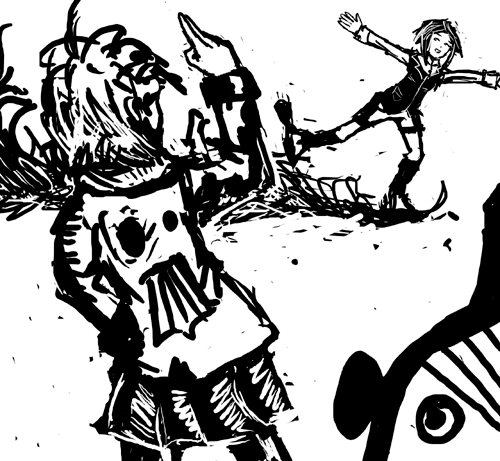
Ogiue the Moldbreaker

My fondness for Daidouji Tomoyo predates my obsession with Ogiue by a number of years. At one point, pre-Ogiue, I was talking with someone online, who mentioned that in his opinion Hotaru from Sailor Moon is a “better” Tomoyo. I held nothing against him despite his being completely wrong, but remembering this brief conversation got me to thinking about how many characters I would call variations of Ogiue’s character-type. Ogi-esque, if you will. After much deliberation, it dawned on me that no such other characters exist. Other fujoshi characters bear little resemblance to Ogiue, and are typically much more cheerful. It’s easy to call Ogiue a tsundere, but her tsundere is like nothing else. It’s not even a stronger type of tsundere, like with Kugimiya characters, but it’s a unique flavor full of body and depth that leaves you satisfied.

I think it has to do with Ogiue being a very balanced, well-rounded character. She has this mix of passion and repression that comes out in everything she does. Her simple one-word responses speak volumes as to the kind of person she actually is, particularly because throughout the story she tries her best to hide her true self. And certainly there are characters who often don’t say what they actually think or feel, but this attribute occurs much more frequently on far more aggressive characters.

Or maybe I’m just incredibly biased. Which I am. But I’m still right.

A Source Not Worth Citing

According to MSNBC’s recent article on anime and otaku culture, not only is anime NOT KIDS’ STUFF, but apparently lolicon is short for “lolita + comics.” Oh, and Gurren-Lagann and Urotsukidoji can be mentioned in the same breath with ease.

The writer makes some valid points, such as the division between 2d and 3d among a portion of the otaky population, but It does no one any favors when a mainstream news service such as MSNBC posts an article full of logical leaps so astounding they’d have taken the gold at Beijing. Students of all ages eager to write their school essays on anime, or even relatively inexperienced academics trying to examine fandom from a broader scale might actually take this article seriously. And if anime-related academia on any scale is ever going to improve, we need to not have yet another “BAM! POW! COMICS AREN’T JUST FOR KIDS ANYMORE”-type article, no matter how dressed up it is with hipper, modern references like Gurren-Lagann or Akihabara.

また馬から落ちてしまった: Continuing Adventures in JLPT2 (Non-)Studying

I’ve registered for the JLPT2, which happens December 7th, 2008. As a reminder, registration ends around September 20th, so get a move on it if you plan on seeing just how much Japanese you know while under the pressure of a test environment with a test purposely designed to fool you.

After Otakon, my studying had dropped significantly, and I found myself forgetting kanji i thought I knew. Alarmed, I became determined to study more with the help of a friend. I answered some sample questions from the JLPT2 and got most of them right. However, being correct doesn’t matter if you don’t actually answer all of the questions, and this is where I learned the harsh reality of the JLPT2: It is a LOT of questions in very little time. One section wants you to answer 100 questions in 40 minutes, leaving you actually less than 30 seconds per question. Granted, you only need to get 60% of the test correct in order to pass, but the pressure of that time limit is so harsh it’ll cause me to lose 2 PP every time I attack.

I also have been trying to improve my listening comprehension, and decided to be all hardcore about it and listen to the Nikkei News Podcast. What I learned is that I can understand Japanese commercials (or rather the between-news-segments promos) a hell of a lot better than I can understand news about business and economics. Maybe if I listen to it 10 more times I could actually understand 50% of it.

it’s only a few months away so I need to buck up and study more. You may or may not see a decrease in post that are actually about anime.

Love the Robot: Dreaming of Great Mecha Anime

In a dream a few nights ago, I found myself sitting in a restaurant tasked with making a list of attributes necessary for a great giant robot anime. I didn’t get very far in the list, being able to only list one tenet of a great mecha anime, but it sat very prominently in my mind, even making it past my dream memory into reality, something that sadly does not happen to most of my dreams.

Rule #1 of great giant robot anime: Giant Robots have to be important.

It wasn’t those exact words, but the whole point of this first rule is that you cannot call something a good giant robot anime if the viewer believes that the show would be better without giant robots. This is not to say that any show is made better with giant robots (Kannazuki no Miko is proof of that), or that a show without giant robots is somehow worse. Nor is it to say that giant robots have to be prominently displayed in the anime.

What there cannot be is disdain towards the giant robot from the creators and viewers. The giant robot cannot be pushed to the ignored or regarded as some kind of detriment to the show itself.

This came to me in a dream, but I realize that I believe strongly in it. As for rules 2 through 10 and beyond, well who knows. Rule #1 might be all that’s truly needed.

Beyond the T-Shirt: Otaku Apparel, or Lack Thereof

The stereotypical image of an otaku is an overweight or underweight person wearing a t-shirt sporting an anime character on the front and possibly the back. Pants-wise, he’s wearing some kind of jeans or shorts or something. Maybe this is draped in a beat up black trenchcoat in an attempt to look cool. Otaku tend not to be known as very fashionable people unless they’re in the midde of cosplay. One look at anime-themed clothing however, and you begin to realize that it’s pretty much all t-shirts. I think the problem lies not with the otaku’s lack of fashion sense, but simply the fact that there is not enough variety in clothing for otaku to proudly display their fandom.

Uniqlo, with its Shounen Sunday 50th Anniversary, and the recent Pokemon 151, have both been attempts to push this kind of geek apparel into higher fashion, but in the end they’re still t-shirts. You also have the clothes which only vaguely hint at their relationship to anime, and those are fine for what they are, be they from Hot Topic or a super nice Eureka Seven t-shirt (seriously I love those). What I want to see though is clothing that clearly shows its anime roots that can be worn for different sorts of occasions and for different effects.

Why not some polo anime shirts? Why not pull the anime logos and character away from the shirt and towards the pants and skirts and dresses? Then, change up the types of pants. Why not have pair of capris pants with Kenshin on the side or something, for you Hitokiri Battousai fans? Rather than having a Lucky Star t-shirt with a school swimsuit on it, why not have a vest which when buttoned up resembles that swimsuit? You have the Hello Kitty business suit, but why not the Golgo 13 business suit, made to look just like Mr. Togo’s?

I have no intention to hate on the anime t-shirt. I simply lament the sad and lonely state of its existence. If only some kind-hearted designer would take its proverbial rib and create for it an Anime-Clothing Eve, all would be well.

And no, the shoulder bag is not Anime-Clothing Eve.

A Guide to the Characters of Xam’d: Lost Memories

Takehara Akiyuki

Nishimura Haru

Nakiami

Teraoka Furuichi

Nazuna

Kakisu Toujirou

Benikawa Ishuu

Dissidia: Final Fantasy has an AMAZING voice cast

I’m not the biggest Final Fantasy fan, but watching the new trailer for the upcoming PSP crossover Final Fantasy fighting game, Dissidia, I came out completely blown away by the voice cast. It is one of the best voice casts you will EVER see in a video game, take my word for it.

I couldn’t find a single guide, so for my convenience and yours, here’s a list of all voices revealed so far. As more voices and characters are announced, I’ll continue to update this list.

By the way, the names are spelled as they are on the official site, so don’t complain that Kefka is Cefca, I’m just going by what’s there.

Last Updated 10/16/2008.

Warrior of Light (Final Fantasy): Seki Toshihiko (Legato Bluesummers, Trigun)

Frioniel (Final Fantasy II): Midorikawa Hikaru (Zelgadis, Slayers)

Onion Knight (Final Fantasy III): Fukuyama Jun (Lelouch Lamperouge, Code Geass)

Cecil Harvey (Final Fantasy IV): Hodoshima Shizuma (Jonouchi Hisashi, Boogiepop Phantom)

Butz Klauser (Final Fantasy V): Hoshi Souichirou (Kira Yamato, Gundam SEED)

Tina Branford (Final Fantasy VI): Fukui Yukari (Nia Teppelin, Tengen Toppa Gurren-Lagann)

Cloud (Final Fantasy VII): Sakurai Takahiro (Kururugi Suzaku, Code Geass)

Squall Leonhart (Final Fantasy VIII): Ishikawa Hideo (Uchiha Itachi, Naruto)

Zidane Tribal (Final Fantasy IX): Paku Romi (Edward Elric, Fullmetal Alchemist)

Tidus (Final Fantasy X): Morita Masakazu (Rail Tracer, Baccano!)

Shantotto (Final Fantasy XI): Hayashibara Megumi (Ayanami Rei, Neon Genesis Evangelion)

Cosmos (Dissidia Final Fantasy): Shimamoto Sumi (Nausicaä, Nausicaä of the Valley of the Wind)

Garland (Final Fantasy): Utsumi Kenji (Raoh, Hokuto no Ken)

Emperor of Palamecia (Final Fantasy II): Horiuchi Kenyuu (Jamil Neate, Gundam X)

Cloud of Darkness (Final Fantasy III): Ikeda Masako (Maetel, Galaxy Express 999)

Golbeza (Final Fantasy IV): Kaga Takeshi (Chairman Kaga, Iron Chef)

Exdeath (Final Fantasy V): Ishida Tarou (Count Cagliostro, Lupin III: Castle of Cagliostro)

Cefca Palazzo (Final Fantasy VI): Chiba Shigeru (Narrator, Hokuto no Ken)

Sephiroth (Final Fantasy VII): Morikawa Toshiyuki (Hayami Masumi, Glass Mask 2005)

Ultimecia (Final Fantasy VIII): Tanaka Atsuko (Kusanagi Motoko, Ghost in the Shell)

Kuja (Final Fantasy IX): Ishida Akira (Xelloss, Slayers)

Jecht (Final Fantasy X): Amada Masuo (Manev the Gale, Trigun)

Gabranth (Final Fantasy X): Ohtsuka Akio (Batou, Ghost in the Shell)

Chaos (Final Fantasy): Wakamoto Norio (Cell, Dragon Ball Z)

Narrator (Dissidia Final Fantasy): Sugawara Bunta (Kamaji, Spirited Away)

Updated for Dissidia Duodecim:

Kain Highwind (Final Fantasy IV): Yamadera Kouchi (Spike Spiegel, Cowboy Bebop)

Gilgamesh (Final Fantasy V): Nakai Kazuya (Mugen, Samurai Champloo)

Tifa Lockhart (Final Fantasy VII): Itou Ayumi (Tifa Lockhart, Final Fantasy: Advent Children)

Laguna Loire (Final Fantasy VIII): Hirata Hiroaki (Sanji, One Piece)

Prishe (Final Fantasy XI): Hirano Aya (Suzumiya Haruhi, Melancholy of Suzumiya Haruhi)

Lightning (Final Fantasy XII): Sakamoto Maaya (Kanzaki Hitomi, Vision of Escaflowne)


When You Have Free Time, You Can Either Watch Anime or You Can

You heard the lady.

My Friend the Nattou

Following a Sunday where I delighted myself with a traditional Irish breakfast (blood pudding is delicious), I spent Labor Day with friends at the New Jersey Japanese-based Mall known as Mitsuwa. The last time I was there was over a year ago, and I looked to relive some of that experience, particularly when it came to my dining experience. I knew before I even went that I had to get the Nattou Set, otherwise known as a traditional Japanese breakfast. And just as the idea of a pudding made of blood turns some off, so does the sticky stringy fermented soybean dish known as nattou.

I am well aware of the fact that nattou is easily purchasable in New York City, but I tend to not buy it these days as a courtesy to others. I owe a lot to nattou, as it was the key food in keeping me healthy and keeping my wallet fat while I studied in Japan. It is perhaps as important to my time in Japan as my bicycle and Ogiue (Ogiue riding a bike while eating nattou?) The traditional nattou-based breakfast is a combination of rice, nattou, and raw egg. Each bite was a combination of satisfaction, strong-yet-pleasant flavor, and nostalgia.

It is delicious, if you’re me. A friend of mine who accompanied me to Mitsuwa knew of my affinity for nattou, and so he decided to try it for the first time. One whiff and he decided to hand it over to me. I was happy to oblige.

As an aside, I thought of purchasing some manga or something while I was there, and I had my eye on a volume of the original Japanese Kino’s Journey light novel. I then realized that, having seen the anime, I already knew much of the story and decided to hold off on it, at least for now. Oh, but Volume 7 of La Sommeliere is out. I’m only up to volume 3, so I can’t jump the gun just yet. Sadly I couldn’t find Patrick Macias’ “Otaku in USA,” though I’m sure Kinokuniya or something has it. No worries there.

The Right Way to Do “VS” Arguments

Who would win in a fight, Kenshiro or Golgo 13?

Lina Inverse or KOS-MOS?

Toilet Paper or a Snickers Bar?

I love this sort of argument generally, but it’s generally considered in very poor taste by large parts of fandoms, tired of seeing them. It is considered a useless endeavor, be it in the “unstoppable force vs immovable object” sense, or just being futile and biased based on favoritism by the people arguing. , but there is a wrong way to do it, as stated, and there is a right way to do it, which begins with realizing its uselessness is not a problem at all.

At the end of the first Phoenix Wright game, and this is the point where those of you who haven’t played should turn back in case you don’t want to get spoiled, the message given is that in a court of law the prosecution and defense aren’t working against each other but with each other to arrive at the truth. This is what you should be doing with VS arguments, except that there’s clearly no actual truth. You may want to reach for it, but the goal is not to grind the other person underneath your forum avatar’s heel. The real goal instead is to build upon each other’s arguments and logic and to challenge each other’s opinions in order to promote critical thinking, even if it’s all in jest.

There’s never really a loser in VS arguments, and that’s the fun of it. Work on opposite sides, but work together, just as Phoenix and Edgeworth* do.

*Substitute their Japanese names if you so feel inclined.