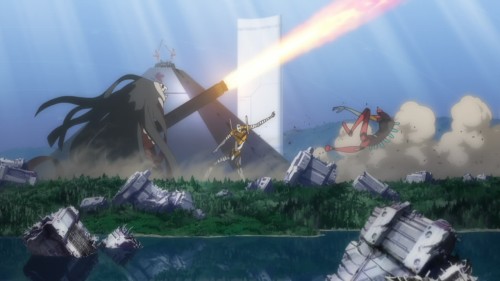
THE COMIPO TRIAL EXPIRES TODAY SO HERE IS ONE LAST HURRAH


In case this somehow convinces anyone to purchase it: Official Site

If you want to see true mastery of Comipo, head over to Dave‘s Kawaiikochan Gaming no Korner.

Return of Comipo

Appreciating Fandom at Nishicon 2011

This past month I had the opportunity to attend an entirely brand-new anime convention in the Netherlands, Nishicon.

Taking place in the city of Haarlem, Nishicon was held in a kind of sports gymnasium, which meant a few things. First, the primary form of seating was bleachers, which given the small con population (though by no means a disappointing turn-out) actually made for very convenient seating. Practically everything took place on that central floor, with workshops and video games being the only exceptions, so it was easy to move from one thing to another. If you were on the main floor, it was essentially impossible to avoid hearing the cosplay and AMV competitions, which seemed more of a close gathering of enthusiasts than the massive arena-filling extravaganzas of a large or even medium-sized American anime convention. When the AMV contest was taking place, every so often I could peer over to the other corner of the room and catch a glimpse of it.

Another feature of Nishicon was the bar and maid cafe, which like “Anime Con” in  Netherlands (and unlike New York Anime Festival) allowed the maids to serve its customers. This maid cafe is run by a different group than the one from Anime Con, and in speaking to one of the head maids I found out that they were looking to differentiate themselves from other maid cafes at Dutch anime cons by providing a more interactive experience. In addition to custom snacks (alongside the standard Dutch bar fare, beer, frikandel, kroket, etc.), they also provided a chance to play card games and board games, as well as provide a shoulder massage which only cost 2 euros.

Speaking of cost, I’ve noticed that Dutch cons seem to provide much more affordable food options than their American counterparts. While a tad pricier than just going to an automat, a broodje kroket (croquet on a roll) cost me a mere €2.50 or so. While I don’t know the exact reason for this, I have to imagine that it’s because every convention I’ve been to so far has had some sort of fully stocked bar attached to it, and they simply charge the prices they normally would. That said, if you’re coming from the United States watch out for the dollar to euro conversion rate.

I bought one piece of merchandise at this convention: a card game called “Manga Manga” (no relation). As you can see from the box, it has Action Power.

Outside of the AMVs and the cosplay, there were no big “events” or panel programming. For me, this is quite unusual, as I primarily spend my normal convention experience darting from panel to panel, with breaks for food and checking out the dealers’ room. As a result, this meant that if I were to enjoy myself at Nishicon, it would have to be at a relaxed, non-goal-oriented pace. In that regard, I think Nishicon was quite successful for me. I was able to play Go for the first time (and lose, naturally). I spoke to people at tables, asking them what they thought of the convention, one of whom mentioned that it’s fortunate for a convention to be located more towards the western side of the country). I found myself at a drawing area (run by the fine folks at mangaschool.nl) next to people I didn’t know, putting to paper whatever came to mind. It was actually the first time in a long while that I’ve drawn that much, and that made me feel good (or bad, depending on how you look at it).

What it all came down to for me was that the “lack” of major events made me participate in the convention the way I think most con-goers in general do. The point isn’t to listen to fans and creators talk about some aspect of anime and manga, nor is it to expect some “thing” out of it. That vital aspect I think people are looking for is the simple pleasure of being surrounded by others with the same passion for anime, and that is something that can be experienced by just sitting around other anime fans. Don’t get me wrong, I love attending Otakon, but I would not have ever sat down there next to other artists (aspiring and otherwise) in order to just relax with pen and paper.

Before I leave off with a barrage of photos, I want to mention something that might make some people feel a tad salty: did you know that Michiko & Hatchin was released in the Netherlands but not the United States?

The Evangelion Pilots, Represented in Combat

I’ve been revisiting Neon Genesis Evangelion lately and have come to appreciate it in ways that I hadn’t before. While I always found the show to be especially good at showing the deep-seated fears and emotions within the characters to the point that they feel almost tangible, I’ve begun to take note of how well the characters’ words and actions exemplify their personalities.

One example that stands out in my mind comes from Episode 19, the famous episode where EVA-01 goes berserk and eats the enemy angel, Zeruel. When Zeruel descends upon Tokyo-3, it is first met by a barrage of artillery fire from Asuka and her EVA-02, just weapon after weapon after weapon, with Asuka getting progressively angrier until she is defeated. Rei then appears, her EVA-00 missing an arm, and charges at Zeruel with a powerful bomb with the plans to detonate it at point blank range. Later, right before Zeruel can attack the staff of NERV, Shinji bursts through and engages in melee combat, then loses power, then goes berserk. What I’ve come to realize is that the way each character fights in that scene represents them incredibly well, acting as more than just a visual spectacle.

Asuka is always looking to prove her self-worth, particularly as a pilot and as compensation for her traumatic childhood, and her desperation mounts increasingly as more and more weapons are deployed by the EVA-02. This loud, brash display of firepower is Asuka.

From the way everyone else reacts to seeing Rei carry the N² Mine, it is clear that no one knew of this beforehand, which means that the idea is entirely her own. Rei, who constantly questions whether or not she is human at all, has very little regard for her own life.

Shinji fights with a form of desperation different from Asuka’s, and as one of his core traits is a vague sense of self-identity, Shinji’s close combat perhaps shows his desire to gain an identity through the piloting of EVA-01. This also differs from Asuka because Shinji is not looking to prove himself, but rather to find himself. It might also be possible to say that the berserk scene itself shows Shinji’s tendency to be pulled along, though I’m not sure about that one.

I think the best indicator for how much this particular moment in Evangelion represents the inner feelings of its characters comes from a comparison to the redone scene in the second Rebuild of Evangelion movie. In it, Mari replaces Asuka in EVA-02 for the film’s iteration, and the fight begins in a similar fashion, with EVA-02 surrounded by firearms which Mari initially uses one after the other. However, the scene itself feels remarkably different. Mari uses each weapon more slowly and deliberately, never really reaching the intensity that Asuka did in the TV series, and after only a few decides to run in up close with a melee weapon. The method Asuka used is something only Asuka can do; it would not reflect Mari’s character.

As for Rei and Shinji, their changes highlight more of a subtle shift in character, a fundamental part of the new films. Rei, just like the original, attempts to defeat Zeruel by detonating a bomb at point-blank, but in this version Rei takes the time to push Mari and the EVA-02 out of the blast radius while thanking her, showing that her actions do not simply stem from doubting her own humanity but from also affirming the humanity of others. Shinji’s fight is initially similar, but as I once mentioned in my review of the film, Shinji never loses control, the “berserk” EVA-01’s actions conscious and deliberate on the part of Shinji. While he still seeks his own identity, he is able to set that aside to save Rei, establishing a stronger identity in the process.

I’d like to actually end by talking about Mari once more, because as I was making this comparison I realized the role she plays relative to the others in terms of their relationship to the Evangelions. Asuka pursues self-worth, Shinji self-identity, and Rei a connection to humanity, but Mari seeks pleasure in the act itself. She revels in being an EVA pilot in and of itself, with no seeming underlying motivation except perhaps some strange desire to experience life to its fullest. Her “bestial” fighting style, even before she activates the actual “THE BEAST” mode, is indicative of this. That Evangelion is able to cut to the core of its characters in even its action scenes makes it truly impressive.

The “Nervous” Visual Style of the Boku wa Tomodachi ga Sukunai Manga

Last week I wrote a post comparing the Boku wa Tomodachi ga Sukunai anime and manga (neither of which are the original source material) and showed that I have a clear preference for the manga and its visual style. I gave image comparisons to try and show exactly what I meant, but while some readers got it, I noticed that others were still confused as to why I think the manga looks better, especially because of how “rough” the art is in comparison to the more “stable” designs of the anime. Because of that, I’m going to elaborate on why I find the visuals to be more interesting and more aesthetically pleasing so that even if people disagree with me, I think they can see where I’m coming from.

Let’s start with a visual aid, the first panel in Chapter 19. This time, I’m using an untranslated version of the manga because the points I’m making don’t have anything to do with what Sena is saying, nor does it have a mirror scene in the TV series. I want to emphasize that I do not think the anime should necessarily look just like the manga. This is just straight-up analysis of the manga without having to compare it directly to the anime. If you want more of that, you can check out JP’s response to my comparison.

Sena is cropped from the chest up in the panel, and we can clearly see that she has large breasts, but the thing that stands out most in the entire panel is her expression. She’s blushing heavily, her eyebrows are furrowed in an unusual manner, her eyes are to the side, and her index fingers are touching each other, all indicating that Sena is quite nervous. You can tell that as she’s talking, she’s in an uncomfortable position for whatever reason. That nervousness takes absolute priority over the fact that she has a nice body, and so it becomes the most noticeable thing about her in that panel.

While the line quality of the manga doesn’t approach Robert Crumb levels of jittery, it still creates an interesting sort of tension in the comic. The “sketchiness,” as I’ve seen some people refer to it, results in characters and environments that indeed make the art look “incomplete” if you associate completeness with firm inks and closer pursuit of anatomical correctness in the hands and such, but that mildly quivering line also makes the entire comic feel like everything does not quite fit comfortably within it. When it comes to a series all about people with generally very dire personality flaws,  the fact that the art looks somewhat uncomfortable in its own skin in itself contributes to the sense that the entire series is about people who have trouble making friends. Their nervousness bleeds from them, through the panels, and into the very “texture” of the comic itself. At the same time, it still sticks to fairly conventional character designs to emphasize the cuteness of the girls such that element is still definitely there. It’s just that some of the cuteness also comes from the “instability” in the art style because it shows that they themselves are a little (a lot?) unstable.

I hope this did a better job of helping people to understand my point of view, but if this has only made you more confused, don’t hesitate to ask me more questions in the comments.

Ogiue Maniax on the Webcomic Beacon Podcast

I was a guest on the Webcomic Beacon, a podcast dedicated to (you guess it) podcasts. As a follow-up to my post Explaining Decompression in Comics, we discuss the concepts of compression and decompression in comics, what they mean and how they’re used, and how you could potentially use it in your own work. Have a listen and leave a comment, either here or there.

Webcomic Beacon #208: Decompression vs. Compression in Comics

The Boku wa Tomodachi ga Sukunai Anime Could Be Better

Earlier this year, I started to read the Boku wa Tomodachi ga Sukunai manga.

I became an instant fan.

I really enjoyed the manga because of how it showed the difficulties of making friends when inexperience and considerably flawed personalities are thrown into the mix. It’s a decidedly otaku-oriented series that hits kind of close to home in a pleasant way. So when I heard that it was getting an anime adaptation I was pretty thrilled about it. I had my fingers crossed that it would be the anime of Fall 2011. Now, a few episodes into the TV series, I find it safe to say that I am fairly disappointed with the anime adaptation of Boku wa Tomodachi ga Sukunai.

On a basic level, the anime and manga are not that different from each other. They have the same premise, a group of people who are very bad at making friends trying to help each other to humorous effect. They have the same characters with the same personalities. They both have fanservice and their fair share of otaku references. But where I find the manga to pass with high marks using this mix of ingredients, the anime by comparison falls short of the manga’s success.

I think the best place for me to begin is the art, because the character designs for the manga and anime are drawn in markedly different styles. Whereas the anime has more of what I’d call a typical light novel/visual novel-esque style to it, the manga’s artwork seems more loose and fun. The manga doesn’t feel the need to stick to its template too closely, and perhaps because it doesn’t have to devote frames of animation to consistency, it makes the comic feel comparatively more energetic. Putting aside more abstract aspects of manga such as page and panel layout, decompression, etc. (things which I think the manga does quite well and do contribute to the quality of the series), even the smiles from the characters in the manga show a lot more emotion behind them. I feel like I can understand the inner workings of the characters and I’m pleased by that. The anime on the other hand, while its designs aren’t abysmal or anything, don’t seem capable of as much expressiveness, and in general the show feels a little stiff and wooden by comparison. I understand that the anime’s designs are closer to the original light novel’s but I still like them less. On that note, I have not read the light novels, so I cannot say if either is a faithful enough adaptation to the original, but the problem isn’t faithfulness so much as it is the particulars of execution.

Another major factor is the fanservice. By that, I don’t mean that the manga is devoid of fanservice which makes it somehow automatically better. In both cases, the girls are still cute, Sena’s chest is equally impressive, and they all have a tendency to wear attractive outfits. There’s nothing particularly objectionable about this. However, the anime has significantly more fanservice, to the point that I find myself saying, “The girls are already cute enough! You don’t have to do anything more with them!” The fujoshi character Rika has scenes showing her fantasizing in both versions, but the anime’s depictions tend more towards a climax in an eroge while the manga emphasizes the extent to which it leaves her flustered. The show also has a tendency to repeatedly linger on the female characters below the belt to a degree which exceeds the yuri mahjong anime Saki. The opening video itself seems particularly dedicated to showing off the girls’ bodies and ignoring the friend-making aspect of the show, and I find myself wishing it had been done differently, perhaps something akin to the Toradora! OP. To put it simply, there’s a difference between the girls wearing a sexy bikini that shows off her figure and a shot that draws specific attention to the underboob.

Now, I understand that the series has something of a harem vibe to it. It’s an unavoidable aspect of it, for better or worse, and it’s not like I have anything against a harem series which is designed to show off its girls. I once compared Infinite Stratos to Kore wa Zombie Desuka? and while I found the latter series better and more engaging overall I thought the girls of Infinite Stratos were more attractive with better designs. That approach is fine, if a little limited in its appeal. With that said, I find the key difference to be that, based on how the two adaptations approach the categories mentioned above, the expressiveness of the characters/aesthetics in general and the approach to showing off the attractiveness of the girls, the manga does a much better job of making me think of the female characters as people first and cute girls second. While I certainly don’t mind that the girls are nice to look at, what made me love the series in the first place was that it encourages a deeper understanding of the characters, particularly their awareness of their own personal flaws. With the manga, I feel that it gives a much stronger sense that these characters really do wish they could make friends in a way that outshines the fanservice, which I think gives it far greater ability to reach otaku and other readers with that bit of warmth. With the anime however, although that aspect is still there, I think it makes it more difficult to see past that simple harem exterior and into the meat of it (no pun intended for Sena fans).

I’m not going to accuse people who really like the show of having poor taste or think they’re simply unenlightened fools. I much prefer the manga and its style, but people may choose the anime’s designs over them for whatever reason. The girls are cute and it’s okay to think that they’re cute, to be attracted to them or even obsessed with them. Perhaps most importantly, while I find the level of fanservice in the manga to be more or less acceptable, I know there are people out there who would find that the cheesecake ruins the character portrayals in the manga. Even so, I just can’t shake the feeling that the anime’s approach to Boku wa Tomodachi ga Sukunai obscures its greatest strengths too much.

Smooth Criminal: Genshiken II, Chapter 69

Last time we met what can be best described as the Luigi to Yoshitake’s Mario, Yoshitake Risa. No, seriously, think about it. She’s younger, taller, and jumps higher.

Anyway, unlike the previous little sister in Genshiken who didn’t really get a dedicated spotlight until many volumes later, we get to learn a lot more about Risa just one chapter after her introduction. She’s quite an intriguing character, so I’m all for it.

(Did you know Yoshitake has the power to snore in English?)

As the freshman drinking party concludes at Yoshitake’s place with everyone crashing for the night, we get to learn quite a bit about young Risa. She awakened to her nature as a shotacon because of a particular child star, though she prefers the timelessness of 2-D over the aging process which inevitably affects the inhabitants of the real world. Also, though she loves playing basketball (enough to attend games instead of going to doujin events), she is tired of everyone assuming that she’s going to pick a college based on her hoops prowess. Yoshitake Rika, always the loving older sister, not only buys all of Risa’s doujinshi for her, but brought her to Shiiou University to help her think things through.

When all’s said and done, Risa has one last request. Knowing that Hato began crossdressing so that he could make friends with fujoshi, Risa is curious as to just how “challenging” that process is, how far Hato has gone for the sake of meeting like-minded people. Yoshitake, who can also be a “helpful” older sister, manages to twist the situation such that it ends with a visit to Hato’s place.

There, Yoshitake wants to use the time Hato spends showering to find out all of his secrets, but Yajima stands in her way. Despite assistance from the younger sibling , Yajima manages to stop Yoshitake, though in the process they inadvertently open the door to the bathroom and both Yajima and Risa get to see that Hato is indeed a man, albeit an incredibly smooth one. Risa, with Hato’s image possibly burned into her brain, now finds a reason to take the exam for Shiiou University, much like the other Genshiken little sister.

Before I get into my thoughts on the chapter itself, I want everyone to look at this image of Risa’s body.

Risa’s figure can be described as that of a tall, slender but athletic woman with small curves. It makes sense, given the amount of time she puts into sports. It is also an incredibly uncommon body type for a female character in a manga with men as its primary audience. Sure, there are girls with small chests in shounen/seinen, and there are also plenty of athletes, but rarely are they like Risa’s. Even in most comics targeted towards girls of all ages, a body type like this is not drawn with as much focus on anatomy.

Ohno, Kasukabe, and Ogiue’s bodies were already quite different, and Yajima is of course overweight, but Yoshitake Risa’s realistically athletic figure, which doesn’t really try to adhere to typical notions of feminine appeal nor masculine portrayals of heavy musculature, makes me fully aware of just how varied the body types of the female characters are in Genshiken. It’s actually quite impressive, and I think shows that Kio Shimoku, more than ever, is trying to draw female characters for men in a way that fosters understanding of women as people.

The way this chapter is, it actually feels like a hang-out between girls (plus Hato). It’s kind of like that scene at the retreat back in Volume 7, only without the painful recollection of traumatic events from the past. Instead, they were able to create new traumatic events (again, Hato). Again, it’s not out of the blue, and when I look back on Genshiken it’s clear that it’s always been different in portraying female characters, but Chapter 69 somehow feels like a particularly strong example of this approach.

I continue to enjoy the sibling relationship between Rika and Risa for reasons touched upon in the chapter summary above. Yoshitake comes across as a person who genuinely loves and looks out for her younger sister, and it’s clear that her happy-going personality has had a positive effect on Risa’s development through the years. That Risa is comfortable with calling her older sister for advice is in itself a strong sign of their bond, as is the fact that Risa feels compelled to go along with her sister’s hair-brained schemes (crossdressing, bearhugging Yajima). Again, I have to contrast it with the Sasaharas, who eventually reached something along those lines, but only through a long and arduous process.

As for Yajima, I find that she is in this strange position where Hato’s crossdressing has taken on the opposite effect of what it used to be for Yajima. Initially, Hato’s female guise made Yajima rather uncomfortable, as it challenged certain deep-rooted feelings and beliefs in her. As they have become friendlier however, the crossdressing almost acts like a barrier preventing Yajima from thinking of him as a man, which Yajima consistently views as a kind of “other,” like so many nerds out there. This is why you see Yajima try to prevent Risa from convincing Hato to change into his male version. Poor Yajima.

Speaking of Hato, the chapter also provided some insight into his life. For one thing, we learn that the reason Hato lives so far away is that he had to find an apartment with a walk-in closet to store both his dresses and his massive amount of doujinshi. Now that’s the kind of dedication that Risa can understand.

Next chapter is the school festival, and while not quite as exciting as a ComiFest chapter, it’s still something I look forward to from Genshiken. We’ll also get to see Ogiue again. And if that’s not enough, Volume 11 is on its way in February December with a special edition and an exclusive Hato figure. I’ll probably end up owning one myself, if only because I try to get every single special edition of Genshiken that I can.

I do not intend to ever break that streak.

The “Curse” of Redline’s Aesthetic

Ever since before its actual release, Redline has been getting a lot of buzz among anime reviewers who have noted the look of the film, incredibly unique especially in today’s anime environment with a good deal of exquisite animation and attention to detail. The crowds are full of life and interesting alien designs. The vehicles used for racing are all incredibly stylish and showcase the wide array of personalities in the film. Redline oozes style and panache. However, for as refreshing as Redline‘s art is, it appears to be a double-edged sword through no fault of its own.

The “problem” with Redline‘s art is that it apparently makes people think the movie has no story, that it’s nothing but a pretty face, and has little to offer people who are interested in characterization and narrative. This is a mistake.

I’ll explain what I mean by just using the introduction to the film.

The movie begins with the Yellow Line race, a preliminary to the main “Redline” race which everyone in the galaxy looks forward to. The main character is Sweet JP, and based on the fact that it’s the start of the film, it’s easy to assume that we’ll know what will happen. If it’s a race designed to make JP look impressive, he’ll win. If he’s supposed to look like an underdog, he’ll lose. But then Redline throws us two seemingly contradictory bits of information. First, JP is a notorious for purposely throw races for profit. Second, JP really loves to race and has a passion for high-speed shenanigans. Just from that bit of information, the outcome of the race becomes ambiguous, as does JP’s character. How can a guy who fixes races enjoy himself behind the wheel that much? It gives Sweet JP a sense of mystery, and as the Yellow Line race builds up towards its climax, the question isn’t simply “will JP win or lose?” but rather “what kind of person is JP?” Would he give up money for the opportunity to enter Redline? It makes for a compelling protagonist, and it’s done with a good degree of subtlety.

I think part of the issue might be that Redline‘s frenetic, intense, and to some extent macho style makes people think that a show like that can’t have some heart, and even if the reviewers think otherwise, it doesn’t come across in the way they talk about it. While I do think that the aesthetic of Redline is such a prominent part of the film that if you dislike the way it looks you probably won’t enjoy it, I strongly believe that someone who is merely neutral towards the look of Redline can still get a ton of enjoyment out of it. Let’s not forget those potential viewers.

Explaining Decompression in Comics

“Decompression” has been a hot topic in the American comics community for a number of years now. Characterized by a high panel count with each individual panel being relatively “light” on information, it is noted as being the primary mode of panel progression in manga as well as an increasing presence in American comics. Among superhero fans however, it seems to garner a particularly adamant resistance, one that goes as far as to champion “compressed” storytelling in contrast to it.

A cursory investigation on the topic of decompression on comics sites and blogs results in far greater instances of harsh criticism aimed at decompression than ones defending it, with the criticisms usually pointing out a lack of paneling efficiency or an unsatisfactory amount of story development within a given chapter. Because of the thin, monthly format release traditional to superhero comics, decompression is thus characterized as being a waste of not only time and (page) space, but also money. “Why show in five panels what you could easily show in one or two?” is the question lobbed at manga and decompressed comics in general.

Panel efficiency, and for that matter storytelling efficiency in general, is important. A story which gives the impression that it is wasting a reader’s time is a story that will probably never finish for the reader, but what is most fascinating about the criticisms directed towards decompressed storytelling is how it reveals the priorities and values of the American comics community. Consider the following comment from 2004:

Amazingly, at a time when new comic titles are lucky to survive beyond 12 issues, we are seeing comics where an entire month is devoted to the protagonist talking to his girlfriend. Most of us have had relationships that didn’t last that long. It is only a matter of time before we will see a superhero title get cancelled before the hero even makes his first appearance in costume. Imagine “Superman” getting the axe just before the rocket lands in Smallville.

No wonder it now takes five issues for Spider-Man to beat the Green Goblin nowadays.

As well as this one from 2007:

It’s a city in the future (a bagel breakfast cost 9 dollars, some futuristic cars and ad scrolls, the parking meters, the coffee cup disintegrates before it hits the ground).
The main character is black and looks like Avery Brooks, as someone pointed out to me when issue #6 came out. (Sorry, I can’t remember who it was.)

Umm … yeah, that’s it. Four panels for that???? If you found this comic page floating along our hypothetical street after someone in a fit of pique after spending 3 bucks on this ripped it out and hurled it to its fate, you would know absolutely nothing about this comic book except that it’s set in the future. That’s it. Would that make you want to buy the book?

They make a fair point. You don’t want a story with so little content that it becomes completely forgettable. However, from the above statements, you can begin to see how the concept of “content” is defined by the American superhero comics community. Content is a superhero getting their first costume. Content is Kal-El’s ship crashing in Smallville, Kansas. Content is Spider-Man foiling the Green Goblin. In other words, “content” consists of crystallized plot points within a story, things you can point to in a summary however large or small to say, “these are the moments of importance.” What content is not, apparently, is the silent expression of a moment in time or an entire month devoted to a main character and his relationship with his girlfriend. That those elements are considered to be superfluous to what “really matters” is, I think, the root of major misconceptions when it comes to understanding decompression or manga-style paneling.

If you were to go up to a manga author and say to them, “Your manga wastes the vast majority of its space,” they would probably look at you incredulously, because efficiency in page layout is actually very important for manga creators. If you then pointed to a Silver Age superhero comic as an example of brilliant economization of panels, they would probably react with still more disbelief, amazed at how much the page seems to be weighed down by its own contents. This is because the concept of “panel efficiency” is defined differently between the American superhero comics tradition and Japanese comics tradition. The difference can be summarized to some extent as the contrast between efficiency defined as the greatest amount of “stuff” packed into the smallest amount of space possible and efficiency defined as a slick, streamlined experience, but that doesn’t quite tell the whole story.

Above is a scene from Genshiken, a comic about a group of nerds who hang out together. It’s one of my favorite moments from my favorite manga about my favorite character, to the extent that I use it for the Ogiue Maniax banner. In it, Ogiue, the girl with the “paintbrush” hair and this blog’s namesake, has just witnessed a frivolous argument between two guys in her club, and is using that as fuel for an elaborate fantasy involving the two guys as romantic partners. Partway through, she tries to curb her imagination, but it’s so futile that she seamlessly transitions back into the fantasy.

Looking at those two pages, this moment is expressed in 11 panels. While you could make this scene more “efficient” in the American comics sense and just drop it down to maybe three or so panels—one for her beginning to fantasize, one for her trying to stop, and one for her continuing—it would change the very nature of this scene. It wouldn’t necessarily be a “worse” depiction, but the emphasis would be different. In panel 2, you see a closeup of Ogiue’s face with no text. From it, you can sense that the gears in her head are beginning to turn. Then, in the subsequent panels, the thought comes to life, growing slowly as if it has a pulse and rhythm all its own. The panels show Ogiue from different angles with varying expressions on her face, punctuated every so often by a brief pause, allowing the reader to see into her mind, not just in terms of what she’s thinking, but the process by which her thoughts unfold. So while the broad arc is “fantasize, pause, fantasize,” it is the “decompression” of that moment which gives it strength as a moment of characterization.

You may be thinking that the reason I like these pages are because of the fact that Ogiue is in them, but it’s actually quite the opposite. Moments like these are why I grew to like Ogiue in the first place.

Decompression in comics is not the same as having “natural-sounding dialogue” or having a moment feel more “realistic.” While those end up having a presence in many decompressed comics, especially in many of the American comics which have been in that vein, they’re not the reason decompression happens. Instead, decompression is about giving moments in a comic room to breathe, to show that those spaces in between the “major points” are important in their own way, or perhaps just as, if not more important. The result is that it affects everything else in the comic, from characterization to page design.

A “decompressed” comic packed into the same space as a “compressed” comic can have just as much content depending on how you define “content.”

That is not to say that decompression can be used as a default excuse to defend the pacing of a comic. A comic which meanders, whether it’s manga or a superhero comic, can be enormously frustrating, but there is a big difference between “being slow” and “being directionless,” and the idea that “nothing is happening” may actually just be based on a pre-existing valuation of certain traditional elements within American comics that was less emphasized in Japanese comics. It is also important that decompression not be considered automatically a better form of comics expression, because the artistic tradition that has grown out of superhero comics is just as valid as any other. The rich “information density” of a “compressed” comic is its own sort of adventure, and you can even find some manga that utilize it to a certain degree, such as the work of Shirow Masamune (Ghost in the Shell, Appleseed). On that note, it would also be a mistake to say that a comic of purely decompressed panels is better than one consisting of entirely compressed panels. This is because not only is it impossible to truly achieve both (even the most “decompressed” panels involve some compression and vice versa), but also because individual execution and personal preference play enormous roles at that point. Perhaps some of the trouble brought on by the presence of decompression has less to do with the properties of the concept and more to do with the growing pains that have come from transitioning and adapting it into the American superhero comics culture.

Sometimes I think “decompression” is both the right and wrong word to describe this style of storytelling in comics. On the one hand, it does a good job of bringing to mind the “room to breathe” concept, emphasizing the lingering, undefinable inner emotions of a character or growing tension or the blow-by-blow impact of a fight scene. On the other hand, it also implies that the “significant” portions of the story are being pushed further apart from each other, when what is really happening is that the “small” moments are being regarded as anything but.