Anime and Idealized Figures

When it comes to figure drawing in the western art tradition, the standard human is marked at about 7-7.5 heads tall. Increasing those proportions will result in a more idealized figure, to the point where if you want to make a figure look heroic you make him 9 heads tall. However, based on information I’ve learned from the manga drawing workshop at Anime Expo 2012 (and backed up by the Wikipedia entry on body proportions), it turns out that manga and anime much prefer a 6.5-head-tall character as its baseline, and in some cases as an ideal.

The Wiki entry gives moe as an example of where those proportions change, but even putting aside moe girls and going straight into masculine tough guy territory, what I find particularly interesting is that even some of the majestic figures in anime and manga are about 6.5 heads tall.

Reinhard von Lohengramm (right) is a genius tactician and a brilliant leader beloved by all who serve under him, someone who’s not just heroic but legendarilygalactic heroic, and yet he himself is only 6.5 heads tall, maybe 7 heads at best.

Kinnikuman is a super powered wrestler with muscles rivaling even the greatest of American comics superheroes, and yet he too ranks in at about 6.5 heads tall. The same even applies to that most recognizable of anime superheroes, Goku.

Obviously not all anime and manga characters are 6.5 heads tall, and there are plenty of tall, svelte characters who go into fashion model territory, but I have to wonder how this might affect people’s perceptions of characters both male and female. For example, are anime characters viewed as more child-like or less powerful when viewed by someone unaccustomed to manga for these reasons?

Explaining Compression in Comics

Last year I wrote a post titled “Explaining Decompression in Comics” in response to what I felt to be persistent misconceptions concerning decompression in comics storytelling. “Decompression” is characterized in these instances as using multiple panels to do what can be done in just one panel, and the gist of my argument was that decompression is less about total page count or delaying the rate at which a story is told and more about how information unfolds. It was quite a popular post, and it seems to have helped people get a better understanding of some of the particulars of decompression, especially in terms of manga paneling. However, even before I wrote that post, I was well aware that the opposite problem exists, where some readers of comics, particularly manga readers, can have trouble with the way “compression” works, especially in superhero comics of the Jack Kirby tradition. That is why I am writing this followup, to point out different ways as to how content can be conveyed.

Before I begin, I want to make something of a correction to my previous post that also applies to this one. In using titles like “Explaining Decompression” and “Explaining Compression,” I may give the impression that decompression and compression are simply things which comics “do.” This is not exactly true. Rather, decompression and compression are best thought of as descriptions of a variety of elements and how they interact within a comic, words which help to summarize an overall effect achieved by the relationships of many constituent parts such as panel layout, density of information, and the arrangement of elements within a panel. Also, I’m associating “decompression” with manga and “compression” with American comics due to their respective histories, but I’m well aware that the line has never been rigidly defined.

Suppli

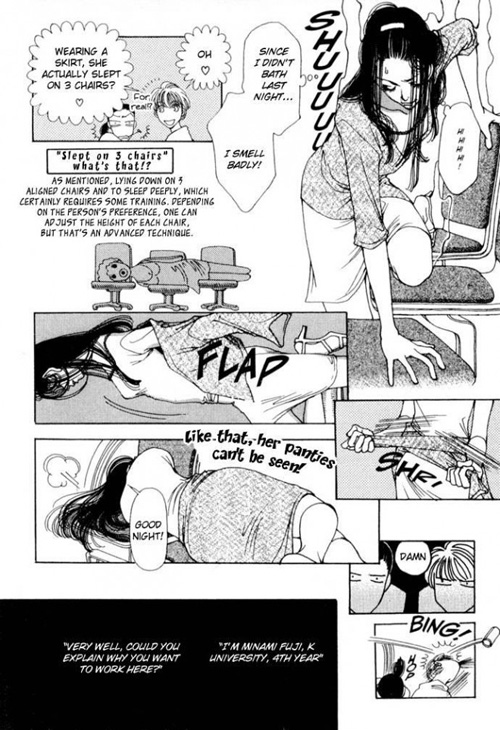
In a recent article comparing the manga Suppli and 2011’s Batman #7, Forrest Helvie criticized Suppli for being overly compressed while praising  Batman for avoiding this problem, an odd opinion given manga’s notoriousness for being “too decompressed.” While this usage is somewhat erroneous, the nature of that mistake brings up some important points about the meaning of “compression.” Essentially, he associates visual conciseness with decompression and visual complexity with compression, when such distinctions are non-existent. A comic can be concise and compressed, just as one can be elaborate and decompressed, and in fact those two ideas better summarize the visuals of Batman #7 and Suppli respectively.

Even the seemingly easy-to-understand compression turns out to not be so simple, so it should come as no surprise that American comics and their tradition of compression can be a tough read for those unfamiliar with it, notably readers of manga. While the stereotype is that manga fans’ dissatisfaction has to do with the content itself, characterized by caped musclemen and good vs. evil dichotomies, I would say that it also has a lot to do with how those comics work visually.  More specifically, the problem is that a highly compressed comic can make a reader more accustomed to the decompressed nature of manga feel as if the story is dragging along, creating a sense of impatience.

This can seem rather peculiar, given that decompression is stereotyped as taking forever to get to anything significant, but the word impatience takes on a different meaning depending on whether we’re talking about decompression or compression. For decompression, a sense of impatience has to do with the feeling that a comic is taking forever to get to where it needs to be. Impatience towards compression, on the other hand, derives from a sense that the story being told is not moving as quickly as your eyes want to, and this can be a significant hurdle which the inexperienced must overcome if they are to derive greater enjoyment from such comics.
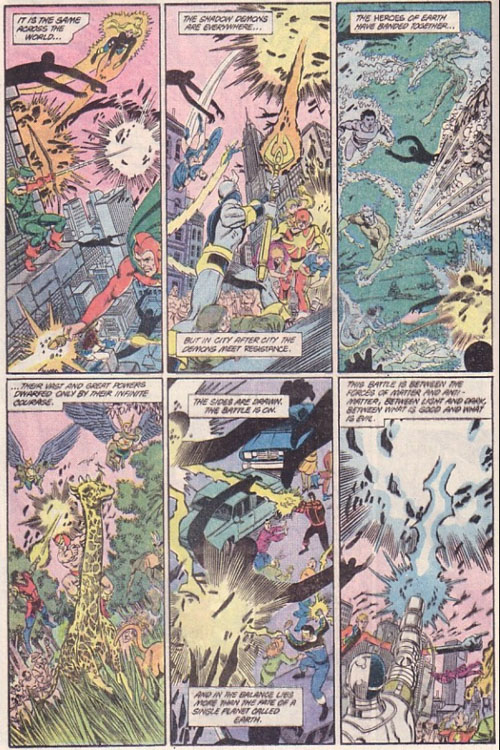
The above page, taken from a scene in Crisis on Infinite Earths, DC Comics’ first mega-crossover, called the “Battle Around the World,” is a classic example of complex compression, a big fight scene with simply a lot of figures acting and participating, with the text boxes very thoroughly explaining the context in which the battle is occurring. Though there is a cohesiveness to the page as a whole, this comic places incredible importance on each individual panel, where even the smaller elements within each panel encapsulate some distinct meaning. Each panel tells its own dense, rich story, a glimpse at events in every corner of the planet, and each character is posed to show them performing an action which defines their character to some degree. In the first panel for instance, the Green Arrow shoots from his bow and Starman is firing a blast from his signature weapon, the Star Rod. The image composition of each individual panel is vivid, each of them related to each other through similarities in both form and content.

For someone more used to manga, the way in which this information is organized together can be overwhelming. Whereas a character may be placed and posed to influence the reading direction of the page in manga, here the characters and panels are more self-contained. As a result, the manga reader may start to feel as if the story comes in fits and starts, almost as if someone were slamming the breaks every time there was something interesting to see. Manga and other comics which are more decompressed present panels as fragments of a whole, but here, panels are whole ideas unto themselves.


Batman #7

If we look at Batman #7, we can see that the word bubbles are fairly precise. There is no deluge of visual information requiring the reader’s attention. However, each panel is still being presented as a whole nugget of information, communicating a clear and specific point in every instance. That is not to deny the overall relationship the panels have with each other or the page on which they sit, but if you then look at Suppli, while it has some panels which present information as dense exposition, each panel (as well as each visual element within the panel), appears to cascade into the next, with the reader collecting bits of information along the way. Keep in mind, however, that compression and decompression, though essentially operating on opposite philosophies, can co-exist in a story, and the dividing line between them is not absolute, though one is often more present than the other.

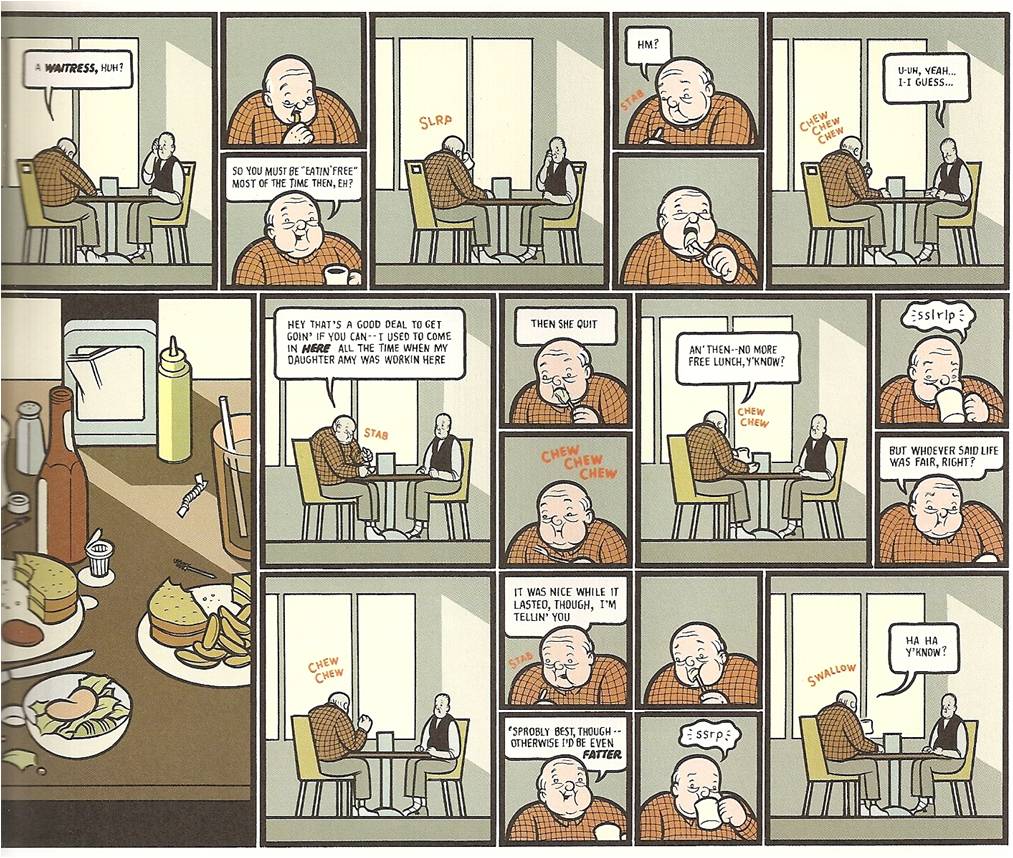
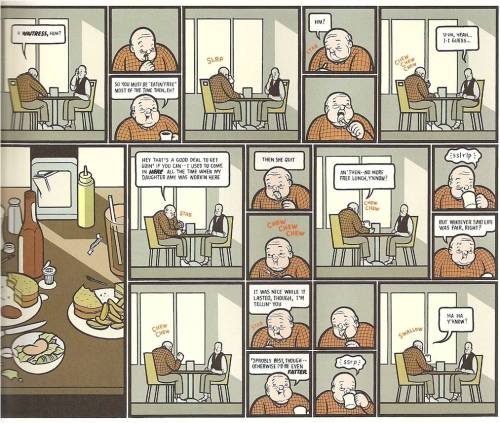
Decompression is increasingly a part of American comics, but the long-standing history of compression in American comics can be seen even in the ways a lot of more current comics have incorporated decompression. Marvel writer Brian Michael Bendis, for instance, is known for his snappy, natural-sounding dialogues which occur over multiple panels and pages, and which lend his comics a sense of decompression, but different artists have use different ways to portray those extended conversations, some of which are more compressed than others. Similarly, Chris Ware’s work (something decidedly non-superhero) can be both sparse and minimalist or extremely detailed and elaborate, but the paneling used in his comics also shows signs of an American comics tradition, albeit transformed heavily. The panels are somewhere between existing for complete information while also trying to hold back and let themselves strongly present their relationships to the panels around them.
So in the end, what can be done to help the reader for whom compression is a problem? In my opinion, the key is mainly awareness of how the panels operate. If you find yourself being weighed down by the comic, then just try to approach it one panel at a time. Think of the panel in a compressed comic as a lake or a pond. You dive in to examine its breadth and explore its depths, and then surface before moving on to the next one. Over time, your experiences will accumulate, but it’s important to let them build up.

Mysterious Girlfriend X is Somewhat Different in Anime Form

I’m actually a pretty big fan of the manga Mysterious Girlfriend X, so I naturally had to check the anime out. While it followed the manga very closely, I still came away with a somewhat different experience (though not necessarily a bad one), and it has something to do with some of the choices they made in adaptation, as well as the very act of adaptation itself.

Mysterious Girlfriend X is definitely a weird concept that just isn’t for everybody. The story centers around a high school couple, Tsubaki Akira and his girlfriend Urabe Mikoto, and their connection through saliva, specifically the fact that Urabe’s drool seems to have paranormal properties related to empathy. As boyfriend and girlfriend, rather than kissing, they exchange saliva by finger. I’ve seen it argued that the series is solely for people who have a saliva fetish, but I think this is really shortchanging the series and its viewers, because the reasons for following it aren’t as overly specific and narrow as “liking drool.” The appeal is more basic than that, as you have this thrilling and bizarre romance between an established couple who share a bond that seems to go deeper than anyone else’s.

That said, I found the experience of watching the whole saliva exchange to be different between the anime and manga in a way I’m not entirely for. In the manga, the drool is kind of a visual motif, drawn very simply, something that while ever-present is almost just like a rendered symbol. In the anime, however, they go out of their way to make the drool glisten and glow, to give it depth and dimension. The real killer is the sound, because in addition to all the effort they put into it visually, they also tried to make it sound as loud and slimy as possible. Again, drool is definitely a part of the series, but I think a little too much attention is given there.

Another thing that makes the anime quite different is the lack of manga-style paneling. This is kind of unavoidable, as anime is a different medium that works along different rules (unless it went out of its way to mimic the panel-based structure of manga), but Mysterious Girlfriend X has really fantastic page composition and paneling, especially in its smart usage of the contrast between black and white. I even used it in my article about decompression in comics. Take a look at the page above, and you’ll see that even if you took every one of those panels and animated them together, it would simply lack the overall structure of the “columns” created by the characters. When you then add color to the film-like style of the anime, it just makes for a different impression.

There are also a couple of more minor things to note. The first is that the elaborate dream backgrounds, which are fully drawn in the manga, are rendered in CG in the anime. A practical change of course, but one which kind of takes away that impressive bit where you realize someone drew all of that. The second is that the voice actor for Urabe doesn’t sound like I imagined she would, though that’s more on my end than anything else. Her voice actor also seems to be quite new at this, showing something of a similar effect to Omigawa Chiaki in her days as Maka from Soul Eater.

I’m still going to keep watching Mysterious Girlfriend X, of course, and I’m probably going to enjoy it. I just wanted to say something about the subtle changes that are present, and perhaps how this speaks to the things that can occur in adaptation from one medium to another.

Dead or Alive 5 and the Portrayal of Women

When Tecmo’s Dead or Alive 5 was first announced, the developers express the desire to portray their female characters better than they had in the past, with Team Ninja’s head developer Hayashi Yosuke even mentioning in an interview that “we’re trying to focus on the real women that surround us; the voice of a female, the mannerisms. We are being realistic about it.”

The DOA franchise has always been known for its sex appeal, from the first game’s available option to set level of breast jiggling to the Xtreme Beach Volleyball series where the girls trade their fighting uniforms for bikinis, so the promise of increased realism and improved depictions of women led to a some questions. Just what did they mean by real women, and could this fall flat on its face? Thus, although the guest appearance of Virtua Fighter protagonist Akira Yuki was the main headline, the new promotional trailer for Dead or Alive 5 is significant in that it gives us our first glimpse at just what the developers were aiming for.

Kasumi, main heroine, in DOA4 (left) and DOA5 (right)

Given the comparison image above and the statements from Hayashi, I think it’s clear that the changes to Kasumi’s look are not caused solely by improvements in graphics technology in the 7-year time span between the games. While Kasumi is still meant to be obviously attractive, there has been a bit of a reduction in her breast size and her face is substantially different, coming across as indeed “more realistic.” In fact, given the track record of the series, where greater realism could have meant shapelier breasts, Team Ninja has done a better job than probably anyone expected.


Ayane, Kasumi’s sister and rival, in DOA4 (left) and DOA5 (right)

Another feature that’s not really obvious without another character for comparison purposes is that DOA5 looks to be making more of an effort to give each character a more distinguishing face. When you look at any of the girls in previous titles, there isn’t much difference in their facial structure, andhen you look at the DOA4 versions of Kasumi and Ayane especially, they’re not that different from one another. With DOA5 however, their faces have substantial differences. They’re still designed to be attractive, and they still have similarly idealized bodies, but there seems to be an effort to vary the characters by more than their costumes and three sizes.

One element of Kasumi and Ayane’s newfound realism is that she seems to come across as “more Asian” than their previous iterations. Even though I haven’t actually seen this point discussed, I feel like this could potentially lead back to an argument concerning the appearance of anime characters where Japanese characters supposedly look “white” or distinctively “non-Japanese,” and that there may be some underlying psychological and historical reasons for making Japanese not look Japanese. The counter-argument to this has been that to assume the wide eyes of anime characters somehow equals “whiteness” is a cultural assumption in and of itself, but in the face of these revised looks, how does this hold up?

When I look at DOA4 Kasumi, even though her face comes across as “less Asian,” I still find that it comes across as more Asian than anything else, especially when compared to the non-Asian characters. And actually, Asianness and Whiteness as a binary is probably the most important mistake to avoid. Instead, the key difference is in another type of realism. In previous versions the characters come across across as more plastic and doll-like, especially in the eyes, with Kasumi’s own doe-like gaze, for example, acting more like an element of innocent seductiveness than anything else. In somewhat of a contrast, Kasumi in DOA5‘s eyes aren’t more realistic just because they’re closer to an Asian’s eyes in the real world, but because there is a sign of personality behind them.

I think the change in not just the way the characters’ eyes are, but the way in which they stare speaks towards what Hayashi meant when he referred to “the real women around us.” To some extent, this is aided by the improvement in technology, but it still requires the desire to move in that direction. Even as Kasumi continues to act as the sexy poster girl for the franchise, and while it can also be argued that her (and everyone else’s) bodies are ridiculous, I think that from what we’ve seen, Team Ninja actually seems quite serious about making the changes to the franchise that they promised.

THE COMIPO TRIAL EXPIRES TODAY SO HERE IS ONE LAST HURRAH


In case this somehow convinces anyone to purchase it: Official Site

If you want to see true mastery of Comipo, head over to Dave‘s Kawaiikochan Gaming no Korner.

Return of Comipo

Appreciating Fandom at Nishicon 2011

This past month I had the opportunity to attend an entirely brand-new anime convention in the Netherlands, Nishicon.

Taking place in the city of Haarlem, Nishicon was held in a kind of sports gymnasium, which meant a few things. First, the primary form of seating was bleachers, which given the small con population (though by no means a disappointing turn-out) actually made for very convenient seating. Practically everything took place on that central floor, with workshops and video games being the only exceptions, so it was easy to move from one thing to another. If you were on the main floor, it was essentially impossible to avoid hearing the cosplay and AMV competitions, which seemed more of a close gathering of enthusiasts than the massive arena-filling extravaganzas of a large or even medium-sized American anime convention. When the AMV contest was taking place, every so often I could peer over to the other corner of the room and catch a glimpse of it.

Another feature of Nishicon was the bar and maid cafe, which like “Anime Con” in  Netherlands (and unlike New York Anime Festival) allowed the maids to serve its customers. This maid cafe is run by a different group than the one from Anime Con, and in speaking to one of the head maids I found out that they were looking to differentiate themselves from other maid cafes at Dutch anime cons by providing a more interactive experience. In addition to custom snacks (alongside the standard Dutch bar fare, beer, frikandel, kroket, etc.), they also provided a chance to play card games and board games, as well as provide a shoulder massage which only cost 2 euros.

Speaking of cost, I’ve noticed that Dutch cons seem to provide much more affordable food options than their American counterparts. While a tad pricier than just going to an automat, a broodje kroket (croquet on a roll) cost me a mere €2.50 or so. While I don’t know the exact reason for this, I have to imagine that it’s because every convention I’ve been to so far has had some sort of fully stocked bar attached to it, and they simply charge the prices they normally would. That said, if you’re coming from the United States watch out for the dollar to euro conversion rate.

I bought one piece of merchandise at this convention: a card game called “Manga Manga” (no relation). As you can see from the box, it has Action Power.

Outside of the AMVs and the cosplay, there were no big “events” or panel programming. For me, this is quite unusual, as I primarily spend my normal convention experience darting from panel to panel, with breaks for food and checking out the dealers’ room. As a result, this meant that if I were to enjoy myself at Nishicon, it would have to be at a relaxed, non-goal-oriented pace. In that regard, I think Nishicon was quite successful for me. I was able to play Go for the first time (and lose, naturally). I spoke to people at tables, asking them what they thought of the convention, one of whom mentioned that it’s fortunate for a convention to be located more towards the western side of the country). I found myself at a drawing area (run by the fine folks at mangaschool.nl) next to people I didn’t know, putting to paper whatever came to mind. It was actually the first time in a long while that I’ve drawn that much, and that made me feel good (or bad, depending on how you look at it).

What it all came down to for me was that the “lack” of major events made me participate in the convention the way I think most con-goers in general do. The point isn’t to listen to fans and creators talk about some aspect of anime and manga, nor is it to expect some “thing” out of it. That vital aspect I think people are looking for is the simple pleasure of being surrounded by others with the same passion for anime, and that is something that can be experienced by just sitting around other anime fans. Don’t get me wrong, I love attending Otakon, but I would not have ever sat down there next to other artists (aspiring and otherwise) in order to just relax with pen and paper.

Before I leave off with a barrage of photos, I want to mention something that might make some people feel a tad salty: did you know that Michiko & Hatchin was released in the Netherlands but not the United States?

The Evangelion Pilots, Represented in Combat

I’ve been revisiting Neon Genesis Evangelion lately and have come to appreciate it in ways that I hadn’t before. While I always found the show to be especially good at showing the deep-seated fears and emotions within the characters to the point that they feel almost tangible, I’ve begun to take note of how well the characters’ words and actions exemplify their personalities.

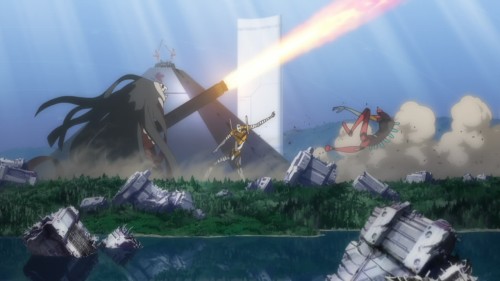
One example that stands out in my mind comes from Episode 19, the famous episode where EVA-01 goes berserk and eats the enemy angel, Zeruel. When Zeruel descends upon Tokyo-3, it is first met by a barrage of artillery fire from Asuka and her EVA-02, just weapon after weapon after weapon, with Asuka getting progressively angrier until she is defeated. Rei then appears, her EVA-00 missing an arm, and charges at Zeruel with a powerful bomb with the plans to detonate it at point blank range. Later, right before Zeruel can attack the staff of NERV, Shinji bursts through and engages in melee combat, then loses power, then goes berserk. What I’ve come to realize is that the way each character fights in that scene represents them incredibly well, acting as more than just a visual spectacle.

Asuka is always looking to prove her self-worth, particularly as a pilot and as compensation for her traumatic childhood, and her desperation mounts increasingly as more and more weapons are deployed by the EVA-02. This loud, brash display of firepower is Asuka.

From the way everyone else reacts to seeing Rei carry the N² Mine, it is clear that no one knew of this beforehand, which means that the idea is entirely her own. Rei, who constantly questions whether or not she is human at all, has very little regard for her own life.

Shinji fights with a form of desperation different from Asuka’s, and as one of his core traits is a vague sense of self-identity, Shinji’s close combat perhaps shows his desire to gain an identity through the piloting of EVA-01. This also differs from Asuka because Shinji is not looking to prove himself, but rather to find himself. It might also be possible to say that the berserk scene itself shows Shinji’s tendency to be pulled along, though I’m not sure about that one.

I think the best indicator for how much this particular moment in Evangelion represents the inner feelings of its characters comes from a comparison to the redone scene in the second Rebuild of Evangelion movie. In it, Mari replaces Asuka in EVA-02 for the film’s iteration, and the fight begins in a similar fashion, with EVA-02 surrounded by firearms which Mari initially uses one after the other. However, the scene itself feels remarkably different. Mari uses each weapon more slowly and deliberately, never really reaching the intensity that Asuka did in the TV series, and after only a few decides to run in up close with a melee weapon. The method Asuka used is something only Asuka can do; it would not reflect Mari’s character.

As for Rei and Shinji, their changes highlight more of a subtle shift in character, a fundamental part of the new films. Rei, just like the original, attempts to defeat Zeruel by detonating a bomb at point-blank, but in this version Rei takes the time to push Mari and the EVA-02 out of the blast radius while thanking her, showing that her actions do not simply stem from doubting her own humanity but from also affirming the humanity of others. Shinji’s fight is initially similar, but as I once mentioned in my review of the film, Shinji never loses control, the “berserk” EVA-01’s actions conscious and deliberate on the part of Shinji. While he still seeks his own identity, he is able to set that aside to save Rei, establishing a stronger identity in the process.

I’d like to actually end by talking about Mari once more, because as I was making this comparison I realized the role she plays relative to the others in terms of their relationship to the Evangelions. Asuka pursues self-worth, Shinji self-identity, and Rei a connection to humanity, but Mari seeks pleasure in the act itself. She revels in being an EVA pilot in and of itself, with no seeming underlying motivation except perhaps some strange desire to experience life to its fullest. Her “bestial” fighting style, even before she activates the actual “THE BEAST” mode, is indicative of this. That Evangelion is able to cut to the core of its characters in even its action scenes makes it truly impressive.

The “Nervous” Visual Style of the Boku wa Tomodachi ga Sukunai Manga

Last week I wrote a post comparing the Boku wa Tomodachi ga Sukunai anime and manga (neither of which are the original source material) and showed that I have a clear preference for the manga and its visual style. I gave image comparisons to try and show exactly what I meant, but while some readers got it, I noticed that others were still confused as to why I think the manga looks better, especially because of how “rough” the art is in comparison to the more “stable” designs of the anime. Because of that, I’m going to elaborate on why I find the visuals to be more interesting and more aesthetically pleasing so that even if people disagree with me, I think they can see where I’m coming from.

Let’s start with a visual aid, the first panel in Chapter 19. This time, I’m using an untranslated version of the manga because the points I’m making don’t have anything to do with what Sena is saying, nor does it have a mirror scene in the TV series. I want to emphasize that I do not think the anime should necessarily look just like the manga. This is just straight-up analysis of the manga without having to compare it directly to the anime. If you want more of that, you can check out JP’s response to my comparison.

Sena is cropped from the chest up in the panel, and we can clearly see that she has large breasts, but the thing that stands out most in the entire panel is her expression. She’s blushing heavily, her eyebrows are furrowed in an unusual manner, her eyes are to the side, and her index fingers are touching each other, all indicating that Sena is quite nervous. You can tell that as she’s talking, she’s in an uncomfortable position for whatever reason. That nervousness takes absolute priority over the fact that she has a nice body, and so it becomes the most noticeable thing about her in that panel.

While the line quality of the manga doesn’t approach Robert Crumb levels of jittery, it still creates an interesting sort of tension in the comic. The “sketchiness,” as I’ve seen some people refer to it, results in characters and environments that indeed make the art look “incomplete” if you associate completeness with firm inks and closer pursuit of anatomical correctness in the hands and such, but that mildly quivering line also makes the entire comic feel like everything does not quite fit comfortably within it. When it comes to a series all about people with generally very dire personality flaws,  the fact that the art looks somewhat uncomfortable in its own skin in itself contributes to the sense that the entire series is about people who have trouble making friends. Their nervousness bleeds from them, through the panels, and into the very “texture” of the comic itself. At the same time, it still sticks to fairly conventional character designs to emphasize the cuteness of the girls such that element is still definitely there. It’s just that some of the cuteness also comes from the “instability” in the art style because it shows that they themselves are a little (a lot?) unstable.

I hope this did a better job of helping people to understand my point of view, but if this has only made you more confused, don’t hesitate to ask me more questions in the comments.

Ogiue Maniax on the Webcomic Beacon Podcast

I was a guest on the Webcomic Beacon, a podcast dedicated to (you guess it) podcasts. As a follow-up to my post Explaining Decompression in Comics, we discuss the concepts of compression and decompression in comics, what they mean and how they’re used, and how you could potentially use it in your own work. Have a listen and leave a comment, either here or there.

Webcomic Beacon #208: Decompression vs. Compression in Comics