The Adventures of Tsunacon 2012 ~New Wings~

This year was my second time at the Dutch anime convention known as Tsunacon. As a one-day event I won’t have a ton of things to say about it, but there were some significant differences this year, not least of which is the move from the town of Sliedrecht over to the more well-known city of Rotterdam to make room for the ever-growing con attendance numbers.

Naturally, the first difference was transportation. Whereas last year required me to transfer to a rather small and adorable train, Rotterdam is one of the largest cities in the country and so took only one train to get there (getting back was a different story, but more on that later). This also means that for other people living around the country, there is a far likelier chance that the trains will be relatively more convenient for them as well. But unlike in Sliedrecht where it took only a short walk from the station to the convention, going to the new location required an additional bus or tram. Well, you could still walk but it would probably take you over an hour, and if you’re like me and European cities and streets confuse you, then it would take you about twice that amount. The trams and buses are both very close to the train station though, so it isn’t really a hassle.

The actual site of the convention this year was the Social Sciences building of Erasmus University, and it was, as promised, significantly larger than the old place. With three floors available as opposed to just one, and a significant amount of space per floor, it seemed just the right size for the convention, providing enough room for people to move around, but not being so spacious as to dwarf the crowd and make the place seem barren. Cosplayers were naturally everywhere, and as is common here, the dealer’s room is combined with the artists’ alley, with dealers and artists all mixed together. Overall, the university was lacking some of the charm of the old location in terms of its coziness and warmth, but I think it was a fair (and of course necessary) trade.

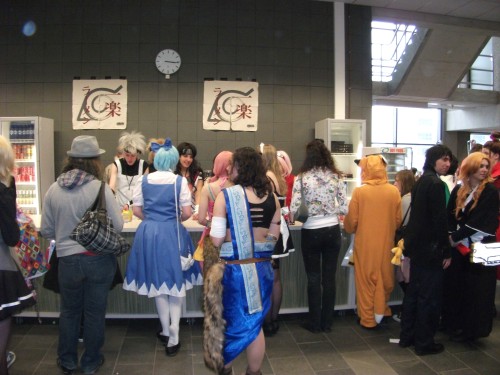
One major difference with the new location was the way in which food was handled. The spot in Sliedrecht was something of a fitness and recreation center, so it had both a small bar in the main area, as well as a bar with seats where karaoke had taken place. One of the most vivid memories for me at my first Dutch con was seeing a fairly large crowd chowing down on cup noodles like they were the best thing ever made (a claim that is supported to some extent by the fact that it has its own museum). This year however, cup noodles were practically a thing of the past, as Tsunacon saw it fit to serve actual bentou and bowls of ramen straight out of Naruto (with signs saying “Ichikaru Ramen” hanging above the serving area). Though the lack of a bar limited the food options (no bitterballen or Japanese beer as far as I could tell), this did not seem to bother the patrons at all, because the line was gigantic.

Even though I passed by the line repeatedly over the course of many hours, not once did the line ever die down, as if the people’s desire for ramen was insatiable. Honestly, I can relate, because unless you live in Den Haag, Rotterdam, or Amstelveen, it can be quite difficult to get a half-decent bowl of Asian noodle soup in the Netherlands, whether it’s ramen, wonton noodles, or pho. I know it’s a hunger that never fully dies down, and maybe on a different day I would have joined them.

There’s some obvious advice for you: serve Japanese food at an anime convention and you’re sure to be a smash hit. Think Pocky is the talk of the town? Why not hit them with some udon?

The larger space also allowed for something new this year: panels. Whereas last year the closest thing you could get to a panel was a cosplay/AMV competiton or an arts and crafts workshop or two, Tsunacon dedicated a room to the endeavor. Seeing as the panels were in Dutch, I couldn’t exactly get the most of them, but I did attend the one panel I could actually follow along with: Name that Anime. Divided into categories such as “openings,” “action scenes,” and “traps” (yes, that kind of trap), the panelists showed footage from a large variety of anime. As far as I could tell, most of the anime were from the last decade or so, with a sprinkling of Ghibli as the primary representation of anime 20 years and older. As I wasn’t sure of the exact nature of the panel going into it, I didn’t participate for fear that my inability to speak or comprehend Dutch would hold me back, but I might try next year. Overall, the panel was 90 minutes, which might either be too much or not enough for this kind of “game show,” but it seemed like it was on a good track to improvement for next year.

The last thing I did at the con was go to the karaoke room, as anyone who knows me is aware of the fact that I enjoy singing anime songs even though I can’t sing. It’s also fun to see people really get into the songs they love, which ranged from Vocaloid tracks to the popular shounen titles to the English Pokemon theme, which seems to be universally popular among singing anime fans. I spoke about this last year, but the people responsible for karaoke at Dutch cons have an entire fancy system set up to mimic a proper set. With a monitor displaying words in-sync with the song, just about anyone can follow along if they know the basics of the song, something that not even Otakon has. As for myself, I recognized a lack of burning passion in people’s selections, so I went with the go-to song for both me and one Astro Toy columnist: Kanjite Knight. Though quite off-key, the crowd was still nice enough to applaud my endeavor.

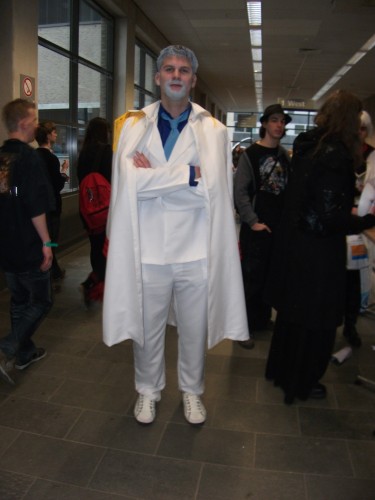
When I look at the attendees at these conventions in the Netherlands, I get the feeling that, while tastes are largely similar between the US and Dutch fans, there seem to be some major differences as well. Most notably, One Piece seems to be more well-loved among the Dutch anime fans. Does anyone else get this impression? People sang One Piece songs at karaoke, One Piece merchandise seemed to be popular in the dealer’s room, and I even saw a Garp cosplayer, which is something I have never seen at an American con (though I may have just not been paying attention). How popular is Monkey D. Luffy and his merry band of pirates among Dutch otaku, anyway?

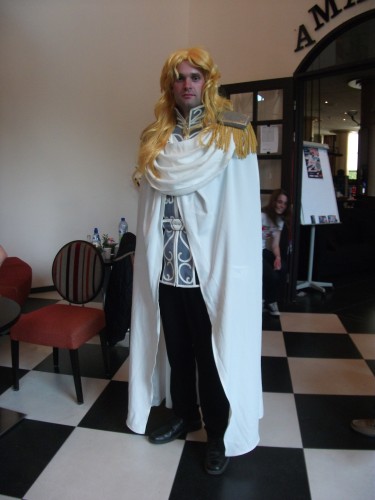
In any case, cosplay:


(To the cosplayers above who asked me to send you this photo, my apologies as I seem to have lost your card!)


The famous combo of Chii & Stocking

I would have stuck around longer, but by 4pm noticed that it had began to snow. As I have learned during my time here, snow + Dutch trains = not fun, and what was once a 30-minute trip turned into 2 hours. Obviously, that’s no fault of the convention itself, and in hindsight I can only imagine how much worse the delays would have been going to and from Sliedrecht. In spite of those troubles, it was overall a fun convention where people just enjoyed being anime fans.

To Tsunacon This Weekend

This Sunday, February 12, I will be attending the Dutch anime convention Tsunacon in its new location in the city of Rotterdam, which so happens to be where I was a couple of weeks ago watching the premiere of the Ace Attorney movie.

Seeing as I’m generally bad at finding my way to places, I expect to get lost at least a couple of times on my way to the convention center, but hopefully things will turn out all right.

I’ll likely have a badge to identify me in case anyone wants to say hi, though as for some kind of unique clothing, it all depends on the weather (for those of you not currently in Europe, it is so unbelievably cold here!).

If you want, you can also read my coverage of last year’s Tsunacon in its old location in Sliedrecht.

(I’ll miss that tiny train.)

Appreciating Fandom at Nishicon 2011

This past month I had the opportunity to attend an entirely brand-new anime convention in the Netherlands, Nishicon.

Taking place in the city of Haarlem, Nishicon was held in a kind of sports gymnasium, which meant a few things. First, the primary form of seating was bleachers, which given the small con population (though by no means a disappointing turn-out) actually made for very convenient seating. Practically everything took place on that central floor, with workshops and video games being the only exceptions, so it was easy to move from one thing to another. If you were on the main floor, it was essentially impossible to avoid hearing the cosplay and AMV competitions, which seemed more of a close gathering of enthusiasts than the massive arena-filling extravaganzas of a large or even medium-sized American anime convention. When the AMV contest was taking place, every so often I could peer over to the other corner of the room and catch a glimpse of it.

Another feature of Nishicon was the bar and maid cafe, which like “Anime Con” in  Netherlands (and unlike New York Anime Festival) allowed the maids to serve its customers. This maid cafe is run by a different group than the one from Anime Con, and in speaking to one of the head maids I found out that they were looking to differentiate themselves from other maid cafes at Dutch anime cons by providing a more interactive experience. In addition to custom snacks (alongside the standard Dutch bar fare, beer, frikandel, kroket, etc.), they also provided a chance to play card games and board games, as well as provide a shoulder massage which only cost 2 euros.

Speaking of cost, I’ve noticed that Dutch cons seem to provide much more affordable food options than their American counterparts. While a tad pricier than just going to an automat, a broodje kroket (croquet on a roll) cost me a mere €2.50 or so. While I don’t know the exact reason for this, I have to imagine that it’s because every convention I’ve been to so far has had some sort of fully stocked bar attached to it, and they simply charge the prices they normally would. That said, if you’re coming from the United States watch out for the dollar to euro conversion rate.

I bought one piece of merchandise at this convention: a card game called “Manga Manga” (no relation). As you can see from the box, it has Action Power.

Outside of the AMVs and the cosplay, there were no big “events” or panel programming. For me, this is quite unusual, as I primarily spend my normal convention experience darting from panel to panel, with breaks for food and checking out the dealers’ room. As a result, this meant that if I were to enjoy myself at Nishicon, it would have to be at a relaxed, non-goal-oriented pace. In that regard, I think Nishicon was quite successful for me. I was able to play Go for the first time (and lose, naturally). I spoke to people at tables, asking them what they thought of the convention, one of whom mentioned that it’s fortunate for a convention to be located more towards the western side of the country). I found myself at a drawing area (run by the fine folks at mangaschool.nl) next to people I didn’t know, putting to paper whatever came to mind. It was actually the first time in a long while that I’ve drawn that much, and that made me feel good (or bad, depending on how you look at it).

What it all came down to for me was that the “lack” of major events made me participate in the convention the way I think most con-goers in general do. The point isn’t to listen to fans and creators talk about some aspect of anime and manga, nor is it to expect some “thing” out of it. That vital aspect I think people are looking for is the simple pleasure of being surrounded by others with the same passion for anime, and that is something that can be experienced by just sitting around other anime fans. Don’t get me wrong, I love attending Otakon, but I would not have ever sat down there next to other artists (aspiring and otherwise) in order to just relax with pen and paper.

Before I leave off with a barrage of photos, I want to mention something that might make some people feel a tad salty: did you know that Michiko & Hatchin was released in the Netherlands but not the United States?

Ogiue Maniax Headed to Nishicon 2011

To partially sate my persistent curiosity about the anime fandom in the Netherlands, I’ll be attending Nishicon tomorrow, November 13, in Haarlem. As far as I know this is the very first Nishicon, and I’m interested in seeing how it debuts. The only other fledgling conventions I’d been to otherwise were New York Anime Festival and New York Comic Con, and those are quite different in scale for a variety reasons, one of which is that the NY cons are professionally run exhibitions.

In any case, I’ll be there for probably most of the day. You can find me by speaking Dutch and observing my blank stare.

Ice Ice, Cold Cold: Otakon 2011

Otakon 2011, occurring over a blistering 100-degree weather weekend, was a unique anime convention for me because it was the first US anime convention that I have been able to attend since my departure to the Netherlands. In the context of my vacation back in the US, it was an odd little break within a break that felt all the more special as a result.

There was also just a lot to do at Otakon, even more than previous years.

Premieres

Otakon this year was packed with premieres, anime that had never officially aired outside of Japan. In an age where convention viewing rooms have lost their importance compared to when they were the main reason to go to a convention, the willingness for Japanese companies to debut their works at cons brings back a bit of old school flavor.

I attended the showing of episodes 1 through 3 of Puella Magi Madoka Magica, the dark, subversive magical girl anime which this past year took the Japanese internet by storm. Though normally I would not watch at a con something I’d seen already, especially a series which doesn’t rank among my top favorites, I attended the premiere in order to gauge the audience reaction to the show. Who exactly was attending this premiere? Despite its popularity among fans on the internet, how many people had actually seen Madoka Magica?

Though there were a number of people who had obviously seen the show already, it was clear that for much of the audience, this was all-new. The crowd cheered and clapped not at the moments where you expect someone with full knowledge of the show would, but at points in the episodes where new and exciting things happen, such as when a magical girl transformation happens for the first time. Also, in re-watching these early episodes, I noticed some particular details, such as how Mami’s transformation sequence is different every time. Overall, I think the show made quite a good impression on the viewers, and I expect the series to reach some degree of success.

Another of the big showings was for the film Trigun: Badlands Rumble, a follow-up to the enormously popular Trigun series. Trigun is probably one of the most beloved anime titles among American fans. I’ve known a lot of people both personally and through observation who had been itching for more Trigun anime for years, and Badland Rumbles scratches that itch pretty well. Centering around Vash the Stampede’s confrontation with a robbery-obsessed villain named Gasback, who only ever takes money so he can use it to fund his next heist. The film features all of the main Trigun cast, and acts as a good reunion for fans, though I’m not sure how well it would do for someone who’s never seen any Trigun before. If I had to make a guess, I think it could still do a decent job because of how action-packed and fun it still is.

The last premiere I attended was for Shinkai Makoto’s new film, Hoshi o Ou Kodomo: Children who Chase Lost Voices from Deep Below. Known for deeply introspective works such as 5cm per Second and The Place Promised in Our Early Days, Hoshi o Ou Kodomo is a first for Shinkai, a more mainstream-feeling title that, although possesses a good deal of introspection, has a greater emphasis on adventure and exploration. Focusing on a young girl named Asuna who gets drawn into a mysterious world, the film has a number of flaws, feeling like it tried to introduce too much all at once and so occasionally lost focus. It manages to mostly overcome these problems, though they’re still a sticking point. This may be a sign of Shinkai’s inexperience with this type of film.

Regardless of the film’s strengths and weaknesses however, the showing of Hoshi o Ou Kodomo was made all the more special by the fact that Mr. Shinkai himself was a guest at Otakon 2011, his first ever American anime convention.

Guests, Directors, Producers

We were given a number of opportunities to interact with Shinkai, with a Q&A directly after his film on Saturday, an additional Q&A later in the day, a press conference on Sunday, and then a final Q&A with a bunch of directors and producers. Due to certain conflicts, I was only able to attend the first and last Q&A but both were extremely informative. Shinkai is not just simply polite but actually very humble, giving detailed answers to every question asked. At the first Q&A, Shinkai elaborated on his desire to create a more mainstream film that is visually accessible not only to a Japanese general audience but an international one as well. I was able to ask Shinkai a question myself:

Q: In the film, Agartha is in decline and the people there think it’s best to accept it, but others struggle not just against death itself, but struggle to live their lives. What are your own thoughts on to what extent a person should struggle against that fate or accept it?

To which he responded:

In the film, there are those who have accepted that they are not long for this world. But Shin, a resident of Agartha, hasn’t accepted it. If asked this question 15 years ago, I would have definitely sided with Shin, but now that I’m older I can’t help but say I understand the view of the other people. In this film, I didn’t want to side with either side. I didn’t want to deny either side.

I had originally wanted to ask Shinkai about digital animation, but after seeing the film and the concept of accepting the decline of one’s own civilization, it had me thinking about the way in which all of the various characters struggle in different ways and to varying degrees against their circumstances, and it spurred me to ask this question instead. Fortunately, I would have another opportunity to ask Shinkai about the animation process itself at the Directors Q&A Panel.

The Directors Q&A was nothing short of amazing, as it brought together directors Ishiguro Noboru (Macross, Legend of the Galactic Heroes), Murata Kazuya (To Heart, Full Metal Alchemist: Sacred Star of Milos), and Shinkai, and every answer showcased just how different these three were in terms of age and experience. The best example might be when someone asked what series would be considered the directors’ top must-watch anime. Whereas Murata picked a good, yet fairly expected response in Future Boy Conan, Ishiguro mentioned old Czech puppet shows, Canadian animator Norm McLaren, and a Chinese sumi-e-style animation from decades prior called Muteki and Shinkai actually selected Ishiguro’s own Legend of the Galactic Heroes. This generational difference was also evident in their responses to how the recent earthquake and tsunami might affect the industry and its people, with Ishiguro mentioning that the lack of escalators and power outages were something that he remembers and is familiar with from decades ago, while Shinkai talking about how he thinks that there is definitely potential to use this event to fuel the creative process but doesn’t quite know yet how to do so.

Keeping in mind this living history of directors available, and also remembering a comment from Ishiguro earlier in the panel about how he has had trouble adjusting to digital animation, I crafted my question accordingly: I asked if Shinkai and Murata, who both worked in digital animation, had any advice for Ishiguro in terms of working with digital animators. If you think about it, Ishiguro worked primarily in an age of analog animation, Murata worked in the transitional period between the two, and Shinkai is purely digital, this meant that each of their responses would embody different experiences and values. Knowing that Ishiguro is a living legend and that neither Shinkai nor Murata would want to show any disrespect towards him, I tried to phrase the question to give them as much leeway for politeness as possible, but it was still clear that this was going to be a tricky situation when the translator actually said, “I’m not going to touch this one.” Fortunately, Ishiguro, upon learning what I asked, actually encouraged the younger directors to give answers, sincerely willing to set aside seniority for some help.

Murata spoke of his own initial thoughts towards digital animation. Having worked with cel animation and remembering the hardship of lining up cels and taking photos of the compiled images one by one, Murata saw the move to digital as an opportunity to do more with more freedom. Shinkai, however, actually said that today’s digital animators should be learning from the older cel animators because, at the end of the day, as long as the initial images are still drawn with pencil on paper, those experiences and talents are still very important. Another interesting conversation arose when Shinkai mentioned working with older animators and how they worked in “millimeters” while digital animators think of space in terms of “pixels,” to which Ishiguro responded that he had to deal with the opposite problem, seeing the term “pixels” for the first time and wondering how many millimeters that was supposed to be. My question was the last one and it felt good to end the panel that way.

I was also able to get Evan Minto from Ani-Gamers to ask Shinkai a question at the press conference, about what it’s like to work with computers in animation. Interpreting the question as to mean 3DCG, Shinkai remarked that he actually prefers 2D animation despite his background in games, and would only go back to 3D if 2D faded away. Given the number of great anime creators who only started working in anime because they couldn’t find more “legitimate” work, I have to wonder if this could be another case for allowing 3D anime to fully mature.

There were Q&A sessions with both Ishiguro and Murata, as well as Madhouse founder and perpetual Otakon guest, Maruyama Masao, but unfortunately they conflicted with just about everything else. Notably, Maruyama’s and Ishiguro’s panels ran during the showing of Shinkai’s film. Still, I am glad I got the opportunity to see Ishiguro on the Directors/Producers panel, and I managed to get autographs from both Ishiguro and Maruyama. Speaking of Maruyama, the man has worked on so many things it’s actually kind of hard to be completely unable to find merchandise related to his work. In my case, I had him sign my Cardcaptor Sakura movie DVDs.

Industry Panels

This year’s Otakon included a Sunrise industry panel, which might not seem all that special compared to other companies’ panels until you realize that Sunrise never holds industry panels. Usually, there stuff goes to Bandai Entertainment, but this time it was Studio Sunrise, creators of Gundam, coming straight out of Japan to talk to the fans at Otakon about their shows. The panel began with an introduction from Sunrise producer, Ozaki Masuyuki, and then continued with a video showing called “The World of Gundam,” giving a brief history of the franchise and how it has affected Japanese animation. The video delivered on two points, first of which is that it fulfilled my wish for it to have a hilarious English-language narrator, and second of which is that it managed to result in a few surprises. Ozaki was clearly expecting the cheers for the original Gundam and titles like Gundam W, but when the crowd went into a roar over G Gundam, I could literally see that Ozaki didn’t expect it, with his body actually being taken aback by it.

From there, they showed a recap of the first season of Tiger & Bunny (which contained spoilers!), and it was also evident that the show was extremely popular. I also had a bit of a realization during that section, as Ozaki asked one by one if each hero was the crowd’s favorite character. Naturally, characters like Wild Tiger, Barnaby, and Blue Rose got good reactions, but when he asked about Dragon Kid, I found myself to be the only one clapping and hollering.

(Dragon Kid is the best, forget y’all.)

The panel also had a bunch of new show previews, the most interesting of which is probably (Gundam AGE aside) a series titled Phi Brain Puzzle of God. Apparently, it features a kid who is good at solving puzzles. The title alone makes me want to check it out.

Speaking of Gundam, the Tamashii Nations booth in the Dealer’s Room featured this:

Being that this was the first and possibly only time we’d ever see an official Sunrise panel, a lot of questions were asked about a lot of series. Patz from Insert Disc for example asked about the possibility of streaming older shows, especially the Yuusha robot series, and the answer there was that they were looking into streaming as much as they can but that there were no definite plans. I asked about the possibility of reviving significantly older giant robot franchises such as Zambot 3 and Daitarn 3, to which the response was that Sunrise prefers to create new concepts rather than going back to older ones, unless there is significant fan demand or a director/producer has interest in doing so. Gundam, I assume, falls under both the former and latter. There was also a lot of praise for Tiger & Bunny and hope from the fans that there would be more. Probably the question that sticks out to me most was the lone girl who politely asked them for more My-HiME/My-Otome in a thick southern accent, if only because that franchise didn’t seem to be on anyone’s radar. Interestingly, Ozaki said that the My series is designed to have sequels. These are certainly not concrete answers, but more than I typically expect from a company official.

If you want real answers at an industry panel though, look no further than Vertical Inc., publishers of Twin Spica, Chi’s Sweet Home, and a plethora of classic Tezuka titles. While going through all of their upcoming titles, marketing guy Ed Chavez (who you may remember from the old Vertical Vednesdays) would talk about his own feelings towards them, giving a genuine sense that he had a personal investment in all of their licenses, which include a manga adaptation by Furuya Usamaru of No Longer Human, Princess Knight, and The Drops of God. In answering a question of whether or not the manga would be flipped or unflipped, Ed remarked for instance that The Drops of God would remain unflipped despite its potential for success outside of manga readers because of how the intricate labels on wine bottles would be excessively difficult to correct afterwards.

The Bandai After Dark panel tried to be a somewhat free-flowing, “casual” panel as well but didn’t quite come across that way. That said, there were a number of highlights. The Gosick and Nichijou anime have been licensed for DVD release, as has the Nichijou manga, which according to one person I know is far superior to its adaptation in terms of comedic timing and such. The composer for The Disappearance of Suzumiya Haruhi was also present, and he played a violin solo of that movie’s main theme, Yasashii Boukyaku. I really love that song, and I think that was one of my favorite moments from Otakon.

In terms of industry panels, last but not least must be the Angel ScandyS Q&A, which centered a show that isn’t even actually in production yet. Ishiguro, the aforementioned director of Macross, has thrown his hat into the ring that is the moe idol genre. Planned to be a story about angels, devils, and human idols competing over a young man’s soul (or something), what’s fascinating about this project is that they bothered to show it at Otakon at such an early stage, something I’m certain has never been done before. The voice actors, who were selected first and had characters based on them rather than the other way around, had prepared a skit as well, both in valiant Engrish and in Japanese, to give the audience an idea of what the show might be like. When asked about the music, we were told that Ishiguro himself wrote the lyrics for the music. Ishiguro meanwhile, had been sneaking around the panel itself, preferring to film the panel from an audience perspective. I asked them about the character designs, which seem oddly familiar despite being so generic, but was told that 1) it was done by an unnamed Artland (Ishiguro’s studio) employee and 2) that the character designs aren’t even final. I don’t know, seeing a project so early in its life piques my interest.

Fan Panels

Due to the sheer amount of premieres and unique industry panels this year, on top of the scheduling conflicts that caused similarly themed panels to run at the same time (Gundam Unicorn showing vs. Sunrise panel vs. Gundam panel vs. Underrated Mecha panel), I unfortunately was unable to attend very many fan panels. Still, of what I saw I certainly enjoyed.

The Reverse Thieves ran two panels this year, “The Best Manga You Never Read: Tokyopop Edition” and “Investigating Detective Anime.” The former pointed out titles that the two considered to be underrated titles, many of which did so poorly in the US as to be canceled even prior to Tokyopop’s demise. One good reason to go that panel is actually the Q&A section, not because they give out free stuff, but because they’re actually really good at answering questions and taking suggestions. The Detective Anime panel showed the sheer range of genre fiction available in Japanese animation, and focused less on finding the most obscure titles possible. Again, their Q&A session was excellent.

I also made a quick stop at the “Moe Moe What?” panel, curious about how exactly they were going to approach the subject. Though I cannot say how the panel turned out by the end because I had to leave early, I found the panel to be informative enough, though obviously geared towards fans of moe who are looking for an intelligent way to defend the idea.

I attended both of Daryl Surat of Anime World Order‘s panels, “Remembering Satoshi Kon” and “Anime’s Craziest Deaths.” As someone who knows Kon but doesn’t really know Kon, it was a highly informative panel which showed his influences and his connections to other great names in manga and anime. In particular, Kon began his career as a manga assistant for Otomo Katsuhiro (Akira), and even worked with Oshii Mamoru (Ghost in the Shell) on a number of occasions. As for Anime’s Craziest Deaths, I had talked to Daryl when he was originally planning it a couple (?) of years ago, and even contributed some examples, but was just unable to see the final result for a long time. Now that I’ve experienced it, I can say that it’s really worth its own title, though I realized that my suggestion of Zambot 3  felt a little weak compared to the blood-and-guts violence of the likes of Baoh and Violence Jack. Perhaps something from later on in the series would do it more justice, though I think it more has to do with the fact that the “craziness” of the deaths in Zambot 3 are more contextual than visceral.

The last fan panel I attended was the Otakon Game Show, which had four contestants on-stage showing off their anime trivia skills, one of whom was an aforementioned Reverse Thief. The format of the game had it so that the audience could participate as well, and keen panel attendees might have noticed that I reached second place in Round 1 of the Game Show, just about 30 points shy of the #1 spot.

I realized my own frightening power during that panel. One of the categories in the second round was “Shower Scenes,” and for one question, even before the clip started playing and all the only thing visible was a shower head, I said “Chun-Li” to my friends and was eventually proven to be correct. Sadly, none of the contestants actually got it, though any arguments I make about that shower scene being really distinct and iconic does not help me in any way. Still, for one moment I shined in the most brilliant yet dark way imaginable.

Though that was the last panel I participated in as an audience member, I was also a panelist on “Anime and Manga Studies,” which had us answering questions from both the moderator, Mikhail Koulikov as well as the audience. It was a Sunday 9am panel, which meant that attendance would inevitably be somewhat sparse, but I was still glad to see quite a few people show up. I hope we provided a good panel for you all!

Cosplay

I’ll let this section more or less speak for itself, but I do want to say that the three of the biggest cosplay this year were probably Madoka Magica, Panty & Stocking, and especially Tiger & Bunny. Sadly I did not get any photos of Tiger & Bunny, and the only Dragon Kid cosplayer I managed to find was when I was waiting for the bus on the way home.

Miscellaneous Noteworthy Things

The artist’s alley this year had some really interesting features, an “Art of Akira” exhibit that features the animation cel collection from a diehard Akira fan and did a really good job of showcasing the visual excellence of that film.

A couple of artists also caught my eye, especially one Ashwara, who I commissioned to draw a piece of Ogiue fanart for me. Amidst a number of artists who draw well but pretty much look the same in style, his work really stood out and I was glad to have seen it.

There was also a wall at the Aniplex booth where people could ask Kyubey for a wish. Seeing it, there was one wish I knew I had to make.

Is it a cat?

This year also gave attendees the opportunity to donate to Japan in light of the recent disaster, to which they gave merchandise. I received this Madoka poster for my efforts.

In terms of cheap and simple food, a Jimmy John’s had opened up since the previous year, which had me jumping for joy (you can ask others about it). Back in college, I frequently visited the local Jimmy John’s, and had not been able to partake of it in over five years. Now that I know that there’s one to greet me every Otakon, I know where I’ll be eating at least once. It’s nothing fancy, but it’s really quick and I think it tastes better than Subway.

In terms of more expensive food though, the place to go this year was Abbey Burger Bistro, which features a number of exotic meats in burger form. My burger ended up being a medium-well Kangaroo burger with mushrooms, onion rings, chili mayo, herb yogurt, swiss, and pepper jack. The only thing that made it better was being in the company of good friends, including Daryl and Gerald from Anime World Order, the Reverse Thieves, Patz, the crew over at Ani-Gamers, and many more. Same goes for everyone I met over the weekend. You know who you guys are.

A Special Message

In the sweltering heat of Baltimore in July, when humidity and temperature worked together as an unpleasant duet, only one man was truly able to save us from the sun. He sold cool, freezing temperature water for a mere dollar, and he had a powerful advertising jingle to go with it. Apparently around last year, the addition of the megaphone made his presence fully known. Even for those who did not buy his goods, he was quite possibly the most refreshing part of Otakon 2011, his pitch quickly becoming a popular tune to sing along with for the attendees. I found myself in that group as well.

Ice Cold Water cosplay is inevitable.

Study Up for Otakon 2011

This weekend from July 29th to the 31st is Otakon weekend and I will be in attendance. Otakon this year is packed with guests and premieres, and I’ll most likely be attending as many of those as I can, as well as a bunch of other panels in between.

I’ll be wearing this:

I’ll also be participating in one panel, which is “Anime and Manga Studies” on Sunday at 9am. If you’ve ever thought about using anime or manga in a school paper, or if you’re interested in becoming a research of anime and manga, this is the panel for you. Don’t worry about not being “academic” enough, either. I’m a fan who became an academic, and as anyone who knows me is aware, my fandom is stronger than ever.

I also recommend attending the Masao Maruyama Q&A (even though I probably won’t be so I can see Shinkai’s new film). He comes every year but those things are always incredibly, incredibly informative. Ask him about the new Kaiji Season 2 that’s currently airing!

This is only a tentative schedule, and my plans might change on a whim or because I’ll be hungry, but here are just some of the things I am considering attending. I’ll also be trying to get a bunch of autographs.

Friday

  • 9:00am: Best Manga You’ve Never Read (Panel 4)
  • 10:30am: Moe Moe What? (Panel 4)
  • 11:00am: Remembering Satoshi Kon (Panel 1)
  • 12:00pm: Becoming a True Pokemon Master (Panel 4)
  • 1:00pm: Opening Ceremonies (Panel 3)
  • 3:00pm: Aniplex of America Panel (Panel 1)
  • 5:00pm: Madoka Magica + Q&A (Video Room 5 HD)
  • 8:00pm: Chemistry Concert (Hall D)
  • 9:30pm: Fukushima Dai-ichi (Panel 1)
  • 11:00pm: Bad Anime, Bad!! (Panel 5)

Saturday

  • 9:00am: Unusual Manga Genres (Panel 2)
  • 10:00am: Hoshi o Ou Kodomo +Q&A (Video Room 5 HD)
  • 1:00pm: Special Surprise Premiere (Video Room 5 HD)
  • 2:30pm: Trigun: Badlands Rumble (Video Room 5 HD)
  • 4:00pm: Vertical Industry Panel (Panel 5)
  • 5:30pm: Full Metal Alchemist: Sacred Star of Milos (Video Room 1)
  • 7:30pm: Sunrise Industry Panel (Panel 3)
  • 10:00pm: Dubs that Time Forgot (Panel 1)
  • 12:30am: Anime’s Craziest Deaths (Panel 6)

Sunday

  • 9:00am: Anime and Manga Studies (Panel 2) <– I will be on the panel
  • 12:00pm: Kylee Concert (Hall D)

See you at Otakon!

Anime 2011: Armored Hotel Almelo

This past Saturday I found myself on the train heading towards the eastern part of the Netherlands, stopping just a few miles away from the German border. It was my actually my first time that far out east, but I wasn’t there to sight-see, I was there to attend an anime con. And not just any anime con, but Anime!

Living in a new and unfamiliar country, I had decided months ago that I would use my current situation as an opportunity to get an idea of anime fandom outside of the United States and Japan. I had previously attended Tsunacon, a relatively small one-day event held in Sliedrecht (but moving to Rotterdam starting next year), but Anime 2011 was my first time at a full-out 3-day Dutch anime convention. Though I was only able to attend Saturday, I still felt a strong sense of love for anime, manga, and video games.

Arriving in Almelo after a nearly three-hour trip, it was a short and pleasant walk through an open-air market to Theaterhotel Almelo, called so because it actually features a theater room capable of seating hundreds, something which makes Theaterhotel Almelo a good fit for an anime convention. Benefitting tremendously from gorgeous, 80-degree weather (that’s about 27 degrees Celsius), the spacious front area of the hotel acted as a nice spot for attendees to relax, pose for photos, and take a smoke break.

At three stories tall, and a restricted maximum attendance of 2500, Anime 2011 at Theaterhotel Almelo was not quite as large as the American conventions I’m used to, with Otakon boasting over 30,000 attendees last year, the fact that it was held in a hotel made it comfortably familiar to me, as it reminded me of my early convention experiences. Though, the fact that Anime con is actually only one of three anime conventions total in the Netherlands, and considered large for a Dutch con, should give readers an of the sheer difference in scale. In fact, in the Dealers’ Room, I had struck up a brief conversation with a Dutch attendee about precisely this topic. In a way, it made Otakon and Anime Expo sound downright legendary.

Speaking of the Dealer’s Room, I heard a familiar sound there, that of the loud exclamation of “Yaoi” and how it is probably fresh and hot and available here. Was that something which this con shared with the American ones? Was it actually universal?

Not quite, it was actually doujinshi seller Hendane’s Netherlands debut. He had heard about Anime 2011 from his time in a Dealer’s Room in Denmark. Asking him what sold well here, he said it’s pretty much the same everywhere, though what varies is the amount of disposable income that the young fans have. In Denmark, they’re apparently loaded. In the Netherlands, that is significantly less the case. The guy was doing his best to push Touhou, though I get the feeling that it hasn’t quite made its mark on the fandom here, even if I did photograph a Cirno cosplayer at Tsunacon.

Going around the rest of the dealer’s room, I also asked a few of the vendor what sold best for them. The most consistent answer was Lucky Star, which I find interesting for a number of reasons, most of them having to do with the age of that show. While certainly not old, in terms of anime fan memory it’s quite a few years in, and to see it maintain some kind of longevity was a pleasant surprise. One vendor also said that One Piece sold very well for them, which was also somewhat unexpected. Was there something about Oda’s title that gave it relatively more otaku clout here than in the US?

Just like Tsunacon, the Artist’s Alley and Dealer’s Room were one and the same, and so before I left I decided to pick up a fan-made magazine. And as I said last time, the artists at the con seem to showcase their output primarily in comics form, as opposed to individual illustrations (though those were still available). In a way, it reminded me of Japanese doujin events, and it’s actually something I kind of prefer over the US Artist’s Alleys.

Having missed out on the AMV competition last time, I made an effort to go check it out here, though by the time I got to the aforementioned large theater where it was being held, it was already full and I could not stay long. The AMV competition was sponsored by Archonia, the largest distributor of anime goods in Europe, which makes them a very familiar name to those living in Europe but probably unknown outside of it. They were actually in the Dealer’s Room. Before I left, I got a glimpse of an AMV featuring Naga the White Serpent from Slayers to the tune of Lady Gaga’s “Poker Face.” Makes sense to me.

Around this time, I was feeling the need to take a break, and noticed that Anime 2011 had its very own maid cafe. Normally, I’m not big on maid cafes, but I saw one thing and I had to go: the maids were actually taking orders or serving food. Now that might not sound like a big deal, but let’s put it into perspective a little. New York Anime Festival has touted their own “maid cafe” for a few years now, except that the Jacob Javits Center in which the NYAF takes place has its own unique rules, namely that non-union workers cannot handle food. In other words, the only thing the “maids” are good for at NYAF is posing for photos, which is not to detract from their efforts in entertaining con-goers, but it’s just not quite the same. Seeing that these girls at Anime 2011 had no odd rules to deal with, and also seeing that their menu consisted of a combination of Japanese snacks and Dutch treats, I decided to sit down to some waffle and bitter lemon soft drink. As I looked around, I noticed that the customers were pretty even in terms of gender diversity.

Given the size limitations of the hotel, the convention could not have very many panels and workshops, though there were still a decent number. Of the activities at Anime 2011 though, only one of them resembled the kind of fan panel you would typically see at an American convention. Titled simply “Your Anime Sucks,” it was a guy at the front of the room doing his best to lightheartedly rag on any title you gave him. To keep it easy on everyone, primarily mainstream titles were preferred (and silly me, I thought Akagi was a mainstream title. Whoops!). Interestingly, the guy made an explicit point of using English instead of Dutch, because of the fact that he found Dutch as a language ill-equipped for the task at hand, whether it meant a lack of sufficient wordplay or just not enough derogatory phrases in the language. The guy put in a good effort, and if I had any suggestion to make to him, it is that he doesn’t dive deeply enough into the fabric of the shows to tear them apart. That, and his criticism of the Fate/Stay Night anime didn’t involve mentioning the CG dragon inside Saber’s vagina at all.

Possibly the most impressive part of this convention was its Game Room. Filled with Japanese-style sit-down arcade machines, obscure items like Evangelion pachinko and a Vectrex, all of the newest titles and consoles, and of course Dance Dance Revolution, Anime 2011’s Game Room was good enough for a con ten times its size. Wandering around, I heard an oddly familiar song, which turned out to be the Futari wa Precure opening coming out of a Taiko no Tatsujin game, and it took me back to when I was in Japan, playing that very same song on a machine in Akihabara. It made me reflect a little on how lucky I’ve been to live in so many different places in the world.

Another good feature of this game room was the fact that it was right next to the outdoors, which meant that fresh air was coming into it the whole time. If there is a cure for Game Room funk at conventions, it is actual air circulation.

I tried my hand at a little Super Smash Bros. Brawl where I was clearly rusty, moving on to an unusual Sega wrestling game, and then a couple of fighting games, where I got frustrated by the fact that I was unable to defeat the CPU Sol Badguy in Guilty Gear X. It also reminded me that I simply never got used to arcade sticks.

The last event of the evening was the concert with the convention’s guests of honor, the electronic band Aural Vampire. Sadly, I had a train to catch so I couldn’t stay for the whole concert but I actually enjoyed their music more than I thought I would. Comprised of gothic vocalist Exo-Chika and masked DJ Raveman (who I hear from good sources plays the blazin’ beat), their performance was fun and engaging, and I’d like to see them again, either here in the Netherlands or perhaps even in the United States. Photography was not allowed though, so you’ll have to settle for this picture of Clara the cow, one of two convention mascots. Its owner, not pictured here (but pictured on the official site), is a magical farm-girl named Marieke.

Overall, Anime 2011 was a different experience from both Tsunacon and the American conventions I’m used to, but still familiar enough that I could really feel that anime con atmosphere. If I have any regrets from the convention, they have to do with some necessary concessions on my part. As mentioned in the beginning, it’s a hotel con but I could only stay for one day, and I know from experience that having a convention involve commuting gives it a different impression. In that sense, I probably did not experience the true Anime 2011, especially because I could not be around for one of their signature events, the “Ecchimated Music Video” competition, i.e. an 18+ AMVs contest, which is something totally non-existent in the US as far as I know. I also could not convince anyone I knew to go to the convention with me, so it ended up being a solitary affair. Again, while still fun, conventions are made better by friends. Maybe next time I’ll go, I’ll be able to trick someone into attending as well.

It’s Only Greater

Recently I was thinking about how great it is that I have friends and people with whom I can share my love of anime and manga, with whom I can discuss my feelings on specific works, trends among fans, and much more. Nowadays I think that it’s really, really wonderful to be an otaku.

It makes me consider the concept of anime fan gatherings that aren’t conventions or anything tied to specific activities or venues, but just something where everyone can sit back and enjoy themselves, like a relaxed discussion on the internet but in real life, so not everything has to be in words. Preferably this is all done over a big pot of chili (with vegetarian/vegan alternatives for whoever needs them), or I guess donburi if we want to stick to the whole Japan thing.

Surely there are disagreements among otaku all the time, and heated arguments about minutiae that seem many times larger, but just the fact that we can be so engrossed in something is itself a glorious thing.

If you want to know what makes the “geek” special, it’s not brains or looks (or lack thereof) or anything like that, it’s simply passion. I have a lot of it, and as it continues to grow I know I have you to thank.

Trekked to Sliedrecht, Did the Anime Thing: Tsunacon 2011

It’s been quite a few years since I was able to attend any sort of anime-related event outside of the United States, so when I found out that right here in the Netherlands are not one, not two, but three anime cons, why I had to check at least some of them out. This report is about the first of them, Tsunacon, located in the town of Sliedrecht. I’m not sure why it’s called Tsunacon, though I suspect it’s a play off of “Tsunami.”

Held in De Lockhorst, a complex devoted to athletic activities and just having spaces and rooms available for just this very kind of thing, Tsunacon is a one-day event. I’ve attended one-day events before, namely the PAS Spring Fest in New York City and Tekkoshocon‘s Tekko 1/2 held at the Carnegie Library, and if I had to compare Tsunacon to those two mini-cons, I’d say that Tsunacon feels the most like an actual anime convention. This might have to do with the fact that Tsunacon is not a free event (although the ticket price is more than fair) whereas the other two are, but it’s more the atmosphere of it.

Before I go into the con itself though, I have to point out the train to Sliedrecht. Moving between the cities of Dordrecht (not to be confused with Dordray) and Geldermalsen and about 4 cars long, I think it’s kind of adorable and also anime-related if you stretch your logic a bit. You can do it, Spurt-tan!

De Lockhorst is only a short walk from the Sliedrecht train station. On my way there, I saw two couples holding hands and possibly cosplaying as well. Ah, nerd love.

When you get inside the first thing you’ll notice is the concession area. While the collection of Japanese snacks (Yan Yan, Ramune) are likely a familiar sight to the American con attendee, there are a number of uniquely Dutch snacks, such as poffertjes, tiny pancakes in powdered sugar, and frikandel, a kind of minced meat sausage. They also had a cotton candy machine, which I’ve never seen at any US anime con.

The big culinary hit here was Cup Noodles, at €3 a cup. Now you might be asking, “3 Euros?! Isn’t that a bit overpriced?” It most certainly is, but the attendees could not get enough off Momofuku Ando’s glorious creation. I couldn’t tell you why it was so popular, but I wonder if the more traditionally Dutch foods don’t carry the same novelty. Maybe it’s just the sheer joy of eating noodles from a cup alongside your friends.

When I think about it though, the Broodje Kroket (croquet breads) ares kind of like the Croquet Pan you’d find in Japanese bakeries. Even when you’re eating “normal foods,” you’re not too far off, Dutch anime fans!

The real kicker though would probably be that they sell beer alongside everything else. And not just any beer…

That’s right, Japanese beer for the Japanese anime fans.

Given that the average age at Tsunacon was decidedly “teenager,” this might set off some alarms, but I must point out that the drinking age here is actually 16, excluding hard liquors. In fact, despite the relatively low median age of the attendees here, everyone seemed quite well-behaved. Even the “hug me” signs seemed more subdued compared to their US peers.

Tsunacon obviously isn’t devoted solely to food though, and close by were the manga library, a game room, a workshop room, and the dealer’s room.

The Manga Library had a fairly sizable collection of titles in both English and Dutch, as well as a few in Japanese. It grew more and more popular throughout the day, and as if to anticipate the creative spark that reading manga would inspire, they left pencil and paper around so that people could draw. I myself decided to revisit an old friend and read the Sai vs Touya Meijin chapters of Hikaru no Go.

The Game Room, which meant specifically video games (sorry card and board game fans, though I did see a number of Yu-Gi-Oh! players dueling it out), had systems ranging from the classic NES to the X-Box 360 and Wii, as well as popular convention games like Dance Dance Revolution. I have no idea what version it might have been.

One thing that stood out to me was the European SNES, pictured above, which resembles the Japanese Super Famicom a lot more than it does its American counterpart. If you’re wondering what game that is, it’s Battletoads vs. Double Dragon. It is a terrible game, but the thought is appreciated. And yes, 4chan memes are popular here too.

I originally planned on participating in a Super Smash Bros. Brawl tournament, but the slots filled up extremely quickly, and by the time I got there it was too late. However, it turned out that the Super Street Fighter IV tournament was short on competitors, so I decided to throw my hat into the ring. I picked Sagat, my favorite character from the Street Fighter series, and defeated my first opponent only to lose to the very next one 1:2. You might not think that to be terribly impressive, but I was quite proud of myself given that-

  1. I’ve never played Super Street Fighter IV
  2. I’ve only played vanilla Street Fighter IV once

But Sagat is Sagat, and I just threw fireballs and delivered uppercuts on my way to victory, at least for a short while.

The workshop room had workshops on cosplay and drawing manga, all in Dutch so even if I felt particularly motivated to start cosplaying I wouldn’t be able to reap its benefits.

The Dealer’s Room also doubled as the bag check room, and was mandatory if you were planning on doing any shopping, or even playing  in the game room. The main activities of the Dealer’s Room, aside from shopping of course, were the “Manga School” workshop and the goldfish-catching game straight out of your favorite festival episode. The winner who caught the most “goldfish” (they had to use rubber balls here) would win some Haruhi pins and a poster of a J-Pop singer whose name I’ve unfortunately forgotten. My goldfish endeavors came out to a big fat zero, but that’s okay.

Another interesting element of the Dealer’s Room at Tsunacon was that, perhaps due to space limitations, the Dealer’s Room also doubled somewhat as an Artist’s Alley. But while American cons’ Artist Alleys seem primarily focused with individual images, Tsunacon’s anime fan artists were big on self-publishing, often times with their very own original characters, though publications based on existing series were also present. In this regard, one table in particular caught my eye.

A Genshiken-themed doujinshi of all things! Of course I had to get it. It’s not 18+, in case you were wondering.

You know what I like? Ogiue. And you know what else I like? Pokemon. This book manages to combine both, and that is quite all right with me. I was also flattered to find out that they actually knew about Ogiue Maniax, and I was proud to have them do the doujin event thing and get some sketches. Thanks a lot to all of you! I wish you had a website URL in the book so I could direct people.

A short walk from the entrance where the concessions and around the corner landed me in the anime karaoke lounge. Now I’ve done karaoke at dedicated locations, and I’ve done convention karaoke, but what was nice about this place was that it was more or less a small bar/restaurant. In addition to the snacks you could get from before, helpful staffers worked as waiters, taking orders for food and drink while everyone sat around enjoying the fan-powered renditions of God Knows, Hatsune Miku, various Final Fantasy themes, the Chobits opening, and more. They actually had it set up so that the lyrics would pop up in romaji which the singer could follow, much like a real karaoke place. This is quite different from Otakon where they hand you the lyrics on a sheet and you have to do your best given the circumstances. Not knocking Otakon or anything, but this system was way more useful for people who felt like they kind of knew their songs but still needed some help.

I partook of a macaroon from a helpful staffer/waiter before exercising my own lungs. My song of choice: the Mazinger Z opening, which I performed a little better than I thought I would. (Fortunately) I do not have any record of the event, as while I love to karaoke, I am not what you might be calling “talented.” It might be better to say that I can display a degree of courage when it comes to on-stage performances. Despite the relative youthfulness of the crowd, they actually got quite into my performance, and by the time I was done I received a full applause from the room. Thank you all.

If you weren’t paying attention to the singing though, you might have noticed the interesting decorative choice in the form of various Disney statues placed throughout the bar/lounge.


The two “main events” of Tsunacon would have to be the competitions, both AMV and cosplay. Unfortunately, despite knowing this beforehand it somehow slipped my mind while there, and I didn’t go to either. My apologies! While I’m normally not much of an AMV or cosplay sort of person, I still wish that I’d managed to check them out. According to the schedule, the same room also housed video showings and some quiz-based panels, so it was ostensibly the video and competition/events room. Next year!

While I did not attend any actual cosplay events, I did see quite a few excellent cosplayers, which you can see below. There was a really good Crocodile from One Piece cosplayer, but I wasn’t able to catch him.

Overall, Tsunacon was a fun little one-day excursion where there the focus was primarily on letting the attendees do their thing. Rather than going from event to event or even spending the entire day in one location, the con seemed more conducive to just hanging out with your otaku comrades. In that regard, I do wish I had brought others with me, because as cool as it was a one-man trip to a con can only get you so much. It’d also be cool if they had more informational panels in addition to their workshops and games, not for me as my Dutch is abysmal, but to foster learning that doesn’t necessarily have direct utility. The space was also a tad crowded, but nowhere near as insane as some of the bigger cons I’ve attended, and if anything this is a good sign that Tsunacon is getting increasingly popular.

I’ll leave off with these collaborative drawing boards. I drew a couple of things myself. See if you can spot them!

The Not-So-Gentle Path: Genshiken II, Chapter 57

From the moment I began this blog, I’ve established the fact that I am a huge fan of Genshiken. After reading the inaugural chapter of the all-new Genshiken II however, I realized that this is the first time that I’m actually reading fresh material alongside all my fellow Genshiken enthusiasts. Sure, there was the second TV series, but that was mostly existing material, so in a sense this new “limited series” acts as a kind of return to basics for Ogiue Maniax, a starting point for me to share my thoughts so to speak.

So to celebrate this small revival and to welcome back this blog’s namesake to the world of serialization, I am going to give my thoughts and impressions on this first chapter. As more chapters come out there’s a possibility that you’ll be seeing Ogiue Maniax’s first ever instance of episodic chapter blogging, but I’m not making any guarantees.

New Genshiken feels different. I won’t pretend that it doesn’t. The cast is mostly different and is now populated primarily by women, replacing the “awkward men’s club” vibe that kicked off the original series. At first this seemed a little jarring, but Ohno’s off-handed mention of the soul patch guy, aka the Genshiken member that never was, reminded me that prior to the arrival of Yajima, Yoshitake, and Hato the membership barely ever increased. Ogiue and Kuchiki arrived together, while the following year Sasahara’s sister Keiko entered, and in the case of Kuchiki and Keiko both of them were already introduced previously. Sue is Sue. If anything, with such a large cast change I’d be surprised if the series didn’t feel a little different.

The focal point of Chapter 57 is the cross-dressing Hato Kenjirou (who might be a reference to Hayate the Combat Butler author Hata Kenjirou), or rather, everyone’s opinions of Hato. I think Hato’s inclusion set off alarms in a lot of readers’ heads more than anything else, creating a bit of fear that the series would lose its heart and pander too much to otaku at the expense of what made Genshiken good in the first place. As the chapter went on, I could feel that fear growing in myself, but I think it was actually all just set-up for a really pointed reminder that Kio Shimoku did not forget what made Genshiken tick in the first place.

While I clearly favor Ogiue, I think the real star of the chapter was Yajima. Throughout most of the chapter the club feels almost uncontrollable when it comes to the topic of Hato and cross-dressing in general despite Ogiue’s best efforts, sort of like the impression you might get at an anime con seeing a bunch of young attendees with no supervision. Then Yajima comes out and says that she’s kind of uncomfortable with Hato’s cross-dressing. By presenting this point of contention, Yajima manages to bring the club (and the manga itself) back down to Earth and keeps the club environment from getting completely out of hand.

This sort of conflict is actually a pretty persistent theme in Genshiken, whether it’s in the earlier days with Kasukabe’s mean-spirited attacks on the club, or later on with Ogiue and her own inner demons. In a way, Yajima’s somewhat direct personality and her unfamiliarity with the beast that is the Society for the Study of Modern Visual Culture makes her the “Saki” of the new bunch, even if she can’t match Kasukabe in looks. Whereas Saki was a normal person experiencing the world of otaku for the first time, Yajima, who is already an otaku, has to deal with an anime club unlike any she’s ever experienced. That’s not to say that the other characters are unrealistic, though. Hato is developing well, and even the way in which Ohno, Sue, Yoshitake, and Kuchiki get carried away is not that unusual. It’s simply that Yajima, as well as Ogiue, act to rein them in a little, creating a new and different character dynamic.

On the topic of Ogiue, I found it quite interesting that, aside from a small bit of pictorial exposition by Sue, Ogiue goes through the entire chapter without her signature paintbrush style. Even the one-shot had Ogiue tie her hair up, something that was established in previous material as a habit of hers when drawing. Though I’m sure it’ll return in at least one future chapter, it still feels like a break of sorts with the previous series. In terms of her character, it’s interesting seeing Ogiue as Genshiken chairman. After all, back when the original series ended it was one of my greatest wishes to see the continued appearance of Ogiue as head, and in this situation I find myself to be quite fortunate.

Ogiue isn’t a natural leader. In fact, none of the previous chairmen were, with the possible exception of the mysterious First Chairman. However, all of them were able to develop their own natural strengths into leader-like qualities, whether it was Madarame’s strong self-image as an otaku, Sasahara’s subtle confidence and understanding, or Ohno’s gentle guidance, and Ogiue looks to be doing the same. Though not always consistent, Ogiue can have quite a forceful personality, especially when she puts her foot down about something, and I think that this aspect of her personality, combined with the fact that those new members are all freshmen, will result in her being more and more comfortable with her position of authority as time passes.

So that’s the start Genshiken II, and I look forward to more. Of course.