Anime 2011: Armored Hotel Almelo

This past Saturday I found myself on the train heading towards the eastern part of the Netherlands, stopping just a few miles away from the German border. It was my actually my first time that far out east, but I wasn’t there to sight-see, I was there to attend an anime con. And not just any anime con, but Anime!

Living in a new and unfamiliar country, I had decided months ago that I would use my current situation as an opportunity to get an idea of anime fandom outside of the United States and Japan. I had previously attended Tsunacon, a relatively small one-day event held in Sliedrecht (but moving to Rotterdam starting next year), but Anime 2011 was my first time at a full-out 3-day Dutch anime convention. Though I was only able to attend Saturday, I still felt a strong sense of love for anime, manga, and video games.

Arriving in Almelo after a nearly three-hour trip, it was a short and pleasant walk through an open-air market to Theaterhotel Almelo, called so because it actually features a theater room capable of seating hundreds, something which makes Theaterhotel Almelo a good fit for an anime convention. Benefitting tremendously from gorgeous, 80-degree weather (that’s about 27 degrees Celsius), the spacious front area of the hotel acted as a nice spot for attendees to relax, pose for photos, and take a smoke break.

At three stories tall, and a restricted maximum attendance of 2500, Anime 2011 at Theaterhotel Almelo was not quite as large as the American conventions I’m used to, with Otakon boasting over 30,000 attendees last year, the fact that it was held in a hotel made it comfortably familiar to me, as it reminded me of my early convention experiences. Though, the fact that Anime con is actually only one of three anime conventions total in the Netherlands, and considered large for a Dutch con, should give readers an of the sheer difference in scale. In fact, in the Dealers’ Room, I had struck up a brief conversation with a Dutch attendee about precisely this topic. In a way, it made Otakon and Anime Expo sound downright legendary.

Speaking of the Dealer’s Room, I heard a familiar sound there, that of the loud exclamation of “Yaoi” and how it is probably fresh and hot and available here. Was that something which this con shared with the American ones? Was it actually universal?

Not quite, it was actually doujinshi seller Hendane’s Netherlands debut. He had heard about Anime 2011 from his time in a Dealer’s Room in Denmark. Asking him what sold well here, he said it’s pretty much the same everywhere, though what varies is the amount of disposable income that the young fans have. In Denmark, they’re apparently loaded. In the Netherlands, that is significantly less the case. The guy was doing his best to push Touhou, though I get the feeling that it hasn’t quite made its mark on the fandom here, even if I did photograph a Cirno cosplayer at Tsunacon.

Going around the rest of the dealer’s room, I also asked a few of the vendor what sold best for them. The most consistent answer was Lucky Star, which I find interesting for a number of reasons, most of them having to do with the age of that show. While certainly not old, in terms of anime fan memory it’s quite a few years in, and to see it maintain some kind of longevity was a pleasant surprise. One vendor also said that One Piece sold very well for them, which was also somewhat unexpected. Was there something about Oda’s title that gave it relatively more otaku clout here than in the US?

Just like Tsunacon, the Artist’s Alley and Dealer’s Room were one and the same, and so before I left I decided to pick up a fan-made magazine. And as I said last time, the artists at the con seem to showcase their output primarily in comics form, as opposed to individual illustrations (though those were still available). In a way, it reminded me of Japanese doujin events, and it’s actually something I kind of prefer over the US Artist’s Alleys.

Having missed out on the AMV competition last time, I made an effort to go check it out here, though by the time I got to the aforementioned large theater where it was being held, it was already full and I could not stay long. The AMV competition was sponsored by Archonia, the largest distributor of anime goods in Europe, which makes them a very familiar name to those living in Europe but probably unknown outside of it. They were actually in the Dealer’s Room. Before I left, I got a glimpse of an AMV featuring Naga the White Serpent from Slayers to the tune of Lady Gaga’s “Poker Face.” Makes sense to me.

Around this time, I was feeling the need to take a break, and noticed that Anime 2011 had its very own maid cafe. Normally, I’m not big on maid cafes, but I saw one thing and I had to go: the maids were actually taking orders or serving food. Now that might not sound like a big deal, but let’s put it into perspective a little. New York Anime Festival has touted their own “maid cafe” for a few years now, except that the Jacob Javits Center in which the NYAF takes place has its own unique rules, namely that non-union workers cannot handle food. In other words, the only thing the “maids” are good for at NYAF is posing for photos, which is not to detract from their efforts in entertaining con-goers, but it’s just not quite the same. Seeing that these girls at Anime 2011 had no odd rules to deal with, and also seeing that their menu consisted of a combination of Japanese snacks and Dutch treats, I decided to sit down to some waffle and bitter lemon soft drink. As I looked around, I noticed that the customers were pretty even in terms of gender diversity.

Given the size limitations of the hotel, the convention could not have very many panels and workshops, though there were still a decent number. Of the activities at Anime 2011 though, only one of them resembled the kind of fan panel you would typically see at an American convention. Titled simply “Your Anime Sucks,” it was a guy at the front of the room doing his best to lightheartedly rag on any title you gave him. To keep it easy on everyone, primarily mainstream titles were preferred (and silly me, I thought Akagi was a mainstream title. Whoops!). Interestingly, the guy made an explicit point of using English instead of Dutch, because of the fact that he found Dutch as a language ill-equipped for the task at hand, whether it meant a lack of sufficient wordplay or just not enough derogatory phrases in the language. The guy put in a good effort, and if I had any suggestion to make to him, it is that he doesn’t dive deeply enough into the fabric of the shows to tear them apart. That, and his criticism of the Fate/Stay Night anime didn’t involve mentioning the CG dragon inside Saber’s vagina at all.

Possibly the most impressive part of this convention was its Game Room. Filled with Japanese-style sit-down arcade machines, obscure items like Evangelion pachinko and a Vectrex, all of the newest titles and consoles, and of course Dance Dance Revolution, Anime 2011’s Game Room was good enough for a con ten times its size. Wandering around, I heard an oddly familiar song, which turned out to be the Futari wa Precure opening coming out of a Taiko no Tatsujin game, and it took me back to when I was in Japan, playing that very same song on a machine in Akihabara. It made me reflect a little on how lucky I’ve been to live in so many different places in the world.

Another good feature of this game room was the fact that it was right next to the outdoors, which meant that fresh air was coming into it the whole time. If there is a cure for Game Room funk at conventions, it is actual air circulation.

I tried my hand at a little Super Smash Bros. Brawl where I was clearly rusty, moving on to an unusual Sega wrestling game, and then a couple of fighting games, where I got frustrated by the fact that I was unable to defeat the CPU Sol Badguy in Guilty Gear X. It also reminded me that I simply never got used to arcade sticks.

The last event of the evening was the concert with the convention’s guests of honor, the electronic band Aural Vampire. Sadly, I had a train to catch so I couldn’t stay for the whole concert but I actually enjoyed their music more than I thought I would. Comprised of gothic vocalist Exo-Chika and masked DJ Raveman (who I hear from good sources plays the blazin’ beat), their performance was fun and engaging, and I’d like to see them again, either here in the Netherlands or perhaps even in the United States. Photography was not allowed though, so you’ll have to settle for this picture of Clara the cow, one of two convention mascots. Its owner, not pictured here (but pictured on the official site), is a magical farm-girl named Marieke.

Overall, Anime 2011 was a different experience from both Tsunacon and the American conventions I’m used to, but still familiar enough that I could really feel that anime con atmosphere. If I have any regrets from the convention, they have to do with some necessary concessions on my part. As mentioned in the beginning, it’s a hotel con but I could only stay for one day, and I know from experience that having a convention involve commuting gives it a different impression. In that sense, I probably did not experience the true Anime 2011, especially because I could not be around for one of their signature events, the “Ecchimated Music Video” competition, i.e. an 18+ AMVs contest, which is something totally non-existent in the US as far as I know. I also could not convince anyone I knew to go to the convention with me, so it ended up being a solitary affair. Again, while still fun, conventions are made better by friends. Maybe next time I’ll go, I’ll be able to trick someone into attending as well.
It’s Only Greater

Recently I was thinking about how great it is that I have friends and people with whom I can share my love of anime and manga, with whom I can discuss my feelings on specific works, trends among fans, and much more. Nowadays I think that it’s really, really wonderful to be an otaku.

It makes me consider the concept of anime fan gatherings that aren’t conventions or anything tied to specific activities or venues, but just something where everyone can sit back and enjoy themselves, like a relaxed discussion on the internet but in real life, so not everything has to be in words. Preferably this is all done over a big pot of chili (with vegetarian/vegan alternatives for whoever needs them), or I guess donburi if we want to stick to the whole Japan thing.

Surely there are disagreements among otaku all the time, and heated arguments about minutiae that seem many times larger, but just the fact that we can be so engrossed in something is itself a glorious thing.

If you want to know what makes the “geek” special, it’s not brains or looks (or lack thereof) or anything like that, it’s simply passion. I have a lot of it, and as it continues to grow I know I have you to thank.

Trekked to Sliedrecht, Did the Anime Thing: Tsunacon 2011

It’s been quite a few years since I was able to attend any sort of anime-related event outside of the United States, so when I found out that right here in the Netherlands are not one, not two, but three anime cons, why I had to check at least some of them out. This report is about the first of them, Tsunacon, located in the town of Sliedrecht. I’m not sure why it’s called Tsunacon, though I suspect it’s a play off of “Tsunami.”

Held in De Lockhorst, a complex devoted to athletic activities and just having spaces and rooms available for just this very kind of thing, Tsunacon is a one-day event. I’ve attended one-day events before, namely the PAS Spring Fest in New York City and Tekkoshocon‘s Tekko 1/2 held at the Carnegie Library, and if I had to compare Tsunacon to those two mini-cons, I’d say that Tsunacon feels the most like an actual anime convention. This might have to do with the fact that Tsunacon is not a free event (although the ticket price is more than fair) whereas the other two are, but it’s more the atmosphere of it.

Before I go into the con itself though, I have to point out the train to Sliedrecht. Moving between the cities of Dordrecht (not to be confused with Dordray) and Geldermalsen and about 4 cars long, I think it’s kind of adorable and also anime-related if you stretch your logic a bit. You can do it, Spurt-tan!

De Lockhorst is only a short walk from the Sliedrecht train station. On my way there, I saw two couples holding hands and possibly cosplaying as well. Ah, nerd love.

When you get inside the first thing you’ll notice is the concession area. While the collection of Japanese snacks (Yan Yan, Ramune) are likely a familiar sight to the American con attendee, there are a number of uniquely Dutch snacks, such as poffertjes, tiny pancakes in powdered sugar, and frikandel, a kind of minced meat sausage. They also had a cotton candy machine, which I’ve never seen at any US anime con.

The big culinary hit here was Cup Noodles, at €3 a cup. Now you might be asking, “3 Euros?! Isn’t that a bit overpriced?” It most certainly is, but the attendees could not get enough off Momofuku Ando’s glorious creation. I couldn’t tell you why it was so popular, but I wonder if the more traditionally Dutch foods don’t carry the same novelty. Maybe it’s just the sheer joy of eating noodles from a cup alongside your friends.

When I think about it though, the Broodje Kroket (croquet breads) ares kind of like the Croquet Pan you’d find in Japanese bakeries. Even when you’re eating “normal foods,” you’re not too far off, Dutch anime fans!

The real kicker though would probably be that they sell beer alongside everything else. And not just any beer…

That’s right, Japanese beer for the Japanese anime fans.

Given that the average age at Tsunacon was decidedly “teenager,” this might set off some alarms, but I must point out that the drinking age here is actually 16, excluding hard liquors. In fact, despite the relatively low median age of the attendees here, everyone seemed quite well-behaved. Even the “hug me” signs seemed more subdued compared to their US peers.

Tsunacon obviously isn’t devoted solely to food though, and close by were the manga library, a game room, a workshop room, and the dealer’s room.

The Manga Library had a fairly sizable collection of titles in both English and Dutch, as well as a few in Japanese. It grew more and more popular throughout the day, and as if to anticipate the creative spark that reading manga would inspire, they left pencil and paper around so that people could draw. I myself decided to revisit an old friend and read the Sai vs Touya Meijin chapters of Hikaru no Go.

The Game Room, which meant specifically video games (sorry card and board game fans, though I did see a number of Yu-Gi-Oh! players dueling it out), had systems ranging from the classic NES to the X-Box 360 and Wii, as well as popular convention games like Dance Dance Revolution. I have no idea what version it might have been.

One thing that stood out to me was the European SNES, pictured above, which resembles the Japanese Super Famicom a lot more than it does its American counterpart. If you’re wondering what game that is, it’s Battletoads vs. Double Dragon. It is a terrible game, but the thought is appreciated. And yes, 4chan memes are popular here too.

I originally planned on participating in a Super Smash Bros. Brawl tournament, but the slots filled up extremely quickly, and by the time I got there it was too late. However, it turned out that the Super Street Fighter IV tournament was short on competitors, so I decided to throw my hat into the ring. I picked Sagat, my favorite character from the Street Fighter series, and defeated my first opponent only to lose to the very next one 1:2. You might not think that to be terribly impressive, but I was quite proud of myself given that-

  1. I’ve never played Super Street Fighter IV
  2. I’ve only played vanilla Street Fighter IV once

But Sagat is Sagat, and I just threw fireballs and delivered uppercuts on my way to victory, at least for a short while.

The workshop room had workshops on cosplay and drawing manga, all in Dutch so even if I felt particularly motivated to start cosplaying I wouldn’t be able to reap its benefits.

The Dealer’s Room also doubled as the bag check room, and was mandatory if you were planning on doing any shopping, or even playing  in the game room. The main activities of the Dealer’s Room, aside from shopping of course, were the “Manga School” workshop and the goldfish-catching game straight out of your favorite festival episode. The winner who caught the most “goldfish” (they had to use rubber balls here) would win some Haruhi pins and a poster of a J-Pop singer whose name I’ve unfortunately forgotten. My goldfish endeavors came out to a big fat zero, but that’s okay.

Another interesting element of the Dealer’s Room at Tsunacon was that, perhaps due to space limitations, the Dealer’s Room also doubled somewhat as an Artist’s Alley. But while American cons’ Artist Alleys seem primarily focused with individual images, Tsunacon’s anime fan artists were big on self-publishing, often times with their very own original characters, though publications based on existing series were also present. In this regard, one table in particular caught my eye.

A Genshiken-themed doujinshi of all things! Of course I had to get it. It’s not 18+, in case you were wondering.

You know what I like? Ogiue. And you know what else I like? Pokemon. This book manages to combine both, and that is quite all right with me. I was also flattered to find out that they actually knew about Ogiue Maniax, and I was proud to have them do the doujin event thing and get some sketches. Thanks a lot to all of you! I wish you had a website URL in the book so I could direct people.

A short walk from the entrance where the concessions and around the corner landed me in the anime karaoke lounge. Now I’ve done karaoke at dedicated locations, and I’ve done convention karaoke, but what was nice about this place was that it was more or less a small bar/restaurant. In addition to the snacks you could get from before, helpful staffers worked as waiters, taking orders for food and drink while everyone sat around enjoying the fan-powered renditions of God Knows, Hatsune Miku, various Final Fantasy themes, the Chobits opening, and more. They actually had it set up so that the lyrics would pop up in romaji which the singer could follow, much like a real karaoke place. This is quite different from Otakon where they hand you the lyrics on a sheet and you have to do your best given the circumstances. Not knocking Otakon or anything, but this system was way more useful for people who felt like they kind of knew their songs but still needed some help.

I partook of a macaroon from a helpful staffer/waiter before exercising my own lungs. My song of choice: the Mazinger Z opening, which I performed a little better than I thought I would. (Fortunately) I do not have any record of the event, as while I love to karaoke, I am not what you might be calling “talented.” It might be better to say that I can display a degree of courage when it comes to on-stage performances. Despite the relative youthfulness of the crowd, they actually got quite into my performance, and by the time I was done I received a full applause from the room. Thank you all.
If you weren’t paying attention to the singing though, you might have noticed the interesting decorative choice in the form of various Disney statues placed throughout the bar/lounge.


The two “main events” of Tsunacon would have to be the competitions, both AMV and cosplay. Unfortunately, despite knowing this beforehand it somehow slipped my mind while there, and I didn’t go to either. My apologies! While I’m normally not much of an AMV or cosplay sort of person, I still wish that I’d managed to check them out. According to the schedule, the same room also housed video showings and some quiz-based panels, so it was ostensibly the video and competition/events room. Next year!

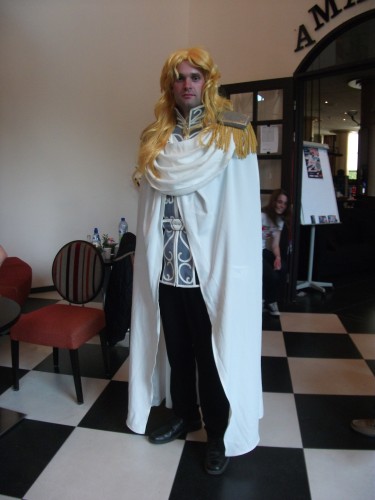
While I did not attend any actual cosplay events, I did see quite a few excellent cosplayers, which you can see below. There was a really good Crocodile from One Piece cosplayer, but I wasn’t able to catch him.

Overall, Tsunacon was a fun little one-day excursion where there the focus was primarily on letting the attendees do their thing. Rather than going from event to event or even spending the entire day in one location, the con seemed more conducive to just hanging out with your otaku comrades. In that regard, I do wish I had brought others with me, because as cool as it was a one-man trip to a con can only get you so much. It’d also be cool if they had more informational panels in addition to their workshops and games, not for me as my Dutch is abysmal, but to foster learning that doesn’t necessarily have direct utility. The space was also a tad crowded, but nowhere near as insane as some of the bigger cons I’ve attended, and if anything this is a good sign that Tsunacon is getting increasingly popular.

I’ll leave off with these collaborative drawing boards. I drew a couple of things myself. See if you can spot them!

The Not-So-Gentle Path: Genshiken II, Chapter 57

From the moment I began this blog, I’ve established the fact that I am a huge fan of Genshiken. After reading the inaugural chapter of the all-new Genshiken II however, I realized that this is the first time that I’m actually reading fresh material alongside all my fellow Genshiken enthusiasts. Sure, there was the second TV series, but that was mostly existing material, so in a sense this new “limited series” acts as a kind of return to basics for Ogiue Maniax, a starting point for me to share my thoughts so to speak.

So to celebrate this small revival and to welcome back this blog’s namesake to the world of serialization, I am going to give my thoughts and impressions on this first chapter. As more chapters come out there’s a possibility that you’ll be seeing Ogiue Maniax’s first ever instance of episodic chapter blogging, but I’m not making any guarantees.

New Genshiken feels different. I won’t pretend that it doesn’t. The cast is mostly different and is now populated primarily by women, replacing the “awkward men’s club” vibe that kicked off the original series. At first this seemed a little jarring, but Ohno’s off-handed mention of the soul patch guy, aka the Genshiken member that never was, reminded me that prior to the arrival of Yajima, Yoshitake, and Hato the membership barely ever increased. Ogiue and Kuchiki arrived together, while the following year Sasahara’s sister Keiko entered, and in the case of Kuchiki and Keiko both of them were already introduced previously. Sue is Sue. If anything, with such a large cast change I’d be surprised if the series didn’t feel a little different.

The focal point of Chapter 57 is the cross-dressing Hato Kenjirou (who might be a reference to Hayate the Combat Butler author Hata Kenjirou), or rather, everyone’s opinions of Hato. I think Hato’s inclusion set off alarms in a lot of readers’ heads more than anything else, creating a bit of fear that the series would lose its heart and pander too much to otaku at the expense of what made Genshiken good in the first place. As the chapter went on, I could feel that fear growing in myself, but I think it was actually all just set-up for a really pointed reminder that Kio Shimoku did not forget what made Genshiken tick in the first place.

While I clearly favor Ogiue, I think the real star of the chapter was Yajima. Throughout most of the chapter the club feels almost uncontrollable when it comes to the topic of Hato and cross-dressing in general despite Ogiue’s best efforts, sort of like the impression you might get at an anime con seeing a bunch of young attendees with no supervision. Then Yajima comes out and says that she’s kind of uncomfortable with Hato’s cross-dressing. By presenting this point of contention, Yajima manages to bring the club (and the manga itself) back down to Earth and keeps the club environment from getting completely out of hand.

This sort of conflict is actually a pretty persistent theme in Genshiken, whether it’s in the earlier days with Kasukabe’s mean-spirited attacks on the club, or later on with Ogiue and her own inner demons. In a way, Yajima’s somewhat direct personality and her unfamiliarity with the beast that is the Society for the Study of Modern Visual Culture makes her the “Saki” of the new bunch, even if she can’t match Kasukabe in looks. Whereas Saki was a normal person experiencing the world of otaku for the first time, Yajima, who is already an otaku, has to deal with an anime club unlike any she’s ever experienced. That’s not to say that the other characters are unrealistic, though. Hato is developing well, and even the way in which Ohno, Sue, Yoshitake, and Kuchiki get carried away is not that unusual. It’s simply that Yajima, as well as Ogiue, act to rein them in a little, creating a new and different character dynamic.

On the topic of Ogiue, I found it quite interesting that, aside from a small bit of pictorial exposition by Sue, Ogiue goes through the entire chapter without her signature paintbrush style. Even the one-shot had Ogiue tie her hair up, something that was established in previous material as a habit of hers when drawing. Though I’m sure it’ll return in at least one future chapter, it still feels like a break of sorts with the previous series. In terms of her character, it’s interesting seeing Ogiue as Genshiken chairman. After all, back when the original series ended it was one of my greatest wishes to see the continued appearance of Ogiue as head, and in this situation I find myself to be quite fortunate.

Ogiue isn’t a natural leader. In fact, none of the previous chairmen were, with the possible exception of the mysterious First Chairman. However, all of them were able to develop their own natural strengths into leader-like qualities, whether it was Madarame’s strong self-image as an otaku, Sasahara’s subtle confidence and understanding, or Ohno’s gentle guidance, and Ogiue looks to be doing the same. Though not always consistent, Ogiue can have quite a forceful personality, especially when she puts her foot down about something, and I think that this aspect of her personality, combined with the fact that those new members are all freshmen, will result in her being more and more comfortable with her position of authority as time passes.

So that’s the start Genshiken II, and I look forward to more. Of course.

Seeing Manga for What It is

New York Anime Festival, much like the teenagers who attend it, is a fairly young convention especially when compared to other cons. This year saw it merged with its sister convention, the New York Comic Con, and while I did not attend, a number of reports have stated how the Comic Con side so dominated the Jacob Javits convention center that the Anime Festival became relegated to what has now been commonly referred to as the “anime ghetto.” There is no word as to why the ghetto formed, or whether the sharp delineation between comics (and everything else) and anime was a sign of disrespect towards anime fans, but regardless of intent, it is quite clear that things were Different. Dave over at Colony Drop writes:

Far from the exhibition floor, there was an invisible line in the Javits Center that weekend: one that denoted where the comic con ended and where the anime con began. I marked this line down in my mind late in the first day, when I stopped to make a phone call and saw my first pack of running, screaming Hetalia cosplayers. This display was immediately followed by a creepy girl who was going around the hallway alone and serially glomping any character she recognized. It had taken me all day to get there— NYCC offered me more as a gamer than NYAF offered me as an anime fan— but there was no mistaking that I was now in Anime Country.

That invisible line that Dave mentions is largely social; all the con did was greatly exaggerate it through the structure of the convention center itself. Anime fans want to be seen as anime fans. They want to be different and special. Others are glad to oblige, doing so by expressing their disdain for “those damn anime kids.” In either case, a division is formed, between “anime and manga” and “not-anime-and-manga.” Meanwhile, others are quick to step in and give the message that “it’s all just cartoons and comics anyway.”

The trouble with both the acknowledgment and disapproval of such categorizations is that each side has its own fair share of pitfalls. By regarding manga as special (and from here on out I’ll be sticking to manga for the sake of convenience), supporters can end up tying it down, obscuring (or even willfully ignoring) the fact that one of manga’s real strengths is its sheer diversity in style, content, and tone. Instances of this can be seen in the way that early iterations of the Morning International Comics Competition (back when it was called the Morning International Manga Competition) were less aesthetically diverse than the more recent ones. This is further compounded when its detractors regard manga as being narrowly defined by negative traits. And yet, while it is in no way disrespectful to refer to manga as “comics,” doing so becomes problematic when the traits that have developed as the result of a unique comics history are intentionally brushed aside for the sake of generalizations. A person who regards manga as being no different from other comics inadvertently disregards the histories of comics cultures the world over.

One mistake people commonly make when they talk about what separates one form of comics from another is that they start at the visuals first. Some never get beyond the surface, and they define a form of comics entirely by the look of characters and details. Others can look beyond the first layer and delve deeper, finding meaning behind those images. Now taking the top-down approach is actually perfectly valid, but it only provides half of the total picture. By also taking a bottom-up approach, you can begin to see how the various non-visual contents of stories in comics manifest themselves on the pictorial level. It is good to not only see how the river-like flow of panels in manga affects storytelling for instance, but also how the storytelling can influence the panel structure in manga. From there, you can really begin to see what makes manga special, and at the same time discover its connections with the greater category of “comics.”

It can seem like a complete contradiction to say that manga should be seen as both unique and like all other comics, but that’s only the case if you define it in black and white terms. Look carefully, and you’ll see that the actual lines which separate manga from other forms of comics are actually quite nebulous. Rather than having manga’s identity be frozen in time, forever unwavering and unchanging, it is important to see manga as the result of decisions made over the years, trends that ebb and flow, and the combined efforts of people who dared to pick up a pencil and merge words with images in sequential format. Even as comics creators increasingly take notes from their peers two continents away and the divisions begin to crumble, they do not automatically wipe out what has come before. Just the same however, manga is not beholden to its past, and can grow in unpredicted ways. The past provides a foundation for the unseen future.

DO YOU WANT TO EAT DURING NEW YORK ANIME FESTIVAL/COMIC CON?!

The Brotherly Combination of New York Comic Con and New York Anime Festival is this weekend (Oct 8-10), and while I cannot go this year due to that pesky thing called the Atlantic Ocean, I still want to help out any way I know how. As of late, I’ve noticed that people planning on attending the con, especially those from outside of NYC, are concerned about where to go eat, and it just so happens that I love eating and eating in New York.

First thing first however, there are some “harsh” truths I have to get out of the way. Namely, the Jacob Javits Center, located between 34th St and 39th St on 11th Ave by the Hudson River, is quite a ways away from everything else. Even 10th Ave can feel distant, and the closest trains, the A, C, and E (aka the “blue” trains), are as far as 8th Ave. So unless you want to pay those ridiculous convention center food prices, you’re going to have to walk, and you’ll need at the very least 10 minutes to even get to the closest place, a McDonald’s on 34th St and 10th Ave which undoubtedly be packed. Another thing to keep in mind is that, generally speaking, “avenues” are much longer than “streets” in New York. Remember that as you plan out where to go with the time you have.

Oh, and seeing as I’m not in NYC, I cannot verify everything will be as I say it is for the weekend. Food places open up and close all the time in New York, after all. My apologies!

The simplest method to obtaining food is to go along 34th and you’ll hit a number of other fast food places. There’s a Burger King, two Subways, a Wendy’s, and even a Chipotle’s by the time you reach 8th Ave. Of course if you take the food to go, you’ll save even more time.

But I hear you asking, what if we want to sit down and eat, maybe take our time? Well first, I would have to ask if you planned on going back to the con center, and second, I would have to once again point out the New York City subways. They may not be the most reliable, but they’re plentiful and they go to almost every nook and cranny in Manhattan, let alone the other New York City boroughs. At that point, I would say just find whatever, but I know that a lot of people are distinctly looking for places to eat near the Javits.

Once you understand that “near” is a relative term, you have quite a few options. There are multiple diners along 34th, such as the Tick Tock Diner and the Skylight Diner. All of them are decent enough, and good for holding a large crowd if you get there at the right time.

Also keep in mind that you’re in Hell’s Kitchen, and going north along 9th Ave (and to a lesser extent 10th Ave) is going to reward you with any number of restaurants of varying costs. As a general rule, the further up you go, the pricier the food will be, but you can still find places, like Burgers & Cupcakes on 9th Ave between 35th and 36th. According to a friend, there’s a couple of excellent bars as well, Pony Bar and Rudy’s. Don’t be scared by the appearance of smaller locations either, as they may very well serve good food. One such place is Tehuitzingo Deli Grocery on 47th St and 10th Ave, which serves the best tacos I’ve ever eaten. Try the cow tongue!

If you’re really unsure of how you want your dining experience to be, then my location of choice is 38th St between 7th and 8th Aves. Not only is this the street where you can get my beloved Go Go Curry, but if you’re looking for places that can hold more people, there’s Lazarra’s Pizza, a sit-down Balkan restaurant called Djerdan (if you’re a real anime fan you’ll get the Musaka and shout, “MASAKA?!”), Korean Fried Chicken at Bon Chon, and even a Chinese restaurant called simply 38th Street Restaurant and Bakery which serves food closer to the kind you’d find in Chinatown than your typical General Tso’s fare. Also along 8th Ave between 38th and 37th is 2 Bros Pizza, which has convenient $1 slices. There’s also a 42nd Times Square Yoshinoya, in case you want to quickly feed your desire for Japanese food and Go Go Curry is too full.

If you have a bit more time than that and a bit of cash to lay down, then I must recommend Tony’s Dinapoli, a family-style Italian restaurant located on 43rd St between 6th and 7th Aves. The place is popular so you’ll need a reservation, but the portions are big and the food is hearty, and they’re used to housing large crowds.

And if you’re vegetarian, you may want to check out some of the nearby Indian restaurants. While I haven’t been to it myself, the closest one appears to be Tawa Tandoor, on 34th St by 9th Ave.

So those are some basics to eating during your New York Anime Festival/Comic Con weekend. Happy dining! And if you want to find something specific to eat in NYC, even outside of the Javits range, don’t be afraid to ask me on Formspring or Twitter or even in the comments below.

Mitsuya Yuuji Throughout Combattler V: A “Lesson” in Voice Acting

At Otakon 2010, voice acting veteran Mitsuya Yuuji (or Yuji Mitsuya) was a goldmine of valuable information about the industry and the art of voice acting, using his own experience as a complete seiyuu rookie on Choudenji Robo Combattler V as an example During the panel, he mentioned that an interesting exercise is to compare a voice actor’s performance in the first episode to their performance in the final episode.

Taking that suggestion to heart and expanding on it a little further, I’ve compiled a clip of Mitsuya’s voice acting progression from the beginning to end of Combattler V‘s 54 episodes. Not every episode is shown here, but it still gives a good indication of how much effort he put into improving.

Early on, you can hear that he’s clearly an amateur and not entirely sure what to do with the role. He also sounds much deeper, having not yet hit upon the right voice for the main hero Hyouma. You can also hear him experimenting with all sorts of ways to say Combattler V’s name, stretching this syllable, shortening that one and so on. Towards the middle around when the story starts to really ramp up, he puts a lot more intensity into his performance. Then, in the second half you’ll notice that he’s starting to find a “standard” of sorts on how to shout, “Combattler….V!” until it pretty much solidifies, for better or worse.

Remember that this was Mitsuya’s debut role, and here you can really see his growth as a voice actor. It’s no wonder he’d go on to form his own voice acting school.

At his panel, Mitsuya placed great emphasis on the fact that a lot of male voice actors these days try too hard to maintain the “coolness” of their characters and don’t put their all into their performances, citing that this probably has to do with the fact that not nearly as many voice actors these days come from a theatre background (if any at all). It’s interesting then to think about how Mitsuya’s own theatrical experience still had to be molded to fit voice acting.

As a bonus, take a look at his performance in 2000’s Super Robot Wars Alpha, where he has to perform the same line as in the above video roughly 25 years later. Skip to 0:46 to hear it (or watch the whole video, it’s cool). Amazingly, his voice appears to have gone up with age.

Onegai Dutch Dutch Koko ni Dutch

So I’ve spent my first two days in Europe, getting slowly accustomed to the lifestyle here. While the schedule is fairly loose around here, I do not know how much time I really have to update Ogiue Maniax, nor do I know if I should. Is it a sign of slacking off? I guess that’s only the case if I’m using too much time that should be spent doing important manga research. In any case, as was made obvious by my lack of a post yesterday, the streak has been broken and it is a very likely chance that no longer will I be posting daily.

Part of what I was interested in was how cultures outside of the US and Japan perceive anime. Fortunately, I spoke with a Japanese (that is, ethnically) philosophy PhD today, who informed me that the Netherlands does indeed have one or two small anime conventions. Maybe I’ll check one of them out. It’d be an exciting experience, I think.

Anyway, this is the start of my path to changing the face of anime and manga academia. Wish me luck!

Continuing Con Con

Over the past 9 years or so, I have gone to a number of conventions. Large or small, anime-focused or emphasizing other areas of geekery, I’ve gone from a relatively inexperienced con-goer to one with agendas. As I have grown as a geek, so too have my tastes developed, and I realize that as much as I find my growth to be a good thing, I sometimes wish I knew less.

When I went to my first convention, the science fiction-themed Lunacon, I recall there being quite a few things I wanted to see (Godzilla vs Megaguirus comes to mind), but at the same time I allowed myself plenty of opportunities to just wander into panels just to see what was going on. But now that I’ve developed my focuses as an anime fan, as a nerd and admirer of fiction and art, I feel myself less able to wander.

Sure, when it’s small and there aren’t very many good guests or must-see events it’s easy to remain the con flâneur. But when there are a ton of worthwhile things to see, then I start to feel like I’ve affixed myself to some rails. The rails may be of my own design, and I am capable of deviating from them, but they can still feel somewhat restrictive. I could try to just float through the convention, but then I’d be missing so much.

It’s kind of like going to a restaurant. If nothing on the menu looks familiar to you, you’re more likely to just try something new, but if you happen to see your favorite dish on the menu, then it takes no small amount of willpower to not order it and go for the new and the mysterious.

Otakon 2010: I Don’t Believe It. That’s Unbelievable.

At this point, having gone to Otakon for the past four years, I feel it safe to call myself an Otakon veteran to some degree. In terms of what to expect, this year didn’t feel that different from all the previous times I went, but a lot of things have happened to me over the past year or so, makes me think I’ll reflect back on Otakon 2010 particularly fondly.

Ogiue Maniax’s Panelist Debut

Otakon 2010, from July 30th to August 1st, was the first time that I came to the convention as a panelist. And I had two to boot!  It may have been obvious from all the posts I made about panel preparations, but I really wanted to do a good job and I really wanted people to come to the panels, so up until I finished both of them, I had been very nervous.

The mahjong panel, titled “Riichi: Japanese Mahjong, Anime, and You” was a collaboration between me and Sub over at Subatomic Brainfreeze. With a 9:30am Friday timeslot when a good portion of the con hadn’t even been registered, and a fairly obscure topic like mahjong, we were both worried that our panel attendance would amount to our friends and acquaintances, and while we would have been glad to teach them about mahjong, our real goal was to reach those people who were only barely familiar with mahjong anime. Fortunately, the turnout was better than we had ever expected, and while I am to understand that our panel room was the smallest of the bunch, we still managed to pretty much fill the whole room, getting approximately 160 people to listen to us talk about an old Chinese tile game and the way it works in Japanese cartoons.

The Riichi panel itself also went far better than we expected. Knowing how much information there was to convey despite the fact that we had already decided to cut large amounts of information, we had practiced the panel on multiple occasions, barely finishing on time. But while our practice sessions felt kind of strange and awkward, the actual panel itself had an amazing energy to it. Both Sub and I were playing to our strengths, playing off of each other, and we managed to give all of the information we wanted to while also keeping the audience entertained. We even finished early and had a good amount of time for questions! From this experience, I have learned that Sub and I make a good paneling team and I look forward to the next opportunity we have to do a panel together.

By the way, for those of you who were at the mahjong panel but were unable to copy down the URL for the additional mahjong resources, here it is.

My second panel was also on Friday, but at the opposite end of the day at 11pm. Entitled “Portrait of a Fujoshi: The Psychology of Ogiue Chika,” this joint effort between myself and Viga the Otagal was in many ways a culmination of what I had been doing on this blog. Last year, Viga challenged me to do a panel all about Ogiue, and that’s how we ended up on stage.

I understoood well that even if a good portion of the convention was into yaoi and Hetalia and the like that they would not be interested in deep character analysis, so while the panel attendance wasn’t as high as it was for the mahjong panel, it was still quite impressive, and once again we managed to play off the energy of the audience and each other and give a good presentation, with me giving a more subdued approach. Also, once again, where practice netted us a panel that had about 10 minutes worth of Q&A, the actual thing gave us three times the amount. While I wish we had prepared more, I think we did a good job of expressing what makes Ogiue such a great character and why we connect so well to her (and why you should too!).

When I think about it, doing a panel on a single character is unusually rare at an anime con. You have panels about Evangelion, but never is it a panel specifically about Ayanami Rei. I hope we can start a trend at anime cons, as I think it’s a worthwhile way of running things.

I don’t know if any video recordings are available so I apologize for those of you who were unable to attend but wanted to see them. I also want to say thank you, thank you from the bottom of my heart, to all of you who attended my panels. I hope you enjoyed them.

Now having panels at both extremes of the day has its drawbacks, but it also had the great benefit of avoiding conflict with the majority of events, thus freeing up the rest of the con for me. As is the case with every year, my primary mode of entertainment at Otakon is the panels, both industry and fan. Fortunately or unfortunately however, I found that there was still too many entertaining things crammed into a single weekend and I still had to sacrifice one panel for another.

Industry Panels

In terms of guests, I was not looking forward particularly to any of them this year, but I’m glad I attended the Q&A’s that I did as all of them provided incredible insight into the industry, with Mitsuya Yuji’s panel perhaps being the most informative of all. Attending his Friday panel, the voice acting veteran told us how voice acting became a “profession” rather than a side job for dramatic actors and how voice acting should come from the entire body and not just the voice. He also talked about how in the old days, if you flubbed a line, rewinding the film reel and readjusting everything was a huge pain, so mistakes were a big deal.

Throughout the panel, Mitsuya showed us what it was to truly be a voice actor, from passionate yells (he delivered a passionate “CHOUDENJI SPIIIIIIN” on more than one occasion) to voice changes to even the change in jobs given to you as you age and can no longer be the handsome male lead. Also, seeing as his debut voice acting role was as Hyouma, the main character of Combattler V, I asked him the question I had asked of Macross director Ishiguro and Gundam creator Tomino: What were your experiences with legendary anime director Nagahama Tadao?

Mitsuya gave us the impression that Nagahama was an incredibly passionate man. Gentle and understanding, he took his role as director very seriously and pushed Mitsuya to improve his performance. Mitsuya had originally tried out for both the lead Hyouma and the rival Garuda, and Nagahama made him redo his Garuda takes ten times. When asked if this was typical of a mere audition, everyone said that this was highly unusual. Mitsuya would later find out that all of this, from the audition to the strict voice sessions, were all signs of the fact that Nagahama had seen the amazing potential Mitsuya had and wished to nurture it into something greater.

Maruyama Masao was back again this year. The head producer over at Studio Madhouse, in my opinion the best anime studio there is, Maruyama is a staple of Otakon, but despite the fact that he comes pretty much every year, I look forward to it every time. This year we finally learned that Redline, the series he had been working on for six years which he also mentioned at numerous past Otakons, is finally getting a theatrical release in October, though its director also passed away before it could debut. Redline is  high-intensity anime, resembling the most elaborate portrayal of F-Zero ever, and Maruyama claims it will be the last truly hand-drawn anime ever.

Otakon was also the American debut of Welcome to THE SPACE SHOW, a feature-length film from the animation team which brought us Read or Die and Kamichu. As such, the creators were also there at Otakon, and managed to have an informative Q&A session. I gave a question targeting mainly Ishihama, the character designer, asking if he felt there is a trend in anime films to move towards simpler character designs which lend themselves towards looser and more whimsical animation. Ishihama responded that he believed there is indeed such a trend, but that there is also a counter-trend present, where more detailed, less fluid animations are also becoming popular.

As for Welcome to THE SPACE SHOW itself, the movie is quite fun but is too unfocused. The story of kids who travel into outer space in a way reminiscent of Galaxy Express 999, the film had opened up many good directions the story could have gone but ended not taking very many of them and losing a good deal of its potential. The film also dragged on after a while in a way where even the expertly animated sequences and wonderful set of aliens felt less exciting overall. At the Q&A session, we learned that this was the team’s first feature-length work, and in hindsight it really showed.

The only American industry panel I ended up attending was the Vertical Inc. panel with Ed Chavez and Peepo Choo author Felipe Smith. Ed, responsible for all of those Vertical Vednesdays I keep talking about on the blog, is about the most personable marketing guy in manga. While giving hints at interesting new titles coming in the future (including another Tezuka title), he also showed that he has some strong opinions on manga, stating that Vertical would not license Yokohama Kaidashi Kikou because “I don’t like it.”

Fan Panels

I had a lot of fun with the fan panels I attended, which mainly focused on exploring elements of anime and manga but I also attended some fun ones too. In the “elements” category there were three panels:  “You Don’t Like Moe and Here’s Why,” “The Changing Faces of Anime,” and “The Life and Times of Akiyuki Shinbo.” In the “fun” category, there was Anime World Order‘s “10 11 Anime You’ve Never Heard of But Must See,” the “Mecha Fan Panel,” and Megaman in Anime and Manga.”

The moe panel focused on the concept as a phenomenon and the meanings it gains as it has become a part of the industry itelf. It took a while to get off the ground but eventually found its footing, and the best advice I can give to the panelists is that more can be done to bridge the gap between what they are talking about and what the audience understands.

The Changing Faces of Anime panel, run by Evan Minto of Ani-Gamers, was a literal look at faces in anime, discussing changes in character designs over the years. It was a good panel which generated even better discussion, and it’s a difficult topic to tackle in only an hour.

The Shinbo panel, presented by wildarmsheero, showed that he had clearly done his research on the eccentric director and took a look at all the stylistic elements Shinbo loves to employ in his works. It ran a big long, forcing the Q&A session to be cut.

The “Must-See Anime” panel was very entertaining, though it was focused less on recommending good shows to anime fans and more about showing amazingly obscure anime that were difficult to obtain and had a lot of excitement value (but could still be good shows). I know that I’m going to track down Natsuki Crisis and other titles. Also, while obviously the clips themselves say a lot, it also doesn’t always convey some of the more overarching positives of a title, so more talking might be a good idea.

The Mecha Fan and Megaman panels meanwhile were fairly similar, giving the history of mecha and Megaman in Japanese graphic fiction. I won an old issue of Nintendo Power at the Megaman panel, and enjoyed the liveliness of the mecha panel, but I think that both could benefit greatly from delving even more into their topics. The Megaman panel also suffered from everyone reading from their scripts too much. It was very obvious that everyone at the panel was an expert in the field of Megamen, and I think removing the script would have made it more personable. On the other hand, it also showed the best Rockman.exe opening, so it’s all good.

Entertainment

While neither was truly the start or the end of the convention, I find that the opening ceremony and the Home Made Kazoku concert act as nice bookends to the con proper, mainly because of the positive impression Home Made Kazoku made on the audience at the former, which led to great anticipation about their performance for the latter. A hip hop-oriented Japanese group, their music and live performance was really infectious, and I think that music-wise it was a great success for Otakon this year, especially when I found out that the shamisen-playing Yoshida brothers managed to fill the concert area so tightly as to nearly be a fire hazard.

Speaking of fire hazards, the talk of the town was clearly the fire alarm Saturday Afternoon which forced all of the nearly 30,000 attendees to evacuate the Baltimore Convention Center. Given the general immaturity of the con crowd (including whoever actually pulled the fire alarm), I was pleasantly surprised to see people doing the right thing in the even of the fire: leave in a calm and orderly manner. Even the most rambunctious anime teen knows not to mess with this sort of thing, which brings a smile to my face.

Food and Friends

But going to a con isn’t just about the anime or the guests, it’s about meeting people and having a great time doing so. The con begins on Friday, but the con experience truly begins the Thursday before, from the point the bus arrives, and only really ends when we get back home. This year’s Otakon featured the return of glorious Brazilian Buffet, being amazed at the evergreen awfulness of G-Saviour while watching it in the hotel room, large gatherings with people relaxing and joking about, and amazingly deep discussions about everything anime and manga.

As I rode the bus home with my travel companions, we discussed for about four hours straight the very nature of enjoying anime and manga, as well as their qualities as creative forms of expression, and it made me realize just how much better conventions are when you add the human element to it.

I love it, and love makes Otakon better, I can guarantee you that.