

After Happiness Charge Precure! failed to live up to its potential, I had hoped that the next series in the long-running Precure anime franchise would fare better. Fortunately, Go! Princess Precure wildly exceeded my expectations to become one of my favorite iterations of the popular magical girl anime. From the serious to the silly, Go! Princess Precure hits a homerun.

Go! Princess Precure follows Haruno Haruka, a teenage girl who dreams of becoming a princess. As a small child, she met a handsome young prince named Kanata who inspired her to hold onto her love of princesses, in spite of discouragement by others. In the present day, as Haruka comes to the prestigious “Noble Academy” with the goal of learning what it means to be a “true princess,” she finds out that monsters have begun to attack the school, preying on everyone’s hopes and aspirations. Haruka becomes a “Precure,” a magical warrior with the power to defend against the forces of Dysdark, and is soon joined by two other girls, Kaido Minami and Amanogawa Kirara, who also use their dreams to fight back.
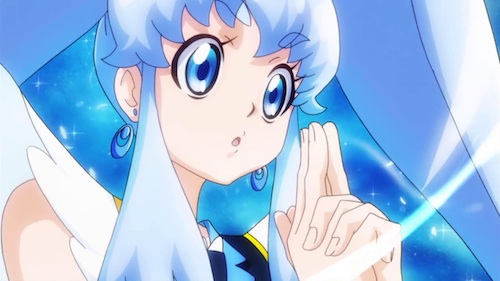
Princess fever has taken over amidst the enormous popularity of Frozen in Japan, and Go! Princess Precure asks, “What is a princess?” While this question (as well as the thematic flourish of the series) can potentially be criticized on a surface level as sexist and regressive, a closer look shows that Go! Princess Precure aims to claim the concept of the princess as a symbol of hard work and kindness towards others. To this point, a major villain of the series, the powerful Princess Twilight (no relation) even confronts Haruka (Cure Flora) with the idea that one can only be born a princess, and while she’s technically more correct than Haruka in terms of how it works in real life, Go! Princess Precure shows how Haruka, Minami (Cure Mermaid), and Kirara (Cure Twinkle) strive to embrace the idea of a “princess” as being the product of one’s effort. In other words, according to Go! Princess Precure, being a princess doesn’t make you a better person. Rather, being a better person who strives for their dreams and helps others is the key that allows any girl to become a princess all on their own.

Not only is Go! Princess Precure strong thematically, it’s just an incredibly solid show in general. In terms of animation, it has some of the finest fight sequences in all of Precure as early as episode 1, and while it rises and dips in quality as is typical of a year-long anime, its overall consistency as well as its high points are notable. The outfits and character designs are all on point (In terms of narrative, the series benefits from an entertaining main cast with well thought out character development. Flora’s story at the half-way point connects to that greater theme of “princess” self actualization. Kirara as the donut-loving fashion model eager to speak her mind is one of the most unique Precure characters ever (I voted her as my favorite among the Princess Precures for this reason). The supporting characters, though not quite on the level of Heartcatch Precure!, grow admirably throughout the series as well.
Perhaps most notably, when the anime introduces a fourth Precure late into its run, she does not overshadow the rest of the cast. It’s a common problem for shows like Precure or Super Sentai, where in an effort to push the new character and her toys she ends up practically taking over the show. Honestly, I can’t recall a single bad episode.
Go! Princess Precure might be quite the hard act to follow. Whether it’s in comparison to the rest of Precure or as an anime all on its own, Go! Princess Precure is simply an outstanding work that embodies a lot of what is best in children’s shows and the magical girl anime genre. I highly recommend anyone, even those skeptical of mahou shoujo, to take a look.

—
If you liked this post, consider becoming a sponsor of Ogiue Maniax through Patreon. You can get rewards for higher pledges, including a chance to request topics for the blog.
 What is appropriate for an audience of American children? This is a concern that comes up all the time with cartoons, whether it’s My Little Pony: Friendship is Magic‘s first season explicitly giving moral lessons to live up to its E/I (Educational/Informative) Rating, or the decision to change Japanese names to English ones when adapting anime. Though it feels out of place in this current era, the recent



 OGIUE MANIAX