Kio attended a live screening of the newest How Do You Like Wednesday?, which included people from the cast. It was a fun and unusual experience. He did not attend in Ikebukuro.
Kio made these Madarame drawings as part of a special collaboration with the series Love-yan, which features a protagonist who resembles Madarame. Kio also vaguely denies knowing about the Rocking Spark attack from Ultraman and how similar it looks to Madarame’s pose.
Kio recalls how tough it was to live on the top floor (6th) of a building because of how hot it got in the summer. He tells fellow manga creator Kusada to take care of himself amid some very high temperatures.
The first tweet states that really good artists can draw Image B, where the frame is mostly taken up by the left leg. Kio says that he tries to draw B but can only really do A.
Kio has played Elden Ring for over 50 hours and is over Level 50, but only just reached Limgrave.
He can’t get the timing for rolling and such down, and while he played King’s Field, he hasn’t played later FromSoftware games aside from Shadow Tower and Dark Souls.
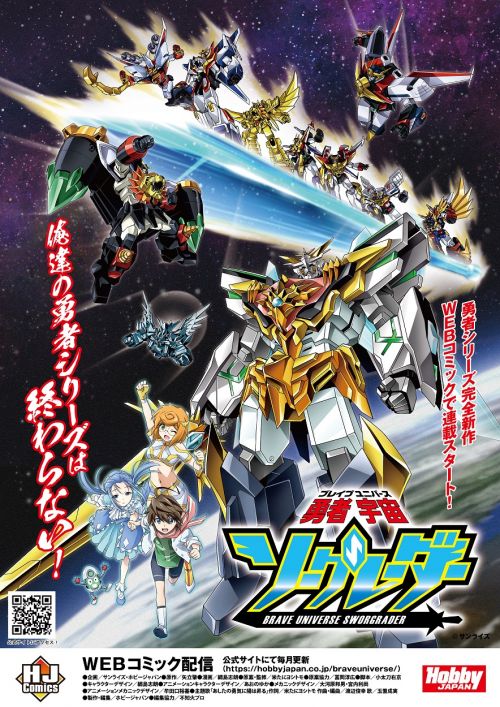
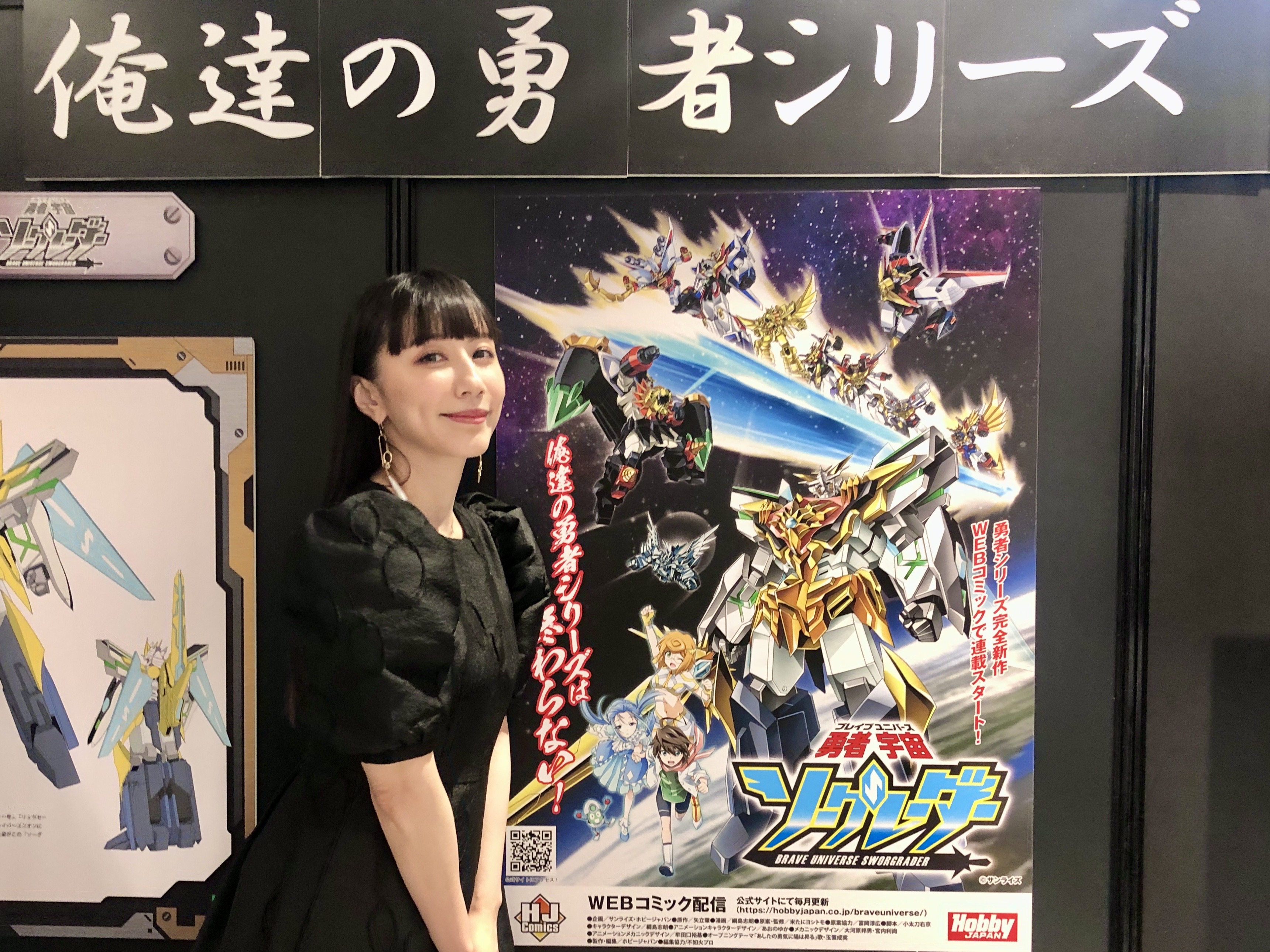
This past week, the Gaogaigar 25th Anniversary Exhibition in Japan featured a surprise announcement: A new entry in the Brave Series has been greenlit! Brave Universe Sworgrader is heading our way, albeit with a caveat. Unlike all its anime-based predecessors, it will debut as a web manga.
Sworgrader isn’t totally alone in regards to not coming out the gate as an anime. The sequel to Gaogaigar Final, King of Kings: Gaogaigar vs. Betterman, started off as a web novel series before being adapted into a manga. Other old anime have also received novel-only nostalgic sequels, such as Raijin-oh and even the magical girl title Ojamajo Doremi. One major difference is that Sworgrader is wholly original, though the teaser art and the whole “Brave Universe” thing seems to imply that the previous Brave Robots will somehow be involved—even the shelved sequel that only ever got a spotlight in video games, Baan Gaan.
I do feel a mix of joy and sorrow in all this: It’s great to see Brave franchise make something of a comeback, but also a shame to know how diminished it is compared to its heyday. I suspect that something like a 90s throwback robot toy franchise isn’t going to attract the massive kids market that was tuning into Exkaiser and such thirty years ago (otherwise this would at least be a mobile game). It’ll mostly be banking on the adults who had grown up with the old shows, and merch will probably be premium figures and model kits, as opposed to children’s toys.
That all said, it’s worth pointing out that despite likely having more “Big Friend” appeal than anything else, the main characters are clearly cut from the traditional Brave cloth: They’re kid heroes through and through. So many retro-style series prefer to have characters who are at least in their late teens in order to be more relatable to that older audience, but I kind of admire the creators of Sworgrader for trying to be faithful to the Brave spirit. Gaogaigar really hit its stride once the shackles of toy advertisement were loosened, and Sworgrader is potentially going to be like that from Day One.
In addition to overseeing the entire project, Gaogaigar director Yonetani Yoshitomo is also the lyricist on the main theme for Sworgrader; something he’s had experience doing thanks to Gaogaigar and Betterman. In fact, similar to Sworgrader, Gaogaigar vs. Betterman has “opening” and “ending” themes despite there being no anime. Thetheme will be sung by Tamaki Nami, who got her debut in anime singing the fourth and final Gundam SEED opening, “Believe.” All this takes me back to my very first time in Japan in 2005: a year when Gaogaigar: Grand Glorious Gathering was on TV, and I could hear Tamaki’s SEED openings while in the supermarket.
And while I believe a Sworgrader anime will have some trouble coming to fruition, not all hope is lost: One of the credits on the project is Aono Yuka (Shinkalion Z, Brave Beats) as “Animation Character Designer” as distinct from “Character Designer” Tsunashima Shirou, the artist of the Jinki franchise (talk about another throwback). Similarly, there are separate credits for “Mechanical Design” (Ookawara Kunio, Miyauchi Toshinao) and “Animation Mechanical Design” (Mutaguchi Hiroki) Maybe we’ll see some cool shorts, at the very least?
Whatever form Sworgrader takes, I look forward to seeing its arrival. I will neither automatically love it or hate it, but I do hope it brings joy and excitement to all.
July is a packed month. Not only do I have Otakon at the end of the year, but I’m also in LA this weekend for Anime Expo and to see today the first HololiveEN live concert, Connect the World! Back when tickets became available, I almost missed them entirely, but I got lucky that there was some available after the initial prerelease sale. I fully intend on writing a review of the experience.
I won’t be lying when I say that I’m nervous about attending large events after just getting over COVID a month ago, but I will be masked as much as humanly possible for my sake and others’. I hope everyone else treats others attending these big gatherings with respect and compassion.
Thank you to my Patreon subscribers at the start of this summer season!
I got to conduct an extensive interview with a 20-year veteran of the industry. Tabata goes into detail and working with the late, great Kimura Takahiro.
Anime Expo and Connect the World has many powerful individuals I’m interested in, but Otakon has Iwao Junko: the voice of Tomoyo from Cardcaptor Sakura. Here’s to hoping I can get an interview with her! It would be a dream come true.
Gundam manga artist Tokita Kouichi shares a photo of a first-era Gundam model kit. Kio reacts by saying that the instructions are from before they changed how joints work on Gunpla models.
Kio’s tortoise has been walking quickly around in their home, being hyper. Kio comments that outdoor spaces would be good for it, but the actual outdoor space available right now isn’t all that big, so this is the best he can do right now.
The reason it’s so hyper is because the warm summery weather is affected it as a cold-blooded creature.
Kio visited actual sites from some How Do You Like Wednesday? Specials. The first tweet shows one of 12 bridges featured, and the second is Suigou Sawara Ayame Park.
Kio thanks a fan for sharing a Monthly Newtype video about manga in 2008, the height of one of the host’s teen years. Genshiken and Spotted Flower both get mentioned briefly. (See 23m45s in the video below.)
Kio later tweets about the video separately, commenting that he likes how writer and host Mafia Kajita says that Spotted Flower has had one hell of a development.
As Kio sees artists tweeting about whether they got into Comiket or not, he is working on his (unrelated) erotic doujinshi. He’s been drawing but also cutting content out, so even though he’s drawn 30 pages, it feels like only the beginning.
Working on his new ero doujinshi seems to be an endless task. It includes things like fretting over which erotic sound effects to use, like “guchu” vs “gucho.”
Kio, after getting his ass kicked by the boss Margit in Elden Ring, goes back to drawing ero manga. He likes how he can just skip bosses and explore elsewhere in an open world game.
Kio got through 63 pages of his ero manga manuscript, but is setting it aside to get some of his professional work done. Apparently, the next part is the climax.
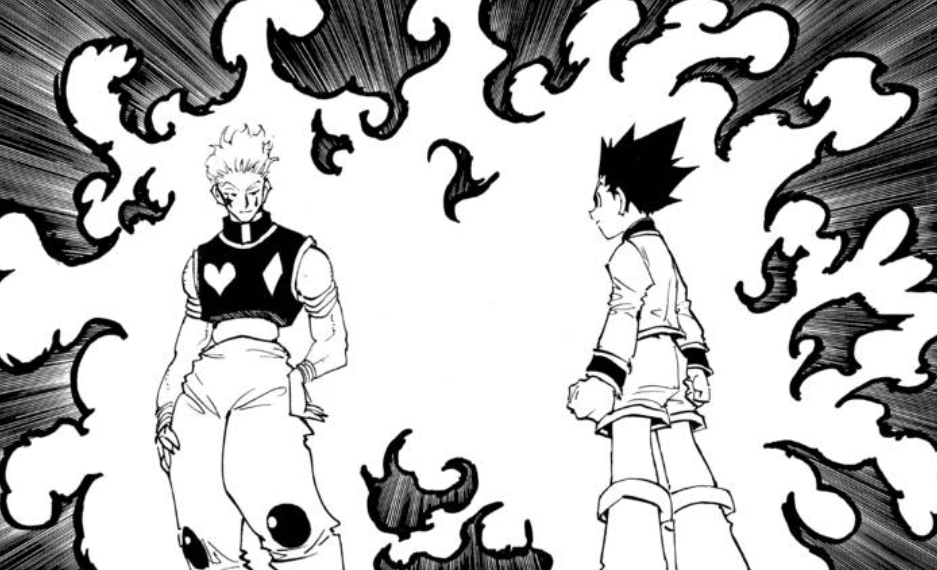
Hunter x Hunter has long been one of those series that I defined by the enthusiasm of its fans. Without knowing much about the series, I would often see it regarded as one of the best shounen action manga ever, and arguably a cut above author Togashi Yoshihiro’s other major work, YuYu Hakusho. The only thing that seemed to stifle its relentless charge was the fact that Togashi has very serious medical issues that have inevitably resulted in numerous stops and starts. But with the series getting some new chapters last year and VIZ putting all previous chapters on their Shonen Jump app to read for free, I’ve decided to jump on board this bumpy ride called Hunter x Hunter and see what the hype is all about.
The world of Hunter x Hunter is one where the most revered but challenging career is that of a “hunter.” A hunter of what? The answer is “anything and everything.” Gourmet foods, cultural artifacts, criminals—everything is fair game. Our hero, a boy named Gon, has long heard that the father he never knew was actually a hunter, and he seeks to follow in his footsteps so that he can meet his dad. Few are able to pass the arduous and deadly test, but Gon’s combination of kindness, cleverness, athleticism, and perseverance that friends and rivals alike take notice of.
I have read around 70 chapters of Hunter x Hunter, which for all I know is only scratching the surface of what makes it so renowned. From this limited experience, though, I can begin to understand why fans of shounen fight manga love it so much, even if it hasn’t captivated me in quite the same way. This is because Hunter x Hunter feels both more advanced than the typical formula but well within its boundaries.
There are two common action formulas for what I call “structured” shounen fighting, that is to say battles that have some sort of in-story framework governing it. The first is the tournament arc, where everyone ostensibly fights to figure out who’s #1. The second is the Bruce Lee’s Game of Death–style fight to the top, where the heroes must vanquish one “boss” after the next before being able to reach the goal, like in a video game. Hunter x Hunter, at least from what I’ve read, is the formulas distilled down to their essences and mixed together so that everything is one or the other or both. But working off a formula doesn’t necessarily mean it’s formulaic, and where Hunter x Hunter shines is by emphasizing that the solution to fights isn’t always sheer strength or a passionate heart. It’s cleverness that often wins the day.
At the same time, I feel like anyone who isn’t in love with shounen fighting might have a difficult time with the series, unless they’re maybe really dedicated to shipping the characters. I think the most helpful comparison might be to JoJo’s Bizarre Adventure, which has a similar focus on fights that require wits and ingenuity, but the highly eccentric and over-the-top nature of JoJo’s gives it a level of spectacle I haven’t seen in Hunter x Hunter. It’s like JoJo’s loves to break rules while Hunter x Hunter prefers to at most bend them.
It’s very possible that I’m on the cusp of the series getting turned on its head, and that I’m just one step away from the series transforming into something I love rather than merely enjoy. It’s happened before, but I can’t say I’m there yet.
There are many unforgettable moments in Initial D. Whether it’s seeing the AE86 drift for the first time, the battle against Ryousuke, the Trueno vs. Levin battles, or many other examples, the races are often showcases of protagonist Takumi’s unbelievable feats. But there’s one battle that often sticks out in my mind—the 86 vs. the Suzuki Cappuccino—because it features an important lesson about not limiting your self-perception.
Throughout Initial D, Takumi is very familiar with being the underdog due to his car being much older and weaker compared to his opponents’. The result is that he has to use various tricks (as well as an intuitive understanding of his own vehicle) to topple one Goliath after another. But the Cappuccino presents a different challenge: It’s actually smaller and lighter than the 86, and can pretty much outdo Takumi’s car at what it does best. Ultimately, though, Takumi prevails by doing what has not come naturally to him: He overpowers the weaker vehicle, even using the relatively larger frame of the 86 to block the Cappuccino.
Often, we think about our strengths in absolutes: “I’m good/bad/mediocre at this.” However, this is all relative. Maybe you’d normally be considered undersized, and have patterned your life to compensate for that, but there could be times where you are the bigger individual and have to use that to your advantage. If you get too stuck on who you’re “supposed” to be and how your actions should reflect your identity, you might lose out on opportunities.
Avoiding tunnel vision about your own attributes is the key—all too fitting for a series about racing.
So it finally happened: I got my first case of COVID-19. I’ve been isolating, but I’ve also finally started testing negative, so I think I’m over the hump.
I already announced it on Twittter, but anyone who attended Anime Central 2023 should probably get themselves tested if they haven’t already. While I was masked for pretty much the entire time, I most likely had COVID-19 during the entire event, and it’’s better to be safe than sorry when it comes to the coronavirus.
While it might be too late for anyone who’s first reading about my COVID-19 case here, I still wanted to talk about it in this status update for a couple reasons. First, well, this is technically the “status of Ogiue Maniax.” Second, many people are afraid to admit they got COVID, worried that they might be looked upon negatively if they say anything, or feel a sense of guilt about how they put themselves and/or others in danger. But I think the more we publicly talk about it, the more we can reduce the stigma without downplaying the ongoing severity of the pandemic (it’s not just “the flu.”)
Thank you to my Patreon subscribers, who allow me to continue to indulge in this hobby of mine:
While Anime Central wasn’t ideal due to my condition, I did manage to conduct some interviews, and I think they all turned out well. Expect to start seeing them soon!
Replying to manga creator Kusada (who just got done selling at the doujin event Comitia), Kio mentions that he’s also hesitant about posting URLs to his 18+ doujinshi on Twitter for fear of being shadowbanned.
Kio has decided to undertake a rather massive personal project. Back in 2010, Kio sold at Comiket a very rough manuscript of a genderswapped Episode I parody called Sister Wars. Now, he’s turning the entire thing into a fully illustrated doujinshi. (Note that I will be making a separate post about this at some point.)
Another person talks about wanting to own Sister Wars, but Kio says that if it’s something where money needs to get involved, then it’ll cause issues, so his intent is to keep it free and online-only.
Kio says the whole thing is 350 pages, but it’s someone he always wanted to do, and he feels that it’ll be a waste if he doesn’t use the free time he has now to work on it. He put a lot of thought into it beyond the genderswap aspect too.
Another commenter recalls there being no Jar Jar, to which Kio responds that other characters from Episode II were also cut, as they seemed to mainly be there originally to just make things more confusing.
Kio realizes a line during the theme song for the variety show/special series How Do You Like Wednesday? comes from a spoof drama they did called Shikoku R-14. Kio originally thought it may have been unused footage.
Finishing the drawings of the Kujibiki Unbalance dating visual novel, here are Koyuki and Chihiro routes as reviewed by Kohsaka and Ohno, respectively.
Some old Genshiken-related drawings. Kio couldn’t remember when it was or what it was used for other than being part of some multi-creator piece, but a fan points out that it was part of an Afternoon 20th Anniversary illustration, as seen on the above library card.
High-quality version of the cover illustration for Genshiken Volume 5.
A fan comments that they remember not being able to read the doujinshi the Genshiken club made, to which Kio responds that most people couldn’t [because it was heavily mosaic’d as part of the joke].
A Genshiken drawing used for the cover of a 2004 issue of Monthly Afternoon with Saki helping to zip up Ohno’s Kuradoberi Jam cosplay, and Ogiue staring awkwardly in the background. Kio also responds positively to people talking about how great Ogiue is in this image, even saying that Ogiue looks like she’s seeing cosplay for the first time. He recalls wanting to draw a scene that doesn’t happen in the actual manga.
I actually found my old instructions for the Kotobukiya Ogiue figure, as well as the glasses for her, all of which I had thought I lost! Kio retweeted it.
Kio saw the 2022 movie Bullet Train. Even though the depiction of Japan is not at all genuine, he was entertained nevertheless. In fact, he even liked the scene in the quiet car. He really wishes he saw the movie in the theater like he had originally planned.
Kio bought Go Go! Ghostbusters Club by Kusada, and mentions wanting to see more of the assistant and wanting to find out why the club president would start a Ghostbusters Club when they’re afraid of ghosts. Kusada thanks Kio as well. (Note that Kio often retweets Kusada, which is not fully reflected in these tweet summary collections.)
Kio watches and reacts to the DVD for the How Do You Like Wednesday? special, How Do You Like Japanese History If We Only Travel by Late-Night Bus for Three Nights Straight?
(Without context, I can’t really properly summarize the reactions so I will leave it like this.)
Kio read Love Comedy Experiments Manga by Shima Toki and really liked the part where they have to stop right before climax (sundome). Shima thanks Kio as well. (Shima is another author who often gets retweeted by Kio; both them and Kusada all do manga for Rakuen, the magazine that runs Spotted Flower.)
While trying to figure out how to fix the warping in this kit part, Kio receives various pieces of advice ranging from pliers to dryers.
Thank you! These days, I'm doing two things while taking a break. One is to draw an R-18 doujinshi (sold at FANZA, titled "ぜんぶ、せんせいのせい。"). The other is to draw "シスターウォーズ" on Twitter.
Kio building a 1/144 Gundam Aerial model kit. He added a bit of weathering effects to the paint job. It also felt like a long while since Kio worked on a Gundam kit.
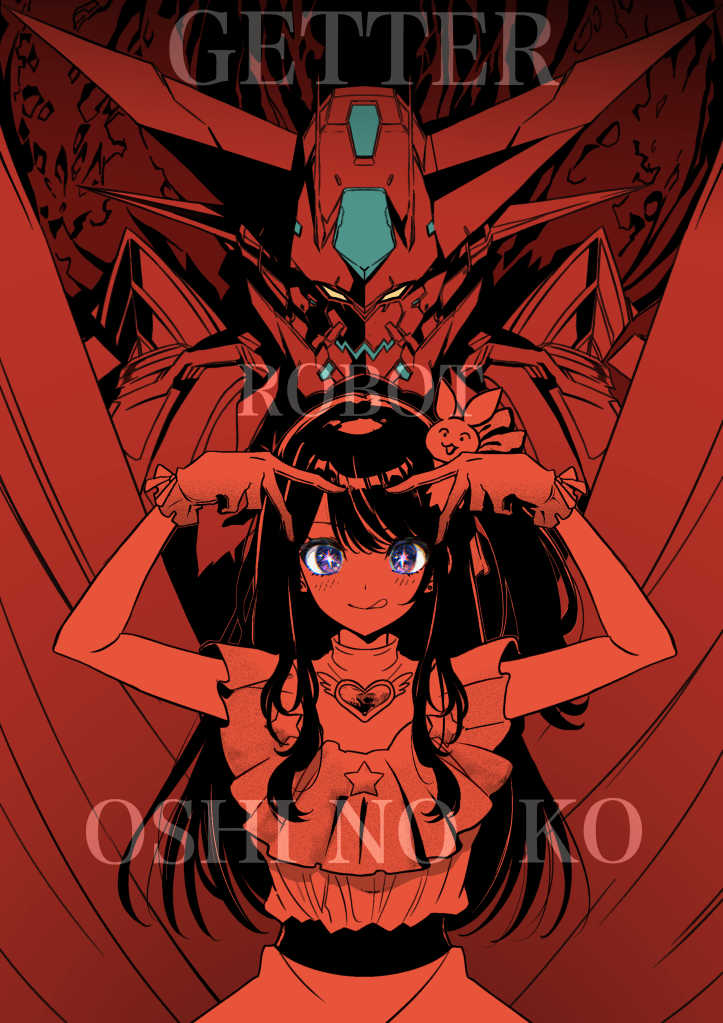
For those who don’t quite get the joke, this is a mashup of the anime opening themes for 2023’s [Oshi no Ko]and 2000’s Shin Getter Robo vs. Neo Getter Robo. The two songs, “IDOL” and “STORM,” share a similar build-up during their respective choruses that makes one transition into the other almost seamlessly, with only a tweek to the tempo being necessary.
As a fan of both (the latter of which I watched during my formative years as an otaku), it makes me happy to see these two shows and their respective theme songs getting love. More than that, it made me think about a few things.
First, I’m actually kind of surprised that so many people have a fondness for Shin vs. Neo. I know Getter Robo is just part of the bedrock of anime and the mecha genre, but I had always assumed Shin vs. Neo was just known in the little corner of the fandom I had occupied. Glad to see people have a sense of nostalgia for it, though that does make me feel old.
Second, if this is how newer anime fans discover Shin vs. Neo, then so be it. I hope they enjoy seeing a shirtless man beat a dinosaur soldier into submission, in addition to all the robot action. At the very least, the fact that this joke incorporates more footage of the anime means it’s able to show itself off better than Fighbird and the aforementioned pigeon meme.
Third, it’s a bittersweet reminder that one of the singers of “STORM,” Mizuki Ichiro, passed away earlier this year. IAs one of the elder statesmen of anime music, he might have very well leaned into this, and we might have legitimately gotten a cover of this. At the very least, Kageyama Hironobu and the rest of JAM Project are all around, and they are definitely game to perform memes (see their cover of “Okkusenman.”)
I think what I ultimately really like about Getter no Ko is that it showcases both series well. Their original content doesn’t get lost in layers of obfuscation, and I hope anime fans are able to experience and appreciate both.
I can finally say that I am hip to the trends of 20th-Century South American anime and manga fandom, as well as other fandoms worldwide. I have continued my reading of the original Saint Seiya all the way to the end, and I now know who the characters are, where their appeal lies, and what makes the series so memorable. At least, I think I do.
Saint Seiya (also known as Knights of the Zodiac) is a 1980s Shounen Jump manga about Seiya, a teen orphan who earns the power of a mystical armor called the Bronze Pegasus Cloth in order to find his missing sister. However, taking this path results in him having to fight rival Saints, before eventually teaming up with them to take on greater threats—including the forces of Greek gods. The series takes a while to find its footing, but once it all coalesces, the result is a work full of passionate pretty boys with intense camaraderie whose many battles take readers through a roller coaster of emotions as one shocking development leads continuously to the next.
It’s very clear to me that the series plays things by ear rather than possessing a more concrete long-term plan. Many seemingly important plot points fall by the wayside, as if the author, Kurumada Masami, wasn’t always sure what Saint Seiya should be. It takes a circuitous path to becoming the tales of Athena’s Saints protecting the Earth, and even after that, many arcs conclude feeling like they might be the last. Characters frequently come back to life or have their armor seemingly irreparably broken only to be restored in some never-before-seen way. According to George Horvath, a big Kurumada fan, the author actually let the readers decide who would join the team, and the series does really feel like it was built in part off fan input in a manner similar to pro wrestling.
But what carries the manga through is just the sheer spectacle and excitement built around its core cast, the Bronze Saint, all of whom have very distinct personalities and appeal. Pegasus Seiya is brave and clever, as is befitting a shounen protagonist. Dragon Shiryu is wise and righteous like a kung fu master. Cygnus Hyoga is cool yet fierce. Andromeda Shun is gentle and compassionate. Phoenix Ikki is headstrong and stoic, his sparse appearances akin to a much less merciless and infinitely more effective Tuxedo Mask who throws traumatic hallucinations instead of roses. Every time one of them gets to shine, their most prominent qualities are on full display and add to the drama of the moment.
One thing that increasingly stood out to me is how every character is extremely willing to sacrifice themselves for others. Again and again, warriors both major and minor try to throw their bodies into the jaws of doom to help save the day. At one point, in what’s called the Poseidon Arc, a critical moment goes from Seiya willing to attack in a way that could cost him his life; to the female character Eagle Marin using her body to shield Seiya; to Seiya trying to shield Marin instead; to Shiryu shielding both; to Shiryu, Hyoga, and Shun forming a wall. It’s a whole lot of wreckless selflessness.
Saint Seiya is the origin of the once-notable “boys in armor” genre, but its reach extends beyond that immediate purview of Samurai Troopers and Brave Command Dagwon. The series is known for being huge with BL fans in the 1980s, and was a major force in the doujinshi scene at that time. It really is no wonder, what with all these fit-looking guys with expressive eyes acting passionate and emotional as they get bloodied and bruised in combat. Without even knowing beforehand, Shun and Shiryu would seem incredibly popular in this regard, the former with his soft and feminine aura, and the latter with his sharp features and long black hair. I don’t know for sure how aware Kurumada was about this fandom, but there are multiple times where Saint Seiya seems to try to get more hetero (are those sparks flying between Seiya and Athena???)—though it always ends up receding into the distance. Call it a template for future works in shounen.
Famously, the manga artist group CLAMP got their start drawing Saint Seiya BL doujinshi. When I think about that fact, I feel like I can tell that the CLAMP aesthetic owes itself in some part to the look of Saint Seiya. Especially in something like RG Veda, the handsome and beautiful characters, the detailed yet confusing full-page attacks, and the general atmosphere evoke the struggles of Seiya and his allies to a certain degree.
Speaking of art style, I know that there is some debate among the fandom about Kurumada’s art style, which tends to be less conventional than the anime adaptation’s character designs. I can see why this divide exists, but I think there’s a certain charm to the manga’s look—an extension of its overall nonstop intensity. Even if the characters’ faces look kind of lopsided, it still carries an energy befitting Saint Seiya.
Although it rushes to wrap up a few dangling plot threads, Saint Seiya ends pretty decisively, making the reading experience satisfying overall. As is the case when I check out big titles from the past, it’s both entertaining and helps give me greater context for both manga history and manga fandom. As both a standalone work and a series that would inspire so much, it stands the test of time.



 OGIUE MANIAX