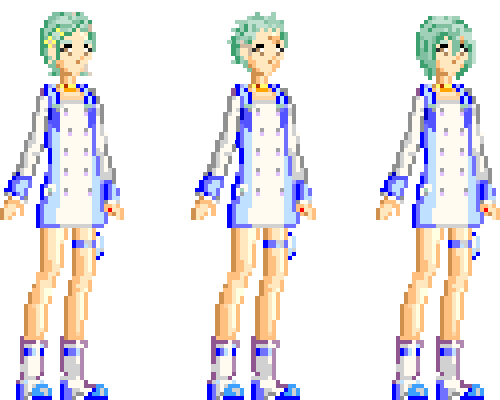
The Fujoshi Files 6: Fujiyoshi Harumi

Name: Fujiyoshi, Harumi (藤吉晴美)
Alias:
N/A
Relationship Status:
Single
Origin: Sayonara Zetsubou Sensei

Information:
Fujiyoshi Harumi is a second-year (11th grade) high school student and the only fujoshi in her class at a school whose company-sponsored name changes every week. Although she is comfortable enough with her fujocity that the other students are aware of her hobby, Fujiyoshi is still somewhat afraid of showing others her yaoi doujinshi manuscripts. Fujiyoshi is a talented artist and regular participant at Comic Market, and her doujinshi range from Gundam SEED to Pretty Cure.

Fujiyoshi often has problems distinguishing conventional thinking from her own personal opinions, even among fujoshi. Fujiyoshi will also often draw very unconventional pairings, though she is also a fan of more popular pairings and even a few male-female ones. Unlike many fujoshi, Fujiyoshi is surprisingly athletic.

Fujiyoshi’s name is a pun on the word “fujoshi” itself. Harumi is the name of a former location of Comic Market.

Fujoshi Level:
While Fujiyoshi’s talent at sports may seemingly contradict her status as a fujoshi, it is actually the best indication of that status. Fujiyoshi’s athleticism is the result of pushing herself past her own limits while enduring Comic Market and other doujin events for long hours. This makeshift exercise, powered by her desire for yaoi doujinshi, improves her physical stamina, strength, and speed, making her able to do even more at future events. Her devotion to doujinshi has resulted in Harumi being fujoshi in both mind and body.

Suddenly, Eureka

Manly Slice of Life

Why should slice of life be purely the realm of cute girls? Why can’t middle-aged men have pleasant day-to-day experiences?

Imagine, if you will, an automobile shop, run by a rough yet kind man and his friends. They’re all getting a bit old, but they would not trade their shop for anything in the world. Every day, between fixing engines and repairing brakes, they take the time to sit around at a small, rickety table discussing anything that comes to their mind. Though they may posture and ridicule each other, at the end of the day they know their friendship is stronger than anything.

It’s slow, it’s pleasant, and it’s manly.

You’ve got a lot to learn before you beat me. Try again, baka inu!

YOU GET OGIUE

Don’t Think I Forgot About the 4th of July Either

You can help me celebrate the fact that THIS IS USA, as opposed to JAPAN.

Today, on this Independence Day, I order you to  act like an American Anime Character.

-Remember to replace simple Japanese pronouns and random words with AMERICAN ones.
-Blond hair isn’t necessary, but it can often help.
-If you have trouble gaining acceptance, claim that you are in fact Half-Japanese.
-TALK AS LOUDLY AS POSSIBLE.

If you’re still not up to the task, I instead ask that you observe Americans in the wild.

Skin-deep Personality: Thoughts on the Categorization of Anime Girls

As anyone who reads this blog would know, I like girls in anime, and I like moe. However, there are times when even I question the kind of conversations that arise from talking about female characters and what effects they’re having on fans.

Growing up, I was taught various lessons on beauty, namely that inner beauty trumps simple appearance. “Don’t judge a book by its cover.” “It’s the inside that counts.” Adages such as these shaped the idea that while physical beauty is more prominent in society, emotional beauty, personality, and character are considered to be deeper aspects to admire. While I do not discount physical beauty in people be they fictional or otherwise, this idea of personality trumping looks is something I still believe in. In anime, especially with the current prominence of moe, something which I think is much more personality-based, with moe visuals derived from personality, this seems to be the case.

However, with the increase and proliferation of moe terms, it can sometimes feel like character traits are no different from physical traits. Calling a character a tsundere becomes not much different from calling a character a busty redhead. Personality can become just as simplified as appearance and turns into something very immediate, very at-the-surface, and easy to fetishize. Liking a character for their personality becomes just as shallow as liking someone because they have nice legs.

Sexualization isn’t the thing that bothers me. Rather, it is that the type of sexualization that can occur as a result of this categorization of traits makes it difficult to see if someone actually genuinely likes a character or not. If I ask someone why they like a character, and they say, “Because she’s a shy twintail tomboy meganekko,” then I myself wonder, “Is that REALLY why you like them?” If an entire conversation is spent simply throwing out these categories as descriptions in lieu of actually talking about the characters, it can give the impression that these characters are undeveloped and shallow. Maybe they actually ARE that shallow sometimes and it’s all in good fun, but it still creates the feeling in me that personality becomes just another facet of a character to get gratification from, rather than something to cherish on a deeper level.

This is I assume a personal thing, and I don’t expect others to necessarily feel this way. I’m not faulting anyone for doing this, nor am I criticizing the existence of otaku vocabulary, as I do this myself pretty often. Still, there’s this gnawing bit of doubt that can occur when I see it when I think a real dialogue or discussion should be occurring.

Kaiba and What He Expects Out of His Anime

Defining 90s Shoujo…maybe

When speaking of the spring 2008 show Itazura no Kiss, the way I and others describe it as “so very 90s shoujo.” And it’s true. The show, even animated in 2008, screams the conventions of shoujo from that decade, which is no surprise seeing as the manga is from the 90s.

But then, I thought, what if someone had no idea what 90s shoujo was like, and that description was therefore useless? How could I accurate convey the properties which make up 90s shoujo?

This is the challenge I’ve set out for myself, and I have to admit, I have no idea how this will turn out.

Visually, 90s shoujo is all about clean, almost cartoonish designs for characters. Girls are much more cute than sexy, but it’s not the type of cute one expects to moe or fawn over immediately. Guys are certainly bishounen, but rarely do they look completely feminine. Line work tends to be very simple, giving 90s shoujo a very flat look, but not so flat that the reader or viewer becomes distinctly aware of it.

The melodrama dial isn’t cranked up nearly as high as it is in 70s shoujo, where characters’ emotions hit harder than a train filled with lead, but characters are affected strongly by the small events around them. There is suffering, but it tends to be a beautiful sort of suffering where you can tell that the characters will recover from whatever their problems may be.

90s shoujo is innocent. This doesn’t mean that it’s devoid of sex. Far from it, in fact. The difference is that there is not much venom (or lead poisoning) between characters. The drama is strong but fairly civilized, and characters generally do not end up wanting to kill each other. Love triangles do not end in ridiculous tragedy.

90s shoujo is pleasant in a way that shoujo from other eras is not. It’s about 50/50 escapism and realism, and is almost always uplifting.

Hokuto no Ken Event for 7/7

Seven artists are going to be making redesigns for the four Hokuto Brothers (Kenshiro, Raoh, Jagi, Toki), as part of the Hokuto no Ken 25th Anniversary Celebration.

The event will be held on July 7th, 2008 at a Tower Records in Tokyo.

As for the “redesigns” themselves, it’ll be…interesting…as let’s just say the artists selected do not exactly have Hara Tetsuo-esque styles.

The 7 Chosen Ones

Kitai Shinichirou (DEVILROBOTS)

Mad Barbarians

Tenmyouya Hisashi

Inoue Takaho

Urata Spancall

Hirose Soushi

Matsushima Satoshi

Source: Anime! Anime!