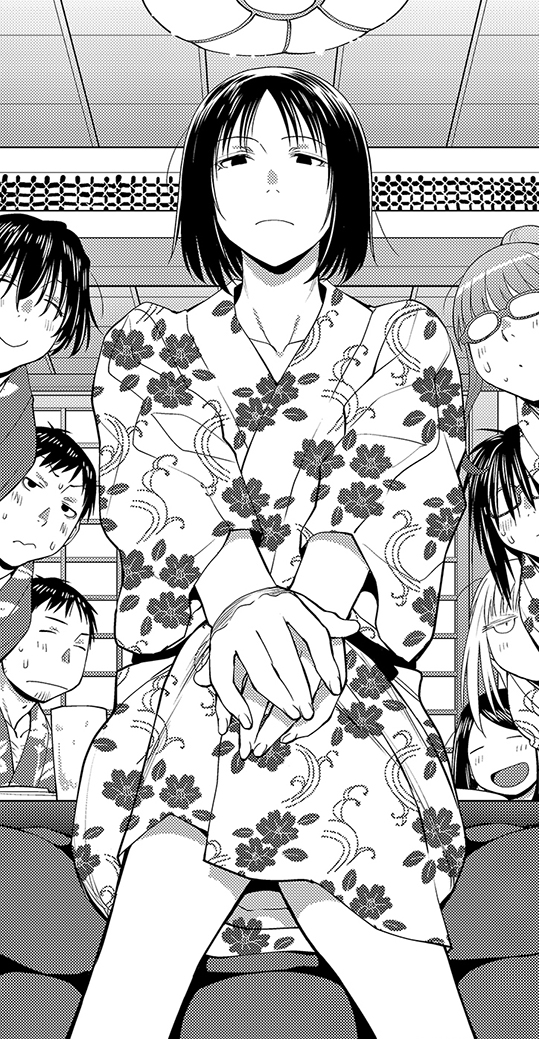
You’ve Already Led: Final Thoughts on “Fist of the North Star Side Story: The Genius Amiba’s Otherworld Conqueror Legend”

Fist of the North Star Side Story: The Genius Amiba’s Otherworld Conqueror Legend is an isekai spinoff starring a minor villain from the popular shounen franchise, and it concluded earlier this year after nine volumes. This manga been one of my favorite series in recent years, so I wanted to just give my final thoughts on this ridiculous work.

For context, here are my previous two posts about the series:

Warning: Spoilers 

The “hero” of this series is Amiba, the cruel Toki impersonator who met a grisly (and hilarious) end from being forced to walk backwards off a ledge before exploding into a gory mess—a fate courtesy of franchise protagonist Kenshiro. Now reincarnated in a fantasy world, he has to fight monsters using his own bastardized version of the pressure points martial arts Hokuto Shinken, all while learning about the magic that governs his new environment. As he gains unlikely allies (because it’s really hard to make friends when you’re a self-centered asshole), Amiba ends up on a collision course with the army of the Demon Lord, including the Four Demon Generals. And all along, no matter his successes or numerous failures, the man still declares himself to be an unparalleled genius. 

There are three main recurring gags in this manga:

First, nearly everyone Amiba encounters oddly resembles people from his original world, though not necessarily sharing personalities. He travels with Lilin (Rin) and Pat (Bat), and fights foes like Southern (Souther) and Maou Kenshi Rou (Jagi). 

Second, many of his allies are alternate versions of other bad guys. My favorite is a gigantic old lady who was originally a muscly thug in a poor disguise but in this world is actually a titanic grandma. 

Third, Amiba remains a mostly delusional dickhead throughout, but people also don’t put up with his bullshit.

If you’re not a fan of Fist of the North Star, a lot of the in-jokes will likely go over your head, but I am squarely in its target demographic and highly entertained. Fortunately for other readers, The Genius Amiba’s Otherworld Conqueror Legend also features a contemptible antihero who actually grows and learns to a degree, avoiding running its premise into the ground.

In the original story, Amiba is presented as irredeemable, but here in a different world and context, we find that he has the power to do good even if he is anything but noble. He might not be healing people out of the goodness of his heart, but the results are the same. The road to hell is paved with good intentions, but what if bad intentions create benevolent results? It makes one wonder if society (or lack thereof) is what made Amiba into the absolute monster he was, instead of the somewhat less obnoxious person he is after death.

Amiba goes from one-off character to fascinating psychological study as a result. He vastly overestimates his martial arts skills, but that’s only in comparison to the impossible standard set by the warriors of the post-apocalypse he came from. His magic starts off poor at best (a nominal bump in his mana is his only isekai power-up), but his unreasonably high confidence allows Amiba to break through those limitations and create a hybrid magical kung fu. And as reluctant as he is to admit it, Amiba learns an important lesson: Other people are capable in their own right, and they can work together with him to achieve greater things. They’re just not as capable as himself, of course.

The story reaches its climax in Volume 9. After defeating the Four Generals, it’s revealed that the legendary heroic armor and weapons Amiba obtained actually house the divided soul of the Demon Lord. That demon’s name: Maoh (as opposed to Raoh). Yes, he’s Maoh the Maoh (Japanese for Demon Lord).

His last surviving general channels the Demon Lord to take over Amiba’s body as a new physical vessel. Yet, despite being nearly overwhelmed, Amiba is able to resist the takeover through sheer ego. Maoh then answers this stubbornness by plumbing the depths of Amiba’s soul and manifesting his greatest fear: Kenshiro. Suddenly, Amiba finds himself with his back to that ledge again.

On the verge of giving up, Amiba sees images of his allies in the new world giving their support. Naturally, in his inner world, they have nothing but effusive praise for his endless brilliance. With both feet back on the ground (and a body decidedly not exploded), Amiba starts fighting back, using all that he’s learned since being isekai’d. He battles Kenshiro’s Hokuto Shinken using his own magic-infused martial arts, but can only reach a stalemate at best. Then, something incredible happens: The Kenshiro in his mind compliments Amiba for getting stronger, refers to him as another powerful rival, and fades away. It’s not clear if this is simply Amiba imagining Kenshiro accepting him, or if Kenshiro is such a great hero that even a psychic apparition of him exhibits a high standard of honor, but the result is the same. Amiba wins.

The series epilogue jumps a few years into the future, mirroring the second part of the original Fist of the North Star. Lilin and Pat, both adults now, discover that Amiba has created his own peaceful kingdom populated entirely by minor bad guys. He’s said to have later tried to take over the world, inadvertently uniting the humans and demons against him, but the veracity of this (and everything else that has happened in the story) is up to the reader to decide.

I choose to believe that everything we’ve seen is super duper canon, and if they ever make another fighting game, I hope they put this version of Amiba in there. 

The Genius Amiba’s Otherworld Conqueror Legend is a lot of things: Spin-off, parody, silly take on a popular genre. But it also scratches an itch to see a fundamentally flawed and morally void protagonist somehow manage to improve his world, at least for a little while. All the terrible qualities possessed by Amiba are channeled into doing good, all thanks to the people around him. It’s perhaps an even more far-fetched dream than all the harem and power fantasies in the world, but I simply can’t resist a wacky redemption tale that gives a new perspective on one of manga’s jerkiest villains. Isekai is ultimately about second chances, and Amiba uses his to the fullest.

Musin’ on Muzan: Ogiue Maniax Status Update for September 2025

Summer is winding down, and the first Demon Slayer: Infinity Castle movie will be in theaters soon. I already have my ticket, and I’m eager to see how this series begins to conclude. I feel they made this into a trilogy in order to make more money, but I don’t begrudge them about that. If there’s a reason to make it a big event and draw fans to theaters, so be it.

Later in the month are some big hololive milestones, namely Myth’s 5th anniversary and the first online concert for Holostars EN. I’ve decided I’ll celebrate Myth with some Raising Cane’s, but I haven’t figured out what would be fitting for the EN boys.

I’m also fresh off of Anime NYC and hololive EN’s third concert, All for one. I intend to get my thoughts about both before the end of the month.

General:

Ko Ransom

Diogo Prado

Alex

Dsy

Sue Hopkins fans:

Serxeid

Hato Kenjirou fans:

Elizabeth

Yajima Mirei fans:

Machi-Kurada

Blog Highlights from August

VTubers + Baseball = ???

If I’m right, GQuuuuuuX fits into the Gundam timeline in an important way.

Do you want to fight? Or do you want to fight?

Kio Shimoku

Are we nearing the end of Spotted Flower?

Kio caught COVID-19 but is alive.

Closing

Amid the erosion of human rights and the destruction of the United States’ scientific expertise, the weird obsession with tariffs feels like kicking someone while they’re down. I desperately hope, for the sake of everyone regardless of political beliefs, that things are made right. We should not be beholden to the most ass-backwards ghouls who seem to want to burn the world down so they can grift just a little more.

Kio Shimoku Twitter Highlights August 2025

Kio caught COVID at the beginning of the month. He went to the hospital (which is a very normal thing in Japan), got some medicine, and his fever broke around the 5th. He also thanks all the fans who wished him well. 

Kio is drawing swimsuit art for the release of a volume next month—appropriate for the heat.

Kio impressed with a well-endowed lady from Chapter 14 of the manga Dekapai Kishi Makari Tooru!, or The Big-Boobed Knight Goes Unpunished.

Kio finds the design of the manga Isshinjo no Kaii to be really appealing.

The last of the Rakuen web extras for the period are up. Kio encourages everyone to read them.

The Confrontation: Spotted Flower Reaches a Crucial Point

The moment has come in Kio Shimoku’s Spotted Flower: In the most recent chapter first published in June, the Wife (aka Not-Saki) confronts the Husband (Not-Madarame) about his adulterous actions with Asaka-sensei (Not-Hato). With a rather sparse publication schedule consisting of printer chapters and digital-only supplementals, getting to this point has taken many years. Now that we’re here, though, the confrontation really emphasizes the essence of this thinly disguised Genshiken alternate universe.

The Story Thus Far

A lot has happened since I last posted about Spotted Flower, so I think some brief catchup is in order. Note that I might not remember all details correctly because of how convoluted things have become: 

Spotted Flower is about an otaku husband and his normie wife, both of whom were members of the same otaku club in college. At first, the story is about their very different tastes and behaviors, as well as the challenge of having a sex life while she’s pregnant and he suffers from low blood pressure that makes even morning wood difficult to come by. They occasionally meet with and talk with old friends, who are all suspiciously similar to other characters from Genshiken (though they’re not the same).

The Wife eventually gives birth to their daughter, Saki, and one consequence is that the Husband feels inadequate as a partner. Seeing his beautiful wife chatting with her Ex-Boyfriend (Not-Kohsaka), he panics and secretly solicits Asaka-sensei, their old college club junior who once regarded themselves as a crossdressing mane but has since gotten some feminization surgery and whose gender is less clear-cut. The Husband tries to start something, but can’t get it up. No problem, Asaka-sensei declares, and puts their penis up Not-Madarame’s butt.

The Husband is plagued with guilt and shame for cheating on his wife, and Asaka-sensei tries to keep the tryst a secret from everyone they’re close to, including their own partner and manga assistant (aka Not-Yajima). While the two have an open relationship, it’s still big news that Asaka-sensei banged their old senpai. But the truth slowly leaks out little by little, with different people learning at different points from different people. Eventually, the rumor reaches Not-Kohsaka, who decides to look into it on his own.

Of course, the Wife is a sharp and perceptive person, and had naturally suspected that something weird was going on. Eventually, in a moment of weakness, the Wife propositions her ex-boyfriend, but he refuses, despite the fact that he’s actually a serial philanderer. It’s not clear at this point what he’s planning, but we also learn a few things about him as well—namely, that he seems to have hidden feelings for Not-Sasahara, and at one point even kisses Not-Sasahara when he thinks the latter is asleep (He isn’t).  

Speaking of Not-Sasahara, his relationship with Ogino-sensei (Not-Ogiue) takes an unexpected turn as she proposes a polygamous marriage between the two of them and her manga assistant (Not-Sue), with whom she already sleeps with. However, this is unlikely to turn into a threesome situation because Not-Sue hates Not-Sasahara for not letting her monopolize Ogino-sensei. 

Most recently, the old club members have gathered together for a group getaway. And then, two chapters ago, as the guys and girls are hanging out in gendered groups, Not-Kohsaka casually tells all the boys about what happened between the Husband and Asaka-sensei. Not-Kuchiki, shocked by the news, rushes over to the Wife and blurts it out, asking if it’s true. Here, the Wife herself gets a weighty grin on her face and says, “So it’s finally public knowledge, huh?”

And Now…

That’s where things stand before this latest chapter, which starts with everyone in the same room. The Wife asks if being with her was really that awful, the Husband tries to explain that it’s been great, but that he thinks she’s a goddess residing in a realm on high, and he lives crawling in the mud in the world below. She doesn’t understand what this means, so the Ex-Boyfriend explains that this is an otaku self-consciousness thing. The Ex also explains that he couldn’t possibly be with the Wife because she actually hates his guts—a fact that Not-Saki herself didn’t even remember herself.

The Wife grills the Husband about the whole situation with everyone else (especially the fujoshi) listening intently. As the Wife explains, the guy tends to hide his feelings, so she wants him to be honest. From this, they learn that he couldn’t get hard, but that it actually felt kind of good to be on the receiving end (to the thrill of the fujoshi crew). Not-Saki then goes on about what a weird little otaku club they are: Otaku are supposed to be these innocent and naive people who don’t really know what sex is like, but the people here have sex while cosplaying, engage in threesomes (which Sue adamantly denies), and her own husband got it from behind by a crossdresser. They’ve all had the wrong idea about otaku.

The chapter ends with an ultimatum from the Wife to the Husband: He must get an erection for her, or their marriage is over.

What Does This Mean?

We won’t know what happens with the two of them for another few months, but regardless of how it pans out, there’s a lot to ruminate on already.

I think the biggest revelation from this is the fact that the Wife actually hates her Ex. What has previously come across as a fairly cordial “let’s just be friends” might have been something more serious and dramatic. We know that Not-Kohsaka sleeps around more than everyone else in Spotted Flower, but that a part of him feels empty inside. I had wondered if this was him still taking the break-up poorly, but maybe this behavior from the Ex was already a problem. Or perhaps his unrequited feelings for the Editor were there all along, and he wasn’t honest with himself. Whatever the case may be, I really think it changes the assumed dynamics of the characters, and by extension the story as a whole 

I know Spotted Flower is controversial, and that some English-speaking fans of Genshiken have viewed it with derision. While I approach it as a kind of strange alternate universe, the fact that this is the only “new” material is understandably confusing and maybe even frustrating. But the way this latest chapter has played out, I have to wonder if there actually is light at the end of this tunnel for the readers who wanted something a little more wholesome. Granted, the tunnel is still of twists and jagged rocks, and a rock slide might close off the exit, but we’ll just have to see what awaits us.

Fallen Angel’s (and Ascended Devil’s) Thesis: Ogiue Maniax Status Update for August 2025

Anime NYC is this month! Takahashi Youko of “Cruel Angel’s Thesis” fame will be holding a concert there, and this year’s hololive World Tour will feature IRyS, among others. And both concerts are on the same day! Talk about timing. It’s also funny that Elizabeth Rose Bloodflame sang the ending theme from Panty & Stocking with Garterbelt for her 3D debut. Just angels and devils all over the place.

This past month has been a bit of a whirlwind, as I’ve been doing more traveling and general going out than normal. I have a bunch of things I want to write and report on, and I hope I can do so in a timely fashion.

I often feel that I have both too many blog posts and not enough ready. I’m trying to strike the right balance between being informative and expressing my thoughts.

Thank you to this month’s Patreon supporters!

General:

Ko Ransom

Diogo Prado

Alex

Dsy

Sue Hopkins fans:

Serxeid

Hato Kenjirou fans:

Elizabeth

Yajima Mirei fans:

Machi-Kurada

Blog Highlights from July

My review of the wild ride that was Gundam GQuuuuuuX.

I interviewed Inoue Honoka, voice of Anne Shirley and daughter of

I attended Dooby3D and Nimi Nightmare’s 3D concert!

Kio Shimoku

A relatively light month. Kio saw the Demon Slayer: Infinity Castle movie!

Closing

As I’ve gotten older, I’ve been considering dropping down to about one post per week, maybe two if things are good and I have more time. I do feel like I might be losing something if I make my posting that sparse, though, as I don’t know if it would necessarily make for better writing in general. Hopefully, I can find a good answer.

I also just read the latest Spotted Flower and wow. I’m just trying to figure out if I should write about it ASAP or wait for the next chapter in three months.

Kio Shimoku Twitter Highlights July 2025

Kio’s PC is not doing so well.

The print edition of the latest chapter of Spotted Flower is out (and by the time of this blog post, so should the digital!).

Kio watched one of his How Do You Like Wednesday? Blu-ray: Visiting 21 European Nations in Our 21st Year.

Kio voted in Japan’s recent elections. 

Because he has a number of days off, Kio feels he should go see the Demon Slayer: Infinity Castle Part 1 movie.

When he saw the movie Kokuhou, Kio managed to eat ramen and not have to pee for the entirety of the 175-minute movie, so he decided he’ll do the same for the Demon Slayer movie, which is 155 minutes long.

Kio talks about not feeling the effectiveness of some mochi (This is missing some context, but it might be related to the ramen).

The ramen plan worked. “Total victory.”

Kio got into Demon Slayer thanks to the anime and then bought the entire manga. However, he never finished it, so he doesn’t know how it ends. 

Kio thought a picture of two tortoise toys from the Ichiban Kuji line looked shockingly realistic, only to realize one of them was an actual tortoise. It reminds him a lot of his own pet.

The Second-Best Time: Medalist

The last time we saw a figure skating anime hit big, it was the sensation known as Yuri!!! On Ice. Medalist takes a different approach, telling a story of both an older coach and a younger skater trying to make up for lost time.  

Medalist follows Akeuraji Tsukasa, a former competitive ice dancer who retired after failing to podium in his final event. As a high schooler, he dreamed of competing, but went into ice dancing after being told he was too old to start in traditional figure skating. When he meets a meek yet oddly daring 10-year-old girl named Iori, he discovers in her a girl who so desperately wants to be a skater that the local rink’s security guard shows pity on her by letting Iori sneak in in exchange for worms. Witnessing Iori’s passion for the sport, Tsukasa volunteers to become her coach, but 10 is already considered a late start in a field where beginning at five years old is typical, and Iori’s own mother is dead-set against it because another daughter of hers was injured competing.

Medalist is originally a manga by Tsurumaikada, and it currently still runs in the magazine Monthly Afternoon: a seinen magazine with more of an otaku appeal aimed more at an older male audience, though it tends to be fairly experimental as well. I imagine this is why Medalist has the structure it does, with a grown man and a young girl sharing the spotlight. As the competitor, Iori has more of the classic sports manga thrust of improving and aiming to overcome rivals, but it’s told more often from Tsukasa’s perspective as a guiding hand. These dual threads are interesting in that sports series tend to place the vast majority of the emphasis on one side or the other. With Tsukasa and Iori, however, you get to see things two ways most of the time: from the point of view of an older person who knows what it’s like to fall short of a dream, and that of a younger person anxious to compete but who dwells on the here-and-now. They’re also both passionate and timid in different ways, creating a fun and frantic dynamic between coach and player.

One of the basic questions of the series is “Where do you find your inner strength?” Is it built up as you stack blocks of experience bit by bit? Does it come from desperation to do all you can with what you have? Is it about “believing in me who believes in you?” One of Tsukasa’s greatest strengths is his ability to recognize what others do well and give them the encouragement to keep at it, such as when he lights a fire under Iori. At the same time, Tsukasa has no confidence in himself, which seems to consign him to a fate of being a great coach and a mediocre act were he to ever compete again. 

Yet, when another ex-skater sees Tsukasa, he points out that it’s a flaw for one to assume they’re the underdog even when they’re not. As the series progresses, we get to see conundrums not just Tsukasa and Iori but also an ever-expanding cast of friends and rivals have their own takes on such challenges. They show the complex feelings that come with competition, and knowing that the people you’re facing bring their own strong convictions and desires to make it to the top.

Medalist is a great work, and it’s worth checking out in anime or manga form. As for which is preferable, it really depends on what you’re looking for. The anime has the advantage of being able to portray figure skating in full motion with sound, replicating the feeling of watching and experiencing competitions. The manga is further along in its story, and the intensity of the art makes it feel as if the characters are radiating energy when they compete. Certain characters can give a very different impression as a result of the stylistic differences: Kamisaki Hikaru, the #1 skate in Iori’s age group, looks aloof in the anime but sometimes seems to border on sociopath in the manga. But no matter the medium, Tsukasa and Iori are a wonderful and endearing duo who work together to tell a story about striving for a dream while also trying to give hope to the next generation.

Return of the Mackerel: Ogiue Maniax Status Update for July 2025

I can’t believe the summer anime season has arrived! I’m already behind on the spring shows, so I may be stuck in a perpetual state of being behind on everything.

I’m looking forward to the return of Panty & Stocking, as well as a chance to finally see what Hell Teacher Nube is all about.

Thank you to this month’s Patreon supporters!

General:

Ko Ransom

Diogo Prado

Alex

Dsy

Sue Hopkins fans:

Serxeid

Hato Kenjirou fans:

Elizabeth

Yajima Mirei fans:

Machi-Kurada

Blog Highlights from June

Reviewing the finale of Thunderbolt Fantasy!

Also, check out this follow-up post about the Q&A at Anime Central 2025!

It’s about time.

Kio Shimoku

If you want to see Kio’s rough manuscripts, this is a good month.

Closing

We got a new fish in town! I feel like we might see big moves from her soon—including with many other big names, like Dooby3D, Nimi Nightmare, Mint Fantôme, and Dokibird.

Kio Shimoku Twitter Highlights June 2025

If you’ve ever wanted to read the entire manuscript for Kio’s Sister Wars: Episode I, this is your chance!

Kio watched the movie Eiyuuden, and was impressed by the fight scenes. The movie consulted with an actual martial artist for them. The organization that provided the consultation thanked Kio.

Kio bought a complete version of the manga Roca.

Kio feels that he should be starting to think up a new idea for serialization (that is not porn). This is easier said than done, because he often starts having ideas for new ero manga instead. When one fan asks if he’ll do fantasy, Kio responds that all he can say is that he won’t say anything.

Kio knows what he’d like to work on, which is more Sister Wars. Last time he was working on a proper draft, he stopped one page short of introducing Anakin. However, he also feels that instead of doing a full draft, he should be working on the rough manuscript for Episode II.

The arm for his smartphone holder broke, but he managed to get it fixed.

The man is a fan of the Harta manga Akitsu.

Chapter 2 and on of Sister Wars: Episode I. The first few pages are fully drawn and inked, while everything that follows comes from the rough manuscript. Note: This is around 150 pages of work.

A reader, seeing Sister Wars, can’t help but think that everyone in it is “packing,” regardless of gender. Kio apologizes in response.

Having read the Perfect Edition of the manga Mujina, Kio comments on the final volume being intense.

The Facades We Wear: Oshi ga Yameta

I follow the VTuber La+ Darknesss, who reads a lot of manga on a regular basis. Every so often, she throws out a recommendation, and one such title that caught my attention was Oshi ga Yameta, or My Fav Idol Quit

Miyabi is a 25-year-old woman who is obsessed with a male idol, the 22-year-old Miku. She devotes her entire life to supporting him, even going as far as doing sex work to fund her fandom. Miyabi also meets up with a group of like-minded women, each of whom have their own favorite idols, and each of whom have their own secrets about their personal lives. But when Miku announces that he’s quitting the business, Miyabi ends up like a boat adrift in the ocean. What she doesn’t realize is that Miku’s retirement is the catalyst for drama, turmoil and discovery—not only for Miyabi and Miku, but also the people around them.

The world of Japanese idols is a great subject for stories because the clash of fantasy and reality is inherent to it. Oshi ga Yameta focuses on the drive of fans to keep living in an illusory world, but not solely in a negative manner or judgmental manner. Individual and societal circumstances, like the pressure put on Japanese women to marry young, undergird the seemingly foolish decisions being made by idol fans. At the same time, the manga also portrays the idols themselves as being of all stripes, from those who genuinely buy into the idol image to those who enter the industry with ulterior motives. The lives depicted feel both ugly and beautiful, and it’s not always clear which aspects are which. Is Miyabi’s main sex client any better or worse than Miyabi herself in terms of how passion, love, and lust intertwine?

Comparing it to the biggest idol drama work of the day in Oshi no Ko, Oshi ga Yameta entirely lacks the supernatural elements as a plot hook. The latter also maintains its heroine’s perspective as a fan and nothing more (as opposed to having her enter the industry), and puts greater emphasis on the torrent of complicated emotions arising from a lifestyle that is both self-affirming and self-sabotaging. The art in Oshi ga Yameta is also very different, showing a messier style with less distinct differences in character designs, but which emphasizes its characters’ own dysfunctions and roiling emotions. The two series do resemble each other more in certain ways, but it’s not immediately obvious how.

I originally planned to read all of Oshi ga Yameta a lot sooner, so it’s funny that I would finish after the news about the Fuji TV scandal involving the former leader of the idol mega group SMAP. Juxtaposing this real scandal with that of the manga’s, it becomes clear that there’s still an element of fantasy even as stories feel “too real.” But the ability to approach sensitive topics while cloaked in fiction helps to provide plenty of food for thought, and this particular manga provides a hell of a buffet.