Watamote’s Tomoko is Basically Butt-Head

Hear me out.

Tomoko, the main character of No Matter How I Look at It, It’s You Guys’ Fault I’m Not Popular! (aka Watamote) is a sad sack whose life gradually rolls downhill as her own delusions of greatness collide with the reality of her crippling social awkwardness. You can even see this in the fact that, contrary to original translations of the manga, the title emphasizes that she blames other people for her problems. Some of those problems are real, some imagined, but what’s generally true is that she makes things worse for herself.

A lot of characters are likened to Tomoko as a kind of shorthand to understand the humor, horror, and appeal of her character. I’ve seen Shinji from Evangelion, Wile E. Coyote (because of how everything she does backfires), and I was originally even fond of comparing Tomoko to Charlie Brown, but the more I think about it, the more that I realize that ol’ blockhead for all of his misfortune doesn’t quite cut it, and that there is only one true answer.

  • Obsessed with media and entertainment, but also thinks a lot of it is crap
  • Not entirely incompetent, but definitely overestimates his own intelligence
  • Awkward, stuttering laugh
  • Hears dirty words where there are none
  • Misguidedly misanthropic
  • Plans to make his life better backfire constantly
  • Sometimes believes he got “laid” just by being near a girl

Think about it. I guess the only thing is that Butt-head “wins” more often because he enrages his principal.

The Relationship Between Classic Toei Heroines and Moe Characters

Not too long ago I half-jokingly suggested that the first moe character was Hilda (pictured above), the heroine from the 1968 animated film Hols: Prince of the Sun. The basis of this was that Hilda was the creation of a young Takahata and Miyazaki, who would later go on to form Studio Ghibli, and if you’ve ever read Miyazaki’s recollection of his first time watching Legend of the White Serpent, you’ll not only see similarities between Hilda and Pai-Nan, the heroine of Legend of the White Serpent, but also between his reaction and the way fans of Key games talk about their beloved works: Miyazaki actually cried the whole night, and fell in love with Pai-Nan. Of course, if Pai-Nan had such an impression, then it’s possible to argue that she’s the first moe character, but regardless of what character has the distinction, I suspect that the tragic element which defines both of these characters also has an influence on the development of female characters in anime and manga, and by extension the idea of moe.

In the trailer to Hols: Prince of the Sun, Hilda is introduced, accompanied by on-screen text saying, “Am I a demon, or a human being?” This highlights the inner conflict of her character, as Hilda is both the sister of the main villain as well as the love interest of the hero. She plays both a romantic and an antagonistic role, and the fact that she struggles over which is her “true self” is the inherent tragedy of the character. Star-crossed lovers are nothing new to media, of course, but according to The Pretty Character Chronicles: The History of Animation Heroines, 1958-1999, the early Toei animated films, of which both Hols and Legend of the White Serpent are included (though these titles are themselves about a decade apart), often feature heroines who begin the movies as antagonists.

Pai-Nan doesn’t quite fit this concept, as she’s more of a tragically cursed character, a princess in need of rescue in the vein of  a classic Disney Princess. This makes a degree of sense, given that Toei’s goal was to try to be the “Disney of the East,” but when you look at heroines in classic Disney films, none of them fulfill the role that Hilda or other similar Toei heroines play as partial antagonists. In fact, if you look at Disney animated films as a whole, there’s pretty much only one character who does fit this bill: Megara from Hercules, a film from 1997. In other words, “damsel-in-distress” is not quite the function of these Toei heroines.

What relevance does this have to current anime and the presence of moe, then? My argument is that the tragedy component of heroines such as Hilda has been reduced or compacted to varying degrees, so when you have a character who has traits commonly considered moe, such as a character who suffers from being short in a slice-of-life comedy, what you’re seeing is an on-going series of tiny tragedies, like with Yuno in Hidamari Sketch. The tsundere, especially the more contemporary tsundere type, is another example, as a character who struggles with being true to her feelings can be considered tragic in her own way. Hidamari Sketch also provides one such character in the form of Natsume, whose feelings for the character Sae remain unrequited due to Natsume’s own stubbornness.

While I think the criticism of moe characters as feeding off the desire of men to want to rescue the poor female victim is valid to a good extent, I think that the quality which has transmitted itself from those early Toei days all the way to the current age is not so much that of the “helpless girl” but that of “helplessness.” A girl tragically trapped in a situation can be moe, but what’s considered even more moe is the heroine who can’t be helped no matter what. In such a case, powerlesssness becomes not so much the half-way point in an elaborate power fantasy, but the end point in and of itself, with the potential for empathy between not just the viewer and the hero, but the viewer and the heroine. Of course, that’s somewhat of an extreme case, and the end result really depends on how individual works wish to resolve the inner conflict of the descendants of the tragic antagonistic heroines.

The Fujoshi Files 76: Masana

Name: Masana (雅奈)
Alias: Masa-nee (雅姐)
Relationship Status: Dating
Origin: Fujoshi Kanojo.

Information:
Office lady, writes BL novels. Has obscure tastes and doesn’t like when things go mainstream. She particularly has a thing for yaoi stories about businessmen. Has an eye doctor boyfriend who is really into audio equipment, and is not very understanding of her fujoshi hobbies, creating a good deal of tension in their relationship. Good friends with Yuiko and Sacchin.

An older office lady, Masana (“Masa-nee” to her friends Yuiko and Sachi) is an author of BL novels. Interested especially in stories concerning businessmen, she has obscure tastes and does not enjoy genres as much when they become too mainstream. Masana dates an eye doctor who is not very understanding of her fujoshi hobbies, which creates a good deal of tension in their relationship, especially because he seems unable to see that his obsession with audio equipment is just as strong as Masana’s passion for yaoi.

Fujoshi Level:
In a fit of anger, Masana once wrote fanfiction of her boyfriend being the uke to the wires and cables of his own audio equipment.

Humicane from Rotten Boy: Genshiken II, Chapter 89

As Yoshitake pressures Yajima into potentially revealing that she has feelings for Hato, Kuchiki sees a distraught Hato committing the worst crime of ComiFes: not enjoying himself. In a rare moment of clarity and benevolence (albeit still horribly awkward), Kuchiki teaches Hato that worrying what other people think about you goes against the otaku way. Hato, who suspects that his interest in Madarame may be a matter of him being interested in Madarame in particular and not guys in general, suggests that he hook up with Angela (who is of course likely eager to do so).

This month’s Genshiken II, titled “Festival Evol,” is a reference to the anime Aquarion Evol, which is appropriate in a number of ways. First, Aquarion Evol is the next generation of characters after the original Genesis of Aquarion, which is similar to Nidaime. Second, in the final episode of Aquarion Evol (SPOILERS), the titular robot turns into “Aquarion LOVE,” which is of course one of the themes of Chapter 89. You could maybe read something into the separation between boys and girls in that series too, but that might be going too far. The next chapter preview quote is also from another robot anime, Chousoku Henkei Gyrozetter, so it’s a good month for mecha references.

I find this chapter to somehow be incredibly straightforward but also quite complicated in terms of its developments, so I’m not entirely sure how to approach it. I guess the first thing I’ll say is that, I do know from personal experience that sometimes you think you like someone more than you actually do. I’ve had cases where I was interested in girls, and when they got significant others, my feelings were not jealousy or regret or forlorn heartbreak, but simply satisfaction and relief. In those cases, “what could have been” doesn’t really enter the equation, a personal realization that my own feelings weren’t that strong after all. Is this the case with Hato and his feelings towards Madarame? Something tells me “no,” if only because it only seems to be deflecting or delaying the problems surrounding him. I’m not sure if the BL genre’s classic “I don’t like men, I just like you!” line really works in “reality,” nor the reality Genshiken wishes to depict.

More generally, not understanding one’s own feelings is a recurring element of the otaku subculture, especially when it comes to human interaction. Not to fall into the stereotype of otaku and fujoshi having no social skills or sex, but it’s clear from previous chapters that their experiences with romance have been limited or marred with awkwardness. It only makes sense that not only Hato but Yajima seems to be either consciously or unconsciously denying something, even if it doesn’t necessarily go as far as sexual attraction. I find it both interesting and relevant to this chapter that both Hato and Yajima are the types to restrain themselves to a certain degree even when among their comrades.

The highlight of this chapter may be the fact that this is the first time we’ve seen Kuchiki successfully do something admirable. He’s tried in the past before, like when trying to stop the cosplay thief at the club recruitment fair, but that led to such disaster that it’s one of the first things mentioned in Genshiken II. While Kuchiki is obnoxious and doesn’t understand social problems, he does bring up the relevant point that Hato’s interests in and of themselves do not cause trouble for anyone, nor should they. It makes me think about the other classic annoying character of Genshiken who hasn’t appeared in forever, Haraguchi, and how different the two are. Unlike Haraguchi, Kuchiki is selfish and rude but too honest to be manipulative.

As for the possibility of Angela being Madarame’s first time, I actually really want it to happen now. I don’t particularly care if Madarame and Angela become a “thing,” and of course there’s the long-distance component in all that, but there’s something about Angela just getting the job done that I find potentially hilarious. Genshiken has never been big on valuing female virginity, going all the way back to Saki discussing her sex life with the club members, or the fact that Ogiue is at this point very much not one, but somehow Madarame the virgin is the bigger deal. Losing it in a brief fling where both parties are aware of the lack of classic romance as well as the time limitations would be appropriate and a subtle defiance of the “nerd guy gets the hot girl!” trope, without necessarily being sad, even if Madarame is portrayed as somewhat of a romantic at heart.

This month’s Genshiken also came with an extra comic by another artist, about one of the Genshiken Nidaime anime voice dubbing sessions. As previously discussed, the new anime has an entirely new voice cast, and it’s a lot about the director (who has worked on the previous Genshiken anime) instructing them on the nuances of the characters. Naturally, they don’t reference the previous actors, as that would compromise the legitimacy of the current cast. Probably the most interesting tidbit is at the end, when it turns out that a lot of the female voice actors are themselves fans of Genshiken, and were all asking Kio Shimoku for his autograph. Kio is reportedly a very private individual, which actually just makes me think of him as Madarame, secretly attractive.

The Fujoshi Files 75: Ameya Yuiko

Name: Ameya, Yuiko (飴谷結子)
Alias: Yui (ユイ)
Relationship Status: Dating
Origin: Fujoshi Kanojo.

Information:
Ameya Yuiko is an older woman dating a younger college student named Mutou Taiga. Ameya enjoys teasing him on a regular basis by showing him yaoi and referring to him as “Sebastian” (Sebas) while having him make tea. Preferring uke characters, she sees Mutou as one as well. Ameya works as an Office Lady, a job where she must frequently fend off the advances of her boss.

Ameya has a close circle of fujoshi friends, including Masana and Sachi, as well as Seto Akari. She is particularly fond of the shounen series Sepatte Takuro, about the Malaysian sport of Sepak Takraw.

Fujoshi Level:
Once, when Yuiko was ill, she tried to convince her boyfriend read BL to her as if it were a bedtime story.

Comparing Manga with the Otaku Guy + Popular Girl Theme: Otaku Riajuu vs. 3D Kanojo

Recently I read two manga with very similar conceptions, I’ll Make You into an Otaku, So Make Me into a Riajuu and 3D Kanojo (also known as “Real Girl.”) Both are based on the concept of an otaku guy and a fashionable girl forming a friendship (or something more), but the messages they convey, at least from what little I’ve read, are significantly different. In particular, the way Otaku Riajuu handles its female lead is pretty embarrassing, and highlights a lot of things wrong with whatever mindset produced the story, and for which 3D Kanojo provides a better alternative.

First things first, there are some differences in the setup of each. Unlike 3D Kanojo, which is about the budding romance between the otaku guy and the fashionable girl, Otaku Riajuu is similar to Toradora! in that the two leads are at least initially trying to help each other to get together with someone else. Other similarities include the fact that the girl is tiny and feisty, much like Taiga. Toradora! is pretty great, so that’s not so bad in and of itself, but there’s more to it.

In Otaku Riajuu, the girl, Momo, has a reputation for sleeping around a lot. The guy, Naoki, upon becoming aware of this, basically wants nothing to do with her. He thinks of her as a “bitch” (in Japanese context, the term veers closer to “slut,” see Panty in Panty & Stocking with Garterbelt for a prime example), and therefore wants nothing to do with her. A pretty messed up opinion to be sure, but then when he find out she’s actually uncomfortable around guys and clearly can’t be the bed crusader the rumors make her out to be, then he gets along with her a lot better.

Think about it: Naoki doesn’t like her when he thinks she’s a slut, but when he finds out otherwise everything’s “okay.” I’m not one to throw out the term “slut-shaming” liberally, and in fact this is the first time in the history of the blog that I’ve even used it, but it is literally the main character looking at a girl with disdain for being sexually active. The fact that we’re supposed to think Naoki the poor closet otaku is a Good Guy for changing his opinion of her after he learns the truth makes it even worse.

3D Kanojo on the other hand establishes that its female lead, Iroha, actually does sleep with a lot of guys, but doesn’t make the concept itself an inherent minus other than the fact that she has to deal with a lot of angry former lovers. Here, although the male character Hikari, being an awkward otaku virgin, is uncomfortable with the way Iroha is, the series seems to be more about their budding romance both in spite of and because of their differences. Hikari is also a nice guy in that he tries to save Iroha from a couple of angry suitors and gets so nervous when she invites him to have sex that he ends up avoiding it, but it’s clear he sees her as a person neither in spite of or because she’s sexually active.

I think a lot of the reason for this difference is just the intended demographic. Otaku Riajuu is based on a light novel, and aims for that male otaku market. Although not always the case (and not something exclusively otaku or Japanese), a valuing of virginity and purity by way of moe aesthetic is very clear and obvious here, and the strange idea the manga has about what it means for a guy to be “nice” likely stems from this. 3D Kanojo however is a shoujo manga, and this can be seen in the male lead who has a smattering of “gentle, ideal boyfriend” in him. He’s awkward around girls, but that’s what makes his attempts at heroics all the more charming. It also goes a long way in explaining why Iroha is written in a more well-rounded manner.

I’ve only read a bit of each, so I can’t say for sure if my opinions of either title would change down the road, but for now I’d have to say that 3D Kanojo is clearly the better title. The differing approaches to the popular girl character used by it and Otaku Riajuu do not form the entirety of my reasoning for recommending one over the other, but I think they give a good indication anyway.

Inhuman Fujoshi Comedy: f ningyo

It’s taken a while for Japanese publishers to get anywhere close to the idea of free online manga, but we’re finally getting somewhere. There’s Grand Jump (from Shueisha, the same publisher as Shounen Jump), which releases a few of their titles online every month for a limited time, and the decently popular Onepunch Man comes from another Shueisha site, Tonari no Young Jump. Now, while One Punch man gets all of the attention, I do want to point to a different title on there I enjoy, the 4-koma manga  f ningyo, by G3 Ida.

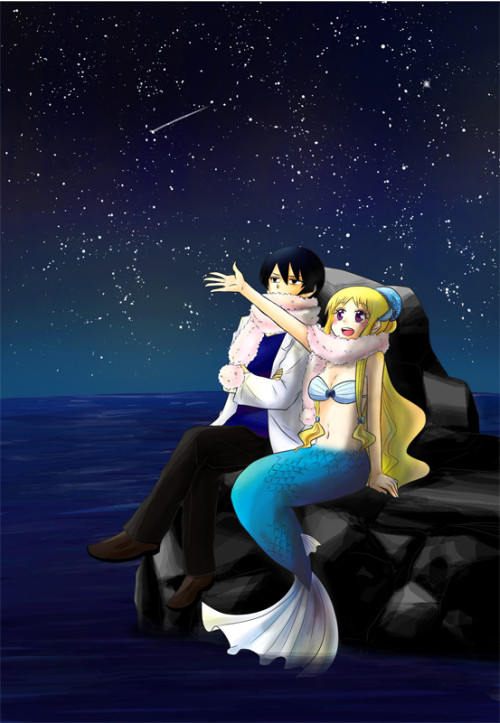
It’s a comedy about a fujoshi mermaid.

More specifically, it’s about a mermaid named Mero whose only conception of the human world comes from yaoi manga, so to her the surface is just teeming with guy on guy action. She’s discovered by a marine biologist named Tsubsa Reiji who’s far more interested in fish than women, and in order to keep this research a secret he tells everyone that she’s his girlfriend (her fins turn to feet when away from water for prolonged periods). The two other recurring characters are the scientist’s student, and his childhood friend, whom the mermaid sees as the scientist’s lover and a fellow fujoshi, respectively. Given the white lies and misconceptions on their parts, the foundation of the series’ humor comes from everybody misunderstanding each others’ words and intentions, sort of like Minami-ke. When she first introduces herself to Reiji, Mero tells him that she’s clearly not human because she has no balls.

fningyo-magazines-cropped

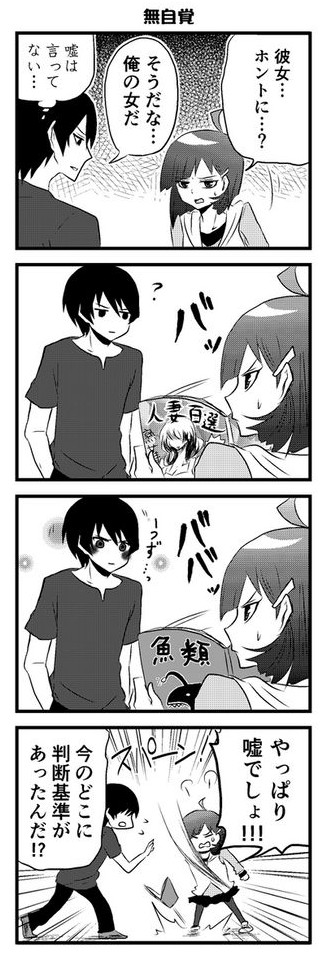
Even though the fujoshi-based humor is funny, two of my favorite jokes from the manga don’t even really have to do with that angle. The first is when Reiji’s friend, who has a crush on him, is extremely suspicious of his claims that the beautiful girl in his office is his girlfriend and decides to test him. She shows him a porn magazine, zero response. Then she follows up with a magazine about aquatic life and he immediately perks up.

fningyo-squid-cropped

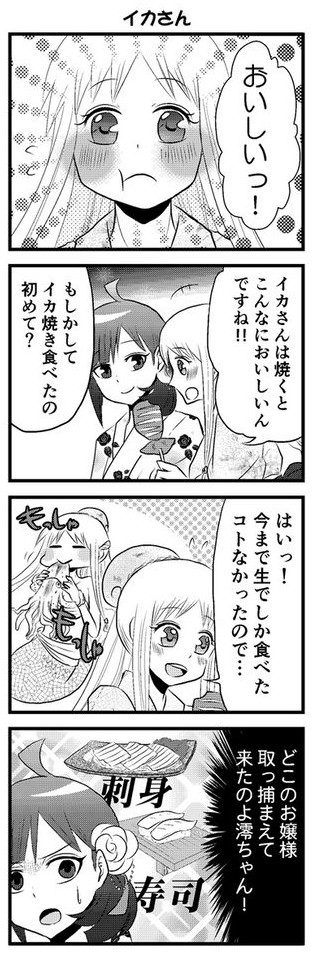
The second is when they’re all out at a festival, and the mermaid gets the chance to eat some fried squid. Being from the sea, she remarks that she’s only ever eaten raw squid before (which she would literally catch and bite into live), but the friend misinterprets her words as those of an incredibly well-to-do woman of luxury, i.e. “I only ever eat squid sashimi.”

Unfortunately, I think this manga has a lot less chance of being released in English like One Punch Man has been. That said, it is the second most popular manga on Tonari no Young Jump, so maybe there’s hope after all.

The Fujoshi Files 74: Sachi

Name: Sachi (早智)
Alias: Sacchin (さっちん)
Relationship Status: Married
Origin: Fujoshi Kanojo.

Information:
A blogger and housewife, Sachi is fortunate to have a husband who is accepting of her hobby. Called Sacchin by her friends Yuiko and Masana, she is a hardcore seiyuu otaku who tries to buy everything voice actor-related that she possibly can. Sachi has the ability to recognize any voice actor in any role, and is particularly fond of the seiyuu Kubokouji Akira.

Fujoshi Level:
Sacchin listens to BL drama CD’s while doing the dishes and the laundry, even when her husband is around.

Watashi Rashiku: Genshiken II, Chapter 88

Genshiken II, Chapter 88 is Winter ComiFes! As always, the Comic Festival chapters are among the best or most interesting in Genshiken.

It’s Day 1 of ComiFes and Angela Burton the Athletic Bostonian has come back to Japan. Though she’s decided to tone it down she still ends up stirring the pot, especially by noticing that something funny’s going on with Madarame and Sue. During the event, as the others move about, Ogiue and Yabusaki sell the doujinshi they’ve been working on. They even manage to completely exhaust their 1000-book supply, which is a first for them. Hato, who is abstaining from BL, tries to act like a normal otaku and even perv out like a normal otaku, but it just doesn’t work for him, and he ends up not enjoying what is normally a highlight of his life. The chapter ends at the start of Day 2. Yajima plans to buy a yaoi doujinshi for Hato, which may be hinting at some more romantic feelings.

This chapter of Genshiken had the same energy as the old ComiFes chapters, and especially compared to the last one doesn’t have quite so much overt drama. Not that it doesn’t have any drama, of course, but it’s a little more low-key, and you can really feel the hustle and bustle of a event as huge and as crazy as not-Comiket (because it’s a fictional world, remember). At least, that’s how it is for Day 1. Who knows what Days 2 and 3 will bring?

I couldn’t recognize either cosplay this time around, but thankfully there’s at least one blogger who knows his stuff: The first cosplay (pictured above) is from a new series called Shuushokunan Zombie Tori Girl (“Employment Scarcity Zombie-Catching Girl”), and the other is from Hi Score Girl, which if I recall, won some kind of award recently? In any case, I want to check out both manga now. The image of a blue collar worker using a combination fishing pole and net is quite striking.

Just in general, I thought the fashion in this chapter was really nice. Clothing-wise, the two characters who stand out to me the most this chapter are Yoshitake and Angela, for different reasons. For Yoshitake, it’s because of the way she’s able to at times look like the coolest girl around and at other times like the biggest dork in history (or “history dork in history”), when probably both are true. For Angela, I feel like Kio expresses her character through her clothing especially well. Even when trying to hold herself back (another “be yourself, or not” moment?), she still exudes a confidence in herself, her body, and her actions that’s hard to find in even someone like Saki. I’d like to point out that she’s wearing shorts in the middle of winter, when Comic Market is known for sometimes for being blisteringly cold.

I actually like Angela more and more every time she shows up, possibly because of the way that she shakes up the current situation of the club no matter what it might be. Her attitude towards just about everything is a far cry from everyone else, best exemplified when she suspects there being a thing between Madarame and Sue. Angela has some romantic and physical interest in Madarame, and to see her react not with jealousy or anger but with the same excitement she displays when talking about her favorite character types really cuts through the more conventional sense of relationships you see elsewhere.

Ogiue gets a good amount of focus this time around because of the fact that she’s selling her collaborative doujinshi with Yabusaki. If you’re not sure why the two of them are freaking out from the get-go, it’s because they’ve been put in a spot that’s usually reserved for the most popular and highest-selling doujinshi circles. Their table is against the wall, and at a doujin event, the groups whose products will create the most traffic are put against the wall in order to reduce traffic congestion. Ogiue says it’s mainly because the title they chose to parody this time is extremely popular, and that it wasn’t all under their own power, but I think selling out of 1000 copies is amazing no matter the circumstances.

While I of coursed loved seeing Ogiue back when she was struggling with herself, it also brings me joy to see Ogiue this happy. Though she’s hardly what you’d call totally uninhibited now, it’s clear how much more relaxed and comfortable she is now, especially when her nervousness this time around has more to do with feeling like a little fish in a big pond, and not anger at herself. The pinnacle of this can be seen in the very last panel of the chapter, where she’s in the classic doujinshi-buying frenzy. The panel even references the line that something is opening up at the top of her head, the thing that happened to Sasahara at his first ComiFes. The last time we saw Ogiue do this, she was disguised and frustrated about having to disguise herself, but now Ogiue isn’t holding herself back, or trying to disguise herself, or anything. It’s Ogiue, who has allowed herself to be herself. I don’t think I’ve ever seen Ogiue with such a look of confidence and authority before.

Even her interactions with Yabusaki show this, and it’s possible to see how far their friendship has come from what was once a decidedly antagonistic relationship. Speaking of Yabusaki, or rather Asada, it’s interesting to see how a once-extremely minor character has been developed to the point that you can really get a sense of her friendship with Yabusaki, and how the two get along with each other. What once appeared to be Yabusaki as boisterous leader and Asada as quiet tag-along is actually more complex.

By the way, I think it’s telling that Nakajima did not show up, despite Ogiue being so much easier to find this time around.

“Being yourself,” as cliche as it sounds, seems to be the theme of this chapter, especially when taking into account Hato’s own situation. On this first day of ComiFes, the day with generally the most female-oriented and yaoi content, Hato decides that he will not buy any BL. The line towards the end of the chapter says it all, though. On Day 2, Hato has a revelation: “Everyone seems to be enjoying ComiFes, but I haven’t been enjoying it at all.”

In forcing himself to do the “right thing,” Hato suffers. ComiFes is supposed to be the space where otaku can let their otakudom loose, but he’s restrainined himself. Hato’s attempt to be a “normal” otaku brings up an important question: if you’re not having fun as an otaku, why are you trying to be one in the first place? Whether we’re using the older definition of otaku as a pathetic person lost in the delusion of his hobbies, or the more charitable one that emerged later on to just refer to someone passionate about his fandom, “otaku” is not something that’s supposed to cause you anguish because you can’t fulfill the proper behavior in being one. If anything, it’s traditionally the opposite such as with Ogiue.

Anyway, with everything happening, I am certainly looking forward to next month. Last time, I asked about the possibility of Sue x Hato. What about Hato x Yajima? I’m not one to pair couples typically, but there’s something about having the guy better looking than the girl which can create interesting stories and dynamics, particularly in terms of the issue of confidence.

The Fujoshi Files 73: Seto Akari

Name: Seto, Akari (瀬戸灯里)
Alias: Kaworu (カヲル)
Relationship Status: Single
Origin: Fujoshi Kanojo.

Information:
Seto Akari is a teenage cosplayer under the name “Kaworu.” While she works to keep her hobbies a secret from her family, she makes far less effort to hide it from her brother Kouji, who is nonchalant and oblivious enough not to really care or mind. Akari is friends with a number of fellow fujoshi, namely office lady Ameya Yuiko, and is a fan of the series Sepak Takraw-themed manga Sepatte Takurou, preferring to cosplay even the main character from it. Akari’s palms are exactly six inches, which she can use to accurately measure materials while making costumes. In terms of preferences, she enjoys not just BL but bishoujo as well.

Fujoshi Level:
Akari is into cosplay more than yaoi, but is more than willing to pair her own brother up with his friends.