If Only There Was an Angela Burton Spinoff

While I’m naturally excited about the new Genshiken anime that’s been announced recently, there’s one thing I wish could happen but most likely never will: a spinoff about Ohno’s American friend Angela Burton. I feel like it would be fun to see some of the quirks of American anime fandom accurately and painfully conveyed.

One big element of American fandom that for the most part doesn’t exist in Japan would be the convention scene, with its fan panels, industry Q&A, and AMV competitions, providing a unique venue and experience compared to the chapters about Genshiken‘s Comic Market analogue, Comic Festival, but also giving it a similar treatment concerning scale and impact. The huge otaku that she is, it would be no surprise to see Angela attending multiple conventions as a cosplayer, especially Anime Boston given that she’s from the area.

The Angela spinoff I’m picturing would have the same strong sense of characterization as Genshiken proper, giving the same sort of loving but at times harsh portrayal to the personalities that tend to crop up in college anime clubs in the US. I also see Angela herself making for an interesting main character, despite the fact that she has a fairly minor role in Genshiken because of her forward personality and her undeniable love of anime and manga.

One potentially serious topic could actually be the whole “fake geek girl” thing, as I can imagine Angela being subject to it fairly often. Angela is not only portrayed as extremely attractive to the point of being able to make guys nervous, but also as someone with relatively liberal views on relationships and sex (she doesn’t think one-night stands are that big of a deal) that might cause people who didn’t know her better to accuse her of not being “real.”

Incidentally, in reading Japanese comments about the new anime, it’s clear that the concept of the “fake geek girl” exists in Japan as well. There, it’s tied to the whole Densha Otoko boom and the “mainstreaming” of Akihabara, which at least a few commenters claim the Genshiken manga is reflecting.

The Fujoshi Files 65: Sannomiya Shiho

Name: Sannomiya, Shiho (三宮紫穂)
Alias: Untouchable Empress (禁断の女帝)
Relationship Status: Single
Origin: Zettai Karen Children

Information:
Sannomiya Shiho is one of the most powerful espers in the world, whose “Psychometry” ability allows her to read the innermost thoughts, emotions, and histories of anything or anyone she touches. This allows her to accomplish feats at the peak of human ability, due to the fact that if she uses the tools of an expert she will match them accordingly, but utilizing anything by a rank amateur will produce similarly lesser results. As a member of the Japanese government organization B.A.B.E.L., Shiho fights as a member of “The Children” alongside her best friends Akashi Kaoru and Nogami Aoi, as well as her supervisor and caretaker Minamoto Kouichi, on whom she has a crush.

Fiercely loyal to Kaoru, Aoi, and Minamoto, she does everything in her power to protect them, though she is not above pulling pranks on them as well. Her abilities give her a unique perspective on the world, as her fount of knowledge and (transferred experience) makes her also especially fearful of things she cannot explain (particularly the supernatural), while her ability to sense emotions somewhat of a sadist; Shiho eats meat because she can sense the animals’ suffering through it.

Fujoshi Level:
Shiho is not a particularly strong fujoshi, and was only recently introduced to it by her classmate, fellow esper, enemy, and ally Patty Crew. While Shiho’s interest in yaoi was immediate, it appears tied to some degree to her sadistic enjoyment of extreme subjects. Shiho has read Hetalia.

Zeorymer the…Lolicon Manga?!

zeorymercovers

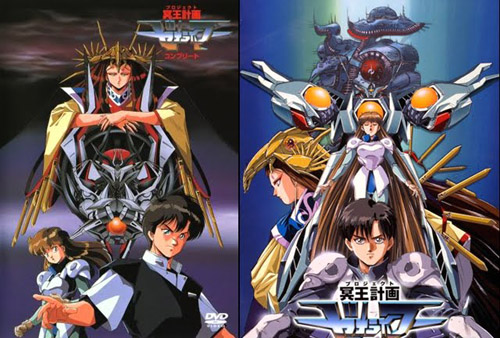
Hades Project Zeorymer was a run-of-the-mill 80s OVA that faded from whatever prominence it had pretty quickly. With its tough dudes, attractively voluptuous ladies, and giant robots, it was indicative of the sex and violence often associated with titles of the period such as MD Geist and Baoh. That’s why I was surprised to learn that Zeorymer originally actually began in the (in)famous bishoujo/lolicon magazine Lemon People.

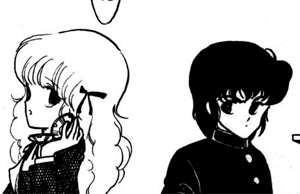
To be fair, from what I know of Lemon People, it was unlike a modern adult (18+) manga magazine in that it covered a variety of genres and tried to include plot beyond who’s having sex with who how many times (though don’t be mistaken in thinking it didn’t include that material at all). The Zeorymer manga appears to have been along that vein, utilizing a lolicon aesthetic (which was itself not quite the same as it is today) for its female character designs while having an overall sf/fantasy narrative. It’s not that uncommon in general for character designs to change when adapted from one form to another, but it’s funny to think about the fact that these two characters…

zeorymercouple

…used to look like this:

zeorymercouplemanga

I’m no expert on Zeorymer or Lemon People, so I can’t make any definitive statements, but I think that the change might say something about where the 80s OVA market was at the time, what the people making anime at the time thought would fly better among consumers, and where the limits were in that regard. Along that line of thought, I wonder if this is speaks towards a difference between a hardcore anime fan and a hardcore manga fan of the period, because it’s not just the girls who were drawn differently but characters of both genders.

In any case, enjoy how overpowered Zeorymer is in the Super Robot Wars games.

First Drawing of Sagimori Arata

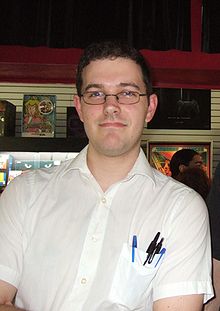
The Nostalgia Critic AND the Angry Video Game Nerd in Zettai Karen Children: The Unlimited

UPDATE: The Angry Video Game Nerd made a cameo too! Thanks, VF5SS!

I tweeted about this as well, but I also want to leave a more permanent record of this rare occurrence.

theunlimited-criticandnerd
The Unlimited Episode 5

critic_7168The Nostalgia Critic

220px-James_D._RolfeThe Angry Video Game Nerd

Coincidence?

Edit: Actually with the way he’s wearing that tie, there’s no way that’s mere coincidence.

Sketch in Celebration of the New Genshiken Anime + More

The Current Genshiken Club Members

The Hokuto Brothers (I think Toki turned out the best)

Yoshimori and Tokine from Kekkaishi

Nonowa etc.

Drifting Clubroom: Genshiken II, Chapter 84

Before we jump into the chapter, I have to make sure you’ve heard the news.

ATTENTION:

NEW GENSHIKEN ANIME!!

YOUR EYES DO NOT DECEIVE YOU

You’d think after the Madarame/Saki climax from a few chapters ago that Genshiken would let up for a while, but Chapter 84 is an intense one.  In the previous chapter, Madarame revealed that he was going to quit his job near the school (implying he would be unable to visit the college as often as he used to), despite Saki’s advice not to do so. As Madarame appears to feel increasingly alienated from the current club’s atmosphere (and Yoshitake tries to convert him to the church of BL), Hato is having trouble of his own as his emotions become a mystery to even himself. As Ogiue asks him to contribute to a “Tiger & Bonny” doujinshi, Hato begins to wonder about his relationship with Madarame, and the seeds of doubt Kaminaga placed in him about his heterosexuality begin to sprout.

Meanwhile, Sue of all people seems to have feelings for Madarame as well, though her character might mean it’s stranger (or simpler) than that.

I do not think that the change in demographic in Genshiken is the root cause per se for Madarame’s decision. Rather, my suspicion, based on my own experience, is that Madarame’s connection to the actual Genshiken as an on-campus club is starting to weaken. I had a similar group of nerd friends back in high school, and for the first three years after I graduated I would visit the school often to maintain that experience. Eventually, however, everyone who I even had a loose connection to graduated, and I lost any compelling reasons to continue. I’m still friends with a lot of the people I knew from that time, but our friendship has in a certain sense transcended the physical location, and I could see Madarame feeling like the clubroom itself is no longer that important.

That said, I’ve noticed, based on some of the response to the new Genshiken anime, that there are fair amount of readers both Japanese and non-Japanese who feel a bit alienated or even betrayed by Genshiken II, and I think Madarame is meant to embody that feeling to some extent, being the character who most embodies that classic otaku personality. Perhaps the deal with Madarame’s character is that he’s caught in a state of limbo, where he’s not yet fully integrated into adult living but at the same time his old haven away from reality, Genshiken, is starting to fade away.

The more that Genshiken focuses on Hato, the more I realize that he is probably the most psychologically complicated character in the entire manga (though I get the feeling that there’s something up with Nakajima that might be even more complex). Ogiue is one thing, as her story cuts to the bone, but Hato’s situation is such that you can’t even explain it as simply “he’s realizing he’s gay.” There’s a good chance that’s what’s happening, but based on the specifics of the chapter and of his history, doubting his own sexual orientation doesn’t seem to be the only thing going on.

In the chapter, Hato tries to shoo away the suggestions of his imaginary counterpart, only to have the female Hato replaced by Kaminaga, who echoes the real Kaminaga’s statement that the crossdressing likely facilitates the potential homosexuality of Hato. In that scene are a lot of things to take into consideration, starting with the fact that the Stand (i.e. Hato’s inner thoughts?) transforms specifically into Kaminaga. Based on previous chapters, it’s still not clear what his feelings towards her are. Does he want her? Does he want to be her? Does he perhaps desire both? Even the fact that the transition from Stand Hato to Kaminaga is a little hard to spot at first if you just skim through the chapter is indicative of the fact that Stand Hato continues to resemble Kaminaga, despite the fact that Hato has undergone an image change by semi-permanently switching to the shorter wig, as if to show that she specifically continues to influence him. It’s a weighty past and a convoluted present for Hato.
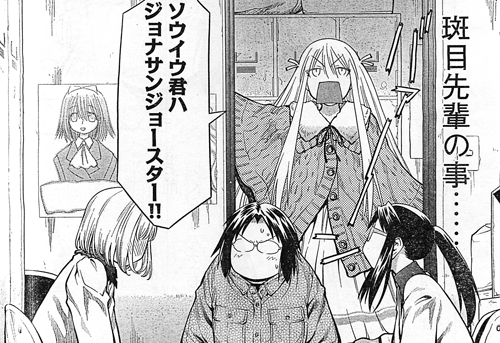
As for Sue, the easiest connection to make in regards to her blushing is the kiss she placed on Madarame’s cheek at the school festival as a sort of prank. Putting aside the notion of “Madarame: mack daddy of American fujoshi,” I’m starting to realize that Sue pretty much functions in Genshiken the same way the penguins do in Mawaru Penguindrum, bringing into the very foreground some of the “hidden” elements of the characters’ relationships at the time. I also think it’s quite appropriate for her to quote Dio Brando, and to have it be not one from the more popular Part 3 Stardust Crusaders story but from the original Phantom Blood.

There’s not much Ogiue this chapter, but there’s probably going to be another chapter at least partly focused around her soon, given the impending Comic Festival, though I imagine it won’t be until at least another three or four chapters.

The Fujoshi Files 64: JUNE-chan

Name: JUNE-chan (JUNEちゃん)
Alias: N/A
Relationship Status: N/A
Origin: Tonari no 801-chan

Information:
A doujin event friend and acquaintance of 801-chan, JUNE-chan’s name is a reference to the earliest BL manga magazine, which also reflects JUNE-chan’s tastes. As such, JUNE-chan creates doujinshi in that vein, which is a source of friendly disagreement between her and 801-chan.

Fujoshi Level:
In addition to the creature she transforms into upon having her yaoi interest piqued, JUNE-chan’s fondness for an old-school type of yaoi sets her apart from many of her peers.

The Fujoshi Files 63: Chi-chan

Name: Moe-chan (地ちゃん)
Alias: N/A
Relationship Status: N/A
Origin: Tonari no 801-chan

Information:
Chi-chan’ is one of 801-chan’s friends. She is knowledgeable about Akihabara, and her name may reference her abilities as a tour guide. She appears fond of the maid cafe Schatzkiste.

Fujoshi Level:
Nothing is known, other than that she is a fujoshi.

The Stylistic Stew of Dragon Who

Manhwa, or Korean comics, are something I am relatively unfamiliar with. I can spot the similarities and obvious influences from manga in modern manhwa, and I’ve looked at a few titles here and there, but I have neither the knowledge of history nor the personal experience to say I have a firm sense of how manhwa “is.” Given that my expertise (if you can call it that) is primarily in manga, however, I found it quite interesting when a manhwa title I’ve read recently, Dragon Who, takes elements clearly inspired by manga but cross-pollinates them in a way which normally never happens among Japanese comics.

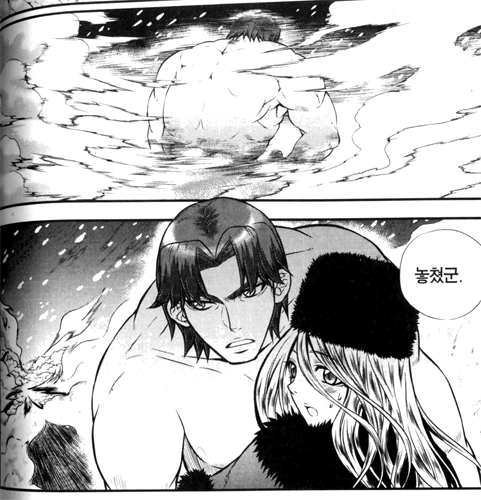
A title from 2009, Dragon Who is about a dragon boy named Roa Coatl who travels to South Korea to find the descendant of Quetzacoatl to make her his bride so that they can prevent an impending global disaster. In other words, it’s a shounen-esque school comedy/romance/action title that probably wouldn’t feel too alien to manga readers aside from the decidedly Korean names for most of the characters. Given that comfortable familiarity I think one would expect certain stylistic approaches, and indeed Dragon Who looks the part of a shounen manga to a good degree, but take a look at this image:

(By the way, for those unfamiliar, manhwa reads left to right.)

The character designs look quite shounen, perhaps even closer to late 90s shounen titles, but the use of blooming flowers in the foreground to introduce a character (and this is the main heroine Go So-Ahn’s first appearance) is an element straight out of shoujo. When combined with the fact that So-Ahn herself is designed to be fairly normal as opposed to strikingly beautiful, looking closer to a best friend character than a main character herself, it makes for an almost defiant combination of visual elements: a shounen title with a shoujo-esque heroine with shounen heroine looks.

Not only that, but Dragon Who has its own fair share of attractive guys, and while the title is neither harem nor reverse harem, the following image can give a certain impression as to how the title skews.

At this point, I think it would be easy to chalk it up to the popularity of shounen titles among female reader inside and outside of Japan (and I would have to assume Korea as well), and the titles which are designed to appeal to girls in Japanese comics to varying degrees such as Black Butler and Kuroko’s Basketball, but I’m not so sure that explains it. For one thing, Dragon Who is still keen to include elements like beefy muscular guys who aren’t all lithe bishounen, as well as fanservice for male readers.

Just to be clear, this is not a matter of manhwa looking “enough” like manga or not, but rather seeing how the manhwa inspired by manga doesn’t have to play by the rules (or at least plays with chunks of rules from four different places). To me, it feels more like Dragon Who is the product of authors taking aspects and visual language from manga regardless of genre or intended audience and putting them all in one place, or like if a shoujo writer were paired with a shounen artist. It’s a crossing of assumed boundaries which can show how thin and permeable those walls can be if only we’d allow them to be.