The Fujoshi Files 67: Rinbara Megumi

Name: Rinbara, Megumi (林原恵)
Alias: Buchou/President (部長)
Relationship Status: Complicated
Origin: The Manken Club, Like Whirlwind and Surge Waves!!

Information:
Rinbara Megumi is a second-year student and the president of her school’s manga club, though somewhat irresponsible. She is comfortable with using her body for personal gain.

Fujoshi Level:
Rinbara depleted the Manken Club’s funds by buying nothing but yaoi doujinshi.

Jaoh Shingan: Genshiken II, Chapter 85

It’s back to basics in Genshiken II, Chapter 85 as  Sue, Yoshitake, and Yajima revive the old Genshiken tradition of spying on club members who think they’re alone. When it looks like Hato is getting unusually close to Madarame. Right when things seem to be getting to the point of no return, in comes Keiko, who quickly deduces that Madarame’s decision to quit his job comes from a desire to regress back to his old self now that he’s been rejected by Saki. When Keiko suggests that Madarame come to her Cabaret Club to “get dirty,” Sue interferes and inadvertently makes it known that they were being watched. An embarrassed Hato runs home, only to be met by Sue as the chapter ends.

The more I write these reviews, the more I worry that my constant references to the old chapters may be unfair to the new series. Perhaps if I engage the current Genshiken on its own terms, I’ll be able to do it justice. At the same time, I do actually feel that many of the ideas being explored in Genshiken II have their roots in the original manga, and that the new characters allow for a more complex elaboration.

Back when Ogiue’s own main storyline resolved, the message was one of acceptance. So what if others find your tastes weird? You’re who you are. While such a conclusion fit perfectly for Ogiue’ character, the question of whether the border between fantasy and reality is airtight or porous wasn’t answered to any great length. Not that it needed to be, but if we accept acceptance and remove moral and value judgments from the equation, how complex can that interaction be? This, I believe, is what is happening with Hato and his interactions with Madarame. Hato can go where Ogiue never could.

Hato is clearly emotionally confused in the current story, where everything he thought he knew about himself is being thrown into question. I don’t get a sense of a fear of homophobia from his situation, but that he is having trouble establishing the distinct barrier between his male self and female guise and that it means he doesn’t understand himself anymore. The breakdown hints at the power of imagination, of how we see and define ourselves, and invokes the idea that, while sexuality isn’t a learned behavior, that learning provides additional information for reflection.

Once again, if we go back to Ogiue, she once stated that the Sasahara of her yaoi fantasy is clearly different from his real self, but she also clearly enjoys and is even turned on by Sasahara when he role plays his imaginary “Strong Seme” self. For Hato, who not only includes a form of Madarame in his yaoi fantasies but is also becoming increasingly good friends with him, he almost provides a powerful thought experiment whose solution can’t be as simple as “he’s gay,” even if he turns out to be.

Something I find particularly interesting about Madarame’s portrayal in this chapter is the focus on his neck. The current Madarame looks different from when he was in college, and this is shown most overtly in his change in hairstyle, but when viewed up-close from behind, he still looks the same as he always had. Given that in this chapter he basically admits to wanting to regress, and the fact that Sue, Yoshitake, and Yajima did the old spying trick, I can’t see this callback as unintentional.

Keiko continues her role as a kind of substitute Saki in her own unique way. By that, I mean that where Saki has a natural pragmatism about her that Keiko lacks, Keiko seems to make up for it with sheer (mistake-filled) experience. I almost get the impression that her experience working at a cabaret club is actually increasing her perception skills far beyond what they already were, which even back when she was still attending college were still quite sharp (she’s the one who immediately noticed the sexual tension between Sasahara and Ogiue). I really can’t tell if Keiko is actually into Madarame or not, though the reveal that she’s been purposely mispronouncing his name as “Watanabe” the whole time says something. Even if Keiko is curious about Madarame, though, I can only see her interest being short term, even more than Angela’s.

As for the general idea of the “Madarame harem,” I think that it’s only a name. Take Sue, who both this chapter and last chapter was caught blushing in front of Madarame. The most obvious interpretation is a crush, but why did Sue stand back and watch when it looked like Hato was putting the moves on Madarame, but interfere when it looked like Keiko was about to do the same? For that matter, why did Sue interfere with Angela back when she was trying to get into Madarame’s pants? Given her appearance at Hato’s door at the end of the chapter, we’re probably going to find out more, but wish fulfillment fantasy with Madarame at the head this is not.

I am curious as to where Sue (who was super cute this chapter) is going. Is she going to get some real character development? She did start off as a kind of larger-than-life super fujoshi from another country, and to humanize her may either be an amazing decision or a terrible mistake. I have faith, though.

The last thing I want to point out is the significance of the Children’s Literature Society member we see in this chapter. In the past, that club was clearly on good terms with Genshiken given the whole spying thing, but I got the impression they were not exactly into anime and manga. The fact that this particular fujoshi chose to be part of the Children’s Literature Society in spite of the presence of not only Genshiken but also the Anime Society and the Manga Society (which has a large fujoshi contingent) has a connection with the recurring theme of  the generation gap between otaku that primarily manifests in the mainstreaming of the otaku and the rise of the fujoshi. The otaku are not limited to the clubs that are meant for them, which I think says a lot.

As for Ogiue ending the spying thing, it only makes sense given that she was already the victim of it in more ways than one.

Energy Girl

The Fujoshi Files 66: “Goidou Yui”

Name: “Goidou, Yui” (五位堂結)
Alias: Katsuragi, Keima (桂木桂馬)
Relationship Status: N/A
Origin: The World God Only Knows

Information:
Goidou Yui is the daughter of a wealthy family, a talented musician, and the vessel for the goddess Mars. Having to deal with overprotective parents and possessing a timid personality, Goidou winds up switching personalities with male classmate and game addict Katsuragi Keima when the soul of a demon enters her body. The real Goidou is not actually a fujoshi in any way, nor is Keima; rather, it is the combined entity of Keima’s soul inside of Yui’s body that is something of a fujoshi.

After their minds return to their original bodies, Goidou takes on a more “masculine” personality, dressing in men’s clothes and even going so far as to try to romance Keima as if he were a dainty maiden. She also takes up the drums and joins her classmate Chisato’s band, the 2-B Pencils. Katsuragi returns to his old self, no longer interested in otome games.

Fujoshi Level:
Though not wholly a “fujoshi” mindset, the combined entity of Katsuragi Keima’s mind in Goidou Yui’s body brought Keima’s endless devotion to male-oriented dating sims to female-oriented ones, BL or otherwise.

American Mahjong Manga

As a follow-up of sorts to my previous post about American Mahjong, I drew this (read left to right):

If Only There Was an Angela Burton Spinoff

While I’m naturally excited about the new Genshiken anime that’s been announced recently, there’s one thing I wish could happen but most likely never will: a spinoff about Ohno’s American friend Angela Burton. I feel like it would be fun to see some of the quirks of American anime fandom accurately and painfully conveyed.

One big element of American fandom that for the most part doesn’t exist in Japan would be the convention scene, with its fan panels, industry Q&A, and AMV competitions, providing a unique venue and experience compared to the chapters about Genshiken‘s Comic Market analogue, Comic Festival, but also giving it a similar treatment concerning scale and impact. The huge otaku that she is, it would be no surprise to see Angela attending multiple conventions as a cosplayer, especially Anime Boston given that she’s from the area.

The Angela spinoff I’m picturing would have the same strong sense of characterization as Genshiken proper, giving the same sort of loving but at times harsh portrayal to the personalities that tend to crop up in college anime clubs in the US. I also see Angela herself making for an interesting main character, despite the fact that she has a fairly minor role in Genshiken because of her forward personality and her undeniable love of anime and manga.

One potentially serious topic could actually be the whole “fake geek girl” thing, as I can imagine Angela being subject to it fairly often. Angela is not only portrayed as extremely attractive to the point of being able to make guys nervous, but also as someone with relatively liberal views on relationships and sex (she doesn’t think one-night stands are that big of a deal) that might cause people who didn’t know her better to accuse her of not being “real.”

Incidentally, in reading Japanese comments about the new anime, it’s clear that the concept of the “fake geek girl” exists in Japan as well. There, it’s tied to the whole Densha Otoko boom and the “mainstreaming” of Akihabara, which at least a few commenters claim the Genshiken manga is reflecting.

The Fujoshi Files 65: Sannomiya Shiho

Name: Sannomiya, Shiho (三宮紫穂)
Alias: Untouchable Empress (禁断の女帝)
Relationship Status: Single
Origin: Zettai Karen Children

Information:
Sannomiya Shiho is one of the most powerful espers in the world, whose “Psychometry” ability allows her to read the innermost thoughts, emotions, and histories of anything or anyone she touches. This allows her to accomplish feats at the peak of human ability, due to the fact that if she uses the tools of an expert she will match them accordingly, but utilizing anything by a rank amateur will produce similarly lesser results. As a member of the Japanese government organization B.A.B.E.L., Shiho fights as a member of “The Children” alongside her best friends Akashi Kaoru and Nogami Aoi, as well as her supervisor and caretaker Minamoto Kouichi, on whom she has a crush.

Fiercely loyal to Kaoru, Aoi, and Minamoto, she does everything in her power to protect them, though she is not above pulling pranks on them as well. Her abilities give her a unique perspective on the world, as her fount of knowledge and (transferred experience) makes her also especially fearful of things she cannot explain (particularly the supernatural), while her ability to sense emotions somewhat of a sadist; Shiho eats meat because she can sense the animals’ suffering through it.

Fujoshi Level:
Shiho is not a particularly strong fujoshi, and was only recently introduced to it by her classmate, fellow esper, enemy, and ally Patty Crew. While Shiho’s interest in yaoi was immediate, it appears tied to some degree to her sadistic enjoyment of extreme subjects. Shiho has read Hetalia.

Zeorymer the…Lolicon Manga?!

zeorymercovers

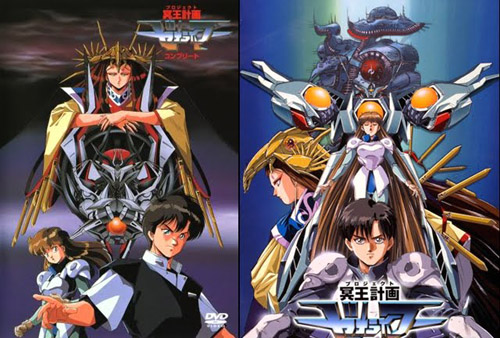
Hades Project Zeorymer was a run-of-the-mill 80s OVA that faded from whatever prominence it had pretty quickly. With its tough dudes, attractively voluptuous ladies, and giant robots, it was indicative of the sex and violence often associated with titles of the period such as MD Geist and Baoh. That’s why I was surprised to learn that Zeorymer originally actually began in the (in)famous bishoujo/lolicon magazine Lemon People.

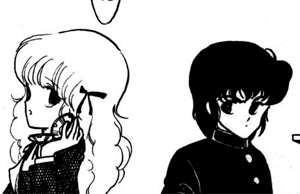
To be fair, from what I know of Lemon People, it was unlike a modern adult (18+) manga magazine in that it covered a variety of genres and tried to include plot beyond who’s having sex with who how many times (though don’t be mistaken in thinking it didn’t include that material at all). The Zeorymer manga appears to have been along that vein, utilizing a lolicon aesthetic (which was itself not quite the same as it is today) for its female character designs while having an overall sf/fantasy narrative. It’s not that uncommon in general for character designs to change when adapted from one form to another, but it’s funny to think about the fact that these two characters…

zeorymercouple

…used to look like this:

zeorymercouplemanga

I’m no expert on Zeorymer or Lemon People, so I can’t make any definitive statements, but I think that the change might say something about where the 80s OVA market was at the time, what the people making anime at the time thought would fly better among consumers, and where the limits were in that regard. Along that line of thought, I wonder if this is speaks towards a difference between a hardcore anime fan and a hardcore manga fan of the period, because it’s not just the girls who were drawn differently but characters of both genders.

In any case, enjoy how overpowered Zeorymer is in the Super Robot Wars games.

First Drawing of Sagimori Arata

The Nostalgia Critic AND the Angry Video Game Nerd in Zettai Karen Children: The Unlimited

UPDATE: The Angry Video Game Nerd made a cameo too! Thanks, VF5SS!

I tweeted about this as well, but I also want to leave a more permanent record of this rare occurrence.

theunlimited-criticandnerd
The Unlimited Episode 5

critic_7168The Nostalgia Critic

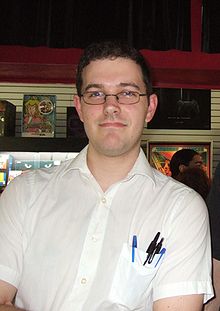
220px-James_D._RolfeThe Angry Video Game Nerd

Coincidence?

Edit: Actually with the way he’s wearing that tie, there’s no way that’s mere coincidence.