The Otaku Diaries Hint at the Secretive Triumvirate of Hugpillow Enthusiasts

Now that the Otaku Diaries main events are over, the Reverse Thieves have seen it fit to hit us with all sorts of tidbits, from the number of people who were officers in anime clubs (13) to the number of man-crushes on Daryl Surat (greater than 0) to the number of people who own hugpillows.

Some of the trivia also sounds like it came straight out of anime. And assuming that everyone told the truth as they were expected to, that’s amazing. For example, the person who broke up with his girlfriend after canceling a date to watch Yu Yu Hakusho reminds me of a manga, Fujoshi no Honkai, where a closet fujoshi breaks up with her boyfriend by telling him that she’s “spending time with another man,” when in reality she bought a cake to celebrate the birthday of her favorite character. And when you realize that something like a manga based on the daily lives of otaku is trying to mirror the reality of the fandom, it’s almost like the beast feeding itself.

But really, looking at this trivia hodgepodge, I think it hits me harder than any of the previous Otaku Diaries posts just how similar/dissimilar we all are as fans of anime and manga. We are all united under the banner of Japanese comics and cartoons, but that sturdy felt cloth hanging high above us belies the sheer variety of places we come from. Gone are the days that anime fans all came from a single nerdy source of science fiction fandom or from watching the Pokemon on the TV. And though I use the term “anime fan” to encompass both those who watch anime and those who read manga, there are even people who almost exclusively focus on one or the other. All of it is surprising and yet none of it is.

Do You Truly Know What It Means to Draw the Right Card?

Last week while taking the train home, I saw a kid with his head buried in some kind of Bakugan guide, and it got me thinking. The first thing was that it reminded me of when I used to sit on the same train with a printed Pokemon pokedex, poring over move lists and trying to imagine new movesets and strategies. It filled me with a sense of nostalgia. The second thing was that it got me thinking about the future of anime.

Bakugan, one of those collecting and battling game franchises designed to separate kids from their money, has an anime to act as a half-hour commercial for the product. It’s one of the latest in a long line of merchandising engines, from Pokemon to Digimon to Yugioh to Beyblade and so on. The shows can still be pretty decent; there’s no illusion about their true purpose, but it doesn’t mean they can’t be entertaining.

That said, what if someone made a collecting and battling anime that wasn’t there primarily to push a product? “Impossible!” you might say. And to some extent you’d be right. Shows are made because they have some kind of chance at making money. But my response is, give it a decade.

In those ten years, the kids who grew up with those trading card games and battle tops will be getting older and older. They’ll be adults working full-time jobs and looking back fondly on their childhoods. It would mirror the progression mecha anime has had, with shows now being made for adults and having more advanced and mature concepts. In this situation, a collecting and battling anime which really takes an artistic and philosophical look at the nature of collecting and battling anime would be perfect.

It could look at the nature of probability and psychology. Perhaps it would ask what it means to play a game where you must collect to improve your chances of winning. There could be legitimately well-written characters and a skeptical eye, but still a love letter to the genres of TCGs and monster battles. It would really master and perfect the sense of timing and tension that would make the heroes’ actions seem all the more worthwhile. Actual rules to the game are optional.

It would be the Gurren-Lagann of collecting and battling anime.

The Threat of Emasculation in the World of Fictional Icons Beyond Manga

For many years now, manga has undergone a curious transformation. Where once comic magazines devoted space to stories which taught boys how to be men and provided ample role models for how to live, that innocent desire has been corrupted by a display of weak-willed, wobbly-kneed pretty boys who fight not to save the world but to draw power away from men and place their entertainment in the hands of the opposite sex.

Originally, even though I could only shake my head at the manga aisle at the Barnes and Noble, I at least was confident in the knowledge that this breakdown of integrity in fiction was limited to what we’d call “entertainment.” Manga, television shows, books, it was as if the ovarial agenda was happy to willfully quarantine itself to the realm of fictional tales. But I realize now that I was simply too naive, and that the attack goes well into the realm of iconic figures who exist in our daily imaginations.

Look at this man here. You might think he’s the main character in the newest Jump comic, or perhaps his clean-shaven look and gentle eyes mean he’s the latest teen heartthrob. But sadly, truly sadly, you are incorrect. This is the Brawny Man.

Looking back, the clues were obvious. Paper towels absorb the messes of kitchens and bathrooms and store a record of human activity. Likewise, manga pages absorb the ink from the artists’ pens, also resulting in a similar record of human activity. Paper towel rolls and manga magazines are essentially cousins, and if the integrity of one can be damaged, the other is just as vulnerable.

It’s a likely possibility your mind blocked out the first image I showed you. For your benefit I have included a picture of the previous Brawny Man to help transition your mind into the harsh reality of the present. Comparing the two, it is clear that at some point  the powers that be decided that the Brawny Man was too great a symbol of all that is good and decent in the world, and so took steps to correct this “error.” They were threatened by his full mustache and his rugged looks, and concluded that the only solution was to begin depriving him of the very essence of his influence.

The new Brawny Man is still fairly masculine, but the fact that he escaped still well on the side of the Y-chromosome is attributed more to his inherent fortitude than anything else. A lesser male character would have transformed into a female baboon. A visual kei member would have found new life as a sentient petticoat. It is an ordeal few can survive even once.

Let us pray for the Brawny Man. Though he may now be too malformed and misshapen to ever inspire a generation of true men, we must still accept and forgive him.

What to Buy, Man? Why, a Mahjong Set of Course!

The March gathering of the US Professional Mahjong League was possibly the most exciting yet.

For those who don’t know the USPML is devoted to playing Japanese-style mahjong, which is probably best known for the ability to declare a hand as “ready” or “riichi” in order to score extra points and to clearly reveal yourself as the aggressor. While I was without my usual accomplice on this occasion, I was joined by thedigitalbug, who I believe had heard of these mahjong sessions from my previous posts on the subject.

We played two games total, one east + south game and a quick east-only game after that. The first game was quite intense, with people declaring ron and tsumo all over the place, and not a single round ending due to all the tiles being drawn. I was the first to lose points in the match, getting hit for a decent amount, but my fortune was reversed as I managed to win using a high scoring hand which turned the tables of the match and put me in the lead. Actually, at first I thought my hand was worth less than it actually was, misreading my “junchan” (All sets have at least a 1 or 9 in them) hand as the similar and less valuable “chanta” (All sets have at least a 1, 9, or “honor” kanji on them). On top of that, by declaring riichi and winning instantly off of it, my hand’s score increased further. In total, I netted 12,000 points. To give an idea of scale, for these sessions we start with 29,000 points each and games typically use 25,000.

By the final round I was about 17,000 points in the lead, and the other players were scrambling for second place. With such a comfortable lead, I could have very well ended the game by intentionally dealing into another player’s hand, but thanks to a mix of luck, greed, good reading of the game, and even a fortunate accident, I managed to end the game on a very high note.

For this round, I started my hand with two 8-su (bamboo), which was the bonus “dora” tile. If you have seen Akagi, the “dora” tile was the centerpiece in the final battle between young Akagi and the blind player Ichikawa (in that instance it was the pure white “haku” tile). Seeing another 8-su discarded, I called for it, which, while improving my potential score, also limited its freedom by removing the only pair I had in my hand. Having a pair in your hand is a vital part of winning at mahjong, and I could have very well thrown my only opportunity away.

Things were looking good however, especially because I had two of the “south” wind tiles which in sets of three are worth extra, provided you are playing in the south round, or alternately if you’re sitting in the south position. Both of these criteria applied to me at the time so I would score off of both of these if I won. However, when I looked down, I realized my opponent had already discarded a south tile and I had simply failed to notice it. Silently cursing, I waited for the next opportunity, hoping that the last south tile (there are four total in a set) would fly out of someone’s hand. As luck turns out, the same player who had discarded it previously believed it to be a safe tile and decided to toss it out again. Seizing the opportunity, I called for it, and was one step closer to completing my hand. Now the open parts of my hand looked truly threatening, and the other players were surely aware of it.

In the end though, they were unable to stop me, and with a shout of “Ron!” I won off of a player’s discard. My hand ended up being the following:

Toitoiho (All triplets)
Honitsu (Psuedo-flush)
Bakaze (Round wind)
Jikaze (Seat wind)
Dora 3 (3 bonus tiles)

Which all together looks like this:

A demigodly hand

In total, this hand was worth a “Baiman,” or 18,000 points. Winning like this was a rare and wonderful feeling, like I was actually in a mahjong anime and lightning and thunder had come crashing down as I revealed my hand. Actually, I once again did not initially notice just how much the hand was worth, and had to have someone tell me its true value.

What’s funny about this win was that had I paid more attention in the match, I would have probably called on the first discarded south wind tile, which would have then changed the flow of the match considerably. It was possibly my brief lack of concentration which let me win so gloriously.

After some mutual handshakes and a quick break, we started the next game. Here, I did not do so well, scoring dead last, but I did manage to get one good hand in, and I had better concentration than last time. Previously, I had made the mistake of drinking too much soda, which dehydrated me and wore me down and hampered my ability to focus, but this time I went with a non-caffeinated root beer as well as a bottle of water. I still lost, but at least felt alert the whole way through.

I had a great time, as I do every time, and I don’t mean that simply because I won so hard that I accidentally impregnated a woman half-way around the world. It just reminded me that while online mahjong is certainly fun, the direct human element is irreplaceable.

As for the Pringles, they were available once again, but this time I ate them with a pair of chopsticks. Yes, it was rad.

Spreading Cubeesm, Finally

I’ve actually been meaning to post about this for almost two years now, but have never gotten around to it until now.

The above image is from the site Cubeecraft, which provides free papercraft models of characters from anime and manga and other areas of nerd popular culture. While I haven’t taken the opportunity to construct any myself, which I understand limits the authority of my opinion a great deal, I’ve seen them in action firsthand. The really great thing about Cubeecrafts is that, unlike many other papercraft which require a lot of precision and know-how and exact details, Cubeecrafts are beautifully simplistic and easy to construct. They don’t even require any tape!

So naturally when it came to picking an image to lead this post, I had to go with my namesake.

So check it out when you have the chance. Having a color printer helps of course, but is not absolutely necessary. Also, I’m well aware that these things have been featured on Adult Swim in addition to Cartoon Network proper, so you’ve likely heard about it well before I ever got off my lazy ass and made this post, but I wanted to do this, just in case.

Postignorism

I like the postmodernist idea that when given a work of art,  fiction or anything with any degree of abstraction, everyone interprets it and enjoys it their own way. The artists have power but so does the audience. That said however, I do feel that there is a distinct danger in becoming too wrapped up in your own interpretation, particularly at the expense of what is actually there.

In the case of anime fandom, this often takes the form of watching something through the lens of esoteric criteria such as a set of rules for enjoying (or not enjoying) a series established by a fan community for a fan community. It’s okay to watch Inuyasha because you really like Sango, but it’s another matter entirely to judge a given episode’s merit almost entirely on percentage of Sango content or that the series would be objectively improved by more Sango screen time. Shipping can often become a similar beast. Having a favorite pairing is very reasonable even in series without a hint of romance, but the game changes when a series’ ability to provide ammo for that specific coupling is considered the most vital criteria of success.

There is a delicate balance in terms of arguing for the sake of the creator vs the sake of the audience. It may sound like I’m faulting the viewers for not going along with what the creators have laid out, but I understand that creators are not infallible gods even when it comes to their own works, and what they think happens in their own story can play out very differently on the page and screen. I encourage people to really understand their own tastes and to not treat their personal criteria as frivolous, but at the same time if your rubric for enjoyment is too narrow, then it starts to reach a point where what you’re demanding from a work of fiction is that it caters to you, even at the expense of the work itself. On some level it’s not even about like or dislike, good or bad, but rather making an opinion on what’s there rather than what doesn’t exist.

I want to emphasize that I’m not trying to tell people they need to enjoy their shows a certain way, as I don’t believe in that. However, what I do believe in is having some sense of how you approach fiction and to acknowledge the whole of the work when thinking about it, and then taking steps from there to express your mode of enjoyment. Indulging your fantasy is okay as long as you don’t confuse it for the “reality” of the story. If you’re going to be ignoring an aspect of a work, at least be somewhat aware that you’re ignoring it.

What is the Most Moe Kickboxing Tournament?

K-On! World Grand Prix

Now It’s Partially for Consistency’s Sake

Back in 2007 when I first posted about  Mousou Shoujo Otakukei (aka Fujoshi Rumi), I complained about how the price difference between buying the Japanese language version from a Japanese bookstore was nearly at the point where it wasn’t actually worth it. At that point, it was about $8 or $9, very close to the typical $10 price of an English-translated manga.

Now it’s 2010 and six volumes in the problem is bigger than ever. Stopping by Kinokuniya the other day, the price for the current volume is about $10.50, compared to the English releases’ $12 per volume. What makes this sting extra hard is that the death of Asahiya last year means Kinokuniya basically has no competition and can sell its Japanese-language manga whatever price it wishes. Granted there’s Bookoff for low-price manga, but that consists entirely of used books, and I have this strange feeling I’m the only person in New York City buying Mousou Shoujo.

At this point you may be wondering why I’ve stuck with the series even after I said “meh” to its Volume 1, aside from keeping up with the Fujoshi Files. Well, after having read further, I realized that it’s not until Volume 2 that the series and its characters really begin to find their voices. It’s a fun series with nice developments, and I’m eager to see what happens next. Though out of all the fujoshi-themed manga I’ve read so far, I think I like Fujoshissu! best.

There Are Two Kinds of People in This World: Winners and Trolleys

In Anime World Order’s look back at the previous decade of anime, guest Matt Alt talks about how the true successor to giant robot anime isn’t current giant robot anime, instead bestowing that title to those shows which spawn trading cards and games revolving around collecting. Essentially, the true spirit of super robots lies not in the continuation of the aesthetics of giant robot anime, but rather in their ability to push merchandise.

Considering this point, I can only think about how much more today’s anime for boys fosters a sense of competition, with trading card games and the like being at the center of children’s entertainment. The kids don’t have to be competitive “high-level” players, and they don’t even have to necessarily know the rules, and I still think these games, even if their shows talk about friendship and honor, still push the theme of competition more than anything else. Just the fact that there are  specific rules and stats and points means that, in a given activity, there will be winners and losers, even if it’s just cheap plastic being spun in an enclosed space. In contrast, that’s not really possible when you just have toy robots and the like. You can perhaps beat your friends by collecting more toys than them, or even create arbitrary rules of competition or even create fake competitions between your toys as Cobra Commander attacks with his vicious horde of My Little Ponies, but at the end of the day there’s no definitive way to become King of Make-Believe.


Well, almost no way.

This in turn got me thinking about the anime fandom and how we have figured out ways to compete via anime. The act of watching cartoons is not really an area in which you can determine winners and losers (unless you say that we’re all losers), so the community instead focuses their competitive spirits towards anime-related activities such as making music videos and cosplaying. These competitions are far more subjective in their criteria and human judgment is paramount in determining winners, but all the same we have taken a relatively passive activity and found ways to test our abilities against others.

I don’t really have a grand point I’m trying to reach, as I’m just laying down some thoughts. But be it through subjective judging or concrete goals, I don’t think an increase in competitive spirit is really a bad thing. That said, it can be taken too far.

I Thought We Liked Mahjong Series!

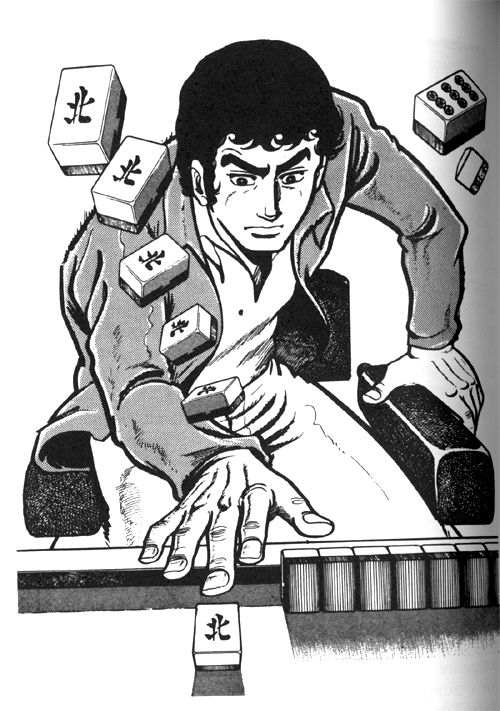
While Akagi and Saki were probably a lot of people’s introduction to the notion of manga based on the game mahjong, I don’t think I’m alone when I say that my first introduction to “mahjong manga” was from Frederik L. Schodt’s seminal book Manga! Manga! The World of Japanese Comics.

In it, Schodt explores the burgeoning genre and talks about popular titles such as Mahjong Houroki (“Tales of a Wandering Mahjong Player”) and Jigoku Mahjong (“Mahjong Hell”), even citing the author of Mahjong Houroki, Kitano Eimei, as the sort of “father” of mahjong manga, who showed that a comic about dealing tiles could look and feel exciting.

Truth be told, while I was fascinated by the idea of mahjong manga back when I first read Manga! Manga! ten years ago, I am not so different than the people who discovered it through Akagi, as that was the first mahjong series which I actually had the privilege to see. And while I don’t expect mahjong manga to become a runaway success in even the scanlation community, it’s clear that it has its devoted followers.

Here’s the odd thing though: Where are the scans of Mahjong Hourouki? If Akagi and Saki have resulted in people from all over the fandom getting into mahjong even at a periphery level, why hasn’t anyone bothered to look into these significant works which established the genre that so many are enjoying now? And it can’t really be the case where fans of these newer series might not like the older series due to the artwork. After all, we’re talking about Akagi fans here, and I’ve never seen anyone proclaim, “If the characters don’t have ultra pointy faces and noses and everyone looks shocked all the time, then I refuse to read it!” And I see you considering making a comment where you reiterate what I just said. I’m watching you.

Oh, and of course the reason I’m talking about it in the realm of scanlations and such is that no sane company would license a mahjong series in the United States. The closest you’d get to one that could conceivably do well is Saki which is streamed on Crunchyroll, and even that is a bit of a stretch when you consider the not-internet.

The most likely culprit is probably scarcity. It’s no doubt difficult to find these old series in the first place, especially with a niche genre like mahjong. And I’m as guilty of not contributing to the pursuit as any other. This is the first post I’ve made about it, and it’s only because I was re-reading Schodt’s book today. But still, I’m making the call out. We have to find these old works, titles like Mahjong Fuunroku (“Mahjong Crises”) and Gambler no Uta (“The Son of the Gambler”), and bring them to the forefront of consciousness.