Subete Wakannee: Genshiken II, Chapter 101

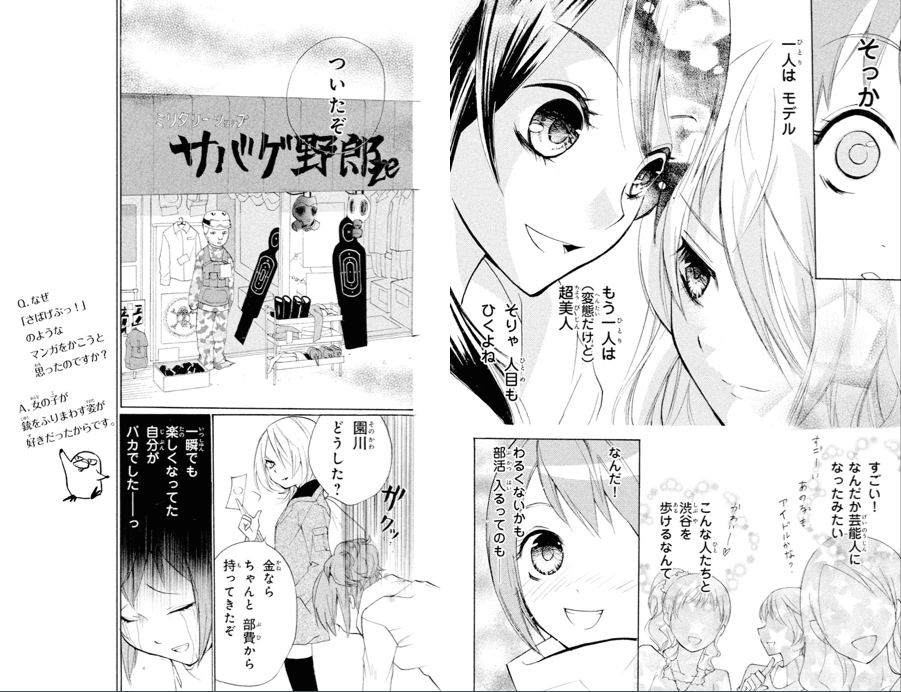
Since the last chapter, Madarame has been mulling over Hato’s Valentine’s chocolate. Feeling a sense of happiness over receiving them yet also confused and alarmed by this very reaction, he seeks the advice of Kugayama, who is the only other guy out of the old Genshiken crew to not have a significant other and thus won’t spill the beans to the girls. As the two get increasingly drunk over some barbecue, Madarame reveals where he believes the confusion lies: to him, Hato is a man and therefore someone Madarame can relate to, whereas women are so foreign to him that he doesn’t know how to even begin dealing with their affections. Kugayama suggests going to a soapland to help him get over his fear of women, but realizing that it’s probably too big a jump for either of them they consider instead going to a cabaret club, more specifically Keiko’s.

For a chapter basically consisting of two scenes and a brief look into Yajima’s attempt to improve her figure drawing with the help of Yoshitake, there’s actually a whole lot to unpack. At this point, it’s something I expect from Genshiken even putting aside my own tendency to analyze the series in depth, but the more I thought about the simple events and topics of this chapter, the more complex the exploration of otaku sexuality and its perception in the otaku mind becomes.

Although I’ve had to re-assess the manga’s messages when it comes to attraction and sexuality a number of times, at this point one thing continues to be certain: Genshiken presents the idea that one’s “2D” and “3D” preferences neither overlap entirely nor are they truly separate. It wasn’t that Hato was in denial when he originally said his preference for BL existed purely in the realm of doujinshi and the like, but that he honestly felt that way. However, as we’ve learned, even the distinction between “2D” and “3D” is tenuous, as the characters of Genshiken ship real people (or at least imaginary approximations of real people). I would argue that BL was not Hato’s realization of homosexuality, but something which made the idea a distinct possibility in his mind that helped him to clarify his feelings for Madarame.

While I don’t think Madarame is having the same thing happen to him, I do think his actions in this chapter reflect a similar semi-disconnect between his 2D and 3D desires. Consider the fact that one of Madarame’s warning signals was that he began re-playing his otoko no ko eroge. One would expect the situation to be that ever since Madarame received the chocolates that he began to look into those games, but he in fact had them for a while. While Madarame maintained is self-identity as heterosexual, he was playing those types of games the whole time, and as implied in the chapters where he first discusses his experience with those games, it’s less about being into guys 2D or 3D and more about the use of sexual expression coded generally as “female” in otaku media that appeals to him. Hato, who similarly performs “femininity” looks to be hitting the same triggers in Madarame, and the very fact that this deliberateness in the end positions Hato to be male is also what makes Madarame feel as if he can relate to Hato better than any woman.

The female sex is something Madarame has viewed his entire life as a realm of distant fantasy, only barely entering his purview of reality when Kasukabe suggested that maybe they could’ve had something if circumstances had been different. This, I think, is why Madarame has trouble deciding what he feels in reaction to Sue and Angela (via Ohno) giving him romantic chocolates as well. Madarame has expressed interest in 2D characters similar to Sue, and there’s no doubt that he finds Angela attractive on some level, but they’re a foreign existence, both figuratively and literally. In that sense the anime girl and the real girl are equally “farfetched.” This is also what makes the Chekhov’s gun that is Keiko’s heavily photoshopped business card so powerful. Not only is it the case that Madarame’s refusal to visit the cabaret club back in Chapter 59 potentially overturned the next chapter, and not only is Keiko one of the other girls into Madarame, but Keiko herself plays a “character” at her workplace. Even firmly within the realm of “3D,” the line between fantasy and reality blurs.

Another thing I find interesting about this whole notion that Hato’s feelings are easier to respond to because Madarame can relate to them as a fellow guy is how this somewhat mirrors one of the reasonings touted for why people get into BL of shounen manga. Traditionally, female characters and love interests in battle/sports/competition manga have been on the sidelines, and most of the displays of fiery passion consist of male rivals and enemies confronting and antagonizing each other, which leads to more time and effort to devoted to those relationships than the ones between the hero and his would-be girlfriend. While this isn’t quite the same as what Madarame and Hato have, what is similar is this concept of guys being able to understand each other on some deeper level (or with girls in yuri), whether it’s intrinsic or something that’s developed over time. In the case of Madarame, it’s perhaps an inevitability given his inexperience with women. In a way, Kugayama’s solution of breaking the “mystique” of the opposite sex through the use of a “professional,” while extremely typical in various cultures (there was even a King of the Hill episode on the subject) is itself also a breakthrough for the otaku-minded, as it involves a desire to get away from the ideal of sexual purity and enter “reality,” though even that conception of the world is fueled by a fantasy. There’s a more I could say about Kugayama as well, but I’ll leave it alone for now except to say that Kugayama in some ways occupies Yajima’s position.

As for the scene with Yajima, Yoshitake, Hato, and Sue, although it’s fairly short, it is notable that Yajima is actually trying to improve her drawing despite being previously resigned to suck at it forever, and Hato’s mention that he’s been drawing manga lately is likely going to mean that he’s gotten past his previous dilemma of only being able to draw BL when dressed as a girl and a rather bizarre style when as a boy. The “disappearance” of the two voices that accompanied Hato (his other self and the other Kaminaga) were likely a prelude to this development. I suspect we’ll see more in the next chapter.

Also, Ogiue does not appear in this chapter but is at least mentioned twice, once when Madarame believes Sasahara would definitely tell her if Madarame were to divulge his secret struggle, and once when Yoshitake states that it was Ogiue’s suggestion for Yajima to do some rough sketches.


Of All Things, an Introspective Card Game Anime – Battle Spirits: Shounen Toppa Bashin

A few years ago, I went to an event at the Japan Society in NYC, where Satou Dai of Cowboy Bebop and Eureka Seven fame was a guest. In the lobby, they had design materials from shows he’s written for, and among the works on display was something unfamiliar which caught my eye. This anime was Battle Spirits: Shounen Toppa Bashin, a show whose character designs by Shimogasa Miho (probably best known for Demashitaa! Powerpuff Girls Z) stayed with me for years. Having finally decided to take a look, it turns out that Shounen Toppa Bashin is surprisingly strong in the categories you wouldn’t expect a trading card game-themed anime to even take into consideration, such as personal psychology and portrayals of parent-child bonds. It’s one thing to be an anime like Selector Infected Wixoss, which tries to mess with the conventions of this genre, but this very first Battle Spirits doesn’t subvert so much as challenge and uplift.

The basic premise of Battle Spirits: Shounen Toppa Bashin is about as standard as it gets: kids (and adults) love a trading card game, and they somehow are able to access another dimension and battle with 3DCG monsters. They challenge each other, enter tournaments, form friendships. It basically sounds like a Yu-Gi-Oh! clone. What is notable, however, is that the character relationships in Shounen Toppa Bashin really stand out in a way that I would expect more from a Satou Jun’ichi magical girl show (Ojamajo Doremi, Fushigiboshi no Futagohime) than a TCG merchandising engine. I guess I shouldn’t be that surprised that the man responsible for the series composition of Eureka Seven would also give an impressive showing here.

For example, when you see the extremely straightforward, shounen fighting spirit main character Bashin Toppa talk to his mom Hayami (both pictured above), you get a real sense that his energy and attitude come directly from how she’s raised him. Rather than ignore or deny that familial connection as is often the case with anime, the show uses it to give a real sense of personality to Toppa, to show that his simple-mindedness is also surprisingly deep. After all, what does it really mean to always look ahead, to always want to “Break through the front,” as Toppa often says? It sort of reminds me of Sei and his mother in Gundam Build Fighters, though it also doesn’t hurt that Hayami is not only a classy lady just like Rinko but a taxi driver famous for her Initial D-level driving.

There are a lot of other examples too, but I’ll only mention one more. Another source of delightful interaction comes from the fact that the devious ace player Suiren is actually the popular idol My Sunshine, and Toppa’s inability to see through her disguise in spite of how much time they spend together is pretty hilarious. At the same time, however, it’s also the impetus for Suiren to open up to others and to form friendships with the rest of the main cast. The character designs by Shimogasa really shine here, which reminds me somewhat of Chousoku Henkei Gyrozetter and its own strong character designs and personalities. Speaking of character designs, they’re probably at their best when looking at the show’s ending videos.

Seeing all of these characters with really simple yet vibrant personalities interact with each other in clever and entertaining ways while sporting those strong character designs just makes the show a joy to watch to the extent that it pretty much overshadows the card battling aspect of the series, which almost feels intentional given how much the show rushes through the matches. Usually, when it comes to TCG anime like Yu-Gi-Oh!, the drama is mostly focused on the card game, seeing step by step how the hero overcomes his opponents, but Shounen Toppa Bashin is different. In fact, in most episodes it generally skips a lot of turns to get straight to the climax of a match. The result is that, like Yes! Precure 5, the “fights” seem supplemental to the characters. Maybe not the best for selling the “Battle Spirits” card game, but purely as an anime I would rate it higher than most other shows in its genre.

There is one TCG-relevant aspect, however, that I do find unique to Shounen Toppa Bashin, which is that the anime makes an effort to show how the characters gradually gain experience with the card game they’re playing in a way that is easy to follow. Toppa is head-strong and prefers a straightforward approach of busting through his opponent, for example, but then loses a match early on because he doesn’t take into account strategies that more directly counter his deck type. By the next battle, you see this weakness made up for to an extent, and then strengthened further in a following match. It’s a nice touch to show that the characters are learning, instead of just seeing them bust out a new deck with “all-new secret strategies!!!” (though that happens sometimes too). What also helps is that a lot that both male and female characters are considered strong players, and everyone will take games off of each other fairly regularly so there are no real “weak links” in the core group, and even those who start off that way improve over time.

I’ve only watched 26 episodes so far, but I definitely look forward to seeing how the show continues to unfold. It’s the kind of show I wish more morning boys’ anime would be.

Eat to Live, Live to Eat: Mogusa-san

When it comes to characters in fiction, it’s fairly common for me to find characters that resonate with me. Much rarer, however, is to find a character that is more of a kindred spirit, someone who fundamentally connects with who I am. This is the experience I have when reading the manga Mogusa-san, the romantic story of a girl who loves to eat all the time.

One of my passions in life is food. When I travel, I mainly think in terms of things I can possibly eat. That is not to say that I am a “foodie,” as the term usually implies someone who is in constant pursuit of the next superbly executed dish. Rather, whereas a typical foodie would not touch Chef Boyardee after having freshly made authentic Italian pasta, I can eat both. I can switch freely between Époisses and Kraft American Singles and not feel that my culinary experience has been ruined. Nor do I consider myself someone with no sense of taste whatsoever, or someone who can’t appreciate finer qualities in food. Trying new dishes, revisiting old ones, complex flavors, simple tastes, approaching different cultures through their cuisine, I simply love the experiences that come with eating. So, when the titular heroine of Mogusa-san (whose name is based on mogumogu, the onomatopoeia for munching) shows a similar fondness for eating, I feel this sense of deep understanding with the character. Heck, I even made her my Twitter banner.

Food manga is a fairly ubiquitous genre, and is usually based around the intense experience of eating something so delicious that it can only be described in metaphor. Yakitate!! Japan, The Drops of God, Oishinbou, Gokudou Meshi, all of these series are about the pleasures of specific dishes and how they were made with love and care. Mogusa-san is a different experience, as it’s more about the feelings derived from the act of eating itself. It’s not just that Mogusa is always hungry or has a large appetite (common features in manga characters) which makes this manga a joy to read, but that the sheer bliss on her face—the wide-eyed sense of wonder, the small but genuine smile, the soft blush that fills the panels—is delightfully overpowering. It more or less describing how I feel whenever I eat, and on a certain level, I find this to be something missing from most food manga.

Mogusa-san feels no need for hyperbole, at least when it comes to describing taste. Instead, its sense of exaggeration lies is in how Mogusa manages to accomplish the task of eating nearly 24/7. While Mogusa is embarrassed about her love of food (because every girl around her is more about dieting), it certainly doesn’t stop her because Mogusa has mastered the art of stealth eating. She keeps packages of eel jerky in her wallet. She disguises an extra helping of rice as a French dictionary. In the image below, Mogusa is supposedly eating only one “Takenoko” chocolate snack, but is actually eating multiple ones, switching between them constantly with the skill of a wild west gunslinger to create the illusion that she’s only been eating one the whole time. In this way, the techniques used by other food manga to describe the taste of dishes transfers over to Mogusa’s consumption tactics.

I’ve been told that I make food look delicious when I eat, and this is also what I get from looking at Mogusa. As much as I love to eat, I also am fond of watching other people enjoy food as well and i n this respect, I also end up connecting to the boy who befriends Mogusa, Koguchi Torao. It’s rather satisfying to me to see someone’s face light up when they eat something that truly blows their mind. In fact, part of the experience of traveling for me is seeing others’ faces light up as they taste something new and exciting, or something familiar and comforting. The art does a good job of showing not only Mogusa’s sense of happiness while eating, but also the fact that Koguchi appears to fall in love with her every time she decides to chow down on something, which, again, is all the time.

Mogusa-san began on the web-only Shueisha platform Tonari no Young Jump, but has since begun serialization in the real Weekly Young Jump magazine due to its popularity. While the first volume has already been published, you can still read a few chapters online in Japanese, and while the language barrier is an issue I think this manga is one where that matters a little less. It’s a manga that I feel profoundly drawn to, and if you love eating the same way I do (or maybe just really like Sasha from Attack on Titan), there’s a good chance you’ll feel the same way.


Like the Transformers Movies but Less Stupid: Godzilla 2014

The 2014 Godzilla film is a strange amalgam of sorts. The most famous of Japanese giant monsters is many things to many people, its movies spanning generations, the narratives of which vary between Godzilla as the power of nature made reality, a representation of the hubris of humankind, and kick-ass monster eager for a rumble against its fellow kaijuu. Rather than going for the heavy reintepretation as with the old 1998 film, Godzilla 2014 tries to embrace all facets of the lizard with some mixed results.

I have somewhat of an “improper” understanding of Godzilla. Certainly I grew up on some of the movies, having watched my Godzilla vs. Megalon and Godzilla vs. Mechagodzilla VHS tapes religiously as a kid, for example. However, I’ve still never seen the original (not even the English adaptation with Raymond Burr inserted in), nor am I so hardcore into Godzilla that I can tell you all of its production history. I’ve realized that deep down I think of Godzilla first and foremost as teaming up with Mothra or Jet Jaguar and giving monster smackdowns, so when I originally came to the movie expecting something more along the lines of a disaster flick, I could feel the kid inside of me smile as the film revealed that it was definitely leading to a massive battle.

At the same time, Godzilla 2014 definitely does not have the same feel as those Showa-era movies I’d grown up on, the heavy emphasis on military presence makes it feel somewhat closer to the Michael Bay Transformers films. Fortunately, Godzilla maintains the image of futility as the US Navy’s weaponry proves overall ineffectual, a classic trope of the franchise, and so it avoids the more jingoistic feel of Transformers when it comes to representations of the military. Even though the main protagonist is a soldier, and he accomplishes quite a bit as a human being, his significance pales in comparison to Godzilla, and the film does a good job of conveying the smallness of humanity.

In this respect, the movie tries to have its cake and eat it too, being on some level the disaster movie I expected going in, but also the monster mash that Godzilla is famous for, but also the contemporary US blockbuster with that strangely stylish militaristic vibe that has increasingly become a part of the movie experience. I find that it balances these incongruities surprisingly well, which is actually pretty impressive, but I also can’t help but shake the feeling that the “something for everyone” approach allowed it to only go so far. I won’t say that it was like three films in one, as I do think there is a good sense of continuity and cohesion overall. Instead, it’s more that Godzilla 2014 embodies the idea of an “American-made Godzilla” to a tee, for better or worse.

The Price of Art: Miyazaki Hayao’s “The Wind Rises”

It’s been a few weeks since I took the opportunity to see Miyazaki’s The Wind Rises. For personal reasons I’ve been unable to write about it until now, which makes me a little sad since my memories of the movie are no longer as fresh. Nevertheless, the film made such an impression on me that I can still remember its effects on me, the mild trembling and near-existential crisis I experienced after leaving the theater that I feel compelled to write about it. This is because while other Miyazaki films have been beautiful, profound, poignant, heart-warming, and intelligent, The Wind Rises is challenging.

I’m going to spoil quite a bit. If you haven’t seen it, I highly recommend this movie.

The Wind Rises is a highly fictionalized account of the life of Horikoshi Jirou, inventor of the “Zero,” the most famous Japanese plane of World War II. We first see him as a child in love with the idea of flight, though sadly unable to ever truly take to the skies due to his terrible eyesight. Instead, in a dream where he meets Caproni, a famous Italian aeronautical engineer, he realizes that if he can’t fly the planes, then at least he can build them. The movie is thus the story of a man with a passion that stays with him throughout his life. The main issue is that he lives in the 1930s, and Japan already has an alliance with Nazi Germany. We know what Jirou’s passion will lead to, and this aspect of his story is how The Wind Rises confronts its audience with difficult questions.

There is a sort of romantic image surrounding the artist who lives for his craft, and over and over again the movie shows how Jirou would rather not think of anything but the plane itself. However, The Wind Rises juxtaposes this quality in Jirou with the era in which he lives. Given the imperialist and militaristic nature of Japan at the time as depicted in the film, it is clear where Jirou’s inventions will eventually take him, and yet given the context of his society, it’s also the only opportunity he really has to fulfill his dream. He makes the best of his situation, pursuing his life-long goal using the means available to him, and though on a personal level this can be seen as the emblematic of the adaptability of the creative human mind, it also comes at a very real cost of millions of lives, claimed essentially by Jirou’s imagination. At the end of the movie when Jirou returns to his dreams of the sky and we see the clouds in the sky transform into his greatest invention, there’s a clear sense of tension on the screen between the beauty of the Zero and the ugliness inextricably tied to it. This is why when I see people accuse this film of being militaristic, I feel as if they did not bother to actually see what was happening in the film.

Can art truly be made for art’s sake? This is one of the central questions of the film, and The Wind Rises answers that this passion, as much as we might want to bottle it and isolate it from the world, is nevertheless still a part of it. Even the refusal to compromise ends up being a type of compromise in itself, and the film makes this point clear not only through Jirou’s profession but also his personal life. Falling in love with a woman suffering from tuberculosis in a time when there was no cure, throughout the movie they make sacrifices between their immediate and future happiness. When ultimately they decide to live together despite knowing that this will shorten her lifespan, the parallel is clearly established that, whether it is at home or in another country, Jirou’s passion in a sense destroyed lives. And yet, it is impossible to see Jirou as a “villain,” or as morally reprehensible. There is no guarantee that we would not have done the same thing, living in the here and now while hoping for a brighter future. Jirou’s choices cannot simply be divided into “right and wrong.”

The very fact that Miyazaki himself is an artist making some of the most successful animated films ever makes the ideas of The Wind Rises feel both self-critical and targeted toward society at large. One of the more interesting decisions for the movie was that Anno Hideaki, creator of Neon Genesis Evangelion, animator on Miyazaki’s Nausicaa of the Valley of the Wind, and otaku extraordinaire was cast as the voice of Jirou. Anno is no voice actor, and it shows in his amateurish performance, but I think this was a deliberate choice because Anno is also a “passionate person” as an otaku. Evangelion was Anno’s attempt to tell otaku to get out there and confront the world, and in certain ways the opposite happened, so I believe that Anno in the role of the protagonist speaks to the idea that otaku are generally considered obsessive people in some sense “cut off” from society. There is an earthquake at the beginning of the film, and when the ground begins to crumble and shake, it looks like the old Gainax style more than that of Ghibli, and I have to wonder if it was animated in this way to call attention to the otaku. As with Jirou, the question would be if we can call otaku a pocket of society, a subculture, or if that passion should be contextualized. It’s a confrontation with both otaku and non-otaku.

I saw this movie at a period in my life where many things are in flux. The future often looks uncertain, the present looks frightening, and more than a few people I’ve known have become ill or worse in recent years, and this movie hits me hard in those areas. Moreover, as someone who has spent his life in creative endeavors, whether it’s art or writing, I feel as if this movie peered straight into my soul, asked me about my life, and forced me to ask myself what a human being really is. In spite of this—or perhaps because of this—however, The Wind Rises may very well have become my favorite Miyazaki film ever (which has been Laputa: Castle in the Sky for the longest time). In fact, when I think about it, the last time I felt this profoundly affected by any anime was the masterful Turn A Gundam. If I had to summarize my thoughts on the film in three words it would be: beautiful, deep, painful. 

Chocolat à la Folie: Genshiken II, Chapter 100

Can you believe it’s finally Chapter 100? Genshiken has come a long way, and you’d expect a manga to make a pretty big deal out of something like this, but this month is actually fairly low-key in spite of it being about Valentine’s Day. Perhaps that casual approach is the most appropriate way to celebrate Genshiken.

I get the feeling most people reading this will be familiar with the distinction between giri (platonic) and honmei (romantic) chocolates in Japanese Valentine’s Day, but I’m pointing out the distinction here just in case.

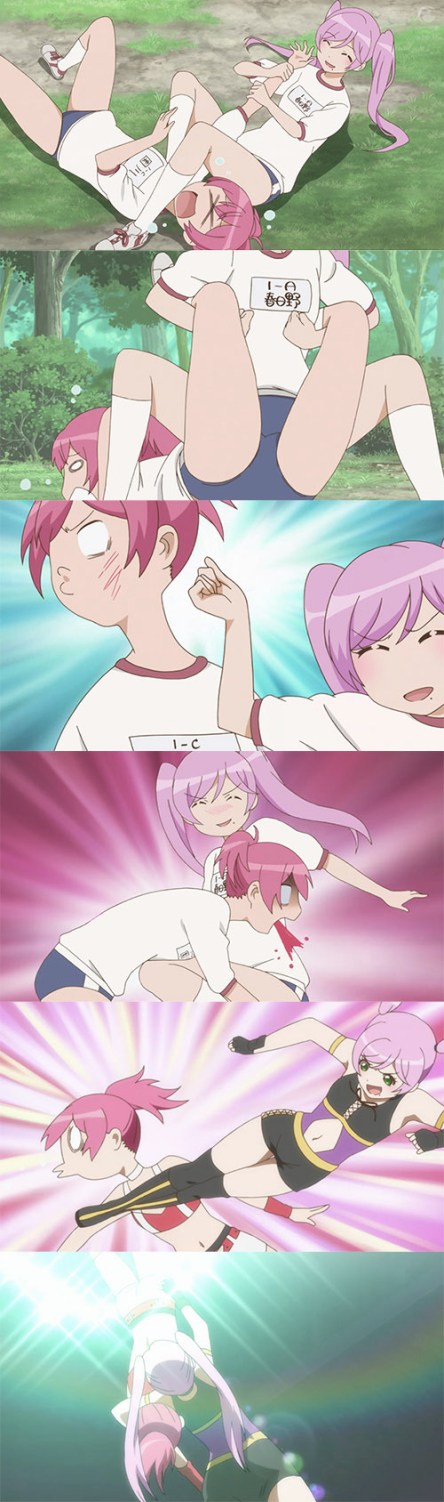
The women of Genshiken are buying chocolates for Valentine’s Day, though in the spirit of cooperation and camaraderie they’ve decided to buy their chocolates together, and for everyone to buy each other chocolates. Or rather, that is the plan on the surface, as it’s really an opportunity for everyone to buy chocolates for their respective crushes and make it look like an egalitarian affair. Yajima appears to chicken out at the last second and just buys a box of chocolates for everyone to share, but this too is revealed to be a ruse. Kuchiki comes in and is (somewhat justifiably) angry that no one remembered to give him chocolate, and Yajima gives the chocolates meant for Hato to Hato but only so that he can offer them to Kuchiki to quell his nerd rage. In the end, Hato (with Sue) goes over to give him some honmei chocolate, which causes Madarame to blush profusely.

The title of this chapter—”Is it the birthday of the Van Allen Radiation Belt?—is a reference to Kyuukyoku Choujin R. It’s also been the source of a lot of Sue’s quotes, and reminds me of Tamagomago’s post on the difference between Genshiken and R. As mentioned there, Genshiken used to be compared a lot to R, but their approaches to the generation gap between club members is different. I’ve pointed out the contrast between the old and new era of Genshiken, though at 45 chapters into Nidaime it’s at the point where the Ogiue-led Society for the Study of Modern Visual Culture has been its own thing for almost 4 years now. Even though the connections pop up still, I’ve gotten the feeling that the manga has been trying to move away from that disparity between “young” and “old,” and more towards this incarnation of the club having its own rhythm. That sense that the “fujoshi-laden Genshiken” is unique has always been there, but in this chapter it really comes through.

Genshiken has never really done Valentine’s Day, and while at first that seems kind of unusual given how long the manga is, it makes sense that it would happen only after 1) the club went from being mostly guys to mostly girls (Valentine’s Day is a holiday in Japan where girls give chocolates) and 2) after romantic feelings are front and center in the story. The chapter purposely makes note of the fact that the way the Genshiken members go about celebrating Valentine’s Day doesn’t quite match up to the way things go in anime, but at the same time it still kind of falls into the same parameters. All of the twists and turns in the plot summary above are basically attempts by the girls to Trojan Horse honmei chocolates as giri chocolates, making for something as complex as the political machinations of some royal nobility. I do find it funny that Ohno, having spent some time in the US, gives the “I wish it were more like anime!” vibe like you’d expect out of her fellow Americans.

Always lurking in the proverbial background (and let’s face it, also the foreground) is the fact that this collection of fujoshi (+ fudanshi) for the most part have rather limited and awkward experiences with romance. Even a “veteran” such as Ogiue is still relatively new to the whole girlfriend thing; as the title page mentions, this is only her second time ever celebrating Valentine’s Day with Sasahara. Sue still uses the “Ogiue is me wife” defense mechanism and both  Yajima and Hato are smack dab in the middle of a love dodecahedron. Even though Yoshitake is not directly involved, I generally get the feeling, based on her willingness to dispense advice on even a subject as unfamiliar to her as love, that she would probably handle romance worse than Yajima. It’d be the perfect culmination of all those times Yoshitake has gotten Yajima to do embarrassing things. Of course, even better than a punchline is  Yoshitake and Yajima actually punching each other, in this casebecause of the former’s “schemes” and the latter’s “cowardice.”

A while ago, I read a review on Anime News Network for Genshiken that was mostly positive but criticized the manga for an overwhelming use of word balloons that supposedly detracted from the visuals. I disagree, not because I think there aren’t a lot of word balloons or that I believe them insignificant, but rather because they add to the experience of looking at manga, guiding the eyes from one significant element to the next while also giving the sense that the characters are chitchatting pretty constantly. Genshiken is sort of an atmospheric manga, but that aspect is minimized most of the time only to let the moments of total “silence” have that much more impact.

As for Madarame’s blushing, I’m not going to say that Hato x Mada is impossible (unlikely, yes), but I think it’d be wise not to read too much into Madarame’s reaction. Once again, we’re talking about a character who is the quintessential super otaku. Even if he finds himself surprisingly popular at the moment, and not so long ago was told that maaaaybe he might have had a chance with the girl of his dreams if circumstances had been different, this is the first romantic Valentine’s Day chocolate he’s ever received from anyone, guy or girl. It can be a lot for a guy. Then again, Nidaime relative to Madarame has partly been about how that classic otaku type is not static, but is rather subject to change due to the influences around him.

If there is anything marking this chapter as a milestone, it might be Ogiue’s behavior. Ogiue was originally a very intense and blunt person with a lot of personal emotional pain inside of her. Here in Chapter 100, Ogiue is rather sharp-tongued, but in a way that really contrasts with her old self. Whether it’s telling Ohno that she can’t play the “recently returned to Japan from abroad” card, or pointing out that Ohno took another year to graduate, there’s a strange kind of serenity to Ogiue’s verbal jabs. Ogiue’s always been a character with a lot of interesting and complicated facets, but subtlety in her words was never really one of them. Maybe it comes from becoming a professional manga creator, or maybe it’s just part of her growth in general. The fact that she’s the spotlight for the title page in spite of not being the focus of the chapter shows her overall importance to Genshiken. Though she’s no longer really in the spotlight, Ogiue continues to be the best character.

By the way, Genshiken Volume 16 is on sale June 23rd. I hope they don’t mess with me again and have a special edition and exclusive editions at Japanese stores!

Not Quite Knight Rider: Girl and Car on the Beat

Manga Box is a nice digital manga app for just checking out some strange and obscure titles. A lot of the titles on it are not especially experimental, and probably won’t be the next Attack on Titan, but often these works are short and fun. One of my favorite titles on Manga Box is Girl and Car on the Beat, and as the early issues of Manga Box gradually go away, I think it’d be a shame if more people didn’t read it. In fact most of the chapters are unavailable currently, and I regret not posting about this sooner.

girlandcar

Girl and Car on the Beat is about an old police car with the personality of a worn-out veteran and a rookie female officer who loves its rugged old appearance, and the humor in the series comes from the girl’s ridiculous enthusiasm for mundane aspects of police life juxtaposed with the police car’s “experience.” Though the car can’t “talk” the way K.I.T.T. would in Knight Rider, there’s still a strange and charming interaction between the two, especially because the girl is pretty much the only one left who has any respect for it. Each chapter is short, and at just 12 chapters total Girl and Car on the Beat is a quick read overall. It won’t blow any minds, and it’s not quite as hilarious as Rookie Female Police Officer Kiruko-san, but reading it is a nice way to spend an afternoon or a lunch break, and I think one of the better titles on Manga Box overall.

Shiftylook’s “Wonder Momo” Anime is Straight Out of the 90s

wondermomo-wonderhoop-small

As part of a move to briefly revive some of their old and beloved properties, Bandai Namco commissioned a comic based on the old Wonder Momo franchise, which was subsequently adapted into a short anime. At five episodes total and seven minutes per episode, it’s not much of a time commitment so even though it didn’t impress me at first I decided to just watch through the whole thing.

Here’s my verdict: The show looks fine, the actors (aside from Akihabara idol legend Momoi Halko) are clearly inexperienced. Overall, Wonder Momo is like a 90s OVA adaptation of a 90s anime fanfic. Let me explain that last point.

In the 80s and 90s, anime had a curious reputation in the United States. Aside from the idea that it was mostly porn and gore, the fact that a lot of the anime that came out were more long commercials for existing manga or video games resulted in the notion that anime was big on visuals but short on narrative. Stories didn’t make sense (and I don’t meant that they were boring, I mean they felt like nonsense), series ended at odd moments, and details like “who are these people” were glossed over readily because they expected you the fan to fill in the blanks. The Wonder Momo anime feels very similar in this regard, in that everything is a bit rushed and there’s no real sense of conflict.

The other thing is that a lot of the humor feels like it came straight out of 90s US anime fandom, like someone had taken inspiration from all of those Ranma 1/2 fanfics of the era and said, “Yes! This is what comedy is, you bakas!!!” While  the Wonder Momo anime is done in Japanese and so there’s no Janglish to speak of, it’s kind of surprising that it doesn’t devolve into a flurry of sweatdrops and chibis. I suspect it has to do with its webcomic source material, but I haven’t read enough of it to judge.

In a sense, Wonder Momo answers a long-standing question: what would it look like if the 90s US fandom’s idea of anime got made into an actual anime? In that regard, I find it to be more a proof-of-concept than anything else.

Half Court Press: Genshiken II, Chapter 99

After being absent for many chapters, Yoshitake Risa makes her return. Having given up a potentially successful career in basketball to take the entrance exam for Shiiou University, she and her older sister Rika have a heart to heart talk the night before, which quickly turns extremely otaku. At the same time, Yajima, Hato, and Sue have their own conversation about the younger Yoshitake, based around the fact that part of her inspiration for trying to get into their university is Hato and his crossdressing. Despite waking up late, a freak snowstorm delays the test, and Risa manages to make it there on time and pass the test.

The title of this chapter, “Little Sister Entrance Exam II,” is a reference to when Sasahara’s sister Keiko tried to get into Shiiou University herself. She failed, though Risa appears to be a good deal sharper academically, which changes the result.

This month’s Genshiken, despite having a clear general focus on Risa and her test, is still surprisingly complex to the extent that I’m not sure if I can cover everything, though to be honest I rarely every do despite my attempts. There are three areas which I think are especially interesting, though, so I’ll focus on those. The first would be Risa’s relationship with Hato, or more specifically her image of him. An unabashed shotacon, Hato’s naked body is what made Risa realize that her interests could be fulfilled in the adult world. However, the fact that she sees Hato as a kind of real life version of her ideal male fantasy (she asks him to wear legs-exposing short pants if she passes, which over the course of the chapter degenerates into some kind of reverse-gender take on zettai ryouiki), clashes in an intriguing way with the developments we’ve seen Hato go through all this time. He’s gone through a period where he refused to wear women’s clothing, and then come back around as he’s accepted his own feelings for Madarame, and here Risa is projecting her own interests onto him. What was already a complicated situation continues to grow, and that’s not even mentioning Risa’s own gender-bending actions.

The second area would be the start of Hato’s “harem.” Recently, the focus of Genshiken has been the number of people interested in Madarame, which the series has been using to explore the idea of the harem manga by way of the otaku sensibilities of the Genshiken characters. In this chapter, we not only see once again that Yajima has feelings for Hato, but that there might also be something with Sue, and Risa expresses her own interests in Hato (even if they’re mixed up with her otaku fantasies). Then there’s also Konno the googly-eyed goddess, who doesn’t appear in this chapter. Suddenly the series isn’t about one man’s “harem” (even though the term is kind of bad for describing when two or more people like you), but two intersecting ones. Granted, Yajima’s fear of Sue seems fairly unfounded, and I think it’s meant to show more her concern over potentially being outclassed, as well as her realization that it’s getting harder for her to deny her own feelings for Hato when she references her and Risa as “rivals.” I also find it notable that Risa is the only one to state some sort of interest in Hato to him, instead of only confessing to friends.

The third area is of course the subject of the entrance exam itself. Rika’s advice to her little sister is this mix of big sister attitude and fellow understanding as an otaku. In particular, Risa struggles with whether it was okay to walk away from basketball on a whim, to which Rika essentially responds that being an otaku means living by your passions even if it means making seeming unreasonable choices. The idea is that otaku aren’t as able to stifle their interests in the hopes of integrating with the rest of the world, and Risa already has done a relatively bang-up job what with her successful high school life. Something about this really strikes a chord with me, probably because I know others who’d probably give the same advice, and it’s something I’d encourage as well. On the other hand, this advice can also be abused such that one might refuse to better oneself, but that’s the kind of risk that exists with this sort of philosophy.

One last note: Sue’s snow shenanigans at Madarame’s place make me think of her as a kindred spirit to Calvin from Calvin & Hobbes. Now that’s some crossover fanart I’d be interested in.

Samurai? Flamenco?

If you’ve watched all of Samurai Flamenco you’ll know that even though the show has humble beginnings and then progressively gets into increasingly more outlandish territory. It’s the kind of thing that you try to keep your mouth shut about so as not to spoil the uninitiated (by the way, SPOILER WARNING), partially because it’s obvious how intentional the whole thing has been.

The main character Masayoshi goes from tryng to be like a Kamen Rider-type to actually being a Kamen Rider-type, to being the leader of a Super Sentai team (with giant robot) and eventually even an Ultraman-style giant (and that’s not even mentioning the final genre shif at the end). The changes are so abrupt and swing so heavily from one thing to the next that I can only interpret the show as poking fun at the mid-season corporate meddling that can happen to a tokusatsu series and yet genuinely embrace it as a part of tokusatsu history.

I have to wonder, did Samurai Flamenco hint at this from the start? Perhaps Samumenco was always projecting an aura of neverending incongruities. Just think about the name “Samurai Flamenco.” What gimmicks or powers would a guy with a codename like that have? He’d maybe have some rhythm or dancing abilities (like Cure Lovely in Happiness Charge Precure) and probably a costume based more on a Japanese suit of armor. Real tokusatsu series do similar things, like how Ressha Sentai ToQger currently features trains, and even the fake in-universe shows of Samurai Flamenco like Red Axe features… a guy with an axe. Samurai Flamenco, however, is neither Samurai nor Flamenco, and when he finally gets a set of effective weapons his gimmick of all things turns out to be “weaponized office supplies.” In that respect suddenly getting a giant robot that’s a mix of Combattler V and Dancougar isn’t so odd.

Perhaps Samurai Flamenco was always about the hodgepodge, the elements that don’t quite fit together so you have to smash them all in and enjoy what comes out. After all, it does start with a guy dressed like a superhero getting beat up by kids, who then forms a friendship with a cop where they sit around and watch children’s television.