Ogiue Maniax on the Speakeasy Podcast, Talking About Giant Robots

I recently appeared on the Reverse Thieves‘ podcast, the Speakeasy, where we discussed the topic of recommending giant robot shows for people who have had negative experiences with that genre. If you’re not sure what that means, it is not referring to fans who have simply never seen any mecha anime and are just waiting to discover the glorious territory that is giant robots, but people who may have preconceived notions about the limitations of giant robot anime based on prior exposure.

Even though that’s the main topic however, I think there’s a little something for others as well, whether you’re a  robot expert or mecha newbie. Have a listen, and make sure to comment on either the Speakeasy or the Reverse Thieves’  blog.

Gundam’s Jetstream Attack

Gundam has undergone many changes over the years, either creating sequels or alternate timelines where new stories can be told, and every incarnation inevitably leads to some complaints that the franchise is heading in the wrong direction and that it can’t capture the magic of an older, more beloved series (often times this is considered to be Zeta Gundam). At the same time, people also complain that the series which try to play off of the old classics are too bogged down in their continuity. It seems almost impossible to fulfill all of the criteria set for a new Gundam (especially when you take into account the blame that is often placed on the fans themselves for not liking a certain series), and I think Sunrise and Bandai have realized this too. This time around, they’ve decided not to put all of their Mobile Eggs in one basket, and given everyone what they want, separately.

Gundam Unicorn, currently running, is an OVA series which acts as a direct sequel to the film Char’s Counterattack, seeks to capture those old UC fans who were never quite comfortable with the feel of later series such as Gundam W and Gundam 00, or even the later Universal Century timeline series such as Gundam F-91 and V Gundam. The character designs harken back to an 80s aesthetic and the plot itself is such that it appeals most to people who are already invested in its universe.

Gundam AGE is an all-new TV series in an entirely original universe with very modern character designs (sometimes regarded as “kiddy”), a generational motif that could potentially give it a wide appeal, and a merchandising system that is updated for the age of Pokemon and Yu-Gi-Oh!  Unlike Unicorn, it requires no prior knowledge of Gundam, and seems designed to capture fans unfamiliar with the franchise.

Gundam: The Origin is an anime adaptation of a manga based on the original anime. First Gundam is unique relative to even its direct sequels ina number of ways, and it could both introduce the original beloved story to new fans as well as appeal to those people who enjoyed Gundam decades ago but never became “Gundam Fans” per se.

Given this multi-pronged assault, I have to wonder why some fans still complain in the direction Gundam is going. Never mind that Gundam AGE isn’t even out yet, I can understand why someone would look at AGE and think, “This is so not for me,” but you’re literally getting something for non-fans, something for old hardcore fans, and something somewhat in the middle. The only logic I could see behind being against this approach is that the three anime muddle the image of Gundam, compromising its overall artistic merit. I disagree with that as well.

If Kyoto Animation Made Sacred Seven…

Fans would pay through the nose to own AUTHENTIC REPLICAS OF REAL ROCKS AND PEBBLES that the characters collect.

Don’t you want to feel a little closer to Wakana? I’m sure you do. I’ve got a couple of things in my pocket to help you out.

Brave Proles and Brave Pols

PS: The Perfect Codec Pack for This Show

The Destiny of Kicking Ass

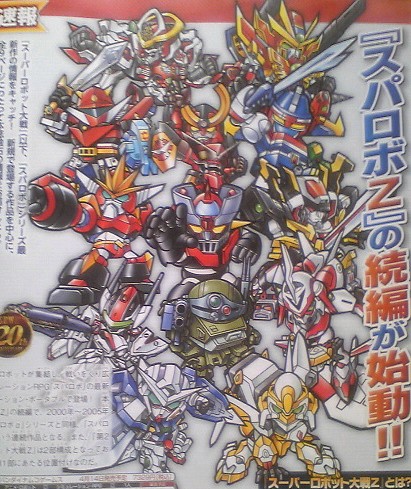
In very exciting news, Super Robot Wars Z 2 (Part 1) has been announced. Subtitled Break the World, the game has some surprising new entries into the world of SRW, from both recent and not-so-recent anime. Before I start elaborating on my thoughts concerning the lineup, I’m showing the complete series list uses for the game.

Italics means this anime has been in SRW before but was not in SRWZ.
Bold means this anime is brand new to the SRW franchise.

Muteki Choujin Zambot 3
Muteki Koujin Daitarn 3
Muteki Robo Trider G7
Space Emperor God Sigma
Space Warrior Baldios
Rokushin Gattai Godmars
Sentou Mecha Xabungle
Armored Trooper VOTOMS
Armored Trooper VOTOMS: The Last Red Shoulder
Armored Trooper VOTOMS: Red Shoulder Document – Roots of Treachery
Armored Trooper VOTOMS: Pailsen Files
Super Dimension Century Orguss
Mobile Suit Z Gundam
Mobile Suit Gundam: Char’s Counterattack
New Mobile Report Gundam W
After War Gundam X
Turn A Gundam
Mobile Suit Gundam SEED Destiny
Mobile Suit Gundam 00 1st Season
Choujuu Kishin Dancougar
Juusou Kikou Dancougar Nova
Shin (Change!!) Getter Robo: Armageddon
Shin Mazinger Shougeki! Z Saga
Earth Defense Corp. Dai-Guard
The Big O
Overman King Gainer
Choujuushin Gravion Zwei
Genesis of Aquarion
Code Geass: Lelouch of the Rebellion
Tengen Toppa Gurren-Lagann the Movie: Gurren Saga
Macross F
Macross F the Movie: The False Songstress
Psalms of Planets Eureka Seven: good night, sleep tight, young lovers

There’s a lot to talk about here, especially with shows like Code Geass, Gundam 00, and a major curveball in the form of Dai-Guard, but probably the two newest entrants which are the biggest deals are VOTOMS and Gurren-Lagann, though for somewhat different reasons.

VOTOMS hails from early 1980s and is considered among the “realest” of real robot anime. It has a grittiness to its robots and overall setting that is rarely seen in mecha, let alone anime in general, as can be seen from my reviews of the series (though I must apologize for never actually writing my final review). For years people thought it was a shoe-in for the SRW series, but when years and years went by and VOTOMS still wasn’t included, fans started coming up with excuses. Oh, maybe the robots would be too weak and bland, or Chirico would be too strong of a pilot, or it somehow wouldn’t fit in among the earth-shattering forces that populate the roster. But as if to lay those possibilities to rest, SRWZ2 puts it into the same game as Gurren-Lagann, one the biggest example of escalating power levels and over-the-top, universe-rending attacks in a robot anime ever (which is the “problem” with Gurren-Lagann), as if to say that while all of those possible reasons may have once been valid, they’re history. Sure this first part of SRWZ2 is going to avoid having to deal with the really crazy stuff, but it’s inevitably going to have to confront the big guns of Gurren-Lagann by the next game. And it’s the movie version on top of that!

I understand that the reason this lineup works is that the plot of the game is based heavily on Orguss, which involves going to different dimensions and universes, so they can even do things like have Shin Mazinger where they once had Mazinger, and the Eureka Seven movie to replace the TV series, but that’s all right. Plot was never exactly the strong suit of the SRW games, after all, as the latest anime proves.

So to conclude, various fanboyish notes:

-Can’t wait to see Zeus in action.
-Mazinger Z is going to get not one but two crazy powerful finishers. No need for the Kaiser here!
-I wonder if Zambot, Daitarn, and Trider are going to have a Final Muteki Special. Sun, Moon, and Phoenix?
-Re: Godmars – ポゥーン
-I wonder how much Dai-Guard will cost to replace if it blows up in battle?
-I’m looking forward to the VOTOMS BGM.
-I know I’m jumping the gun and putting expectations on the next game, but Amuro vs Ribbons? Hell yes.
-Setsuna F. Seiei gives the best (worst) pep talks.
-I think movie Eureka and Fyana from VOTOMS will get along swimmingly.
-I wonder if the geass will factor into gameplay in any way, shape, or form?
-Aquarion and Shin Getter better not accidentally deface the moon too much or they’re going to make Loran Cehack sad. They’ll also make Garrod upset but for a different reason.

My Anime Regions

Born and raised in the US, having studied in Japan about 5 years ago, and currently living in the Netherlands, I consider myself quite fortunate to have been on three different continents for long periods, enough to say that I wasn’t simply a tourist. The benefits have been many, but the one that is perhaps most important to me is that I’ve gained a bit of perspective on how things work differently from country to country. As an otaku, this of course applies to my pursuit of anime and manga as well, and so I want to just talk about my own firsthand experiences in this regard.

Before I go into detail though, I think it’s important to highlight a few points about myself:

First, my English is my native language, and I have studied Japanese for a number of years and am reasonably fluent in it. I cannot read any other languages to any decent extent, and I can only understand one other when spoken.

Second, my available “access points” varied from place to place, meaning television, internet, etc. Also, I was in Japan before streaming anime became a big deal, whereas currently I am living through the age of the official streaming simulcast alongside everyone else. Well, sort of, but I’ll get into that later.

United States

Now because I’m native to the United States, I’ve seen my fair share of how anime/manga and its surrounding fandom and industry have changed over time, but as I’m not looking to make this a history lesson I’m going to mainly focus on the state of obtaining anime from about 2005-2010. In that period, whether it was in college or back home, I had cable television and high-speed internet, as well as the fortune of living in a city with Japanese book stores (or at least a Japanese grocery when it came to college). I used the TV and internet to varying degrees to satiate my desire for anime, and as my Japanese improved I was encouraged to start buying manga in Japanese as they tended to be less expensive even with import mark-up, especially if they were used books.

Even ignoring the untranslated titles, anime and manga have been quite accessible, whether it’s through downloading, Cartoon Network’s (increasingly sparse) anime line-up, or just going to the Barnes & Noble to pick up a volume of something. Companies are currently trying to increase their internet presence, with more and more titles, including older ones that are no longer available otherwise, being streamed on sites such as Hulu and Crunchyroll. The genres available were and are surprisingly diverse, particularly when it comes to manga, though they don’t cover everything Japan has to offer, just because some things simply do not sell in the US (and some titles that were released certainly did not either).

It’s important to note that anime took quite a long time to get big, and it was only really with the advent of Pokemon that it became such a big deal. While it’s come quite a long way, it’s still considered quite a “niche” thing, and a lot of works which can survive in Japan based on overall higher readership there will most likely tank in the US. Anime as “anime” is still quite young compared to the rest of the world. Anime and manga are definitely accessible in the America, it just takes a bit of effort to really sink yourself in, and although it takes a while to feel the limitations in genre, you may eventually feel it. Also remember that the US is big, and that my experience can be quite different from someone living in, say, the Midwest.

Japan

In Japan I had television but no reliable internet, and while I hear that most otaku in Japan use a Tivo, I unfortunately did not own one, which meant that I had to follow the official schedule in order to keep up. While it could be trying at times, there was a certain thrill in planning my days around the TV broadcasts. The fact that Futari wa Pretty Cure Max Heart and Zoids: Genesis ran simultaneously on two different stations meant I had to choose, which is something that has never really been an issue with anime fandom in the US, at it was rare that two stations would be showing anime at the exact same time. I myself didn’t have to deal with this since the days when Pokemon would chase Digimon out of its time slots. If there was a show on late at night that I really wanted to catch, say, Glass Mask, I would go to sleep early so that I could wake up at 1 or 2am, watch it, and then go right back to sleep. I also remember getting home from a trip to Akihabara, pedaling hard as I could so that I wouldn’t miss the beginning of Gundam SEED Destiny. That also reminds me of when I had faith in Gundam SEED Destiny. Those were innocent times.

(By the way, I chose Pretty Cure).

Manga though, it’s hard to live in Japan and not see comics available for sale. In addition to larger bookstores and specialty shops, you could find the latest manga magazines in convenience stores, your Jumps and Sundays and such. While those stores didn’t carry everything, you could still find some surprising titles; it was through a convenience store that I found the Hulk Hogan manga. The ubiquity of manga was especially advantageous for just sheer exposure: by buying just a few magazines you could get a pretty wide range of works, from good to otherwise.

One unique advantage I had while in Japan was that I had access to the library of the school at which I was studying abroad, which meant access to their extensive collection of anime on DVD. Nowadays it’s not that hard to go online and find all these obscure titles, but back in 2005 this library’s DVD collection went well beyond what was fansubbed (and probably still does today), with series such as Zambot 3 and Tetsujin 28 in their entirety. I know I just picked two robot titles too, but trust me when I say there was more.

So when it came to anime or manga, despite my internet situation I probably had more titles available to me than I ever had before or since. The only trouble of course is that it’s all in Japanese, and while my Japanese is good I’m still not comfortable with it, let alone comfortable with it five or six years ago despite the rapid improvement that living in Japan itself caused. In any case, the main point to take away here is how easy it was to just be surrounded by the stuff.

The Netherlands

A few months ago, Irish anime podcaster Eeeper wrote this letter where he pointed out the difficulties in being a European anime fan, particularly in this current age where anime is officially streamed. Before I arrived in Europe, I could see his point and could agree, but it was only after I actually started living here that I could really feel it.

Having high-speed internet but no TV here, online is mainly how I watch things. When it comes to the streaming of anime, Europe seems to get left out pretty often. The entirety of Hulu is off-limits save for a single, terrible-looking show (not anime in case you’re wondering). Funimation’s video site automatically redirects to a generic company page. This is something I previously only really experienced when I couldn’t watch the official Japanese-only episodes of Bakemonogatari on their official site. It’s not all bad, as some shows on Crunchyroll work just fine. However, others do not, and you get these really odd situations, like how Naruto Shippuden is available for me to watch but the original Naruto is region-blocked. The fact that I just came from the US, where I recently watched all of Kekkaishi and Slayer Revolution (and Evolution-R) on Hulu, makes me very aware of this disparity. That said, internet here is quite fast and what I can watch I get in a flash.

Manga is a bit of a different situation. In terms of the internet, no official sites as far as I can tell have blocked their manga from European access. In terms of actual physical books, comic stores aren’t amazingly common in the Netherlands, but cities are generally small enough that you don’t need too many, and cities with more comic stores are only a short train ride away. Going to Amsterdam takes about half an hour, which is longer than it took me to get to Manhattan, and the selection of manga (as well as European comics) can be surprisingly extensive, usually taking the form of English-translated titles  imported from the US or Dutch-language books. One interesting thing to note is that some titles get translated into Dutch before they are translated in English, possibly owing to the fact that manga and anime have had a strong presence in Europe way before the “anime boom” ever hit the United States. In fact, a friend told me that Urasawa’s works were available in Dutch way before they were in US bookstores. It might also have to do with the proximity to Belgium, which has its own rich comics history and influences the regions around.

On that note, one big difference with the Netherlands and Europe more generally is that everything is more packed together. While traveling by train in Japan is somewhat comparable to doing so in the Netherlands, Japan is still an island, while going from where I live to Belgium, an entirely different country, is a mere 3-hour train ride. Europe also gets a good deal of titles that the US does not, but they’re mainly for people who speak French and alas neither I nor Eeeper (I assume) are capable of this feat.

Final Thoughts

So there’s a bit of my anime experience across three countries. I of course cannot speak for every anime fan who has lived in the countries I have, let alone the countries where I have never set foot, but I hope that this post helps to bring a bit of understanding to fans around the world, to see the varying circumstances that affect our fellow fans. If you want to chime in with your own experiences for any country/area that I did not cover, feel free.

欧米日

Otakon 2010: I Don’t Believe It. That’s Unbelievable.

At this point, having gone to Otakon for the past four years, I feel it safe to call myself an Otakon veteran to some degree. In terms of what to expect, this year didn’t feel that different from all the previous times I went, but a lot of things have happened to me over the past year or so, makes me think I’ll reflect back on Otakon 2010 particularly fondly.

Ogiue Maniax’s Panelist Debut

Otakon 2010, from July 30th to August 1st, was the first time that I came to the convention as a panelist. And I had two to boot!  It may have been obvious from all the posts I made about panel preparations, but I really wanted to do a good job and I really wanted people to come to the panels, so up until I finished both of them, I had been very nervous.

The mahjong panel, titled “Riichi: Japanese Mahjong, Anime, and You” was a collaboration between me and Sub over at Subatomic Brainfreeze. With a 9:30am Friday timeslot when a good portion of the con hadn’t even been registered, and a fairly obscure topic like mahjong, we were both worried that our panel attendance would amount to our friends and acquaintances, and while we would have been glad to teach them about mahjong, our real goal was to reach those people who were only barely familiar with mahjong anime. Fortunately, the turnout was better than we had ever expected, and while I am to understand that our panel room was the smallest of the bunch, we still managed to pretty much fill the whole room, getting approximately 160 people to listen to us talk about an old Chinese tile game and the way it works in Japanese cartoons.

The Riichi panel itself also went far better than we expected. Knowing how much information there was to convey despite the fact that we had already decided to cut large amounts of information, we had practiced the panel on multiple occasions, barely finishing on time. But while our practice sessions felt kind of strange and awkward, the actual panel itself had an amazing energy to it. Both Sub and I were playing to our strengths, playing off of each other, and we managed to give all of the information we wanted to while also keeping the audience entertained. We even finished early and had a good amount of time for questions! From this experience, I have learned that Sub and I make a good paneling team and I look forward to the next opportunity we have to do a panel together.

By the way, for those of you who were at the mahjong panel but were unable to copy down the URL for the additional mahjong resources, here it is.

My second panel was also on Friday, but at the opposite end of the day at 11pm. Entitled “Portrait of a Fujoshi: The Psychology of Ogiue Chika,” this joint effort between myself and Viga the Otagal was in many ways a culmination of what I had been doing on this blog. Last year, Viga challenged me to do a panel all about Ogiue, and that’s how we ended up on stage.

I understoood well that even if a good portion of the convention was into yaoi and Hetalia and the like that they would not be interested in deep character analysis, so while the panel attendance wasn’t as high as it was for the mahjong panel, it was still quite impressive, and once again we managed to play off the energy of the audience and each other and give a good presentation, with me giving a more subdued approach. Also, once again, where practice netted us a panel that had about 10 minutes worth of Q&A, the actual thing gave us three times the amount. While I wish we had prepared more, I think we did a good job of expressing what makes Ogiue such a great character and why we connect so well to her (and why you should too!).

When I think about it, doing a panel on a single character is unusually rare at an anime con. You have panels about Evangelion, but never is it a panel specifically about Ayanami Rei. I hope we can start a trend at anime cons, as I think it’s a worthwhile way of running things.

I don’t know if any video recordings are available so I apologize for those of you who were unable to attend but wanted to see them. I also want to say thank you, thank you from the bottom of my heart, to all of you who attended my panels. I hope you enjoyed them.

Now having panels at both extremes of the day has its drawbacks, but it also had the great benefit of avoiding conflict with the majority of events, thus freeing up the rest of the con for me. As is the case with every year, my primary mode of entertainment at Otakon is the panels, both industry and fan. Fortunately or unfortunately however, I found that there was still too many entertaining things crammed into a single weekend and I still had to sacrifice one panel for another.

Industry Panels

In terms of guests, I was not looking forward particularly to any of them this year, but I’m glad I attended the Q&A’s that I did as all of them provided incredible insight into the industry, with Mitsuya Yuji’s panel perhaps being the most informative of all. Attending his Friday panel, the voice acting veteran told us how voice acting became a “profession” rather than a side job for dramatic actors and how voice acting should come from the entire body and not just the voice. He also talked about how in the old days, if you flubbed a line, rewinding the film reel and readjusting everything was a huge pain, so mistakes were a big deal.

Throughout the panel, Mitsuya showed us what it was to truly be a voice actor, from passionate yells (he delivered a passionate “CHOUDENJI SPIIIIIIN” on more than one occasion) to voice changes to even the change in jobs given to you as you age and can no longer be the handsome male lead. Also, seeing as his debut voice acting role was as Hyouma, the main character of Combattler V, I asked him the question I had asked of Macross director Ishiguro and Gundam creator Tomino: What were your experiences with legendary anime director Nagahama Tadao?

Mitsuya gave us the impression that Nagahama was an incredibly passionate man. Gentle and understanding, he took his role as director very seriously and pushed Mitsuya to improve his performance. Mitsuya had originally tried out for both the lead Hyouma and the rival Garuda, and Nagahama made him redo his Garuda takes ten times. When asked if this was typical of a mere audition, everyone said that this was highly unusual. Mitsuya would later find out that all of this, from the audition to the strict voice sessions, were all signs of the fact that Nagahama had seen the amazing potential Mitsuya had and wished to nurture it into something greater.

Maruyama Masao was back again this year. The head producer over at Studio Madhouse, in my opinion the best anime studio there is, Maruyama is a staple of Otakon, but despite the fact that he comes pretty much every year, I look forward to it every time. This year we finally learned that Redline, the series he had been working on for six years which he also mentioned at numerous past Otakons, is finally getting a theatrical release in October, though its director also passed away before it could debut. Redline is  high-intensity anime, resembling the most elaborate portrayal of F-Zero ever, and Maruyama claims it will be the last truly hand-drawn anime ever.

Otakon was also the American debut of Welcome to THE SPACE SHOW, a feature-length film from the animation team which brought us Read or Die and Kamichu. As such, the creators were also there at Otakon, and managed to have an informative Q&A session. I gave a question targeting mainly Ishihama, the character designer, asking if he felt there is a trend in anime films to move towards simpler character designs which lend themselves towards looser and more whimsical animation. Ishihama responded that he believed there is indeed such a trend, but that there is also a counter-trend present, where more detailed, less fluid animations are also becoming popular.

As for Welcome to THE SPACE SHOW itself, the movie is quite fun but is too unfocused. The story of kids who travel into outer space in a way reminiscent of Galaxy Express 999, the film had opened up many good directions the story could have gone but ended not taking very many of them and losing a good deal of its potential. The film also dragged on after a while in a way where even the expertly animated sequences and wonderful set of aliens felt less exciting overall. At the Q&A session, we learned that this was the team’s first feature-length work, and in hindsight it really showed.

The only American industry panel I ended up attending was the Vertical Inc. panel with Ed Chavez and Peepo Choo author Felipe Smith. Ed, responsible for all of those Vertical Vednesdays I keep talking about on the blog, is about the most personable marketing guy in manga. While giving hints at interesting new titles coming in the future (including another Tezuka title), he also showed that he has some strong opinions on manga, stating that Vertical would not license Yokohama Kaidashi Kikou because “I don’t like it.”

Fan Panels

I had a lot of fun with the fan panels I attended, which mainly focused on exploring elements of anime and manga but I also attended some fun ones too. In the “elements” category there were three panels:  “You Don’t Like Moe and Here’s Why,” “The Changing Faces of Anime,” and “The Life and Times of Akiyuki Shinbo.” In the “fun” category, there was Anime World Order‘s “10 11 Anime You’ve Never Heard of But Must See,” the “Mecha Fan Panel,” and Megaman in Anime and Manga.”

The moe panel focused on the concept as a phenomenon and the meanings it gains as it has become a part of the industry itelf. It took a while to get off the ground but eventually found its footing, and the best advice I can give to the panelists is that more can be done to bridge the gap between what they are talking about and what the audience understands.

The Changing Faces of Anime panel, run by Evan Minto of Ani-Gamers, was a literal look at faces in anime, discussing changes in character designs over the years. It was a good panel which generated even better discussion, and it’s a difficult topic to tackle in only an hour.

The Shinbo panel, presented by wildarmsheero, showed that he had clearly done his research on the eccentric director and took a look at all the stylistic elements Shinbo loves to employ in his works. It ran a big long, forcing the Q&A session to be cut.

The “Must-See Anime” panel was very entertaining, though it was focused less on recommending good shows to anime fans and more about showing amazingly obscure anime that were difficult to obtain and had a lot of excitement value (but could still be good shows). I know that I’m going to track down Natsuki Crisis and other titles. Also, while obviously the clips themselves say a lot, it also doesn’t always convey some of the more overarching positives of a title, so more talking might be a good idea.

The Mecha Fan and Megaman panels meanwhile were fairly similar, giving the history of mecha and Megaman in Japanese graphic fiction. I won an old issue of Nintendo Power at the Megaman panel, and enjoyed the liveliness of the mecha panel, but I think that both could benefit greatly from delving even more into their topics. The Megaman panel also suffered from everyone reading from their scripts too much. It was very obvious that everyone at the panel was an expert in the field of Megamen, and I think removing the script would have made it more personable. On the other hand, it also showed the best Rockman.exe opening, so it’s all good.

Entertainment

While neither was truly the start or the end of the convention, I find that the opening ceremony and the Home Made Kazoku concert act as nice bookends to the con proper, mainly because of the positive impression Home Made Kazoku made on the audience at the former, which led to great anticipation about their performance for the latter. A hip hop-oriented Japanese group, their music and live performance was really infectious, and I think that music-wise it was a great success for Otakon this year, especially when I found out that the shamisen-playing Yoshida brothers managed to fill the concert area so tightly as to nearly be a fire hazard.

Speaking of fire hazards, the talk of the town was clearly the fire alarm Saturday Afternoon which forced all of the nearly 30,000 attendees to evacuate the Baltimore Convention Center. Given the general immaturity of the con crowd (including whoever actually pulled the fire alarm), I was pleasantly surprised to see people doing the right thing in the even of the fire: leave in a calm and orderly manner. Even the most rambunctious anime teen knows not to mess with this sort of thing, which brings a smile to my face.

Food and Friends

But going to a con isn’t just about the anime or the guests, it’s about meeting people and having a great time doing so. The con begins on Friday, but the con experience truly begins the Thursday before, from the point the bus arrives, and only really ends when we get back home. This year’s Otakon featured the return of glorious Brazilian Buffet, being amazed at the evergreen awfulness of G-Saviour while watching it in the hotel room, large gatherings with people relaxing and joking about, and amazingly deep discussions about everything anime and manga.

As I rode the bus home with my travel companions, we discussed for about four hours straight the very nature of enjoying anime and manga, as well as their qualities as creative forms of expression, and it made me realize just how much better conventions are when you add the human element to it.

I love it, and love makes Otakon better, I can guarantee you that.

The Feminine Touch to the Manly Spirit

Whenever I listen to the full version of the opening to Brave of the Sun Fighbird, a particular lyric gets my attention. Not present in the TV version, the line says, “Kanashimi o kudake, taiyou no tsubasa,” or “Crush sadness, oh wings of the sun.” The way the singer Yasuko Kamoshita emphasizes each syllable of “kanashimi o kudake” sends a jolt of excitement through me.

I think the reason why I notice it so much is because it’s a super robot theme sung by a woman. However, it’s not just because it’s a female vocalist, but because I feel like given the exact same song with the exact same fiery lyrics, male singers and female singers for super robot anime produce different results. Music’s not my strong suit, but if I had to describe the difference, it’s that the male singers tend to sound more passionate while the female singers tend to sound more heartfelt. When Kamoshita tells Fighbird to “crush sadness,” you can hear a twinge of sadness in her voice too.

You might be thinking, “But wait a second, it might just be because this is a 90s anime and at that point anime songs were changing!” And you’d be right on both points, but I think that this feeling extends back towards previous decades as well. Let’s not forget that female singers for super robot anime have been around for quite a while. I get the same impression from Horie Mitsuko’s work on Super Electromagnetic Machine Voltes V and Space Demon Daikengo, as well as MIO/MIQ’s Aura Battler Dunbine and Heavy Metal L-Gaim openings, though those two  are real robot shows so that genre shift factors in as well.

“Men and women sound different!” seems like such an obvious thing, but it really makes me aware of how the same song or piece of art can take on varying emotions once you change certain pieces.

For a fun comparison, let’s look at various openings throughout the decades featuring duets between Horie Mitsuko and anime song legend Mizuki Ichirou.

Behold, the Greener Grass Saga!

While I love anime and manga, I also like cartoons and comics the world over. I grew up with superhero comics, so even though I don’t keep up with them terribly much these days, I still like to know what’s going in them. In reading American comics blogs, it makes me aware that certain topics which garner extensive discussion and debate are hardly blips on the radar for anime and manga discussion. One topic in particular is character interpretation.

Spandex-and-cape comics, particularly the big mainstream ones from Marvel and DC, have a long history of changing writers, and so too with them comes different ideas of how the same characters should act. In time, you have notions of things like “definitive runs,” or the story or series of stories where the portrayal of a particular character ends up carrying through well after that writer has left. Examples include Alan Moore’s Swamp Thing, where a B-level character whose power was basically vegetation-based was revealed to have been an “Earth Elemental” all along, or Frank Miller’s Daredevil, which gave the blind superhero’s stories more gritty realism as he fought the mobster dregs of New York City. As time goes on, a character’s chances of getting more definitive portrayals increases. With a longstanding character like the Joker, the wild variation from comic slapstick villain to utterly mad mass murder can seem almost schizophrenic. Appropriate in a way for someone like the Joker, but perhaps less so for others.

Fans can discuss which is the best, most true face for the character. Others can argue that all of the portrayals are authentic, and that the character is an iconic concept to be interpreted by the creators. It’s just the kind of talk that doesn’t have very much opportunity to occur in manga given the difference in history between it and superhero comics. The closest thing anime and manga have to discussions of continuity and portrayal is probably Mobile Suit Gundam. Granted, it’s pretty close, especially with something like Turn A Gundam, a series which takes the idea of all portrayals of Gundam being “true” Gundams and turns it into a cohesive story. But sometimes I look over and think, “I wonder what manga discussion would be like with more of that.”

Then I look at all the downsides of continuity and retcons and the arguments that come with it, and I’m pretty okay with where anime and manga are. It’s a fair trade-off, I think, and I’d rather have the comics of the world be more different than the same.