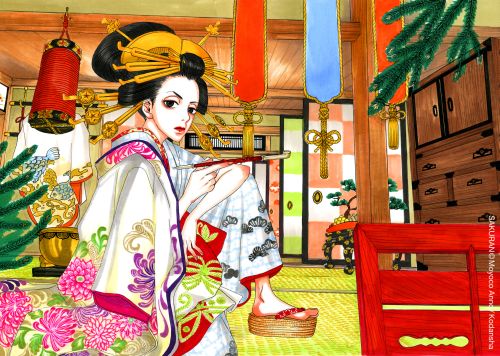
Ogi 3, Gooooooo!!!

Today marks the 3-year anniversary of Ogiue Maniax. Looking back at all that’s happened to me and this blog since last November, it almost doesn’t feel real.

These days, I generally update Ogiue Maniax twice a week, but for over two years I posted daily. It was a signature of sorts for this blog, and I was dedicated to constantly thinking of new areas to explore, questions to ask, and bad jokes to tell. I was fairly proud of keeping up this pace, and swore to myself that only the most drastic circumstances could possibly derail me from my schedule. Even when I was working seven days a week, I still maintained it. But as I sit here in the Netherlands, a country I’ve never visited previously on a continent I had never set foot on, knowing that my purpose here is to focus my passion for anime and manga and penchant for analysis into a doctoral thesis, I know that life answered my challenge. Or perhaps it might be better to say that I challenged life. I hope you’re still enjoying this newer, slimmer Ogiue Maniax.

So if it weren’t for that big change, the most significant blog-related event would have definitely been the revival of Genshiken. It was December when I found out about the one-shot sequel known as Genshiken Chapter 56. Wanting to share it, I spent my Christmas Eve translating it so that all could enjoy one last Genshiken hurrah, not realizing that there would be another follow-up months later. With Genshiken 56 appearing last December and Genshiken II having started in October, the series almost acts as a bookend for year 3 of Ogiue Maniax. It’s more Genshiken than I could have possibly asked for. Not that I’m complaining, of course.

Then there were the panels at Otakon, my trips to play real mahjong with real people, and so many other things. It’s been exciting times, to say the least.

Really though, I am grateful for everyone who’s read Ogiue Maniax, whether you’ve commented or not. I simply can’t take that for granted, and if I do then something must be terribly wrong. Although I’m far away from my friends, my family, and those I cherish most, I still take great joy in being able encourage others to take a closer look at the anime they love and to deepen that passion a little bit more.

From the moment I found out I was moving to when I arrived here, I had this constant feeling that my life was entering a new stage. But when I think about it, my life’s been moving forward for a while now, and I have you to thank.

Used that Mangekyou One Too Many Times

I recently had a conversation with OGT where he mentioned his participation at the University of Kentucky’s annual Asia Art Festival. There, he participated in a panel on anime and all that good stuff. But after the panel, an interesting conversation occurred. I’ll let OGT speak for himself.

…I chatted a bit more with the panelists (one a soon-to-graduate senior, the other a freshman) and the topic somehow swerved to the manga industry, its travails, and its push to make a market for more esoteric, alternative manga (which for all intents and purposes mostly means “not BESM-standard”).

After hearing this, the freshman subsequently asked “So, like, are they trying to make it cool to read print manga?”

What?

It turns out that in the guy’s high school, reading manga in book form meant you were at a disadvantage, not only in terms of keeping up with the story but also socially. One possible explanation for this is the fact that scanlations are of course quicker and, high school being what it is, no one wants to discuss something which has already passed its expiration date for trendiness, be it Bleach or the Super Bowl.

But regardless of the why, I must reiterate my (and OGT’s) feelings on the matter: What?

The more I think about that person’s statement though, the more I feel it to be a revelation!  It’s like through all of the discussions and debates out there on how to get people to buy manga, as well as all of the talk directed towards making people aware of piracy, we all forgot the fact that teenagers are teenagers, and the choice to read an online version of their favorite comic can be as simple as whether or not it would be acceptable by their friends and fellow manga fans. Knowing this, I can’t help but think, “How blind we all are!”

As someone who was once ages 13 through 18, I know that not every decision a person that age makes is the product of group pressure, and that a teenager can even defy that pressure, but I know that it is still a very powerful, perhaps even overwhelming force. And despite what they themselves might think, keeping up with what’s “cool” can affect nerds, especially when it’s due to the judgment values of their fellow dorks. Sure, this feeling can definitely be exploited for marketing purposes—there are industries built entirely around doing so—but all of the logic and strategy in the world can’t always account for the fickle, volatile psyche of the teenager.

So in conclusion, I feel old. You should too.

People Who Play to Prove Something Cause Damage to Those Switching Out

While I have had many friends over the years who were quite fond of Magic: The Gathering, for one reason or another I never quite got into it. So when I began reading about the different player types in Magic as defined by the cards’ creators, I found it so fascinating in a way that I kind of wish I had gotten into the game more. But while I do not have familiarity with Magic, I have thrown many hours into the Pokemon series, and I thought about whether or not I’d be able to determine by player type based on my experience there.

According to Mark Rosewater, the architect behind the current card creation system, players of Magic fall into one of three categories: Timmy, who “wants to experience something,” Johnny, who “wants to express something,” and Spike, who “plays to prove something.” More details can be found here. I’ve found myself unable to quite determine where I fall in the spectrum, but perhaps if I explain how I feel about one aspect of the Pokemon, maybe you can help me out.

The second generation of Pokemon games introduced an attack called “Hidden Power.” Story-wise, it was supposed to be a mysterious strength lurking deep within your Pokemon which allowed it to attack with a type element that it normally would not able to. On a technical level, it was an attack ranging in power from weak to medium strength that could be any one of the 17 Pokemon types in the game depending on your individual Pokemon’s inherent statistics. At first it came across as a move you were “lucky” to get, but its meaning and purpose changed in the context of high-level competition, where it could be manipulated to give you exactly the type and strength you wanted. Combined with the fact that nearly every Pokemon could learn it, Hidden Power became a wild card of sorts, customizable just like everything else in the game.

I did not like Hidden Power then, and even though its capacity has been a little more limited since Diamond and Pearl and the re-categorization of “physical” and “special” attacks where the move only becomes useful to “Special Attackers,” I still do not like it. As a person who really enjoys creating Pokemon teams using Pokemon that are not the cream of the crop and trying to figure out different ways to make them work even when they’re at a distinct disadvantage, the way Hidden Power has been continuously used as a near-automatic suggestion to fill a Pokemon’s move slot has always bothered me. Need your Hypno to fight a Swampert? Just give it Hidden Power Grass. Ground types giving your Jolteon trouble? Hidden Power Ice is your answer. Rather than encouraging players to really sit down and think about how a Pokemon could make the most out of its limitations, Hidden Power became a band-aid that could be applied to just about anything, the chainsaw applied to the proverbial hedge maze which just encourages laziness. While I don’t necessarily fault anyone for using the move (why ignore it if it’s there?), I would rather it never existed in the first place.

I am well aware of the counter-argument that Hidden Power is a boon to these lesser Pokemon of which I’m so fond, as it gives them diversity and the ability to compete where without it they would just have no other choice. After all, why should Dragonite get Ice, Electric, Fire, and Water attacks but not Pidgeot? I understand that side well, but I just wish the solution wasn’t as simple and widespread as Hidden Power. With Hidden Power, there’s so much less challenge in trying to get a Pokemon to work that it takes some of my enjoyment out of team-building, because I can’t just ignore that it exists because it’d inevitably be used against me.

So what do you think? I get the feeling I’m not really all that Spike, and I know hybrids can exist, but I’m not too sure where I fall between Timmy and Johnny.

As an aside, I’m quite pumped that Mewtwo finally gets its own signature attack. I’ve been hoping for this since forever because previously Mewtwo’s only distinguishing trait was that it was “really good.”

G…lee…COOOOOOOO

When it comes to the musical arts, I have to admit that I am quite lacking. I’m a novice in regards to musical theatre, and I am far from knowledgeable about popular music from my own era, let alone from decades prior. So it might seem unusual that I consider myself among the many who enjoy Glee, a show about a high school glee club populated by misfits which combines both of those elements and adds a large dose of teen drama to boot. But not only is Glee fun, it appeals to me on both artistic and intellectual levels as well.

The vast majority of fictional TV shows and films attempt to mimic reality. This does not necessarily mean that they are realistic or that they could be confused for anything but fiction, but that they attempt to create a simulacrum of the real world to facilitate their audiences’ suspension of disbelief, whether it’s Law & Order, The Expendables, or The Andy Griffith Show. Glee is different. Whereas most other shows want you to ignore their existence as “television programs,” Glee revels in the fact that it is fiction first, a portrayal of high school second. The method of characterization, the cinematography, the storylines, the acting, and, yes, even the music, all work together to create an experience where the viewer can practically see the strings and enjoy it for that reason. Its candor is something I can really appreciate, and when watching it I can feel myself picking up on the clever elements of its production while also engaging its story and characters.

Going back to how Glee fosters its self-image as fiction, I want to highlight how characterization is handled in particular. Let’s take Rachel Berry, the talented singer so driven by the pursuit of perfection that she can be incredibly abrasive even to the few friends that she has. In one episode, you learn that she is so constantly focused that she wakes up early every morning to the tune of Matthew Wilder’s “Break My Stride” and jumps on an elliptical for half an hour while staring at a self-made motivational note. Here, you can see how the show really exaggerates her personality traits almost to the point of tangibility. Other good examples include Sue Silvester, the cheerleading coach so Social-Darwinist in her beliefs and so ruthless in her methods that she practically comes across as a supervillain, Emma Pillsbury, the attractive guidance counselor whose neurotic obsession with cleanliness leaves her incapable of eating her own lunch without wearing gloves, and Kurt Hummel, a male soprano so accustomed to being bullied that he can plan his day around it and still remain outspoken. However, while these aspects make up a good portion of their characters, it doesn’t dominate their portrayals. They’re still allowed to grow and develop over the course of the series, and maybe learn an important lesson or two along the way.

If anything, the characterization in Glee reminds me of how many anime and manga approaches characters. There is a similar sense of over-the-top portrayals that are still able to create strong emotional connections and give room for genuine character growth that you might see in 70s sports shoujo (Aim for the Ace!, Swan) or the works of Imagawa Yasuhiro (G Gundam, Giant Robo: The Day the Earth Stood Still). In fact, I think that if someone were to adapt Glee into an anime, they would barely have to change a thing, and I mean that in the best way possible.

So despite the fact that I can’t recognize songs 9 out of 10 times unless they’re anime-related, I can recommend Glee. Well, at least the first season. I’ve yet to experience the second.

Source

One Inch Hunch

In episode 35 of Ojamajo Doremi, Doremi is auditioning for a role in a film and is asked to pantomime eating a steak, a la Maya from Glass Mask. Before beginning Doremi asks whether or not the imaginary steak is a cheaper, supermarket steak or a high-quality restaurant steak as pictured above. Upon seeing it for the first time, my initial thought was, “TWO-INCH STEAK? THAT’S HUGE!”

But of course that’s not a two-inch steak at all. It’s two centimeters, and just by virtue of growing up in the United States I naturally assumed that the ruler would be an imperial one when given no other point of reference. And it goes without saying that I didn’t bother noticing that each unit of measurement was broken up into 10 sections instead of 8.

It’s really simple and also kind of silly, but it makes me really aware of how my environment has affected me on a variety of levels. In fact, lately I’ve been trying to avoid making too many assumptions based on prior knowledge, even going so far as to read a Japanese language book about American comics to see what might not necessarily be “obvious” to someone who didn’t grow up with a non-robot-driving Spider-Man.

If I can keep learning, then it’s all for the best.

Shudou Takeshi, Pokemon, and Me

*NOTE: Turns out some of the information I have in this post is inaccurate. Check the comments below for the correct information!

Shudou Takeshi, anime writer, has passed away at age 61. To fans of magical girl anime, he may be best known as the writer for Fairy Princess Minky Momo, and giant robot fans may associate him with his work on series such as Sengoku Majin Goshogun, but as for me and for millions of others all over the world, our first true exposure to Shudou was through his work on the Pokemon anime. Pokemon is undoubtedly one of the most successful anime series of all time, having penetrated popular culture down to its core along with the games on which it’s based, and while a good portion of its success can no doubt be contributed to effective marketing, underneath it all you will find a surprisingly engrossing story that can attract people of all ages, particularly in the beginning. It is Shudou’s work on those early seasons of Pokemon that helped to give it so much character and memorability.

Pokemon wasn’t always considered the evergreen franchise that it is today, and Shudou’s writing on Pokemon in those early days reflects that. Let’s go back to the very first Pokemon series, to the time when it was just 151 Pokemon; if you were to ask someone who watched the series avidly during this time to list their most memorable moments with the show, what would they say? Most likely, they would recount moments such as Pikachu defeating an Onix by activating ceiling sprinklers, Team Rocket giving their famous speech for the first time, a Bellsprout with expertise in martial arts overwhelming opponents many times its size, and a mysterious and absolutely menacing Pokemon in cybernetic armor asserting total domination over Gary Oak. What these events and many others have in common is that they not only broke the rigid logic of the Pokemon games but also created rules where there were none.

Before the games told us that Pokemon lay eggs and that Rhydon’s horn can act as a lightning rod, the anime gave us a story about how Ash’s Butterfree had to leave to find a mate and showed us that Rhydon’s invulnerability to electricity could be bypassed by attacking it through the horn. Before female main characters were an option, the anime saw fit to turn a water-loving boss character into a supporting cast member. Unorthodox creativity characterized those early seasons of Pokemon under Shudou, and while it meant that kids who believed the show’s every word tended to do poorly when playing against their friends on their Game Boys, on a storytelling level it was a complete boon. I believe that it is this dedication and relative freedom that Shudou and his fellow staffers were able to exercise is that enabled the anime to capture the imaginations of people everywhere and bring them into the Pokemon franchise. They wanted, above all else, to tell a good story.

Nowhere is this desire to entertain and inform more evident than in the very first Pokemon film. Placing Ash, Pikachu, and their companions against the formidable armored Pokemon which so soundly defeated Gary, Mewtwo Strikes Back on its surface seemed like it would be the story of Ash taking on a villain and coming out victorious, but it turned out to be far more profound than perhaps anyone anticipated. Watching the movie through a VHS fansub, I was introduced to Mewtwo, a cloned Pokemon genetically engineered to be the ultimate fighting machine. Having come into the world fully grown and told of its purpose as a living weapon, Mewtwo first destroys its creators and eventually sets out to show that clones are inherently better than their natural counterparts, or at least that’s the initial story. While perhaps even Mewtwo believes that its own goal is telling the world about the superiority of genetic enhancement, in actuality Mewtwo’s true desire is to find worth in its own existence. Ultimately, the important message to take from the film is as follows: the circumstances of why you’re in this world don’t matter nearly as much as the fact that you’re alive and have the right to keep on living.

As the man responsible for the story of Mewtwo Strikes Back, Shudou Takeshi gave us an amazingly complex antagonist in Mewtwo, by far the most well-developed character in Pokemon to date, as well as an amazingly intelligent children’s movie, and his only cues from the original games were that Mewtwo was an offspring of a Pokemon named Mew, that Mewtwo destroyed a lab and escaped, and that Mewtwo is designed to be the strongest Pokemon ever. The manner in which Shudou was able to weave these simple story elements together into an existential tale of a being cursed with incredible power is nothing short of amazing, and it is this very reason that I consider Mewtwo Strikes Back to be the best movie of the franchise, with or without nostalgia. This is also why I was so disappointed at the English release of the film back in 1999 and still am today, as it almost completely whitewashed the actual message of the movie, replaced it with a thematically inappropriate “fighting is wrong” moral. But even with such a compromised story, the light of Shudou’s script is able to shine through, at least a little.

Pokemon was and is one of my first great obsessions, and I cannot understate how beneficial my time with Pokemon has been. I have made lifelong friendships through it. I have interacted with fellow fans about it, and through those interactions established the roots of both my writing style and my approach towards anime as an artform. Without those early seasons of Pokemon, I would not be who I am today. Thank you, Shudou Takeshi. You have made my life.

Seeing Manga for What It is

New York Anime Festival, much like the teenagers who attend it, is a fairly young convention especially when compared to other cons. This year saw it merged with its sister convention, the New York Comic Con, and while I did not attend, a number of reports have stated how the Comic Con side so dominated the Jacob Javits convention center that the Anime Festival became relegated to what has now been commonly referred to as the “anime ghetto.” There is no word as to why the ghetto formed, or whether the sharp delineation between comics (and everything else) and anime was a sign of disrespect towards anime fans, but regardless of intent, it is quite clear that things were Different. Dave over at Colony Drop writes:

Far from the exhibition floor, there was an invisible line in the Javits Center that weekend: one that denoted where the comic con ended and where the anime con began. I marked this line down in my mind late in the first day, when I stopped to make a phone call and saw my first pack of running, screaming Hetalia cosplayers. This display was immediately followed by a creepy girl who was going around the hallway alone and serially glomping any character she recognized. It had taken me all day to get there— NYCC offered me more as a gamer than NYAF offered me as an anime fan— but there was no mistaking that I was now in Anime Country.

That invisible line that Dave mentions is largely social; all the con did was greatly exaggerate it through the structure of the convention center itself. Anime fans want to be seen as anime fans. They want to be different and special. Others are glad to oblige, doing so by expressing their disdain for “those damn anime kids.” In either case, a division is formed, between “anime and manga” and “not-anime-and-manga.” Meanwhile, others are quick to step in and give the message that “it’s all just cartoons and comics anyway.”

The trouble with both the acknowledgment and disapproval of such categorizations is that each side has its own fair share of pitfalls. By regarding manga as special (and from here on out I’ll be sticking to manga for the sake of convenience), supporters can end up tying it down, obscuring (or even willfully ignoring) the fact that one of manga’s real strengths is its sheer diversity in style, content, and tone. Instances of this can be seen in the way that early iterations of the Morning International Comics Competition (back when it was called the Morning International Manga Competition) were less aesthetically diverse than the more recent ones. This is further compounded when its detractors regard manga as being narrowly defined by negative traits. And yet, while it is in no way disrespectful to refer to manga as “comics,” doing so becomes problematic when the traits that have developed as the result of a unique comics history are intentionally brushed aside for the sake of generalizations. A person who regards manga as being no different from other comics inadvertently disregards the histories of comics cultures the world over.

One mistake people commonly make when they talk about what separates one form of comics from another is that they start at the visuals first. Some never get beyond the surface, and they define a form of comics entirely by the look of characters and details. Others can look beyond the first layer and delve deeper, finding meaning behind those images. Now taking the top-down approach is actually perfectly valid, but it only provides half of the total picture. By also taking a bottom-up approach, you can begin to see how the various non-visual contents of stories in comics manifest themselves on the pictorial level. It is good to not only see how the river-like flow of panels in manga affects storytelling for instance, but also how the storytelling can influence the panel structure in manga. From there, you can really begin to see what makes manga special, and at the same time discover its connections with the greater category of “comics.”

It can seem like a complete contradiction to say that manga should be seen as both unique and like all other comics, but that’s only the case if you define it in black and white terms. Look carefully, and you’ll see that the actual lines which separate manga from other forms of comics are actually quite nebulous. Rather than having manga’s identity be frozen in time, forever unwavering and unchanging, it is important to see manga as the result of decisions made over the years, trends that ebb and flow, and the combined efforts of people who dared to pick up a pencil and merge words with images in sequential format. Even as comics creators increasingly take notes from their peers two continents away and the divisions begin to crumble, they do not automatically wipe out what has come before. Just the same however, manga is not beholden to its past, and can grow in unpredicted ways. The past provides a foundation for the unseen future.

“Hey, Your Sister’s Pretty Cute,” He Said

Ore no Imouto ga Konna ni Kawaii Wake ga Nai, literally “My Little Sister Can’t Possibly Be This Cute,” is a Fall 2010 anime based on a light novel by the same name. Known as Oreimo for short, the series follows an “average” high schooler, Kyousuke, and his hardcore otaku of a younger sister, Kirino. Though only two episodes are out as of this writing, the show quickly explains the unwieldy title of the show by pointing out that “This Cute” basically means “like the loyal and affectionate little sister character you’d find in a moe anime or a visual novel.”

However, while the series emphasizes how Kirino is not “This Cute,” Kirino is shown to be so objectively good-looking that she works as a clothing model. Kyousuke expressing how he cannot see Kirino and her disrespectful, overachieving attitude as anything resembling adorability is akin to a man going into a crowd and loudly proclaiming his absolute hatred for chocolate. Even if he were telling the truth, an outburst like that would still make everyone think of chocolate.

The degree to which Kyousuke and the show itself remind the viewer that he is as far from a sister complex as possible reminds me of a certain situation in fanfiction, where an author notorious for creating Mary Sues, impossibly perfect characters often used as wish-fulfillment for the writer, tries to prove that they are capable of doing otherwise by creating extremely flawed characters. Ultimately though, these “Reverse Mary Sues” are just that: the tails to the Mary Sue’s heads, equally as “special” in terms of how much attention is given to them, even if it’s just about how imperfect they are.

Does that describe Kirino? Well, the easy assumption would be that Kirino exists on one side of the coin while the standard “moe little sister” resides on the other, but that wouldn’t be quite accurate. Kirino is not simply the opposite extreme, but more of a moe little sister character who also incorporates elements from the more established little sister archetype of smart-alec brat seen in American shows such as Boy Meets World and Full House and perhaps best exemplified in anime by Pop, the younger sister of the titular Ojamajo Doremi. Kirino, who nonchalantly disrespects her older brother, complains about a lack of privacy, and also expresses vocal disgust at the idea of a sibling romance, has those bratty qualities juxtaposed with the amount of time and effort the show devotes to putting Kirino’s cuteness on display.

By establishing Kirino as being not-cute-but-actually-really-cute, as well as giving her qualities closer to a more antagonistic and thus arguably more “realistic” younger sister, it begs the question of whether or not Oreimo is trying to diversify the concept of the moe “little sister” by incorporating those bratty elements, perhaps in response to any possible growing weariness with established and rigid moe tropes. In other words, could Oreimo be an attempt at reconfiguring moe from within, and if so, is that a sign of the times? Assuming these to be true, it would not be Kirino herself who equates to the Anti-Sue, but rather the genesis of Kirino as a new type of little sister bearing similarities to the initial motivation by which the Anti-Sue is formed, though handled with more skill and professionalism than your stereotypical fanfiction.

Further complicating the whole matter is the fact that Kirino herself is an otaku fanatically devoted to the “little sister” type who, instead of envisioning herself as the little sister yearning for the affections of her older brother, sees herself in the role of that fictional older brother. Moreover, Kirino is actually embarrassed about her hobby and is a closet otaku. When these aspects of Kirino are taken into account alongside Kyousuke and the degree to which he expresses his disinterest in little sisters both “real” and “fictional,” Kirino’s existence as an “attractive girl” actually takes priority over her existence as a “little sister” in certain respects. In particular, by making her the “otaku” and making Kyousuke the “normal one,” the (male) otaku watching may find themselves relating more closely to Kirino than her older brother, despite gender differences. That’s not to say that she is the viewer surrogate, of course, as Kirino is still very much designed to be the object of desire for the audience.

Essentially, Kirino’s charm starts to become that of a cute girl who is also someone’s younger sister, something is much more applicable to the real world than the typical visual novel archetype, seeing as how many females out there are younger sisters to someone. At the same time however, the trappings of Oreimo, namely the frequent and prominent use of the term “little sister,” also bring that fandom/fetish to the forefront of the viewer’s consciousness. Oreimo thus occupies a sort of contradictory space, where it appears to both reinforce and subvert little sister moe by being a variation on the established formula which also goes about reminding the viewer of that original formula. In doing so, the series then casts into question, perhaps unintentionally, the nature of the “little sister” character itself, as well as whether or not someone can enjoy a character who falls into a moe archetype without being specifically catered to by that archetype’s inherent qualities. Given such a contradiction, I have to wonder, is the overt “little sister” aspect of Oreimo a boon or a detriment? Or to put it another way, would Oreimo be better off if it weren’t about a little sister at all?

That all said, it’s only been two episodes. I’ll have to ask again at a later date.

The Cross-Cultural Exchange of a Couple of G’s

In 1996, Russian-American animator Genndy Tartakovsky premiered Dexter’s Laboratory and pioneered the thick-lined,”flatter” animation style. This style can also be seen in Samurai Jack and Star Wars: Clone Wars, as well as in Powerpuff Girls, where Genndy was director.

Flash back a few month to 1995 and we get one of most the influential anime ever, Studio Gainax’s Neon Genesis Evangelion. Gainax, known for a variety of works from various genres, are especially fondly remembered for their giant robot fare, most notably Evangelion but also Aim for the Top! and Tengen Toppa Gurren-Lagann.

Now, in late 2010: Gainax’s latest anime is a tongue-in-cheek cartoon about a pair of misfits and heavily utilizes thick outlines and very flat character designs, while Genndy Tartakovsky’s newest show is an honest, non-parody attempt at a super robot-themed series. Both series’ debuts occurred less than three weeks apart from each other.

While the relationship between Japan and America’s cartoons and comics have been put in the spotlight recently with collaborations such as the joint Iron Man and Wolverine projects involving Marvel and Studio Madhouse, the fact that Genndy Tartakovsky’s Sym-Bionic Titan and Gainax’s Panty & Stocking with Garterbelt have come into existence so close to one another puts an even greater focus on the two nations’ cartoons. Here in one cross-section of time, we can see the active/passive exchange of ideas as these cultures’ animation styles appear to intertwine so tightly that they sling each other across the Pacific Ocean.

Neither show is so like the animated series of the others’ country that they come off as weak imitations. Sym-Bionic Titan takes fusing robots, a fight against a powerful invading force, and various other giant robot tropes, mixes them in with Genndy’s own character aesthetics, and places the story firmly within America and its own cultural norms. Meanwhile, Panty & Stocking utilizes the visual elements and humor of early “Cartoon Cartoons” (as Cartoon Network referred to them) while also injecting very anime-esque expressions and reactions from its characters, most notably in their faces, and also ramping up the humor to more “adult” levels. The two series and their hybrid styles reinforce both the idea that creativity is not limited by national borders and that individual cultures can still maintain some of their distinctiveness when it comes to artistic output.

This is not a bad thing.

As a final aside, the personal robot used by the character Lance in Sym-Bionic Titan reminds me of the titular robot from Galaxy Gale Baxinger.

I can’t be the only one, right?

Four Concealed Triples Contain Ten Times As Many Perils

Almost a year ago, I wrote about how glad I finally was to achieve a San An Kou, or Three Concealed Triples, in mahjong. It is a hand where you manage to draw three sets of 3-of-a-kinds all on your own. When I first got the San An Kou, it felt like an eternity before I was able to achieve one. What I didn’t know was that getting its beefier older sibling would take a lot longer.

This is Suu An Kou, or Four Concealed Triples, and is highlighted in Saki episode 10, where perennial newbie Senoo Kaori mistakenly refers to it as a “Riichi Tsumo Toi Toi (All Pungs as the subs put it),”a hand which would be worth significantly less if you took her words literally. Like the Kokushi Musou and the Sho Suushi, it is a Yakuman and therefore one of the strongest hands in mahjong, possessing enough killing power to end the game in one shot. It is also significantly more powerful than the San An Kou, and to give you a basic idea of the sheer disparity, you could get six San An Kou in a single game and it still might not be worth as much as a single Suu An Kou.


Oh Kaori, this is why Sub and I made you our mascot for our mahjong panel.

Like all Yakuman, it is an exceedingly rare hand, and what I’ve begun to find interesting about Yakuman in general is that they can often be rare for entirely different reasons. While the Kokushi Musou is difficult to obtain because it is a hand that cannot be anything but a Kokushi, and the Sho Suushi similarly rare because the tiles in it are always valuable to someone at the table (and thus there is a very good chance that someone will hold onto them), the prospective Suu An Kou seeker faces yet another issue, one that I would simply call “temptation.”

Imagine that there was a 0.1% chance for you to win $1,000,000, no questions asked. So of course you take the opportunity, but as you move closer and closer to that cold million, another sign pops up:  “Go for $100,000 instead and your chances of gaining a cash prize go up to 50%!” Then another flashes in giant neon letters, “$200,000, 25% chance to win!” Similar deals continue to pop up over and over again and try as you might, you can’t seem to block them out of your mind. What should you do?

In a situation like that, I wouldn’t look down on anyone who settles for less. Hell, I would probably abandon the million myself, but that’s essentially the obstacle that stands in the path of those who seek the Four Concealed Triples. Along the way to getting that Yakuman, you are continuously enticed by hands that, while not nearly as majestic as the Suu An Kou, can still be quite good, and to ignore those hands is almost as insane as ignoring a 50% chance to get 100 grand for a 0.1% chance at a million. Here, the biggest obstacle is that you are constantly being steered away by appeals to your rationality and common sense, and when your aim is to take huge risks, that is perhaps the most dire threat of all.

Of course, the probabilities I’ve given are in no way accurate to actual mahjong, but I think they give you a fair picture of it. Call it embellishment for dramatic effect.