Wacomplex: Genshiken II, Chapter 87

First thing first, Genshiken anime info dump! it’s been confirmed that the Genshiken II (or Nidaime) anime will be starting this summer, with a different studio but with a lot of old staff. I do find it kind of funny that Genshiken can’t seem to get a consistent animation studio or anime character designer, and given the sheer variation of work that the character designer Taniguchi Junichirou has worked on, it’s hard to predict how they’ll look exactly. Also, Uesaka Sumire will be singing the opening. Next month is the voice cast reveal, so let the speculation begin!

Anyway.

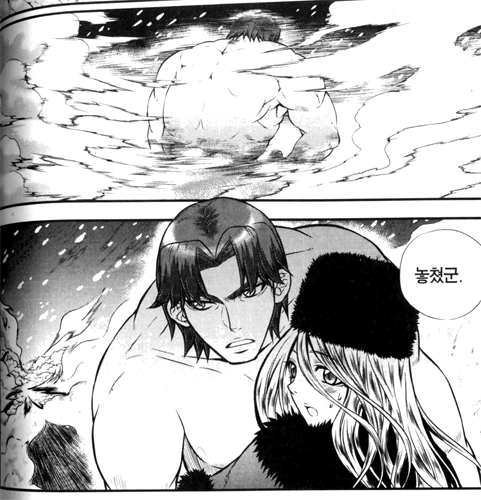
In Chapter 87, Hato continues to try to be one of the boys, but the fact that he is unable to draw properly for the sake of Ogiue’s ComiFes doujinshi when not in drag causes him to go back to it, at least in private. At the same time, Ogiue has decided to charge into the 21st century by buying a pen tablet monitor in order to save time and manpower, but the transition isn’t as simple as she hoped for. As ComiFes is drawing near, familiar faces appear as Angela makes her return to Japan and Keiko is looking to take another stab at the event.

I literally laughed out loud when I saw the pen tablet monitor. It was clearly introduced by Kio Shimoku as a metaphor for not only Hato’s current situation, but also the Genshiken club itself and even the manga as a whole. In this regard, I think it does an excellent job of representing the dimensions of a generational divide.

By showing Ogiue struggling with her tablet despite purchasing it to alleviate her work schedule, Genshiken touches upon the idea that transition can be a difficult thing because of how much we must acknowledge and rework our assumptions. The strengths and limitations of the zoom function, referenced during Ogiue’s little rant, is the perfect example. On the one hand, it lets you get up close and put detail into even the smallest part of a drawing, but on the other hand it can be stifling if one is obsessed with detail.  Ogiue’s plight somewhat mirrors the difficulty by which the manga itself has transitioned into its new cast and their very different values, not only in terms of the content of the manga, but also for a good portion of the manga’s readerbase which seems to see the new Genshiken as “not Genshiken.”

However, I think it would be a mistake to say that the ideas implied by the tablet transition are narrowly limited to Genshiken as a topic, as I really think it goes beyond this one manga. What really adds to the tablet metaphor is the conversation between Hato, Yajima, and Yoshitake where they mention the simple fact that, for some artists, digital drawing is all they’ve ever known.

Drafting, cleaning, paneling, for them, everything is done on the monitor, and it highlights this idea that, rather than this newer generation of artists being untrained in the old ways, that their “environment” is simply different and they have adapted to it in kind. Instead of the tablet being a facsimile of “real” drawing by mimicking pen on paper, for them the tablet is real drawing. That difference in mindset is so central to the changes between generations, whether it be music and art, dance, technology, or any other topic, and it shows how neither the old or new generation are “bad,” but that people are the product of their experiences.

I get the sense that, as the manga continues, Ogiue will continue to use the tablet, but that it will require her to adjust her current work habits to better fit it, or to make it more of a supplementary tool. In either case, if she does incorporate it, it means that her work may never be the same again. The impossibility of returning to the “old way” is also shown in the beginning of this chapter, when we see Madarame, Hato, and Kuchiki discussing anime much in the same way the club used to, with mentions of sakuga, seasons (cour), and the economic side. While definitely similar to the old Genshiken, something’s not quite right, especially in terms of how Yoshitake and Yajima appear a bit alienated by it because it’s not the atmosphere they’ve participated in and even helped to create. It feels a bit artifical and out of step with time, which also has implications in regards to Hato, who is trying to act like a “proper” male otaku.

If we look at the notion of the “proper” otaku (and perhaps even the whole debate over fake geeks), it’s kind of funny that people prescribe a certain set of behavior as “proper” for a group that has been traditionally stereotyped as behaving improperly by virtue of being otaku. I think Hato’s vain attempt to quit crossdressing and yaoi may be a sign of how ridiculous this can be, as if the manga is saying that it’s not as simple as getting rid of the girly stuff to bring back the “true” Genshiken, and that there has been a change in environment that the manga has been trying to address.

I may have gone a little too crazy with that analysis, but I honestly think that I haven’t completely or properly explained the intricacies of the tablet metaphor, though I’ll leave it as is for now. It’s been a while since we’ve had this much Ogiue in a chapter, so I’m pleased in that regard, and I’d been wondering when Angela would show up again a she’s a significant factor in the whole Madarame-Hato story. The fact that Keiko is planning to go to ComiFes out of her own free will may actually say everything about how much the world in and around Genshiken has changed.

(A bit of Ogiue Tohoku-ben inner dialogue teaching us that Ogiue is still not used to Kanto winters.)
Attack on Titan is the Mobile Suit Gundam of Shounen Fighting Manga and Anime

Attack on Titan, the manga and now anime about a world where humans live in walled cities for fear of being eaten by nigh-invulnerable giants, is an interesting and unique title in that it goes against the grain of shounen action series and their conventions, especially when it comes to heroics. In particular, I find that Attack on Titan emphasizes people as a group over individuals in a way which doesn’t really happen in other popular titles.

When it comes to shounen fighting series, especially over the past ten years or so, gigantic ensemble casts are the norm. In something like Inuyasha or even Hajime no Ippo, you have the main characters, their friends and family, rivals, enemies, enemies turned allies, and so on until they require multiple volumes of guide books to keep track of them all. It’s even more the case that titles in the shounen fighting genre will emphasize group-oriented concepts, such as friends (One Piece) or fighting for a greater cause (Saint Seiya), but ultimately it boils down to unique characters cooperating. Where Attack on Titan differs, at least initially, is that it gives you a sense of a world where individual heroics are much more ineffectual, and it is only through the massing of people that they can have any hope of surviving in their world, and a slim one at that.

The reason why I make the comparison to Mobile Suit Gundam (though I understand that the comparison is not perfect) is that Gundam is known for bucking the trend of giant robots as metal superheroes, instead positioning it as an individual war machine as part of a greater force. The Gundam is still glorified to an extent, but compared to the shows which came before it, this is much less the case.

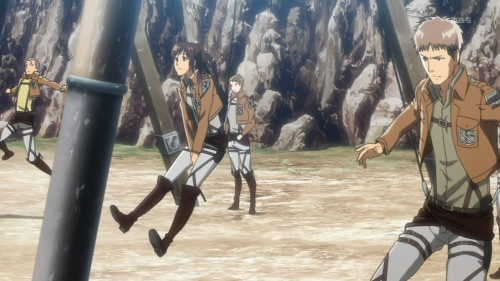
I think my point can be seen by just looking at the opening to Attack on Titan and comparing it to intros from other shounen fighting anime. Popular and long-running shounen fighting anime go through a process where their first openings emphasize a core group of characters, but as the cast expands they find it important to at least show a bit of each remotely significant characters. Whether it’s those slower-paced initial openings or the later frantic ones, though, there is still that focus on a multitude of individuals. In Attack on Titan‘s opening on the other hand, you barely get glimpses of the core cast, who are shown running and jumping from one structure to the next, almost as if the camera can’t stay on them for too long. Even Eren receives only a few brief moments centered on him, and in some of those cases he’s still seen as part of a group of fighters. The fact that the soldiers are all similarly dressed, male or female, instead of wearing unique outfits, and the fact that they all use standardized weaponry, creates a sense of them as a unified army.

That’s not to say that Attack on Titan lacks individualized or unique characters. There’s a clear protagonist in Eren, and there is a core cast of characters who are given personalities and particular skills such as sound judgment and lack of mercy. I’ve also read enough of the manga to know that there are developments which change things up significantly. However, the sense of group which Attack on Titan portrays goes beyond the typical shounen concept of such, and it lends an atmosphere which almost (but not quite) puts more attention on the military force than the people who comprise it. They swarm the titans like ants, which is about as un-shounen heroic as it gets.

On the Use of Fending Off Sexual Assault as a Way of Defining Strength in Female Characters

In the past I’ve written in an attempt to pinpoint what I find so troubling about some portrayals of “strong” female characters, especially in American superhero and fantasy comics, but despite having expressed various reasons for these impressions as such I still have never felt that the answers I’ve given were entirely adequate. It’s been an on-going process of self-questioning and observation, and the reason I’m making this post is that I’ve come to realize another issue when it comes to the representation of female strength.

It came to me while I was reading the comic Flipside, which features as its main character a sexy and strong female jester named Maytag. Throughout the first volume, Maytag is repeatedly  confronted with a similar sequence of events. Some bad men confront her, threaten her with rape or call her a bitch, and then Maytag turns their expectations upside down and defeats them (for the most part), while still emphasizing her sexuality or making some sexual innuendos.

Keep in mind that Flipside isn’t a particularly egregious example, as it suffers more (at least early on, I haven’t read further) from a lack of experience and characters overly designed as wish fulfillment, nor are anime and manga completely innocent of this. Also, the act of knocking out your would-be rapists can be empowering imagery. Instead, what I realized by seeing this two-step process over and over in such a short span of pages is that the the seeming need for sexual threats to happen in order to establish a female character as strong diminishes a story because strength winds up being defined as the ability to not get sexually assaulted. In these scenarios, the girl can’t be strong in a world which accepts the possibility of strength in a woman as a believable occurrence, only in a world which has to constantly remind her what a girl she is and how as a girl she’s liable to be attacked.

Another problem is what I would label the “straw misogynist,” or characters who are purposely set up to be extremely sexist so that they can be put in their place when the girl fights back. The way straw misogynists are used in situations like the ones I’ve been describing is that by threatening rape or sexual abuse they immediately bring attention to the sexuality of the girl target, creating this mixed message where the thrill is both in that danger but also in the sexual way the girl fights back. As a result, it ends up conveying something along the lines of, “You might not be able to overpower me sexually, but if you could oh boy would you be having fun!” And even a sexual fantasy such as that is not a problem because it’s just fantasy, but if it’s being touted as an example of how female characters can be strong, then there should be no surprise if some readers reject that notion.

This is not to deny the use of dangerous situations for women in stories, nor do I think that stories need to “ignore” gender. Instead, what I want to emphasize is how showing someone is strong is a different experience from showing someone is strong with constant and persistent caveats to that notion.

Tamako Market, the Never-Ending 12-Episode Anime

Over the course of Tamako Market‘s run I noticed that it had a mixed reception, especially among Kyoto Animation fans. I may be mistaken as to how many people really disliked it, but I’ve seen enough to want to say something about it. As for myself, I had considered it an interesting and welcome step forward for the popular studio, and wondered what could be the source of this difference in opinion. After some conversations with friends, I think I’ve figured it out.

To put it simply, for the most part the girls of Tamako Market do not have, in their presentations, visual designs, or their personalities, the sort of near-tangible qualities that have made people in the past fall in love with Kyoani characters. The girls are comparatively less “moe,” and they certainly aren’t tragic, which leaves the show with a different sort of appeal that may seem alien to fans of Kyoto Animation’s existing body of work. The main character Tamako herself is simply a smart and capable but naive girl who loves mochi and who, to a small degree, reminds me of Madoka from Rinne no Lagrange. Dera the talking bird is as far from “cutesy girl” as one can possibly get, and seems to have been particularly unpopular. The main exception seems to be the carpentry girl Kanna (pictured above, left) whose eccentric personality, to be fair, does kind of steal the show.

(I’m fond of Shiori, the girl on the right, myself).

The best way I can describe Tamako Market‘s appeal is that it’s not so much about showing off an ensemble cast consisting of various characters with easily identifiable quirks like how K-On! is, but about showing the residents of the Usagiyama shopping district as a small community of people. While many of the side characters are never really developed, they don’t really need to be, as they add to the feeling of an oxymoronic slow-paced hustle. Seeing the small developments that occur in the residents’ lives feels not so much like “slice of life,” but like a low key-yet-silly comedy.

Someone asked me what anime out there was similar to Tamako Market. After some thought, I realized the answer: Sazae-san, a popular comedy anime about a Japanese housewife and her family, and which 1969 has continued to run on Japanese TV making it the longest-running anime ever. That’s probably the furthest answer from Haruhi possible, so I think that might say it all about how Tamako Market is different, and why I think it’s the sort of show that could’ve gone on forever.

Chop Chop Chop, Judo Flip: Genshiken II, Chapter 86

Genshiken II, Chapter 86 looks to possibly be a turning point. We’ve had quite a few of those already though. Also, next month there might be more news about the upcoming anime! It’ll be a long 30 days or so.

Sue visits Hato’s place, using Janglish to ask if he likes Madarame. Hato denies, but is clearly hiding something. After a tussle pitting Hato’s judo training against Sue’s freestyle which ends in a win by submission for the American, Sue discovers Hato’s secret Mada x Hato (in drag) drawings. Hato, who is increasingly confused about his feelings for Madarame (he feels that at this rate he might actually start liking Madarame), decides to just stop crossdressing and go back to being “a normal otaku.” This clearly makes Yajima uncomfortable despite her previous objections to Hato’s crossdressing.

With this chapter, I think I finally understand one of the big overarcing themes of Genshiken II. Yes, there’s the generation gap and the otaku/fujoshi distinction, but even more fundamental to the manga is a concept I’d describe as “the complexities of personal perceptions.”

The foremost example is Hato. He is getting to the point where he likely feels something for Madarame. I want to point out, however, the fact that Hato had no problems showing his “Hato x Mada” art to Sue, declaring that it was just the realm of fiction, but for some reason he also felt it necessary to keep his “Mada x Hato” hidden. I think the distinction between the two pairings is extremely important because it indicates a denial of clear-cut narratives about sexuality in describing otaku.

“What’s fiction is fiction, and what’s real is real” is a clear and concise argument. So is “what you’re attracted to in fiction can influence your real life preferences (and vice versa).” The former argument is used by Hato, while the latter was suggested by Kaminaga. With Hato and his feeling towards Madarame, however, it might actually be the case that his yaoi delusions are separate from his real feelings, but he began developing feelings for Madarame anyway due to their growing friendship, and that this manifests as Hato x Mada vs. Mada x Hato. I wonder if this is the case just because Mada x Hato for some reason apparently has to involve Hato crossdressing, as if to say the idea does not “make sense” to him otherwise.

In anime and manga about (or including) fujoshi, often there is significant time spent explaining how important the orders of pairings are important. “It’s like saying ‘curry on rice.’ No one says ‘rice on curry!’ says a character from the 4-koma series Doroko. This is generally played for laughs while trying to introduce to the reader the “mysterious” mind of the fujoshi, to allow the reader to say, “Oh fujoshi, you’re so lovably wacky.” I think that with Genshiken, Kio is trying to discuss that mindset a little more seriously.

I predict Ogiue is going to start playing a bigger role in this, just because Hato looks like he’s trying to run away from his current situation at all costs. Ogiue is more than familiar with this situation, is aware of how much trying to deny oneself can generate a festering wound of self-loathing, and just how complicated the real/fiction distinction can get. I think, or perhaps I simply hope, that Ogiue will manage to be Hato’s mentor, like how Ohno was there for her. Also, Hato says he’s “going back” to being a normal otaku, but was he ever a normal otaku? He discovered yaoi in junior high, so it’s been with him for a long time, which makes me think that Hato is trying to simply act like how a “normal otaku” is supposed to without truly direct experience, somewhat like how Ogiue sometimes tried to approximate a “non-otaku.”

If the Hato example is a little too crazy, I think Yajima in this chapter also provides an interesting case of personal perception. Clearly the reason why Yajima blushes at the end is because she still associates male Hato with the time she accidentally saw him naked, in addition to just the fact that he’s a guy. She doesn’t react this way so much to Hato in her female guise, which means that the wig and dress is enough to “trick” Yajima psychologically so that the first thing she thinks about is Hato’s clean-shaven personal area. What Yajima thinks of Hato is of course its own puzzle having at its origin her own self-image and her lack of experience interacting with men.

I don’t know if Sue counts towards this as well, but I do find it interesting that Sue’s embarrassment over kissing Madarame has nothing to do with him and everything to do with the fact that Kasukabe saw her doing it. On some level, I feel like I can really understand that distinction. Somewhat like that famous scene in His and Her Circumstances when Miyazawa accidentally runs into Arima while out of her “perfect student” guise,” there are people you feel like you can be a fool around and people you don’t. I also continue to think that it’s kind of brave of Kio to give Sue a larger role, as semi-fluent foreigner is not the easiest thing to pull off without reverting to very basic stereotypes. Sue is many things, but “basic” isn’t one of them.

By the way, there’s something I find really impressive about Sue and Hato’s fight scene, particularly the panel where Hato drags her and sweeps the leg. It captures that one moment so incredibly well, while allowing it to transition into the next set of panels. It actually makes me want to see Kio draw an action series.

To end, I want to ask a simple question: Sue x Hato, what are your thoughts? If this were a more popular series, I’m sure that neck-licking thing would have people talking.

Why the Little Sister is an “Osaka Mama” is a Little Sister

Boku no Imouto wa “Osaka Okan”, or, My Little Sister is an “Osaka Mama” is an odd anime. Ostensibly about a younger sister who grew up in Osaka having to move back to Tokyo, this (sparsely animated) show is actually a way of showing various cultural differences between the two cities. It’s a funny little series, with the ever-changing ending theme based on the events of each episode being a highlight, but what I find especially funny about this anime is its origins.

Boku no Imouto wa Osaka Okan actually comes from a series of books designed to educate people about Osaka customs. The first book, Osaka Rules (as in “to live by,” not as in “Hulkamania”), is itself part of the Rules series for various parts of Japan. It was followed by Osaka Okan, which was designed to help people marrying into Osakan families to understand and deal with their in-laws better. What this means, then, is that the “little sister” component was added specifically for the anime, as if to try and capitalize on current otaku trends. I certainly can’t think of any other reason.

There’s something unbelievably shameless and perhaps even tongue-in-cheek about this that I can’t help but clap in admiration rather than hang my head in shame. Sure, little sister-focused stories are a dime a dozen in light novels, but what if the scope was widened in the way that Boku no Imouto wa “Osaka Okan” has shown us?

My Little Sister is a Forbes 100 CEO

My Little Sister is Doing a PhD on Molecular Biology

I Discovered My Little Sister is an Excellent Game Show Host

I Can’t Believe My Little Sister is the Catalyst for a Proletariat Uprising

The possibilities, as they say, are endless. I’m also aware that this sort of parody joke exists already, but I think the key difference is that the little sister component should appear deliberately grafted on, rather than being the axis upon which an anime revolves.


By the way, this show is from the gdgd Fairies people so you know it’s good.

On JManga’s Closure, and the Movement of People and Technology

JManga, the digital manga service backed by a number of Japanese publishers, is shutting down. No more points may be purchased, and all titles will be taken down by May 30, 2013. Any remaining points on users’ accounts will be refunded to them in the form of Amazon Gift Cards.

JManga, unlike so many other official manga sites, was at least partly accessible in regions outside of the US, and it was for this reason that I initially supported it in spite of its initial convoluted pricing scheme. Eventually, they changed the pay format to something a little more enticing and easy to understand, but when a friend told me that he wished he could purchase a title that was already on JManga, it made me realize just how unknown the site was. I tried to do my part and encourage others to use JManga, but for one reason or another it apparently wasn’t enough. It’s a shame, because I think they really made some excellent strides in getting manga to a digital format, even if their reader left something to desire in terms of functionality and ease of use.

The news of JManga’s impending demise brought up conversations about piracy and users’ rights that is affecting industries well beyond manga at this point (the Sim City server problems being currently the most prominent), and one of the arguments being made is that it’s in the end the fault of scanlations. I have a problem with this. While I don’t doubt that scanlations impact sales, especially when it comes to the popular titles, the fact is that none of the manga on JManga were heavy hitters. Their famous titles were things that simply don’t sell too well, like volume 1 of Golgo 13. I believe their most successful manga was Soredemo Machi wa Mawatteiru (some of which I purchased and am kind of miffed that it’s going to vanish in a couple of months), which to put it lightly is not a Naruto or a Sailor Moon.

The lineup at JManga was extremely esoteric, and while this had a great amount of appeal for me personally, I’m also aware that the average manga fan, whether they read free manga online or not, is not going to chomp at the bit to go read about a Heian era fujoshi (another purchased title I will miss). Essentially, the titles on JManga were so out there that for the most part they were not the things people would look to scan and distribute, so the traditional argument of piracy doesn’t really apply here. Also, JManga was apparently shackled by the fact that publishers would not hand over their A-List titles. Tokyopop tried the flood of mediocrity approach as well, and that didn’t go so well in the end. While it is possible to say that fans should have subscribed anyway in order to give JManga the opportunity to go after the big titles, as Narutaki over at Reverse Thieves and the Speakeasy podcast pointed out, you can’t expect people to pay money in the hopes that they might someday get the titles that they want, especially if they’re from wildly different genres and demographics.

I could see it argued that manga scanlations created the environment which made publishers fear handing over their major titles, and by extension was the cause for JManga’s demise, but I think this would be overlooking the fact that media companies tend to be conservative about trying out new platforms until they absolutely must. HBO’s business model, for instance, is based on subscriptions to their premium cable service. This is fine and all, but it turns out that people who only want to watch online (legally, mind you) must also buy cable and HBO anyway. Media companies, if they can help it, will dig their feet into the ground to the point that they pretty much have to be dragged kicking and screaming to evolve alongside their potential customers’ habits. As a classic example, would the music industry have even bothered with digital distribution and the mp3 format if something like Napster hadn’t forced them to do so?

This is not me defending piracy as some kind of noble endeavor, but merely making the point that if scanlations did not exist and were not so ubiquitous, then I highly doubt that Japanese manga publishers would have simply decided to put manga online “just because.” In other words, to say that JManga would have been fine had readers of manga behaved all along is I think a flawed argument because there’s a good chance we wouldn’t even have sites like JManga or J-Comi. Valuing creative talent and creative output is still important, but defining that value according to current conventions and blindly accepting the current distribution methods (or lack thereof) is problematic itself. That’s not to say that one must rebel against the system in order to “save manga” or “stick it to the man,” but it would be beneficial to acknowledge where it is flawed, and to also not put blame squarely on the shoulders of readers, especially when the site was not giving them what they want.

The “Fake Geek” in “Fake Geek Girl”

The “Fake Geek Girl” is a topic that has been discussed extensively, mostly in terms of the sexism that arises from the designation and how it’s used. Certainly this criticism and discussion is warranted, but I think that understanding its connotative usages requires to some degree a removal of the “Girl” and a look at just the concept of the “Fake Geek” independent of gender. With that in mind, I’m going to lay out why I think the Fake Geek, or rather the concept of such, seems to engender bitter, defensive stances from those who would label themselves True, Legitimate, No Artificial Flavors Geeks (100% Authentic).

The idea of the Fake Geek (tied to the hipster) is someone who uses their feigned or marginal interest in a topic to gain some sort of advantage. That advantage may be an enhanced reputation or some form of cred, but generally the benefit is characterized as being able to increase one’s social circle, be it in the form of friends or otherwise. While I think that 1) any geek who has ever made good friends through their hobbies cherishes those friendships, and 2) we all to some extent have decided to check something out or keep up with something to a degree for social reasons, and thus I imagine the idea of friendships forged through nerd fires is not unappealing to people who are against “Fake Geeks,” what I believe to be the significant component in the creation of the “Fake Geek” as a symbol of disingenuous behavior has to do with the notion of “sacrifice.”

While geek friendship is more than possible, historically the label of geek came at a price, which is to say that it made friendship less possible with large groups of people instead of more. By being so engrossed in chosen, socially unapproved interests, geeks sacrificed their opportunities for social interactions and the friendships which would have been more likely to occur. When friendships were made through fandom or hobbies, it presumably required people who both (perhaps unconsciously) were aware of what they have given up. When you contrast this with the very idea that I talked about earlier, that the identify of the geek might be considered a clear and obvious way to make friends with others, that it no longer requires a “sacrifice” but may in fact be the opposite—something with socially inherent benefits—it comes across as a contradiction.

Imagine a guy who loves to eat eggs, but was told from the very beginning that eggs are high in cholesterol, bad for his health, and that anyone who ate them often would suffer. Wanting to remain healthy but also wishing to maintain his egg consumption, he adjusted every aspect of his diet, exercise, and daily habits to accommodate. Then, one day a report comes out that says the cholesterol in eggs are perfectly fine, and that everyone can benefit from eating eggs more often. Of course, the guy benefits from this information too, but he looks back and sees everything he gave up for the sake of his love of eggs, and then sees everyone around him now scrambling and poaching without a care in the world. The guy, understandably if also sadly, ends up accusing these newcomers of not being true egg connoisseurs.

Now, if you layer on the strange relationship geek culture has traditionally had with women, one which mixes reverence,  jealousy, and desire, I think you might start to see why the “Fake Geek Girl” is considered especially objectionable by those who decry their presence. A girl, with her “feminine charms,” is supposedly able to bridge the social gaps the old geek cannot, and on top of that is this notion that being a geek is a boon to social interaction instead of a disease, creating what is perceived as an “unfair advantage.” The Fake Geek Girl becomes a reminder of all the geek is not or could not have, and thus a bitter reaction is born from its conceptual existence.

The Stylistic Stew of Dragon Who

Manhwa, or Korean comics, are something I am relatively unfamiliar with. I can spot the similarities and obvious influences from manga in modern manhwa, and I’ve looked at a few titles here and there, but I have neither the knowledge of history nor the personal experience to say I have a firm sense of how manhwa “is.” Given that my expertise (if you can call it that) is primarily in manga, however, I found it quite interesting when a manhwa title I’ve read recently, Dragon Who, takes elements clearly inspired by manga but cross-pollinates them in a way which normally never happens among Japanese comics.

A title from 2009, Dragon Who is about a dragon boy named Roa Coatl who travels to South Korea to find the descendant of Quetzacoatl to make her his bride so that they can prevent an impending global disaster. In other words, it’s a shounen-esque school comedy/romance/action title that probably wouldn’t feel too alien to manga readers aside from the decidedly Korean names for most of the characters. Given that comfortable familiarity I think one would expect certain stylistic approaches, and indeed Dragon Who looks the part of a shounen manga to a good degree, but take a look at this image:

(By the way, for those unfamiliar, manhwa reads left to right.)

The character designs look quite shounen, perhaps even closer to late 90s shounen titles, but the use of blooming flowers in the foreground to introduce a character (and this is the main heroine Go So-Ahn’s first appearance) is an element straight out of shoujo. When combined with the fact that So-Ahn herself is designed to be fairly normal as opposed to strikingly beautiful, looking closer to a best friend character than a main character herself, it makes for an almost defiant combination of visual elements: a shounen title with a shoujo-esque heroine with shounen heroine looks.

Not only that, but Dragon Who has its own fair share of attractive guys, and while the title is neither harem nor reverse harem, the following image can give a certain impression as to how the title skews.

At this point, I think it would be easy to chalk it up to the popularity of shounen titles among female reader inside and outside of Japan (and I would have to assume Korea as well), and the titles which are designed to appeal to girls in Japanese comics to varying degrees such as Black Butler and Kuroko’s Basketball, but I’m not so sure that explains it. For one thing, Dragon Who is still keen to include elements like beefy muscular guys who aren’t all lithe bishounen, as well as fanservice for male readers.

Just to be clear, this is not a matter of manhwa looking “enough” like manga or not, but rather seeing how the manhwa inspired by manga doesn’t have to play by the rules (or at least plays with chunks of rules from four different places). To me, it feels more like Dragon Who is the product of authors taking aspects and visual language from manga regardless of genre or intended audience and putting them all in one place, or like if a shoujo writer were paired with a shounen artist. It’s a crossing of assumed boundaries which can show how thin and permeable those walls can be if only we’d allow them to be.

The Year of Fujoshi Figures

As someone who likes to keep track of fujoshi characters in anime and manga, I also tend to keep an eye out for merchandise if only to see how much coverage these characters are getting. Aside from the manga and anime they come from, there tends to be not much else, but one thing I’ve noticed is that, over the past months or so, multiple fujoshi character statue figures have been announced or released… which might actually make 2013 the Year of Fujoshi Figures, but we’ll let that slide.

First up is Wave’s “Beach Queens Shiguma Rika” from Boku wa Tomodachi ga Sukunai. A member of the “Neighbors’ Club,” Rika is a genius who is not only into homosexuality but also “mechasexuality.” All of the other female characters in her show, as well as from many other series, are in the Beach Queens line.

Next is Ryuusuke’s “Narumi Nakuru” (NSFW) from Mayo Chiki! A glasses-obsessed high school student, she gets her very own episode at the very end of the anime. This figure is not only expensive as all get-out, but it’s gigantic at a whopping 30+ cm in height. An important warning, this figure’s clothing is removable, so it may not be the best display piece.

Then there’s the “Excellent Model Limited Sazanka Bianca” from Aquarion EVOL. I wrote about her recently, and one thing I have to say is that in an interview with the writer of the series, Okada Mari, she mentions that Sazanka was meant to be a much more minor character but that she gained popularity after episode 4, which revealed her status as a fujoshi. Sazanka’s figure is an exclusive.

Coming from the Winter 2012 season is the Nendoroid Koujiro Frau from the popular Robotics;Notes. A programming genius, Frau (real name Furugoori Kona) is something of a recluse, and talks in real life almost entirely in internet slang. Might we expect a full-size figure of her at some point?

Finally, if you want to count it, there’s this “Gray Parka Service’s Homoo.” Homoo is an ascii art-based character from the mesageboard 2ch, and is meant as a parody of fujoshi and their behaviors. It (she?) crawls around on all fours, exclaiming “Homoo!”

So all in all, kind of a crazy year if you happen to be into fujoshi characters and you enjoy buying figures. That said, I have to wonder why there’s this increase, at all. Sure, there was the Ogiue figure from 2007 (which I gladly own), and some Ohno figures before that, but there seems to be an unusually high amount, likely because we’re seeing more fujoshi characters appear in these ensemble cast anime. With more shows out and on the horizon, I would not be surprised at all to see a figure of, say, Akagi Sena from Ore no Imouto ga Konna ni Kawaii wake ga Nai.