“Smile Precure!” Transformations Are Widescreen as Hell

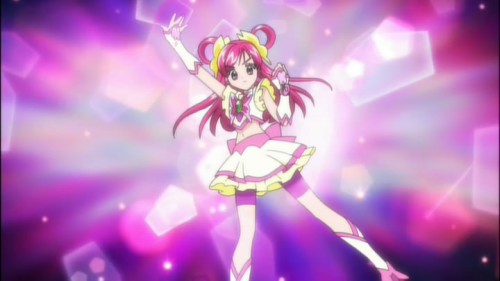
Smile Precure! began this month, and it’s bringing back the five-man team back to the Precure franchise. Incidentally, Yes! Precure 5 was also the first Precure to use a widescreen perspective, and when you compare Smile to Yes 5 and its other widescreen predecessors, Smile’s transformation scenes really stand out in terms of how they utilize screen space, particularly with the individual transformations.

Let’s take a look at the old ones first.


Cure Dream, Yes! Pretty Cure 5


Cure Dream, Yes! Pretty Cure 5 Go Go


Cure Peach, Fresh Pretty Cure


Cure Blossom, Heartcatch Precure!


Cure Melody, Suite Precure

Now here’s Smile Precure!‘s heroine, Cure Happy.

Cure Happy’s pose fills the screen in a way that I very rarely see in any sort of transformation sequence, whether it’s Precure, mahou shoujo, anime in general, or even live-action tokusatsu. Happy is not only shot closer, but her body is also slightly angled with both her arms and her hair spread out wide. This makes it so that her body is contact with all four sides of the screen while also occupying the majority of the space in between.

Then we have Cure Sunny, who doesn’t take up quite as much space as Happy does, but still has a body which cuts the shot in half diagonally almost perfectly, again emphasizing the length of the screen.

Granted, not all of the transformation poses in Smile Precure! are done in this manner, as can be seen by Cure Peace above. But whereas the previous series in the franchise stuck to the single figure in the middle of the screen as almost a rule of thumb, the large amounts of empty space on either side of her becomes more of an individual character flourish, and is perhaps even an indicator of her personality. Though I’m not 100% on this, I get the feeling that leaving that much space around Peace has the effect of emphasizing her clumsy, crybaby personality. In contrast, Happy’s personality is the kind that can fill an entire room just as her image fills the screen during her pose.

I actually think there’s a practical reason for this change, and that is the fact that Japan is finally going to switch over (almost) entirely to digital TV in about a month. Older series had to take into account a large amount of people with analog signal TVs, whereas now they can rightfully assume that most of their viewers will be watching in widescreen.

Manga and Women in Refrigerators

Introduction

If you were to ask an avid and informed fan of superhero comics about controversies surrounding the portrayal of women in the cape-and-mask genre, you might get answers having to do with the male gaze, or the number of female protagonists, or perhaps even whether or not comics need to do more to attract female readers. In every case though, the focus can potentially lead to the phenomenon known as “Women in Refrigerators.”

Coined in 1999 by comics writer Gail Simone (probably most famous for her work on Birds of Prey, a series starring a team of female superheroes), “Women in Refrigerators” refers to a tendency for female characters in superhero comics to be either killed, abused, raped, or depowered in what seems to frequently be a move to anger or inspire a male superhero into action, or to intensify the hatred between the hero and his nemesis. Named after the Green Lantern character Kyle Rayner depicted above (who not only literally finds one of his girlfriends in a fridge but has also lost a number of significant others in his career), WiR has been an on-going discussion among comic fans for the past 12 years. In spite of the age and scope of the topic though, the conversation has not really penetrated the realm of anime and manga.

Given arguments over things like moe and lolicon and how Japanese society treats women, what of “Women in Refrigerators in Manga?” Furthermore, whether they’re informed or ignorant, with the number of people who have spoken or written about WiR in the superhero comics community, what would happen if they all focused their attention more towards manga?

Casca from Berserk, a strong female character horribly traumatized by brutal rape

When initially thinking about the topic, a number of questions came to mind. Would they look at manga and find it to be more sexist than superhero comics? Is the lack of a similar phrase or concept in manga a potential problem for it and any movements towards improving manga? However, I soon realized that WiR and its surrounding discourse are very much shaped by the superhero genre itself; evidence of this includes the whole idea of being “depowered,” something which holds a lot more weight in a setting where super powers are the x-factor in the story.

Of course, comparing one genre to the entirety of manga makes things quite unfair, but even when you narrow it down to, say, shounen fighting and action series, or even a single magazine such as Shounen Jump, the setup of superhero comics has particularly unique consequences.

Conceptual Paradox in the Superhero Genre

The basic superhero (of which Superman is probably the most well-known example) is someone who is somehow stronger, faster, and overall better than the average human, and this allows them to right wrongs. Where the regular authorities falter, the superhero-as-vigilante can come in and thrash the bad guys and make the world a better place. These settings rely on an environment fairly close to our own, one grounded in a similar default reality so that we can compare the ideal of the superhero to the everyday, but it also makes for a world that can start to unravel if the concept is pushed too far.

Adding a superhero to an otherwise normal world can transform it entirely, and when you begin to really question the effects a particular superhero can have on his environment,  you wind up with questions like “If Mr. Fantastic is so smart, why hasn’t he found a cure for cancer?” While there are comics which do explore in detail the influence superheroes can have on society (Watchmen, for instance), and the Mr. Fantastic question isn’t some magic contradiction that destroys the superhero genre, it does point to the idea that a typical superhero story has to set its boundaries if it doesn’t want such questions jumping out at its readers.

The idea of boundaries isn’t limited to superheroes, as just about any story which adds something “superhuman” while wishing to maintain a semblance of normalcy has to draw the line somewhere. The tricky thing with superhero comics, however, is that the manner in which they have developed over the years encourages readers to find those limits through the prominent usage of a shared universe. When a comic is just about Batman, you can see how he fights crime and strikes fear into the seedy underbelly of Gotham City. When you cross him over with Superman though, suddenly Batman is put in contrast with a near-omnipotent alien who can outclass him fifty different ways. The reason to join them together is not to just make Batman look bad but rather to afford both heroes sufficient respect, so it requires Batman to have something extra to make up for it.

Where once he could just be a clever and ingenious individual, Batman is now the smartest man on Earth, armed with the most complex contingency plans ever conceived by man, all to make him Superman’s equal. In manga terms, this would be the equivalent of putting Monkey D. Luffy and Son Goku in the same universe and having to find a way for Luffy to be as powerful and influential as the Dragon Ball protagonist, like saying that Luffy’s rubber body makes him more resistant to ki blasts or something. As Marvel and DC actively promote their shared universes, this type of comparison becomes almost inevitable, and when you’re comparing, then the superhero universe comes under at least a certain degree of scrutiny.

If you then add the on-going saga aspect that is “continuity” to that mix, then the world of the hero can be scrutinized not just in terms of space, but also time. Superhero comics encourage a long-term view of its characters, where the events build on top of each other to create a loose history. And given the longevity that some of these characters possess, an action 30 years ago can continue to be associated with that character. In a comic from 1981, Avengers character Hank Pym hit his wife Janet , and it became a recurring topic all the way up until she died a few years ago. If they were to just ignore it and have the two characters act like nothing had ever happened, then it would have been perhaps silently condoning spousal abuse. However, because they kept it, it wound up defining the characters in certain respects. Although one can argue that this enriched their characters, it also meant that once it was done, neither of them could return to what they were prior to it. And while things are re-written or counteracted on a somewhat regular basis in superhero comics, this shared universe setup means that just one bad decision by one creator can potentially define a character to the point that no amount of reboots or retcons can undo its influence.

One Woman, One Refrigerator, One Universe

Let’s go back to manga for a little bit and pick a title that most definitely has female characters that are WiR candidates: Fist of the North Star. Now I love this series and consider it among my all-time favorites, but its female characters range from essentially cheerleaders to useless. Going in the style of the original Women in Refrigerators post, I’m going to list them with a list of ways they’ve been “fridged.”

Yuria (above) abused, forced to become Shin’s lover, kills herself (not really), contracts a fatal illness from long-term radiation exposure

Mamiya turned into a sex slave, her lover Rei dies, stops fighting entirely

Lin almost forced to have Kaioh’s baby, brainwashed into falling in love with another man

And so on and so forth.

Women are kind of a non-factor in Fist of the North Star no matter what they say about love and no matter how many women nobly sacrifice themselves. But at the same time, the fact that Fist of the North Star ran in Shounen Jump doesn’t mean that its portrayal of women exists in the same environment as One Piece or Toriko or City Hunter. Misogyny can exist, and it can even exist in multiple titles from the same publisher in the same magazine to the extent that you could call the whole thing sexist, but there is less of a risk of the comics congealing into an entrenched, constantly self-reinforcing “super misogyny.”

With superhero comics and their long continuity and shared universes, it can be incredibly easy to permanently “poison the well.” In this environment, a single instance of a WiR does not stand alone in its own conceptual space, but ends up existing in a greater universe, and then stays there in the timeline potentially forever. While this is not inherently a bad thing, it means that more innocent and simplistic stories and concepts have a harder time maintaining that innocence. If someone said The Cat in the Hat and Schindler’s List occupied the same continuity, it would be very hard for Dr. Seuss’s characters to be quite the same when the idea of genocide hangs over them.

This can even apply to the degree to which women are sexualized in comics. Somewhat like how “Hollywood Ugly” requires you to believe that the attractive celebrity in baggy clothes and glasses is meant to be homely, if you take a title where the aesthetic portrayal of women is geared primarily towards the sexual gratification of men and put it in the same world as a comic where the attractiveness of women is depicted in a more neutral fashion, then there is bound to be a conceptual clash, especially if the two were to cross over directly. Either the overt “butt and breasts out” poses would have to be acknowledged directly with respect to how a woman would normally pose herself (accounting of course for stylistic flourish), or the more neutral design would have to be subsumed by the overtly erotic aesthetic. If respect is supposedly afforded to both portrayals, then there winds up being a compromise, much like Superman and Batman’s situation, that generates at least a certain degree of schizophrenia.

It can also be easy to poison the well of a shared universe because once that idea takes root in one corner of the world, it becomes easier for it to spread to other parts as well, and I think this is what ends up really shaping Women in Refrigerators in terms of the superhero genre. While I may be assuming things too much, I think it’s far easier to corrupt an innocent idea than it is to make a corrupted idea turn innocent, and so every time another woman gets killed or raped or depowered, it means less and less of a chance for that whole thing to be turned around entirely, which means the rate at which the universe becomes “darker” winds up being far faster than the rate at which it becomes “lighter,” unless deliberate steps are taken to work against it.

Given everything I’ve said about the danger of a shared universe, does this mean that any sort of shared universe will lead to similar problems? Not necessarily, but I think that regardless of which direction that universe goes, compromise is almost inevitable. When Neon Genesis Evangelion with its emphasis on psychological turmoil enters the crossover environment of the Super Robot Wars games, its story and characters end up less traumatized overall. When Lupin III meets Detective Conan, his role is more of a lovable scamp than a hardened thief. Even taking darker series and making them lighter to fit in another work is a form of compromise. However, neither of those bother to maintain their continuities for prolonged periods. Moreover, while a shared universe does not guarantee Women in Refrigerators, the way that superhero comics have turned out means that it is constantly poised to do so, and as far as I can tell, the discussion surrounding WiR is very much about a concerted effort to turn things around, to deal with what may very well be a case of inertia.

Towards Methods for Manga?

A quote from Gail Simone in 1999 clarifies one of the original purposes of Women in Refrigerators:

My simple point has always been: if you demolish most of the characters girls like, then girls won’t read comics. That’s it!

This is not as much of a problem for manga, even titles and magazines designed for boys, as many publishers in Japan have learned ways to court a female audience. Some titles in Shounen Jump are especially known for their sizable female readerships: Saint Seiya, Katekyou Hitman REBORN!, and The Prince of Tennis, to name a few. Granted, most of these titles have primarily male casts and so the portrayal of female characters is not the primary draw, but that is also getting into another more complex issue of gender-based character identification. I’ll leave this as something of an aside for the sake of not going too off-course, but will say that this might mean that it doesn’t take outstanding portrayals of women to attract a female audience, but at the very least ones that won’t make them feel uncomfortable to be women.

As it is, the “Women in Refrigerators” discourse is especially suited for the superhero genre. Its concerns and the manner in which it can quickly spread to other stories are at least partly predicated on the structure set out by decades of development. If WiR is to be applied to manga, or even a certain genre or magazine/publisher, then it likely needs to be modified to fit a very different history, both in terms of manga itself and the Japanese culture surrounding it. Personally, I’m not entirely sure what changes need to be made. It’s probably an endeavor that is too big for one post, but I can throw out some possible directions.

I think the killing, rape, and abuse aspects probably translate adequately as is, but to go back to the “depowered” aspect of WiR as something very particular to superheroes, perhaps it would be a good idea to find something that is not quite so specific. If we’re dealing with a genre like shounen action, your Dragon Ball‘s and Naruto‘s and such, then maybe it’s not so much a matter of depowering as it is being quickly outclassed or made irrelevant. A lot of characters in these works often get some kind of improvement to their abilities, but that is made obsolete by the fact that every other hero gets stronger at a quicker rate. While this is not exclusive to female characters, it may be something worth tracking among female characters to see how they’re made to be functionally useless.

If we’re looking more at sexually-charged (but not necessarily pornographic) titles, maybe it would be wise to keep an eye out for degradation or humiliation. For example, how often are characters made to do something or wear an outfit that not only embarrasses them, but sexualizes them in the process? What of humiliation as a sexual tool, even when it’s meant to be light-hearted prodding and not something more extreme like torture?

Maybe it would also be a good idea to take a look at one popular title and to note where the female characters are mistreated solely to advance the male characters’ stories. After that is done, the next step would be to look at works that may have come about as the result of its popularity, whether it was because there was a clear influence, there was a blatant attempt at riding the wave, it was the next title readers flocked to, or even if there was some kind of editorial mandate to feature more of those stories. Do some of those WiR-esque ideas and portrayals still exist? Are they getting weaker or stronger? This may be a way to track things across one magazine or one genre without having the shared universe of superhero comics.

Of course, this is all assumes that WiR is not an issue when the female readership has been established and sustained sufficiently, but what about the possibility that the phenomenon not only exists in shoujo and josei, but that such events might occur in greater numbers compared to manga geared towards male readers?

What I’ve provided in the ideas above would not comprise a complete framework, but then again neither did the original list of Women in Refrigerators. There is a distinct possibility that with each genre of manga, even if you were to narrow it to titles somehow similar to superhero comics, that it would require its own adjustments be they subtle or broad. It may even be the case that in the end, we find out that WiR cannot be applied to manga no matter how many modifications are made, but I think it would still be a worthwhile endeavor to figure that out in the first place. I’m sure we’d learn something along the way.

“Broad Appeal?”

Whenever I see an article or post about how anime is declining because of a focus on an increasingly niche, otaku audience, I’m a little taken aback. This is not only because the most commonly given solution, i.e. “make things with broader appeal” is easier said than done, but that the very idea itself doesn’t actually seem to be what its most adamant proponents truly mean or want.

Take Redline for instance, which is touted by a number of people as a sort of magic bullet that has the potential to blast away years of anime-related stigma. Certainly it’s a fantastic film on a number of different levels, but I have a hard time believing that it qualifies as “broadly appealing,” unless your definition of “broadly appealing” is limited to geeks with a penchant for thrills and visual spectacle, or alternately, anime fans from previous decades, especially from when “anime” was closely tied to “science fiction” in their eyes. Don’t get me wrong, I’ll be the first to argue that the storytelling in Redline is excellent, and that it’s far more than just pretty explosions, but something like Redline will be not judged by a more general audience unfamiliar with anime based on the subtle nuance that exists in its otherwise extreme characters. It’s full of violence and has a sprinkling of nudity, and while that sells for some, it’s also an instant turn-off for others.

“Anime with broader appeal.”

“Anime that the average person will enjoy.”

I believe these to be obtainable goals, but I find that when people talk like this, they don’t necessarily want something for a wider audience, they want anime that is closer to what they enjoy most, that possess the qualities they think are most essential to great anime, or at least acceptable anime. Certainly, wanting more of what you enjoy only makes sense, but it results in conflating “broad appeal” with the tastes of the individual. Rather than something like Redline or Cowboy Bebop, maybe the answer will be the anime equivalent of The Big Bang Theory or Hannah Montana or something else far-removed from the aforementioned anime titles. Which is to say, if anime in whole or in part transformed itself to really aim for that bigger audience around the world, the result may not be what we might be expecting.

This somewhat reminds me of all of the manga creators that have been revisiting their older work. Even putting my beloved Genshiken aside, you have GTO: Shonan 14 Days and Rurouni Kenshin, among others. All of them have certain expectations associated with them because you have the original creators working on them, but when you think about it there’s no guarantee that the work will actually be all that similar. After all, artists can change given time and experience. Macross: The First is a retelling of the first series by the original character designer Mikimoto Haruhiko, who is praised especially by a certain generation of anime fans as being one of the best character designers ever. They might point to his work and say, “There, why can’t anime characters look more like that, instead of what we’re getting today?”

The only problem is, Mikimoto’s own artwork today doesn’t look like his work from the 1980s. For that matter, if you look at his stuff from between the original Macross and now, it also looks quite different.

Expectations shattered?

Okay, Seriously, You Really Need to Stick to a Single Title Translation for Mousou Shoujo Otakukei

https://twitter.com/#!/JManga_official/status/139812494880419842
Mousou Shoujo Otakukei, the story of powerful fujoshi Asai Rumi and the man who loves her. I’ve been following it since 2007 and recently finished the series (expect a review, perhaps?), and in that time it’s become one of the more well-known fujoshi-themed manga, getting even a live action drama adaptation as well as an English-language release by Media Blasters.

In its original US release, Mousou Shoujo Otakukei was changed to Fujoshi Rumi. Let’s leave aside the question of whether or not they should have changed the title in the first place, other than to point out how interesting it is that Fujoshi Kanojo decided to go the other route and become My Girlfriend is a Geek.

Mousou Shoujo Otakukei then got a French release. There, its title is actually Otaku Girls.

But now, for the J-Manga release, they’ve decided to go back and change the title to a direct translation of the Japanese. Hence Otaku-Type Delusion Girl.

So that’s four different titles for the exact same manga, all of which are to some degree official (the only possible exception oddly being the actual romanization of the Japanese title).

I don’t think I need to explain why this is confusing.

Thoughts On the Pervasiveness of 4chanspeak

Since its inception, 4chan has generated a peculiar set of vocabulary. The term “weeaboo,” now synonymous with “japanophile” and “wapanese,” was born out of a word filter designed to mitigate usage of the term “wapanese.” Often times extreme and intentionally insulting, 4chan is also known for appending the suffix “-fag” to almost every word possible, to the point that its origin as a homosexual slur almost becomes a generalized slur. How else would you explain the usage of the term “straightfag” to denote someone who is annoyingly heterosexual?

Though it is convenient and perhaps comforting to think of terms such as “weeaboo” and “moralfag” as isolated elements of the 4chan userbase, 4chan-isms have permeated the internet to the extent that people who have never even loaded a 4chan page are using these phrases. I saw one such thread on a reddit video games thread, where after throwing around a bunch of classic 4chan terms, proceeded to ask what /v/ is  (the video games board on 4chan).

Personally, when it comes to my writing and even my online chatting, I prefer to keep the usage of 4chan-isms to a minimum, because I feel that they 1) have too much baggage that requires unpacking and 2) are overly broad when I tend to prefer a bit of precision in my sentences. I also prefer that other people do the same, though I don’t mind seeing it pop up every so often, especially for flavor. On the other hand, overuse of 4chan-isms to the extent that thoughts are conveyed using almost nothing but them can not only be difficult to read but causes my mind to kind of gloss over what they have to say.

However, given the sheer amount of 4chanspeak users out there, I find it increasingly difficult to write off what people have to say solely because of their excessive 4chan-sisms.  After all, if it has become so ubiquitous, if there is an entire generation of internet users who think this to be the normal way to speak online, then it is more than likely that very smart and insightful individuals who communicate primarily through such terms exist. While I can criticize them for using terms which probably have better alternatives, I cannot deny the possibility that smart things can be said in a “inarticulate” fashion. Not only that, but if someone feels most comfortable describing their feelings using 4chanspeak, who am I to judge? If someone says, “I got NTR’d and might become a suicidefag,” and actually means it, then maybe I have to just understand that sentence as being their way of expressing a hurtful situation and to take that seriously.

The Difference in Variety in the New Genshiken

In the past, I’ve written a number of posts in response to some of the backlash that the new Genshiken receives, particularly in regards to the new cast of characters. Whether it’s pointing out how Genshiken changes throughout its run (for the better), or that the general perception of otaku has changed just enough that some are happily willing to be labeled as such, my goal has been to show that the series has never stopped being “real,” and that it most certainly still reflects otaku life. There’s nothing wrong with or invalid about liking Genshiken while disliking Genshiken II (the comic does feel somewhat different, after all), but I just find the criticism that the characters are somehow less developed to be one I can’t agree with.

So when I see the criticism that the new characters in Genshiken lack variety, I was surprised. Upon seeing the reasons, I was confused.

The argument is that the new characters are all into BL, whereas once you had a guy who was into model kits and cosplay (Tanaka), a guy who was ostensibly into drawing (Kugayama), a guy who fought hard for Otaku Life (Madarame). This supposed lack of variety potentially even labels all female otaku as BL-hungry fujoshi, a mistake that many make both in and out of the world of fiction. At first, I considered arguing from the fact that the Genshiken old guard all had fairly similar tastes in erotica and doujinshi, some more extreme than others. I realized, however, that taking such a stance wasn’t really answering the question of variety, and that it’s true that the older characters seemed to have a wider array of otaku hobbies. Among the current members, most of them are indeed into yaoi, many of them like to draw, and their conversations often lead to discussions of pairings and such. That said, there is an important difference between the old and new Genshiken in that the approach to diversity has changed.

It is true that Sasahara and the rest all have different interests as otaku, and together they show a variety of colorful personalities in part due to those interests, but at the same time they’re all different types of Awkward Nerd, Kohsaka with his good looks and upbeat personality being the only real exception. Kasukabe and Sasahara’s sister Keiko of course aren’t even otaku at all, and instead provide a very clear point of comparison, the normals as opposed to the nerds. With the current iteration of the club however, while just about all of them are into similar things like BL, they actually have widely varying degrees of awkwardness. While Hato’s crossdressing can create awkwardness, he himself does not necessarily exude it, and Yoshitake is almost impossible to label as such. Whereas once Kohsaka was the major exception, his approach to being an otaku, while not quite yet the rule, resembling this current generation more than the one before it. Moreover, between Hato’s judo training and the younger Yoshitake sister’s years of basketball you even have now, of all things, athletic individuals devoid of the physical awkwardness that is prevalent in so many portrayals of otaku.

As is explored in Chapter 58 (the drunken party chapter), part of Yajima’s character is that she feels caught in the middle of this transition. In her mind, otaku are supposed to be weird, inept people who look and possibly smell less than ideal (I’m paraphrasing), but all of the girls (and at least one guy) around her in Genshiken seem to be smart, beautiful, talented, and confident. In this regard, she is somewhat alone, her type and level of awkwardness greater than the rest, but with her ability to comfortably interact with all of them even she is a sign of the ever-changing times and identity of “otaku.”

While the new Genshiken may indeed be populated by yaoi fans (and we’re not even sure if Risa’s thing for shota is necessarily also a BL thing), it has a level of variety in characters and personalities that was previously only achieved on a much more extreme scale, one that had to even include non-otaku. Their hobbies may not be as varied, but they themselves are comprise a diverse cast of fully formed otaku-as-characters in a world where awkwardness, social or physical, is not a prerequisite.

Reading into the Negative Responses Against Phoenix Wright in Ultimate Marvel vs. Capcom 3

Phoenix Wright was recently announced as a character for Ultimate Marvel vs. Capcom 3, and his reception from fans of MvC3 has been an interesting mix of unbridled enthusiasm and indignant anger. I find the latter to be particularly interesting because of how the criticisms from fans are being formed verbally and what it says about how a game like Ultimate Marvel vs. Capcom 3 is perceived by its audience on an aesthetic level.

Before we start though, I have to say that I do not know what percentage of fans actually dislike Phoenix Wright’s participation in this game. Whether they are a “vocal minority” or not matters little, as it is more about the reaction of that group in particular.

First off, let’s take a look at some of the comments critical of Wright as a Capcom representative:

“Im not hating at all, the game looks legit I just can’t believe that non-sense was allowed in and not a more traditional fighting game character”

“Phoenix Wright is the most awkward fighting game character I’ve ever seen. Fuck that guy. I hope he’s top tier and everyone ends up using him ’cause he’s so stupid, LMAO.

Nova on the other hand, now that’s a real character. Dude is a beast! He’s like a better Phoenix (non-Dark).”

“I agree, Phoenix Wright feels out of place here, and makes me feel like I want to throat up or something. What a crappy pick, should of been Captain Commando. We already have a Capcom joke character, his name is Frank West and he’s better than Phoenix Wrong lol.”

[In reference to a an attack Phoenix Wright uses in the trailer and the argument that Tron is a joke character too ] “Tron hits ppl, not sneezes on them”

etc.

All of them say essentially the same thing. A) character who is not a fighter an does absolutely nothing resembling combat in his own game should not be in Marvel vs. Capcom 3. B) The humor-based interpretation of his “fighting” style for UMvC3 is a slight against the game itself.

At this point, it would be easy to dismiss these statements with a couple of arguments, but those arguments have problems in and of themselves. The first is the idea that “gameplay is the only thing that really matters, so it’s not relevant if Phoenix Wright fits with the rest of the cast or not as long as he’s a strong character who can create interesting gameplay.” For Marvel vs. Capcom 3, how the game controls and whether or not it’s competitively viable are, while important to its success as a game, are obviously not the only factors in presenting it to the world and its audience. If gameplay were the only relevant component, then it wouldn’t be a crossover of a comic book company and a video game company using iconic characters from their respective libraries. Although it is easy to disagree with people who think Phoenix Wright is too ridiculous for the game (and I do disagree with them), it is besides the point to argue from a primarily theoretical game mechanics perspective.

The second is the idea that “the game is already ridiculous putting up some kung fu guys against ancient gods and beings with the power to rip the Earth in half, so why draw the line at a goofy lawyer?” But while Marvel vs. Capcom 3 (and the entire rest of the Vs. game series) does bring together a cast of characters whose powers and abilities can be horribly mismatched, it does not negate the fact that Phoenix Wright is indeed not a martial artist or in possession of superhuman abilities. A punch is a punch and can be made as strong as necessary, whereas Wright has to use something else entirely.

I think the idea that a fighting game should have “characters that fight” is an interesting one in that MvC3 becomes a sort of haven for a particular type of masculinity, a place where a (presumably male) player can feel comfortable in knowing that the setting and its character will not betray them aesthetically. This is not a coincidence, as the look of Marvel vs. Capcom 3 is masculine and powerful in a way that is particularly appealing to American audiences. This is easily seen when comparing it to its sibling, Tatsunoko vs. Capcom, whose anime influence gives a somewhat softer look to even the most square-jawed and chiseled of warriors. But Phoenix Wright apparently violates that security; to the people critical of his inclusion for the reasons outlined above, he demeans the game he’s being included in because he ends up mocking the aggressive portrayal of competition. Wright risks emasculating part of the game’s audience, somewhat like the entire Arcana Heart series minus the overt sexuality aspect that is near-unavoidable with that franchise.

Again, I do not know what percentage of people playing games feels this way, but I do have to wonder how much this affects a certain portion of gamers’ decisions in which games to pursue. Are games like Call of Duty and Halo even more indicative of this mindset? If so, it may bear taking a look at how and why men look to games to affirm their masculinity.

On NTR

I’ve been thinking recently about “netorare” or “NTR,” a porn subgenre which involves a woman being taken from her significant other by another man and forgetting about her husband/boyfriend entirely, and its rising popularity in ero anime and manga. Generally, the woman does not want to have the affair at first (and the first encounter usually involves coercion, blackmail, or rape), but is swayed by the other man’s superior sexual prowess. About the closest equivalent is a cuckolding fetish. Based on the reactions people have towards it, which is generally something like a mix of anger, frustration, and sorrow (to the extent that you have fans championing “vanilla” material as the heroic counterpart to NTR), I just have to wonder what has made it catch on.

Violence and even rape are not new to pornographic anime or manga. Go back to the 1950s and you will see those as themes in the cheaply produced porn manga that existed at the time. Same thing goes for women cheating on their men. The difference, I think, is that in those older examples, the male viewer was supposed to identify with the seducer/attacker, but in NTR that is no longer the case. The male viewer is now the hapless boyfriend or husband who means well and loves his girl, but can’t do anything about the fact that she’s tasted “better fruit.” The viewer has gone from being the holder of power to being a victim, and the fact that such a scenario has been popular makes me believe that there is a similar feeling of helplessness in those watching.

To me, it doesn’t feel like an extension of the whole “nice guy” phenomenon where girls supposedly prefer jerks, nor is it about affirming the idea that “women are sluts.” I especially don’t believe it’s what the viewers of NTR actually want in reality, and I don’t even think humiliation is the main factor for its relative popularity. Instead, I find it to be more related to perceptions of inherent or fundamental power, in this case represented by the fact that the viewer will be told that the other man has a larger, more satisfying penis that can erase even love itself. In other words, no matter what you have, you may be lacking in the one area where it matters most.

Whether they are in a relationship or not, I think guys into this sort of thing may find a strange kind of comfort in the belief that they are basically powerless or that love is balanced precariously on the fact that the girl has never experienced something better, which may even possibly relate to the appeal of the “virgin” (but we’ll put that aside for this post). To some extent, it may be similar to having a conspiracy theory confirmed or the tension from a horror movie where the main characters are inevitably doomed.

Another possible interpretation might be found in a Japanese critical line of thought concerning lolicon as it was defined back in 80s, girls drawn in a cute, round style reminiscent of Tezuka, as opposed to using a more realistic Gekiga-esque style for portraying females. Here, it is said that the men who enjoy lolicon are actually projecting themselves not onto the man having sex with the girl, but onto the girl herself. The helplessness of the girl is not a preference for weaker girls, but a source of (sexual) comfort for those who feel as weak as those girls.

If that is the case, then NTR may be a sign of men feeling weaker than before, or fearing the danger of the world around them. In this new, harsher time and place, even the comfort of identifying with the woman is taken away now that she is another thing for a man to have and lose. He is made to feel even more powerless. NTR may then be a reflection of some kind of growing discontent or discomfort.

I don’t know if either of the ideas I presented above are actually valid, let alone comprehensive, and the popularity of NTR might just stem from it having more than one type of appeal. In other words, it may have the ability to hit different people in different places, but I do think fear is a significant factor in many of them.

The Perception of Balance in RTS and Fighting Game Communities

This post was originally a reply to someone asking about the differences in how the fighting games community and the real-time strategy community perceive the concept of “balance” in a competitive game, and why that would be the case.

My skills and experience lie neither in RTS or fighting games (though I have played both), so I can’t offer any particulars about why balance is regarded differently in their respective communities, but I think it is worth thinking about with more fighting games than just SF4, even if it is the biggest one right now.

I think it might be good to take a look at a couple of fighting games whose tiers are considered to be relatively balanced in two rather different ways. The first is the Virtua Fighter series, a game with a Brood War-like (outside of Korea) reputation, a very difficult game that is considered by its proponents to be more exquisitely refined than any other fighting game out there. According to this, the tier list for the latest iteration, VF5: Final Showdown comes out as the following:

“S: Akira
A: Lau, Jacky, Taka, Lion
B: Everyone else

That’s quite close! Even if one character is considered by far the best, no one is considered to have anything close to a “failing grade.” The message from this tier list is indeed “Imbalances exist in this game but it’s close enough that anybody can win with anyone.” Also perhaps important to note is that VF is considered a series where you do not have time to master more than one character because of how complex they can be. This might mean that, like SC2, switching characters/races is considered to be too time-consuming to be worth it.

Let’s look at another game’s tier list: Hokuto no Ken (Fist of the North Star).

S++ : Rei
S+ : Toki – Juda
S : Raoh
A : Kenshiro / Thouther / Shin / Mamiya / Heart
B : Jagi

While there are now 5 ranks instead of 3, rather than call Jagi “D” tier and Rei “S” tier, they give the distinction of having them be “B” and “S++.” The distinction here is that while some characters are good, others are GREAT. The reason why HnK’s tiers are the way they are is that every character in this game has 100% combos and infinites. In any other fighting game, they would be brutally S-rank. However, in HnK, the top characters simply have more 100% combos and more ways to successfully land them. It is considered so imbalanced that it is balanced.

When talking to people who have played both of those games, I find that the main thing they have in common for why they are considered to be as balanced as they are is that all of the characters always have a good amount of options at any point in the fight. There is always more than one way to win. In a fighting game then, a character with consistently few options is always at a distinct disadvantage unless there is something else to greatly counterbalance that.

I think that the key difference between the Real Time Strategy and the Fighting Game, and why in the former the community is quick to say “things are unexplored” and in the latter people are eager to immediately lock in “tier lists,” is how time factors into the strength of your race/character. Consider that, outside of super meter, in SF4 a character’s strengths and weaknesses at 1 second into the match are about the same as in 50 seconds into the match. A character still has the same tools no matter where you place them in time. In SC2 however, time plays an enormous factor. Building your 10th SCV earlier rather than later does different things to the strength of your army. Losing a single SCV early on is much more detrimental than losing a single SCV in the mid or late game. Building particular units at different times affects the strength of a race tremendously, as does attacking with them. Options fluctuate tremendously based on when decisions are made, and an early disadvantage can ripple forward in time. This is often referred to as a “slippery slope,” where once one starts falling behind it becomes tremendously difficult to make it back. All the same though, that disadvantage can be potentially mitigated by a different timing altogether.

So the difference between having a constant, unchanging set of options and one that changes over time based on your own decisions are why I think that “balance” is approached differently by the fighting game community and the RTS community. Fighting game players can look at the tools a character has and determine how they will do at any point in the fight, and from there they can determine tiers and even be comfortable with the idea of imbalance, even early on in the game’s life. RTS players though have to factor in the timing of their decisions affecting the very strength of their army itself (and the ability to sustain that army), and that added variable is what makes the game feel so “unexplored” and difficult to determine the balance of.

The Expanding/Contracting Anime Fanbase

Floating out there in the general discourse are what seem to be two contradictory ideas of anime fans.

1) Anime is appealing increasingly to a smaller and more niche crowd of otaku, often through devices such as loads of fanservice or active use of moe. As such, the fanbase is becoming more and more a select group of adult men who grow older and smaller in number over time.

2) Anime fans are getting younger and younger, that anime is attracting a primarily female audience. Moreover, a lot of these young fans are not able to retain their fandom as they grow older. They hit a certain age and anime stops being their obsession.

So somehow you have a fandom that is both shrinking and growing larger, while the median age rises but also lowers or remains the same, and this is all being done with the same collective pool of works we call “anime.” On the surface, something doesn’t quite add up. The more I think about it though, the more I find this isn’t necessarily an irreconcilable contradiction. I mostly have impressions and hunches from observing anime and its fans, but I can think of some possibilities as to how these two concepts can co-exist.

It might be that some fans are longing for another period of anime, a self-defined golden age where anime was at its best.  If it’s not simply a matter of nostalgia or specific tastes though, then it could be that these fans are not finding what they want in either side, the young and general, or the old and niche where they might have once been able to easily. So the anime fanbase may not necessarily be shrinking overall, but the demographic ratios may be shifting in a way that’s troubling to some. This one does not necessarily have any flaws, but it seems more to be a mix-up of personal desire for general trends.

Another possibility is that the effects of anime’s move towards extremes in its fanbase cannot be felt immediately and that it will take some number of years to really see the fallout. Perhaps it would be the age at which the current otaku base starts to literally die off, much like some of the criticism surrounding the current state of American superhero comics. This one doesn’t quite feel right through, and I can’t put my finger on why.

Similarly, while the younger fanbase is increasing, they are finding their access to anime through inexpensive means, be it through outright piracy or simply watching things streaming. “The surest” way at the moment to make reliable profit is to hit the collection/merchandise-obsessed otaku, hence all of the light novel adaptations. The amount of money being generated by anime is not what it used to be and may never be at that level ever again, even if there are new fans.

Overall, I’m not really sure. These are incomplete thoughts and I don’t think I’m going to be reaching a solid conclusion any time soon. I’d like to hear other people’s thoughts.