“I’m an Anime Scholar! Why Should I Watch Anime?”

I love the idea of applying a scholarly or academic approach to anime and manga. If you’ve been reading Ogiue Maniax, I think that”s obvious. Whether it’s studying the works themselves, tracing parallels between fantasy and reality, observing the effects of fan subculture, or any other number of relevant topics, I welcome such discussion and discourse and I think that it’s beneficial to anime and manga overall. There’s just one problem.

Every so often you’ll see scholars writing about anime without taking the time to actually understand it. These are not stupid people, but their approach to anime can be misguided. I want to explain why.

The first issue relates to a problem I posted about previously, the “false positive.” This is where you believe you’re making insightful comparisons, but your lack of experience with anime and manga (and by extension analyzing anime and manga) results in what amounts to grasping at straws of logic and connection. This in itself is not that bad, but we all know that at least in the English-speaking community scholarly exploration of anime is a relatively recent development. The result is a lack of accountability, as writers, whether intentionally or accidentally, try to cover their topic in broad strokes and there’s no one to call them out for the moments where they reached just a little too far. This needs to stop.

The second issue again has to do with understanding the topic you’re studying. It’s one thing to take a detached approach to studying anime so as to avoid being influenced by bias, but become too detached and your words become baby’s first anime lesson only using a more complicated vocabulary. In other words, you begin to say things that are either obvious to people who actually KNOW anime and manga, or that come across as vagueries resulting from again, not actually looking at your material and investing your time in it.

That brings me to the third and last issue, which relates very much to the first two. One should not presume to speak authoritatively about anime and manga without at least understanding a little about the “language” that accompanies them. I of course am not saying you should literally study Japanese (although it can certainly help) but that you should not pigeonhole anime and manga entirely into the context of your own field, subordinating it to your greater topic while simultaneously denying its own creative and artistic language and structures. Even if you do not develop the “vocabulary” commonly used in anime and manga, what’s important is that you develop the ability to convey and translate those ideas. You do not have to be completely “fluent,” but if you’re only a first-year student of this “language” don’t be surprised when your translation is full of errors, and do not try to deny those errors in the first place.

Here’s my overly simplified solution to alleviating these problems: WATCH ANIME. READ MANGA.

Don’t sit back and watch it from the sidelines, engage every show you watch, and when it’s over, grab another and get to work. Love it, love the thing you’re studying even if you don’t think the actual works you’re looking at are any good. Let it become a part of you so that when you do talk about it the words flow naturally. Instead of sounding stiff and awkward, your words will carry the proper weight because you actually WATCHED it instead of just reading about it.

Studying the Realism in the Fujoshi Character Design

Ever since the mid-2000s the fujoshi character has seen an increase in overall presence in anime and manga, as evidenced by my Fujoshi Files, an ongoing project where I catalogue fujoshi characters. While comparing various fujoshi characters, especially in seinen manga, I began to realize something interesting about their portrayal, and that is the fact that they are often the characters closest to how a Japanese girl would actually look: dark, straight hair, possibly wearing glasses.

There are series such as Genshiken and Zetsubou-sensei where the fujoshi characters having dark hair is not unusual given the rest of the cast also sporting dark hair. My discussion focuses on those shows where characters’ hair styles and colors tend to be the anime rainbow stereotype.

When you look at Lucky Star as a whole, you’ll see that bespectacled fujoshi Hiyori is the only female character to sport straight, dark hair. Contrast this with Konata, who is the biggest otaku in Lucky Star and her unrealistic blue hair. Patty, while a fujoshi, is an “American” character first, so she’s blonde. Again, I want to mention that Hiyori is the only example of a character with a realistic hair color and style mainly because of how much the rest of the cast isn’t. In a world where bright pastels rule hair colors, the fujoshi is the exception.

Similarly in Kannagi, Takako is also a dark-haired glasses-wearing fujoshi, though her hairstyle is arguably more unrealistic than most of the other characters. However, it cannot be argued that most of the rest of the cast, especially female characters, have hair colors that do not occur at all or much less commonly in reality among Japanese girls.

Meanwhile in Mousou Shoujo Otakukei (Fujoshi Rumi), the main character of Rumi also stands out as being much plainer than the other girl characters out there and even a lot of the guy characters. Part of this has to do with the fact that she is the main character and that this visual plainness is a part of the story being told, but it speaks to this desire to make her a more realistically accessible character even if it’s only at a shallow level at first.

“There’s plenty of characters who look like that who aren’t fujoshi!” you might be saying, and you’d be totally right. The dark-haired, straight-haired glasses girl predates the fujoshi character boom, and arguably falls into the same category as the “iinchou” class representative character. Adachi Hana from Yankee-kun to Megane-chan is a character who is actively trying to achieve that iinchou look, even going as far as to wear fake glasses. She also bears some resemblance to Asai Rumi from Mousou Shoujo. So in a sense, the author of Mousou Shoujo, Konjoh Natsumi, and the fictional character, Adachi Hana, are attempting to reach the same goal: design a character with the look of a realistic Japanese girl. The main difference of course is that the iinchou is characterized by an ultra-clean look and  responsibility, while the fujoshi is characterized by being somewhat disheveled and a tad irresponsible.

You might then be saying, “Ah, but that’s really how fujoshi look.” But then I have to ask, why is it that in these shows where all other characters are not beholden to reality that the fujoshi ends up being how fujoshi “actually look?” And why is this occurring in comics targeted towards guys?

Most other character types in moe or moe-ish anime tend to be fantastic versions of possible real-life people: childhood friends, reticent girls (tsundere), little sisters, etc. Everyone knows that little sisters in anime are rarely like actual little sisters, and even if you compared the imouto character in an h-game to an actual incestuous younger sister the two images would not line up. In this sense, a fujoshi character can be as unrealistic as the others but it is often the case that a certain sense of realism is desired in fujoshi characters in a manner different from other character types.

Looking back at tamagomago’s essay for which I provided a translation, one line in particular jumps out at me: “No matter how realistic it gets, it’s still a fantasy,” or in other words, no matter how realistic a female otaku character may be, they are still just a character in fiction. What this sentence implies is that there is to some degree a push to make female otaku characters have a sense of relatable realism, perhaps more than other character types, and fujoshi fall into this category by extension.

Perhaps the answer to the question of “why are there these realistic aspects in the fujoshi design” is that having a member of the opposite sex also be an otaku makes them more accessible, gives the male otaku a glimmer of hope brighter than previous. Also, by making them a fujoshi instead of just an otaku, a useful distinction is created. And of course, if applied to actual reality with real girls, it is not in itself a realistic goal as long as the male otaku does not confuse his image of 2d and 3d girls.

Once Upon a Time, a Girl Finished Her Grape Soda: Up

Up once again shows that when it comes to mainstream 3D animation, there’s Pixar and then there’s everybody else. Or to put it differently, the only studio not trying to be Pixar is Pixar itself.

People sometimes ask me why I like anime so much, and though I’ve mentioned in the past that to an extent it is a very personal thing independent of average level of quality in anime, there are still certain recurring traits that keep me coming back: emotional sincerity, respect towards the viewer, respect towards the medium itself, the ability to take simple premises and elevate them. Up manages to fulfill all of these and more. That is of course not to say that the reason Up is good is because it’s “like anime,” because it really isn’t, but its approach and understanding that even for a kids’ movie (or perhaps especially for a kids’ movie) not everything has to fall neatly into place remind me very much of the reasons why I got into and continue to enjoy animation. You can do so much when you’re not limited by reality, and to understand that is to understand that what I just said applies well beyond the visual aspect of animation.

Like Wall-E, Up is a very emotional movie which dares to use a hero that is not just unusual because of the way they look, but because of how the entertainment industry has restricted the roles of certain character types. In the case of Up it is Carl Fredricksen, an old man who used to sell balloons who decides to use his remaining stock to float his house to South America to fulfill a lifelong promise. He inadvertently brings along a young boy scout analogue named Russell, an eager but physically inept boy.

Carl’s curmudgeonly demeanor masks the fact that he was once a wide-eyed but shy boy dreaming of fun and adventure (somewhat similar to young Russell), as well as a man who was very much in love. It’s a mask that we are allowed to peer behind throughout the movie, giving Carl a very strong presence in every scene he’s in. We can see in his current attitude and actions the life he has led up to that point. His interactions with Russell show how easy it is to perceive the elderly as distanced from the rest of society, as well as how incorrect that notion often can be. Carl is an interesting and deep character, and I do not use the word “deep” lightly. He moved me, moved me to tears and smiles and left a deep impression.

Placing an elderly man in the main role of a movie animated or otherwise is a bold move in an entertainment industry which tends to devalue the elderly. Even when they are featured prominently in movies, they are usually placed in teacher roles, or meant to be comically cranky old men. While there’s been a recent trend for older main stars in movies as Hollywood’s big names realize their years are catching up on them (e.g. Sylvester Stallone in Rocky Balboa), most often the message these movies send is “check us out, we can still hang with the young guys.” Up however is different. Carl Fredricksen is not an old man trying to play a young man’s game. He is doing what he feels is necessary precisely because he’s old. There is no denial, there is no shame.

While I said that the movie’s strengths go well beyond the visual, there is no denying that the movie also looks good. Its style is something that I think registers with everyone no matter your age. It’s bright and colorful without bombarding the viewer and overwhelming the retinas. Character designs and backgrounds, are soft without seeming entirely innocuous. The overall three-dimensional design is of course excellent, as expected of Pixar, and if you decide to watch it with 3-D glasses, Up never overwhelms you with shots designed to tell you JUST HOW 3-D THIS MOVIE IS, unlike many other 3-D movies. The use of recurring symbols in Up is also excellent in a way that I rarely see from movies. This is not abstract symbolism, but rather the movie establishing the significance of small but emotionally precious objects, and whenever these objects are referred to or used in any way you know how much weight is put behind them, much like anything Carl says or does.

Up is exactly what a family movie should be, in the sense that it is not just a family movie. Go by yourself, go with your friends, go with your kids or your parents. It’s an intelligent movie which respects the intelligence, both mental and emotional, of its audience, and engages them with such sincerity and power that anyone who sees the movie will feel like they’ve come away from the movie well-rewarded. It will be a reward well-earned because it is almost impossible to feel like an idle observer with Up.

Imagawa and the Pile of Money in Eternity Island – A Dilemma in Anime Direction

Imagawa Yasuhiro does not have very many works tied to his name in a directorial capacity, but mention the ones that he has worked on and you will tend to get very positive reactions from some very loyal fans. His most prestigious work is probably the Giant Robo: The Animation OVA series, an intense labor of love that took many years and many more delays to complete, while his most famous work in America is probably Mobile Fighter G Gundam. And in my personal opinion, he is an astounding director. Possibly more than any other director, he has the ability to take the endless dreams of childhood and translate them into something mature and complex while still remaining faithful to those childhood notions. So why does he get so little work?

We have his latest work, Shin Mazinger. You look at this series, and see a lot of areas that seem to suffer budget-wise. The opening consists entirely of reused footage. Scenes are repeated over and over, and a lot of shortcuts are used. However, the show is still amazing, and still coming out without too many hitches. Sub suggested to me that Imagawa is so much of a perfectionist that the more money you give him, the more likely your anime will never see the light of day because he’ll be too busy making his animators re-do everything to get that one moment just right. As mentioned above, he took practically forever to finish Giant Robo OVA, but he was also kicked off of Shin Getter Robo Armageddon for taking too long. But with Shin Mazinger, where his spending power is limited, Imagawa is forced to make decisions and the result is something that is both Great and On Time.

Imagawa is thus the kind of director to whom you could give 25 cents and he would make the most astounding animation ever that will challenge your very ways of thinking. Imagawa would take those 25 cents, create GEORGE WASHINGTON AND THE LEGENDARY EAGLE, and when the show reveals that WASHINGTON AND THE EAGLE WERE THE SAME FIGURE ALL ALONG (like two sides of the same coin one might say!!), you will notice that your ass is no longer in your chair.

Money is to Imagawa as Time is to Tomino Yoshiyuki and No Editors is to Kawamori Shouji.

The Deception of Hirasawa Ui

This is Hirasawa Ui. She is the younger sister of the Light Music Club’s lead guitarist Hirasawa Yui. She is also a TRICK designed to pull in otaku and leave them with more than they anticipated!

Yes Ui is a little sister, and in that sense many fans may be drawn in by her “little sister” appeal. However, that imouto moe is only on the surface, and what lies underneath is a beast from yesteryear, ready to reclaim the throne of fandom, away from the tsundere, away from the “Onii-chan!” spouting imouto, away from the maids, away from the tsundere imouto maids.

Hirasawa Ui is actually a 1980s Childhood Friend Shounen Heroine in the guise of a little sister. She bears few similarites to Kyon’s sister from Haruhi or Cardcaptor Sakura, while her personality is closer to that of Yuria from Hokuto no Ken or Minami from Touch! Closer to her is Mikan from ToLoveRu but Mikan still leans closer to the imouto moe side. Capable, smart, responsible, and always in a position to help those close to her, Ui is the start of a secret plan to bring back the 80s Shounen Heroine, or at the very least the To Heart’s Akari-style childhood friend (as opposed to the To Heart 2 Konomi-style childhood friend).

“Oh!” you might say, “But she’s not the most popular character!” But that’s where they get you. Because she’s not in the main cast, because she’s not at the forefront of her show, she can slowly build up momentum. She is the first of many. She is avantgarde.

Now that you know the truth, you have two choices: embrace it or fight it. Just know that Hirasawa Ui will be there to serve you tea and make sure you’re comfortable.

Another Vertical Vednesday Descending From the Heavens

Once again, Ed Chavez, owner of the MangaCast and new marketing director of Vertical Press wants to discuss manga with YOU, yes YOU tomorrow, June 3rd from 6:30pm to 8pm at Kinokuniya on 6th ave and 41st Street in Manhattan.

For this Vertical Vednesday, Ed will be discussing Shoujo’s often-overlooked cousin, Josei. For those of you who don’t know, Josei is manga targeted at OLDER women instead of young girls. There may also be some discussion of the Guin Saga series of books. If you’ve never heard Ed Chavez talk about manga, I highly recommend that you go because you will inevitably learn something from him.

There’s an Elephant in the Corner and Her Name is Haruhi

So they tried to sneak an ALL-NEW episode of the Suzumiya Haruhi no Yuuutsu into the season 1 re-airing, but tripped up in the end and left people anticipating its arrival. No more tricks, no more magazine covers to mock the fans. The episode’s come and gone, and fun was had by all. Of course, there’s nothing to stop them from doing this over and over with anything Suzumiya Haruhi-related, and the fans will gladly punch themselves in the stomach for it. Not that there’s anything wrong with that, as the makers and distributors of Haruhi have a unique relationship with their fans.

We saw it with Lucky Star and its meta-self-referential humor which knocks down not just the 4th wall but keeps charging and makes a gigantic hole in the wall behind you as well. Kadokawa even licensed and created a mini-series out of the hit doujinshi series Nyoro~n Churuya-san. They are so aware of their fanbase that they might as well be standing on a pedestal dangling Haruhi merchandise and offering goods in exchange for your undying love and devotion and fan-generated content. It’s kind of like Gainax, but only a step further as Gainax has at the very least presented an air of distance, unlike Kyoto Animation which is right there in the thick of things high-fiving the audience and taking photos with them. And yes, I know my two metaphors just contradicted each other. Let’s just say that they decide to occasionally jump down from that pedestal.

And this newfangled Haruhi has something else to say:

“Enough with the DANCE openings and endings. We are laying to rest the beast we created. Move on, anime! Move on, fans! Well not too much, we still want you to do our Haruhi and Lucky Star dances.”

Will anyone heed their advice? Only time will tell.

Give it let’s say… about 16 years.

News from the Japanese Internet Without Needless Complexity

kransom from welcome datacomp has started a new service, the welcome datacomp linkblog. Its purpose is to introduce to English-speaking anime fans some of the more interesting aspects of the Japanese fandom without having relevant news trapped in between images of tits and ass and WACKY JAPAN that it takes for other anime and manga culture news sites to attract readers.

It annoys me when there are sites which resort to the old-fashioned WOW ISN’T JAPAN CRAAAAAAAZY gimmick to get viewers, which is partly why I’m promoting this alternative as I think it’s much more tasteful, though keep in mind that taste is a relative thing.

Really though, you should go check it out, and see some of the more intriguing threads from 2channel, among other places.

The Thing Which Makes You Think, “Ah Yes, This is an American Comic”

In the comments section for kransom’s translation of Takekuma Kentaro’s lecture on Miyazaki, a lot of talk is brought up regarding styles and trends according to where the artist is from or where the artist draws their inspiration from. Specifically, the comments center around Miyazaki’s style being similar to that of European artists. Commenter JBR states, “Nausicaa is very similar, in many ways, to the European avant-guard [sic] comics of the 1970’s/80’s, which also emphasize densely-constructed panels and attention to background detail.”

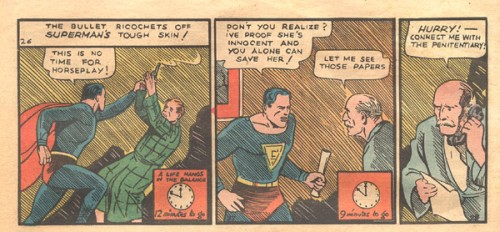
So if the emphasis on European comics is on these “densely-constructed panels and attention to background detail” (something that rings true even for comics that aren’t avantgarde), and the priorities for Japanese story comics is in having the panels be “easy to read” with respect to how panels flow into each other and other aspects, I had to ask myself, “What is the primary feature of American comics, specifically comic books, that makes it stand out?” What, in other words, is the aspect that artists and fans can draw from to make a comic feel very American?

Thinking it over, I’d have to say that I believe that traditionally, the primary feature of American comics is the desire to convey a complete amount of information in a single panel, to really inform the reader that, yes, this is going on right now exactly as you see it. Characters’ poses and actions in relation to text and background all work together to provide a sort of storytelling clarity that some might even regard as overly busy. You know where that foot is going. You know exactly what the characters are doing. You know what is going on in a given scene, as if every panel were an incident in and of itself. Some might say this is the problem with American comics, but I think that wanting to present information in your comic in complete chunks has its merits, in the way radio dramas of yesterday and cd dramas of today do. Of course, I say “traditional” because as comics artists from all over the world interact with each other these differences start to recede, but I think you can still see them in today’s comics.

I’m well aware that there are comics that do not do this, and that even in the comics that do there are plenty of panels which are more for conveying a mood or some other function. I’m also aware that all the visual examples are from superhero comics, and that there’s an entire indie comics scene out there, and famous artists such as Dave Sim, Robert Crumb, Chris Ware, Art Spiegelman, and even Brian Lee O’Malley who do not abide to this “rule” if you can call it one. However, I do feel that this is the aspect of American comics which people remember the most, whether they’re long-time fans or new readers, these panels designed to exist on their own if they have to, but also function as part of a whole.

Pokemon Reflects the Changing Times

The Pokemon anime is making the transition to digital broadcast in the coming months in Japan, and I think it more than anything else marks the beginning of the end for standard television.

The Pokemon anime is older than some of the kids who are fans of the show in the first place. It’s seen some of the most significant changes in animation and entertainment in our time. The anime started in 1998 with cel animation and a somewhat limited budget resulting in somewhat limited animation. As Pokemon reached international success, the show clearly improved, and by the time the 2000s rolled around it was starting to go into digital animation, eventually converting over completely. Along the way there’s been multiple movies done in both cel and digital, and now we have a new era upon us of widescreen, high-definition, digitally animated, digitally broadcasted Pokemon. And that’s not even talking about the basic changes in episode styles and themes that are the result of starting with a primarily Japanese audience and moving into an international one.

It’s amazing, isn’t it? Very few anime can say they’ve seen the world change around them as it has with Pokemon.